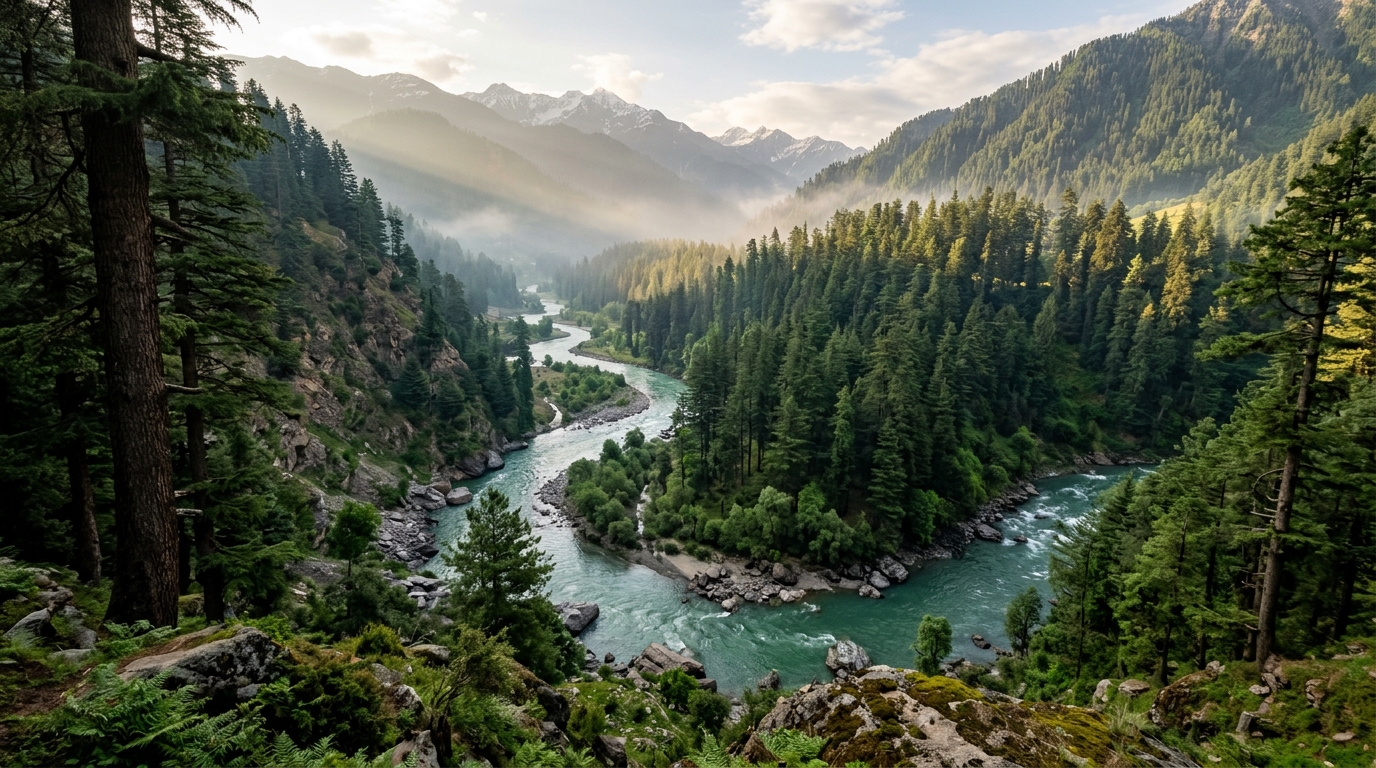
VERINAG · DODA · SHANKARACHARYA HILLS · WESTERN HIMALAYAS19 MIN READ
The Price of Protecting Paradise
The forgotten guardians of Kashmir's forests, the lives sacrificed in defence of nature, the families left behind, and the unfinished responsibility of a society that inherited their ecological legacy.
SHEHR-E-KHAS (SRINAGAR) · BRARI NAMBAL, MARPLAN & KHUSHALSAR21 MIN READ
The Water We Have Forgotten
A longform environmental feature on Srinagar’s lost canals, drowned ghats, and hydraulic memory.
DAL–NIGEEN LAKE SYSTEM · TELBAL CATCHMENT · SRINAGAR · WESTERN HIMALAYAS30 MIN READ
The Mathematics of a Dying Lake
Decades of Conservation, Crores of Expenditure and the Unresolved Engineering of Dal Lake
HABAK · HAZRATBAL · DAL–NIGEEN LAKE SYSTEM · SRINAGAR · 1990s–202614 MIN READ
The Laboratory That Kashmir Lost
When a Dying Lake Lost Its Scientific Institution: The Forgotten Legacy of Habak, the Displacement of Environmental Research and the Institutional Contradictions Behind Kashmir’s Lake Conservation Crisis
DAL–NIGEEN LAKE SYSTEM · SRINAGAR · WESTERN HIMALAYAS · 1859–202636 MIN READ
The Art of Encroachment
How Dal Lake Is Being Turned into Real Estate: A Historical Investigation into Land Appropriation, Administrative Complicity and the Disappearing Waters of Kashmir
KASHMIR · JAMMU · LADAKH · AZAD JAMMU & KASHMIR · GILGIT-BALTISTAN · CENTRAL ASIAN FLYWAY25 MIN READ
The Sky Has No Borders
The Birds of the Western Himalayas: Migration, Ecological Connectivity and the Landscapes We Are Losing
SRINAGAR · DAL LAKE FOOTHILLS · ZABARWAN RANGE · WESTERN HIMALAYAN PROTECTED AREA NETWORK23 MIN READ
The National Park That Became a Golf Course
When Recreation Replaced Conservation: The Forgotten Environmental, Legal and Institutional Legacy of Srinagar’s Sálim Ali National Park
NASEEM BAGH · HAZRATBAL · DAL LAKE WESTERN SHORE · SRINAGAR17 MIN READ
The Chinars in the Shadow of Concrete
Naseem Bagh: When an Institution of Higher Learning Expands Within a Landscape of Living Heritage
RAMBIARA · VISHAV · ROMSHI · DOODHGANGA & SINDH CORRIDORS22 MIN READ
Gravel, Concrete, and the Vanishing Floodplain
An investigative statutory, judicial, and fluvial-geomorphology dossier on mechanized riverbed mining, channel incision, and coldwater habitat loss across Kashmir’s mountain tributaries.
KASHMIR · JAMMU · LADAKH · AZAD JAMMU & KASHMIR · GILGIT-BALTISTAN · WESTERN HIMALAYAS49 MIN READ
Journalism at a Crossroads
Why the Western Himalayas Need a New Direction in Journalism: Beyond Political Patronage, Institutional Dependency, Press Release Journalism and the Boundaries of Conventional Reporting
KASHMIR · JAMMU · LADAKH · AZAD JAMMU & KASHMIR · GILGIT-BALTISTAN · WESTERN HIMALAYAS17 MIN READ
Who Are We Researching For? The World Knows Our Mountains. Do We?
Twenty-Five Years of Environmental Research, International Academic Recognition, Local Scientific Knowledge Accessibility and the Missing Journey from Publication to Environmental Impact.
INDIA · PAKISTAN · KASHMIR · JAMMU · LADAKH · AZAD JAMMU & KASHMIR · GILGIT-BALTISTAN16 MIN READ
South Asia’s Environmental Vanguard
India and Pakistan’s Environmental Giants: Extraordinary Minds and the Lessons They Hold for Kashmir
HAZRATBAL · JHELUM AIR-SHED & WATERSHED CONTINUUM23 MIN READ
Science Has Diagnosed the Valley. Who Will Prescribe Its Governance?
An independent response to ECSSPP 2026, University of Kashmir.
HAZRATBAL · SRINAGAR BOWL & CHENAB–JHELUM INFRASTRUCTURE CORRIDORS23 MIN READ
When the Mountain Rejects the Engineer
An independent response to RECLAIM 2026, NIT Srinagar.
SHALIMAR · GULMARG · PAHALGAM · SONAMARG · ZOJI LA24 MIN READ
Who Gave Development the Right to Exceed the Mountain?
An independent response to the 13th Sustainable Mountain Development Summit.
KISHTWAR · RAMBAN · BANDIPORA · URI · LEH · MUZAFFARABAD · MIRPUR · DIAMER · GILGIT14 MIN READ
The Price of Power
When Mountains Generate Electricity but Their People Remain in Darkness
GILGIT-BALTISTAN · KARAKORAM · SHIGAR · HUNZA · DIAMER · UPPER INDUS BASIN16 MIN READ
The Wealth Beneath the Mountains
Gilgit-Baltistan’s Mineral Resources: Extraction, Environmental Vulnerability, External Commercial Interests and the Question of Local Ownership
MUZAFFARABAD · NEELUM VALLEY · MIRPUR · MANGLA · SUDHNOTI · BAGH · POONCH · UPPER JHELUM BASIN12 MIN READ
The Rivers That No Longer Belong to Their Valleys
Azad Jammu & Kashmir: Hydropower, River Diversion, Submerged Civilizations and the Unresolved Question of Environmental Justice
SRINAGAR · JAMMU · LEH · KARGIL · MUZAFFARABAD · MIRPUR · GILGIT · SKARDU · WESTERN HIMALAYAS & KARAKORAM19 MIN READ
The Western Himalayas Are Sitting on a Time Bomb
The Convergence of Tectonic Instability, Climate Extremes, Ecological Destruction and Unprepared Human Settlements
SRINAGAR · BUDGAM KILN BELT, KHREW CORRIDOR & KASHMIR WINTER AIRSHED26 MIN READ
Six Years of Warnings, and Kashmir Still Cannot Breathe
An independent inquiry into the Peoples' Environmental Council air-quality webinars (2020–2026) and the governance of Kashmir's winter airshed.
KASHMIR VALLEY · WESTERN HIMALAYAS · INDO-GANGETIC PLAINS · HINDU KUSH · KARAKORAM · TIBETAN PLATEAU · CENTRAL ASIA26 MIN READ
The Atmosphere Has No Borders: The Air We Breathe, the Numbers We Cannot Trust
Kashmir's Atmospheric Crisis: Regional Climatology, Himalayan Atmospheric Dynamics, Transboundary Pollution, Aerosol Chemistry and the Scientific Credibility of Air Quality Measurements.
KASHMIR · JAMMU · LADAKH · AZAD JAMMU & KASHMIR · GILGIT-BALTISTAN · WESTERN HIMALAYAS26 MIN READ
When Environmental Laws Exist but the Environment Has No Defence
What the Laws Were Intended to Protect, Where Protection Broke Down and What Must Change
SRINAGAR · NIGEEN, KHUSHAL SAR, GILSAR, DAL, WULAR & ALPINE TARNS25 MIN READ
A Lake Cannot Be Rescued by an Annual Cleanup
An independent inquiry into Nigeen Lake Conservation Organisation, Rotary Club, and civil society lake initiatives across Kashmir.
SRINAGAR · JAMMU · LEH · PIR PANJAL & CHENAB WATERSHEDS21 MIN READ
Who Measures the Success of Environmental Activism?
An independent inquiry into environmental NGOs, civil society organizations, and self-accountability across Kashmir.
SRINAGAR · JAMMU · LEH · SHALIMAR · HAZRATBAL22 MIN READ
The Mountains Have Heard Enough Declarations
An independent inquiry into climate consultations, civil society declarations, and the architecture of unmonitored commitments across the Western Himalayas.
SRINAGAR · JAMMU · LEH · MUZAFFARABAD · GILGIT · 2000–202618 MIN READ
When Politics Promises Green
Political Manifestos, Environmental Commitments and Ground Realities Across the Western Himalayas
SHESHNAG · BALTAL · LEH · SRINAGAR · JAMMU · WESTERN HIMALAYAS29 MIN READ
Selective Environmental Consciousness
When Ecology Becomes Political and Environmental Responsibility Becomes Optional