The Laboratory That Kashmir Lost
When a Dying Lake Lost Its Scientific Institution: The Forgotten Legacy of Habak, the Displacement of Environmental Research and the Institutional Contradictions Behind Kashmir’s Lake Conservation Crisis

INAUGURAL EDITORIAL FOLIO · DESK & OBSERVATORY SYNTHESIS
Research Limitations & Evidentiary Boundaries: Original CAG Audit Report for the year ended March 2011 (including visual inspection of printed pages 80 and 81, Sections 1.3.11–1.3.12 and 1.3.14), October 2009 first-person accounts by Dr. M. R. D. Kundangar and Khurshid Ahmed Naqib, J&K High Court proceedings (August 8, 2017; November 2018; February 2020), historical Dal Lake hydrobiology monograph archives, extracted text of CAG Report No. 4 of 2025 (period ended March 2022; page-image retrieval pending), and March 2025–2026 Sub-District Hospital Habak regulatory reporting have been examined. The original laboratory asset-transfer order, historical equipment inventories, personnel reassignment orders, and authenticated cadastral boundaries remain outstanding. Deliberate scientific suppression, exact ecological attribution solely to laboratory displacement, and the hospital’s exact parcel overlap with the former laboratory cannot yet be stated as established facts. The 12-volume, 90-chapter monograph and Western Himalayan Institute of Aquatic Sciences proposal are editorial research recommendations, not completed studies or existing government programmes.
The Great Contradiction & Kashmir’s Forgotten Foresight
How a society recognized in the 1990s that Dal Lake could not be saved by engineering alone—and then allowed its diagnostic institution to weaken
Imagine a government establishing a specialized medical institution to investigate a progressively deteriorating patient. Imagine that the institution develops diagnostic capabilities, recruits specialists, accumulates historical medical records, and begins investigating alternative treatments. Then imagine that its dedicated facilities are transferred elsewhere, its diagnostic capabilities are weakened, and the administration responsible for treating the patient continues spending substantial public resources without adequately maintaining its original scientific infrastructure.
The patient continues deteriorating. New treatment programmes are announced. New contractors are appointed. New administrative committees are established. New expenditure is sanctioned. Yet the original diagnostic institution struggles to function. Would such an approach be considered scientifically defensible in medicine? Why should it be considered acceptable in environmental management?
Dal Lake is not merely an urban waterbody requiring periodic cosmetic cleaning. It is a coupled biological, chemical, hydrological, and sedimentological system. Kashmir understood this necessity decades ago: during the 1990s it established a dedicated ecological monitoring laboratory at Habak along the Hazratbal foreshore, recruited aquatic scientists, and began investigating the physical and biogeochemical processes driving the lake’s decline. The tragedy is not simply that Kashmir may have lost a laboratory building. It is that Kashmir understood the importance of aquatic science, established infrastructure for it, and subsequently allowed significant deficiencies in that infrastructure to persist while its lakes continued requiring scientific intervention.
That 1990s establishment represented genuine intellectual foresight. Had it been continuously strengthened across the following three decades—across Dal, Nigeen, Wular, Manasbal, Anchar, Khushalsar, Gilsar, and high-altitude glacial tarns—Kashmir could have built an internationally significant centre for mountain freshwater ecology. What became of that opportunity requires examining the scientists who sounded early warnings from within the institution itself.
- •Water chemistry and nutrient dynamics.
- •Aquatic microbiology and biological productivity.
- •Sediment chemistry and internal nutrient loading.
- •Eutrophication and algal proliferation.
- •Aquatic vegetation and ecological succession.
- •Wastewater treatment performance.
- •Catchment hydrology and pollution transport.
- •Seasonal environmental variability.
- •Indigenous restoration technologies.
- •Long-term ecosystem responses to conservation interventions.
“The tragedy is not simply that Kashmir may have lost a laboratory building. It is that Kashmir understood the importance of aquatic science, established infrastructure for it, and subsequently allowed significant deficiencies in that infrastructure to persist.”
The Scientists Who Warned Kashmir—and What Official Audits Confirmed
From Dr. Kundangar’s early-1990s monograph and October 2009 insider testimonies to MoEF inspectors, CAG 2011, and the 2017 High Court
Substantial indigenous scientific knowledge existed in Kashmir before major capital conservation contracts were rolled out. During the early 1990s, Dr. Mohammad Rashid-ud-din Kundangar—working through the Hydrobiology Laboratory at S. P. College and later serving as a founding Director of Research and Development at the Lakes and Waterways Development Authority (LAWDA)—documented nutrient enrichment, sedimentation, invasive macrophytes, and microbiological contamination in a Dal Lake monograph later republished by Kashmir Life.
In October 2009, Dr. Kundangar publicly alleged that scientific objections to selected wastewater treatment technologies had encountered administrative resistance, that researchers supporting alternative methods had been marginalized, that LAWDA’s Research and Development Wing had been dismantled, that its dedicated laboratory building had been reassigned to the Health Department, and that some scientific staff had been assigned duties unrelated to their specialization. In the same archival forum, former LAWDA Vice Chairman Khurshid Ahmed Naqib supported the account that experimental constructed-wetland research had occurred during his administration, stated that examination of larger-scale application was subsequently interrupted, and called for inspection of the original institutional files. While first-person allegations require authentication against original transfer and personnel records, they came from identifiable former leadership—not anonymous rumour.
Official government inspections proved even more damning than editorial criticism. In July 2009, a Ministry of Environment and Forests (MoEF) inspection team examined LAWDA’s scientific infrastructure; the Comptroller and Auditor General (CAG) audit for the year ended March 2011 (Sections 1.3.11–1.3.12, visually verified on printed pages 80–81) reproduced its conclusion: after losing its own building, the laboratory had been shifted into inadequate rented premises described officially as “ill-furnished, ill-equipped and poorly staffed,” and lacked a head throughout the audited programme. While ₹15.93 crore had been sanctioned for wider institutional infrastructure (buildings, equipment, and facilities, not exclusively Habak), ₹47 lakh went to avoidable office rent, 0 of 5 proposed directors were appointed, and staff experienced 9+ years of career stagnation.
Across the three audited oversight bodies—the State Level Monitoring Committee (1 of 22 meetings held; 4.5%), the Scientific Advisory Committee (2 of 11; 18.2%), and LAWDA’s Board of Directors (6 of 18; 33.3%)—only 9 of 51 expected sittings took place (~82% not held, an illustrative measure of meeting frequency), with auditors rejecting “busy schedules” as inadequate. Meanwhile, Section 1.3.14 of the 2011 CAG report flagged performance concerns at three sewage treatment plants and procurement irregularities in ₹34.64 crore contracts for two additional plants—raising the core question of whether engineering procurement advanced faster than the independent scientific capacity needed to evaluate it. Eight years after the 2009 inspection, on August 8, 2017, the J&K High Court was still recording equipment and staffing deficiencies in LAWDA’s Research and Monitoring Division, noting a pending funding proposal for a modern laboratory, and ordering interim water-quality data sharing from the Pollution Control Board.
1990s (Habak monitoring foresight) → 2000–2002 (indigenous constructed-wetland research) → 2009 (July MoEF inspection & October insider testimonies) → 2011 (CAG audit confirms leadership, rental, oversight & ₹34.64 Cr STP procurement defects) → 2017 (Aug 8 High Court calls for modern laboratory) → 2022 (audit cutoff showing 10 missing scientific baselines) → 2025–2026 (CAG Report No. 4 of 2025 & SDH Habak buffer-zone review). A government may change in five years; a lake’s ecological deterioration does not reset with every change of government.
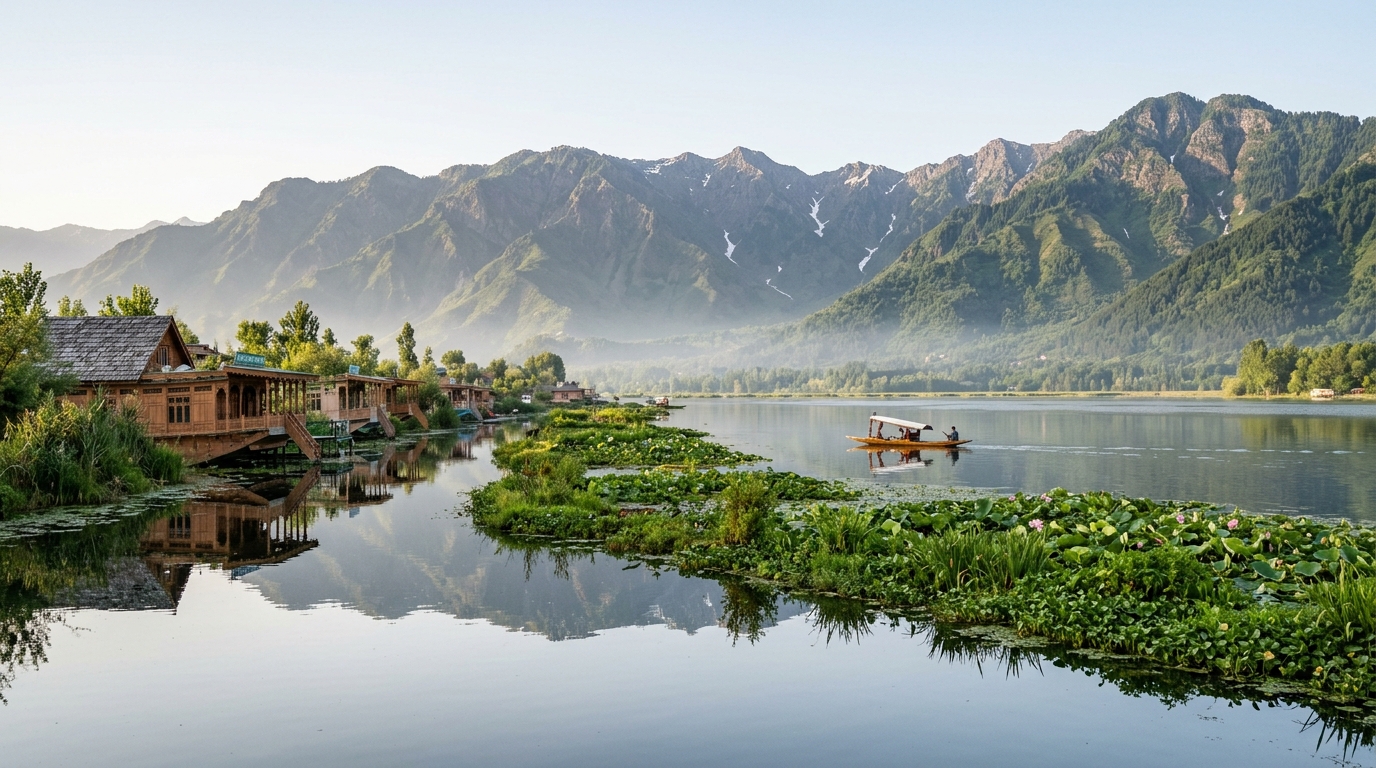
Decades Without Complete Environmental Accounting: The Phosphorus & Land-Use Mathematics
CAG Report No. 4 of 2025, ten missing scientific baselines, the 1998–99 76-tonne phosphorus retention estimate, and 2007–2020 remote-sensing shifts
CAG Report No. 4 of 2025 (covering the period ended March 2022) establishes the direct operational consequence of weakened scientific capacity: across ten foundational limnological requirements—from catchment hydrogeology, post-1998–99 nutrient loading, and post-2006 heavy metals to bathymetric sediment quantification, lake flushing, biodiversity, seed-bank viability, and Anchar–Gilsar connectivity—required studies were either not undertaken or could not be substantiated. When the government replied in December 2022 that scientists were monitoring nutrients at roughly 50 locations and regularly assessing the water budget, auditors recorded that supporting datasets had not been furnished. That distinction separates unknowledge due to unavailable science from governance failure to measure and archive what science already knows how to measure.
Consider the historical phosphorus balance from the 1998–99 project estimates reproduced in the CAG report: estimated annual phosphorus inflow of 156.62 tonnes against 80.62 tonnes of outflow (51.5% exported), leaving 76 tonnes (48.5%) retained inside the lake system in that baseline year. While those 1998–99 estimates are historical and must never be extrapolated across subsequent decades without measurements, they demonstrate why closing the differential mass-balance equation dM_P/dt = L_external + L_internal − L_outflow − L_burial − L_harvesting is indispensable. Without measuring external sewage/stream inflows, internal benthic sediment release, outlet export, permanent burial, and weighed macrophyte/dredge harvesting, authorities cannot determine whether annual conservation crores are genuinely lowering trophic state.
Remote-sensing assessments between 2007 and 2020 reproduced in the 2025 CAG audit underscore the stakes: open water combined with submerged vegetation contracted by −249.5 hectares, while floating vegetation expanded by +153.4 hectares, cropland and plantation by +55.9 hectares, and built-up land by +28.2 hectares. Although Dal Lake’s trajectory reflects multiple interacting stressors—sewage, catchment urbanization, hydrological alteration, and internal nutrient recycling rather than laboratory displacement alone—a deteriorating ecosystem requires stronger, not weaker, diagnostic infrastructure.
Ten Missing or Unsubstantiated Scientific Requirements Documented in CAG Report No. 4 of 2025 (Period Ended March 2022)
| Scientific requirement | Findings of the subsequent audit |
|---|---|
| Catchment geological and hydrological studies | Required studies had not been undertaken |
| Nutrient loading | Adequate monitoring records after the original 1998–99 assessment were not demonstrated |
| Heavy metal assessment | No subsequent LCMA testing documented after concerns raised in the 2006 audit |
| Bathymetric assessment | Later surveys did not adequately quantify accumulated sediment |
| Lake water budget | Subsequent measurements were claimed (Dec 2022 reply cited ~50 nutrient stations & regular water-budget tracking) but supporting reports were not provided to auditors |
| Lake flushing | Prescribed scientific management mechanism was not implemented |
| Biodiversity assessment | Comprehensive ecosystem assessment was deficient |
| Seed bank investigation | Required study had not been conducted |
| Sedimentation rate | Insufficient evidence to establish long-term lake sedimentation |
| Interconnected lakes | Conservation planning remained inadequate for Anchar and Gilsar |
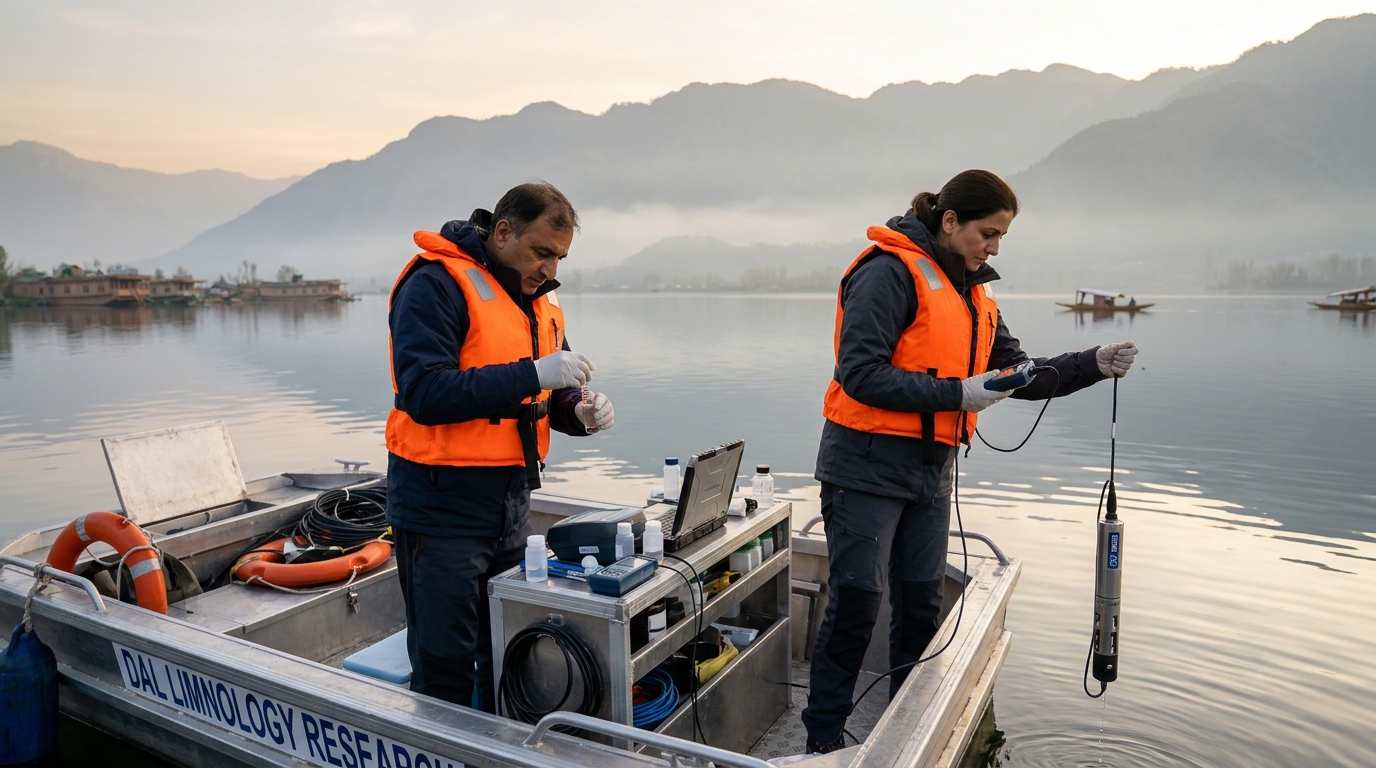
Thirty Years of Counterfactual Opportunity, Global Benchmarks & the Habak Hospital Question
What Habak could have evolved into between 1995 and 2030, lessons from five international aquatic institutes, and why public healthcare never required sacrificing lake science
Viewed as a counterfactual scenario—not a claim of guaranteed outcomes—continuous investment in the original Habak institution between 1995 and 2030 could have progressed systematically from permanent aquatic chemistry benches and applied wastewater trials (1995–2005) through sediment biogeochemistry and mountain hydrological modelling (2005–2015) to satellite water-quality intelligence, molecular algal forecasting, and an integrated Western Himalayan freshwater research institute (2015–2030). Beyond science, such an institution represents lost regional economic opportunity for Kashmir’s environmental graduates across laboratory testing, restoration engineering evaluation, ecological modelling, and High Asian consultancy.
Internationally, societies with prized freshwater landscapes treat long-term research infrastructure as non-negotiable environmental security: Canada’s IISD Experimental Lakes Area (whole-ecosystem field validation), Switzerland’s Eawag (uniting limnology with independent wastewater engineering), Germany’s Leibniz Institute IGB (sustained shallow-lake specialization), the US Geological Survey Water Resources Mission Area (permanent open records surviving political transitions), and the UK Centre for Ecology & Hydrology (multi-decadal monitoring continuity). Kashmir need not match their budgets immediately to adopt their foundational principle: scientific infrastructure is an investment in environmental security, not an expendable administrative asset.
That principle directly illuminates the contemporary Habak hospital question. Modern healthcare for the people of Hazratbal and Habak through Sub-District Hospital Habak is an indisputable public necessity. Yet if the historical reassignment of the original laboratory is authenticated through official files, why was one public necessity allowed to displace another without first commissioning superior replacement laboratory facilities and a scientific capacity preservation plan? Separate March 2025 reporting (Kashmir Observer) documented LCMA blocking hospital expansion work within the restricted Dal Lake buffer zone for want of statutory clearance, followed in 2026 (JK Monitor) by government indications that buffer-zone relaxation was under consideration—while original transfer orders, cadastral boundaries, and final clearance conditions remain to be authenticated. A scientifically mature society should provide both modern healthcare and permanent environmental science without sacrificing the essential functions of either.
Counterfactual Institutional Evolution Scenario for Habak (1995–2030) — Editorial Scenario Analysis
| Period | Potential institutional evolution |
|---|---|
| 1995–2000 | Establishment of permanent aquatic monitoring laboratories |
| 2000–2005 | Experimental wastewater treatment and applied limnology |
| 2005–2010 | Advanced nutrient chemistry and sediment analysis |
| 2010–2015 | Mountain lake hydrological modelling |
| 2015–2020 | Satellite-based water-quality intelligence and automated monitoring |
| 2020–2025 | Predictive algal bloom modelling and molecular ecology |
| 2025–2030 | Integrated Western Himalayan freshwater research institute |
Eight Dimensions of Institutional Ignorance, Professional Introspection & Two Paired Cases
Inward questions for Kashmir’s scientists, advocates, journalists, NGOs and universities—and pairing Sálim Ali National Park with the Habak Laboratory
Rather than assuming every official lacked knowledge or acted with malice, institutional failure across three decades must be examined across eight distinct governance dimensions: scientific, administrative, financial, ecological, technological, institutional, historical, and public ignorance. The gravest institutional ignorance is not the absence of information, but the failure to respond when official inspections, audits, and scientific warnings are repeatedly placed on record.
Connected directly with our companion investigation South Asia’s Environmental Vanguard (Dispatch 16 / Monograph 08), the Habak history also demands inward professional introspection across five regional communities—posed as open investigative questions rather than accusations of silence, while committing to recover and honour every scientist and official who did object: What formal representations did scientists submit to preserve permanent infrastructure? Did environmental advocates test laboratory displacement under public-asset and conservation law? Did journalists follow the displacement continuously across 2009, 2011, 2017, and 2025? Did environmental NGOs treat laboratory independence as a conservation priority? And did universities propose a collaborative consortium to safeguard disrupted monitoring series?
Above all, Kashmir must study two historical transformations side by side—while respecting their distinct legal histories and never treating them as legally identical: Case Study I, Sálim Ali National Park (the protected natural landscape reassigned for golf-course development), and Case Study II, the Habak Ecological Laboratory (the dedicated intellectual and scientific asset displaced into inadequate facilities). Together they pose one inescapable governance question: what happens to a society’s environmental future when both its protected landscapes and the scientific institutions built to understand them become vulnerable to competing administrative priorities?
Eight Dimensions of Institutional Ignorance & Dual Case-Study Governance Comparison (Sálim Ali National Park vs. Habak Ecological Laboratory)
| Diagnostic Dimension / Sálim Ali National Park (Landscape) | Investigative Question / Habak Ecological Laboratory (Knowledge) |
|---|---|
| Scientific ignorance | Were decisions made without adequately examining scientific evidence? |
| Administrative ignorance | Was the importance of permanent research infrastructure understood? |
| Financial ignorance | Were scientific capabilities treated as expenses rather than long-term public investments? |
| Ecological ignorance | Was lake restoration reduced to visible physical interventions? |
| Technological ignorance | Were alternative treatment technologies rigorously compared? |
| Institutional ignorance | Were the consequences of disrupting scientific teams considered? |
| Historical ignorance | Were earlier scientific findings and baseline records preserved? |
| Public ignorance | Was society adequately informed about the significance of the laboratory? |
| Paired Case Axis — Sálim Ali Park: Conservation of nature | Habak Ecological Laboratory: Scientific understanding of nature |
| Paired Case Axis — Sálim Ali Park: Natural public asset | Habak Ecological Laboratory: Intellectual and infrastructural public asset |
| Paired Case Axis — Sálim Ali Park: Protected habitat | Habak Ecological Laboratory: Environmental research capability |
| Paired Case Axis — Sálim Ali Park: Potential ecological opportunity cost | Habak Ecological Laboratory: Potential scientific opportunity cost |
| Paired Case Axis — Sálim Ali Park: Wildlife and habitat conservation | Habak Ecological Laboratory: Water-quality investigation and lake management |
| Paired Case Axis — Sálim Ali Park: Protected-area governance | Habak Ecological Laboratory: Scientific institutional governance |
Naming Institutional Responsibilities & The Habak Scientific Recovery Initiative
Twelve accountable decision-making tiers, the proposed 16-division Western Himalayan Institute of Aquatic Sciences, and KEW’s permanent 12-engine Observatory
Historical description without institutional accountability changes nothing. Our twelve-volume, ninety-chapter Monograph 10 research programme maps specific documentary responsibilities across twelve institutional tiers—from the Council of Ministers, Housing & Urban Development, and Health & Medical Education to LAWDA’s Board, administration, Scientific Advisory Committee, Finance, Revenue, MoEF/MoEFCC, JKPCC, universities, and LCMA. Every identifiable institution and decision-maker is afforded a formal Right of Response, and our evidentiary protocol strictly distinguishes negligence, administrative error, financial irregularity, legitimate scientific disagreement, and deliberate misconduct.
Because historical critique alone cannot restore lost analytical benches, this investigation concludes with two constructive proposals (explicitly presented as editorial and scientific recommendations rather than existing government bodies): first, establishing an autonomous, 16-division Western Himalayan Institute of Aquatic Sciences and Environmental Engineering with protected multi-decadal monitoring budgets, NABL/ISO-grade laboratories, publication independence free from contractor or political veto, and an institutional firewall separating engineering procurement from scientific performance evaluation; and second, launching Kashmir EcoWatch’s permanent 12-engine Environmental Scientific Infrastructure & Institutional Legacy Observatory (/governance/scientific-infrastructure-observatory), with the Habak Laboratory anchored as Case #01.
Twelve-Tier Institutional Responsibility & Right-of-Response Matrix (1990s–2026)
| Institution | Specific Investigative & Documentary Scope |
|---|---|
| Council of Ministers | Original asset-transfer authorization |
| Housing and Urban Development Department | Protection and replacement of scientific infrastructure |
| Health and Medical Education Department | Transfer, possession and development history |
| LAWDA Board of Directors | Recorded deliberations and institutional objections |
| LAWDA administration | Scientific staffing and asset management |
| Scientific Advisory Committee | Research recommendations and responses |
| Finance Department | Budget allocation and asset valuation |
| Revenue Department | Original and subsequent land ownership records |
| Central environmental ministry (MoEF / MoEFCC) | Inspection reports and follow-up |
| Pollution Control Board (JKPCC) | Independent environmental measurements |
| Academic institutions | Research continuity and institutional cooperation |
| LCMA (Lake Conservation and Management Authority) | Current scientific capabilities and historical remediation |
DISPATCH 05 · INTERACTIVE LIMNOLOGICAL & INSTITUTIONAL AUDIT WORKBENCH
Habak Diagnostic Gap, Phosphorus Balance & Recovery Explorer
Historical 1998–99 project estimates reproduced in the CAG report. These are NOT current nutrient loads and must never be extrapolated across subsequent decades without empirical field measurements.
Net phosphorus accumulation persists (+76 t/yr; 48.5% non-flushed fraction). Without a permanent limnological laboratory measuring L_internal, STP ortho-P effluent, and harvested dry-matter P, expenditure cannot be linked to trophic recovery.
The Lake Was Not the Only Thing That Was Dying
Buildings can be reconstructed and instruments repurchased—but decades of unrecorded observations cannot be recovered retrospectively
For decades, Kashmir has witnessed discussions about the deterioration of Dal Lake. The lake became the subject of government programmes, political promises, scientific conferences, judicial proceedings, international attention, and substantial public expenditure. But while society discussed the deterioration of the lake, another deterioration was taking place: the deterioration of the institutional capacity necessary to understand it.
A dedicated environmental laboratory lost its original premises. Central government inspectors documented inadequate rented scientific facilities. National auditors identified deficiencies in institutional leadership, staffing rules, procurement sequencing, and statutory oversight meetings. The judiciary subsequently called for modern scientific infrastructure. Years later, fundamental environmental accounting questions—from post-1998–99 phosphorus loading to bathymetric sedimentation and seed-bank dynamics—remained inadequately substantiated.
Perhaps the Habak laboratory represents something larger than one displaced scientific institution. Perhaps it represents a missed opportunity to transform Kashmir’s extraordinary environmental geography into an equally extraordinary tradition of indigenous environmental science. Kashmir had the lakes. Kashmir had the scientists. Kashmir had the environmental questions. Kashmir had begun developing the institutional foundations necessary to investigate them. What it failed to adequately preserve, according to the documented historical record, was the scientific continuity those questions demanded.
Buildings can be reconstructed. Instruments can be purchased. New scientists can be recruited. But decades of environmental observations, uninterrupted research, institutional memory, and accumulated scientific experience cannot always be recovered retrospectively. That is the invisible cost of institutional neglect. Kashmir has repeatedly asked why Dal Lake continues to deteriorate. Perhaps it is time Kashmir also asks what happened to the science that was supposed to save it.
“Kashmir has repeatedly asked why Dal Lake continues to deteriorate. Perhaps it is time Kashmir also asks what happened to the science that was supposed to save it.”
EDITORIAL PUBLICATION METADATA & 10-STAGE GATE LEDGER
| Gate | Status | Record / Scope |
|---|---|---|
| 01 · Commissioned | completed | Himalayan Dispatch Founding Masthead |
| 02 · Research in progress | completed | Himalayan Dispatch Research & Observatory Desk |
| 03 · Manuscript draft | completed | Assigned Author / Editorial Desk |
| 04 · Evidence verification | completed | Grounded in visually inspected printed pages 80–81 of CAG Audit Report 2011 (Sections 1.3.11–1.3.14), July 2009 MoEF inspection findings, October 2009 identifiable testimonies by Dr. M. R. D. Kundangar and Khurshid Ahmed Naqib, J&K High Court PIL orders (Aug 8, 2017; Nov 2018; Feb 2020), early-1990s S. P. College hydrobiological monograph archives, extracted text of CAG Report No. 4 of 2025 (period ended March 2022), and March 2025–2026 SDH Habak buffer-zone reporting. Outstanding original transfer orders, equipment registers, personnel reassignment orders, and cadastral parcels are explicitly disclosed. |
| 05 · Scientific review (where applicable) | pending | Internal KEW limnological review verified the six-term differential phosphorus mass-balance equation (dM_P/dt), the 1998–99 historical P estimates (156.62 t in, 80.62 t out, 76 t retained — strictly bounded against unmeasured extrapolation), the 9-of-51 oversight meeting arithmetic, and the 2007–2020 remote-sensing land-use table; Stage 05 independent external specialist peer review remains pending. |
| 06 · Editorial review | completed | Founding Editor-in-Chief Desk Review |
| 07 · Copyright and ethics review | completed | Positioned as Dispatch 05 immediately following Dispatch 04 (The Mathematics of a Dying Lake); enforces non-partisan multi-administration analysis, separates insider allegations from audited facts, preserves legitimate public-healthcare recognition for Sub-District Hospital Habak, avoids legally equating Sálim Ali National Park with Habak, uses only governed KEW illustrative plates, extends formal Right of Response across all 12 named institutions, and labels Monograph 10 (90 chapters) and the proposed Aquatic Science Institute as editorial recommendations. |
| 08 · Administrator approval | in progress | Staged on localhost at Stage 08 awaiting Founding Administrator review and approval. |
| 09 · Published | pending | — |
| 10 · Post-publication corrections | not applicable | — |
| Attribute | Final assignment |
|---|---|
| Investigation classification | Dispatch 05 · Special Historical & Scientific Investigation (Immediately following Dispatch 04: The Mathematics of a Dying Lake) |
| Temporal & geographical scope | 1990s–2026 · Habak · Hazratbal · Dal–Nigeen Lake System · Srinagar · Western Himalayas |
| Primary corroborated records | CAG Audit Report 2011 (pp. 80–81, Sec. 1.3.11–1.3.14) · July 2009 MoEF Inspection · J&K High Court Orders (2017, 2018, 2020) · CAG Report No. 4 of 2025 |
| Research & verification status | Stage 08 Pre-Release Investigation & 90-Chapter Monograph 10 Framework · Original Transfer Orders, Cadastral Boundaries & Right-of-Response Pending |

Founding Editor-in-Chief
Dr. Fayaz Ahmad Khan
Founder of Kashmir EcoWatch and Founding Editor-in-Chief of Himalayan Dispatch; writes on alpine hydrology, cryospheric thresholds, disaster resilience, and mountain commons across the Western Himalayas.
View Portfolio & Approved Commissions →NEXT IN THIS EDITION · SPECIAL HISTORICAL & GEOSPATIAL INVESTIGATION · ENVIRONMENTAL CRIMINOLOGY & LAND GOVERNANCE
The Art of Encroachment
By Dr. Fayaz Ahmad Khan & Himalayan Dispatch Geospatial Intelligence, Environmental Criminology, Land Governance and Public Accountability Desk · 36 min read