Return to Kashmir EcoWatch

EST. 2026  ·  KEW WESTERN HIMALAYAS

HIMALAYANDISPATCH

LANDSCAPE.  PEOPLE.  SCIENCE.  TRUTH.

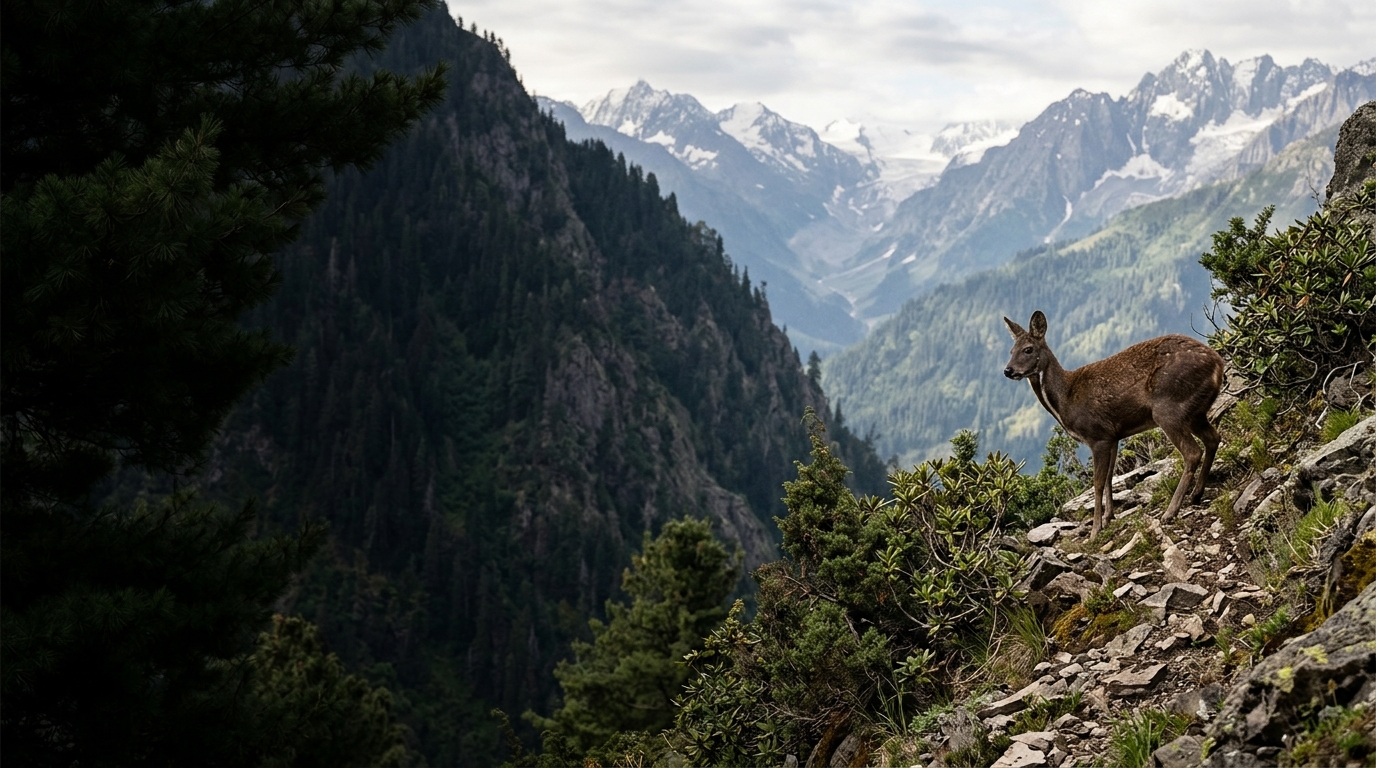
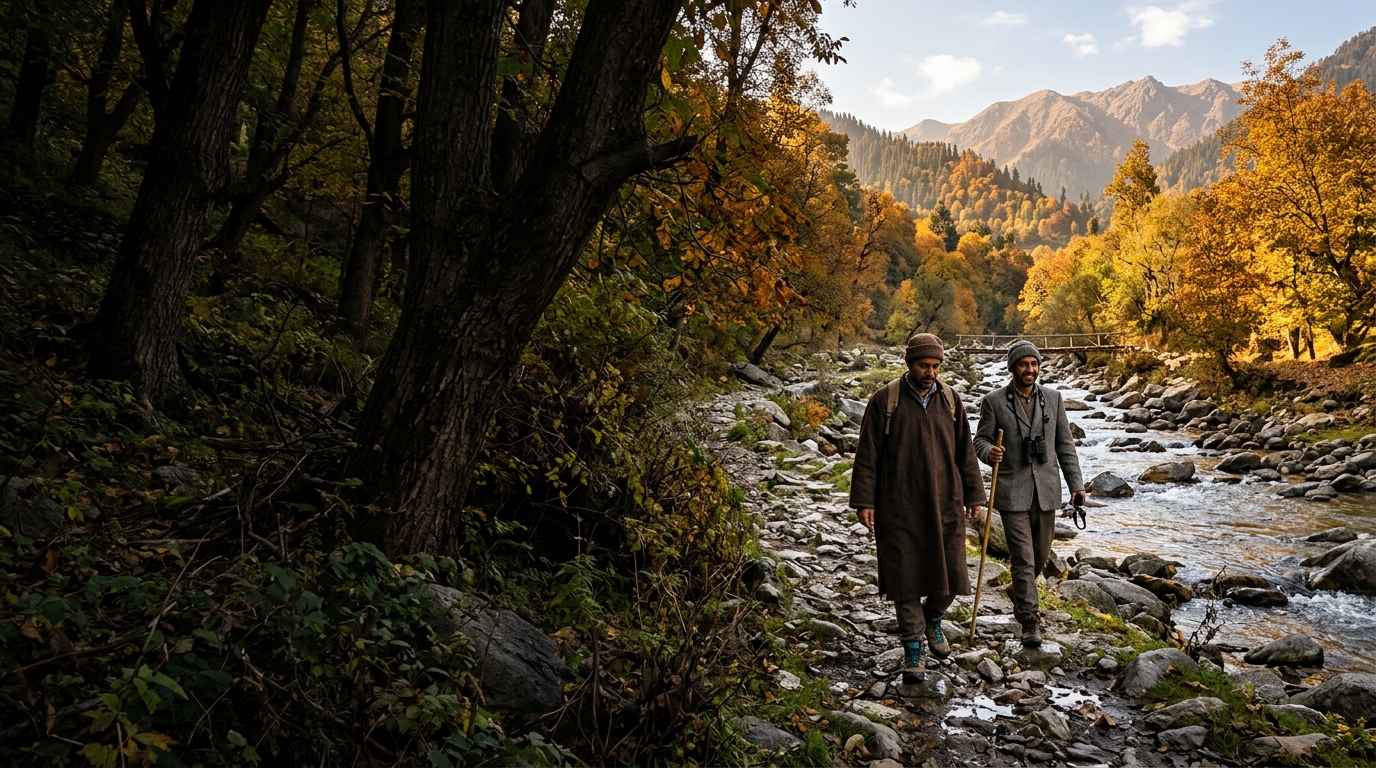
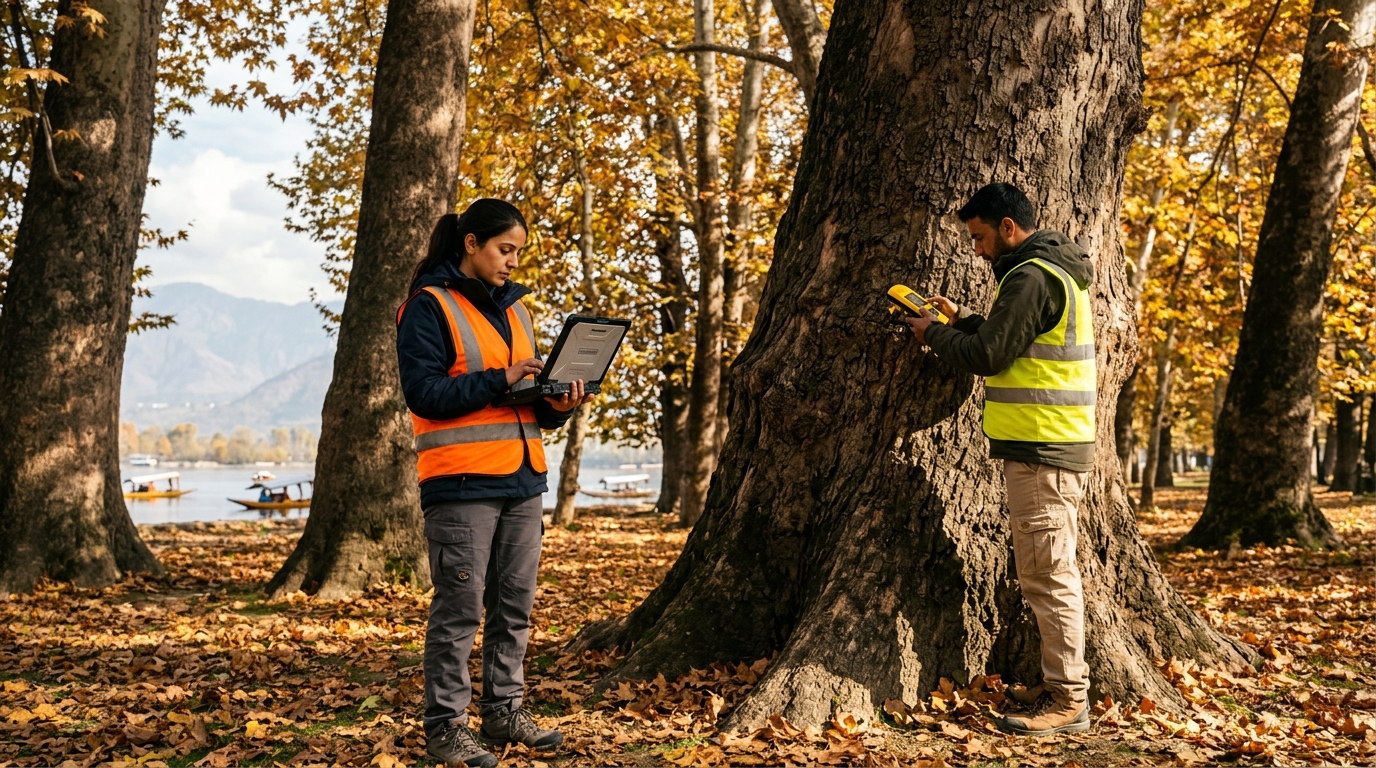
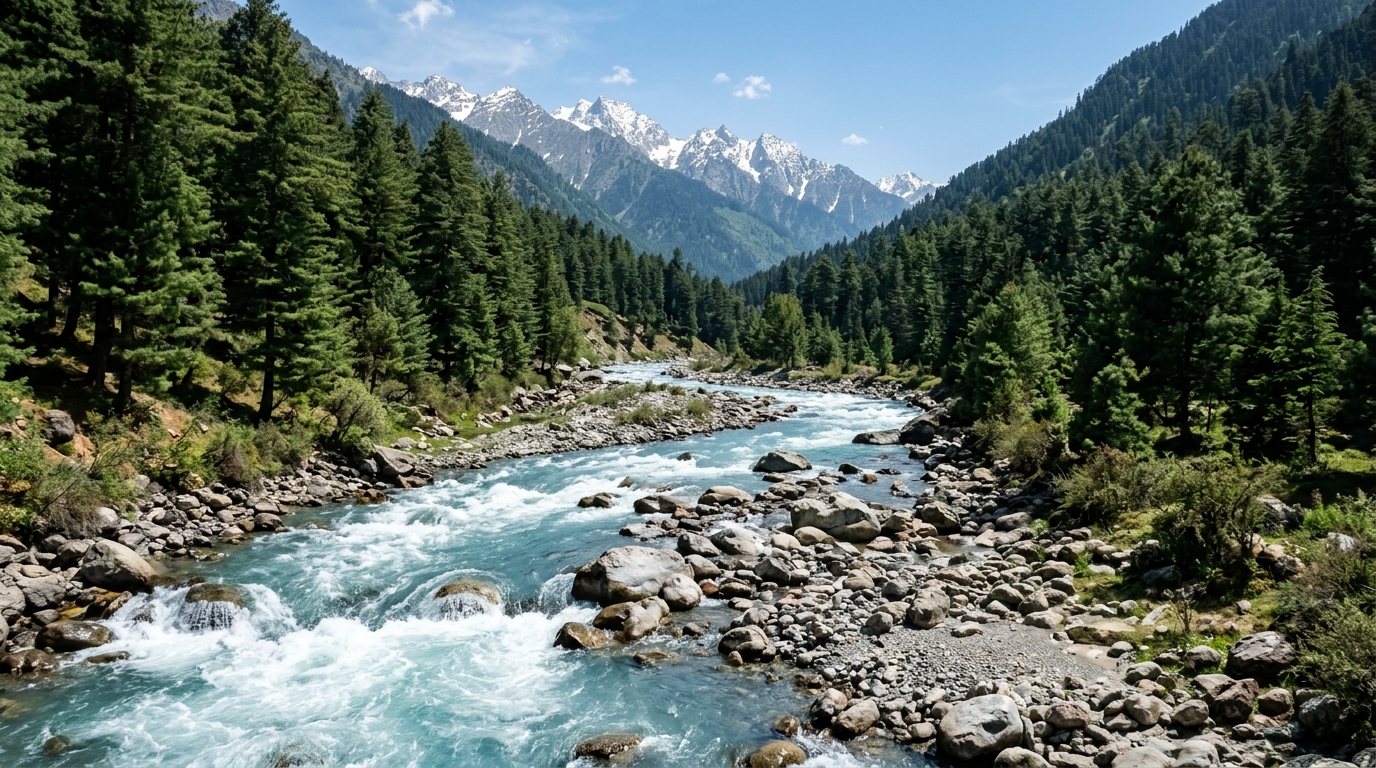
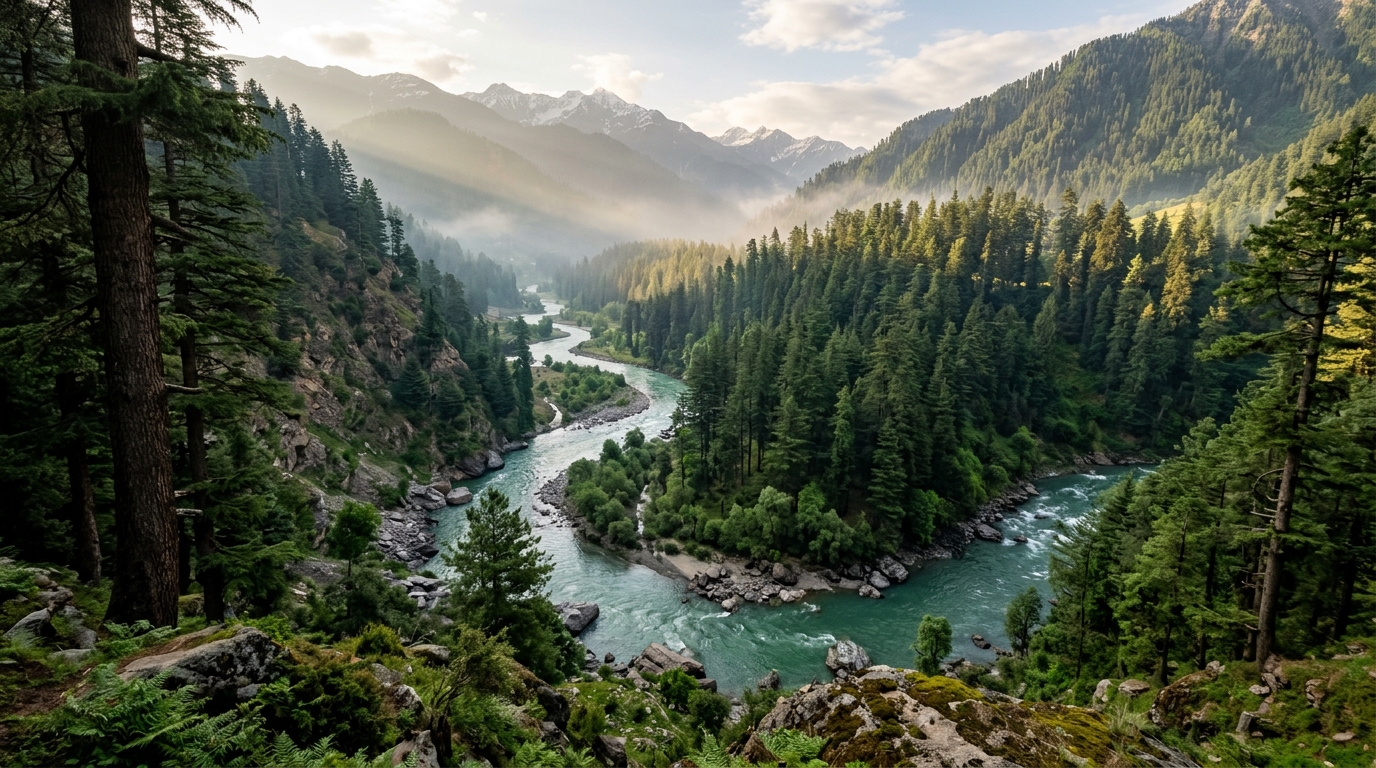
Temperate Western Himalayan deodar canopy and mountain river watershed representative of forest compartments defended by frontline conservation personnel (illustrative landscape plate — not incident photography).

Temperate Western Himalayan deodar canopy and mountain river watershed representative of forest compartments defended by frontline conservation personnel (illustrative landscape plate — not incident photography). — Kashmir EcoWatch Visual Archive

THE INAUGURAL ISSUE  ·  VOL. 01 / NO. 01

The Price of Protecting Paradise

The forgotten guardians of Kashmir's forests, the lives sacrificed in defence of nature, the families left behind, and the unfinished responsibility of a society that inherited their ecological legacy.

Published 2026-11-27  ·  COVER PLATE: Verinag, Doda & Western Himalayan Forest Compartments · Jammu & Kashmir

THE FOUNDING PHILOSOPHY · EST. 2026

For two years, we waited for a voice.

Then we decided to become one.

FOUNDING INSTITUTIONAL NARRATIVE

When Silence Became the Reason to Speak

Two years of unanswered correspondence. A landscape divided by political boundaries. Environmental concerns struggling to find a platform. And ultimately, a decision to create an independent voice.

LETTER FROM THE MASTHEAD

A Quiet Room Beside the Instruments

Across Kashmir EcoWatch, sensors, satellite passes, geospatial models and hydrological ledgers measure the Western Himalayas with necessary precision. Yet numbers alone rarely explain the human cost of keeping a mountain watershed standing, or what happens to a home in Verinag or Doda when a forest guard never returns from duty.

Himalayan Dispatch was founded to build a different kind of room: unhurried, intellectually independent, literary, visually uncompromising and anchored in verifiable truth. A room where scientific evidence meets human experience, where historical decisions encounter contemporary consequences, and where environmental responsibility extends beyond institutional declarations.

Our inaugural cover story, The Price of Protecting Paradise, turns towards the forgotten guardians of Kashmir’s forests, reconciling official memorials with lived occupational realities and asking who protects the protectors.

Across this inaugural volume of thirty-six dispatches, our correspondents listen to high cirque lakes beneath Haramukh, trace Srinagar’s buried waterways, stand at dawn along Hokersar’s reedlines, follow migratory birds across political boundaries and examine thirty-eight winters of snowline retreat.

But this edition also enters less comfortable territory.

The Mathematics of a Dying Lake reconstructs the unresolved engineering questions and eight mass balances of Dal Lake conservation. The Laboratory That Kashmir Lost investigates the displacement and deterioration of the scientific infrastructure established to understand the very ecosystem Kashmir continues attempting to restore. The Art of Encroachment examines the historical transformation of water into land, the pressures of property development, the consequences of political instability and documented allegations of administrative collusion.

The National Park That Became a Golf Course revisits the transformation of part of Srinagar’s Sálim Ali National Park, asking what protected status means when conservation landscapes become available for competing development priorities.

The Chinars in the Shadow of Concrete examines four centuries of living Mughal Chinar heritage at Naseem Bagh alongside decades of campus expansion, asking how an institution of higher learning that teaches ecology, botany, geography and environmental law reconciles academic advancement with the preservation of the living landscape entrusted to its own grounds.

Journalism at a Crossroads turns that same lens inward upon the profession of journalism itself—examining the political establishment–media house nexus, government advertising dependency, media ownership, press-release reproduction, scientific and geospatial specialization, internal protections for working journalists, and the universal obligation of Himalayan Dispatch to subject itself and Kashmir EcoWatch to the very standards it proposes.

Our investigation into academic responsibility, Who Are We Researching For? The World Knows Our Mountains. Do We?, examines the relationship between scientific production, original knowledge, public understanding and measurable environmental outcomes across Kashmir, Jammu, Ladakh, Azad Jammu & Kashmir and Gilgit-Baltistan.

Alongside it, South Asia’s Environmental Vanguard looks beyond our mountains to the extraordinary environmental advocates, journalists, scientists and conservation leaders of India and Pakistan. Their journeys were not always easy. Neither are those of our own professionals. Their struggles, contributions and achievements invite us towards respectful introspection, renewed intellectual ambition and a deeper understanding of professional responsibility.

Through Beyond the Conference, we examine the distance between scientific recommendations and environmental governance, between engineering ambition and geological reality, between development expenditure and ecological recovery, and between agricultural research and a changing mountain climate.

The Price of Power investigates the geographical distribution of hydropower benefits and environmental burdens. It asks who receives the electricity, who receives the revenue, and who lives with submerged forests, displaced wildlife, altered rivers and geological uncertainty. It also examines the contradiction of electricity-generating mountain regions experiencing persistent power shortages.

The Wealth Beneath the Mountains—prepared by our Research Desk’s Gilgit-Baltistan Coverage ahead of future regional correspondent ownership—examines Gilgit-Baltistan’s mineral resources across the Karakoram, Himalaya and Hindu Kush, asking who owns the mineral wealth, who captures its economic value, and who inherits riverbed destabilization, slope hazards and environmental liabilities after the mountains are excavated.

The Rivers That No Longer Belong to Their Valleys—prepared by our Research Desk’s Muzaffarabad Coverage under Central Editorial Board oversight—turns across all ten districts of Azad Jammu & Kashmir, from Muzaffarabad’s post-diversion river-flow and drinking-water paradox to six decades of Mangla submergence, unfinished compensation, drying springs, forest pressures and mining-concession reversals.

The Western Himalayas Are Sitting on a Time Bomb brings these concerns into a wider scientific examination of tectonic instability, accumulated seismic strain, glacial lake outbursts, landslides, extreme weather, vulnerable settlements and interdependent critical infrastructure. Its purpose is not to predict catastrophe or cultivate fear, but to investigate whether our societies are adequately preparing for the natural hazards and human-created vulnerabilities that increasingly coexist within these mountains.

Our atmospheric investigations examine the persistence of unhealthy air, transboundary pollution transport, the integrity of environmental measurements and the limitations of explanations confined within political borders.

Our legal and civil society investigations ask whether environmental legislation is producing environmental protection, whether lake restoration extends beyond recurring cleanup operations, whether activism is generating measurable outcomes, and whether public declarations are being translated into institutional action.

When Politics Promises Green examines environmental commitments against the documentary record of governance, expenditure, implementation and ecological outcomes.

Finally, our closing flagship investigation, Selective Environmental Consciousness, asks whether environmental principles are applied consistently, irrespective of political allegiance, religious affiliation, institutional loyalty, commercial interest or geographical jurisdiction.

No institution should be exempt from legitimate environmental scrutiny.

Neither universities nor regulators. Neither governments nor opposition parties. Neither businesses nor civil society organizations. Neither religious institutions nor communities. And certainly not Himalayan Dispatch or Kashmir EcoWatch itself.

We do not claim that every question raised in these pages has already been answered. Some require historical records that remain inaccessible. Others demand independent scientific measurements, authenticated legal documents, field investigations and responses from the institutions concerned.

Where evidence is incomplete, uncertainty must be acknowledged. Where allegations remain unresolved, they must not be presented as established facts. Where our own interpretations require correction, we must possess the intellectual humility to correct them.

This publication is neither an instrument of political convenience nor a platform for environmental condemnation without evidence.

It is an invitation to examine what we have inherited, what we have transformed, what we have neglected, what we have protected and what we may still be capable of recovering.

The Western Himalayas deserve more than periodic expressions of environmental concern. They deserve sustained scientific attention, independent journalism, responsible engineering, institutional memory and a society willing to examine its own decisions.

The mountains were here before our institutions.

They will remain long after our professional titles, political affiliations and administrative tenures have disappeared.

What remains uncertain is the ecological condition in which we will leave them.

Himalayan Dispatch begins with that responsibility.

Not with the ambition to speak louder than others, but with the determination to listen longer, investigate deeper, remember what has been forgotten and ask the questions that environmental responsibility demands.
Dr. Fayaz Ahmad Khan

Founding Editor-in-Chief

Himalayan Dispatch

Kashmir EcoWatch  ·  Western Himalayan

ARTICLES IN THIS EDITION (36)PERMANENT ISSUE URLS

DISPATCHES 01–15

Environmental Condition, Lake Forensics, Protected Areas & Living Heritage

Conservation martyrs (01), Dal Lake math (04), Habak lab (05), encroachment (06), avian connectivity (08), Sálim Ali Park (10), Naseem Bagh Chinars (11) & cryosphere

DISPATCHES 16–17

Editorial Philosophy & Media Political Economy

Founding manifesto on slow, fearless journalism (16) & Journalism at a Crossroads: media political economy, independence & scientific literacy (17)

DISPATCHES 18–19

Academic Accountability & South Asian Vanguard

Five-region research census (18) & 32 Indian/Pakistani pioneers across four professional mirrors (19)

DISPATCHES 20–28

Beyond the Conference, Hydropower, GB Minerals, AJ&K Rivers & Multi-Hazards

Geological & ecological limits (21–22), The Price of Power (23), GB Minerals (24), AJ&K Rivers (25 · Monograph 17), Time Bomb (26) & restoration/agroecology (27–28)

DISPATCHES 29–35

Atmosphere, Jurisprudence, Civil Society & Manifestos

Transboundary atmosphere (30), environmental law (31), NGOs & electoral manifestos (35)

DISPATCHES 36

Universal Ethical Accountability

Selective Environmental Consciousness & universal responsibility

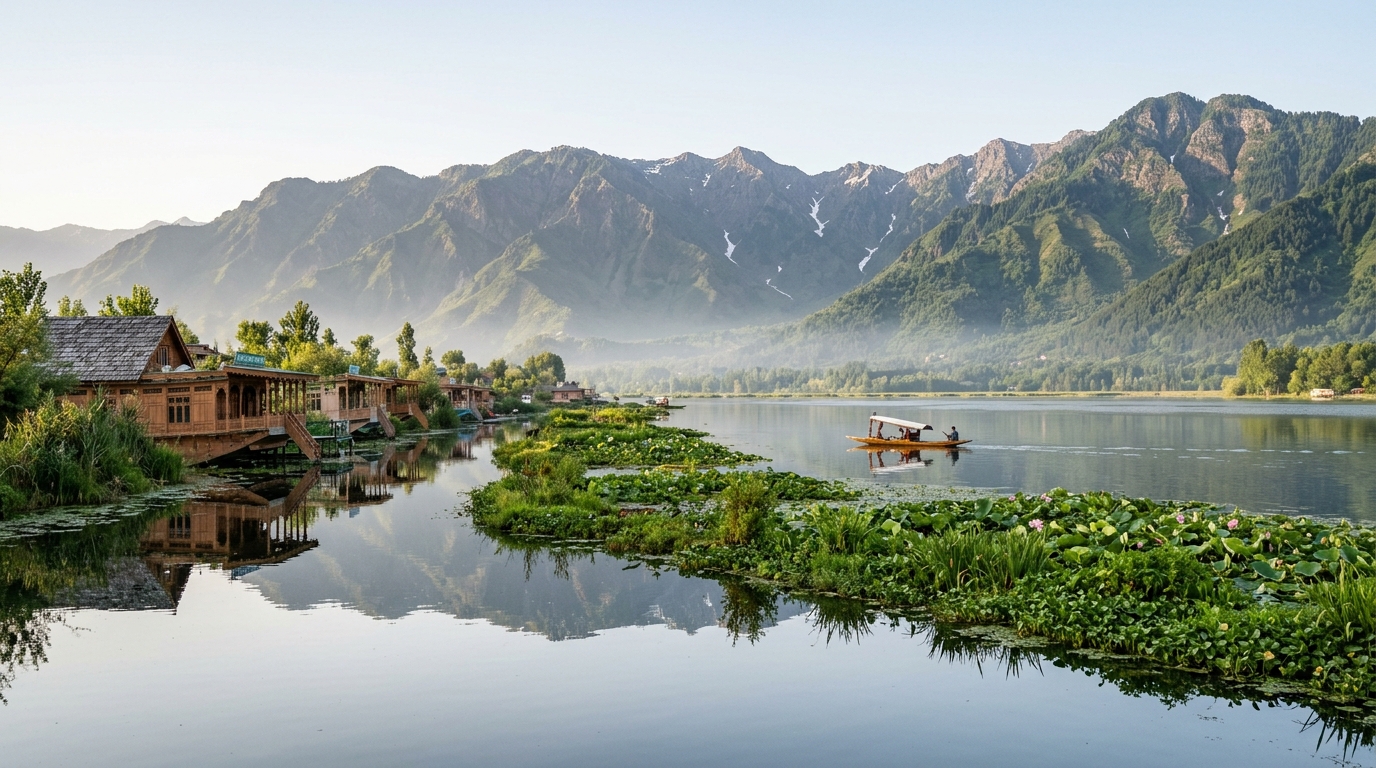
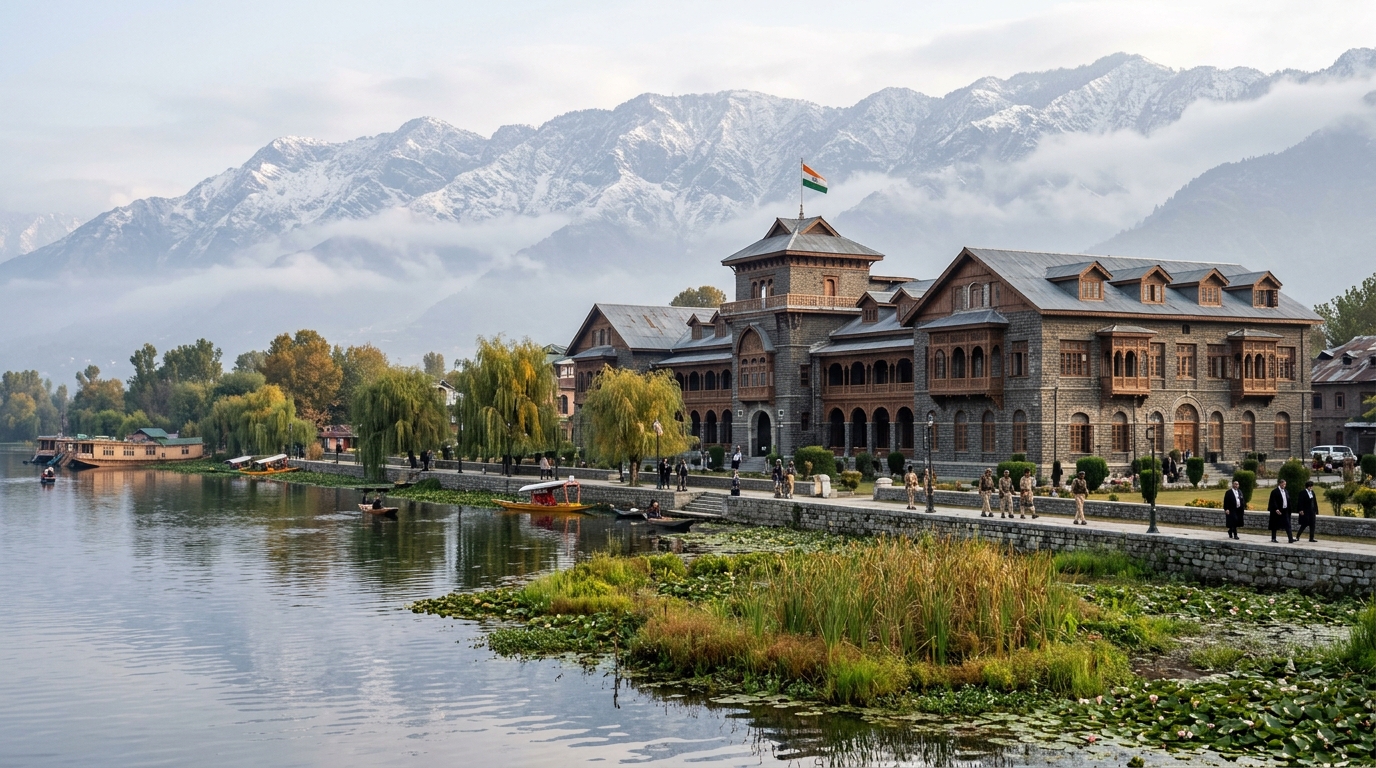
Urban lacustrine basins, shoreline houseboat moorings, macrophyte channels, and surrounding Zabarwan–Telbal catchment slopes across Dal Lake in Srinagar—where physical sediment transport, sewage nutrient stoichiometry, benthic oxygen demand, and public expenditure converge (Illustrative archival plate — Kashmir EcoWatch Visual Archive).

The Mathematics of a Dying Lake

A forensic scientific investigation into Telbal settling basin efficiency (7–57% historical CAG range), the 36.70 MLD peripheral sewage treatment ring versus ~48 MLD estimated wastewater generation, CAG Table 4.2 nutrient removal shortfalls, mechanical de-weeding stoichiometry, slurry-versus-solids dredging math, catchment erosion, hydrological residence time, and the eight interconnected mass balances governing Dal Lake’s survival.

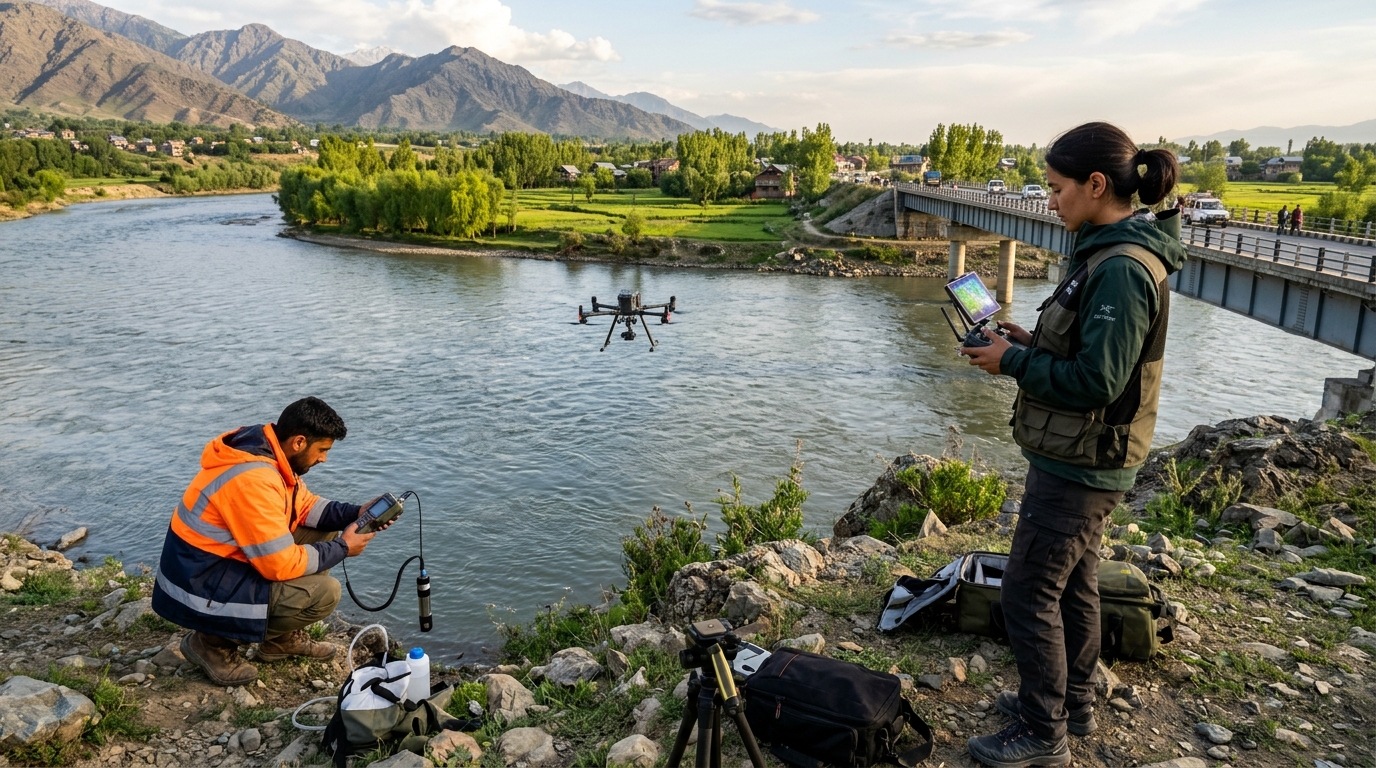
Freshwater chemistry analysis and aquatic diagnostic instrumentation context—illustrating the indispensable role of permanent limnological infrastructure in diagnosing nutrient loading, sediment flux, and treatment performance (Illustrative archival plate — Kashmir EcoWatch Visual Archive; does not depict the historical Habak building).

The Laboratory That Kashmir Lost

While successive governments committed substantial public resources to saving Dal Lake, the scientific institution established to understand its ecological deterioration was displaced. Its research infrastructure deteriorated, its scientific leadership remained inadequately supported, and official warnings continued to accumulate. How did the science necessary to save the lake become secondary to the administration responsible for saving it?

Mooring channels, shoreline embankments, vegetative margins, and Zabarwan foothill slopes across Dal Lake in Srinagar—illustrating the lacustrine geography where open water, traditional habitation, tourism infrastructure, and urban land pressure intersect (Illustrative archival plate — Kashmir EcoWatch Visual Archive; general landscape reference without parcel-specific evidentiary allegation).

The Art of Encroachment

Proposed 15-volume, 100-chapter historical & geospatial dossier · 1859–2026 Dal–Nigeen conversion audit

15 Volumes100 Chapters−49.0% Open Water (1859–2013)Open Monograph 11 →

From 1859 shoreline surveys through decades of political conflict, lost enforcement archives, and documented anti-corruption proceedings to 2026 restoration claims, an investigation into how Kashmir’s flagship lake has been progressively converted from within—and what the institutions entrusted with protecting it actually did.

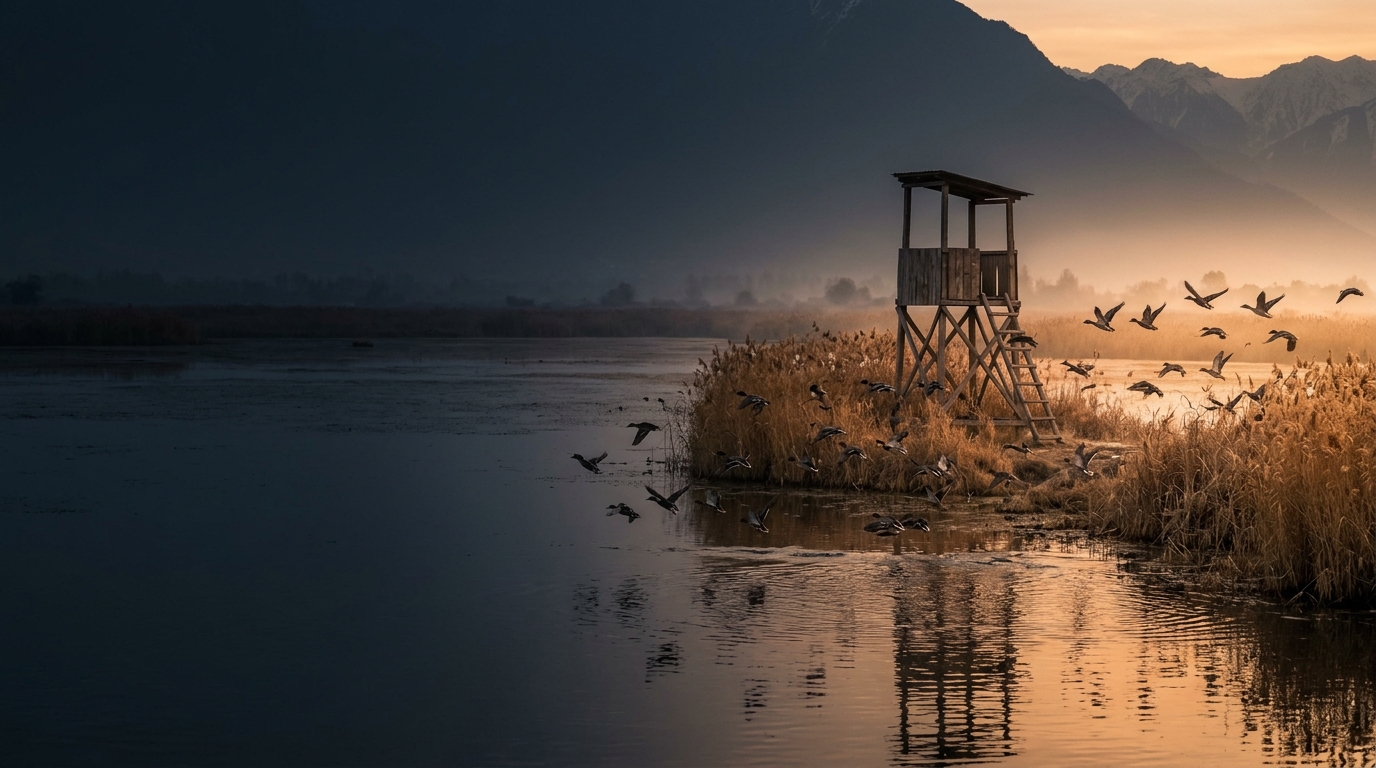
Migratory waterbirds over emergent reedbeds and open winter marsh channels across the Kashmir Valley—where Central Asian Flyway stopover energetics, benthic invertebrate availability, and floodplain hydroperiods converge beneath Western Himalayan ridges (Illustrative archival plate — thematic habitat reference without species-census evidentiary claim).

The Sky Has No Borders

Proposed 18-volume ornithological monograph · Five-region checklist & census reconciliation ongoing

18 Thematic volumes54 Proposed chapters5 Regions Connected habitatsOpen 18-Volume Monograph →

A migratory bird crossing the Karakoram or Pir Panjal recognizes neither the Line of Control nor the Line of Actual Control—only open water, benthic invertebrates, forest canopy architecture, thermal gradients, and tailwinds. Expanding our inquiry from floodplain wetlands to the entire Western Himalayan sky across Kashmir, Jammu, Ladakh, Azad Jammu & Kashmir, and Gilgit-Baltistan, Dispatch 06 audits regional checklists, scrutinizes KEW’s own 601-taxa registry, tests whether 1.34 million counted waterbirds signify recovery or refugia compression inside four surviving wetlands, and establishes the eighteen-volume Monograph 04 research framework.

Temperate broadleaf and mixed conifer woodland along Western Himalayan foothill slopes—illustrating foothill canopy structure, understory habitat, and watershed retention rather than forensic boundary photography of City Forest / Sálim Ali National Park or the Royal Springs Golf Course (Illustrative archival habitat plate, Kashmir EcoWatch Visual Archive).

The National Park That Became a Golf Course

Proposed 10-volume, 75-chapter protected-area & jurisprudence investigation · Primary gazette retrieval ongoing

10 Volumes75 Chapters723 ha Unresolved RemainderOpen Monograph 09 →

An investigation into the transformation of Srinagar’s City Forest (Sálim Ali) National Park into land associated with the Royal Springs Golf Course, the National Board for Wildlife objections recorded after construction, the unresolved fate of 723 remaining hectares, and the lessons this precedent holds for the entire Western Himalayan Protected Area Network.

Mature Kashmir Chinar (Platanus orientalis) avenues and canopy geometry representative of Srinagar’s historic Naseem Bagh cultural landscape—where four centuries of living Mughal arboriculture encounter contemporary campus construction, soil sealing, and root-zone disturbance (Illustrative archival plate, not matched-date change-detection proof — Kashmir EcoWatch Visual Archive).

The Chinars in the Shadow of Concrete

Naseem Bagh: When an Institution of Higher Learning Expands Within a Landscape of Living Heritage — An investigation into four centuries of botanical heritage, decades of institutional expansion and the environmental responsibilities of the university entrusted with its preservation.

1,200+ Historical Mughal planting estimate~700 UoK 2021–22 audit (696 in UniCal)12 / 72 Proposed volumes / chaptersOpen 12-Volume Monograph 14 →

Laid out overlooking Dal Lake in the Mughal era of Akbar and Shah Jahan, Naseem Bagh is one of Kashmir’s oldest designed Chinar landscapes—and today sits inside an institution that teaches botany, environmental science, remote sensing, geography, and law. Tracing the University of Kashmir’s own Institutional Calendar (696 Chinars) and 2021–22 Environmental Audit (~700 Chinars; 74.66 ha main-campus inventory) alongside 2007–2026 construction controversies, root-zone soil science, and the J&K Preservation of Specified Trees Act, 1969, this investigation asks whether academic advancement can be reconciled with living botanical heritage.

Thematic landscape study of braided gravel-cobble bars and riparian terrace geometry characteristic of Pir Panjal snowmelt tributaries (Illustrative archival plate — not forensic site photography of a specific mining lessee).

Gravel, Concrete, and the Vanishing Floodplain

Synthesizing minor-mineral statutes, MoEFCC sand-mining enforcement guidelines, public National Green Tribunal proceedings, and peer-reviewed river science across the Rambiara, Vishav, Romshi, Doodhganga, Lidder, and Sindh corridors, this dossier examines what happens when cobble armor deposited over millennia is excavated faster than watersheds can replenish it.

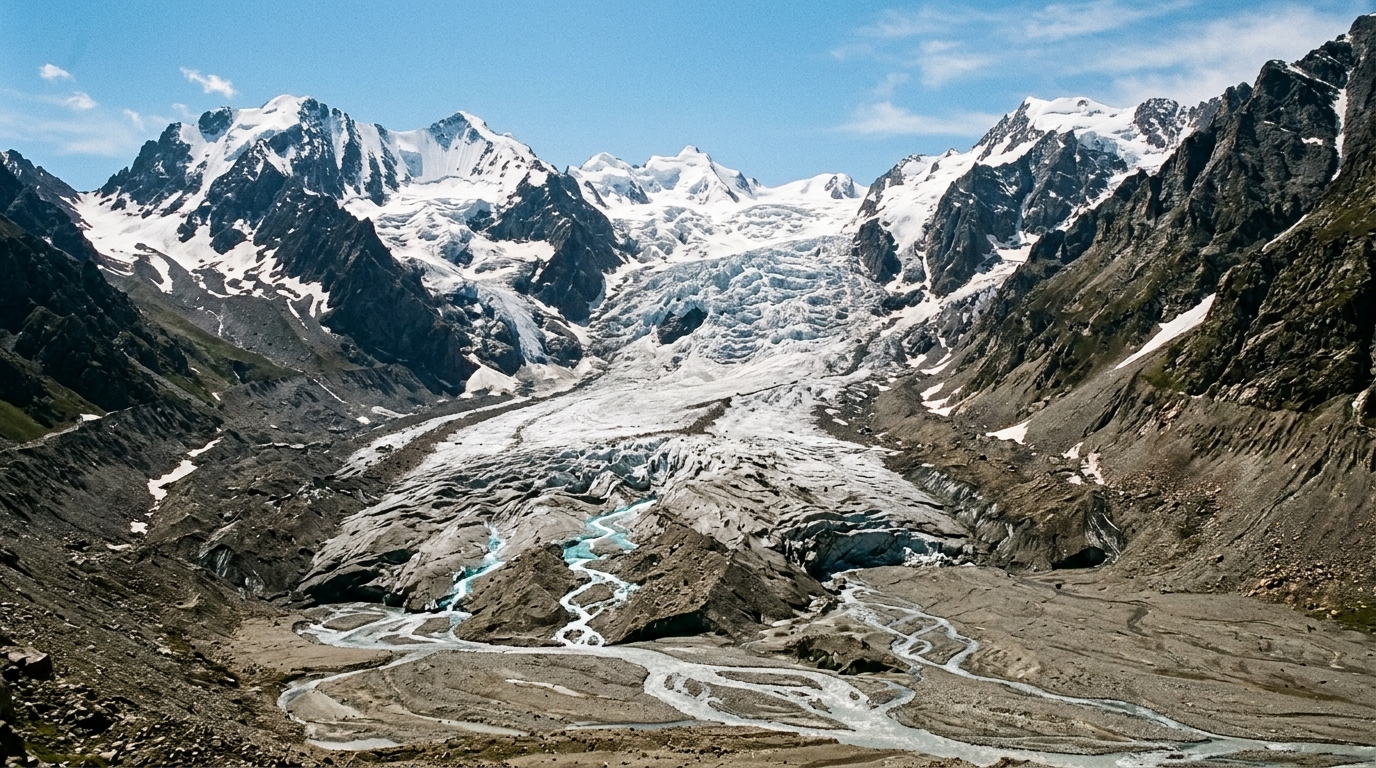
High-elevation glacier ablation terrain, dark supraglacial debris mantle, and proglacial meltwater drainage representative of the Upper Lidder–Sindh headwaters (Illustrative archival plate; quantitative findings carried by the multi-sensor dataset and cited peer-reviewed studies).

Thirty-Eight Winters of Snowline Retreat

Mid-winter satellite maps flatter the Western Himalayas; late September tells the truth. Pairing a 352-scene Landsat and Sentinel-2 hypsometric synthesis (1988–2026) with peer-reviewed mass-balance and debris-thickness studies across Kolahoi, Hoksar, and Lidder headwaters, this data essay traces how rising autumn snowlines narrow the reflective accumulation zone.

High-relief Himalayan ablation zone, supraglacial debris mantle, and proglacial meltwater channel representative of Western Himalayan headwaters (Illustrative archival plate — this feature is a constructed literature synthesis, not a portrait interview).

“A Glacier Does Not Negotiate With Five-Year Plans”

Rather than attributing composite answers to a fictional persona, the editors of Himalayan Dispatch synthesized forty years of published Upper Indus, Jhelum, Chenab, Zanskar, and Karakoram glaciological research into twelve pointed questions on mass balance, peak water, debris-cover thermodynamics, GLOF cascades, and hydrological non-stationarity.

Printed broadsheets, string-tied archival gazette dockets, a reporter’s notebook, and a brass loupe beside dual monitors displaying Himalayan glacier and watershed Earth-observation telemetry—evoking the crossroads between conventional press-release reporting and independent, documentary, scientifically literate mountain journalism (Illustrative editorial study — Himalayan Dispatch Visual Editions Desk; carries no depiction of or allegation against any specific publication or individual).

Journalism at a Crossroads

Why the Western Himalayas Need a New Direction in Journalism — Beyond political patronage, institutional dependency, press release journalism and the boundaries of conventional reporting

15 Thematic volumes90 Proposed research chapters5 Western Himalayan regions20 Specialized journalistic desksOpen 15-Volume Monograph 15 →Media Transparency Observatory →

Beyond breaking news, political statements, press conferences and institutional publicity lies an extraordinary landscape of unexplored scientific questions, forgotten environmental histories, unexamined public expenditure and emerging threats to human civilization. Positioned immediately after the Founding Manifesto as Dispatch 17, this investigation examines the political establishment–media house nexus, government advertising dependency, professional vulnerability, scientific specialization, and the institutional architecture required for independent public-interest journalism across Kashmir, Jammu, Ladakh, Azad Jammu & Kashmir, and Gilgit-Baltistan.

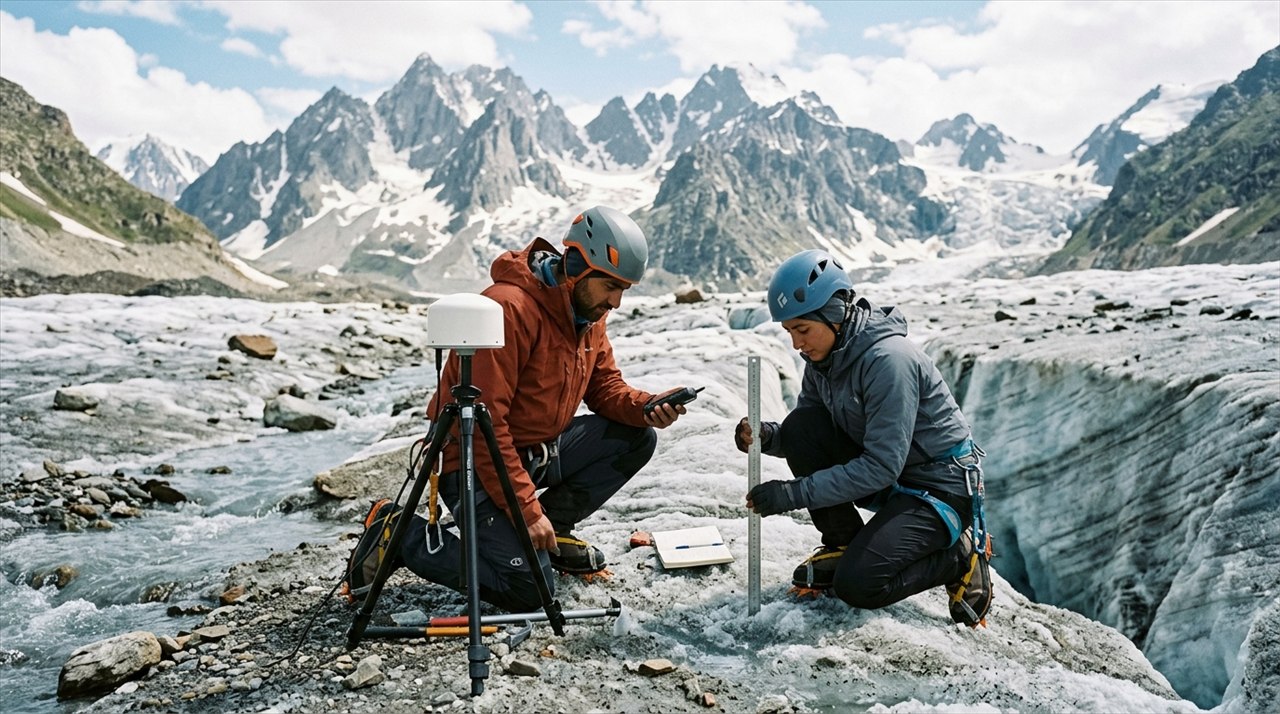
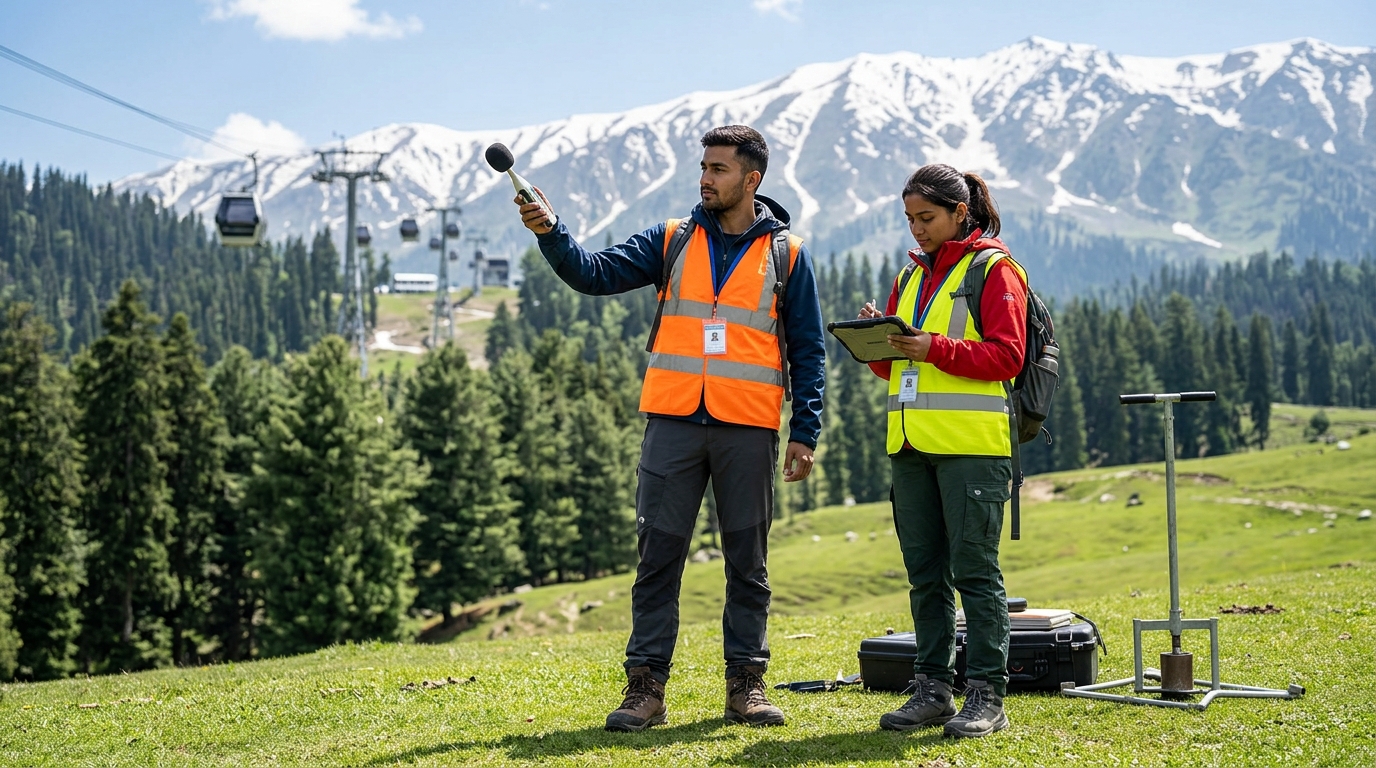
High-altitude scientific measurement and mountain watershed research context in the Western Himalayas—where decades of field scholarship earn global journal recognition while raising the foundational question of how scientific knowledge returns to local communities and ecosystems (Illustrative archival plate — Kashmir EcoWatch Visual Archive).

Who Are We Researching For? The World Knows Our Mountains. Do We?

Across Kashmir, Jammu, Ladakh, Azad Jammu & Kashmir, and Gilgit-Baltistan, a preliminary working inventory identifies 80 environment-related academic departments, laboratories, research centres, and field facilities—and a single University of Kashmir departmental register records 145 publications in five years alone. Positioned immediately before our Beyond the Conference series, Dispatch 12 inaugurates a strict, non-fabricated 2001–2026 bibliometric census and the Western Himalayan Research-to-Society and Impact Protocol to ask: how much of twenty-five years of mountain science has actually returned to the people and landscapes that made it possible?

Glaciated headwaters and high mountain ridges of the Western Himalayas—landscapes studied across the world and sustained at home by scientists, advocates, journalists, conservationists, and students navigating formidable institutional odds (Illustrative archival plate — Kashmir EcoWatch Visual Archive).

South Asia’s Environmental Vanguard

Their journeys were not easy. Neither will ours be. Examining thirty-two distinguished environmental advocates, institution-building NGO leaders, investigative journalists, and pioneering scientists across India and Pakistan—not as distant celebrities, but as four professional mirrors through which the Western Himalayas can confront its own aspirations, institutional constraints, and possibilities.

BEYOND THE CONFERENCE · SERIES II (DISPATCHES 20–22 & 27–28) · SCIENTIFIC & INSTITUTIONAL RESPONSE

Our Editorials Begin Where Academic Conferences End

Himalayan Dispatch does not reproduce conference themes, summarize presentations, or amplify institutional publicity. Building directly upon "Journalism at a Crossroads" (Dispatch 17), "Who Are We Researching For?" (Dispatch 18), and "South Asia’s Environmental Vanguard" (Dispatch 19), and bridged at its centre by "The Price of Power" (Dispatch 23), "The Wealth Beneath the Mountains" (Dispatch 24), "The Rivers That No Longer Belong to Their Valleys" (Dispatch 25), and "The Western Himalayas Are Sitting on a Time Bomb" (Dispatch 26), this five-part response series interrogates systemic blind spots, legal enforceability, and engineering reality—advancing five original governance frameworks for the Western Himalayas.

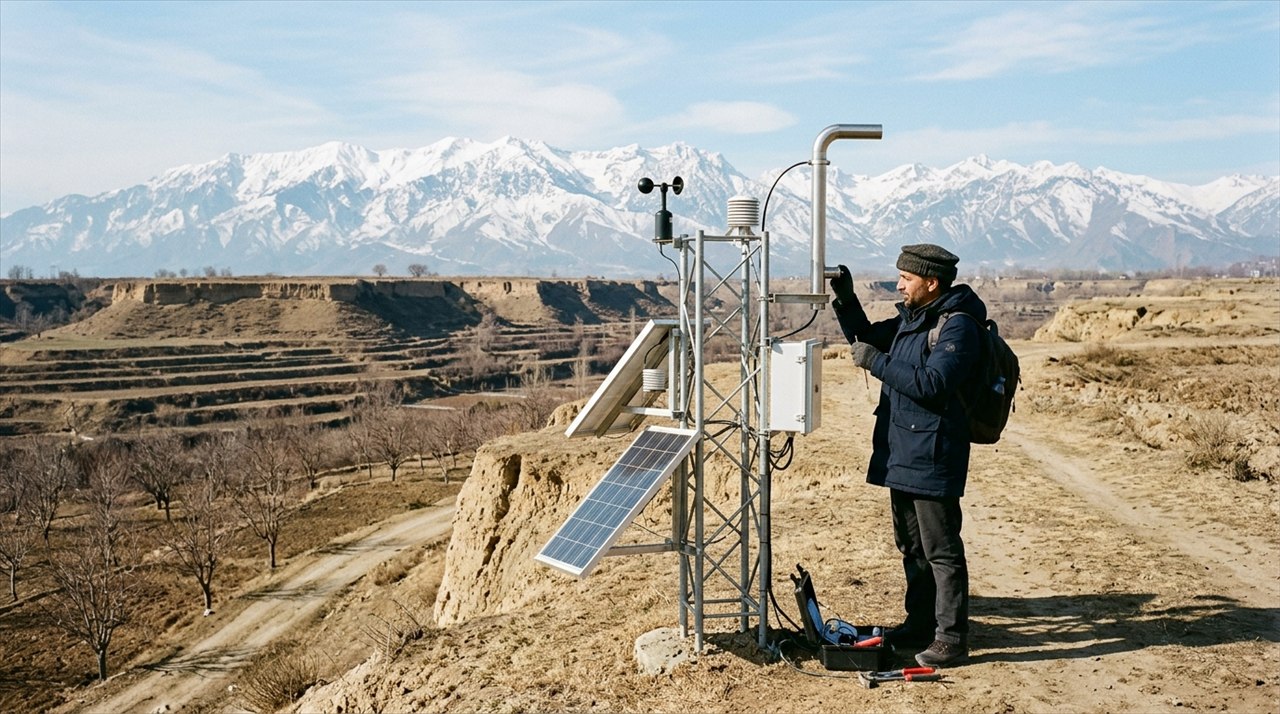
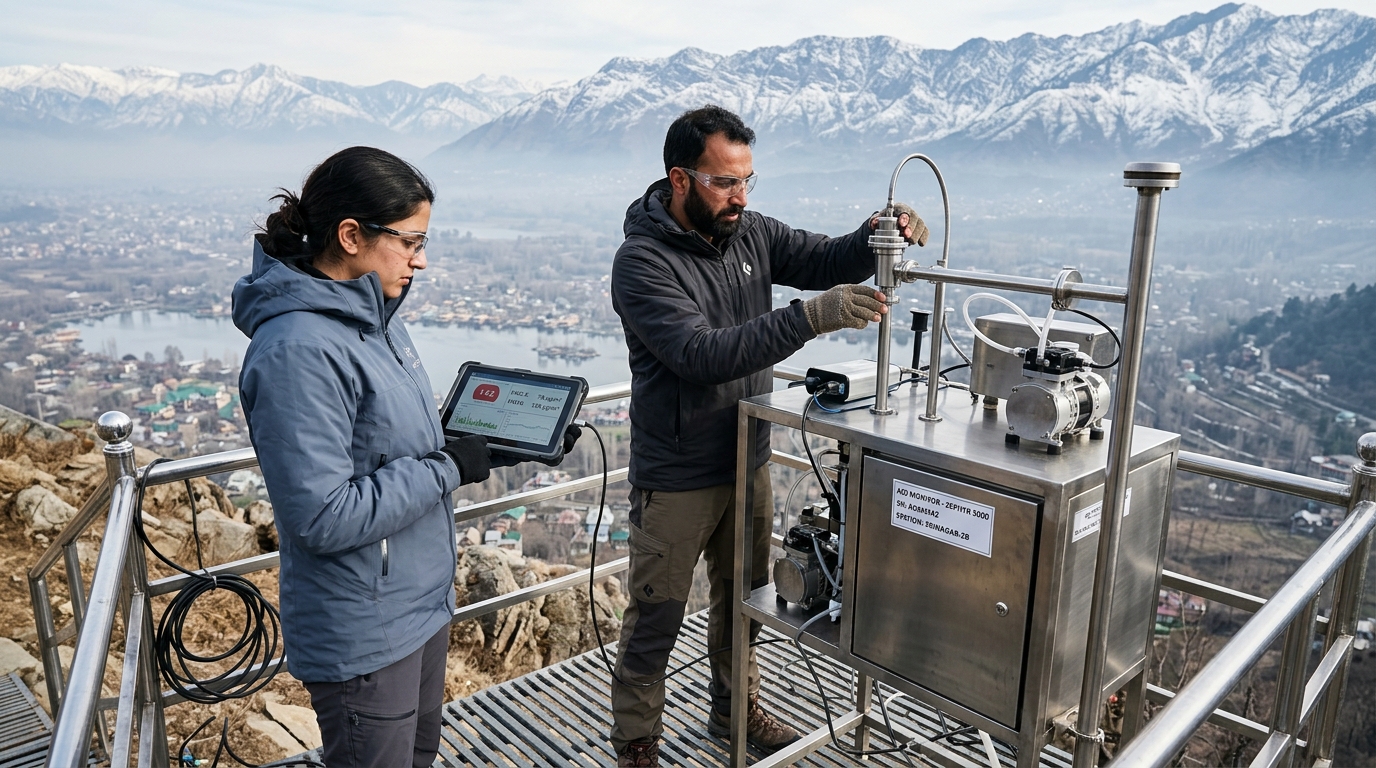
High-elevation atmospheric and watershed observation terrain overlooking a Western Himalayan tableland and snow-fed valley floor (Illustrative archival plate — representative monitoring landscape).

Science Has Diagnosed the Valley. Who Will Prescribe Its Governance?

An independent response to ECSSPP 2026, University of Kashmir. — Proposed Framework: Scientific Evidence-to-Governance Protocol for the Western Himalayas

When ECSSPP 2026 adjourned at Gandhi Bhawan in September 2026, decades of Western Himalayan research on glacier retreat, winter aerosol trapping, and wetland contamination stood assembled in an abstract book. Yet no statutory wire connects a peer-reviewed finding at Hazratbal to an enforceable regulatory trigger across the Jhelum basin.

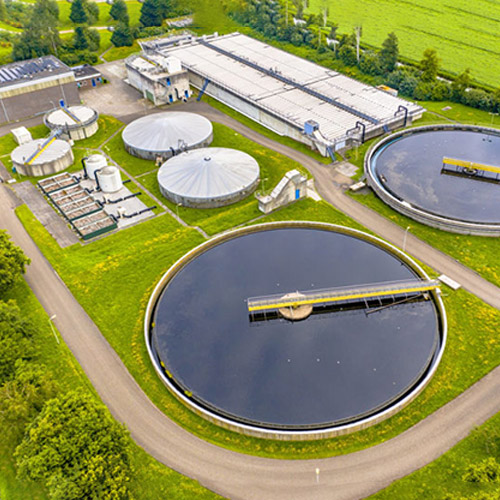
Municipal biological wastewater treatment basins exposed to open mountain winter air—where plains-calibrated microbial design parameters confront near-freezing snowmelt influents (Illustrative archival plate).

When the Mountain Rejects the Engineer

An independent response to RECLAIM 2026, NIT Srinagar. — Proposed Framework: Western Himalayan Environmental Engineering Standard

At RECLAIM 2026, NIT Srinagar rightly spotlighted why biological sewage treatment plants stall in Himalayan winters. Yet cold-influent nitrification collapse is only one symptom of a deeper structural error: governing a 1,600–4,500 m active thrust and cryospheric belt with engineering codes written for warm, flat alluvial plains.

Subalpine valley infrastructure, seasonal road corridors, and montane forest slopes across the Kashmir Himalaya—where physical carrying capacity is governed by dry-season baseflow, slope shear strength, and corridor integrity rather than seasonal visitor targets.

Who Gave Development the Right to Exceed the Mountain?

An independent response to the 13th Sustainable Mountain Development Summit. — Proposed Framework: Western Himalayan Ecological Limits and Development Authorization Framework

In October 2026, the 13th Sustainable Mountain Development Summit at Shalimar placed a draft Jammu & Kashmir Mountain Policy into national deliberation. Yet until ecological thresholds possess statutory power to refuse concrete, tunnels, and unconstrained tourist surges, sustainable mountain development risks becoming polite vocabulary draped over an engineering monologue.

Steep Western Himalayan river-gorge and mountain infrastructure corridor—where snowmelt gradients generate thousands of megawatts while generating districts confront forest submergence, tunnel hydrogeological shifts, slope instability, and winter power curtailment (Illustrative archival plate — Kashmir EcoWatch Visual Archive).

The Price of Power

When Mountains Generate Electricity but Their People Remain in Darkness — Who receives the electricity, who receives the revenue, and who inherits the environmental destruction and geological risks?

1,300 MW Reported J&K winter gap (Nov 2026)10,190 MW 7 selected planned mega-projects20 / 120 Volumes / Proposed chaptersOpen 20-Volume Monograph 12 →

Rivers are diverted, forests are submerged, mountains are tunnelled, wildlife corridors are severed, and communities surrender ancestral valleys to generate low-carbon electricity—yet on November 27, 2026 Jammu & Kashmir warned of a ~1,300 MW winter power gap, flood-damaged stations in Gilgit-Baltistan dropped to 157 MW against 285 MW summer demand, Ladakh ran Nimoo Bazgo and Chutak in emergency isolated mode, and AJ&K residents endured winter outages beside major dams. Completing our three-part mountain engineering sequence, this investigation asks: who receives the electricity, who receives the revenue, and who inherits the ecological and geological risks?

High-relief mountain river gorge and alluvial gravel corridor representative of Upper Indus extractive landscapes—where mechanized placer dredging, hard-rock pegmatite mining, glacier-fed hydrology, and steep tectonic slopes converge (Illustrative archival plate — Kashmir EcoWatch Visual Archive).

The Wealth Beneath the Mountains

Gilgit-Baltistan’s Mineral Resources: Extraction, Environmental Vulnerability, External Commercial Interests and the Question of Local Ownership — Who owns the mineral wealth, who receives its economic benefits, and who inherits the environmental liabilities after the mountains have been excavated?

43,494 km² Reported mineral-interest area (not active mines)590 / 0 Portal study entries / Displayed private leases18 / 108 Proposed volumes / research chaptersOpen 18-Volume Monograph 16 →

Where the Himalayan, Karakoram, and Hindu Kush orogenic belts collide, Gilgit-Baltistan holds documented occurrences of rubies, aquamarine, topaz, tourmaline, gold, copper, graphite, and lithium-bearing pegmatites—attracting official mineral-development interest across a reported 43,494 km². Yet public inspection of the regional mining portal shows 590 study-area entries alongside zero displayed private-lease records, April 2025 saw mass protests in Shigar over mineral-rights reforms, consolidated rules point to an illustrative 85% drop in community royalty share (from 2× royalty to 30%), and August 2026 environmental warnings flagged mechanized placer gold mining threatening rivers and the Diamer-Basha corridor.

Himalayan river-confluence and steep mountain valley corridor context—illustrating the hydrological and civic stakes when upstream hydropower diversions and downstream storage reservoirs reshape river-dependent settlements (Illustrative archival plate — Kashmir EcoWatch Visual Archive; does not depict a specific Muzaffarabad or Mangla structure).

The Rivers That No Longer Belong to Their Valleys

From the submerged villages of Mangla to the diminished river flows of Muzaffarabad, an investigation into what happens when mountain waters are transformed into national economic resources while the communities surrounding them confront displacement, water insecurity and ecological uncertainty. When a region’s rivers are valuable enough to sustain economies beyond its mountains, why must the communities living beside those rivers struggle to secure their own water, electricity and environmental future?

High-relief Western Himalayan mountain, glacier, and valley-corridor terrain—where locked thrust structures, cryospheric retreat, steep fractured slopes, contracted floodplains, and critical human lifelines converge (Illustrative archival plate — Kashmir EcoWatch Visual Archive).

The Western Himalayas Are Sitting on a Time Bomb

Beneath the extraordinary beauty of the Western Himalayas lies an interconnected landscape of active geological faults, retreating glaciers, unstable mountain slopes, expanding glacial lakes, vulnerable settlements, aging infrastructure and intensifying climatic extremes. What happens when these hazards begin interacting with one another? The greatest danger may not be the next earthquake, flood or landslide, but the convergence of multiple hazards within an increasingly vulnerable mountain civilization.

Shallow marsh channels, emergent macrophyte beds, and Himalayan piedmont horizon across the Jhelum floodplain—where flood attenuation and biodiversity depend on intact bathymetric gradients and twenty-year hydrological continuity rather than short-cycle earthwork tenders.

Nature Is Not a Contractor

An independent response to the International Conference on Nature-Based Solutions, IUST. — Proposed Framework: Long-Term Ecosystem Recovery and Restoration Accountability Framework

In August 2026, the Islamic University of Science and Technology at Awantipora rightly elevated wetlands, forests, and floodplains as public climate infrastructure. Yet the instant Nature-Based Solutions enters government Schedule-of-Rates procurement, multi-decadal ecological succession is flattened into thirty-six-month sapling pits and backhoe dredging contracts.

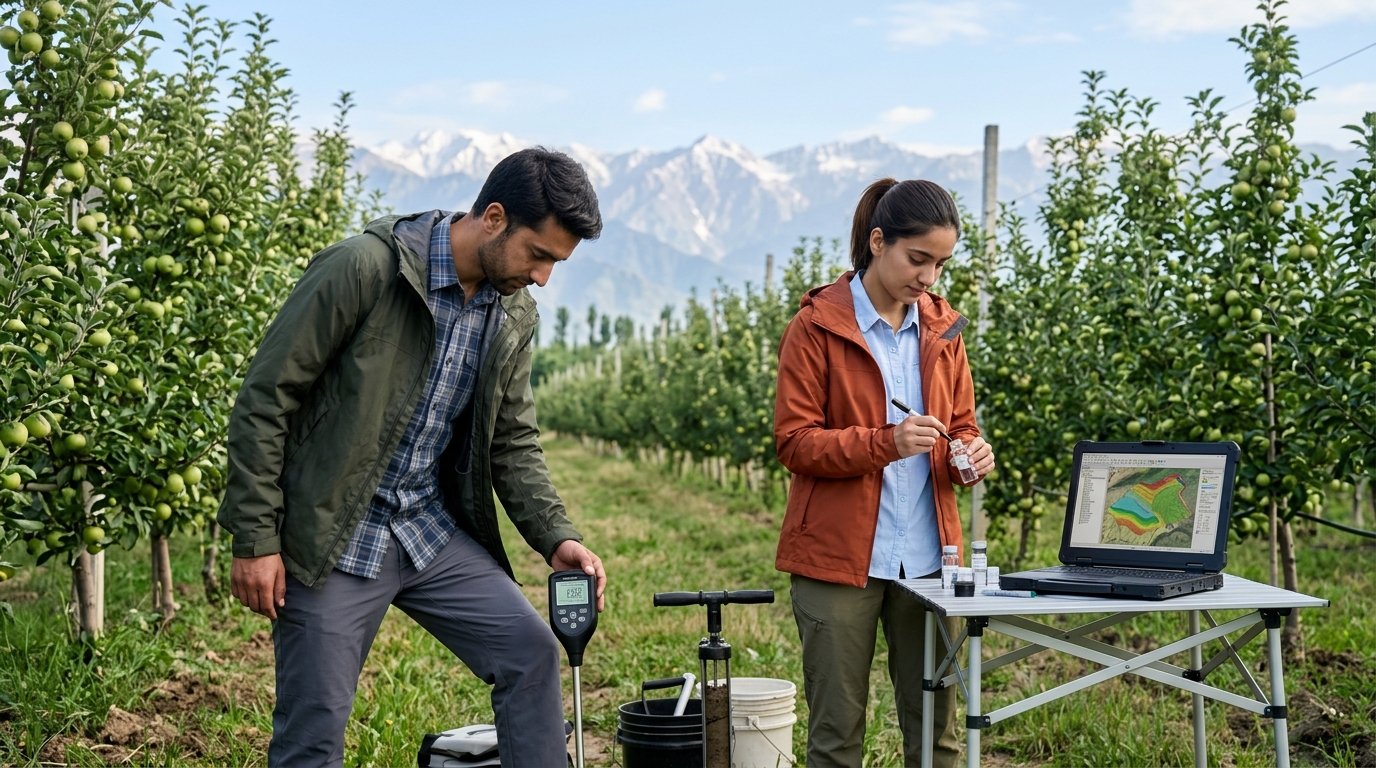
Orchard canopy management and agrochemical drift across Western Himalayan horticultural terrain—where shifting bloom windows, shallow rootstock water demand, and tributary runoff converge (Illustrative regional archive plate).

The Climate Has Changed. Has Agricultural Science?

An independent response to the Indian Ecological Society's 2026 conference. — Proposed Framework: Western Himalayan Adaptive Agroecological Zoning Framework

Between April 28 and 30, 2026, the Indian Ecological Society, SKUAST-Jammu, and SKUAST-Kashmir convened in Chatha to debate climate-resilient agroecosystems. Beginning where the conference podium ends, this response asks whether Himalayan agricultural science can defend a vanishing twentieth-century crop map with shallow-rooted dwarfing stocks, calendar fungicide sprays, and unbudgeted irrigation—or whether non-stationary mountains now demand dynamic agroecological rezoning.

DISPATCHES 29 & 31–36 · CIVIL SOCIETY, ENVIRONMENTAL LAW & UNIVERSAL ACCOUNTABILITY

From Public Advocacy to Measurable Ecological Outcomes

While our university response editorials interrogate scientific methodologies and statutory policy gaps—and Dispatches 04, 05, 06, 10, 11, 17, 18, 19, 23, 24, 25, 26, and 30 investigate Dal Lake engineering math, Habak’s lost laboratory, encroachment, Sálim Ali National Park, Naseem Bagh’s Chinars, journalism’s political economy, twenty-five years of regional research, South Asia’s environmental vanguard, hydropower, Gilgit-Baltistan mineral extraction, Azad Jammu & Kashmir river diversion and displacement, multi-hazard disaster convergence, and the transboundary atmosphere—this series examines environmental advocacy, statutory enforcement, civic cleanups, public declarations, electoral manifestos, and selective consciousness.

Autumn and early-winter atmospheric haze pooling across the enclosed Kashmir Valley floor beneath surrounding Himalayan ridges, where shallow boundary-layer inversions trap domestic biomass smoke, vehicular exhaust, brick-kiln plumes, and orchard-pruning aerosols (Illustrative archival plate — representative monitoring landscape).

Six Years of Warnings, and Kashmir Still Cannot Breathe

Why does environmental knowledge continue to accumulate while clean air remains increasingly uncertain? — Advancement: Regional Atmospheric Source-Apportionment, Sensor-Validation and Clean-Air Accountability Framework (RASS-CAF)

Across six consecutive autumns from 2020 to November 2026, Srinagar's Peoples' Environmental Council has assembled pulmonologists, earth scientists, and pollution regulators to warn of winter smog, orchard-pruning smoke, and chronic lung disease. Yet Srinagar slipped from fourth to twenty-sixth in national clean-air rankings while official monitors, fog-biased optical sensors, and unenforced combustion mandates leave a single question unanswered: why does environmental knowledge accumulate while clean air grows ever more uncertain?

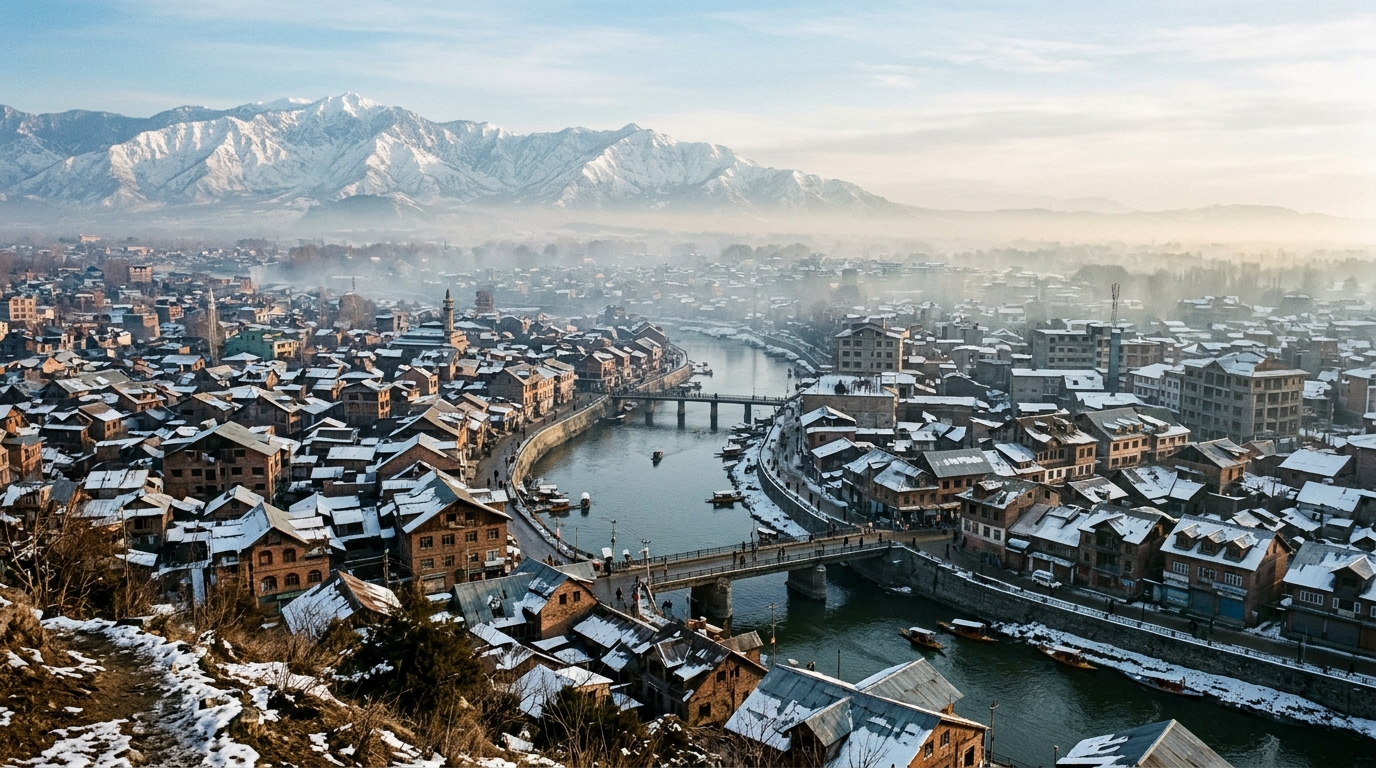
Shallow cold-pool inversion and winter aerosol haze suspended above Srinagar and the Jhelum floodplain beneath Western Himalayan ridges—where radiative surface cooling, weak boundary-layer ventilation, indigenous solid-fuel plumes, and synoptic long-range transport converge (Illustrative archival plate — representative basin meteorology, not incident photography).

The Atmosphere Has No Borders: The Air We Breathe, the Numbers We Cannot Trust

Proposed scientific monograph · Research framework (Ongoing investigation)

12 Thematic parts60 Scientific chapters30 yrs Climate baselineOpen Monograph 01 →

In late November 2026, while official pollution screens in Srinagar reported an Air Quality Index near 140, a private digital platform flashed a reported reading of 708—exposing not merely a polluted winter basin, but a crisis of metrological credibility. Moving from civic clean-air governance to physical atmospheric science, Dispatch 17 establishes the ongoing twelve-volume, sixty-chapter Monograph 01 research framework across the Kashmir Valley, the Indo-Gangetic Plain, the Indus corridor, the Taklamakan rim, and Central Asia.

Fragile Western and Trans-Himalayan wetland, pasture, and mountain watershed terrain—landscapes governed across five regions by four distinct legal frameworks yet repeatedly left defenceless between administrative clearance, missing infrastructure, and ex-post judicial review (Illustrative archival plate — Kashmir EcoWatch Visual Archive).

When Environmental Laws Exist but the Environment Has No Defence

What were the region’s environmental laws intended to protect, where did protection break down across enforcement versus statutory design, and what must change? — Advancement: 15 Western Himalayan Model Legislative & Regulatory Reform Packages + 16-Registry KEW Legislation & Enforcement Observatory

The Western Himalayas do not exist in a legislative vacuum: across Kashmir, Jammu, Ladakh, Azad Jammu & Kashmir, and Gilgit-Baltistan, four distinct legal systems deploy dozens of statutes, constitutional guarantees, and subordinate rules—yet 518 of 697 historically inventoried lakes in J&K have disappeared or shrunk after a 22-year lake-bill delay, Ladakh reported a 12.33 MLD sewage treatment gap before the NGT, Neelum–Jhelum diversions triggered downstream water scarcity around Muzaffarabad, and placer gold mining along Gilgit-Baltistan rivers exposed enforcement gaps. Answering five foundational questions, this Special Legal & Scientific Investigation separates pure enforcement failure from statutory obsolescence and sets out 15 model legislative reform packages.

Stationary cedar houseboats, littoral reed margins, and mountain-framed open water across the Dal–Nigeen lacustrine system—where surface aesthetics conceal continuous dissolved nutrient loading, unintercepted domestic outfalls, and benthic phosphorus recycling.

A Lake Cannot Be Rescued by an Annual Cleanup

Are we cleaning the surface of Kashmir's lakes while allowing the processes that destroy them to continue? — Advancement: Integrated Lake and Catchment Recovery Framework Across Urban, Subalpine & Alpine Waters (ILCRF-WH)

When official agencies abandoned Khushal Sar and Gilsar to solid waste and encroachment, citizen campaigns led by the Nigeen Lake Conservation Organisation reopened choked urban channels and restored public conscience. Yet across eighty-eight monitored Kashmir waterbodies, neither sustained volunteer muck removal nor ceremonial World Environment Day shoreline drives can cure dissolved orthophosphate, cold-winter sewage bypasses, or decades of anoxic sediment memory.

Community stewardship and field mobilization across a Western Himalayan landscape—where the enduring test of environmental action is not the banner unfurled on day one, but the living tree, flowing spring, and enforced legal buffer still standing five winters later.

Who Measures the Success of Environmental Activism?

Should environmental organizations themselves be evaluated using the same standards of accountability they demand from governments? — Advancement: Environmental Civil Society Performance and Accountability Index (ECSPAI)

Across Jammu, Kashmir, and Ladakh, environmental trusts, litigation collectives, youth clubs, and digital observatories rightly demand rigorous transparency from the state. Yet when Kashmir EcoWatch audited its own NGO registry in November 2026 and found placeholder claims of "Positive impact projected" alongside unverified sapling and cleanup tallies across the wider movement, an inescapable question emerged: will environmentalism hold itself to the same evidentiary law it demands of government?

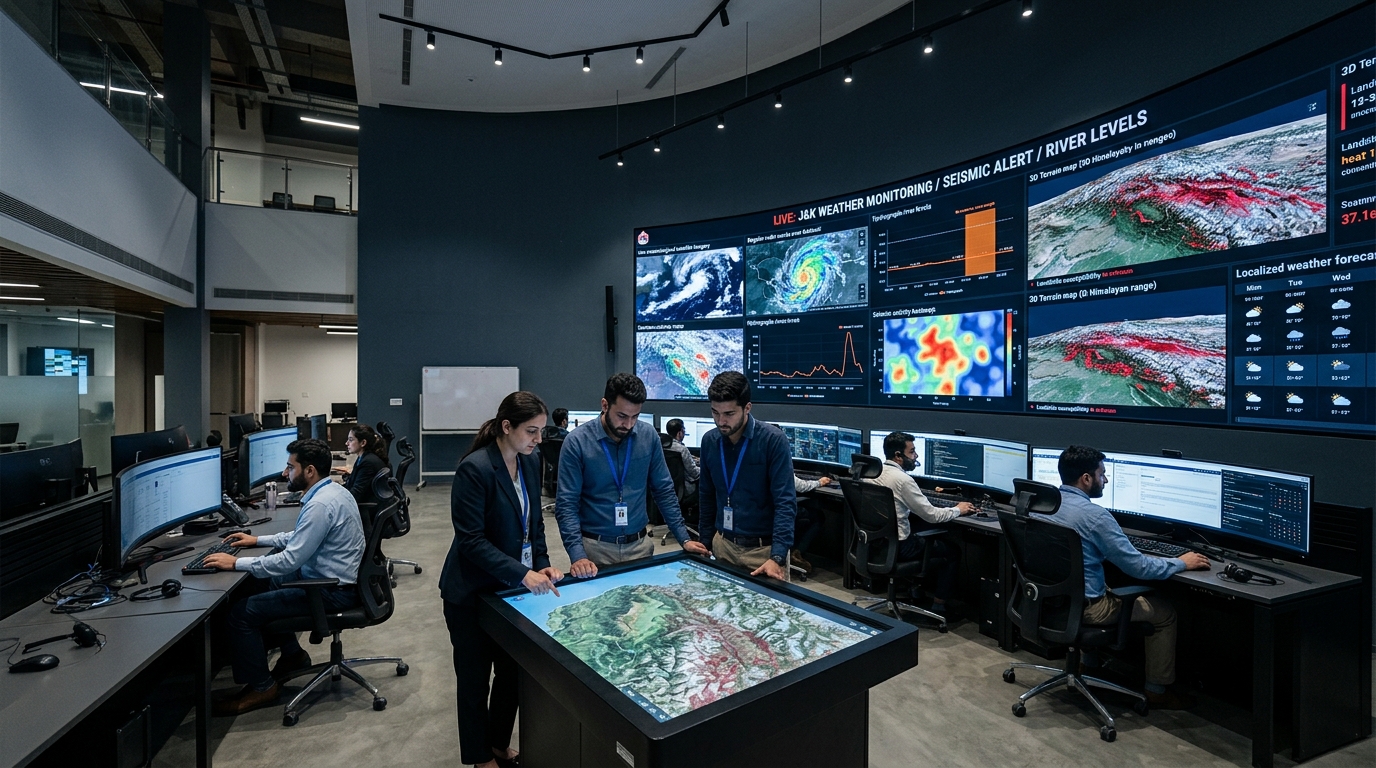
Satellite Earth-observation and watershed synthesis architecture across the Western Himalayas—illustrating the evidentiary shift required when non-binding conference declarations are replaced by continuous, open-access biophysical and fiscal commitment tracking.

The Mountains Have Heard Enough Declarations

When does an environmental declaration cease to be a commitment and become merely a record of good intentions? — Advancement: Public Environmental Commitments and Implementation Observatory (PECIO-WH)

Across a decade of Srinagar, Jammu, Leh, and pan-Himalayan conclaves, earnest environmental charters have proclaimed "Ecology Before Engineering" and "Water Before Infrastructure." Yet ninety days after the ballroom lights dim, almost no clause carries a statutory custodian, a costed budget head, a falsifiable physical unit, or a public audit clock.

Floodplain wetlands, river channels, and mountain catchments in the Western Himalayas—where five-year electoral pledges on tourism, highways, hydropower, mining, and lake rejuvenation meet generational hydrological and ecological law (Illustrative archival plate — Kashmir EcoWatch Visual Archive).

When Politics Promises Green

If every political party can explain what it intends to build during the next five years, should it not also explain what it intends to preserve for the next hundred? — Advancement: Western Himalayan Environmental Manifesto Protocol (WHEMP · 10 Components) & Manifesto Governance Observatory

Across Kashmir, Jammu, Ladakh, Azad Jammu & Kashmir, and Gilgit-Baltistan, every election brings pledges of tourism, highways, hydropower, employment, and green conservation. Examining twenty-six years of electoral politics (2000–2026) under one non-partisan evidentiary ruler, Himalayan Dispatch investigates what parties actually promised, where development pledges contradict ecological limits, who held constitutional power to act, what public budgets delivered on the ground, and how our ten-part Western Himalayan Environmental Manifesto Protocol (WHEMP) turns slogans into auditable century-scale stewardship.

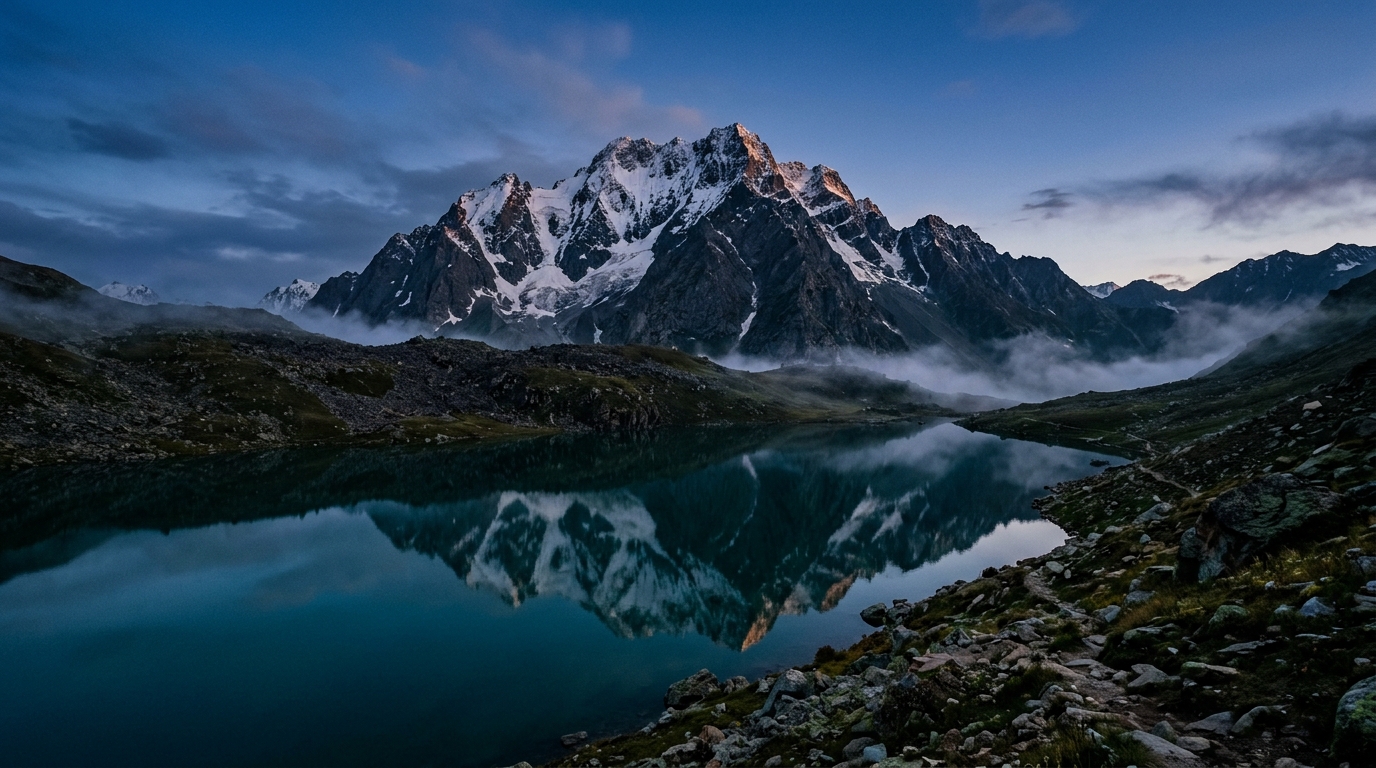
Oligotrophic high-altitude glacial waters and moraine headwalls at Sheshnag (3,590 m) in the Upper Lidder catchment—where periglacial slope mechanics, cold-water nutrient thresholds, and downstream watershed survival obey identical physical laws regardless of political, commercial, religious, or community identity (Illustrative archival plate — Kashmir EcoWatch Visual Archive).

Selective Environmental Consciousness

The central issue is not whether environmentalism should engage with politics—it is whether environmental responsibility survives when political attention disappears. — Advancement: Western Himalayan Environmental Accountability Observatory (WHEAO · 10 Permanent Registries) & 5-Domain Consistency Framework

A comprehensive historical, scientific, sociological and institutional investigation into environmental activism, collective behaviour, ecological destruction and universal environmental responsibility—from the 2008 Baltal–Domail forestland agitation, Ladakh’s 2023–2026 constitutional movement, and the November 2026 Sheshnag excavation controversy to the normalized sewage, wetland, karewa, and riverbed degradation across the Western Himalayas.