GANGBAL & NUNDKOL CIRQUES · MOUNT HARAMUKH, 3,570 M
When Mountains Speak, Who Is Listening?
An exploration of fragile landscapes, human ambition and the ecological future of the Himalayas.
DEPARTMENT VI · CARTOGRAPHY & NUMBERS
Bespoke print-inspired visual essays translating decadal records into human scale.
Rather than generic software widgets, our Data Journalism desk crafts bespoke editorial graphics, elevation-band horizon ledgers, and watershed maps woven directly into literary prose.
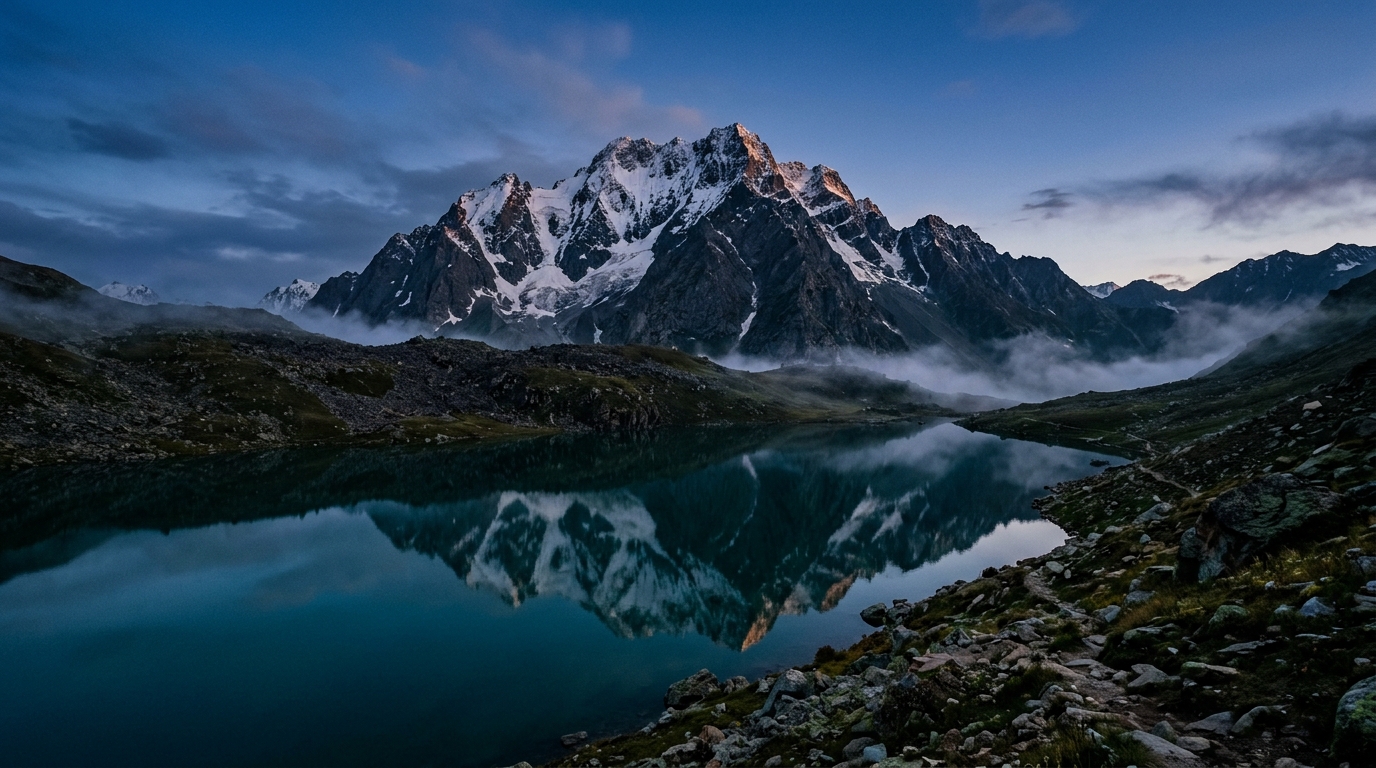
At 3,570 metres beneath Haramukh’s fluted granitic wall, the twin cirques of Gangbal and Nundkol register every warm night, every black-carbon plume, and every hurried road cut below—translating planetary warming into the daily arithmetic of downstream water.
An exploration of fragile landscapes, human ambition and the ecological future of the Himalayas.
A longform environmental feature on Srinagar’s lost canals, drowned ghats, and hydraulic memory.
Decades of Conservation, Crores of Expenditure and the Unresolved Engineering of Dal Lake
When a Dying Lake Lost Its Scientific Institution: The Forgotten Legacy of Habak, the Displacement of Environmental Research and the Institutional Contradictions Behind Kashmir’s Lake Conservation Crisis
How Dal Lake Is Being Turned into Real Estate: A Historical Investigation into Land Appropriation, Administrative Complicity and the Disappearing Waters of Kashmir
Siltation plumes, needle-weir hydroperiods, and the narrowing suburban reedlines of Hokersar and Shallabugh along the Central Asian Flyway.
The Birds of the Western Himalayas: Migration, Ecological Connectivity and the Landscapes We Are Losing
When Recreation Replaced Conservation: The Forgotten Environmental, Legal and Institutional Legacy of Srinagar’s Sálim Ali National Park
Naseem Bagh: When an Institution of Higher Learning Expands Within a Landscape of Living Heritage
An investigative statutory, judicial, and fluvial-geomorphology dossier on mechanized riverbed mining, channel incision, and coldwater habitat loss across Kashmir’s mountain tributaries.
Reading an upward shift of 242 ± 22 meters in the end-of-ablation snowline across the Upper Jhelum and Zanskar fringe—and why honest cryospheric cartography begins with its error bars.
A twelve-part constructed editorial dialogue testing Himalayan hydropower schedules, flood zoning, and water treaties against four decades of peer-reviewed cryospheric physics.
Why the Western Himalayas Need a New Direction in Journalism: Beyond Political Patronage, Institutional Dependency, Press Release Journalism and the Boundaries of Conventional Reporting
Twenty-Five Years of Environmental Research, International Academic Recognition, Local Scientific Knowledge Accessibility and the Missing Journey from Publication to Environmental Impact.
An independent response to ECSSPP 2026, University of Kashmir.
When Mountains Generate Electricity but Their People Remain in Darkness
Gilgit-Baltistan’s Mineral Resources: Extraction, Environmental Vulnerability, External Commercial Interests and the Question of Local Ownership
Azad Jammu & Kashmir: Hydropower, River Diversion, Submerged Civilizations and the Unresolved Question of Environmental Justice
The Convergence of Tectonic Instability, Climate Extremes, Ecological Destruction and Unprepared Human Settlements
An independent response to the Indian Ecological Society's 2026 conference.
An independent inquiry into the Peoples' Environmental Council air-quality webinars (2020–2026) and the governance of Kashmir's winter airshed.
Kashmir's Atmospheric Crisis: Regional Climatology, Himalayan Atmospheric Dynamics, Transboundary Pollution, Aerosol Chemistry and the Scientific Credibility of Air Quality Measurements.
What the Laws Were Intended to Protect, Where Protection Broke Down and What Must Change
An independent inquiry into Nigeen Lake Conservation Organisation, Rotary Club, and civil society lake initiatives across Kashmir.
An independent inquiry into environmental NGOs, civil society organizations, and self-accountability across Kashmir.
An independent inquiry into climate consultations, civil society declarations, and the architecture of unmonitored commitments across the Western Himalayas.
Political Manifestos, Environmental Commitments and Ground Realities Across the Western Himalayas
When Ecology Becomes Political and Environmental Responsibility Becomes Optional
In the absence of early wet western disturbances, nocturnal radiative cooling caps valley air below 300 meters—turning biomass smoke, kiln plumes, and commuter exhaust into a dense dusk lid.
Multi-temporal satellite observations across the Hunza, Ghizer, and Shyok headwaters highlight why transboundary cryospheric data sharing remains vital for downstream valley communities.
The Jhelum is not merely a channel between embankments. From snowfields and fractured Upper Triassic limestone conduits above Verinag to twenty-eight tributary sub-basins, incised gravel beds, forgotten urban canals, and the shrinking floodwater sanctuary of Wular, Kashmir’s axial river is a single living watershed confronting fragmented governance and non-stationary climate extremes.
Can the Chenab sustain multiple interconnected hydroelectric projects—spanning operational Dulhasti (390 MW), Baglihar (890 MW), and Salal (690 MW) alongside the proposed Sawalkote project—without compromising its geological stability, hydrological integrity, and ecological functions? Establishing a 15-chapter, 6-experiment scientific investigation protocol across the Chenab Gorge.
Is human intervention altering Jammu’s rivers—the Tawi, Ravi, Ujh, and Basantar—faster than their natural geomorphological processes can restore equilibrium? Anchored to the February 6, 2025 National Green Tribunal proceedings on Kathua and Samba sand mining and Basantar bridge-pillar exposure, Investigation 02 sets out a 15-chapter, 7-experiment fluvial science protocol.
Is Jammu adequately protecting the natural freshwater infrastructure—anchored by the 350-hectare Surinsar–Mansar Ramsar lake system (designated November 8, 2005) alongside Gharana, Pargwal, Kukarian, and Sanasar wetlands—that sustains its flood resilience, groundwater recharge, and Central Asian Flyway biodiversity? A 15-chapter, 7-experiment research architecture.
In a Trans-Himalayan rain shadow where valley floors receive barely 90–150 millimetres of annual precipitation, human settlement exists only where snowfields, small cirque glaciers, and permafrost active layers release meltwater on time. Anchored in a 2026 scientific synthesis documenting ~0.02°C annual warming, earlier snowmelt, and glacier mass losses of 0.21 to 0.37 metres of water equivalent per year, this investigation examines how hydrograph shifts across Zanskar, Suru, Nubra, Leh, Kargil, Drass, and Changthang threaten gravity-fed oases long before the last ice vanishes.
As seasonal tourist arrivals rival or outnumber permanent oasis populations across Leh, Nubra, Pangong Tso, and Zanskar—prompting a 2026 parliamentary committee warning on water scarcity and waste alongside strengthened June 2026 plastic restrictions—an empirical investigation examines borewell depletion, the shift from zero-water chakdon sanitation to flush hotels, year-round tunnel connectivity, Changthang solar enclosures, and the biophysical limits of a rain-shadow desert.
Dismissed in colonial revenue ledgers and contemporary land-bank schedules as barren wasteland, Ladakh’s Trans-Himalayan plateau sustains psychrophilic permafrost microbiomes, Ramsar wetland refugia, sixty-five high-concern bird species, snow leopard and wild ungulate corridors, and centuries-old Changpa Pashmina commons now strained by linear fragmentation and climate change.
Examining winter thermal inversions, PM2.5 exposure disparities, biomass smoke, and brick-kiln plumes in a mountain bowl.
STAGE 01 · COMMISSIONING DESK
We commission deeply reported environmental narratives, field notebooks, monochrome and color photo essays, investigative dispatches, and cartographic essays rooted in the Western Himalayas.
Never paste sensitive whistleblower identities, raw leaked files, or unredacted coordinates of endangered taxa into a standard web form. Check the confidential channel box to request an encrypted Signal/PGP handoff with our Managing Editor.
WHAT WE LOOK FOR
SEEKING AN ONGOING NEWSROOM ROLE?
Submitting an independent story pitch is distinct from applying to become a regular reporter, district correspondent, or masthead contributor.
Apply via Join the Newsroom →