The Sky Has No Borders
The Birds of the Western Himalayas: Migration, Ecological Connectivity and the Landscapes We Are Losing
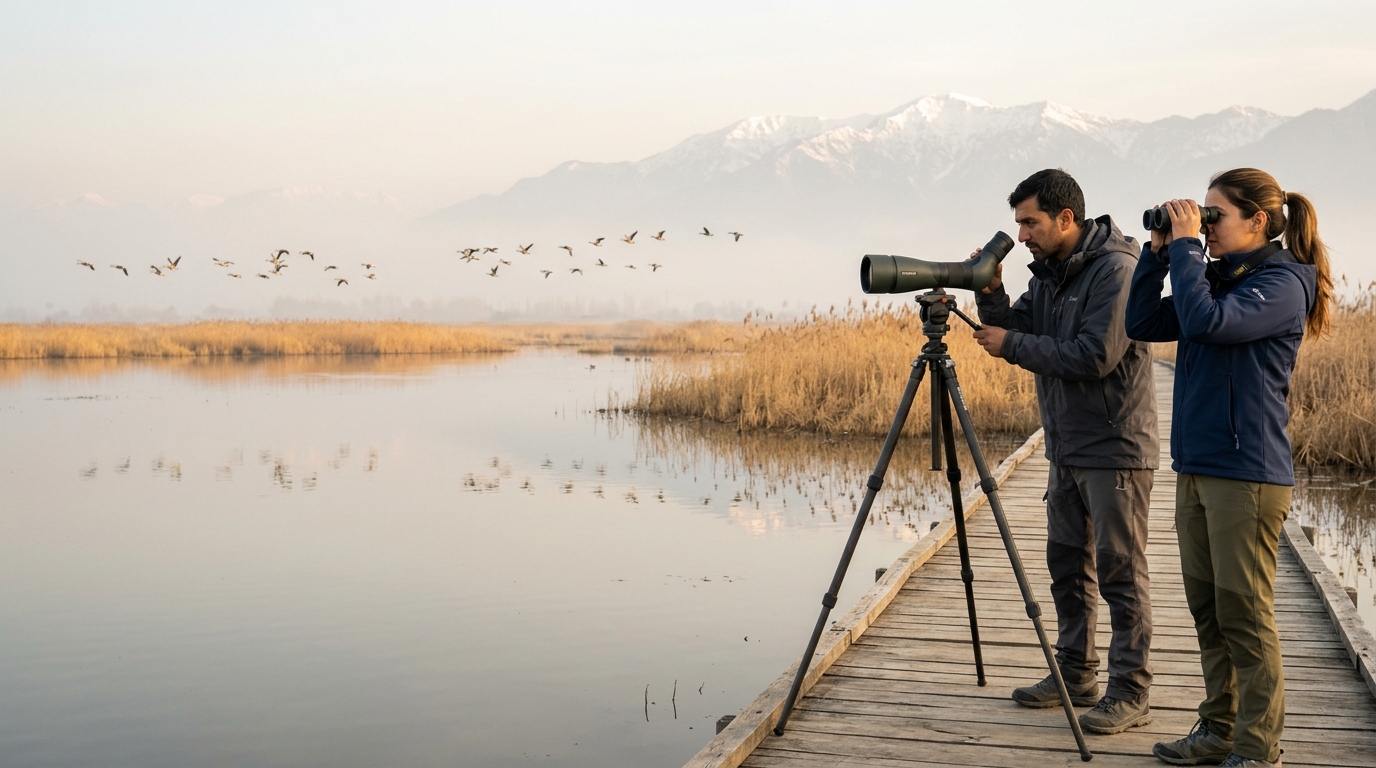
INAUGURAL EDITORIAL FOLIO · DESK & OBSERVATORY SYNTHESIS
Three-Tier Publication Architecture & Ongoing Reconciliation Notice: Dispatch 06 serves as the flagship ornithological investigation in Himalayan Dispatch Vol. 01 / No. 01, placed immediately after Dispatch 05 ("Where the Wild Waters End") and paired directly with Companion Monograph 04 ("The Sky Has No Borders", an 18-volume, 54-chapter, 12-appendix scientific research framework) and the permanent 12-module KEW Western Himalayan Avian Intelligence Observatory (/biodiversity/birds/avian-intelligence-observatory). Multi-backbone taxonomic reconciliation across all five Western Himalayan regions, effort-adjusted waterbird population modelling, and audit corrections to KEW’s 601-taxa registry constitute active investigations in progress rather than completed census claims.
A Wingbeat Across Divided Mountains
Why an inquiry that began in the silt-choked reedbeds of Hokersar and Shallabugh must rise into the divided mountain air of five interconnected landscapes.
Where Dispatch 05 in this Inaugural Issue followed tributary silt, needle-weir hydroperiods, and shrinking suburban reedlines to the edge of Hokersar and Shallabugh, the ecological story cannot stop at the waterline. Lift your eyes from a November marsh channel at dusk and the boundary of a wetland reserve dissolves into an immense vertical continent of air. Skeins of Northern Pintail, Gadwall, Common Teal, and Greylag Geese banking toward open Jhelum backwaters have just descended through freezing katabatic shear from passes exceeding four to five thousand metres; six months earlier, their wingbeats lifted off braided Siberian tundra rivers, Kazakh steppe basins, and high brackish lakes across the Tibetan Plateau and Changthang.
To study the birds of this mountain arc honestly is to confront a foundational geographic truth: avian life inhabits an undivided Western Himalayan ecological continuum spanning Kashmir, Jammu, Ladakh, Azad Jammu & Kashmir, and Gilgit-Baltistan. Cartographers and ministries partition these valleys across separate administrative codes, statutory schedules, and heavily fortified cease-fire ridges. A migratory bird recognizes neither the Line of Control nor the Line of Actual Control. It recognizes open unfrozen water, benthic chironomid and stonefly larvae, submerged macrophyte tubers, closed-canopy hazelnut and fir architecture, ambient temperature gradients, and favourable upper-tropospheric tailwinds.
Yet across all five regions, ornithological knowledge remains nearly as fragmented as the political map—split between incompatible taxonomic checklists, unverified headline census totals, shrinking village memory, and isolated academic papers rarely translated into habitat protection. Even within Kashmir EcoWatch’s own digital architecture, database counters require rigorous empirical housecleaning before they can claim authoritative standing. Dispatch 06 inaugurates that reckoning, pairing an investigative synthesis here with Companion Monograph 04—an eighteen-volume, fifty-four-chapter, twelve-appendix research framework—and the permanent twelve-module KEW Western Himalayan Avian Intelligence Observatory.
Monograph 04 · Trans-Himalayan Ornithological Charter
Proposed Monograph 04 framework (18 Volumes, 54 Chapters, 12 Appendices) and 12-module KEW Avian Intelligence Observatory charter; multi-backbone checklist harmonization remains ongoing.
The regional species census, historical population trends, February 2026 Asian Waterbird Census raw species tables, and KEW's own 601-taxa classifications require formal species-by-species reconciliation prior to final certification; this publication establishes the proposed investigative foundation rather than claiming a completed ornithological census.
How Many Bird Species Cross the Western Himalayas? Reconciling the Checklists
Why adding regional totals produces ecological fiction—and why two credible lists for the same mountain territory rarely display the same number.
Ask a deceptively elementary question—how many bird species inhabit or traverse the Western Himalayas?—and published sources return a bewildering mosaic of figures. Across peer-reviewed regional syntheses and global ornithological aggregators, published Kashmir Valley literature routinely cites more than 300 recorded species; a comprehensive 2024 peer-reviewed checklist for Jammu and Kashmir combined documents 592 species; a September 2026 assessment by the Sálim Ali Centre for Ornithology and Natural History (SACON) and the Wildlife Institute of India (WII) reports 464 bird species across Ladakh, whereas Avibase under the Clements 2025 taxonomy lists 512 species for Ladakh; Avibase under the Howard and Moore taxonomic backbone records 552 species for Azad Jammu and Kashmir; regional inventories for Gilgit-Baltistan compile roughly 362 species; and Kashmir EcoWatch’s own biodiversity registry currently catalogues 601 avian taxa.
The first rule of transboundary ornithology is mathematical: regional species totals can never be summed. Adding 300+, 592, 464, 552, and 362 would fabricate more than two thousand species by counting the same Himalayan Monal, Eurasian Hobby, Common Sandpiper, or Grey Wagtail four or five times as it breeds, winters, or stages across adjacent valleys. Because avian distributions track elevation bands, precipitation shadows, and river corridors rather than district boundaries, hundreds of core Western Himalayan forest, alpine, and wetland taxa overlap across three to five jurisdictions simultaneously, leaving a smaller but scientifically critical set of cold-desert Changthang specialists, subtropical Shivalik foothills residents, and Indus-gorge arid-scrub species that genuinely differentiate the regional total.
Even within a single administrative territory, checklists diverge for four distinct methodological reasons—witness the gap between 464 (SACON–WII 2026) and 512 (Avibase Clements 2025) in Ladakh. First, global ornithology operates across four competing taxonomic backbones—Clements/eBird, the International Ornithological Congress (IOC) World Bird List, Handbook of the Birds of the World (HBW) / BirdLife International, and Howard & Moore—which split or lump polytypic Himalayan complexes such as leaf warblers (Phylloscopus), laughingthrushes, rosefinches, redstarts, and tits under different species concepts. Second, automated polygon intersections in global aggregators frequently pull peripheral records from imprecise grid cells along steep mountain borders. Third, nineteenth-century colonial museum skins bearing vague locality tags such as "Cashmere" or "Western Tibet" remain embedded in historical compilations without modern photographic or specimen corroboration. Fourth, episodic storm-driven pelagics, desert vagrants, and unvetted citizen-science uploads inflate raw checklists unless filtered into rigorous occurrence tiers distinguishing confirmed breeders, regular passage/winter migrants, historical unconfirmed records, and accidental vagrants.
Auditing Our Own House: Scrutinizing the KEW 601-Taxa Registry
Scientific accountability begins at home—examining overlapping guild filters, endemism inflation, statutory schedules, and district geometry inside Kashmir EcoWatch.
Credible investigative journalism cannot interrogate government wildlife statistics while exempting its own platform from forensic audit. Within Kashmir EcoWatch’s public avifaunal directory (/biodiversity/birds), 601 avian taxa are currently catalogued across functional quick-filters reporting 330 songbirds and flycatchers, 161 alpine specialists, 95 migratory waterfowl, 87 raptors and owls, and 45 pheasants and galliformes. Notice immediately that those five guild tallies sum to 718 rather than 601. That arithmetic excess is not a population count—indeed, taxon tallies say nothing whatsoever about bird abundance—but the result of non-exclusive boolean predicates in which species occupying multiple macro-habitats (for example, an alpine-breeding raptor or a high-altitude marsh wader) satisfy more than one category or habitat filter simultaneously.
Deeper inspection of the platform’s summary counters exposes five structural data-quality imperatives that Monograph 04 and the KEW Avian Intelligence Observatory are chartered to resolve species by species before any certified regional total is proclaimed. Loose string-matching across regional descriptors has conflated broad pan-Himalayan or Central Asian distributions with strict Western Himalayan endemism, producing conflicting user-interface counters (353 versus 476) when true restricted-range Western Himalayan endemics defined under BirdLife Endemic Bird Area 128 number around a dozen core species. Similarly, displaying 152 globally threatened species requires separating genuine global IUCN Red List Vulnerable, Endangered, and Critically Endangered assessments from Near Threatened or regionally scarce taxa; displaying 25 versus 27 monitored districts reflects unharmonized administrative arrays across the five regions; and flagging 592 protected species demands replacing generic labels with exact statutory schedule citations across Indian, Pakistani/AJ&K/GB, CITES, and CMS legal instruments.
INSTITUTIONAL SELF-AUDIT · KEW /BIODIVERSITY/BIRDS REGISTRY
Five Mandatory Data-Quality Reconciliation Imperatives for the 601-Taxa KEW Avifaunal Database
| Current KEW Metric / Counter | Required Scientific & Statutory Reconciliation Protocol |
|---|---|
| Catalogued taxa (601) | Execute species-by-species cross-walk across all 5 regional checklists (Kashmir, Jammu, Ladakh, AJ&K, Gilgit-Baltistan), aligning binomials, subspecies splits, historical skins, and vagrant flags across Clements/eBird, IOC, HBW/BirdLife, and Howard & Moore backbones. |
| Globally threatened species (152) | Audit every taxon individually against current global IUCN Red List assessments (CR, EN, VU), strictly separating global extinction-risk categories from Near Threatened (NT) taxa and national or regional conservation priority lists. |
| Endemic species (353 and 476) | Eliminate conflicting UI counters generated by loose substring predicates ("himalayan" / "endemic") and halt classifying wide-ranging pan-Himalayan, Sino-Himalayan, or Central Asian taxa as strict Western Himalayan endemics (EBA 128). |
| District coverage (25 and 27) | Harmonize administrative spatial polygons across all five Western Himalayan regions (J&K, Ladakh, AJ&K, and Gilgit-Baltistan district geometries) so static copy and dynamic filter arrays report identical, boundary-explicit spatial denominators. |
| Protected species (592) | Replace blanket protection flags with exact legal schedule citations: India Wild Life (Protection) Act 1972 (Amendment 2022 Schedules I–II), Pakistan/AJ&K & Gilgit-Baltistan wildlife statutes, CITES Appendices I–III, and CMS Appendices I–II. |
Eight Living Bridges Across Five Divided Landscapes
From hazelnut understoreys linked to Sri Lanka to braided glacial shingle bars and oxygen-starved Karakoram passes, eight indicator species reveal how the mountain continuum actually functions.
Abstract debates over biodiversity connectivity snap into sharp biological focus when traced through eight indicator species whose life histories stitch together divided valleys, elevations, and latitudes. Consider first the Kashmir Flycatcher (Ficedula subrubra), an IUCN Vulnerable restricted-range passerine no heavier than ten grams. Each spring it nests almost exclusively within temperate deciduous broadleaf forests possessing dense wild hazelnut (Corylus jacquemontii) and witch-hazel (Parrotiopsis jacquemontiana) understoreys between 1,800 and 2,700 metres in the Kashmir Valley (Dachigam, Overa-Aru, Hirpora margins) and Azad Jammu & Kashmir’s Neelum Valley—before flying the entire length of the Indian subcontinent each autumn to winter exclusively in Sri Lanka’s central montane cloud forests and the Nilgiri–Western Ghats hills. Alongside it in subalpine fir, birch, and mixed conifer clearings across Kashmir, Kishtwar, Neelum, and Astor lives a second Western Himalayan restricted-range jewel: the Orange Bullfinch (Pyrrhula aurantiaca), whose quiet winter descent into valley-margin willow and orchard belts binds upper timberlines directly to settled piedmonts.
Within old-growth temperate conifer–oak forests, two iconic galliformes measure structural forest integrity and winter snow dynamics. The Western Tragopan (Tragopan melanocephalus)—crimson-throated, white-spotted, and globally Vulnerable—survives only where undisturbed brown oak (Quercus semecarpifolia), West Himalayan fir (Abies pindrow), spruce (Picea smithiana), and dense ringal bamboo understoreys remain unfragmented across Limber, Kazinag, Kishtwar, Dachigam peripherals, and AJ&K’s Machiara National Park, Salkhala, and Leepa Valley. Higher still along the birch timberline and alpine turf across all five regions, the iridescent Himalayan Monal (Lophophorus impejanus) excavates frozen soil for tubers with its heavy bill, serving as an immediate indicator of erratic rain-on-snow ice crusts that lock away winter forage and push birds downslope toward poaching snares.
Across high-altitude wetlands, cliffs, and braided glacial rivers, four further specialists expose distinct physiological and anthropogenic thresholds. On Ladakh’s Changthang marshes—Tsomoriri, Tsokar, Hanle, and Chushul above 4,200 metres—the Black-necked Crane (Grus nigricollis) constructs mud-island nests acutely imperilled by rapid glacial-melt water-level spikes, unregulated off-road lakeside tourism, and pack-hunting feral dogs fed by camp and garrison refuse. Overhead, the Bar-headed Goose (Anser indicus) conquers extreme hypobaric hypoxia across Karakoram and Greater Himalayan passes using evolved physiological adaptations: elevated capillary-to-muscle-fibre ratios, sarcolemmal mitochondrial clustering that shortens intracellular oxygen diffusion paths, a high-oxygen-affinity alpha-haemoglobin amino-acid substitution, and vigorous hypoxic hyperventilation during terrain-hugging flight. Riding thermal updrafts along Zanskar, Gilgit-Baltistan, and Pir Panjal crags, the osteophagous Bearded Vulture (Gypaetus barbatus) shatters marrow bones onto alpine rock ossuaries yet remains gravely vulnerable to veterinary non-steroidal anti-inflammatory drugs (NSAIDs) and poison baits in livestock carcasses. Down in the frigid valley torrents below—along the Lidder, Sindh, Rambiara, Doodhganga, Neelum/Kishenganga, Drass, and Shyok—the cryptic, crimson-billed Ibisbill (Ibidorhyncha struthersii) probes underwater cobbles for stonefly and caddisfly larvae on braided shingle islands now systematically crushed by mechanized boulder mining.
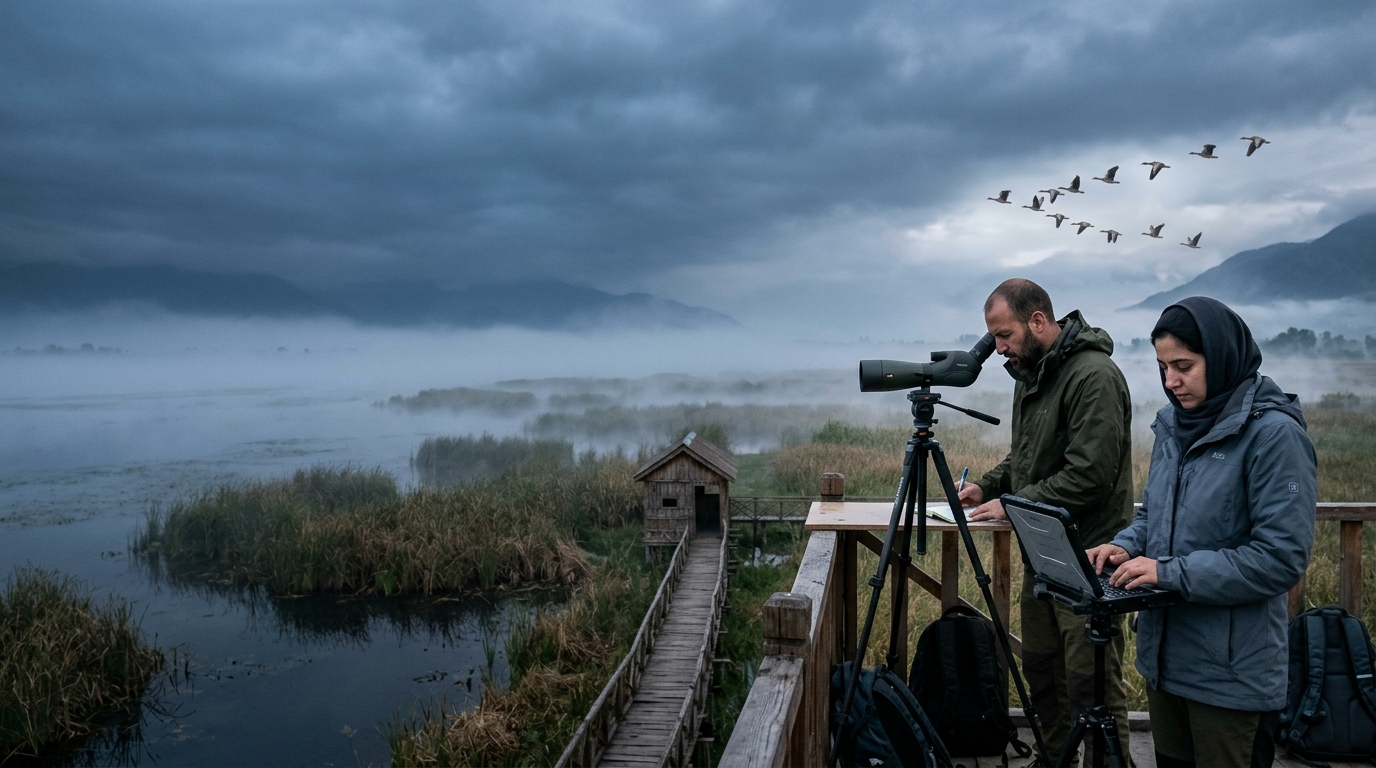
The Central Asian Flyway: Thirty Countries, Multiple Migration Systems
Why trans-continental bird movement across the Western Himalayas is not a single aerial highway, but an intricate weave of longitudinal, loop, and vertical migrations.
Under the Convention on the Conservation of Migratory Species of Wild Animals (CMS), the Western Himalayas occupy the mountainous bottleneck of the Central Asian Flyway—a vast biogeographic realm spanning roughly thirty countries from Arctic Russia, Siberia, Mongolia, Kazakhstan, Kyrgyzstan, Uzbekistan, Tajikistan, and Afghanistan across Pakistan, the Tibetan Plateau, and the Himalayan arc down to peninsular India, Bangladesh, the Maldives, and Sri Lanka. Every autumn and spring, hundreds of waterbird, raptor, wader, and passerine populations must negotiate the planet’s highest orographic barrier—where the Hindu Kush, Pamir, Karakoram, Ladakh, Zanskar, Greater Himalayan, and Pir Panjal ranges converge.
Popular journalism frequently depicts this flyway as a single skyborne highway funneling all birds along identical tracks. Modern ring-recovery, stable-isotope, and satellite-telemetry studies reveal a far more complex architecture composed of distinct, species-specific migration systems. Long-distance Palearctic dabbling and diving ducks—Northern Pintail, Eurasian Wigeon, Common Teal, Mallard, Gadwall, Red-crested Pochard, and Common Pochard—execute broad-front and gorge-channeled longitudinal flights from Ob–Irtysh marshes and Kazakh steppes into Kashmir’s Jhelum floodplain, Mangla reservoir, and northern Indian basins. Several raptors, rosefinches, and shorebirds perform elliptical loop migrations, exploiting autumn tailwinds over western Indus, Chitral, or Shyok valleys while returning northward in spring along warmer eastern piedmont or Tibetan corridors.
Simultaneously, millions of birds never cross continents at all yet migrate just as urgently along the vertical axis. Altitudinal migrants—including Plumbeous and White-capped Redstarts, Spotted and Little Forktails, Rufous-breasted Accentors, Grandalas, Wallcreepers, and mountain finches—descend 1,500 to 2,800 vertical metres when November snows seal alpine scree, relying on ice-free mountain streams, karewa scrub, and village orchards across Kashmir, Jammu, AJ&K, and Gilgit-Baltistan. Conserving only four valley-floor Ramsar marshes while degrading mid-elevation riparian corridors or high-pass stopover tarns severs an interdependent three-dimensional network.

1.34 Million Waterbirds—Recovery, Counting Artifacts, or Refugia Compression?
When 96% of counted wintering waterfowl crowd inside four surviving wetland complexes, rising census headlines can diagnose surrounding habitat death rather than ecological triumph.
Few numbers in recent Himalayan conservation reporting have inspired more official self-congratulation than Kashmir’s winter waterbird totals. According to public wildlife census releases, recorded waterbirds across Kashmir wetlands rose from 813,043 in 2020 to 1,343,506 in 2025—an apparent gain of +530,463 recorded birds, or +65.2% over five winters. Read uncritically in press handouts, a 1.34-million tally appears to prove that Kashmir’s marshes are flourishing. Scientific scrutiny requires an immediate metrological distinction: 813,043 to 1,343,506 represents reported census counts, not an independently established biological population growth rate.
Raw synchronized block counts confound true flyway recruitment with at least three non-biological or displacement variables. First, survey spatial footprint and observer mobilization have shifted markedly: on February 12, 2026, the Asian Waterbird Census (AWC) deployed teams across 27 Kashmir wetlands and 58 designated census points—crucial logistical coverage whose headline scope is publicly documented, even though complete, audited species-wise and point-wise raw count tables remain publicly unavailable for independent variance testing. Second, higher optical resolution, volunteer participation, and mid-morning inter-wetland flock flushing between Hokersar, Mirgund, Shallabugh, and Wular can introduce substantial double-counting unless controlled by strict time-synchronized protocols and effort-adjusted statistical covariates.
Third—and ecologically most alarming—an October 2026 Right to Information (RTI) disclosure revealed that nearly 96% of all recorded wintering waterbirds in Kashmir were concentrated within just four core wetland complexes: Hokersar, Wular, Shallabugh, and the Haigam/Dal mirror system. In landscape ecology, extreme spatial crowding amid regional marsh loss is the classic signature of refugia compression. As dozens of smaller satellite nambals, seasonal paddy-floodplain depressions, and village marshes across Srinagar, Budgam, Bandipora, Pulwama, and Baramulla are landfilled with karewa earth, walled off, or drained, displaced ducks, geese, and coots do not vanish overnight; they pack into the four surviving state-protected water mirrors. Headline reserve counts surge precisely because peripheral habitats have died—accelerating mid-winter depletion of submerged Potamogeton and Trapa beds, intensifying nutritional stress prior to spring trans-Himalayan flight, and creating high-density epidemiological tinderboxes for Highly Pathogenic Avian Influenza (HPAI).
“Crowding ninety-six percent of wintering waterbirds into four surviving wetland mirrors while dozens of surrounding nambals are buried under concrete can mimic conservation recovery on paper while diagnosing acute ecological compression on the ground.”
VOLUME V & VIII · INTERACTIVE POPULATION DIAGNOSTIC
Refugia Compression vs. True Flyway Growth Simulator
Tests how peripheral wetland loss and observer-coverage shifts can produce higher headline census totals while crowding nearly 96% of wintering waterfowl into four surviving reserves.
897,562
+10.4% vs. 2020 baseline (813,043)
89.8%
Oct 2026 RTI benchmark: ~96% in 4 sites
Methodological note: Illustrative sensitivity model anchored to the reported 2020 (813,043) and 2025 (1,343,506) Kashmir waterbird census counts and October 2026 RTI concentration disclosures (~96% in four wetlands). Effort-adjusted hierarchical occupancy modelling awaits release of complete station-level species matrices.
Why More Birds Do Not Automatically Mean a Healthier Landscape
An eight-part diagnostic matrix separating ecological restoration from habitat crowding, climatic phenology shifts, extinction debt, and urban waste subsidies.
Because birds are visible, vocal, and charismatic, raw counts and species lists are routinely weaponized in public administration—celebrated when numbers climb, dismissed as natural fluctuation when numbers fall, or cited as proof of biodiversity richness whenever an unfamiliar vagrant is photographed. Sound ornithological governance requires replacing naive directional assumptions ("more birds equals healthier ecosystem") with mechanistic hypothesis testing across abundance, spatial evenness, phenology, breeding demographics, and trophic guild structure.
Even stable adult counts can conceal silent demographic collapse when long-lived species—such as Black-necked Cranes, Bearded Vultures, or Western Tragopans—persist as ageing adults for a decade while nest predation or agrochemicals drive fledgling recruitment near zero, locking populations into an unpaid extinction debt. Conversely, exploding urban flocks of synanthropic scavengers reflect failing municipal sanitation rather than thriving avifauna. Eight recurring empirical patterns across the Western Himalayas demand disciplined multi-hypothesis interpretation.
DIAGNOSTIC INTERPRETATION MATRIX · EIGHT ECOLOGICAL PARADOXES
Why Raw Avian Trend Signals Require Mechanistic Disaggregation Across All Five Regions
| Observed Avian Signal | Competing Ecological & Methodological Mechanisms |
|---|---|
| 1. Increasing waterbird counts | May reflect true flyway survival, expanded AWC point coverage (e.g., 58 points across 27 wetlands), flock double-counting, cold-snap displacement from frozen northern basins, or refugia compression from destroyed peripheral nambals. |
| 2. Declining local counts | May indicate genuine flyway mortality, local hydroperiod failure (excessive weir ponding drowning shallow dabbling zones <30 cm), disturbance from poaching/mining, or warm-winter short-stopping in Central Asia. |
| 3. Extreme 4-wetland concentration (~96%) | Diagnoses collapse of stepping-stone floodplain connectivity, elevating density-dependent tuber depletion and avian influenza / botulism mass-mortality risk inside Hokersar, Wular, Shallabugh, and Haigam/Dal. |
| 4. Novel species arrivals | Upslope range expansion of lowland thermophilic birds or storm-displaced vagrants lengthens regional checklists while signalling rapid Himalayan isotherm warming rather than habitat improvement. |
| 5. Delayed autumn arrival | Warmer Siberian and Kazakh autumns delay northern freeze-up, compressing Kashmir stopover residence times and altering wetland macrophyte grazing schedules. |
| 6. Premature spring departure | February warm anomalies and early valley snowmelt trigger premature northward departure, exposing migrants to lethal late-spring blizzards across Karakoram and Tibetan passes. |
| 7. Breeding failure despite adult presence | Long-lived cranes, raptors, and pheasants remain countable as adults while feral dogs, sudden meltwater nest flooding, or orchard insecticides suppress chick survival toward zero (extinction debt). |
| 8. Synanthropic urban surges | Hyper-abundance of Black Kites, Rock Pigeons, and House Crows tracks open slaughterhouse offal and uncollected municipal garbage, masking severe declines in insectivores and cavity nesters. |
Five Regions, Five Avian Geographies—and the Lesson of Zanskar
Why satellite indices and global citizen-science portals can never substitute for patient, year-round seasonal fieldwork inside remote mountain valleys.
Each of the five Western Himalayan regions contributes an irreplaceable biogeographic tier to the continuum, and each suffers from distinct observational blind spots. In the Kashmir Valley, intense birding around Srinagar’s peri-urban wetlands and Dachigam contrasts sharply with under-surveyed Pir Panjal subalpine basins, northern Kupwara–Lolab–Kazinag ridges, and southern Rambiara–Vishaw watersheds. Across Jammu, steep bioclimatic gradients climb within eighty kilometres from subtropical Shivalik scrub and riverine plains—home to critically important White-rumped and Egyptian Vulture cliff colonies, the cross-border Gharana Wetland wintering sanctuary for Bar-headed Geese, Surinsar–Mansar Ramsar lakes, and Tawi–Chenab sandbars—up into old-growth temperate pheasant forests in Kishtwar, Bhaderwah, and Poonch.
Across the Zoji La and Shingo La passes in Ladakh, cold-desert steppes, Caragana scrub, Indus–Shyok–Nubra seabuckthorn (Hippophae rhamnoides) thickets, and high Changthang basins host Tibetan Sandgrouse, Ground Tit, Tibetan Snowcock, Horned Lark, White-winged Redstart, and Black-necked Crane. Here, a landmark 2025 year-long seasonal field investigation in Zanskar documented 81 bird species across all four seasons—delivering a vital methodological lesson for Himalayan science. Had researchers relied solely on summer tourist-season eBird uploads, winter resident endurance, early-thaw passage migrants, and elevation-specific microhabitat shifts across Zanskar’s frozen gorges would have remained invisible. Fine-scale, multi-season field ornithology remains irreplaceable.
West of the cease-fire ridges, Azad Jammu & Kashmir and Gilgit-Baltistan complete the ecological arch. AJ&K’s moist temperate Neelum and Leepa valleys, Machiara National Park, Salkhala, and Pir Chinasi ridges sustain contiguous breeding populations of Western Tragopan, Kashmir Flycatcher, Koklass, and Cheer Pheasant (Catreus wallichii), descending southward to Mangla Dam’s vast winter waterfowl staging waters on the Jhelum. Northward across Gilgit-Baltistan, the Deosai Alpine Plateau (~4,100 m), Khunjerab National Park, Astor, Naltar, and the deep Indus, Gilgit, Hunza, and Shyok gorges form the primary aerodynamic funnel through which Central Asian raptors, cranes, waders, and passerines breach the Karakoram–Hindu Kush junction.
Fifteen Quantifiable Pressures Destroying Avian Habitat
Moving past vague laments over "anthropogenic disturbance" to trace the exact physical, chemical, acoustic, and electrical pathways killing Himalayan birds.
Conservation reports routinely blame avian decline on generic "habitat degradation and anthropogenic pressure"—phrasing too vague to guide a district magistrate, chief engineer, or orchardist. Monograph 04 disaggregates Western Himalayan habitat loss into fifteen quantifiable, mechanistically distinct causal pathways. First, wetland encroachment and karewa-earth landfilling eliminate the <30-centimetre littoral shallows required by dabbling ducks and probing waders. Second, mechanized riverbed cobble, boulder, and sand mining using heavy excavators across the Lidder, Sindh, Rambiara, Doodhganga, Sukhnag, Tawi, and Shyok directly crushes ground clutches of Ibisbills, River Lapwings, and Little Ringed Plovers while blanketing downstream riffle stoneflies and mayflies under chronic turbidity plumes. Third, intensive orchard agrochemical schedules—repeated applications of organophosphates (chlorpyrifos), neonicotinoids (imidacloprid, thiamethoxam), synthetic pyrethroids, and broad-spectrum fungicides across high-density apple belts—collapse lepidopteran caterpillar and dipteran biomass precisely during April–June nestling provisioning peaks, inducing brood starvation alongside sublethal cholinesterase neurotoxicity.
Fourth, linear forest fragmentation from widening hill roads, hydropower penstocks, and transmission cuts severs closed-canopy corridors required by interior-forest specialists such as Western Tragopan and Kashmir Nuthatch (Sitta cashmirensis), while lopping of oak and hazelnut strips away winter mast and nesting cover. Fifth, climatic phenological mismatch advances spring valley budburst and insect emergence faster than photoperiod-cued arrival in long-distance migrants such as the Kashmir Flycatcher, decoupling peak food supply from chick hatching. Sixth, ribbon urban sprawl along highway corridors converts wet paddy margins, willow groves, and earthen irrigation bunds into continuous concrete frontages. Seventh, chronic highway, crusher, and generator acoustic masking (concentrated in the 1–4 kHz band) drowns out passerine territorial and mate-attraction songs, reducing pairing success near mountain transport arteries.
Eighth, artificial light at night (ALAN) from floodlit tourist boulevards, ridge resorts, border floodlights, and telecom towers disrupts avian cryptochrome magnetoreception, trapping nocturnal passerine migrants inside fatal disorientation vortices when autumn fog banks hang over mountain passes. Ninth, uninsulated 11–33 kV medium-voltage distribution cross-arms electrocute perching Steppe Eagles, Golden Eagles, Long-legged Buzzards, and Bearded Vultures, while unmarked high-voltage earth-wires strung across valley rivers and wetland flightlines inflict lethal twilight collisions on cranes, geese, and swans. Tenth, illegal punt-gunning, nocturnal reedbed mist-netting, and alpine snare lines inflict direct additive mortality on wintering waterfowl and pheasants. Eleventh, unregulated alpine and subalpine meadow camping, off-road driving, and trekker waste across Gulmarg, Sonamarg, Tosamaidan, Deosai, and Changthang trample ground nests of larks, pipits, and rosefinches.
Four chemical and biological pressures compound those physical hazards. Twelfth, untreated municipal and houseboat sewage drives hypereutrophication, flipping clear charophyte- and Potamogeton-dominated waters into turbid, cyanobacterial states devoid of submerged waterfowl forage. Thirteenth, discarded monofilament fishing nets entangle diving grebes, pochards, and cormorants while benthic microplastics enter wader and dipper food webs. Fourteenth, continued veterinary administration of non-steroidal anti-inflammatory drugs—specifically diclofenac, ketoprofen, aceclofenac, and nimesulide—causes acute uric-acid crystallization and renal failure in Gyps and Gypaetus vultures scavenging treated livestock carcasses. Fifteenth, invasive alien plants (dense Azolla and Salvinia mats suffocating open marshes; Lantana and Parthenium invading foothill scrub) combine with waste-subsidised packs of free-ranging feral dogs that systematically depredate Black-necked Crane, Bar-headed Goose, and ground-nesting galliform clutches from Changthang to Dachigam.
When a Village Grows Silent: The Disappearance of Ordinary Birds
Sealed concrete eaves, insect-starved orchards, and the shifting baseline syndrome erasing twelve everyday bird companions from collective Himalayan memory.
Ecological loss does not announce itself only when a rare pheasant vanishes from a remote national park; it arrives most intimately when an ordinary village courtyard falls quiet at dawn. Across Kashmir and neighbouring valleys, elders recall an everyday acoustic calendar anchored by twelve familiar bird groups embedded in vernacular speech, lullabies, agricultural proverbs, and seasonal rituals: the House Sparrow (Passer domesticus, Kashmiri tsaer) chattering inside timber window lattices; the Barn Swallow (Hirundo rustica, katij) sculpting mud cups beneath veranda beams each spring; the Eurasian Hoopoe (Upupa epops, hud-hud) probing damp turf with its barred crest flaring; the Himalayan Bulbul (Pycnonotus leucogenys, bil-bichur) whistling from garden quince boughs; spring Cuckoos (Cuculus canorus and congeners) calling across terraced maize margins to signal sowing time; flocks of Starlings and Common Mynas following ploughshares; Scaly-bellied and Himalayan Woodpeckers drumming on aged walnut and chinar trunks; White, Citrine, and Grey Wagtails bobbing along stone-lined irrigation kuls; Common, White-throated, and Crested Kingfishers (kola tonch) plunging into clear orchard channels; nocturnal Little, Scops, and Tawny Owls policing granary rodents from hollow willows; and Brown and White-throated Dippers bobbing on spray-drenched boulders in cold mountain streams.
Why have so many of these everyday neighbours thinned or vanished from town wards and orchard villages within a single human lifetime? Two structural transformations explain much of the silence. Architecturally, traditional Kashmiri mud-brick, timber-laced taq and dhajji-dewari homes, earthen granaries, and open-raftered wooden eaves offered thousands of breathable thermal crevices; modern reinforced cement-concrete (RCC) slabs, sealed PVC soffits, flush aluminium glazing, and vertical concrete canal walls have systematically eliminated nesting cavities for tsaer, katij, starlings, owls, and bank-burrowing kola tonch. Agronomically, converting diverse multi-tree homestead gardens, mulberry rows, and unsprayed pasture margins into monoculture high-density orchards under intensive insecticide regimes starves insectivorous broods—even a grain-eating adult sparrow must feed soft-bodied caterpillars, aphids, and spiders to its hatchlings during their first ten days of life.
Here fisheries scientist Daniel Pauly’s concept of shifting baseline syndrome applies with poignant precision to Himalayan ornithology. Each generation defines "natural abundance" by the impoverished baseline it inherited in childhood: a teenager growing up in Srinagar, Anantnag, Sopore, Jammu, Leh, Muzaffarabad, or Gilgit in 2026 perceives a sky populated chiefly by refuse-fed Black Kites, Rock Pigeons, and House Crows—with scarcely a katij nest on the porch or a dipper on a silted stream—as ordinary nature. Yet rigorous science demands methodological restraint: intergenerational oral memory is an indispensable engine of ecological hypothesis generation, not standalone statistical proof. Converting cultural grief into empirical certainty requires pairing ethno-ornithological interviews with standardized multi-year courtyard point counts, nest-cavity inventories, and stream macroinvertebrate audits.
From Static Checklists to Bioacoustics, Telemetry, and Public Science
Modernizing Western Himalayan ornithology with passive acoustic arrays, eDNA, radar, and occupancy models—while returning practical bird science to eleven everyday sectors.
Twentieth-century Himalayan ornithology relied predominantly on opportunistic presence-absence checklists—indispensable for alpha-biogeography, yet incapable of detecting 30% to 50% population declines before local extirpation occurs. Monograph 04 establishes a quantitative twenty-first-century monitoring stack across five non-invasive technologies. First, weatherproof Passive Acoustic Monitoring (PAM) recorders deployed across alpine treelines, hazelnut ravines, and fog-bound passes capture dawn choruses and nocturnal flight calls continuously, processed via calibrated machine-learning acoustic and visual species classification models trained explicitly on Western Himalayan vocal dialects and verified by human bioacousticians. Second, hierarchical occupancy and Bayesian N-mixture models explicitly incorporate observer duration, trail distance, time of day, and detectability covariates so citizen-science growth is never misread as biological expansion. Third, lightweight solar GPS-GSM and Argos satellite tags track multi-border stopover energetics, pass-crossing altitudes, and electrocution hotspots in real time. Fourth, environmental DNA (eDNA) metabarcoding of filtered marsh water detects elusive rails, bitterns, and nocturnal waterfowl alongside amphibian and invertebrate prey assemblages. Fifth, Doppler weather-radar aeroecology quantifies nocturnal migratory biomass flux surging over Pir Panjal and Zanskar crests.
All field streams will cross-validate against seven global biodiversity infrastructures—eBird, the Global Biodiversity Information Facility (GBIF), BirdLife DataZone, Movebank, Xeno-canto, Avibase, and Wetlands International’s Asian Waterbird Census (AWC)—under unified taxonomic reconciliation rules. Crucially, however, data locked inside specialist portals saves not a single nest. Our Observatory charter mandates translating ornithological findings into plain-language, multilingual guidance for all eleven everyday stakeholder groups shaping avian survival: (1) farmers maintaining winter-flooded paddy stubble and unmowed bund refugia; (2) orchardists halting blossom and brood-rearing broad-spectrum sprays while installing tit and owl nest boxes; (3) fishers removing ghost monofilament gillnets and sparing floating macrophyte nurseries; (4) tourism operators enforcing marsh setbacks and dark-sky camp rules; (5) construction firms embedding breathable sparrow and swift nest bricks into modern masonry and halting breeding-season riparian clearance; (6) power utilities insulating 11–33 kV cross-arms and fitting flight diverters across wetland spans; (7) schools logging seasonal courtyard arrival dates to counter shifting baselines; (8) municipalities closing open slaughterhouse/solid-waste dumps and intercepting raw sewage; (9) mosques, shrines, temples, monasteries, and gurdwaras safeguarding sacred chinar, deodar, mulberry, and spring groves as inviolate bird refugia; (10) wildlife departments publishing open, effort-corrected raw AWC species matrices; and (11) local communities defending neighbourhood nambals, kuls, and unmined shingle bars.
Monograph 04 & the Western Himalayan Avian Intelligence Observatory
How eighteen proposed scientific volumes and twelve permanent KEW digital modules convert a single investigation into enduring trans-Himalayan infrastructure.
A magazine dispatch can diagnose an epistemic and ecological crisis; sustaining a cure requires permanent scientific architecture. Companion Monograph 04 ("The Sky Has No Borders", structured across 18 proposed thematic volumes, 54 scientific chapters, and 12 methodological appendices) establishes the multi-year research protocol, while the permanent twelve-module KEW Western Himalayan Avian Intelligence Observatory (/biodiversity/birds/avian-intelligence-observatory) operationalizes those protocols directly inside Kashmir EcoWatch—linking avian records to KEW’s Master Lake & Wetland Registry, Protected Network IBAs, Pesticide & Water-Quality Risk Trackers, and Citizen Sightings.
Every volume of Monograph 04 feeds an auditable Observatory module, ensuring that taxonomic cleanup of the 601-taxa registry, effort-corrected waterbird trend curves, 11–33 kV electrocution hazard maps, and village common-bird baselines remain continuously updated, publicly inspectable, and open to formal scientific review across all five regions.
MONOGRAPH 04 (18 VOLUMES) × KEW AVIAN INTELLIGENCE OBSERVATORY (12 MODULES)
Integrated Research-to-Observatory Architecture Across the Five-Region Western Himalayan Continuum
| Monograph 04 Thematic Volumes (54 Chapters) | Paired KEW Avian Observatory Modules (01–12) |
|---|---|
| Vols. I–II · Biogeography, Paleoclimate & Multi-Backbone Taxonomic Reconciliation (Ch. 1–6) | Module 01: Five-Region Checklist Cross-Walk (Clements, IOC, HBW/BirdLife, Howard & Moore) · Module 02: 601-Taxa IUCN, Endemism (EBA 128) & Statutory Schedule Audit Engine. |
| Vols. III–IV · Central Asian Flyway Systems & High-Altitude Hypoxia Physiology (Ch. 7–12) | Module 03: Central Asian Flyway (~30-Nation) Longitudinal, Loop & Altitudinal Corridor Tracker. |
| Vols. V–VI · Wetland Hydroperiods, AWC Metrology & Refugia Compression Math (Ch. 13–18) | Module 04: Effort-Adjusted Waterbird Census Ledger (2020–2026+) · Module 05: Four-Wetland (96%) Refugia Compression & Energetic Carrying-Capacity Simulator. |
| Vols. VII–VIII · Restricted-Range Forest Breeders, Alpine Pheasants & Glacial River Guilds (Ch. 19–24) | Module 06: Eight Indicator Species Sentinel (Kashmir Flycatcher to Ibisbill) · Module 07: Important Bird Area (IBA) & Forest-Treeline Corridor Integrity Monitor. |
| Vols. IX–X · Five Regional Avian Syntheses & Fine-Scale Seasonal Field Baselines (Ch. 25–30) | Module 08: Five-Region Seasonal Atlas (Kashmir, Jammu, Ladakh/Zanskar 81-Species Benchmark, AJ&K & Gilgit-Baltistan). |
| Vols. XI–XII · Mechanistic Ecotoxicology, Cobble Mining, ALAN & Power-Line Hazards (Ch. 31–36) | Module 09: Fifteen-Pressure Threat Ledger (11–33 kV Electrocution, Riverbed Mining, Orchard Pesticides & Veterinary NSAIDs). |
| Vols. XIII–XIV · Vanishing Village Birds, Vernacular Ethno-Ornithology & Shifting Baselines (Ch. 37–42) | Module 10: Twelve Everyday Bird Groups & Courtyard Architectural/Agro-Orchard Baseline Index. |
| Vols. XV–XVI · Passive Bioacoustics, eDNA, Weather Radar & Occupancy Modelling (Ch. 43–48) | Module 11: PAM Bioacoustic, eDNA & Validated Multi-Repository Pipeline (eBird, GBIF, Movebank, Xeno-canto, Avibase, AWC). |
| Vols. XVII–XVIII · Non-Political Flyway Cooperation & Eleven-Sector Civic Action (Ch. 49–54) | Module 12: Eleven-Stakeholder Practical Stewardship Guides & Verified Public Mortality/Sightings Portal. |
Will They Still Find the Landscapes Their Ancestors Knew?
We may govern our mountain valleys separately, yet no jurisdiction on earth can conserve migratory life alone.
Every March, as apricot blossoms pale along terraced foothills from Uri and Muzaffarabad to Kishtwar and Skardu, a ten-gram Kashmir Flycatcher lifts out of a Sri Lankan cloud forest and steers north toward a specific temperate ravine of wild hazelnut in the Western Himalayas. At the same hour, Bar-headed Geese and Black-necked Cranes test the thinning ice of Changthang marshes, Ibisbills prospect cold turquoise braids of the Lidder and Shyok for uncrushed cobble islands, and Barn Swallows return across seas and passes seeking the exact wooden eave under which they hatched the summer before. Each bird carries inside its nervous system an evolutionary covenant forged long before human treaties drew lines across mountain crests: a promise that after thousands of kilometres of wind, frost, and predation, water will still be liquid, shingle bars will still shelter stoneflies, darkness will still guide the stars, and spring canopies will still teem with insect life.
That ancient covenant leaves our divided region with one inescapable scientific truth: we may govern our landscapes separately across Kashmir, Jammu, Ladakh, Azad Jammu & Kashmir, and Gilgit-Baltistan, but we cannot conserve their migratory biodiversity independently. An orchard pesticide sprayed in one district starves the brood of a migrant cherished two thousand kilometres south; a marsh landfilled in one valley crowds disease-vulnerable flocks into the last open waters of another; an uninsulated medium-voltage pole along one pass extinguishes a breeding pair hatched across a distant frontier.
Counting birds honestly—purging exaggerated claims, auditing our own registries, separating wetland crowding from true recovery, and restoring dignity to the ordinary sparrow and swallow outside our windows—is how a mountain civilization proves it is still paying attention. When the next autumn tailwinds sweep across the Karakoram and Pir Panjal passes, bringing hundreds of thousands of beating wings down through the dusk, will they still find living water, quiet shingle bars, dark skies, and insect-rich canopies waiting below—or only the silent geometry of landscapes their ancestors knew and ours chose not to keep?
“We may govern our landscapes separately across five Western Himalayan regions, but we cannot conserve their migratory biodiversity independently. When the next autumn tailwinds carry hundreds of thousands of wings over the passes, will they still find the living waters, quiet shingle bars, and insect-rich canopies their ancestors knew?”
DOCUMENTARY SOURCES & FURTHER READING
| Source | Documentary relevance |
|---|---|
| Convention on Migratory Species (CMS) — Central Asian Flyway (CAF) Action Plan & Institutional Framework (~30 Range States) | Establishes the multilateral flyway conservation framework linking Arctic/boreal Eurasia, Central Asia, the Tibetan Plateau, the Western Himalayas, and South Asia. |
| Wetlands International — Asian Waterbird Census (AWC) Methodology & Synchronized Mid-Winter Count Protocols | Defines standardized January–February waterbird census protocols used to evaluate reported 2020–2026 Kashmir wetland counts and observer-effort covariates. |
| BirdLife International DataZone — Endemic Bird Area 128 (Western Himalayas) & Species Red List Profiles (Ficedula subrubra, Tragopan melanocephalus, Grus nigricollis) | Provides authoritative restricted-range endemic boundaries (EBA 128) and global IUCN Red List extinction-risk assessments used to audit KEW’s 601-taxa registry. |
| Avibase — The World Bird Database (Regional Checklists Across Clements, IOC, HBW/BirdLife & Howard and Moore Taxonomies) | Documents multi-backbone taxonomic checklist divergences across Ladakh (512 Clements 2025), Azad Jammu & Kashmir (552 Howard & Moore), and Jammu & Kashmir. |
| Scott, G. R., Hawkes, L. A., Frappell, P. B., Butler, P. J., Bishop, C. M., & Milsom, W. K. (2015), Journal of Experimental Biology — How Bar-headed Geese Fly Over the Himalayas | Synthesizes cardiorespiratory, haemoglobin oxygen-affinity, mitochondrial, and terrain-following biomechanical adaptations enabling high-altitude trans-Himalayan migration. |
| Pauly, D. (1995), Trends in Ecology & Evolution — Anecdotes and the Shifting Baseline Syndrome | Provides the foundational theoretical framework distinguishing intergenerational baseline amnesia and oral ecological memory from systematic empirical trend verification. |
| Ramsar Sites Information Service — Wular Lake (#461), Hokersar Wetland (#1570), Surinsar-Mansar Lakes (#1573), Tsomoriri (#1213), Tso Kar (#2443), Hygam (#2492) & Shallabugh (#2493) | Documents official hydroperiod, bathymetric, and wintering waterbird criteria across designated Ramsar wetland complexes in Kashmir, Jammu, and Ladakh. |
EDITORIAL PUBLICATION METADATA & 10-STAGE GATE LEDGER
| Gate | Status | Record / Scope |
|---|---|---|
| 01 · Commissioned | completed | Himalayan Dispatch Founding Masthead |
| 02 · Research in progress | completed | Himalayan Dispatch Research & Observatory Desk |
| 03 · Manuscript draft | completed | Assigned Author / Editorial Desk |
| 04 · Evidence verification | completed | Cross-checked against peer-reviewed Western Himalayan checklists (2024 J&K 592-species synthesis; 2025 Zanskar 81-species year-long seasonal study), September 2026 SACON–Wildlife Institute of India Ladakh avifaunal reporting (464 species), Avibase Clements 2025 and Howard & Moore regional inventories, CMS Central Asian Flyway documentation, October 2026 Kashmir wetland RTI disclosures, February 2026 Asian Waterbird Census field coverage records, and internal source-code audit of KEW /biodiversity/birds. |
| 05 · Scientific review (where applicable) | pending | Taxonomic lumping/splitting protocols across Clements/eBird, IOC, HBW/BirdLife, and Howard & Moore backbones, refugia-compression equations, hierarchical occupancy frameworks, and physiological hypoxia citations internally audited; independent external Stage 05 ornithological certification pending prior to formal release. |
| 06 · Editorial review | completed | Founding Editor-in-Chief Desk Review |
| 07 · Copyright and ethics review | completed | Maintains non-political transboundary ecological neutrality across all five Western Himalayan regions and ~30 Central Asian Flyway nations, transparent institutional self-audit of KEW’s 601-taxa registry, and decorative-only archival habitat plates without synthetic field interviews. |
| 08 · Administrator approval | in progress | Stage 08 Pre-Release Special Scientific Investigation staged for Founding Administrator review and Monograph 04 research-directorate charter sign-off. |
| 09 · Published | pending | — |
| 10 · Post-publication corrections | not applicable | — |
| Attribute | Final assignment |
|---|---|
| Publication | Himalayan Dispatch |
| Volume / Issue | Vol. 01 / No. 01 · The Inaugural Issue (Dispatch 06, immediately following Dispatch 05 "Where the Wild Waters End") |
| Rubric & Classification | Special Scientific Investigation · Ornithology · Migratory Ecology · Biodiversity Accountability |
| Geographic Continuum | Western Himalayas (Kashmir, Jammu, Ladakh, Azad Jammu & Kashmir & Gilgit-Baltistan) · Central Asian Flyway (~30 Nations) |
| Companion Research Monograph | Proposed Monograph 04: "The Sky Has No Borders" (18 Proposed Volumes · 54 Chapters · 12 Appendices · Ongoing Taxonomic & Census Reconciliation) |
| Permanent KEW Observatory | KEW Western Himalayan Avian Intelligence Observatory (/biodiversity/birds/avian-intelligence-observatory · 12 Permanent Modules) |
| Byline | Dr. Fayaz Ahmad Khan & Himalayan Dispatch Ornithology, Biodiversity and Geospatial Intelligence Desk |
| Primary Department | Investigative Journalism |
| Secondary Departments | Field Reports · Data Journalism · Cover Stories |
| Publication Gate Status | Stage 08 · Pre-Release Edition Folio Awaiting Administrator Approval |

Founding Editor-in-Chief
Dr. Fayaz Ahmad Khan
Founder of Kashmir EcoWatch and Founding Editor-in-Chief of Himalayan Dispatch; writes on alpine hydrology, cryospheric thresholds, disaster resilience, and mountain commons across the Western Himalayas.
View Portfolio & Approved Commissions →NEXT IN THIS EDITION · COMMUNITIES · DISPATCHES FROM THE FIELD
The People Who Guard the Forest
By Himalayan Dispatch · Wetlands & Forest Desk · 12 min read