Who Measures the Success of Environmental Activism?
An independent inquiry into environmental NGOs, civil society organizations, and self-accountability across Kashmir.
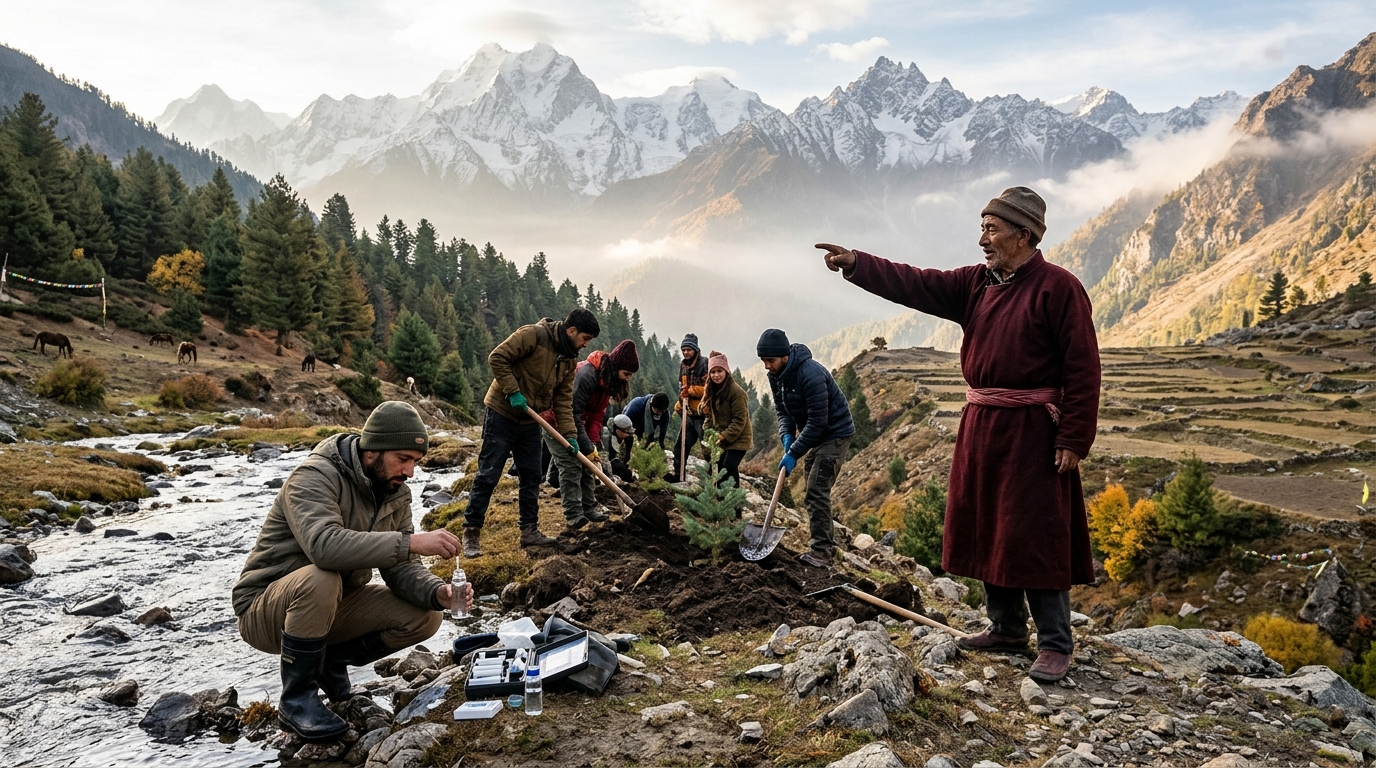
Turning the Mirror Inward: November 22, 2026 at Kashmir EcoWatch
Before an environmental journal dares audit a single grassroots trust, it must open its own database and confess what it found inside.
On November 22, 2026, while preparing the inaugural Civil Society & Environmental Accountability dossiers for *Himalayan Dispatch*, researchers at Kashmir EcoWatch opened two of our own platform’s foundational files side by side: the newly calibrated NGOs and Community Green Champions Registry (`kew-ngos-community.ts`) and an older, spreadsheet-ingested directory of regional non-governmental organizations (`ngo-impact.ts`). What stared back from the screen was an uncomfortable lesson in why self-scrutiny must begin at home.
Across entry after entry of that earlier spreadsheet import—spanning genuine humanitarian and welfare societies such as CHINAR International and Sharva Aikyam Foundation alongside smaller district groups—automated template rows had stamped identical, comforting phrases across complex realities: *"Activities completed: Initial assessment, Community mobilization." "Measurable outputs: Ongoing tracking." "Ecological outcome: Positive impact projected." "Community outcome: Increased awareness."* Several entries carried uniform composite scores of 82 out of 100 and `"Field verified"` labels despite lacking a single georeferenced plot coordinate, water-quality sample, or survival count.
Confronted with that mirror, Kashmir EcoWatch’s research desk wrote a binding internal governance rule directly into its November 22, 2026 telemetry header—archiving reported cleanup truckloads and pond counts strictly as *unverified activity reports* rather than ecological recovery, and posing a strategic question that threatened our own roster count: should KEW make formal registration proof and independently documented fieldwork mandatory before granting verified status, even if that meant moving existing profiles back into research review? We answered yes, reclassifying thirteen organizational profiles into transparent `'RESEARCH_CANDIDATE'` and `'VERIFICATION_QUEUE'` tiers until primary field proof is logged.
That act of housekeeping unlocked a larger, far more consequential reckoning for the entire environmental movement across Jammu, Kashmir, and Ladakh. Over the past two decades, trusts, societies, campus eco-clubs, litigation collectives, service chapters, and digital observatories have multiplied across the region, rightly chastising government departments for paper targets and ecological theatre. Yet almost nobody has dared ask the movement’s most taboo question aloud: *Should environmental organizations themselves be evaluated using the same standards of accountability they demand from governments?*
Documented directly from Kashmir EcoWatch’s internal calibration ledger (src/data/kew-ngos-community.ts, NGOS_COMMUNITY_TELEMETRY, reviewed November 22, 2026) and spreadsheet-ingested NGO registry (src/data/ngo-impact.ts). This inquiry evaluates civil society organizations—and KEW itself—against verifiable public records and conservation science, without pre-judged dismissal of volunteer stewardship or fabricated personal quotations.
Honouring the Frontline Before Auditing the Ledger
Recognizing the real legal, community, and technological breakthroughs achieved by Himalayan civil society under severe constraints.
Critique without gratitude is cynicism, and cynicism has never healed a watershed. Any fair inquiry into environmental civil society across the Western Himalayas must begin by recording how much public good citizen organizations have accomplished—often on shoestring personal savings, without laboratory instruments, and across decades when conflict, administrative centralization, and harsh mountain winters made civic organizing extraordinarily arduous. Where state departments fell silent, citizen groups kept ecological memory alive in the public square.
Consider the diversity of documented contributions catalogued across KEW’s calibrated registry. In urban Srinagar, Manzoor Ahmad Wangnoo and the Nigeen Lake Conservation Organisation (NLCO) mobilized years of neighbourhood labour under *Mission Ehsaas* (2021–2026) to reopen choked channels in Khushal Sar and Gilsar, revive historic springs, and press LCMA on unintercepted sewage. In courtrooms and statutory tribunals, legal-environmental watchdogs—including Advocate Nadeem Qadri at the Wildlife Conservation Fund (WCF) and Dr. Raja Muzaffar Bhat at the J&K Climate Action Group and RTI Movement—transformed Right to Information filings and National Green Tribunal petitions into binding halts against unscientific riverbed mining, wetland dumping, and unmonitored industrial emissions.
Across mountain valleys and sub-Himalayan corridors, persistent local guardians stood watch over neglected commons: Mushtaq Pahalgami’s Himalayan Welfare Organization (HWO) challenging riparian encroachments and trekking waste along the Lidder Valley since 2008; Dr. Rouf Ur Rafiq’s SR Foundation convening community health scrutiny around cement-factory particulates on Pampore–Khrew saffron *karewas*; and Bhushan Lal Parimoo’s Environment Awareness Forum alongside Vivek Parihar’s youth-led LFO-BHF defending Jammu’s River Tawi from untreated effluent, plastic dumps, and ecologically hazardous riverfront concretization.
Most instructive of all are the trans-Himalayan institutions in Ladakh and Baltistan that proved civil society *can* deliver hard, measurable biophysical outcomes when designed around rural livelihoods and engineering rigor: the late Rinchen Wangchuk and Dr. Tsewang Namgail at the Snow Leopard Conservancy India Trust (SLC-IT), whose predator-proof corrals and Himalayan Homestays eliminated retaliatory snow leopard trapping across Hemis valleys; Dr. Shafqat Hussain and Ghulam Mohammad at Project Snow Leopard / BWCDO, whose community-insured livestock pools won international validation; and LEDeG (Dr. Eshey Tondup) and LEHO (Dr. Mohammed Deen), whose insulated decentralized wastewater treatment systems (DEWATS) and passive solar greenhouses transformed winter sanitation and chemical-free nutrition at minus twenty-five degrees Celsius. These pioneers prove rigorous conservation impact is achievable—which is precisely why the wider sector can no longer hide behind good intentions.
“Gratitude for civic courage must never curdle into evidentiary immunity. When environmentalism excuses in its own ranks the paper targets it condemns in ministries, it surrenders its highest moral asset: fidelity to physical truth.”
Optics Versus Ecology: Awareness Theatre, Episodic Drives, and Inflated Claims
Why hotel webinars, seasonal crisis headlines, and unverified social-media numbers erode public and judicial trust.
Step outside those flagship exceptions into the everyday bloodstream of regional environmental activism, and three interconnected habits dull civil society’s ecological edge. The first is the **confusion of symbolic awareness optics with biophysical conservation outcomes**. Across Srinagar, Jammu, and district headquarters, a vast share of NGO energy flows into ceremonial formats inherited directly from government publicity departments: hotel-ballroom symposiums, World Environment Day pledge banners, school poster competitions, green-scarf felicitations of chief guests, and two-hour roadside sapling or litter photo-shoots. Public education holds genuine cultural value when tailored to specific resource users—say, orchardists calibrating fungicide drift in Shopian—but generic “Save Environment” rallies rarely alter a single polluting behaviour once the banner is rolled up.
Closely linked is the **fragile continuity of campaigns beyond initial media headlines**. Environmental damage in the Himalaya operates on slow, cumulative clocks: an unlined municipal landfill leaching heavy metals into groundwater over fifteen years, an unmonitored stone crusher eating into a *karewa* scarp night after night, or winter black-carbon inversions settling onto alpine snowpacks. Yet civil-society mobilization frequently mirrors the seventy-two-hour attention span of social media—surging dramatically after an August flash flood, a viral emerald bloom on Dal Lake, or an autumn forest fire, generating dozens of press statements, and then evaporating during the unglamorous thirty-six-month grind of inspecting Pollution Control Committee consent renewals, tracking budget realignments, or tending planted saplings through three dry summers.
Third—and most damaging when activism enters courts of law—is **imprecision and inflation in public advocacy claims**. In a competitive media ecosystem where newspaper column inches and donor visibility reward dramatic round numbers, organizational press notes routinely announce “50,000 saplings planted,” “4,000 truckloads of silt removed,” or “90 percent pollution increase” without publishing plot polygons, weighbridge slips, laboratory chain-of-custody sheets, or statistical confidence intervals.
Inside the National Green Tribunal or the High Court of Jammu & Kashmir and Ladakh, exaggerated activist claims are a gift to polluters. Experienced state and corporate counsel do not need to prove that a river or wetland is healthy; they merely need to expose one hyperbolic, methodologically unverified number in an NGO’s petition to cast doubt over the entire public-interest brief. As global participatory-science evaluations by Kelling (2018), Seltzer (2019), and Carroll, Furrow, and Gerhart (2025) demonstrate, citizen observations achieve scientific and regulatory authority only when anchored by structured effort logging, expert taxonomic/analytical validation, and transparent uncertainty reporting.
Inside the Fragile Institution: Staffing Deficits and Opaque Ledgers
Understanding the real technical and statutory pressures on Kashmiri NGOs—while asking why public financial disclosure remains rare.
Fairness requires asking *why* so many regional environmental groups default to low-cost awareness events rather than multi-year field science. The honest answer lies in **acute institutional capacity and technical staffing constraints**. Unlike well-endowed national conservation trusts in Bengaluru, New Delhi, or Dehradun that employ full-time eco-hydrologists, remote-sensing analysts, environmental lawyers, and chartered accountants, the overwhelming majority of environmental societies and trusts in Jammu & Kashmir are small, founder-driven volunteer collectives operating out of a domestic study or shared office room.
Without core institutional salaries, a committed local activist cannot easily run ICP-MS heavy-metal assays, model design-storm hydrographs across a Jhelum tributary, or dissect an 800-page highway or hydropower Environmental Impact Assessment (EIA) within a thirty-day public-comment window. Structural sympathy for that resource scarcity is essential. Yet scarcity does not excuse claiming scientific certainty without scientific tools; rather, it argues for disciplined specialization and formal technical partnerships with university laboratories instead of solo amateurism.
More sensitive—and far less excusable—is the widespread deficit in **funding transparency, statutory governance, and expenditure cost-effectiveness**. Following post-2019 statutory transitions requiring re-registration of societies in Jammu & Kashmir, tightened Foreign Contribution (Regulation) Act (FCRA) compliance across India, and the concentration of domestic philanthropy inside corporate CSR schedules under Section 135 of the Companies Act, many small regional groups subsist on irregular local donations, personal founder contributions, or short-term sponsorships from government departments, banks, and hospitality chains.
Yet walk through the public websites and social-media pages of dozens of active environmental trusts and foundations across the region—including entries audited in KEW’s `ngo-impact.ts` registry—and publicly downloadable audited annual balance sheets, Form 10BD/80G donor disclosures, board conflict-of-interest declarations, and unit-cost breakdowns are extraordinarily rare. When an organization raises funds—whether five lakh rupees from neighbourhood merchants or fifty lakh from corporate CSR—communities and ecosystems have an absolute moral right to see what percentage paid for stage backdrops, shawls, hotel teas, and travel allowances, and what percentage actually placed native roots into protected soil or funded laboratory water tests.
The Paved-Road Bias: Srinagar-Centric Visibility and Forgotten Watersheds
How media-hungry activism clusters around urban lakeshores while Pir Panjal rivers, Chenab gorges, kandi foothills, and alpine pastures go unguarded.
Plot every environmental press conference, NGO cleanup drive, and awareness rally held in Jammu & Kashmir over the past five years onto a GIS terrain map, and a stark geographical distortion leaps off the page. Civil-society visibility clusters overwhelmingly along paved urban corridors—above all within fifteen kilometers of Srinagar’s Boulevard Road, Dal and Nigeen ghats, Dachigam’s lower gate, Pahalgam’s market, Leh’s main bazaar, and Jammu’s Tawi bridges. Spatial ecologists studying citizen biodiversity platforms call this the **paved-road and urban-proximity bias**: observers congregate where cameras, journalists, cellular bandwidth, and comfortable afternoon return journeys are guaranteed.
Meanwhile, the Western Himalaya’s severest, most irreversible ecological fractures unfold forty to two hundred kilometers beyond the television tripods, in rural and mountain watersheds where independent civil-society presence is thin or wholly absent. Consider five neglected frontiers documented across peer-reviewed KEW corpus research. Along South Kashmir’s **Rambiara, Veshav, and Doodhganga rivers**, mechanized heavy excavators strip boulder and gravel armour down to bedrock, lowering water tables, desiccating gravity irrigation *kuhls*, and exposing statutory enforcement gaps analyzed by Jafri, Jafri, and Beg (2025).
Across **Shopian, Kulgam, and Pulwama’s high-density orchard *karewas***, uncalibrated fungicide and insecticide spray schedules have created ecological traps that collapsed wild insect pollinator foraging-network connectance by 46 percent compared to adjacent refugia (Riyaz et al. 2026) while threatening shallow rural drinking-water wells. Across the **Chenab Valley’s steep metamorphic gorges in Ramban, Doda, and Kishtwar**, cascading hydropower tunnels, road-widening toe-cuts, and muck-dumping zones intensify multi-hazard slope instability (Jasrotia et al. 2026) with scarcely a single locally headquartered, technically staffed environmental watchdog.
Turn south to **Jammu’s rain-shadowed Shivalik *kandi* foothills and industrial peri-urban aquifers**, where heavy-metal groundwater contamination (Mohan et al. 2024), *Lantana* invasion, and acute seasonal pond desiccation unfold far from Valley headlines; or climb above 3,000 meters into **transhumant *marg* pastures and karst spring recharge zones** (Jeelani, Shah & Goldscheider 2018; Bhat, Dar & Hamid 2022; Saleem et al. 2024), where landless Gujjar and Bakarwal pastoralists navigate climate variability and trail pressures without NGO legal or veterinary-ecological solidarity. An environmental movement that photographs Dal Lake every Sunday while leaving the Chenab gorges, Rambiara riverbed, *kandi* aquifers, and Pir Panjal headwaters unmonitored mistakes capital-city visibility for basin stewardship.
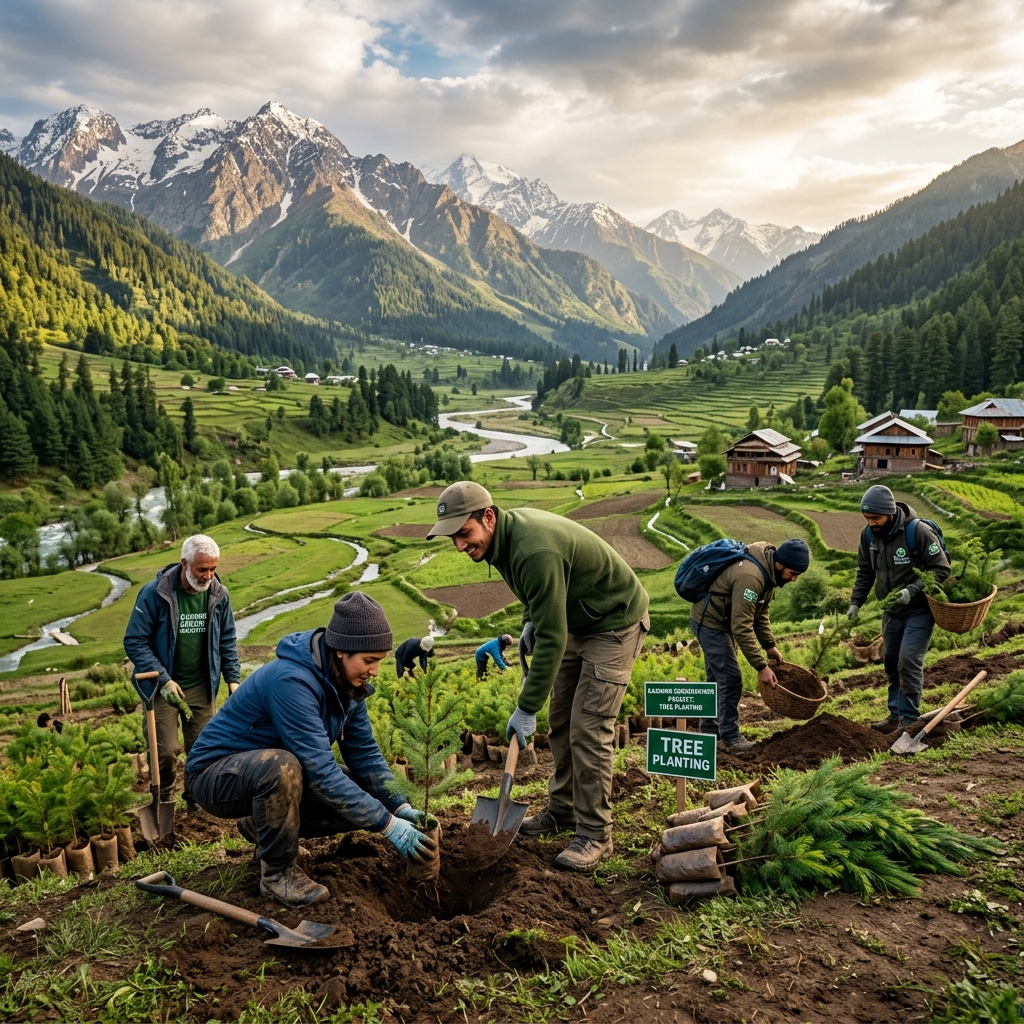
Independence, Duplication, and Turf: The Perils of Co-Optation and Solo Silos
Navigating ceremonial state partnerships while overcoming fragmented one-person trusts and donor-visibility competition.
Three institutional pathologies govern how environmental organizations relate to power and to one another. The first is the delicate boundary between **constructive civic partnership and administrative or corporate co-optation**. Across Kashmir, municipal corporations, forest divisions, tourism authorities, and cement or banking corporations frequently invite selected NGOs onto “multi-stakeholder green missions,” sponsor their banners, or nominate their founders to ceremonial advisory committees. Collaboration with public utilities is sometimes indispensable—NLCO could not haul heavy solid waste from Khushal Sar without SMC tippers and LCMA barges, yet crucially maintained enough public independence in June 2026 to criticize delayed sewage interception.
Far too often, however, institutional patronage subtly domesticates dissent. An NGO reliant on Forest Department nursery saplings, municipal logistics, or corporate CSR cheques from a hospitality or industrial conglomerate rarely files a Right to Information appeal exposing that same Forest Division’s 22 percent Year-Four CAMPA sapling survival, or challenges that corporate sponsor’s untreated effluent before the Pollution Control Committee. When civil society accepts the role of unpaid sanitation auxiliary or ceremonial cheering squad for state schemes, nobody is left in the room to ask uncomfortable statutory questions.
Second is **chronic duplication across fragmented micro-organizations**. Because founding a new trust or society confers immediate presidential titles and social-media mastheads, Kashmir has witnessed a proliferation of overlapping three-person foundations—five groups running identical single-use-plastic awareness stalls in the same Srinagar college corridor, four groups planting unguarded exotic saplings along the same highway verge—each reinventing elementary brochures instead of building one durable institution capable of hiring a full-time hydrologist and litigator.
Third is **turf competition over media credit and donor visibility**. Rather than sharing water-quality spreadsheets, pooling litigation costs on connected Jhelum wetland PILs, or co-maintaining a unified public map of illegal riverbed mining leases, rival forums frequently guard contacts, race to issue competing press releases on the same crisis, and treat conservation data as proprietary organizational branding. Fragmented activism confronting centralized bureaucratic and extractive machinery guarantees structural weakness.
Beyond the Group Photograph: Substantive Participation and Five-Year Proof
Why genuine community ownership and multi-year post-intervention monitoring separate lasting conservation from extractive voluntourism.
Ask a boatman in inner Dal, a *nadru* harvester in Anchar, a *kuhl* irrigator in Budgam, or a Bakarwal elder descending Pir Ki Gali what they think of visiting urban “environmental drives,” and a quiet estrangement surfaces. Too much urban activism treats rural and working-class resource communities as passive backdrops—busing college volunteers into a wetland hamlet for three hours of photography, lecturing villagers who survive on two tonnes of firewood or artisanal fishing about global climate responsibility, and departing before dusk without asking how wetland shrinkage, flood embankments, or conservation enclosures affect household survival.
Substantive public participation looks completely different. As Eastern and Western Himalayan field syntheses (Gaurav, Kri & Gopi 2026) and Ladakh–Baltistan’s community snow-leopard compacts demonstrate, conservation endures only when customary stewards—*mohalla* spring committees, *mirab* irrigation councils, Forest Rights Act (FRA) Gram Sabhas, fisher cooperatives, and pastoralist *deras*—hold co-decision authority, design seasonal grazing or harvesting rest rules themselves, and receive direct economic returns from ecosystem recovery. Community participation is measured not by how many outsiders wore matching caps on cleanup day, but by whether local households still enforce the rule three winters after the NGO’s grant closes.
That brings us to the single greatest evidentiary vacuum across Kashmiri environmental activism: **the near-total absence of long-term multi-year ecological monitoring**. Globally, conservation science underwent a methodological revolution over the past two decades—insisting upon Before-After-Control-Impact (BACI) designs, counterfactual baselines, and multi-year survival tracking (mirrored in IUCN Global Standard for NbS 2020 criteria and participatory verification models such as Maharani et al. 2026) after discovering that unmonitored tree-planting and cleanup projects routinely fail within thirty-six months.
Across Kashmir, virtually no NGO that plants saplings in March returns to publish georeferenced 36-month and 60-month survival, native species richness, and browse-damage audits on an open public ledger. Virtually no group staging river or wetland cleanups publishes 12- and 24-month post-campaign dissolved oxygen, faecal coliform, or orthophosphate trends compared against an upstream control reach. And even in environmental litigation—where filing a PIL often earns front-page praise—few organizations track **post-judgment ground compliance** two years later to verify whether court-ordered mining bans, boundary pillars, or STP upgrades actually materialized in mud and water rather than staying frozen in paper affidavits.
Modern conservation evaluation distinguishes strictly between organizational outputs (workshops held, saplings distributed, petitions filed) and counterfactual biophysical outcomes (net ecosystem recovery relative to comparable untreated control sites across 3–10 year horizons; IUCN 2020, DOI: 10.2305/IUCN.CH.2020.08.en; Carroll et al. 2025, DOI: 10.5334/cstp.825).
Replacing Activity Tallies with Living Outcomes: Nine Mandatory Substitutions
A binding indicator reform shifting civil-society evaluation from organizational busyness to verified ecological and policy change.
Why do governments and NGOs alike cling so stubbornly to counting inputs? Because inputs are entirely under the organizer’s control and guarantee 100 percent reported success by 5 p.m. Any trust can guarantee that a webinar was conducted, fifty press releases were emailed, two hundred volunteers signed an attendance sheet, or five thousand nursery polybags were handed out. Nobody can guarantee without sustained competence, scientific design, and multi-year persistence that a government department actually rewrote its procurement rule, that planted native oaks survived four winters of frost and goat browse, or that faecal coliforms in a village spring fell to zero.
When civil society grades itself by activity counts, it rewards the loudest publicist over the quietest, most effective restorer. A small rural collective in Kulgam or Leh that spends three unpublicized years negotiating rotational grazing rest around two drying springshed recharge zones—achieving a verified 30 percent late-autumn discharge recovery—looks “inactive” beside an urban forum that hosted twenty-four Zoom webinars and issued forty press statements without moving a single brick of policy.
Operationalizing honest self-accountability requires retiring all nine conventional NGO activity metrics as standalone claims of success and pairing each with a verifiable outcome indicator. In `Table 01` below, *Himalayan Dispatch* sets forth the nine mandatory indicator substitutions that environmental organizations, CSR boards, philanthropic foundations, journalists, and Kashmir EcoWatch’s own public registries must adopt.
Read properly, this matrix does not ban webinars, press releases, cleanups, tree planting, or litigation; every one of those tools remains vital as a *means*. What `Table 01` abolishes is treating the *means* as proof of the *end*. A webinar counts when a municipality or farming cooperative implements its technical protocol; a press release counts when it triggers a documented statutory inspection or policy shift; a writ petition counts when excavators physically leave the riverbed and benthic habitat recovers.
MANDATORY CIVIL SOCIETY METRIC REFORM · TABLE 01
Required substitution of conventional NGO activity reporting with verifiable ecological, behavioural, and policy outcome indicators across Kashmir and the Western Himalayas.
| Conventional NGO activity | Proposed outcome indicator |
|---|---|
| Webinars conducted | Recommendations implemented |
| Awareness campaigns | Measurable behavioural change |
| Trees planted | Long-term tree survival |
| Cleanup campaigns | Sustained pollution reduction |
| Press releases | Documented policy intervention |
| Funds raised | Verified ecological outcomes |
| Volunteers enrolled | Sustained community participation |
| Litigation initiated | Environmental protection achieved |
| Conferences organized | Research translated into action |
Mutual Accountability Across All Four Tiers—Beginning with Ourselves
Applying symmetrical scrutiny to universities, Kashmir EcoWatch, state regulators, NGOs, donors, and citizens.
Mutual accountability cannot survive in an ecosystem of double standards. For civil society to embrace outcome verification without fear of selective administrative harassment, all four levels of environmental governance must accept reciprocal obligations—starting at **Level 01: Scientific Institutions and Kashmir EcoWatch**. Universities across Kashmir, Jammu, and Ladakh must stop locking publicly funded water, soil, air, and biodiversity datasets inside unshared departmental hard drives, and instead open subsidized community-science calibration clinics where grassroots groups can validate spring nitrate kits or sapling provenance at nominal cost. **And Kashmir EcoWatch binds itself publicly to this exact standard**: we have purged unverified `"Positive impact projected"` assumptions from verified tiers, separated `"Verified Trophic Status"` from `"Inferred Trophic Risk"`, withheld Stage 05 scientific review badges where external peer review is pending, and committed *Himalayan Dispatch* to a permanent Stage 10 public corrections register whenever our data or interpretations require revision.
At **Level 02: Government and Regulatory Institutions**, accountability demands ending two opposite abuses: weaponizing registration and compliance paperwork to intimidate independent public-interest litigants who expose illegal mining or wetland encroachment, while simultaneously lavishing state awards and funds on pliant, uncritical ceremonial trusts. Furthermore, NGOs can only measure sustained pollution reduction if JKPCC, LCMA, SMC, Forest Divisions, and Geology & Mining publish real-time, machine-readable statutory monitoring data—STP effluent logs, CAMPA polygon shapefiles, and mineral extraction permits—without forcing citizens to wage two-year RTI battles for basic public facts.
At **Level 03: Environmental NGOs and Civil Society Organizations**, downward accountability to local communities must become non-negotiable. Every organization speaking in the name of Dal boatmen, Wular fishers, Pampore saffron growers, Pir Panjal pastoralists, or Chenab villagers owes those communities prior informed consultation, seats on project oversight committees, annual public financial disclosures in plain Urdu, Kashmiri, Dogri, Ladakhi, and English, and the rare institutional courage to publish **honest failure audits**—explaining openly when a plantation withered or a cleanup re-fouled, so the next effort learns rather than repeats.
At **Level 04: Citizens, Regional Media, and Philanthropic / CSR Donors**, public culture itself must mature. So long as local newspapers headline every ribbon-cutting pledge without sending a reporter back twelve months later to count surviving stems, and so long as corporate CSR committees demand instant first-quarter photo albums rather than funding five-year post-planting tending and rural watershed technicians, donors and media actively incentivize the very superficiality they privately lament.
“A movement bold enough to summon ministries before green tribunals must be brave enough to publish its own five-year sapling mortality, its own audited balance sheets, and its own honest failures.”
The Environmental Civil Society Performance and Accountability Index (ECSPAI)
A non-punitive, capacity-adjusted six-dimension framework evaluating grassroots collectives, funded trusts, and observatories fairly.
How can Kashmir and the wider Himalayan region evaluate diverse environmental organizations rigorously without crushing unfunded village volunteers beneath bureaucratic compliance designed for million-dollar foundations? *Himalayan Dispatch* proposes the **Environmental Civil Society Performance and Accountability Index (ECSPAI)**—a transparent, open-method evaluation architecture built on **capacity-adjusted tiering** and **six weighted performance dimensions** totaling 100 points.
Crucially, ECSPAI rejects one-size-fits-all grading by stratifying organizations into four structural capacity tiers before scoring: **Tier A — Grassroots Volunteer & Mohalla/Village Collectives** (annual expenditure `< ₹5 lakh`, zero salaried technical staff); **Tier B — Registered District & Regional NGOs/Societies** (`₹5–50 lakh/yr`); **Tier C — Institutional, CSR-Backed & Externally Funded Trusts** (`> ₹50 lakh/yr`); and **Tier D — Environmental Research Platforms, Litigation Centres & Digital Observatories** (explicitly including **Kashmir EcoWatch**). A Tier A youth club cleaning a village spring in Kupwara or Hunza is never penalized for lacking ICP-MS laboratory chromatography; it earns full evidentiary marks simply by logging honest GPS coordinates, fixed-point before/after photographs across four seasons, community sign-off, and unexaggerated volume estimates. Conversely, Tier C and Tier D institutions face strict requirements for BACI control plots, audited line-item financials, open datasets, and peer-reviewed or statutory corroboration.
Across all tiers, ECSPAI shifts 50 percent of total weight onto **verified biophysical/policy outcomes (30%)** and **multi-year continuity & post-intervention monitoring (20%)**, while allocating **15% to scientific and evidentiary claim accuracy**, **15% to substantive community co-governance and rural watershed equity**, **10% to financial, statutory, and conflict-of-interest transparency**, and **10% to inter-organizational collaboration and open-data sharing**.
Adopted voluntarily as a self-disclosure compact by Kashmir’s civil society—and used by KEW to govern its own Verified Contributor registry going forward—ECSPAI offers legitimate, hardworking grassroots organizations a shield of credible proof while gently retiring hollow publicity theatre.
PROPOSED EVALUATION ARCHITECTURE · TABLE 02
The 6-Dimension Environmental Civil Society Performance and Accountability Index (ECSPAI) with capacity-adjusted verification benchmarks.
| ECSPAI Dimension & Weight (100-Point Scale) | Verification Standard & Capacity-Adjusted Benchmark (Grassroots Tier A vs. Funded/Observatory Tiers C–D) |
|---|---|
| 1. Verified Ecological or Policy Outcomes (30 pts) | Measures net biophysical change (36/60-month native tree survival, spring discharge, DO/SRP shift) or enforced legal/policy action rather than events held. Tier A: fixed-point photo/quadrat & local ledger proof; Tiers C–D: BACI control-site or statutory compliance data. |
| 2. Multi-Year Continuity & Follow-Through (20 pts) | Tracks sustained site stewardship, post-PIL court order ground audits, and multi-season maintenance beyond Year 1 headlines across a minimum 3-to-5-year window. |
| 3. Evidentiary Rigor & Claim Discipline (15 pts) | Audits public statements, petitions, and registries for factual precision—penalizing inflated headcounts or uncalibrated claims while rewarding clear separation of verified data, activity reports, and uncertainty. |
| 4. Community Co-Governance & Rural Equity (15 pts) | Evaluates genuine decision-making power of local mohallas, Gram Sabhas, boatmen, farmers, and pastoralists, with bonus weighting for underserved rural watersheds (Pir Panjal, Chenab, kandi, alpine pastures). |
| 5. Financial, Statutory & Donor Independence (10 pts) | Requires public registration disclosure, conflict-of-interest firewalls from polluting sponsors, and annual expenditure summaries showing direct field-to-event-overhead ratios (audited CA filings mandatory for Tiers B–D). |
| 6. Open Data, Non-Duplication & Collaboration (10 pts) | Rewards shared GIS polygons, joint legal/laboratory coalitions, open-access monitoring logs, and transparent publication of post-mortem failure lessons. |
ECSPAI explicitly protects small volunteer and village spring/pasture committees (Tier A, <₹5 lakh/yr) from elitist technical barriers: honest geolocation, seasonal fixed-frame photography, community validation, and zero claim exaggeration qualify grassroots stewards without requiring expensive laboratory instrumentation.
The Courage to Count What Lives
Why holding environmentalism to rigorous self-accountability does not diminish civic idealism—it makes it worthy of the mountains.
Return in imagination to any quiet ecological frontline across our mountains when no camera crew is watching: a winter afternoon along a silted village *nag* in Budgam where three elders rebuild a dry-stone spring wall; a junior lawyer in Srinagar cross-checking revenue *khasra* numbers at midnight to stop a wetland land-fill; a Ladakhi technician scraping frost off an insulated reedbed filter in Leh; or a young researcher deleting an unverified row from an observatory spreadsheet rather than letting a comforting falsehood stand.
None of those acts looks dramatic on social media, and every one of them carries the moral DNA of genuine environmental stewardship. Across Jammu, Kashmir, and Ladakh, civil society does not suffer from a shortage of love for the land. What has held our collective efforts beneath their true potential is an inherited culture of performative counting—measuring noise instead of change, beginnings instead of survivals, and loyalty to organizations instead of loyalty to ecosystems.
Answering our central question requires neither defensiveness nor despair. Yes—environmental organizations, citizen forums, and observatories like Kashmir EcoWatch *must* be evaluated by the exact standards of evidence, financial candour, rural equity, and multi-year ecological permanence that we demand from ministries and corporations. Far from weakening civil society before state power, an environmental movement that audits its own saplings at Year Five, opens its own accounts, shares its data across organizational lines, and retires hollow photo-ops becomes virtually unassailable in court and in public conscience.
The rivers of the Pir Panjal, the springs of the *karewas*, the marshes of Wular, and the high pastures of the Karakoram cannot read our press releases or applaud our webinars. They register only what stops poisoning their water, what holds their soil in a storm, and what still breathes ten winters after we promised to protect them. Counting what truly lives is the highest respect we can pay both to nature and to the citizens who rise to defend it.
“The Jhelum, the springs, and the birch treeline cannot read our press releases or attend our webinars. Counting only what still lives five winters later is the highest respect environmentalism can pay to the mountains—and to itself.”
DOCUMENTARY SOURCES & FURTHER READING
| Source | Documentary relevance |
|---|---|
| Kashmir EcoWatch NGOs & Community Green Champions Calibration Ledger (November 22, 2026 · NGOS_COMMUNITY_TELEMETRY) | Primary internal KEW audit establishing mandatory registration/fieldwork rules and reclassifying reported cleanup/activity tallies separately from verified ecological recovery (src/data/kew-ngos-community.ts & src/data/ngo-impact.ts). |
| IUCN Global Standard for Nature-based Solutions (First Edition, 2020) | Establishes global benchmark criteria requiring measurable biodiversity net gain, transparent inclusive governance, and adaptive multi-year monitoring. |
| Carroll, Furrow & Gerhart (2025), Citizen Science: Theory and Practice — Consistency and Validity of Participatory Science Data | Evaluates empirical data validity, seasonality accuracy, and structured quality-control needs in citizen-collected ecological observations. |
| Kelling (2018), Biodiversity Information Science and Standards — Improving Data Quality Through Expert Reviewer Networks | Demonstrates how semi-structured effort logging and two-tier expert validation overcome spatial bias and misidentification in participatory science. |
| Seltzer (2019), Biodiversity Information Science and Standards — Scalable & Verifiable Participatory Biodiversity Data | Examines open-data verification architectures turning citizen observations into research-grade biodiversity records. |
| Maharani et al. (2026), PLOS One — Citizen Science-Based Biodiversity Monitoring Design in Working Landscapes | Field-tested protocol demonstrating structured community biodiversity monitoring and multi-season verification. |
| Gaurav, Kri & Gopi (2026), Frontiers in Conservation Science — Integrating Traditional Ecological Knowledge with Ecological Surveys in the Himalaya | Illustrates rigorous synthesis of indigenous community stewardship knowledge with quantitative Himalayan ecological field surveys. |
| Jafri, Jafri & Beg (2025), Central University of Kashmir Law Review — Riverbed Sand Mining Governance & Enforcement Deficits in J&K | Documents rural Jhelum tributary extraction crises and statutory enforcement gaps requiring sustained legal and field compliance monitoring. |
| Riyaz, Nazir, Ashraf & Gupta (2026), PLOS One — Pesticide-Induced Ecological Traps & Pollinator Network Collapse in Kashmir Apple Orchards | Quantifies 46% pollinator network connectance loss in rural South Kashmir orchard belts underserved by urban-centric environmental campaigns. |
| Saleem, Rather, Ahmad et al. (2024), Pastoralism: Research, Policy and Practice — Livestock Carrying Capacity in Kashmir Himalayan Alpine Grasslands | Provides empirical baseline on high-altitude pastoral commons requiring participatory co-stewardship rather than top-down exclusion. |
| Mohan et al. (2024), Heliyon — Pollution Indices & Heavy-Metal Groundwater Contamination in Sub-Himalayan Jammu | Highlights severe sub-Himalayan Jammu groundwater contamination challenges outside Srinagar-focused media attention. |
| Alam et al. (2023), Environmental Monitoring and Assessment — Satellite Data-Based Assessment of Wetland Dynamics in Kashmir Himalaya | Supplies objective multi-decadal Earth-observation baselines against which wetland conservation claims must be verified. |
| Bhat, Dar & Hamid (2022), Scientific Reports — Hydrogeochemical Appraisal of Freshwater Springs in Kashmir Valley | Establishes scientific discharge and hydrochemical parameters required to verify community spring-rejuvenation outcomes. |
EDITORIAL PUBLICATION METADATA & 10-STAGE GATE LEDGER
| Gate | Status | Record / Scope |
|---|---|---|
| 01 · Commissioned | completed | Himalayan Dispatch Founding Masthead |
| 02 · Research in progress | completed | Himalayan Dispatch Research & Observatory Desk |
| 03 · Manuscript draft | completed | Assigned Author / Editorial Desk |
| 04 · Evidence verification | completed | Verified against Kashmir EcoWatch’s November 22, 2026 NGOs & Community Calibration Ledger (src/data/kew-ngos-community.ts · NGOS_COMMUNITY_TELEMETRY) and NGO Impact Registry (src/data/ngo-impact.ts), Societies Registration Act / Indian Trusts Act / CSR & NGT statutory frameworks, IUCN Global Standard for NbS (2020), and peer-reviewed conservation evaluation, citizen-science, and regional environmental governance literature (Carroll et al. 2025; Kelling 2018; Seltzer 2019; Maharani et al. 2026; Gaurav et al. 2026; Jafri et al. 2025; Riyaz et al. 2026; Saleem et al. 2024; Mohan et al. 2024; Alam et al. 2023; Bhat, Dar & Hamid 2022). |
| 05 · Scientific review (where applicable) | pending | Internal scholarly correlation on counterfactual conservation impact evaluation, citizen-science spatial bias correction, and multi-year ecological monitoring completed; awaiting external specialist sign-off at Stage 05 prior to post-pre-release certification. |
| 06 · Editorial review | completed | Founding Editor-in-Chief Desk Review |
| 07 · Copyright and ethics review | completed | Symmetric non-exemption applied across scientific bodies, government regulators, NGOs, citizens, and Kashmir EcoWatch itself; visual assets verified on disk with zero synthetic personas, fabricated quotes, or EXIF claims. |
| 08 · Administrator approval | in progress | Staged at Stage 08 (editorial_approval) for Founding Administrator final release review. |
| 09 · Published | pending | — |
| 10 · Post-publication corrections | not applicable | — |
| Attribute | Final assignment |
|---|---|
| Publication | Himalayan Dispatch |
| Volume / Issue | Vol. 01 / No. 01 · The Inaugural Issue |
| Series rubric | Civil Society & Environmental Accountability Series (Part IV) |
| Folio code | 19 / CIVIL SOCIETY INQUIRY · NGO ACCOUNTABILITY INDEX |
| Title | Who Measures the Success of Environmental Activism? |
| Byline | The Editorial Board · Signed by Dr. Fayaz Ahmad Khan |
| Primary department | Editorials |
| Secondary departments | Investigative Journalism · Data Journalism |
| Ecosystem examined | Environmental NGOs, trusts, litigation collectives, service clubs, youth forums, and Kashmir EcoWatch internal NGO registries across Jammu, Kashmir, and Ladakh |
| Proposed accountability framework | Environmental Civil Society Performance and Accountability Index (ECSPAI · 6 Weighted Capacity-Adjusted Dimensions) |
| Canonical URL slug | who-measures-the-success-of-environmental-activism |
| Workflow gate | Stage 08 · Pre-Release Edition Folio Awaiting Administrator Approval |

Founding Editor-in-Chief
Dr. Fayaz Ahmad Khan
Founder of Kashmir EcoWatch and Founding Editor-in-Chief of Himalayan Dispatch; writes on alpine hydrology, cryospheric thresholds, disaster resilience, and mountain commons across the Western Himalayas.
View Portfolio & Approved Commissions →NEXT IN THIS EDITION · CIVIL SOCIETY & ACCOUNTABILITY · V · DECLARATIONS & OBSERVATORY
The Mountains Have Heard Enough Declarations
By The Editorial Board & Himalayan Dispatch Policy Observatory Desk · 22 min read