Return to Kashmir EcoWatch

EST. 2026  ·  KEW WESTERN HIMALAYAS

HIMALAYANDISPATCH

LANDSCAPE.  PEOPLE.  SCIENCE.  TRUTH.

Dr. Fayaz Ahmad Khan

Founding Editor-in-Chief

Dr. Fayaz Ahmad Khan

BEAT: Cryosphere, High-Altitude Watersheds, Mountain Governance & Ecological Resilience  ·  BASED IN Loudoun County, VA & Kashmir

Dr. Fayaz Ahmad Khan brings more than twenty-five years of environmental geospatial science, mountain hydrology, and critical watershed resilience work to the founding masthead of Himalayan Dispatch, bridging empirical Earth observation with literary public witness.

Having founded ESRO in Kashmir in 2004 and conceptualized Kashmir EcoWatch as an enduring non-commercial knowledge return system for the Western Himalayas, his essays and dialogues examine where glacier physics, watershed memory, and human governance meet.

REPORTING LANGUAGES

English · Kashmiri · Urdu

FELLOWSHIPS & CITATIONS

  • Ph.D., Environmental Geospatial Information Science
  • Founder, Kashmir EcoWatch Western Himalayan & ESRO (Est. 2004)

Out-of-band secure contact options available upon request via the Editorial Desk; never submit Tier III confidential whistleblower files via standard web forms.

Published Edition Stories

25 IN ARCHIVE
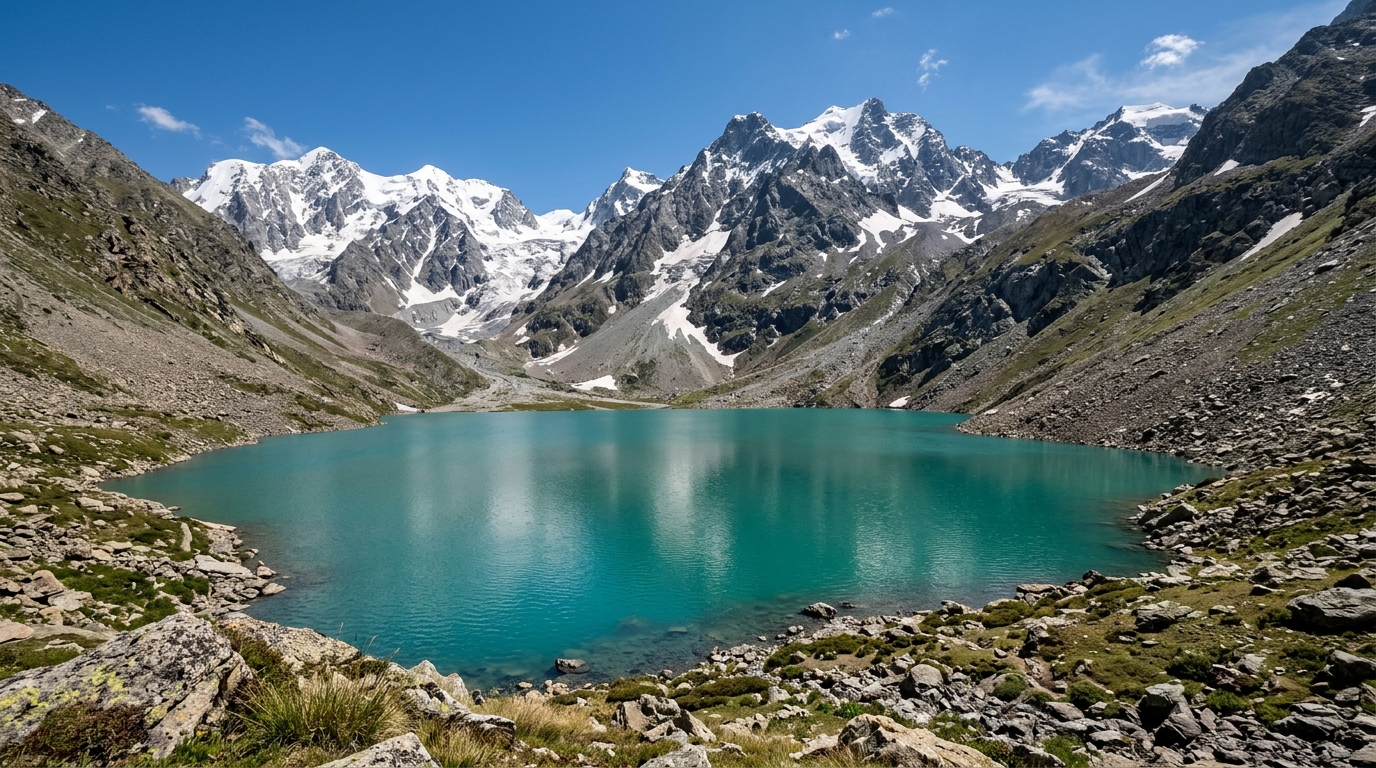
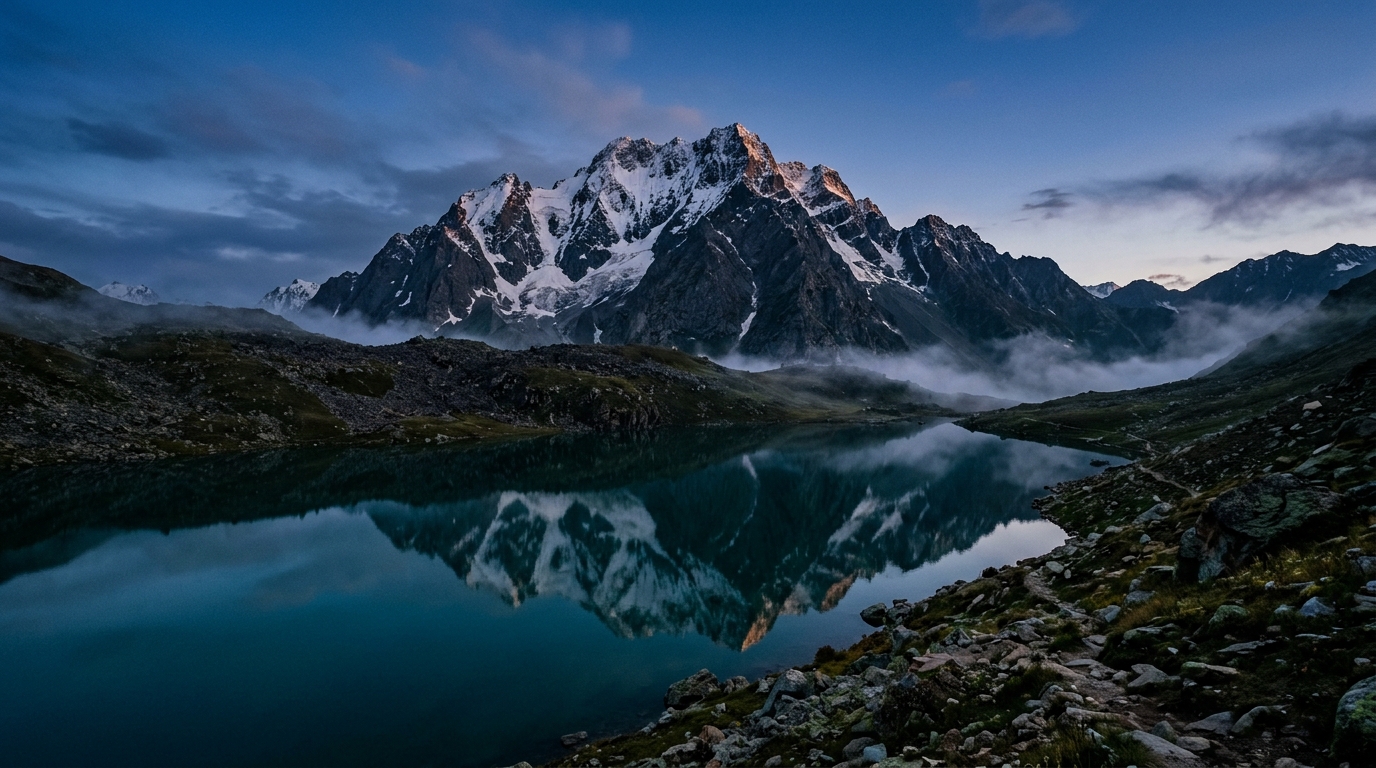
Evening light across the high cirque basin of Gangbal beneath the north-west ramparts of Mount Haramukh in the Central Kashmir Himalaya (Illustrative archival plate).
FOUNDING COVER ESSAYVOL. 01 / NO. 01 · THE INAUGURAL ISSUE

When Mountains Speak, Who Is Listening?

At 3,570 metres beneath Haramukh’s fluted granitic wall, the twin cirques of Gangbal and Nundkol register every warm night, every black-carbon plume, and every hurried road cut below—translating planetary warming into the daily arithmetic of downstream water.

Read Story (18 min)
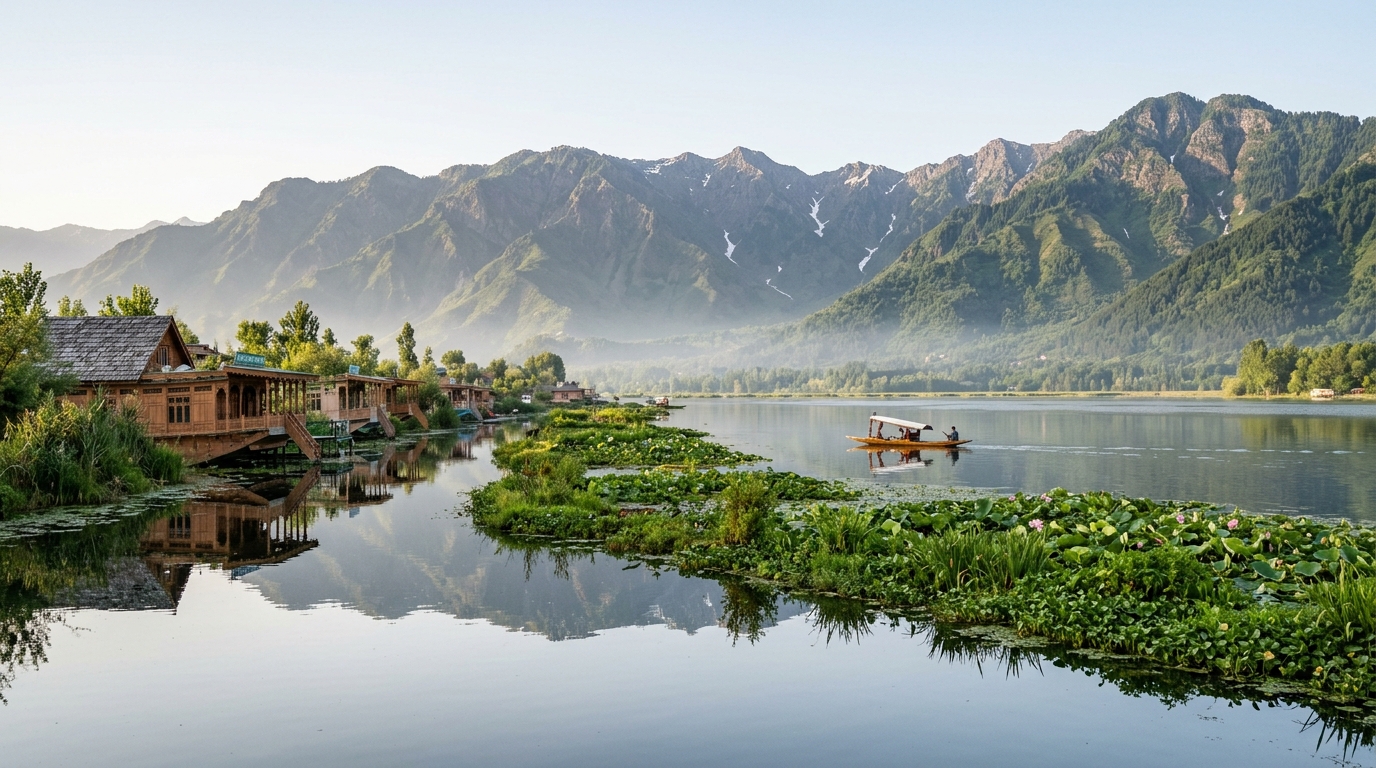

Urban lacustrine basins, shoreline houseboat moorings, macrophyte channels, and surrounding Zabarwan–Telbal catchment slopes across Dal Lake in Srinagar—where physical sediment transport, sewage nutrient stoichiometry, benthic oxygen demand, and public expenditure converge (Illustrative archival plate — Kashmir EcoWatch Visual Archive).
SPECIAL SCIENTIFIC INVESTIGATION · LIMNOLOGY · ENVIRONMENTAL ENGINEERING · PUBLIC EXPENDITURE ACCOUNTABILITYVOL. 01 / NO. 01 · THE INAUGURAL ISSUE

The Mathematics of a Dying Lake

A forensic scientific investigation into Telbal settling basin efficiency (7–57% historical CAG range), the 36.70 MLD peripheral sewage treatment ring versus ~48 MLD estimated wastewater generation, CAG Table 4.2 nutrient removal shortfalls, mechanical de-weeding stoichiometry, slurry-versus-solids dredging math, catchment erosion, hydrological residence time, and the eight interconnected mass balances governing Dal Lake’s survival.

Read Story (30 min)
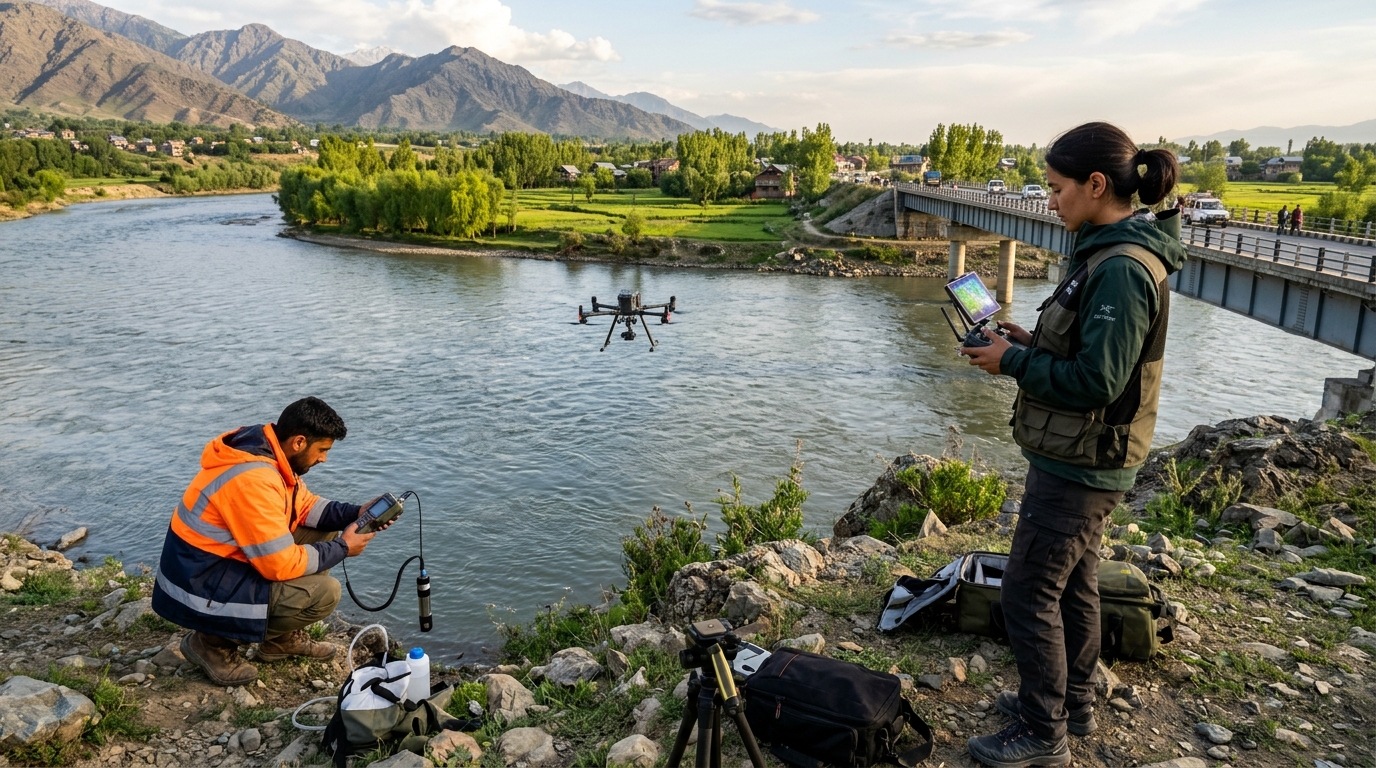
Freshwater chemistry analysis and aquatic diagnostic instrumentation context—illustrating the indispensable role of permanent limnological infrastructure in diagnosing nutrient loading, sediment flux, and treatment performance (Illustrative archival plate — Kashmir EcoWatch Visual Archive; does not depict the historical Habak building).
SPECIAL HISTORICAL & SCIENTIFIC INVESTIGATION · INSTITUTIONAL NEGLIGENCE · SCIENTIFIC INDEPENDENCE · PUBLIC ASSET ACCOUNTABILITYVOL. 01 / NO. 01 · THE INAUGURAL ISSUE

The Laboratory That Kashmir Lost

While successive governments committed substantial public resources to saving Dal Lake, the scientific institution established to understand its ecological deterioration was displaced. Its research infrastructure deteriorated, its scientific leadership remained inadequately supported, and official warnings continued to accumulate. How did the science necessary to save the lake become secondary to the administration responsible for saving it?

Read Story (14 min)
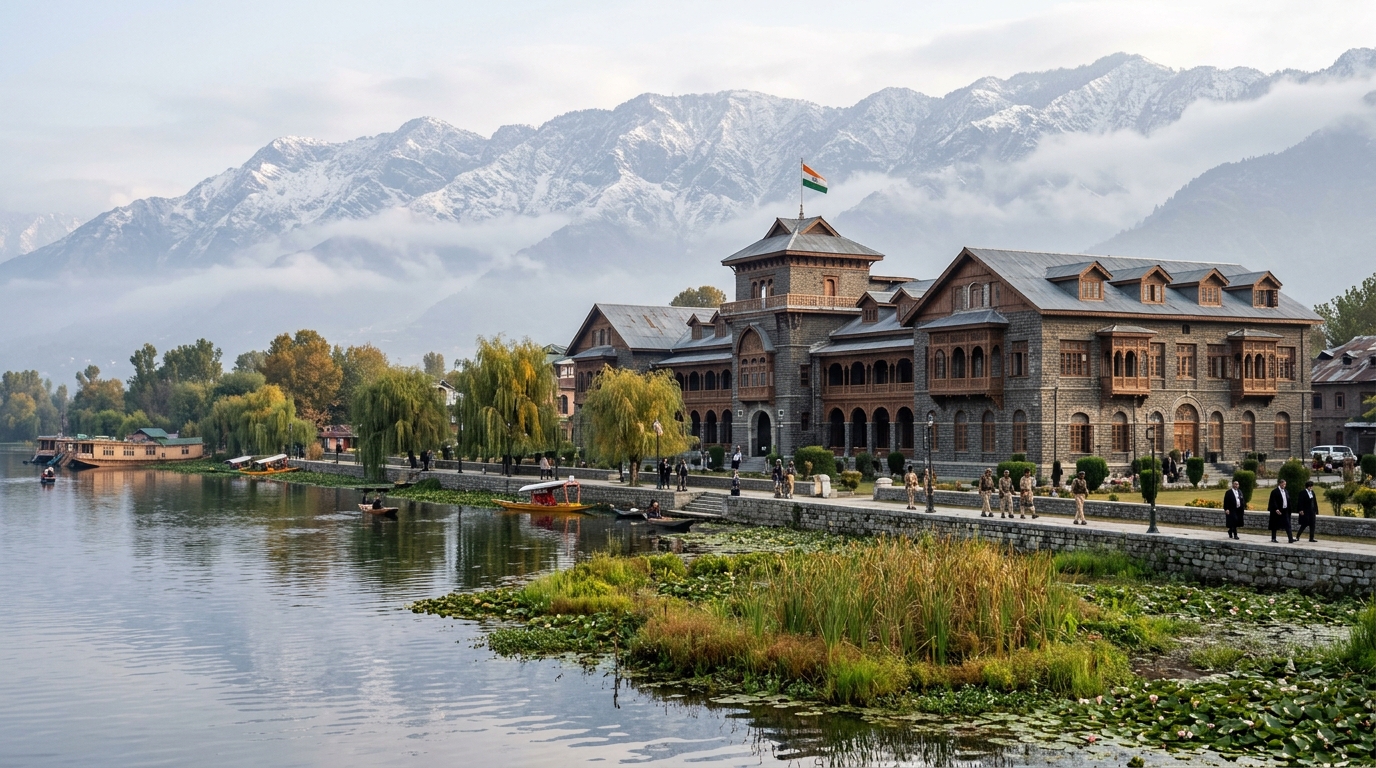
Mooring channels, shoreline embankments, vegetative margins, and Zabarwan foothill slopes across Dal Lake in Srinagar—illustrating the lacustrine geography where open water, traditional habitation, tourism infrastructure, and urban land pressure intersect (Illustrative archival plate — Kashmir EcoWatch Visual Archive; general landscape reference without parcel-specific evidentiary allegation).
SPECIAL HISTORICAL & GEOSPATIAL INVESTIGATION · ENVIRONMENTAL CRIMINOLOGY & LAND GOVERNANCEVOL. 01 / NO. 01 · THE INAUGURAL ISSUE

The Art of Encroachment

From 1859 shoreline surveys through decades of political conflict, lost enforcement archives, and documented anti-corruption proceedings to 2026 restoration claims, an investigation into how Kashmir’s flagship lake has been progressively converted from within—and what the institutions entrusted with protecting it actually did.

Read Story (36 min)
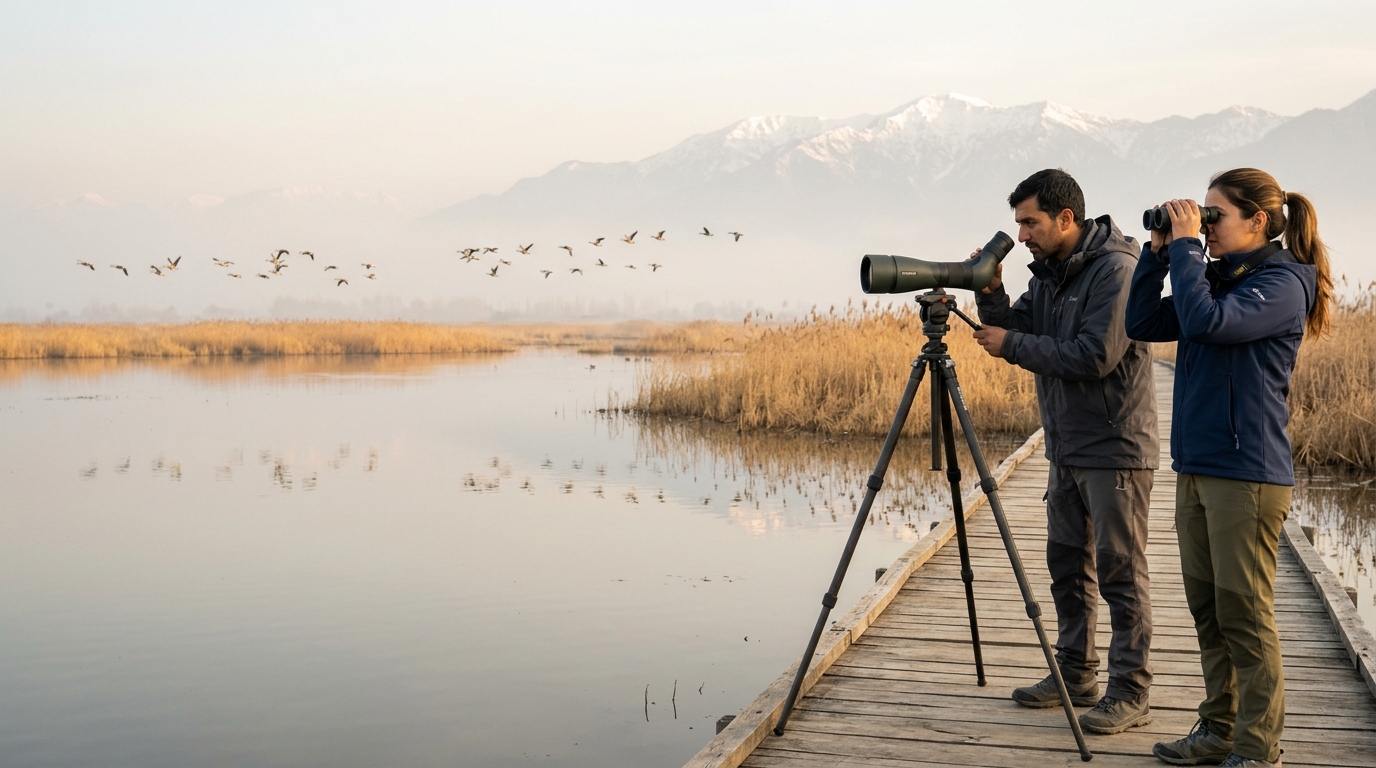
Migratory waterbirds over emergent reedbeds and open winter marsh channels across the Kashmir Valley—where Central Asian Flyway stopover energetics, benthic invertebrate availability, and floodplain hydroperiods converge beneath Western Himalayan ridges (Illustrative archival plate — thematic habitat reference without species-census evidentiary claim).
SPECIAL SCIENTIFIC INVESTIGATION · ORNITHOLOGY · MIGRATORY ECOLOGY · BIODIVERSITY ACCOUNTABILITYVOL. 01 / NO. 01 · THE INAUGURAL ISSUE

The Sky Has No Borders

A migratory bird crossing the Karakoram or Pir Panjal recognizes neither the Line of Control nor the Line of Actual Control—only open water, benthic invertebrates, forest canopy architecture, thermal gradients, and tailwinds. Expanding our inquiry from floodplain wetlands to the entire Western Himalayan sky across Kashmir, Jammu, Ladakh, Azad Jammu & Kashmir, and Gilgit-Baltistan, Dispatch 06 audits regional checklists, scrutinizes KEW’s own 601-taxa registry, tests whether 1.34 million counted waterbirds signify recovery or refugia compression inside four surviving wetlands, and establishes the eighteen-volume Monograph 04 research framework.

Read Story (25 min)
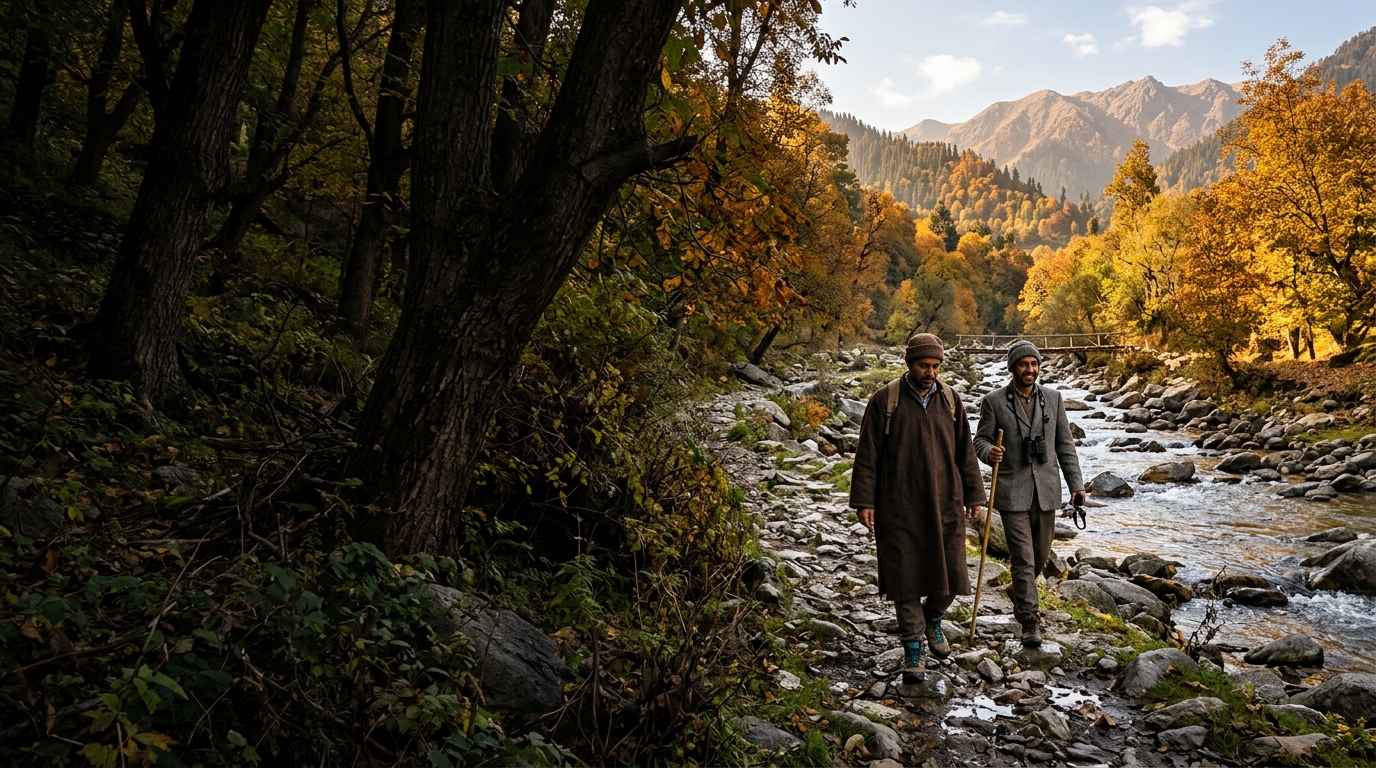
Temperate broadleaf and mixed conifer woodland along Western Himalayan foothill slopes—illustrating foothill canopy structure, understory habitat, and watershed retention rather than forensic boundary photography of City Forest / Sálim Ali National Park or the Royal Springs Golf Course (Illustrative archival habitat plate, Kashmir EcoWatch Visual Archive).
SPECIAL HISTORICAL INVESTIGATION · PROTECTED AREA GOVERNANCE & ENVIRONMENTAL JURISPRUDENCEVOL. 01 / NO. 01 · THE INAUGURAL ISSUE

The National Park That Became a Golf Course

An investigation into the transformation of Srinagar’s City Forest (Sálim Ali) National Park into land associated with the Royal Springs Golf Course, the National Board for Wildlife objections recorded after construction, the unresolved fate of 723 remaining hectares, and the lessons this precedent holds for the entire Western Himalayan Protected Area Network.

Read Story (23 min)
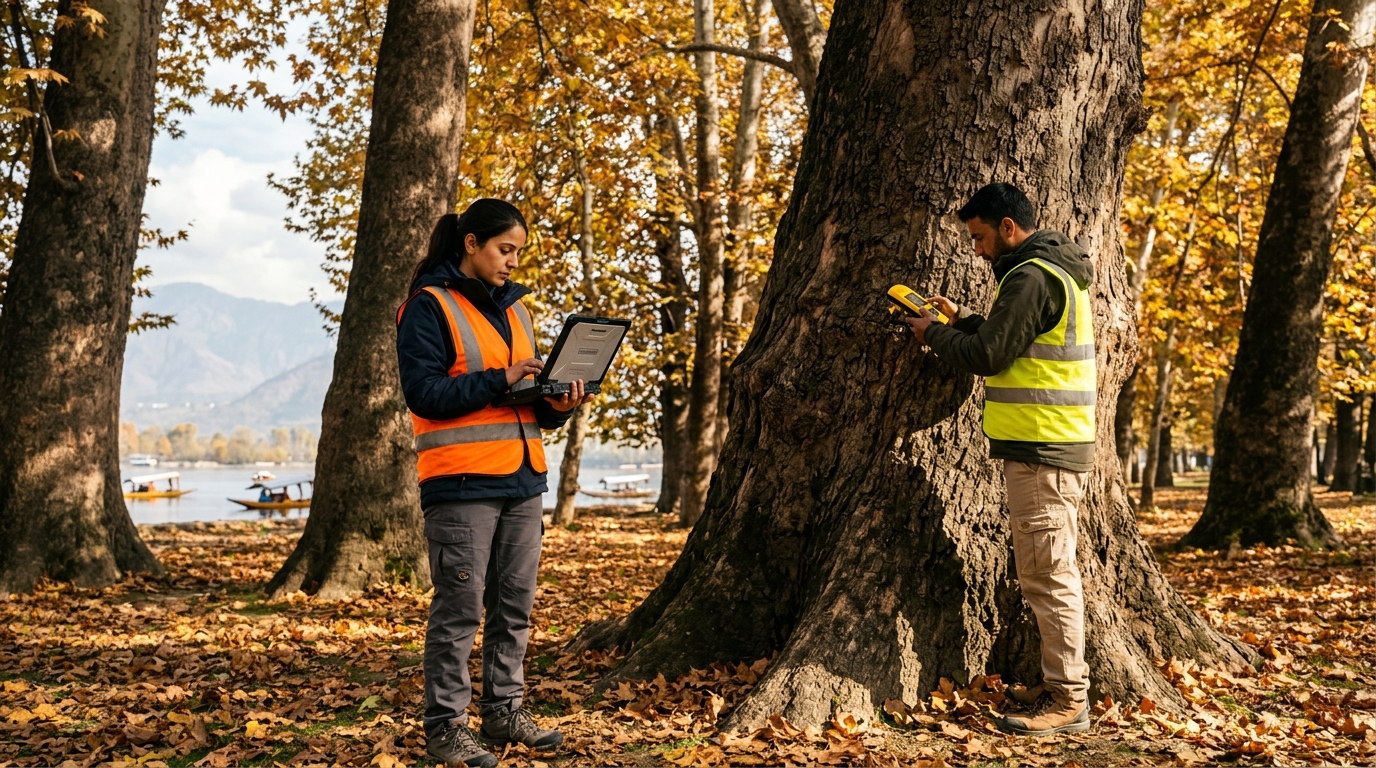
Mature Kashmir Chinar (Platanus orientalis) avenues and canopy geometry representative of Srinagar’s historic Naseem Bagh cultural landscape—where four centuries of living Mughal arboriculture encounter contemporary campus construction, soil sealing, and root-zone disturbance (Illustrative archival plate, not matched-date change-detection proof — Kashmir EcoWatch Visual Archive).
SPECIAL HISTORICAL & ECOLOGICAL INVESTIGATION · LIVING HERITAGE · ACADEMIC ACCOUNTABILITY · LANDSCAPE TRANSFORMATIONVOL. 01 / NO. 01 · THE INAUGURAL ISSUE

The Chinars in the Shadow of Concrete

Laid out overlooking Dal Lake in the Mughal era of Akbar and Shah Jahan, Naseem Bagh is one of Kashmir’s oldest designed Chinar landscapes—and today sits inside an institution that teaches botany, environmental science, remote sensing, geography, and law. Tracing the University of Kashmir’s own Institutional Calendar (696 Chinars) and 2021–22 Environmental Audit (~700 Chinars; 74.66 ha main-campus inventory) alongside 2007–2026 construction controversies, root-zone soil science, and the J&K Preservation of Specified Trees Act, 1969, this investigation asks whether academic advancement can be reconciled with living botanical heritage.

Read Story (17 min)
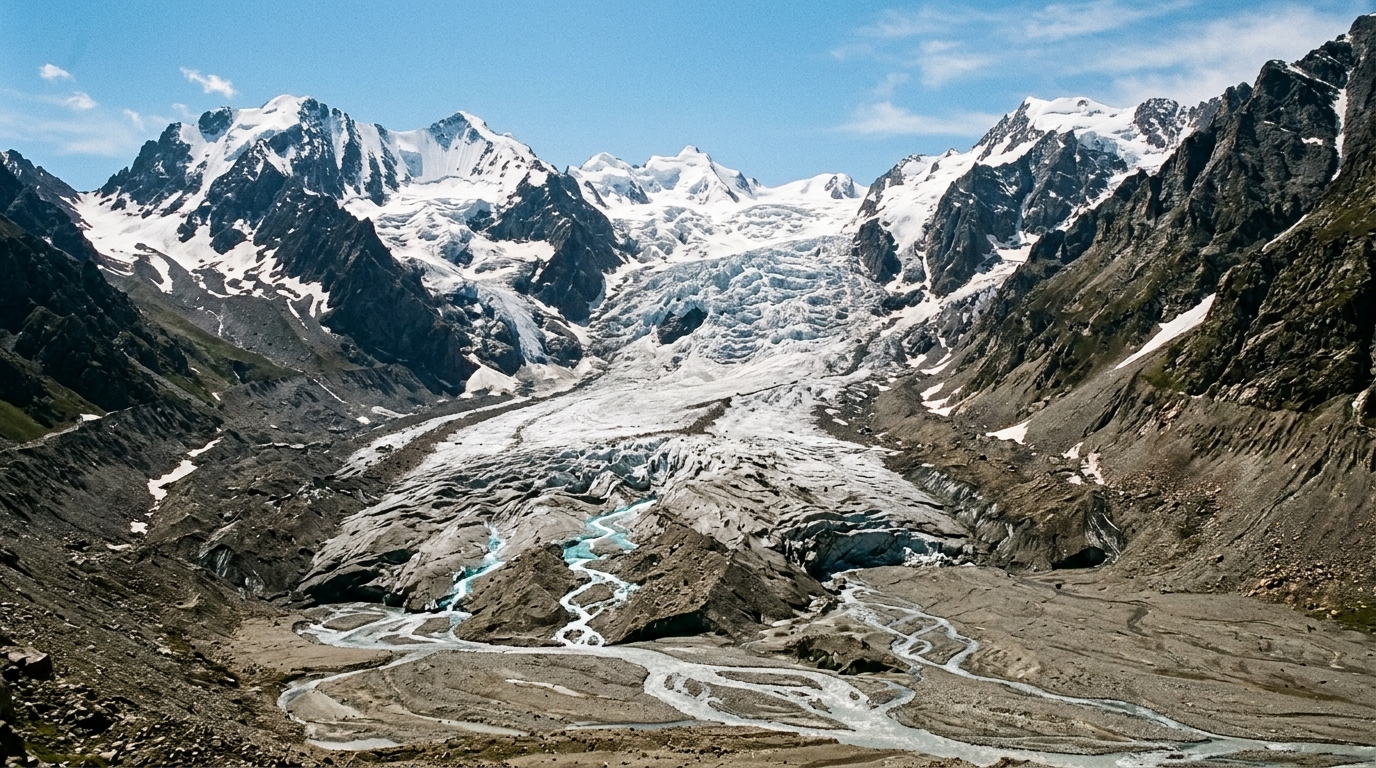
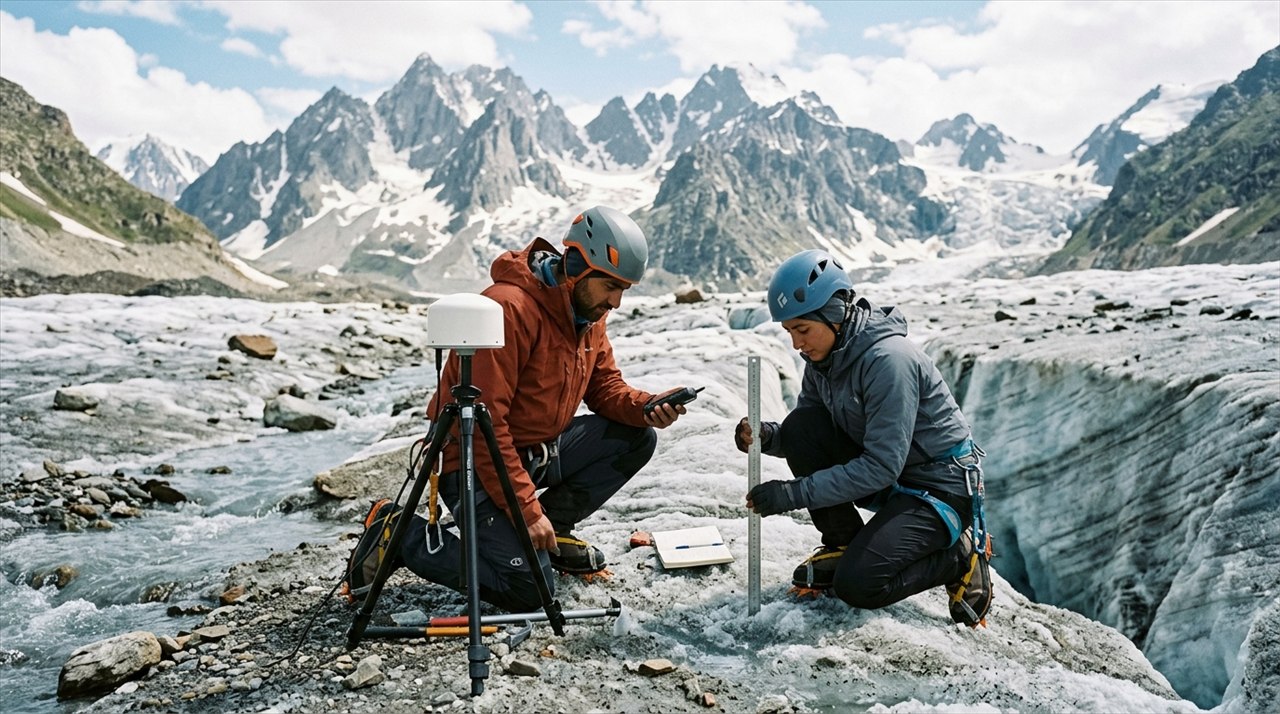
High-relief Himalayan ablation zone, supraglacial debris mantle, and proglacial meltwater channel representative of Western Himalayan headwaters (Illustrative archival plate — this feature is a constructed literature synthesis, not a portrait interview).
CONSTRUCTED EDITORIAL DIALOGUEVOL. 01 / NO. 01 · THE INAUGURAL ISSUE

“A Glacier Does Not Negotiate With Five-Year Plans”

Rather than attributing composite answers to a fictional persona, the editors of Himalayan Dispatch synthesized forty years of published Upper Indus, Jhelum, Chenab, Zanskar, and Karakoram glaciological research into twelve pointed questions on mass balance, peak water, debris-cover thermodynamics, GLOF cascades, and hydrological non-stationarity.

Read Story (15 min)
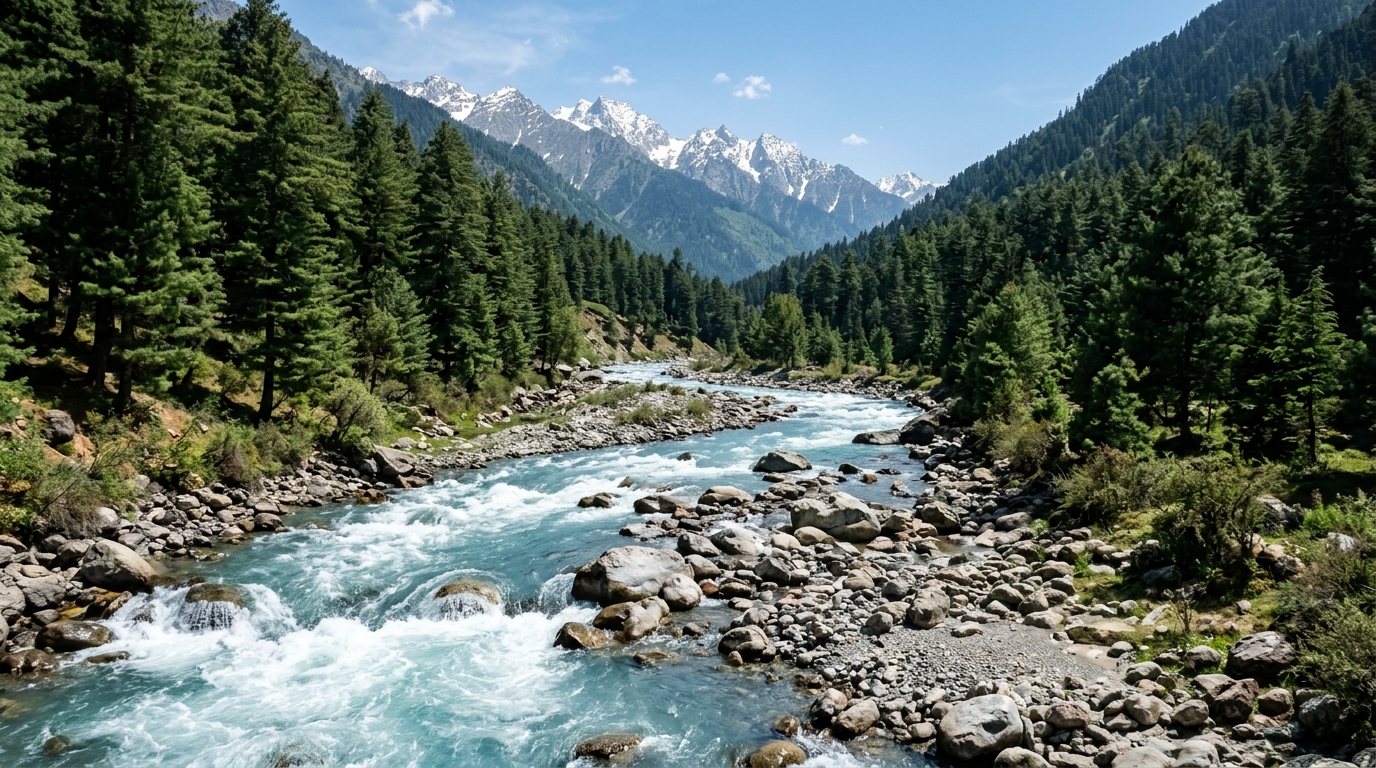
Snowmelt discharge threading over granodiorite and limestone boulders in the Lidder catchment—where geological time outlasts the forty-eight-hour news cycle (Illustrative archival plate).
FROM THE MASTHEAD · FOUNDING MANIFESTOVOL. 01 / NO. 01 · THE INAUGURAL ISSUE

Why the Western Himalayas Demand Slow, Fearless Journalism

Born after two years of unanswered correspondence, Himalayan Dispatch exists for the decades between forty-eight-hour flood headlines: uniting transboundary watershed reporting, explicit error bars, source protection, visual honesty, and self-accountable publication gates.

Read Story (8 min)
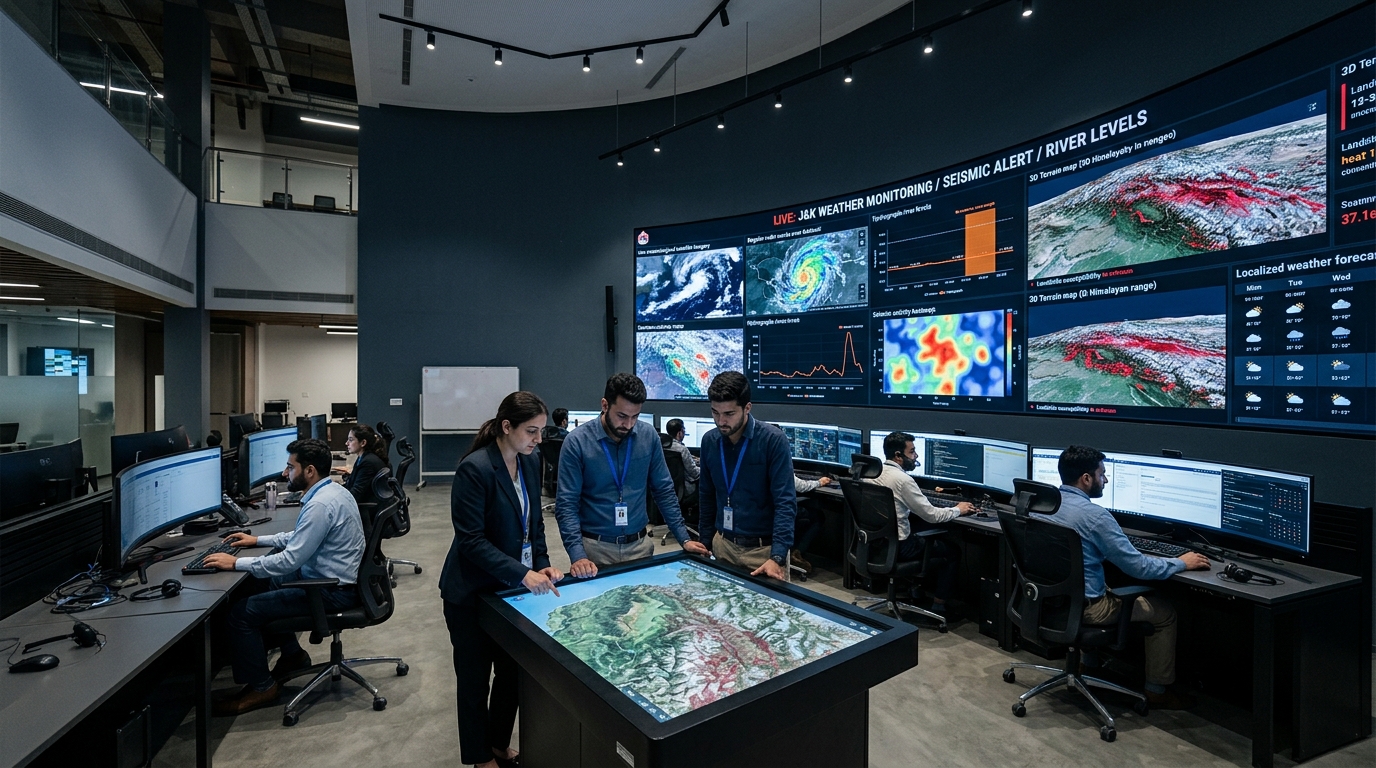
Printed broadsheets, string-tied archival gazette dockets, a reporter’s notebook, and a brass loupe beside dual monitors displaying Himalayan glacier and watershed Earth-observation telemetry—evoking the crossroads between conventional press-release reporting and independent, documentary, scientifically literate mountain journalism (Illustrative editorial study — Himalayan Dispatch Visual Editions Desk; carries no depiction of or allegation against any specific publication or individual).
SPECIAL EDITORIAL INVESTIGATION · POLITICAL ECONOMY OF MEDIA · JOURNALISTIC INDEPENDENCE · SCIENTIFIC LITERACY · MEDIA OWNERSHIP · INVESTIGATIVE ACCOUNTABILITY · PUBLIC INTERESTVOL. 01 / NO. 01 · THE INAUGURAL ISSUE

Journalism at a Crossroads

Beyond breaking news, political statements, press conferences and institutional publicity lies an extraordinary landscape of unexplored scientific questions, forgotten environmental histories, unexamined public expenditure and emerging threats to human civilization. Positioned immediately after the Founding Manifesto as Dispatch 17, this investigation examines the political establishment–media house nexus, government advertising dependency, professional vulnerability, scientific specialization, and the institutional architecture required for independent public-interest journalism across Kashmir, Jammu, Ladakh, Azad Jammu & Kashmir, and Gilgit-Baltistan.

Read Story (49 min)
High-altitude scientific measurement and mountain watershed research context in the Western Himalayas—where decades of field scholarship earn global journal recognition while raising the foundational question of how scientific knowledge returns to local communities and ecosystems (Illustrative archival plate — Kashmir EcoWatch Visual Archive).
SPECIAL SCIENTIFIC INVESTIGATION · ACADEMIC RESEARCH · KNOWLEDGE DISSEMINATION · SCIENTIFIC IMPACT ACCOUNTABILITYVOL. 01 / NO. 01 · THE INAUGURAL ISSUE

Who Are We Researching For? The World Knows Our Mountains. Do We?

Across Kashmir, Jammu, Ladakh, Azad Jammu & Kashmir, and Gilgit-Baltistan, a preliminary working inventory identifies 80 environment-related academic departments, laboratories, research centres, and field facilities—and a single University of Kashmir departmental register records 145 publications in five years alone. Positioned immediately before our Beyond the Conference series, Dispatch 12 inaugurates a strict, non-fabricated 2001–2026 bibliometric census and the Western Himalayan Research-to-Society and Impact Protocol to ask: how much of twenty-five years of mountain science has actually returned to the people and landscapes that made it possible?

Read Story (17 min)
Glaciated headwaters and high mountain ridges of the Western Himalayas—landscapes studied across the world and sustained at home by scientists, advocates, journalists, conservationists, and students navigating formidable institutional odds (Illustrative archival plate — Kashmir EcoWatch Visual Archive).
SPECIAL INTERNATIONAL FEATURE · ENVIRONMENTAL LEADERSHIP · PROFESSIONAL INTROSPECTION · INTELLECTUAL LEGACYVOL. 01 / NO. 01 · THE INAUGURAL ISSUE

South Asia’s Environmental Vanguard

Their journeys were not easy. Neither will ours be. Examining thirty-two distinguished environmental advocates, institution-building NGO leaders, investigative journalists, and pioneering scientists across India and Pakistan—not as distant celebrities, but as four professional mirrors through which the Western Himalayas can confront its own aspirations, institutional constraints, and possibilities.

Read Story (16 min)
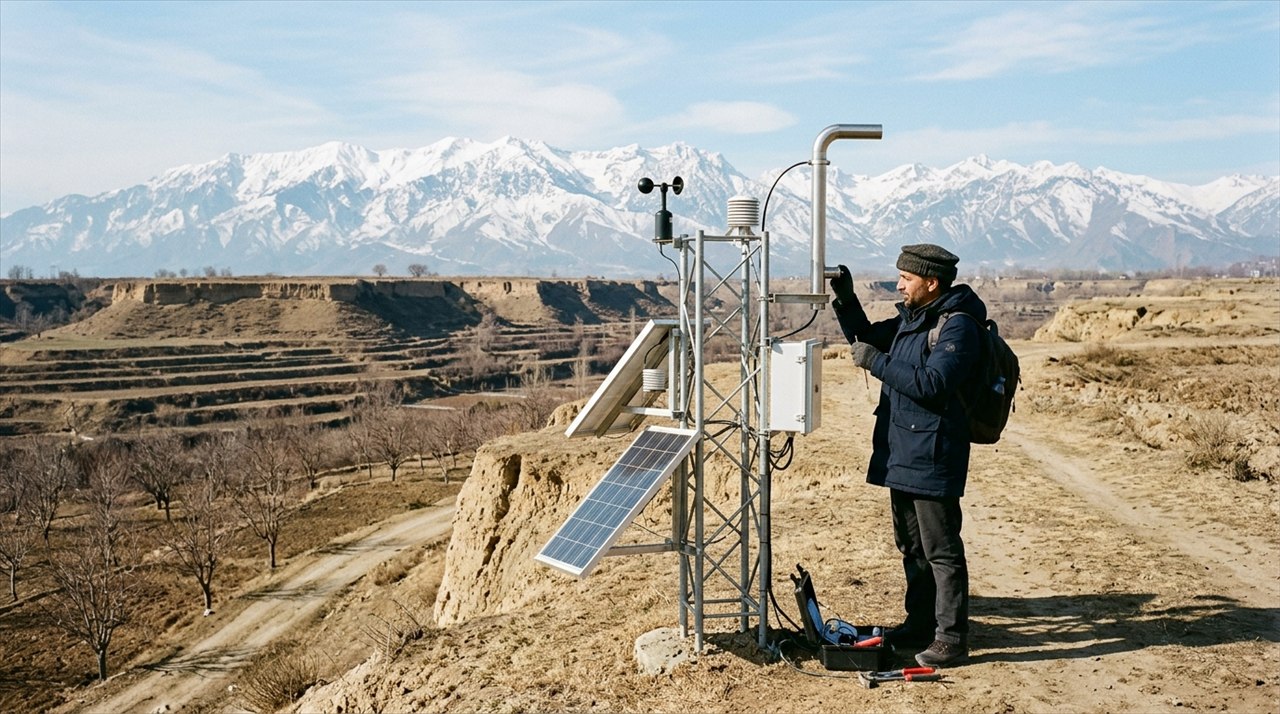
High-elevation atmospheric and watershed observation terrain overlooking a Western Himalayan tableland and snow-fed valley floor (Illustrative archival plate — representative monitoring landscape).
BEYOND THE CONFERENCE · I · SCIENCE & GOVERNANCEVOL. 01 / NO. 01 · THE INAUGURAL ISSUE

Science Has Diagnosed the Valley. Who Will Prescribe Its Governance?

When ECSSPP 2026 adjourned at Gandhi Bhawan in September 2026, decades of Western Himalayan research on glacier retreat, winter aerosol trapping, and wetland contamination stood assembled in an abstract book. Yet no statutory wire connects a peer-reviewed finding at Hazratbal to an enforceable regulatory trigger across the Jhelum basin.

Read Story (23 min)
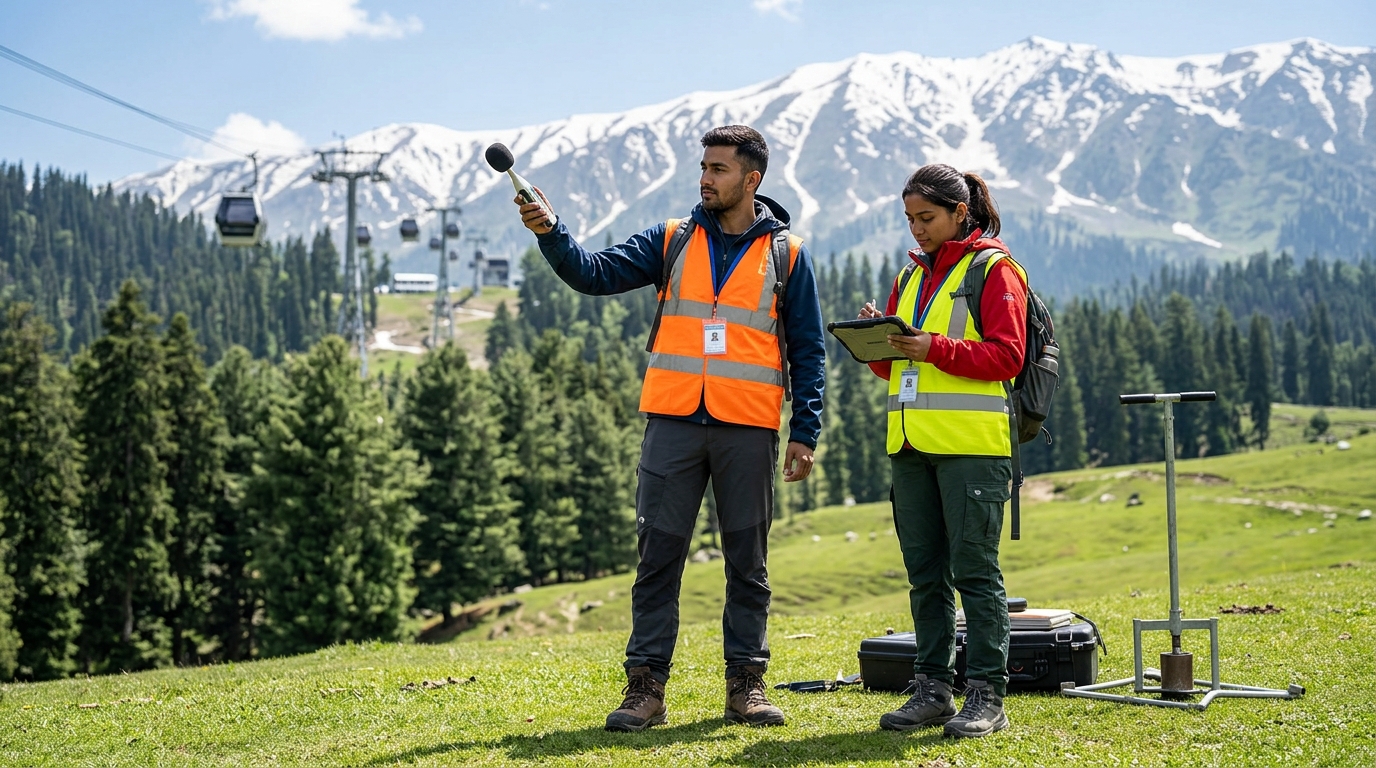
Subalpine valley infrastructure, seasonal road corridors, and montane forest slopes across the Kashmir Himalaya—where physical carrying capacity is governed by dry-season baseflow, slope shear strength, and corridor integrity rather than seasonal visitor targets.
BEYOND THE CONFERENCE · III · ECOLOGICAL LIMITSVOL. 01 / NO. 01 · THE INAUGURAL ISSUE

Who Gave Development the Right to Exceed the Mountain?

In October 2026, the 13th Sustainable Mountain Development Summit at Shalimar placed a draft Jammu & Kashmir Mountain Policy into national deliberation. Yet until ecological thresholds possess statutory power to refuse concrete, tunnels, and unconstrained tourist surges, sustainable mountain development risks becoming polite vocabulary draped over an engineering monologue.

Read Story (24 min)
Steep Western Himalayan river-gorge and mountain infrastructure corridor—where snowmelt gradients generate thousands of megawatts while generating districts confront forest submergence, tunnel hydrogeological shifts, slope instability, and winter power curtailment (Illustrative archival plate — Kashmir EcoWatch Visual Archive).
SPECIAL SCIENTIFIC INVESTIGATION · HYDROPOWER · FOREST SUBMERGENCE · WILDLIFE DISPLACEMENT · TECTONIC HAZARDS · ENERGY JUSTICEVOL. 01 / NO. 01 · THE INAUGURAL ISSUE

The Price of Power

Rivers are diverted, forests are submerged, mountains are tunnelled, wildlife corridors are severed, and communities surrender ancestral valleys to generate low-carbon electricity—yet on November 27, 2026 Jammu & Kashmir warned of a ~1,300 MW winter power gap, flood-damaged stations in Gilgit-Baltistan dropped to 157 MW against 285 MW summer demand, Ladakh ran Nimoo Bazgo and Chutak in emergency isolated mode, and AJ&K residents endured winter outages beside major dams. Completing our three-part mountain engineering sequence, this investigation asks: who receives the electricity, who receives the revenue, and who inherits the ecological and geological risks?

Read Story (14 min)
High-relief Western Himalayan mountain, glacier, and valley-corridor terrain—where locked thrust structures, cryospheric retreat, steep fractured slopes, contracted floodplains, and critical human lifelines converge (Illustrative archival plate — Kashmir EcoWatch Visual Archive).
SPECIAL SCIENTIFIC INVESTIGATION · TECTONIC INSTABILITY · MULTI-HAZARD INTELLIGENCE · CASCADING DISASTERS · CRITICAL INFRASTRUCTURE · DISASTER GOVERNANCEVOL. 01 / NO. 01 · THE INAUGURAL ISSUE

The Western Himalayas Are Sitting on a Time Bomb

Beneath the extraordinary beauty of the Western Himalayas lies an interconnected landscape of active geological faults, retreating glaciers, unstable mountain slopes, expanding glacial lakes, vulnerable settlements, aging infrastructure and intensifying climatic extremes. What happens when these hazards begin interacting with one another? The greatest danger may not be the next earthquake, flood or landslide, but the convergence of multiple hazards within an increasingly vulnerable mountain civilization.

Read Story (19 min)
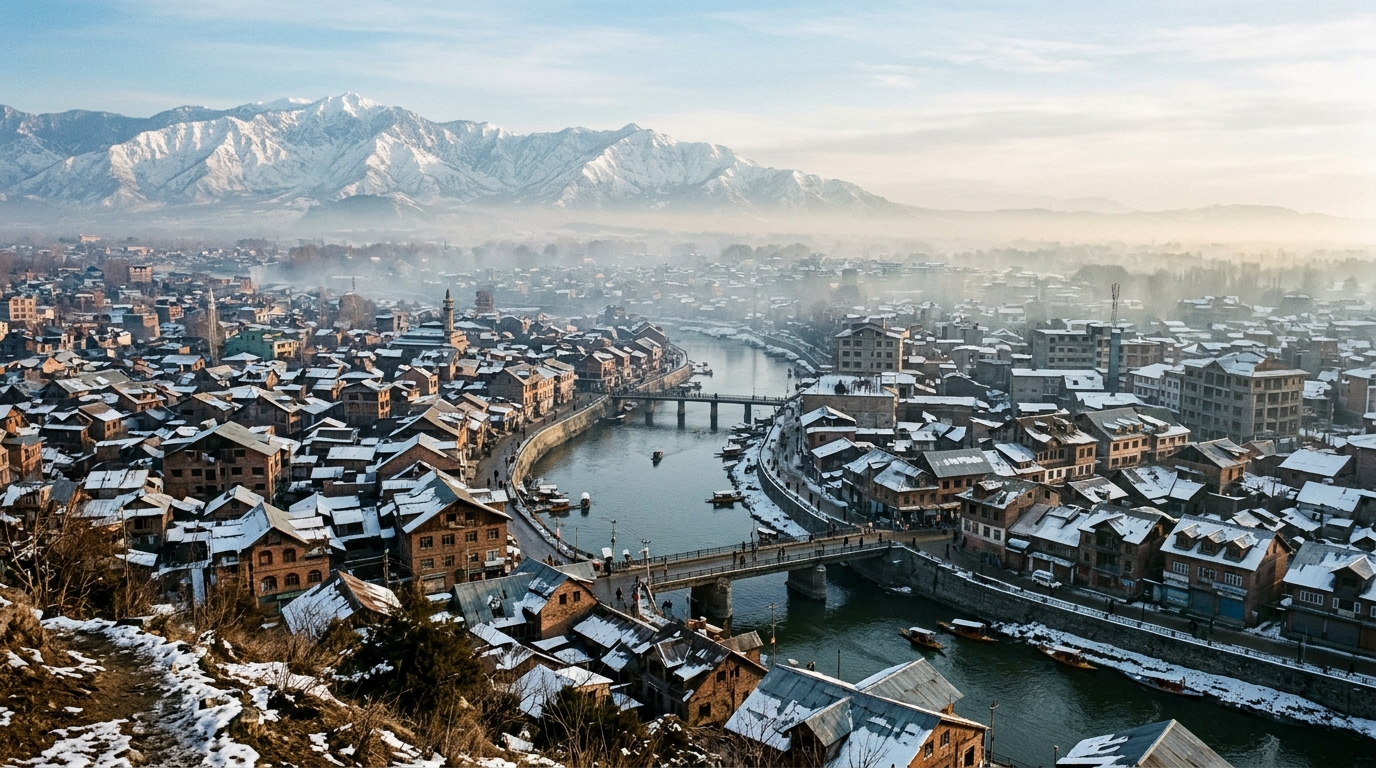
Shallow cold-pool inversion and winter aerosol haze suspended above Srinagar and the Jhelum floodplain beneath Western Himalayan ridges—where radiative surface cooling, weak boundary-layer ventilation, indigenous solid-fuel plumes, and synoptic long-range transport converge (Illustrative archival plate — representative basin meteorology, not incident photography).
SPECIAL SCIENTIFIC INVESTIGATION · CLIMATOLOGY · TRANSBOUNDARY ATMOSPHERIC INTELLIGENCEVOL. 01 / NO. 01 · THE INAUGURAL ISSUE

The Atmosphere Has No Borders: The Air We Breathe, the Numbers We Cannot Trust

In late November 2026, while official pollution screens in Srinagar reported an Air Quality Index near 140, a private digital platform flashed a reported reading of 708—exposing not merely a polluted winter basin, but a crisis of metrological credibility. Moving from civic clean-air governance to physical atmospheric science, Dispatch 17 establishes the ongoing twelve-volume, sixty-chapter Monograph 01 research framework across the Kashmir Valley, the Indo-Gangetic Plain, the Indus corridor, the Taklamakan rim, and Central Asia.

Read Story (26 min)
Fragile Western and Trans-Himalayan wetland, pasture, and mountain watershed terrain—landscapes governed across five regions by four distinct legal frameworks yet repeatedly left defenceless between administrative clearance, missing infrastructure, and ex-post judicial review (Illustrative archival plate — Kashmir EcoWatch Visual Archive).
SPECIAL LEGAL & SCIENTIFIC INVESTIGATION · ENVIRONMENTAL JURISPRUDENCE · LEGISLATIVE REFORM · REGULATORY ACCOUNTABILITYVOL. 01 / NO. 01 · THE INAUGURAL ISSUE

When Environmental Laws Exist but the Environment Has No Defence

The Western Himalayas do not exist in a legislative vacuum: across Kashmir, Jammu, Ladakh, Azad Jammu & Kashmir, and Gilgit-Baltistan, four distinct legal systems deploy dozens of statutes, constitutional guarantees, and subordinate rules—yet 518 of 697 historically inventoried lakes in J&K have disappeared or shrunk after a 22-year lake-bill delay, Ladakh reported a 12.33 MLD sewage treatment gap before the NGT, Neelum–Jhelum diversions triggered downstream water scarcity around Muzaffarabad, and placer gold mining along Gilgit-Baltistan rivers exposed enforcement gaps. Answering five foundational questions, this Special Legal & Scientific Investigation separates pure enforcement failure from statutory obsolescence and sets out 15 model legislative reform packages.

Read Story (26 min)
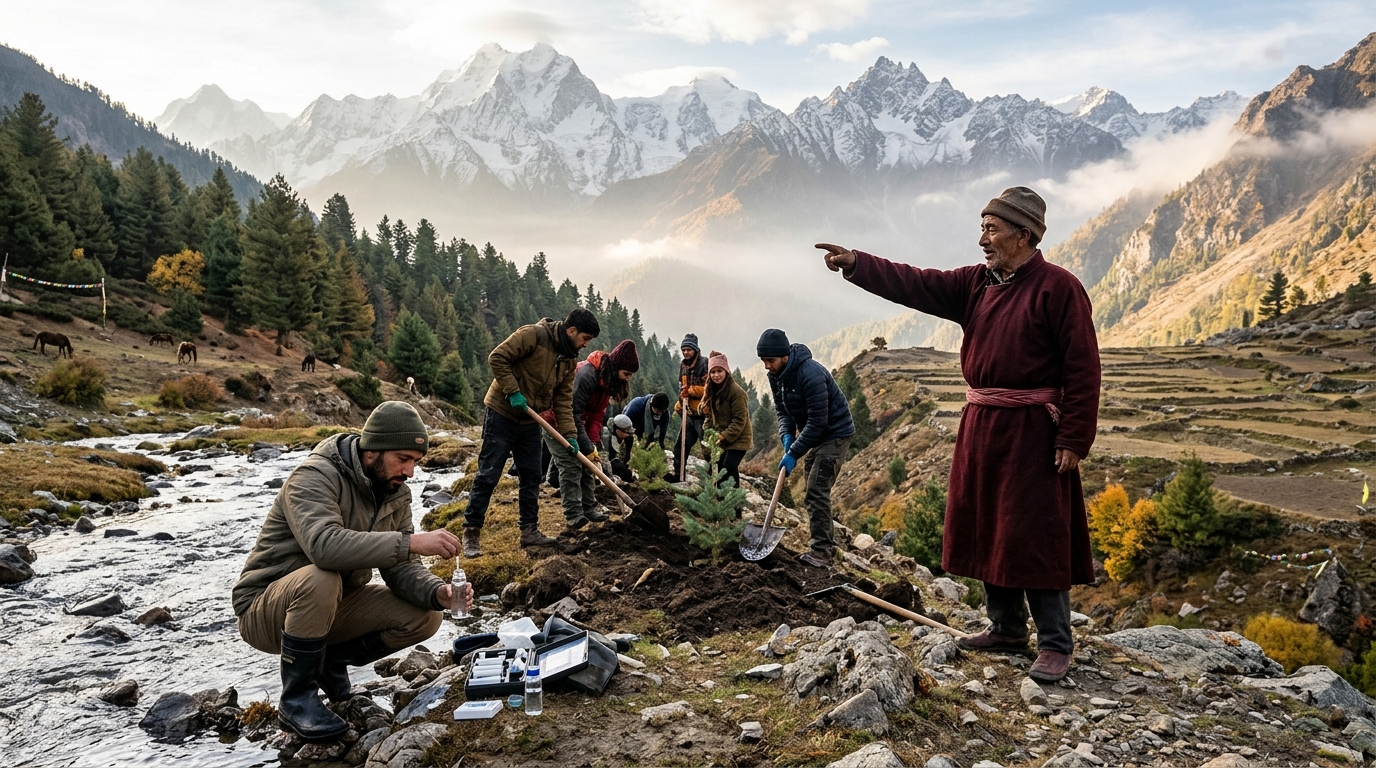
Community stewardship and field mobilization across a Western Himalayan landscape—where the enduring test of environmental action is not the banner unfurled on day one, but the living tree, flowing spring, and enforced legal buffer still standing five winters later.
CIVIL SOCIETY & ACCOUNTABILITY · IV · ACTIVISM & OUTCOMESVOL. 01 / NO. 01 · THE INAUGURAL ISSUE

Who Measures the Success of Environmental Activism?

Across Jammu, Kashmir, and Ladakh, environmental trusts, litigation collectives, youth clubs, and digital observatories rightly demand rigorous transparency from the state. Yet when Kashmir EcoWatch audited its own NGO registry in November 2026 and found placeholder claims of "Positive impact projected" alongside unverified sapling and cleanup tallies across the wider movement, an inescapable question emerged: will environmentalism hold itself to the same evidentiary law it demands of government?

Read Story (21 min)
Floodplain wetlands, river channels, and mountain catchments in the Western Himalayas—where five-year electoral pledges on tourism, highways, hydropower, mining, and lake rejuvenation meet generational hydrological and ecological law (Illustrative archival plate — Kashmir EcoWatch Visual Archive).
SPECIAL INVESTIGATION · ELECTORAL ACCOUNTABILITY · ENVIRONMENTAL MANIFESTOS · GOVERNANCEVOL. 01 / NO. 01 · THE INAUGURAL ISSUE

When Politics Promises Green

Across Kashmir, Jammu, Ladakh, Azad Jammu & Kashmir, and Gilgit-Baltistan, every election brings pledges of tourism, highways, hydropower, employment, and green conservation. Examining twenty-six years of electoral politics (2000–2026) under one non-partisan evidentiary ruler, Himalayan Dispatch investigates what parties actually promised, where development pledges contradict ecological limits, who held constitutional power to act, what public budgets delivered on the ground, and how our ten-part Western Himalayan Environmental Manifesto Protocol (WHEMP) turns slogans into auditable century-scale stewardship.

Read Story (18 min)
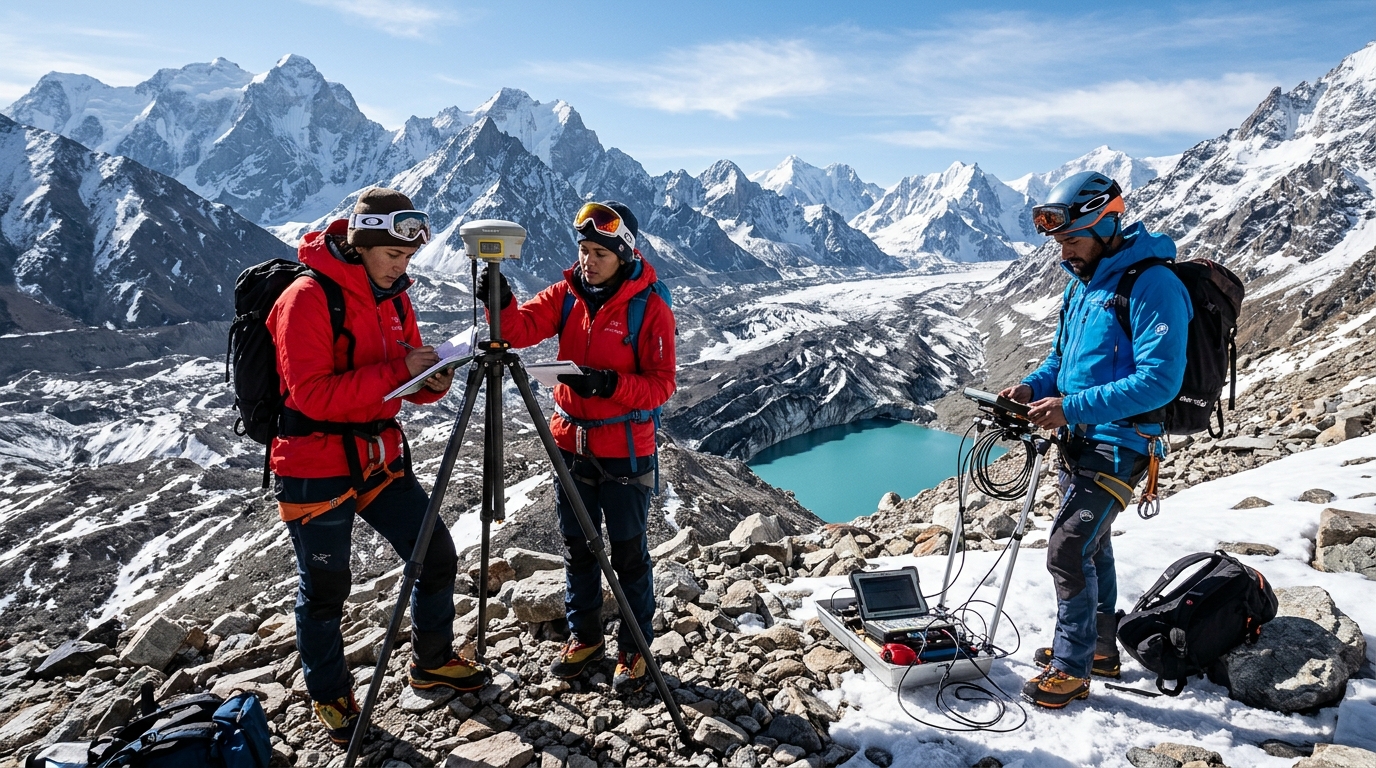
Oligotrophic high-altitude glacial waters and moraine headwalls at Sheshnag (3,590 m) in the Upper Lidder catchment—where periglacial slope mechanics, cold-water nutrient thresholds, and downstream watershed survival obey identical physical laws regardless of political, commercial, religious, or community identity (Illustrative archival plate — Kashmir EcoWatch Visual Archive).
SPECIAL INVESTIGATION · POLITICAL ECOLOGY · ENVIRONMENTAL ETHICS · UNIVERSAL ACCOUNTABILITYVOL. 01 / NO. 01 · THE INAUGURAL ISSUE

Selective Environmental Consciousness

A comprehensive historical, scientific, sociological and institutional investigation into environmental activism, collective behaviour, ecological destruction and universal environmental responsibility—from the 2008 Baltal–Domail forestland agitation, Ladakh’s 2023–2026 constitutional movement, and the November 2026 Sheshnag excavation controversy to the normalized sewage, wetland, karewa, and riverbed degradation across the Western Himalayas.

Read Story (29 min)
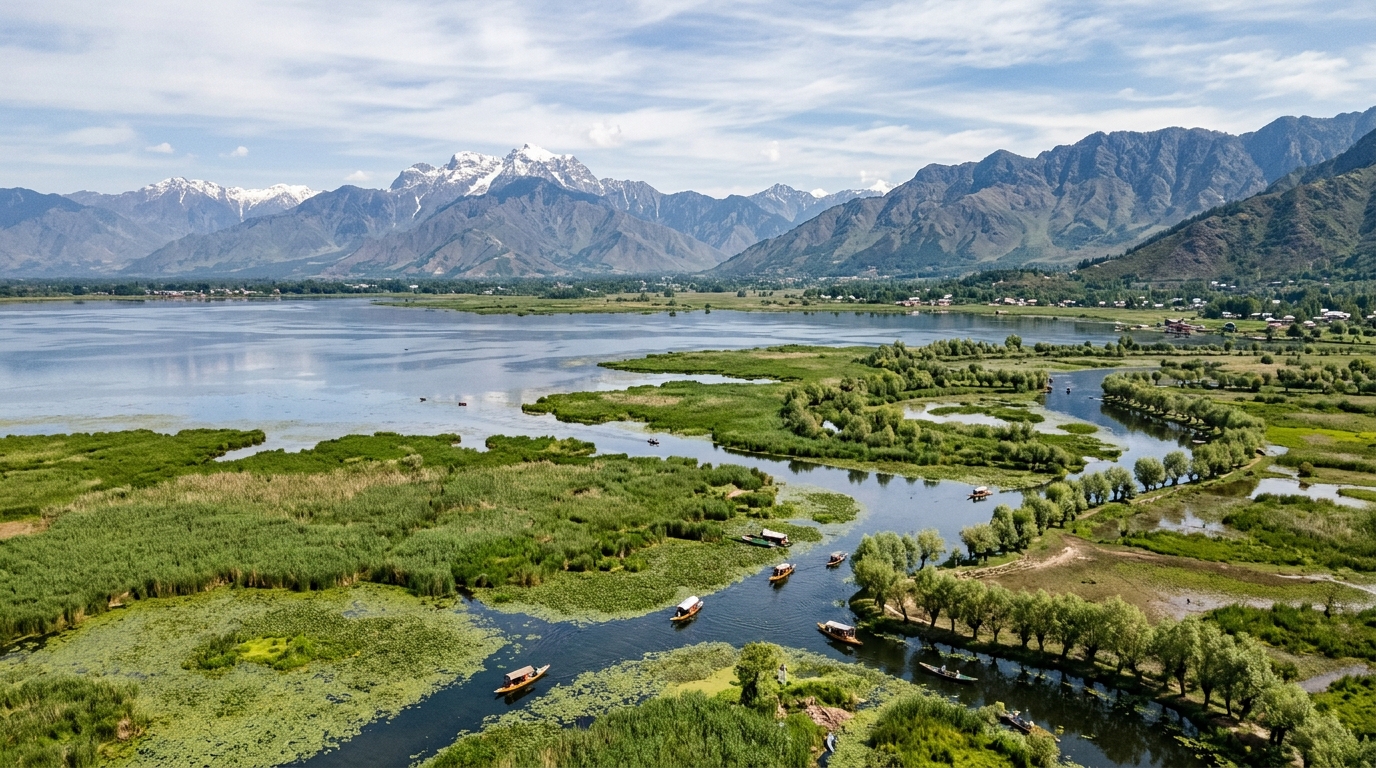
Open-water floodplain storage and peripheral willow marshes across the Wular detention basin in the Kashmir Valley—terminal natural regulator of the Upper Jhelum continuum (Illustrative archival plate — Kashmir EcoWatch Visual Archive).
MONOGRAPH 00 · WATERSHED VOICES · FOUNDATIONAL INQUIRYMONOGRAPH 00 · WATERSHED VOICES

Where the River First Learns Its Name

The Jhelum is not merely a channel between embankments. From snowfields and fractured Upper Triassic limestone conduits above Verinag to twenty-eight tributary sub-basins, incised gravel beds, forgotten urban canals, and the shrinking floodwater sanctuary of Wular, Kashmir’s axial river is a single living watershed confronting fragmented governance and non-stationary climate extremes.

Read Story (36 min)
High-altitude Trans-Himalayan glacier ablation zone, moraine threshold, and headwater meltwater drainage representative of Ladakh’s cryosphere-dependent catchments across Zanskar, Suru, Leh, and the Karakoram margin (Illustrative archival plate — Kashmir EcoWatch Cryosphere Visual Archive).
LADAKH SCIENTIFIC INVESTIGATION I · CRYOSPHERE, PERMAFROST & COLD-DESERT WATER SECURITYSPECIAL SCIENTIFIC ISSUE · LADAKH'S ECOLOGICAL FRONTIERS

When the Glaciers Stop Giving

In a Trans-Himalayan rain shadow where valley floors receive barely 90–150 millimetres of annual precipitation, human settlement exists only where snowfields, small cirque glaciers, and permafrost active layers release meltwater on time. Anchored in a 2026 scientific synthesis documenting ~0.02°C annual warming, earlier snowmelt, and glacier mass losses of 0.21 to 0.37 metres of water equivalent per year, this investigation examines how hydrograph shifts across Zanskar, Suru, Nubra, Leh, Kargil, Drass, and Changthang threaten gravity-fed oases long before the last ice vanishes.

Read Story (14 min)
High-altitude Trans-Himalayan cold-desert terrain, alluvial outwash fans, endorheic wetland margins, and cryospheric ridgelines in Ladakh where compressed summer visitor pulses, commercial groundwater extraction, highway corridors, and rangeland energy footprints converge upon hyper-arid hydrological limits (Illustrative archival plate — Kashmir EcoWatch Visual Archive).
LADAKH SCIENTIFIC INVESTIGATION II · TOURISM, URBANIZATION & ECOLOGICAL CARRYING CAPACITYSPECIAL SCIENTIFIC ISSUE · LADAKH'S ECOLOGICAL FRONTIERS

How Many People Can a Cold Desert Sustain?

As seasonal tourist arrivals rival or outnumber permanent oasis populations across Leh, Nubra, Pangong Tso, and Zanskar—prompting a 2026 parliamentary committee warning on water scarcity and waste alongside strengthened June 2026 plastic restrictions—an empirical investigation examines borewell depletion, the shift from zero-water chakdon sanitation to flush hotels, year-round tunnel connectivity, Changthang solar enclosures, and the biophysical limits of a rain-shadow desert.

Read Story (17 min)
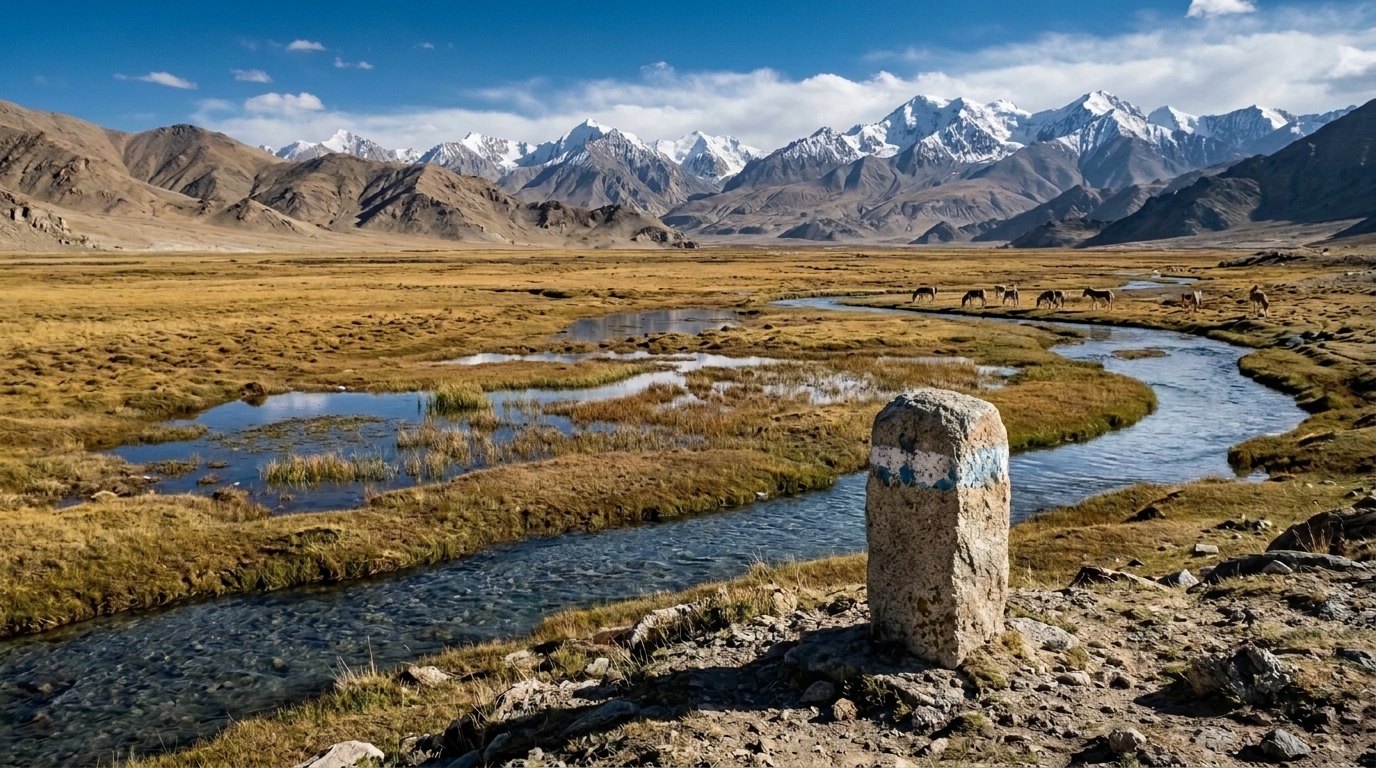
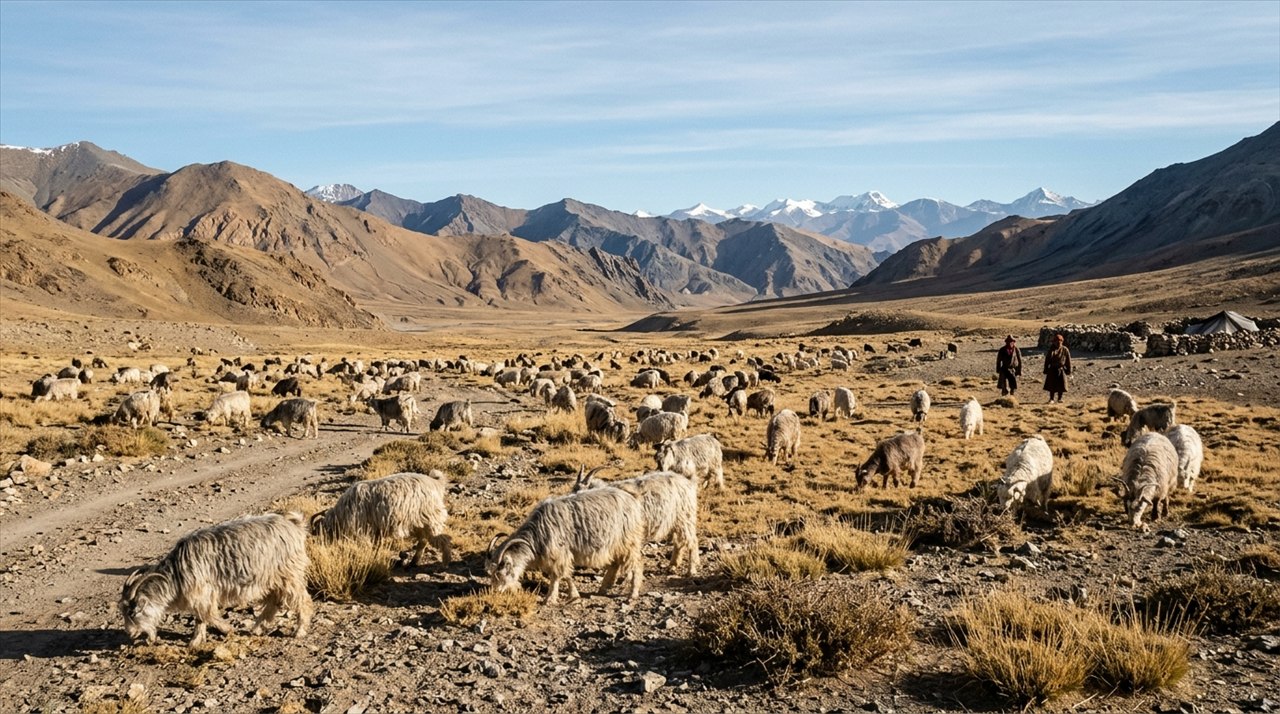
High-elevation sedge-meadow fringes, cryoturbated gravel fans, and seasonal transhumant grazing landscapes across the Changthang plateau—where permafrost soil moisture, snowmelt marshes, wild ungulates, and mobile Changpa pastoralism converge (Illustrative archival plate — Kashmir EcoWatch Visual Archive).
LADAKH SCIENTIFIC INVESTIGATION III · HIGH-ALTITUDE WETLANDS, WILDLIFE CORRIDORS & ALPINE RANGELANDSSPECIAL SCIENTIFIC ISSUE · LADAKH'S ECOLOGICAL FRONTIERS

The Desert Is Not Empty

Dismissed in colonial revenue ledgers and contemporary land-bank schedules as barren wasteland, Ladakh’s Trans-Himalayan plateau sustains psychrophilic permafrost microbiomes, Ramsar wetland refugia, sixty-five high-concern bird species, snow leopard and wild ungulate corridors, and centuries-old Changpa Pashmina commons now strained by linear fragmentation and climate change.

Read Story (19 min)

Filed Daily Dispatches

1 DISPATCHES
2026-11-05  ·  Gilgit Bureau (In Establishment)  ·  Cryosphere, Glaciers & High PassesLate-Season Optical & Radar Synthesis Tracks Autumn Drainage Stability Across Karakoram Ice-Dammed Tributaries

Multi-temporal satellite observations across the Hunza, Ghizer, and Shyok headwaters highlight why transboundary cryospheric data sharing remains vital for downstream valley communities.

FORTHCOMING SLATE

Approved Upcoming Assignments

CONFIDENTIAL INVESTIGATIONS OMITTED

No publicly cleared pre-publication assignments are currently listed on the open slate for this correspondent. Sensitive or embargoed reporting remains undisclosed until publication.