The Chinars in the Shadow of Concrete
Naseem Bagh: When an Institution of Higher Learning Expands Within a Landscape of Living Heritage
Four Centuries of Living Heritage—and an Institutional Contradiction
What happens when an institution that teaches ecology, botany, geography, remote sensing, and environmental law expands inside one of Kashmir’s oldest Mughal Chinar gardens?
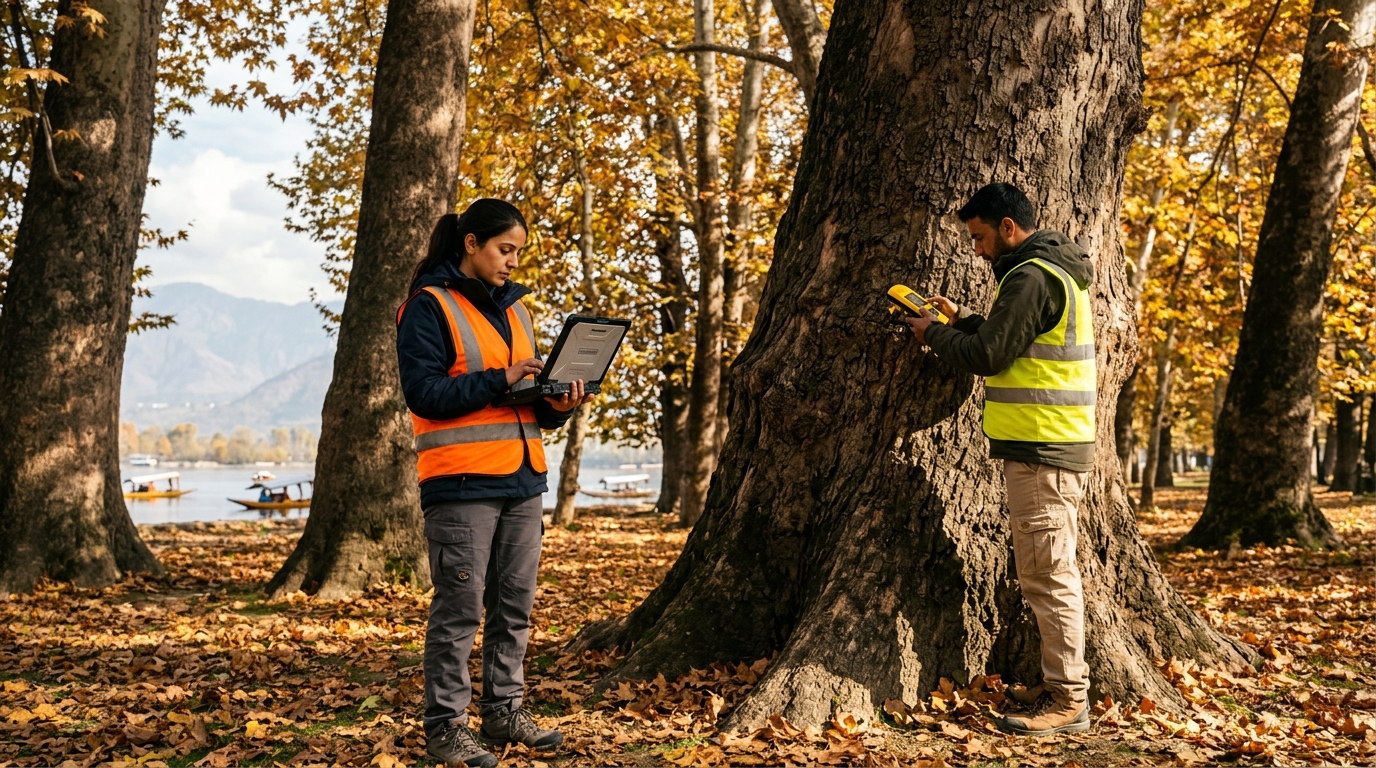
Positioned immediately after our investigation into Srinagar’s Sálim Ali National Park, Naseem Bagh confronts Kashmir with an even more intimate institutional paradox: the responsibility of an institution of higher learning that teaches environmental science, botany, geography, remote sensing, and conservation law toward the four-century living heritage entrusted to its own campus. Associated with the Mughal reigns of Akbar (1586) and Shah Jahan (1635), Naseem Bagh—"the Garden of Morning Breeze" beside Dal Lake—was conceived long before a modern university existed as an integrated cultural and ecological design: ordered Chinar avenues, continuous summer shade, permeable meadow ground, open sightlines to the lake, and centuries-old trees functioning as one living landscape.
Protecting isolated tree trunks while progressively filling the open garden around them with multi-storey academic blocks, guest houses, hostels, stadiums, asphalt roads, and utility trenches does not preserve a historical garden. This inquiry is grounded not in nostalgia, but in a recurring documentary record spanning multiple university administrations—from 2007 guest-house excavations and 2008 heritage-park announcements to 2010–2011 felling reports, the university’s own 2021–22 Environmental Audit, May 2024 rubble dumping, September 2024 stadium pressures, a Chinar falling onto a newly built Institute of Music and Fine Arts block in 2025–26, and fresh November 2026 calls by the Environmental Policy Group for an independent inquiry into campus heritage trees.
Rigorous science begins with strict arithmetic honesty. Historical planting traditions associating 1,200+ Chinars (or a 992-tree historical account cited in 2011) with Naseem Bagh cannot be subtracted from contemporary university figures (~700 in the 2021–22 audit; 696 in the Institutional Calendar) to claim construction-caused loss without accounting for four centuries of natural mortality, replacements, and boundary shifts. Likewise, the 22 Chinars reported cut in 2011 and the 16+ mature Chinars cited by INTACH Kashmir’s Saleem Beg at Hamzah Guest House may overlap and must never be summed without incident-level verification.
DOCUMENTED NASEEM BAGH EVIDENCE BASELINES · STRICT NON-SUBTRACTION & NON-ADDITION PROTOCOL
Historical planting estimates (1,200+; 992) and contemporary counts (~700; 696; 710) cannot be directly subtracted to establish construction-related tree loss; similarly, the reported 22 (2011) and 16+ (Hamzah Guest House) felled trees may overlap and are never added without primary verification.
“A historical garden is not merely a collection of surviving trees. It is the ecological and cultural relationship between those trees and the landscape surrounding them.”
The Heritage Park That Continued to Receive Concrete (1586–November 2026)
From the Institutional Calendar’s pledge to shift departments out of Naseem Bagh to nine categories of modern concrete expansion and the 2007–2011 conflict-displacement rationale.
Few institutional documents frame the Naseem Bagh contradiction more starkly than the University of Kashmir’s own historical Institutional Calendar, which records 696 Chinar trees and explicitly states that several academic departments were shifted from Naseem Bagh to the main Hazratbal campus specifically to facilitate Naseem Bagh’s development as a heritage garden. In March 2008, university authorities again announced plans for heritage protection—and in 2021–22, the university’s Environmental Audit reiterated plans to develop Naseem Bagh as a Chinar heritage park.
Yet a proposed heritage park is not a legally notified, boundary-demarcated, and professionally governed heritage park. In January 2010, reporting documented two Chinars felled shortly after heritage-park announcements; in February 2011, Kashmir Life documented continuing construction and 22 Chinars cut; in September 2023, Outlook India examined concrete encroachment on Mughal garden character; in May 2024, Daily Excelsior reported construction waste dumped inside Naseem Bagh; and in September 2024, Mongabay-India highlighted further construction pressures including an indoor stadium. Across Distance Education, Hamzah Guest House, the Law Department, student hostels, the indoor stadium, the Institute of Music and Fine Arts, internal roads/parking, staff quarters, and subsurface utilities, incremental building decisions repeatedly outpaced formal heritage zoning.
History also requires examining how wider political conflict entered campus land-use decisions. In February 2011, Professor B. A. Wafai, then associated with the university’s Landscape Division, explained that constructing a new guest house—begun in 2007—had become necessary because the university’s earlier guest accommodation was occupied by security forces, within the same report recording activist Zareef Ahmad Zareef’s allegation that excavations had damaged the roots of roughly 20 Chinars. That record does not prove conflict caused every transformation in Naseem Bagh, but it documents how conflict-linked facility displacement was invoked to place permanent concrete inside an irreplaceable heritage grove—raising the vital question of whether non-heritage alternative sites were rigorously assessed.
PART III, IV & V · CHRONOLOGY OF TRANSFORMATION & NINE INFRASTRUCTURE FILES
Documented timeline from Mughal establishment through November 2026, paired with campus developments requiring primary site-selection and permit verification.
| Period or Campus Infrastructure | Documented Event or Principal Forensic Question |
|---|---|
| Mughal period (1586 / 1635) | Establishment under Emperor Akbar and subsequent Chinar avenue expansion under Shah Jahan (Azam Khan) overlooking Dal Lake. (Mughal historical chronicles & INTACH Kashmir cultural-landscape records) |
| 1948 onwards | Establishment of university higher education in Kashmir and progressive institutional expansion across Hazratbal and Naseem Bagh. (University of Kashmir Institutional Calendar (UniCal)) |
| 2007 | New guest-house and campus construction activity initiated within Naseem Bagh; university cites security-force occupation of earlier guest facility. (Kashmir Life (Feb 2011, citing Prof. B. A. Wafai)) |
| March 2008 | University authorities publicly announce plans to protect and develop Naseem Bagh as a Chinar heritage park. (Contemporary press & institutional announcements (2008)) |
| January 2010 | Two Chinars reportedly felled for campus facilities shortly after public heritage-park announcements. (Oneindia News & regional press archives (Jan 2010)) |
| February 2011 | Investigative reporting identifies 22 Chinars cut amid campus development and heritage-park plans; Zareef Ahmad Zareef alleges root damage to ~20 Chinars. (Kashmir Life ("Unsafe in the University", Feb 2011)) |
| November 2019 | University issues campus safety advisory after unseasonal heavy snowfall damages mature Chinar limbs. (University of Kashmir campus advisories (Nov 2019)) |
| 2021–22 | University Environmental Audit documents ~700 Chinars in Naseem Bagh (710 in Table 6; >500 in summary), reiterates Chinar heritage-park plans, and notes infrastructure pressure on green spaces. (DIQA University of Kashmir Green/Environmental Audit 2021–22 (p. 23)) |
| September 2023 | National media investigates fading Mughal-garden character and heritage deterioration associated with concrete campus buildings. (Outlook India Weekender investigation (Sept 2023)) |
| May 2024 | Dumping of construction waste and rubble reported inside Naseem Bagh root zones. (Daily Excelsior report (May 2024)) |
| September 2024 | Environmental reporting documents continuing construction pressures in Naseem Bagh, including an indoor stadium facility. (Mongabay-India report (Sept 2024)) |
| 2025–26 | A mature Chinar falling onto a newly constructed Institute of Music and Fine Arts (IMFA) block elevates tree-building proximity into a campus safety dispute. (University safety statements & regional reporting (2025–26)) |
| November 2026 | Controversy over pruning/cutting of century-old heritage sweet chestnut trees renews public scrutiny; Environmental Policy Group (EPG) seeks independent inquiry. (Kashmir Observer (Nov 13, 2026) & Greater Kashmir (Nov 17, 2026)) |
| Audit File · Distance Education Department | Original site selection, faculty/heritage objections, and footprint over historical lawn axes — Focus: Interruption of Mughal spatial geometry and pedestrian/vehicular soil compaction |
| Audit File · Hamzah Guest House | Reported felling of 16+ mature Chinars (INTACH Kashmir’s Saleem Beg) and alleged root damage to ~20 Chinars (Zareef Ahmad Zareef); security-occupation rationale cited for prior guest house — Focus: Foundation trenching across structural root plates and potential overlap with 2011 22-tree tally |
| Audit File · Law Department building | Construction footprint, impervious apron expansion, and adjacent mature canopy modifications — Focus: Crown-building clearance conflicts and altered surface rainwater infiltration |
| Audit File · Student hostels | Cumulative impact on historical garden continuity, sewage/utility trenching, and daily footfall — Focus: Subsurface utility excavations cutting absorbing root networks |
| Audit File · Indoor stadium | Alternative non-heritage site assessment, large-span footprint, and environmental safeguards — Focus: High-volume soil sealing and loss of unbuilt permeable meadow ground |
| Audit File · Institute of Music and Fine Arts (IMFA) | Why building siting placed new academic rooms within the structural root and fall zone of mature Chinars — Focus: Post-construction reclassification of adjacent heritage trees as safety hazards |
| Audit File · Internal roads and vehicle parking | Extent of soil sealing, curb-cut root severance, and heavy-vehicle compaction over drip lines — Focus: Root-zone hypoxia (reduced O₂ diffusion) and suppressed natural regeneration |
| Audit File · Staff accommodation | Historical land-use transformation from open Chinar grove to fenced residential plots — Focus: Fragmentation of continuous ground-story ecology and garden sightlines |
| Audit File · Subsurface & overhead utility infrastructure | Repeated unmonitored trench excavation directly through Chinar Root Protection Zones (RPZs) — Focus: Cumulative root-system severance and pathogen entry wounds (CODIT breakdown) |
Inside the University’s Own Environmental Audit—and the Chinar Census Discrepancy
Why 74.66 hectares of main-campus land use must be separated from Naseem Bagh proper, and why stable tree counts never prove that ancient canopy survived.
Institutional accountability is strongest when anchored in the institution’s own scientific work. Prepared with contributions from university departments, the 2021–22 Environmental Audit explicitly recognizes that campus green spaces face mounting pressure from infrastructure expansion. Its published land-use table reports 74.66 hectares of total main-campus area—comprising parks (34.89 ha), green spaces (15.04 ha), built-up area (9.97 ha), playgrounds (7.59 ha), roads (6.03 ha), and vehicle parking (0.88 ha). Crucially, however, those figures describe the reported main-campus inventory rather than Naseem Bagh as an independent historical parcel—making a dedicated cadastral and multi-temporal land-use reconstruction of Naseem Bagh essential.
Equally instructive is the variation across Chinar numbers inside institutional and historical records: 992 in a historical account cited in 2011; 718 in an official’s initial inventory; 696 after the removal of 22 trees (matching the Institutional Calendar); "approximately 700" in Naseem Bagh in the 2021–22 audit text; 710 across the reported campus inventory in Table 6 (page 23); and "more than 500" in Naseem Bagh in the audit’s summary. Divergent phrasing does not prove bad faith, but it underscores the urgent necessity of a unified, individually georeferenced census.
Above all, arboricultural science warns against tree-count complacency: a stable or rising stem count achieved by planting young saplings cannot substitute for the crown volume, microclimatic cooling, mycorrhizal soil web, hollow-cavity fauna habitat, carbon stock, or four-century cultural memory of a veteran Mughal Chinar. Nor should the historical vernacular huts and modest structures of Naseem Bagh be overlooked—replacing low-slung structures adaptable for reuse with tall, deep-foundation concrete blocks transforms the entire spatial identity of the garden.
PART VII · UOK 2021–22 LAND-USE INVENTORY & SEVEN CHINAR CENSUS BENCHMARKS
Published main-campus land-use categories (74.66 ha reported total, distinct from Naseem Bagh standalone area) alongside historical and institutional Chinar enumerations.
| Land-Use Category or Census Source | Reported Figure & Methodological Interpretation |
|---|---|
| Main Campus · Parks | 34.89 hectares (46.73% of 74.66 ha reported main-campus total — separate Naseem Bagh boundary audit required) |
| Main Campus · Green spaces | 15.04 hectares (20.14% of 74.66 ha reported main-campus total — separate Naseem Bagh boundary audit required) |
| Main Campus · Built-up area | 9.97 hectares (13.35% of 74.66 ha reported main-campus total — separate Naseem Bagh boundary audit required) |
| Main Campus · Playgrounds | 7.59 hectares (10.17% of 74.66 ha reported main-campus total — separate Naseem Bagh boundary audit required) |
| Main Campus · Roads | 6.03 hectares (8.08% of 74.66 ha reported main-campus total — separate Naseem Bagh boundary audit required) |
| Main Campus · Vehicle parking | 0.88 hectares (1.18% of 74.66 ha reported main-campus total — separate Naseem Bagh boundary audit required) |
| Census · Mughal garden historical planting tradition | 1,200+ — Historical cultural-landscape estimate associated with Akbar / Shah Jahan plantations; cannot be directly subtracted from modern counts without boundary and natural-mortality reconstruction. |
| Census · Historical account cited in February 2011 reporting | 992 — Historical enumeration cited in Kashmir Life (2011); parcel boundaries and survey date require archival verification. |
| Census · University official's reported initial inventory (cited 2011) | 718 — Reported baseline prior to the removal of 22 trees discussed in 2011 investigative reporting. |
| Census · UoK Institutional Calendar (UniCal) / Post-removal inventory | 696 — Recorded in UoK Institutional Calendar alongside statement that academic departments were shifted from Naseem Bagh to develop it as a heritage garden (718 − 22 = 696). |
| Census · UoK Environmental Audit 2021–22 (narrative text) | Approximately 700 — Approximate figure cited for Naseem Bagh while reiterating Chinar heritage-park development plans. |
| Census · UoK Environmental Audit 2021–22 (Table 6, p. 23) | 710 across reported campus inventory — Tabulated campus-wide Platanus orientalis count; includes saplings/younger replacements alongside ancient trees. |
| Census · UoK Environmental Audit 2021–22 (executive summary) | More than 500 in Naseem Bagh — Conservative summary phrasing within the same 2021–22 audit—demonstrating why an individually georeferenced Tree Aadhaar census stratified by age/girth is indispensable. |
The Invisible Destruction Underground—and the Contradiction of Tree Safety
How concrete slabs, trenches, and soil compaction kill veteran Chinars over decades—and why placing buildings inside mature tree fall zones manufactures "safety hazards".
Felled trunks draw headlines; rhizosphere suffocation kills quietly over twenty years. Around a centuries-old Platanus orientalis whose Girth at Breast Height exceeds four to five metres, absorbing feeder roots and structural buttress plates radiate far beyond the visible trunk—internationally codified under British Standard BS 5837:2012 and ISA arboricultural guidelines as a minimum Root Protection Radius of twelve times trunk diameter (and fifteen times diameter for ancient veteran trees). When foundations sever structural roots, heavy machinery compacts alluvial garden soil above 1.6 g/cm³ bulk density, alkaline mortar rubble alters soil pH, asphalt seals off oxygen and rainwater infiltration, and utility trenches repeatedly slice root zones, a standing Chinar enters slow carbohydrate starvation and heartwood fungal decay (Inonotus, Ganoderma)—appearing alive when the ribbon is cut on a new building, only to suffer crown dieback or windthrow years later.
That biological reality illuminates the campus safety controversy of 2025–2026. Defending tree-pruning interventions in November 2026—amid separate calls from the Environmental Policy Group for an independent inquiry into the cutting/pruning of century-old sweet chestnut trees—university officials pointed to an earlier incident in which a Chinar fell onto a newly constructed block of the Institute of Music and Fine Arts. Protecting students, faculty, and staff from falling limbs is an indisputable duty. Yet the sequence poses an inescapable planning question: why was a new academic building sited close enough to mature heritage Chinars—potentially encroaching on their root stability zones and target fall radii—that four-hundred-year-old trees subsequently became classified as threats to the building?
Reconciling human safety with living heritage requires pre-construction arboricultural setbacks, sonic tomography cavity diagnostics, dynamic crown cabling, and snow-load pruning standards—never constructing right beside veteran trees and blaming the trees afterward.
PART VIII & X · TWELVE ROOT-ZONE STRESSORS & FOURTEEN LANDSCAPE-LOSS METRICS
Subsurface biological mechanisms of construction-induced Chinar decline paired with quantitative indicators for forensic reconstruction.
| Construction Stressor or Scientific Indicator | Biological Consequence or Required Forensic Measurement |
|---|---|
| 01 · Concrete & asphalt paving | Seals soil pores, blocking rainwater percolation and reducing rhizosphere oxygen diffusion below root respiration needs |
| 02 · Foundation excavation | Severs structural buttress roots and fine absorbing feeder roots within the Critical Root Zone (12× DBH) |
| 03 · Heavy construction machinery | Compacts alluvial garden loams (bulk density >1.6 g/cm³), crushing macropores and halting fine-root regeneration |
| 04 · Construction debris & cement washout | Raises soil pH (alkaline lime/mortar leachate), contaminates topsoil, and obstructs natural surface drainage |
| 05 · Excessive or unbalanced pruning | Depletes foliar photosynthetic capacity, starves root carbohydrate reserves, and exposes heartwood to decay |
| 06 · Grade changes & soil fill | Buries root flares causing bark suffocation and collar rot, or strips nutrient-rich surface humus horizons |
| 07 · Altered surface drainage | Induces either anaerobic root-zone waterlogging or acute summer moisture deficits in mature crowns |
| 08 · Repeated utility trenching | Inflicts serial linear root amputations for cables, water pipes, and drains across multiple decades |
| 01 · Historical tree population | Number of documented mature Mughal/pre-1948 Chinar specimens |
| 02 · Current tree population | Individually georeferenced, QR-tagged census with girth and height |
| 03 · Mature canopy extent | Hectares of contiguous mature Platanus orientalis crown projection |
| 04 · Canopy fragmentation | Gap-fraction, patch isolation, and avenue-continuity indices over time |
| 05 · Tree age & girth distribution | Centuries-old veteran specimens (GBH >4 m) vs. post-2000 saplings |
| 06 · Built-up expansion | Square metres of historical garden converted to permanent buildings |
| 07 · Impermeable surface area | Asphalt roads, concrete walkways, curbs, and parking lots inside Naseem Bagh |
| 08 · Root-zone disturbance area | Cumulative Root Protection Area (BS 5837 RPA) intersected by trenches/slabs |
Statutory Law, Eleven Academic Mirrors, and the Naseem Bagh Recovery Protocol
Auditing Section 3 of the 1969 Specified Trees Act, inviting eleven university disciplines to examine their own campus, and launching KEW’s 12-registry Living Heritage Observatory.
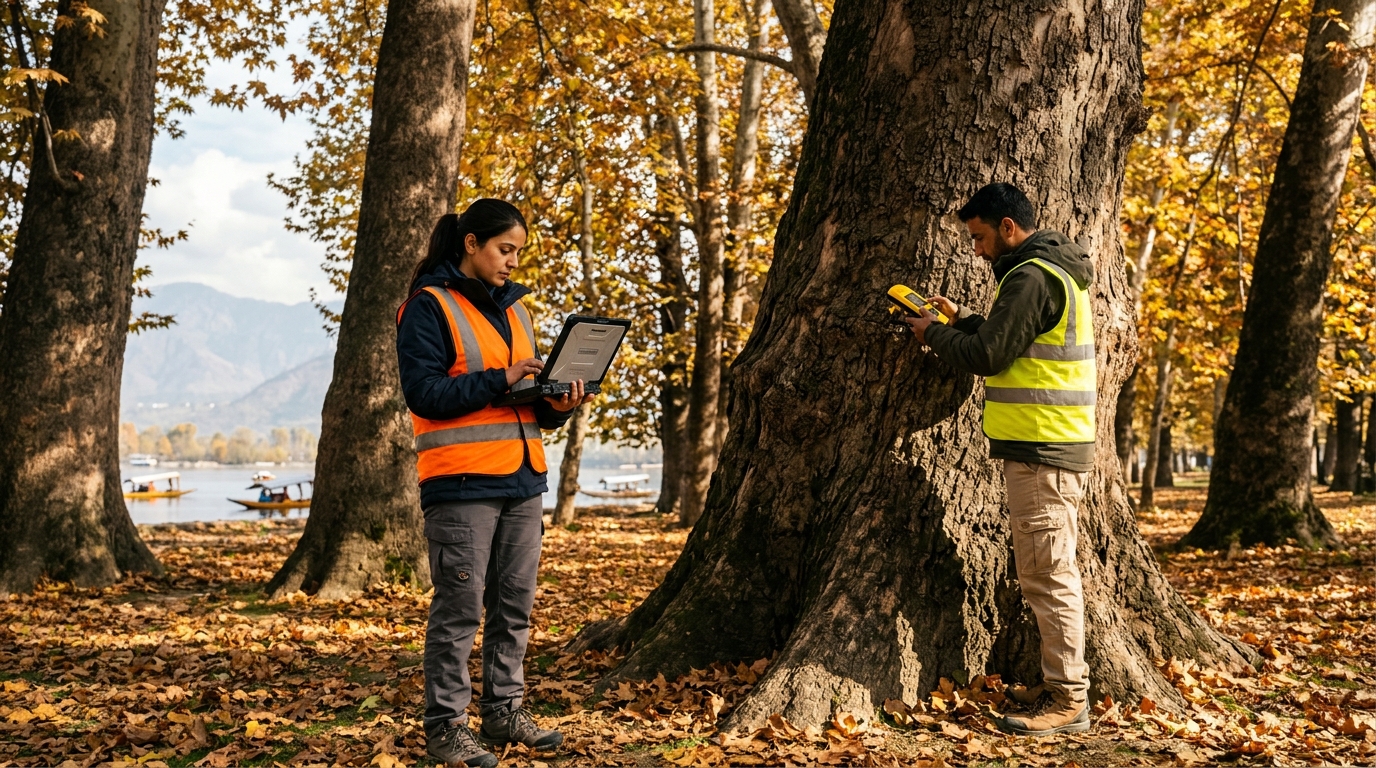
Kashmir’s Chinars do not stand outside statutory law. Under the Jammu and Kashmir Preservation of Specified Trees Act, 1969 (Section 3), felling a specified tree requires prior statutory permission from the prescribed authority—and the statutory definition of "fell" extends beyond cutting down a trunk to encompass burning, girdling, lopping, polling, or damaging a tree in ways that destroy its survival, reinforced by reserved-tree revenue rules and the March 2009 government restriction on Chinar felling and lopping. In strict adherence to evidentiary fairness, Himalayan Dispatch declares no individual campus removal or pruning unlawful in advance; instead, we specify twelve primary records—from Section 3 permits and Landscape Division ledgers to contractor tree-protection clauses—that must be verified against the exact date of each intervention.
At the same time, the University of Kashmir possesses within its own faculties—Botany, Environmental Science, Geography, Geoinformatics/Remote Sensing, Hydrology, Civil Engineering, Law, History, Economics, Journalism, and University Administration—every scientific and legal tool needed to audit Naseem Bagh. Recognising that individual scholars and departments have contributed to the 2021–22 Green Audit and voiced conservation concerns, our investigation invites the university to exercise formal Right of Response and lead by example—guided by international heritage-campus precedents where historic groves and world-class laboratories thrive side by side without sacrificing ancient trees.
To turn scrutiny into enduring restoration, we propose the fifteen-measure Naseem Bagh Ecological & Heritage Recovery Protocol (NBEHRP-15)—combining an independent Mughal-garden boundary survey, a sensitive-zone concrete moratorium, QR Tree Aadhaar geotagging, sonic tomography, BS 5837 Root Protection Zones, concrete-apron removal, debris remediation, and an endowment-backed Living Heritage Management Plan—supported permanently by Monograph 14 (12 Volumes · 72 Chapters) and Kashmir EcoWatch’s Naseem Bagh Living Heritage & Campus Ecology Observatory (/environmental-monitoring/chinar-monitoring/naseem-bagh-heritage-observatory).
PART XII, XIII & XV · ACADEMIC INTROSPECTION, LEGAL AUDIT & 15-POINT RECOVERY PROTOCOL
Questions posed to the university’s own disciplines paired with core measures of the proposed Naseem Bagh Recovery Protocol.
| University Discipline or Recovery Measure | Campus Accountability Question or Conservation Outcome |
|---|---|
| Botany & Plant Taxonomy | Has every veteran Chinar and heritage sweet chestnut received a diagnostic health and pathology dossier? |
| Environmental Science | Have cumulative soil, microclimatic, and root-zone construction impacts across Naseem Bagh been quantified? |
| Geography & Regional Planning | Has the four-century spatial transformation from Mughal waterfront garden to built campus been mapped? |
| Geoinformatics & Remote Sensing | Has multi-decadal canopy loss (1960s Corona, Landsat, high-res optical/LiDAR) been independently published? |
| Hydrology & Soil Science | Have soil compaction, concrete sealing, and Dal-margin infiltration changes been empirically measured? |
| Civil & Geotechnical Engineering | Were building foundations and utility corridors engineered outside BS 5837 Root Protection Zones? |
| 01 · Independent heritage boundary survey | Cadastrally demarcate the historical Mughal garden and Dal-shore buffer as an inviolable heritage core |
| 02 · Moratorium on new sensitive-zone concrete | Halt new permanent buildings, stadiums, and asphalt parking inside Naseem Bagh pending forensic audit |
| 03 · Individual Chinar & heritage-tree geotagging | Assign open-access QR/RFID Tree Aadhaar IDs (girth, crown, age tier) to every tree in Naseem Bagh |
| 04 · Non-invasive arboricultural tomography | Conduct sonic/resistograph cavity diagnostics and mycological care across all ~700 Chinars |
| 05 · Multi-temporal canopy reconstruction | Publish matched-season archival photo, Corona, and VHR satellite canopy maps from 1965 to 2026 |
| 06 · Enforceable Root Protection Zones (BS 5837) | Mandate 12×–15× DBH no-excavation, no-trenching, and no-machinery buffers around every heritage tree |
| 07 · Permeable surface & de-concreting programme | Replace concrete/asphalt aprons around Chinar root flares with porous gravel/turf and air-spade decompaction |
| 08 · Immediate construction-debris remediation | Remove all dumped rubble and alkaline mortar waste (addressing May 2024 findings) and restore topsoil |
| 09 · Native ground-story & avenue rehabilitation | Restore continuous Mughal Chinar sightlines, multi-age succession planting, and pervious meadow hydrology |
“If environmental science cannot adequately influence land-use planning within the institution where it is taught, how can society confidently expect that science to influence development elsewhere?”
INTERACTIVE ARBORICULTURAL, HISTORICAL & STATUTORY WORKBENCH · MONOGRAPH 14
Naseem Bagh Living Heritage, Root-Zone Biomechanics & Accountability Explorer
Conceptual arboricultural simulator (BS 5837 / Veteran Tree RPA equations) paired with documented University of Kashmir audit tables, strict non-subtraction / non-addition census guards, and the 15-measure Naseem Bagh Recovery Protocol.
CONCEPTUAL BIOMECHANICAL PARAMETERS (PLATANUS ORIENTALIS)
HIGH RISK: VETERAN ROOT PROTECTION ZONE INTRUSION
Foundation and scaffolding intrude inside the 15× DBH veteran Root Protection Zone and tree fall radius—inducing multi-year feeder-root dieback and manufacturing a future "building safety" conflict.
Note: Conceptual biomechanical model illustrating Part VIII & IX; actual root architecture and cavity condition at Naseem Bagh require on-site sonic tomography and air-spade verification.
What Did the Chinars Teach the University?
Buildings can be constructed elsewhere; four centuries of living continuity cannot be manufactured within an administrative tenure.
The Chinars of Naseem Bagh stood before the university existed. They stood before its departments, lecture halls, laboratories, hostels, and administrative buildings were conceived. Generations of students found shade beneath them; generations of scholars walked among them as they witnessed political transformations, institutional growth, social upheaval, and the intellectual evolution of modern Kashmir.
They asked for no research grants. They required no academic recognition. Their contribution was expressed through shade, avian and soil habitat, microclimatic stability, historical continuity, and the quiet preservation of a living Mughal landscape overlooking Dal Lake.
Buildings can be constructed elsewhere. Academic departments can be relocated—as the university’s own calendar once envisioned. Institutional infrastructure can be redesigned. But the historical and biological continuity embodied in a four-hundred-year-old Chinar cannot be manufactured within the tenure of a university administration. Joining our companion investigations into the Habak Laboratory, Dal Lake’s real-estate encroachment, Sálim Ali National Park, and twenty-five years of Himalayan scholarship, Naseem Bagh asks an institution of higher learning not to choose between education and heritage—but to prove its intellectual maturity by protecting both.
Research Limitations & Evidentiary Safeguards: The University of Kashmir’s 2021–22 Environmental Audit (including visual verification of its tree inventory on page 23) and Institutional Calendar were examined alongside indexed journalistic extracts (Kashmir Life 2011, Outlook India 2023, Daily Excelsior May 2024, Mongabay Sept 2024, Kashmir Observer & Greater Kashmir Nov 2026). Historical planting estimates (1,200+; 992) and contemporary counts (~700; 696; 710) must never be directly subtracted to claim construction-caused loss, nor may the reported 22 and 16+ tree removals be summed without verifying incident overlap. Exact historical canopy loss, delayed construction-related root mortality, authenticated building/tree-felling permits under the J&K Preservation of Specified Trees Act, 1969, and total Naseem Bagh area transformed remain unverified and constitute the primary forensic objectives of Monograph 14. Each of Himalayan Dispatch’s five institutional environmental history investigations (The Laboratory That Kashmir Lost; The Art of Encroachment; The National Park That Became a Golf Course; The Chinars in the Shadow of Concrete; Who Are We Researching For?) rests on independent documentary proof rather than assumed equivalence.
“For decades, generations of students have received their education beneath the Chinars of Naseem Bagh. Perhaps it is time the institution itself reflects upon what those Chinars were capable of teaching it.”
DOCUMENTARY SOURCES & FURTHER READING
| Source | Documentary relevance |
|---|---|
| Kashmir Life — "Unsafe in the University" (February 2011) | Documents reported cutting of 22 Chinars (718 to 696), Zareef Ahmad Zareef’s allegation of ~20 root-damaged Chinars, and Prof. B. A. Wafai’s statement on 2007 guest-house construction. |
| University of Kashmir Institutional Calendar (UniCal) | Records 696 Chinars and states that academic departments were shifted from Naseem Bagh to the main campus specifically to develop it as a heritage garden. |
| University of Kashmir Environmental / Green Audit (2021–22, DIQA) | Reports ~700 Chinars in Naseem Bagh (710 in Table 6, p. 23; >500 in summary), 74.66 ha main-campus land-use inventory, infrastructure pressures, and reiterated Chinar heritage-park plans. |
| Outlook India — Naseem Bagh Mughal Garden Deterioration (September 2023) | National cultural-heritage investigation into concrete campus construction and fading Mughal garden identity. |
| Daily Excelsior — Construction Waste Dumping in Naseem Bagh (May 2024) | Documents reported dumping of construction rubble inside Naseem Bagh and associated soil/root-zone concerns. |
| Mongabay-India — Pollution & Construction Threaten Dal Lake Chinar Trees (September 2024) | Examines March 2009 felling/lopping restrictions, INTACH assessments, and continuing construction pressures including an indoor stadium. |
| Kashmir Observer — Campus Green Destruction (November 13, 2026) | Contemporary scrutiny of campus tree management, safety-pruning defences, and the earlier Chinar fall on a new IMFA block. |
| Greater Kashmir — EPG Seeks Independent Inquiry into Campus Heritage Trees (November 17, 2026) | Documents Environmental Policy Group calls for an independent inquiry following heritage sweet chestnut tree interventions on campus. |
| India Code — Jammu & Kashmir Preservation of Specified Trees Act, 1969 | Statutory framework (Section 3 permission regime and broad definition of felling/damaging specified trees including Chinar). |
| Kashmir EcoWatch — Chinar Monitoring & Arboricultural Surveillance Hub | KEW’s regional Platanus orientalis Digital Tree Aadhaar, NDVI canopy, pathology, and legal protection observatory. |
EDITORIAL PUBLICATION METADATA & 10-STAGE GATE LEDGER
| Gate | Status | Record / Scope |
|---|---|---|
| 01 · Commissioned | completed | Himalayan Dispatch Founding Masthead |
| 02 · Research in progress | completed | Himalayan Dispatch Research & Observatory Desk |
| 03 · Manuscript draft | completed | Assigned Author / Editorial Desk |
| 04 · Evidence verification | completed | Cross-checked against the University of Kashmir 2021–22 Environmental Audit (including p. 23 Table 6 inventory and 74.66 ha main-campus land-use breakdown), UoK Institutional Calendar (696 Chinars and departmental relocation statement), Kashmir Life Feb 2011 (22 trees cut; Prof. B. A. Wafai 2007 guest-house statement; Zareef Ahmad Zareef ~20 root-damaged trees allegation), INTACH Kashmir (Saleem Beg 16+ Hamzah Guest House trees), Outlook India Sept 2023, Daily Excelsior May 2024, Mongabay Sept 2024, Kashmir Observer Nov 13, 2026, Greater Kashmir Nov 17, 2026, and J&K Preservation of Specified Trees Act, 1969. |
| 05 · Scientific review (where applicable) | pending | Enforces strict non-subtraction between Mughal planting estimates (1,200+; 992) and modern counts (~700; 696; 710), strict non-addition between potentially overlapping 22 and 16+ tree-removal reports, separation of 74.66 ha main-campus inventory from Naseem Bagh proper, and BS 5837 / ISA Root Protection Zone biomechanics. |
| 06 · Editorial review | completed | Founding Editor-in-Chief Desk Review |
| 07 · Copyright and ethics review | completed | Labels reference plates transparently as illustrative rather than matched-date change detection, presumes zero statutory illegality prior to Section 3 permit inspection, credits faculty conservation efforts, and guarantees formal Right of Response to the University of Kashmir. |
| 08 · Administrator approval | in progress | Stage 08 Pre-Release Flagship Investigation staged on localhost for Founding Administrator review. |
| 09 · Published | pending | — |
| 10 · Post-publication corrections | not applicable | — |
| Attribute | Final assignment |
|---|---|
| Publication | Himalayan Dispatch |
| Volume / Edition Placement | Vol. 01 / No. 01 · Dispatch 11 of 33 (Immediately after Dispatch 10: "The National Park That Became a Golf Course" and before Dispatch 12: "An Elegy for Winter") |
| Investigation Rubric | Special Historical & Ecological Investigation · Living Heritage · Academic Institutional Accountability · Landscape Transformation · Urban Ecology |
| Byline | Dr. Fayaz Ahmad Khan & Himalayan Dispatch Living Heritage, Botanical Sciences, Geospatial Intelligence and Academic Accountability Desk |
| Geographical Focus | Naseem Bagh · Hazratbal · Srinagar · Kashmir Valley |
| Companion Monograph | Monograph 14 — The Chinars in the Shadow of Concrete (12 Thematic Volumes · 72 Proposed Research Chapters) |
| Proposed Conservation Framework | Naseem Bagh Ecological & Heritage Recovery Protocol (NBEHRP-15 · 15 Multidisciplinary Measures) |
| Permanent KEW Companion | Naseem Bagh Living Heritage & Campus Ecology Observatory (12 Registries · /environmental-monitoring/chinar-monitoring/naseem-bagh-heritage-observatory) |
| Publication Gate Status | Stage 08 · Pre-Release Edition Folio Awaiting Administrator Approval |

Founding Editor-in-Chief
Dr. Fayaz Ahmad Khan
Founder of Kashmir EcoWatch and Founding Editor-in-Chief of Himalayan Dispatch; writes on alpine hydrology, cryospheric thresholds, disaster resilience, and mountain commons across the Western Himalayas.
View Portfolio & Approved Commissions →NEXT IN THIS EDITION · 03 / THE VISUAL JOURNAL
An Elegy for Winter
By Himalayan Dispatch · Visual Editions Desk · 5 min read