The Mountains Have Heard Enough Declarations
An independent inquiry into climate consultations, civil society declarations, and the architecture of unmonitored commitments across the Western Himalayas.

Ninety Days After the Ballroom Lights Dim
From Dal lakeshore convention halls to university auditoriums in Srinagar, Jammu, and Leh, the Western Himalayas have accumulated an impressive library of ecological vows—and a vanishingly small ledger of verified outcomes.
There is a familiar choreography to environmental concern in the Western Himalayas. On a crisp autumn morning along the Boulevard frontage of Dal Lake, or beneath the timbered ceiling of a university convocation hall at Hazratbal, Shalimar, Jammu, or Leh, folders of cream cardstock are laid beside bottled water and brass microphones. Inside each folder rests a draft charter. Over the past dozen years—accelerating sharply since the catastrophic September 2014 Jhelum inundation—dozens of such documents have been read aloud, applauded, and released to local newspapers: twenty-point charters drafted by Srinagar’s Environmental Policy Group (EPG), detailed administrative memoranda submitted by the Group of Concerned Citizens (GCC), civil society communiqués crystallizing maxims such as “Ecology Before Engineering” and “Water Before Infrastructure” under the banner of a Srinagar Declaration, stakeholder roundtables for the Jammu & Kashmir State Action Plan on Climate Change (SAPCC), pan-Himalayan declarations spanning the Sustainable Mountain Development Summits from SMDS-I through SMDS-XIII, and energetic youth climate parliaments.
Read side by side on a desk in late 2026, these texts are neither frivolous nor cynical. Many are written in lucid, urgent prose. They warn of retreating glaciers, suffocating urban wetlands, stripped gravel riverbeds, karewa scarps sliced for highway fill, unsewered resort towns, and toxic winter air. Yet walk back into the secretariat corridors, municipal wards, and tributary floodplains ninety days after the valedictory group photograph is framed, and an unsettling silence prevails. No treasury demand head has been amended to fund the charter’s flagship watershed authority. No Pollution Control Committee consent register cites paragraph four of the communiqué. No public webpage tracks whether clause eleven was adopted, rejected, or quietly buried between departmental files.
Meanwhile, outside the auditorium doors, physical time refuses to adjourn. Between one Srinagar climate conclave and the next, Kolahoi’s ice tongue thins further, another stretch of Rambiara cobble armor is loaded into tipper trucks, another hectare of Hokersar reedbed silts shallowly toward pasture, and another winter thermal inversion seals particulate smoke over hospital wards. The discrepancy forces a foundational inquiry that neither civil society, academia, government consultation cells, nor independent platforms such as Kashmir EcoWatch can evade any longer: when does an environmental declaration cease to be a commitment and become merely a record of good intentions?
This inquiry audits publicly accessible declarations, policy charters, conference programmes, judicial filings, and SAPCC consultation frameworks across J&K and the Indian Himalayan Region. Absence of a public post-event implementation ledger is distinguished strictly from unproven bad faith: unpublished follow-up letters or closed-door briefings may exist in private files, yet any commitment claiming public authority must be verifiable in the open civic domain. No institution—including Kashmir EcoWatch’s own proposed May 2027 Western Himalayan Cryosphere Summit communiqué track—is exempted from this standard.
Civic Conscience in Difficult Seasons: Credit Where Earned
Why questioning the architecture of declarations begins by honouring the jurists, retired administrators, scientists, and citizens who refused silence.
Fairness demands that an institutional critique begin by rejecting caricature. Across Jammu, Kashmir, and Ladakh, the men and women who have drafted civil society charters, convened public roundtables, and carried ecological memoranda from one secretariat ante-room to another have rarely worked under comfortable or lucrative conditions. When retired civil servants, former judges, constitutional lawyers, physicians, educators, and environmental scientists inside forums such as the Group of Concerned Citizens (GCC) or the Environmental Policy Group (EPG) assembled detailed representations on floodplain encroachment, solid-waste mismanagement at Achan, wetland demarcation, or forest rights, they performed an indispensable constitutional service during years when formal legislative committees were either suspended, overburdened, or distracted by acute political transitions.
Equally deserving of recognition are university departments at the University of Kashmir, SKUAST-Kashmir, NIT Srinagar, the University of Jammu, the Islamic University of Science and Technology, and the University of Ladakh, alongside pan-Himalayan networks such as the Integrated Mountain Initiative (IMI) and Ladakhi ecological societies, whose conferences kept cryospheric loss, springshed depletion, and disaster vulnerability inside public vocabulary. In several documented instances, civil society charters and citizen dossiers supplied the factual scaffolding for suo motu cognisance and Public Interest Litigation before the High Court of Jammu & Kashmir and Ladakh and the National Green Tribunal—compelling inspection committees on Dal Lake, Wular, Hokersar, Doodhganga, and Rambiara when executive oversight stalled.
To ask why declarations evaporate after ninety days is therefore not to belittle civic courage; it is to rescue civic courage from ritual exhaustion. Nor does Himalayan Dispatch write from an imagined pedestal above the problem. Inside Kashmir EcoWatch’s own public planning docket for the proposed May 27–29, 2027 Western Himalayan Cryosphere Summit, the closing Day-3 slot explicitly schedules “Statutory Synthesis & Communiqué Drafting for NGT & Policy Makers.” Without a binding accountability architecture built beforehand, our own 2027 communiqué would face the exact fate of forty predecessors—applauded at 5:30 p.m., archived as a PDF at 6:00 p.m., and orphaned by Monday morning.
“An environmental declaration ceases to be a commitment—and becomes merely a record of good intentions—on the afternoon its authors adjourn without naming a statutory custodian, a costed budget line, a falsifiable physical metric, and a public audit date.”
The Palimpsest of Verbatim Clauses and Institutional Amnesia
How a decade of Himalayan consultations recycled identical resolutions without auditing why earlier charters went unexecuted.
Place ten years of Western Himalayan environmental declarations into a comparative textual matrix—spanning post-2014 Srinagar flood-recovery charters, EPG’s multi-point environmental agendas, GCC policy notes, J&K SAPCC stakeholder summaries, Leh sustainable-tourism resolutions, and successive Sustainable Mountain Development Summit communiqués—and the most striking pattern is verbatim recurrence. Year after year, nearly identical imperatives reappear as fresh breakthroughs: constitute an empowered unified river-basin authority; enforce scientific tourist carrying capacity; halt riverbed sand and boulder mining; demarcate wetland boundaries using revenue records; phase out polythene; mandate source segregation of municipal waste; integrate climate change into school curricula; place “Ecology Before Engineering” and “Water Before Infrastructure.”
Repetition of an unmet demand is sometimes proof of persistence; repetition without historical accounting is proof of institutional amnesia. Almost none of these declarations opens with a baseline ledger auditing its own lineage. A 2026 roundtable calling for wetland boundary pillars around Hokersar, Shallabugh, Anchar, and Wular rarely cites what became of the identical resolution adopted in 2016, 2019, or 2022, which demarcated pillars were physically installed, where revenue mutations stalled, or which district magistrate left compliance incomplete. Each conference resets the calendar to Year Zero, granting state departments perpetual grace to welcome a “timely recommendation” they have left unimplemented for a decade.
Compounding this repetition is the absence of any handover archive between convening bodies. When a university department hosts a three-day climate symposium in September, when a civil society coalition releases a Srinagar charter in October, and when an apex mountain forum convenes in another hill state twelve months later, no shared institutional Secretariat transfers open action items, right-to-information replies, or departmental non-compliance logs to the next organizing committee. Meanwhile, peer-reviewed empirical baselines show the cumulative cost of standing still: Rashid et al. (2020) documented a 23.6 percent retreat of Kolahoi Glacier with statistically significant streamflow depletion across five hydrometric sites; Romshoo, Murtaza, and Abdullah (2022) measured sustained negative mass balance (−0.35 to −0.39 m w.e.) on Hoksar Glacier; Alam et al. (2023) quantified decadal spatial contraction across Kashmir Valley wetlands; and Sultan et al. (2024) confirmed continuing organic and inorganic nutrient-driven macrophytic deterioration in Dal Lake.
Verbs Without Clocks, Clauses Without Named Custodians
Why passive-voice exhortations dissolve inside secretariat hierarchies unless mapped to statutory sections and time-indexed gates.
Examine the grammatical engine of a typical Himalayan environmental declaration and two structural omissions explain its ninety-day mortality. First is the complete absence of time-indexed implementation milestones. Clauses are overwhelmingly cast in open-ended subjunctive imperatives—“steps must be taken,” “authorities should prioritize,” “a comprehensive policy ought to be framed.” Without hard 90-day administrative notification gates, 180-day procurement and baseline-instrumentation gates, and 36-month physical outcome deadlines, delay never triggers a visible breach. An administration can claim five years later that a proposal remains “under active consideration,” and nothing inside the declaration’s own text proves default.
Second—and even more disabling—is the absence of a named institutional responsibility matrix. Public administration in Jammu & Kashmir and Ladakh does not operate through an abstract entity called “the Government.” It operates through strictly bounded statutory offices exercising specific powers delegated by legislation. Water effluent consents and closure directions belong to the Member Secretary and Chairman of the J&K Pollution Control Committee under Sections 25 and 33A of the Water (Prevention and Control of Pollution) Act, 1974. Embankment integrity, floodway encroachment removal, and hydraulic works extraction permits rest with Chief Engineers and the Regulatory Authority under the Jammu & Kashmir Water Resources (Regulation and Management) Act, 2010. Minor-mineral block auctions and District Survey Reports fall under the Director of Geology and Mining and District Magistrates under MoEFCC’s 2020 Sand Mining Guidelines. Eco-Sensitive Zone proposals originate with the Department of Forest, Ecology and Environment for notification under Section 3(2)(v) of the Environment (Protection) Act, 1986.
When a civil society charter or summit communiqué declares “Water Before Infrastructure” without mapping that principle onto a named statutory officer, citing the exact section of law authorizing immediate action, and identifying the legislative Demand for Grants head from which enforcement must be paid, every department applauds the maxim in principle and refers the file sideways in practice. In administrative law, an obligation assigned to everyone is legally enforceable against no one.
Fiscal Unreality and the Uncosted Wish-List
Recommending multibillion-rupee watershed, sewerage, and energy transitions without CapEx/OpEx budgets or Finance Department architecture.
Even where legal jurisdiction is clear, environmental declarations across the Western Himalayas routinely founder on fiscal unreality. A single twenty-point civil society charter or stakeholder SAPCC annexure will simultaneously call for hundred-percent tertiary interception of urban sewage across Srinagar, Jammu, Anantnag, Baramulla, Sopore, Leh, and Kargil; engineered scientific remediation of legacy waste dumps; conversion of hundreds of fixed-chimney brick kilns; acquisition of encroached floodplain corridors; electric public mobility across mountain resorts; and catchment-wide springshed restoration—without printing a single rupee estimate of Capital Expenditure (CapEx) or fifteen-year Operation and Maintenance (OpEx).
Inside the Finance Department and Planning, Development and Monitoring Department, uncosted policy charters are dead on arrival. Public treasuries operate through Medium-Term Fiscal Frameworks, Centrally Sponsored Scheme matching ratios, Finance Commission tied local-body grants, NABARD Rural Infrastructure Development Fund (RIDF) tranches, and strict General Financial Rules. In mountain cities, OpEx—not ribbon-cutting CapEx—is the decisive graveyard of environmental infrastructure. Building a Sequential Batch Reactor sewage plant on the periphery of Dal Lake, Brari Nambal, Pahalgam, or Leh achieves nothing if municipal budgets lack ring-fenced winter electricity tariffs to heat biological aeration tanks below 5°C, chemical coagulant budgets for phosphorus stripping, and salaried instrumentation technicians—precisely the operational deficit behind persistent urban water-quality degradation documented in Srinagar’s Brari Nambal and Jhelum reaches by Shah (2026).
For environmental advocacy to graduate from moral petition to fiscal statecraft, every major recommendation must carry an order-of-magnitude costed docket: distinguishing upfront capital outlay from recurring annual O&M, identifying revenue-neutral user levies (such as ring-fenced high-altitude ecological congestion fees, minor-mineral watershed restoration cesses, or green municipal bonds), and demonstrating how early preventative investment avoids far larger post-disaster relief expenditures across flood-prone Himalayan-Indus basins (Hamidi et al., 2026).
DIAGNOSTIC AUDIT · TABLE 01
Twelve recurring structural deficits identified across a decade of Western Himalayan climate consultations, civil society charters, and summit declarations (2014–2026).
| Recurring Governance Deficit | Documented Pattern Across Declarations & Required Institutional Remedy |
|---|---|
| 01 · Verbatim Clause Recycling | Identical appeals ("unified river authority," "wetland pillars," "carrying capacity") repeated across 2014–2026 charters with zero citation of prior resolutions; requires mandatory prior-clause lineage citation. |
| 02 · Zero Time-Indexed Milestones | Open-ended verbs ("should prioritize") allow indefinite bureaucratic deferral; requires hard 90-day notification, 180-day instrumentation, and 36-month compliance clocks. |
| 03 · Unnamed Statutory Custodians | Addresses "the Government" generically rather than specific officers under Water Act 1974, J&K WRRM Act 2010, or EPA 1986; requires clause-by-clause officer and statutory-section mapping. |
| 04 · Uncosted CapEx / OpEx Wish-Lists | Recommends multibillion-rupee sewerage, transit, and dredging works without capital/O&M costing or Finance Commission / user-fee routing; requires pre-costed fiscal notes. |
| 05 · Non-Falsifiable Physical Targets | Substitutes slogans ("Ecology Before Engineering") for measurable thresholds (mg/L TP, µg/m³ PM2.5/BC, m³/s Q90 e-flow, Year-5 tree survival %); requires SI-unit targets. |
| 06 · Inter-Conference Amnesia | No handover ledger connects EPG/GCC charters, university conclaves, SAPCC rounds, and SMDS editions; requires a permanent inter-institutional open registry. |
| 07 · Regional & Disciplinary Silos | Fragmentation between urban Srinagar lake groups, Jammu kandi/Chenab forums, and Ladakh cold-desert movements; requires cross-divisional watershed compacts. |
| 08 · Exclusion of Frontline Communities | English-language hotel drafting excludes Gujjar-Bakarwal & Changpa pastoralists, hanji fishers, karewa smallholders, and casual forest watchers; requires vernacular co-drafting. |
| 09 · Symbolic Youth Stage Roles | Confines students to pledge recitals, rallies, and certificates; requires paid technical audit fellowships and voting statutory advisory seats. |
| 10 · Zero Post-Event Outcome Audits | Conferences adjourn without 12-month or 36-month independent compliance verification; requires scheduled public report cards. |
| 11 · Missed Multilateral Climate Finance | Literary appeals fail GCF, Adaptation Fund, and GEF bankability and MRV rules; requires accredited-entity adaptation project preparation. |
| 12 · Methodological Border Blindness | Ignores transboundary Indus–Jhelum–Chenab–Shyok–Neelum airsheds, flyways, and flood/cryosphere physics; requires basin-scale scientific telemetry norms. |
Rhetoric Without Units: The Absence of Falsifiable Physical Targets
Why "Water Before Infrastructure" cannot be enforced until translated into milligrams per liter, cubic meters per second, and Year-5 survival.
In science and law alike, a proposition that cannot be falsified by measurement cannot govern behaviour. Principled maxims coined in Srinagar civil society discourse—“Ecology Before Engineering” and “Water Before Infrastructure”—possess genuine moral clarity as civic rallying cries. Yet the instant an executive engineer or project proponent claims in an affidavit that a newly widened highway or lakeside promenade already respects “Ecology Before Engineering,” a slogan without physical units leaves citizens and judges without an objective ruler to test the claim.
Contrast rhetorical aspiration with falsifiable biophysical specification grounded in Western Himalayan peer-reviewed science. In urban and lacustrine water quality—where Sultan et al. (2024) document macrophyte-driving nutrient enrichment in Dal Lake, Irshad et al. (2026) detect agricultural pesticide residues in Hokersar Ramsar wetland, and Elbagory et al. (2026) establish elevated heavy-metal accumulation in water chestnut (*Trapa natans*) with Dal Lake exhibiting the steepest contamination gradient—a verifiable commitment specifies exact numerical ceilings: total phosphorus `< 0.05 mg/L` in pelagic lake basins, outfall BOD5 `< 10 mg/L` throughout January sub-zero operations, and zero raw bypass across all perimeter pumping stations.
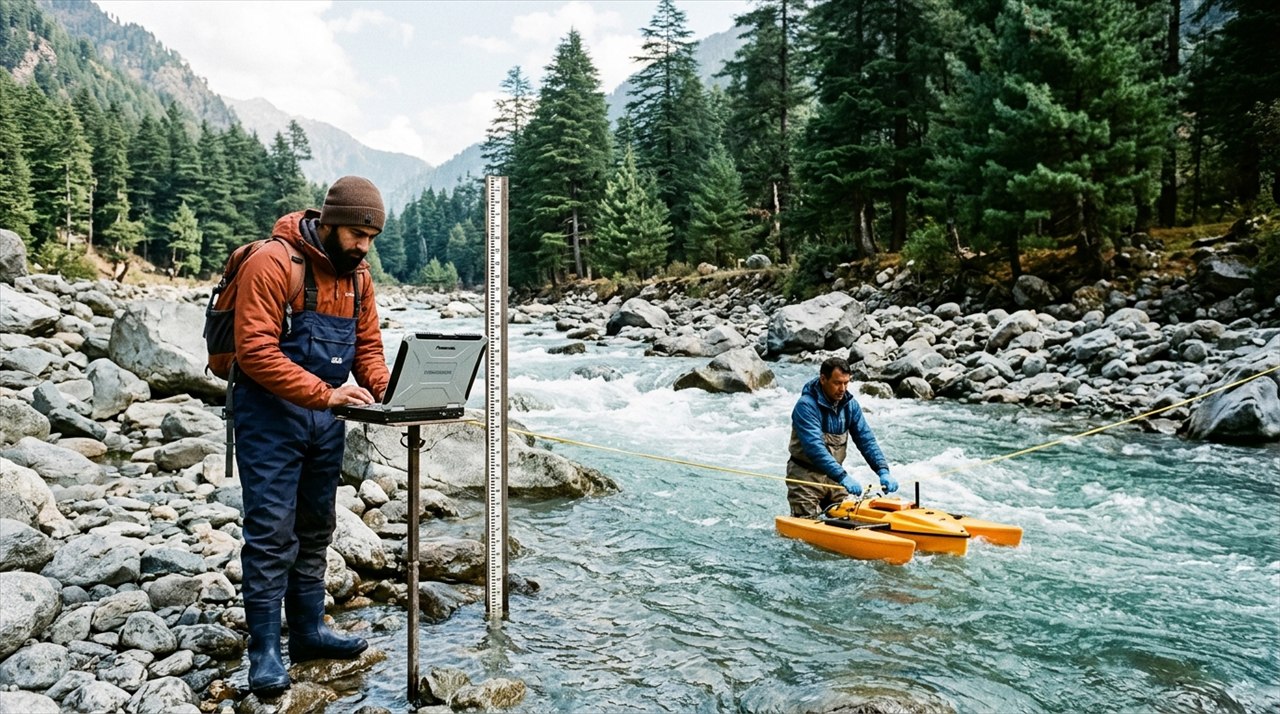
In mountain river management—where Arora et al. (2026) prove that elevation-dependent groundwater sustains up to 70 percent of Himalayan baseflow and Yaseen, Khalid, and Zargar (2026) track anthropogenic hydrochemical stress along the Lidder and Vishav—“Water Before Infrastructure” must translate into continuous Acoustic Doppler Current Profiler (ADCP) and telemetered stage-discharge mandates maintaining dry-season streamflows strictly at or above historical Q90 reserves (`m³/s`), paired with positive net post-snowmelt DGPS bed-elevation balances before a single cobble block is auctioned (Jafri et al., 2025). In regional airsheds—where Bawari et al. (2026) record stagnant winter black carbon above `4 µg m⁻³` and pre-monsoon surges near `14 µg m⁻³`, amplifying snow-albedo reduction by `1.1–1.8×` (Pu et al., 2021)—a serious charter specifies seasonal PM2.5 (`µg/m³`) and subalpine black-carbon ceilings rather than vague appeals for “clean air.” Likewise, afforestation clauses must abolish ceremonial “saplings planted” tallies in favour of audited, geo-tagged native species survival rates (`≥ 75%` at Year 5).
Empirical anchors for falsifiable targets: Arora et al. (2026, Scientific Reports, DOI: 10.1038/s41598-026-49483-2) on groundwater baseflow partitioning; Bawari et al. (2026, DOI: 10.1007/s10661-026-15709-z) & Pu et al. (2021, DOI: 10.5194/tc-15-2255-2021) on black-carbon aerosol-snow forcing; Elbagory et al. (2026, DOI: 10.1038/s41598-026-39522-3) & Irshad et al. (2026, DOI: 10.1007/s11273-026-10188-y) on lentic heavy-metal and pesticide contamination.
Divided Valleys, English Ballrooms, and Missing Custodians
How regional fragmentation and urban conference culture sideline pastoralists, boat-dwellers, smallholders, and casual forest watchers.
A declaration’s political durability depends not only on how it is written, but on who sits at the table before the ink dries. Across the Western Himalayas, environmental advocacy remains weakened by two deep sociological fractures. The first is regional and disciplinary fragmentation. Civic environmentalism in Srinagar has historically concentrated on urban flood protection, Dal and Wular conservation, and valley hill resorts; environmental mobilization in Jammu has wrestled with *kandi* belt springshed desiccation, Tawi pollution, Shiwalik deforestation, and massive slope and displacement trauma along the Ramban–Kishtwar–Doda Chenab hydropower and NH-44 corridor (Jasrotia et al., 2026); movements in Leh and Kargil confront fragile cold-desert meltwater aquifers, industrial-scale solar pasture enclosures, and winter aridity shifts. Rarely do these three constituencies co-author unified, cross-divisional statutory compacts, allowing regulatory divide-and-rule to treat valley floods, Chenab slope failures, and Changthang grazing pressures as unrelated local grievances.
Even deeper is the class, linguistic, and occupational boundary separating urban conference hotels from frontline mountain livelihoods. Almost every prominent climate consultation, SAPCC stakeholder workshop, and civil society roundtable in Srinagar, Jammu, and Leh is conducted in formal English inside gated university or hospitality venues during working hours. Structurally absent from the drafting table are the exact communities who read ecological change first in their hands and household budgets: transhumant Gujjar and Bakarwal *deras* climbing Pir Panjal and Great Himalayan passes; Changpa pastoralists tending pashmina herds across high Ladakhi rangelands; *hanji* boat-dwelling families, water-chestnut harvesters, and artisanal fishers on Dal, Nigeen, Anchar, Manasbal, and Wular; marginal rain-fed karewa orchardists and saffron smallholders in Budgam, Pulwama, and Shopian; and daily-wage casual forest and wildlife watchers patrolling beats on precarious stipends.
Excluding frontline communities produces charters that are not merely socially incomplete, but ecologically blind—occasionally endorsing exclusionary conservation fencing or blanket livelihood bans without transitional income guarantees, while ignoring statutory Community Forest Resource powers already vested in Gram Sabhas and pastoralist communities under Sections 3(1)(i) and 5 of the Forest Rights Act, 2006. Until environmental declarations are co-drafted from the outset in Kashmiri, Dogri, Gojri, Pahari, Ladakhi/Bhoti, and Urdu alongside English—and co-signed by affected Gram Sabhas and occupational guilds—they will remain elite monologues spoken over the heads of the mountain’s primary stewards.
Stage Certificates Versus Statutory Seats: Youth and Post-Event Audits
Replacing symbolic student photo-opportunities with technical fellowships—and instituting 12- and 36-month compliance audits.
Closely allied to community exclusion is the choreography of symbolic youth inclusion. Scarcely a climate conclave, World Environment Day seminar, or mountain summit convenes across the region without a dedicated “Youth Climate Parliament” or student reflection session. Young scholars from colleges and universities deliver impassioned three-minute speeches, recite collective green pledges, hold hand-painted placards for press cameras, and receive laminated certificates of participation before returning to classrooms detached from regulatory governance.
Honouring the intelligence and future stake of Western Himalayan youth requires retiring token stage roles in favour of substantive institutional authority. Across earth sciences, civil engineering, environmental chemistry, forestry, and law faculties in Srinagar, Awantipora, Jammu, Rajouri, Bhaderwah, Leh, and Kargil sits an extraordinary generation of postgraduates capable of rigorous empirical scrutiny. Substantive participation means funding paid, twelve-month Youth Environmental Audit Fellowships: equipping young researchers to run seasonal dissolved-oxygen and fecal-coliform titrations at municipal outfalls, verify satellite mining footprints against District Survey Reports, translate EIA executive summaries into local languages for village public hearings, and hold dedicated, non-tokenistic observer and advisory seats on Pollution Control Committees, Wetland Authorities, and Campus Sustainability Boards.
Those fellowships directly solve the tenth systemic flaw of regional consultations: the total absence of independent 12-month and 36-month post-event outcome audits. Currently, conference budgets allocate generous sums to banners, hospitality, travel, and glossy souvenir volumes, and zero rupees to post-conference verification. If every major university symposium, SAPCC consultation, and civil society charter legally escrowed ten percent of its convening budget to publish an open, clause-by-clause compliance audit at Month 12 and Month 36—grading each recommendation publicly as *Enacted & Verified*, *Partially Implemented*, *Stalled in Secretariat*, or *Rejected*—both organizers and ministers would think twice before signing hollow prose.
“A university graduate holding a dissolved-oxygen probe at a winter municipal outfall—and publishing a 12-month compliance ledger in Kashmiri, Dogri, Gojri, and Ladakhi—wields more transformative power than a hundred stage pledges.”
Stranded Billions: Why Declarations Miss Global Climate Finance
How literary appeals forfeit Adaptation Fund, Green Climate Fund, and cryosphere loss-and-damage windows for lack of MRV bankability.
While Western Himalayan conclaves issue unfunded domestic appeals, billions of dollars in international multilateral adaptation finance pass the region by. Mechanisms established under the UNFCCC—including the Adaptation Fund, the Green Climate Fund (GCF), the Global Environment Facility (GEF) Least Developed and Special Climate Change windows, and emerging Loss and Damage and high-mountain cryosphere adaptation facilities—exist specifically to finance climate-resilient water infrastructure, Glacial Lake Outburst Flood (GLOF) early-warning telemetry, springshed recharge, and ecosystem-based disaster risk reduction in vulnerable mountain regions.
Why do so few resources from these global windows reach sub-basins like Warwan, Lidder, Sindh, Rambiara, Tawi, or Zanskar? Because multilateral climate funds do not disburse grants against conference declarations or moral urgency alone. GCF and Adaptation Fund boards require rigorously structured Concept Notes and Funding Proposals routed through Accredited National Implementing Entities (such as NABARD in India) backed by State Nodal Agencies. Every bankable docket must establish a quantitative climate-attribution rationale—separating anthropogenic hydroclimatic non-stationarity, such as the intensifying precipitation extremes and 10 to 20 percent snow-persistence declines documented by Gaddam et al. (2026) or cascading GLOF and mass-movement hazards mapped by Sattar et al. (2026) and Upadhyaya and Rai (2025), from routine development deficits.
Furthermore, multilateral adaptation dockets require strict Measurement, Reporting, and Verification (MRV) logframes, fiduciary environmental-and-social safeguards, Indigenous and pastoralist Free, Prior and Informed Consent protocols, gender-disaggregated beneficiary accounting, and verified state co-financing commitments. When regional civil society groups, SAPCC cells, and university centres spend their intellectual energy drafting literary communiqués instead of partnering to build open-source, pre-appraised GCF/Adaptation Fund technical dossiers for vulnerable Himalayan districts, the region leaves vital non-debt climate finance stranded on the table.
Rivers That Outrun Checkpoints: Transboundary Interdependence
Why Western Himalayan airsheds, migratory flyways, flood waves, and glaciers cannot be understood inside cartographic silos.
The twelfth silence inside nearly every contemporary Western Himalayan declaration is geographical truncation. Out of understandable diplomatic caution, state consultations and civil society charters routinely discuss the Jhelum, Chenab, Indus, Shyok, Nubra, and Kishanganga/Neelum basins as though atmospheric physics, fluvial sediment transport, biological evolution, and flood hydrographs halted neatly at administrative or international lines of control.
Earth-system science permits no such fiction. Across the Upper Indus Basin continuum, winter black-carbon plumes and fine particulate haze mix across the Indo-Gangetic Plain, Potwar plateau, Pir Panjal passes, and Kashmir Valley airsheds without inspecting passports. Hundreds of thousands of migratory waterfowl commuting along the Central Asian Flyway rely upon an interconnected chain of staging and wintering wetlands linking Wular, Hokersar, Shallabugh, and Gharana with downstream Indus floodplains. Endemic rheophilic fishes such as the Critically Endangered Kashmir catfish (*Glyptothorax kashmirensis*; Gilani et al., 2026) and schizothoracine snow trouts evolved across continuous western Himalayan drainage networks now fragmented by uncoordinated barrages and gravel mining. Most urgently, extreme rain-on-snow cloudbursts, moraine-dammed lake breaches, and systemic basin floods across the Himalayan-Indus system (Hamidi et al., 2026) propagate downstream at velocities measured in hours.
Recognizing transboundary ecological interdependence requires neither political naivety nor departure from constitutional sovereignty. Even amid severe geopolitical strain, international water and meteorological frameworks—including World Meteorological Organization (WMO) hydrological data-exchange protocols, ICIMOD Hindu Kush Himalaya regional science platforms, and the cooperative hydrological-observation principles recognized since Article VII of the Indus Waters Treaty (1960)—affirm that sharing real-time upper-basin precipitation, snow-water-equivalent, glacier mass-balance, and flood-stage telemetry saves human lives on every bank of the river. Civil society and scientific declarations lose intellectual completeness whenever they omit the shared cryospheric and atmospheric commons binding the entire Western Himalaya.
Gaddam et al. (2026, Scientific Reports, DOI: 10.1038/s41598-026-53393-8), Sattar et al. (2026, NHESS, DOI: 10.5194/nhess-26-5587-2026), Upadhyaya & Rai (2025, DOI: 10.1007/s11356-025-36346-y), Hamidi et al. (2026, DOI: 10.1007/s44367-026-00032-8), and Gilani et al. (2026, iScience, DOI: 10.1016/j.isci.2026.116783) underscore non-stationary cryospheric, flood, and biodiversity linkages spanning the wider Himalayan-Indus drainage.
The Public Environmental Commitments and Implementation Observatory (PECIO-WH)
Six institutional protocols to turn Western Himalayan declarations—starting with Kashmir EcoWatch’s own—into auditable civic contracts.
Critique without institutional invention would merely add a twenty-first declaration to the pile. To replace conference amnesia with permanent civic memory, Himalayan Dispatch proposes the establishment of an open-access, multi-institutional **Public Environmental Commitments and Implementation Observatory for the Western Himalayas (PECIO-WH)**. Hosted initially as an open-data public ledger within Kashmir EcoWatch and governed jointly by invited independent legal scholars, hydrologists, public-finance economists, frontline community guilds, and youth fellows across Kashmir, Jammu, and Ladakh, PECIO-WH transforms how environmental commitments are drafted, graded, and tracked.
Under **Protocol 1 (Unique Clause Lineage & Anti-Recycling Registry)**, every clause from historic and future declarations—EPG charters, GCC memoranda, SAPCC action matrices, SMDS communiqués, municipal promises, and KEW’s own proposed May 2027 Cryosphere Summit synthesis—is assigned a permanent machine-readable Commitment ID linked to all prior resolutions on the same sub-basin or statute, prohibiting unacknowledged verbatim repetition. Under **Protocol 2 (Statutory & Fiscal Feasibility Grading)**, no commitment enters the registry as “Action-Ready” (Grade A) unless it specifies the exact empowering statutory clause, named officer, order-of-magnitude CapEx/OpEx estimate, and domestic or multilateral (GCF/Adaptation Fund/Finance Commission) funding pathway; uncosted slogans are transparently tagged Grade D (*Aspirational Principle*).
**Protocol 3 (Falsifiable SI-Unit Baselines)** requires every ecological target to state its baseline value, measurement instrument, SI unit (`mg/L`, `µg/m³`, `m³/s`, `ha`, `% Year-5 survival`), and target date. **Protocol 4 (Vernacular & Frontline Co-Signatory Rule)** withholds “Community-Endorsed” standing from any charter not published simultaneously in relevant regional languages (Kashmiri, Dogri, Gojri, Pahari, Ladakhi/Bhoti, Urdu) and reviewed by affected Gram Sabhas, pastoralist *deras*, *hanji* cooperatives, or smallholder unions. **Protocol 5 (Youth Technical Audit Fellowships)** deploys paid postgraduate fellows to verify field and RTI evidence. Finally, **Protocol 6 (Mandatory 12 / 24 / 60-Month Public Verification Ledgers)** publishes automated open-access scorecards tracking physical watershed change long after conference banners come down.
PROPOSED INSTITUTIONAL DESIGN · TABLE 02
Architecture of the Public Environmental Commitments and Implementation Observatory for the Western Himalayas (PECIO-WH).
| PECIO-WH Core Protocol | Binding Operational Rule, Feasibility Standard & Verification Clock |
|---|---|
| 1. Clause Lineage & Anti-Recycling Ledger | Assigns permanent Commitment IDs cross-referencing 2014–2026 charters (EPG, GCC, SAPCC, SMDS, KEW); requires explicit audit of prior identical clauses before issuing new recommendations. |
| 2. Statutory & Fiscal Feasibility Grading | Grades clauses from Grade A (named statutory officer + exact legal section + CapEx/15-yr OpEx + budget/tariff head) down to Grade D (uncosted normative aspiration). |
| 3. Falsifiable Biophysical Unit Standard | Mandates instrumental baselines and SI-unit targets (e.g., <0.05 mg/L lake TP, ≥Q90 m³/s ADCP e-flow, <1.5 µg/m³ subalpine BC, ≥75% Year-5 geo-tagged native sapling survival). |
| 4. Vernacular & Frontline Co-Signatory Rule | Requires parallel publication in Kashmiri, Dogri, Gojri, Pahari, Ladakhi/Bhoti, and Urdu plus documented input from affected FRA Gram Sabhas, pastoralists, boat-dwellers, and smallholders. |
| 5. Paid Youth Audit Fellowships | Replaces symbolic stage pledges with stipended 12-month university fellowships executing water/air sampling, satellite DSR checks, and RTI/EIA paralegal tracking. |
| 6. 12 / 24 / 60-Month Verification Clocks | Publishes open-data compliance report cards at Months 12, 24, and 60 grading every clause as Enacted & Biophysically Verified, In Progress, Stalled, or Breached—binding KEW’s 2027 Summit first. |
From Ballroom Ink to Riverbed Proof
The Western Himalayas do not suffer from a shortage of eloquent diagnoses; they suffer from commitments designed never to be audited.
Walk along the stone bund of the Jhelum in late November as evening mist rises off cold, slow-moving water, and the distance between conference rhetoric and physical reality feels painfully small. Every retired jurist who stayed up past midnight drafting a citizen memorandum on floodway encroachments, every limnologist who carried nutrient charts into a stakeholder consultation, and every student who spoke earnestly at a youth climate conclave acted from love of a threatened homeland. Nothing in this inquiry diminishes that fidelity.
Yet fidelity to a mountain range in the third decade of the twenty-first century demands sterner discipline than good intentions. When an environmental declaration adjourns without a named statutory officer, without a rupee of capital and winter operating cost, without a falsifiable physical threshold, without frontline translation into the languages of shepherds, fishers, and orchardists, and without an independent 12- and 36-month audit clock, it ceases to be a commitment at the exact moment it is signed. Worse, it risks supplying polite ceremonial cover—creating the comforting illusion of deliberation while glaciers thin, wetlands contract, and slopes are undercut.
The mountains of Jammu, Kashmir, and Ladakh have heard enough declarations. What the Kolahoi cirque, the Hokersar reedbeds, the Rambiara cobble bars, the Jammu *kandi* springs, and the Changthang pastures require now is a generation of institutions—beginning with our own—willing to bind every public word to a gauge in the river, a line in the budget, and a clock in the open square. And as our closing inaugural inquiry now asks, even the sturdiest observatory will fail unless those standards apply with fearless neutrality no matter whose politics chooses the landscape.
“The mountains have heard enough declarations. What they require now is a generation of institutions—beginning with our own—willing to bind every public word to a gauge in the river, a line in the budget, and a clock in the public square.”
DOCUMENTARY SOURCES & FURTHER READING
| Source | Documentary relevance |
|---|---|
| Integrated Mountain Initiative (IMI) & SKUAST-Kashmir — Sustainable Mountain Development Summit Series (SMDS-I to SMDS-XIII, 2011–2026) | Primary institutional archive of pan-Himalayan summit themes, legislators’ dialogues, youth conclaves, and draft mountain policy deliberations. |
| Rashid, Majeed, Aneaus & Pelto (2020), Water — Glacier Retreat & Depleting Streamflow in Kashmir Himalaya | Establishes 23.6% Kolahoi Glacier retreat and statistically significant streamflow depletion across hydrometric stations while decadal policy declarations remained unexecuted. |
| Romshoo, Murtaza & Abdullah (2022), Scientific Reports — Hoksar Glacier Mass Balance in the Upper Indus Basin | Observational field mass-balance benchmark (−0.35 to −0.39 m w.e.) underscoring cryospheric urgency for MRV-compliant adaptation finance. |
| Alam et al. (2023), Environmental Monitoring and Assessment — Decadal Kashmir Himalayan Wetland Dynamics | Quantifies spatial contraction and hydroperiod degradation across Kashmir Valley wetlands despite repeated conservation charters. |
| Sultan et al. (2024), Water Science & Technology — Dal Lake Water Dynamics & Macrophytic Proliferation | Multi-season hydrochemical baseline demonstrating persistent organic/inorganic nutrient loading requiring falsifiable mg/L targets. |
| Irshad et al. (2026), Wetlands Ecology and Management & Elbagory et al. (2026), Scientific Reports — Pesticide & Heavy-Metal Contamination in J&K Lentic Systems | Empirical heavy-metal bioaccumulation in Trapa natans across Dal, Hokersar, Manasbal, and Wular alongside Hokersar pesticide residues (DOI: 10.1007/s11273-026-10188-y). |
| Arora et al. (2026), Scientific Reports — Elevation-Dependent Groundwater Control on Himalayan Baseflow | Isotopic-hydrological proof that elevation-dependent groundwater controls up to 70% of dry-season Himalayan baseflow. |
| Bawari et al. (2026), Environmental Monitoring and Assessment & Pu et al. (2021), The Cryosphere — Black Carbon Aerosols & Snow Albedo Forcing | Establishes winter (>4 µg m⁻³) and pre-monsoon (~14 µg m⁻³) Western Himalayan black-carbon levels and 1.1–1.8× coated-soot snow-albedo reduction (DOI: 10.5194/tc-15-2255-2021). |
| Gaddam et al. (2026), Scientific Reports & Sattar et al. (2026), NHESS — Non-Stationary Precipitation Extremes, Snow Persistence & GLOF Cascades | Climate-attribution baselines for multilateral GCF/Adaptation Fund dockets, paired with J&K mass-movement and GLOF hazard evidence (DOI: 10.5194/nhess-26-5587-2026). |
| Jasrotia et al. (2026), Scientific Reports — Northwestern Himalayan Landslide Susceptibility in Jammu & Kashmir | Demonstrates 87% landslide clustering in high and very-high susceptibility zones across corridor-cut mountain districts. |
| Hamidi et al. (2026), Journal of Disaster Science and Management — Systemic Flood Risk Across the Himalayan-Indus Region | Examines transboundary flood vulnerability co-produced by governance deficits and floodplain encroachment across the Indus-Jhelum continuum. |
| Gilani et al. (2026), iScience & Jafri et al. (2025), CUK Law Review — Endemic Riverine Biodiversity & Jhelum Sand-Mining Law | Links river fragmentation imperilling Critically Endangered Glyptothorax kashmirensis with statutory enforcement gaps in Jhelum aggregate extraction (DOI: 10.66498/cuklr.5.2025.9-34). |
| Green Climate Fund (GCF) & Adaptation Fund — Readiness, Accreditation & MRV Investment Criteria; KEW Proposed 2027 Cryosphere Summit Docket | Multilateral fiduciary and climate-rationale standards contrasted with uncosted regional declarations, alongside KEW’s self-audited 2027 summit communiqué commitment (/webinars). |
EDITORIAL PUBLICATION METADATA & 10-STAGE GATE LEDGER
| Gate | Status | Record / Scope |
|---|---|---|
| 01 · Commissioned | completed | Himalayan Dispatch Founding Masthead |
| 02 · Research in progress | completed | Himalayan Dispatch Research & Observatory Desk |
| 03 · Manuscript draft | completed | Assigned Author / Editorial Desk |
| 04 · Evidence verification | completed | Verified against publicly documented Western Himalayan civil society charters and policy consultations (Environmental Policy Group [EPG] charters, Group of Concerned Citizens [GCC] memoranda, Srinagar Declaration principles, J&K SAPCC consultation frameworks, Sustainable Mountain Development Summits SMDS-I through SMDS-XIII, and KEW 2027 Cryosphere Summit planning records), Water Act 1974, Environment (Protection) Act 1986, Forest Rights Act 2006, Indus Waters Treaty (1960) Article VII, Green Climate Fund / Adaptation Fund accreditation criteria, and peer-reviewed literature (Rashid et al. 2020; Romshoo et al. 2022; Alam et al. 2023; Sultan et al. 2024; Jafri et al. 2025; Arora et al. 2026; Bawari et al. 2026; Gaddam et al. 2026; Hamidi et al. 2026; Irshad et al. 2026; Jasrotia et al. 2026; Sattar et al. 2026). |
| 05 · Scientific review (where applicable) | pending | Internal synthesis across environmental law, public-finance accounting, hydrometric falsifiability, and multilateral adaptation MRV completed; awaiting independent external specialist sign-off at Stage 05 prior to post-pre-release certification. |
| 06 · Editorial review | completed | Founding Editor-in-Chief Desk Review |
| 07 · Copyright and ethics review | completed | Plates verified on disk under Kashmir EcoWatch Visual Archive governance; zero fabricated speaker quotations, synthetic field personas, or unverified camera EXIF metadata. |
| 08 · Administrator approval | in progress | Staged on localhost at Stage 08 (editorial_approval) for Founding Administrator review prior to production release. |
| 09 · Published | pending | — |
| 10 · Post-publication corrections | not applicable | — |
| Attribute | Final assignment |
|---|---|
| Publication | Himalayan Dispatch |
| Volume / Issue | Vol. 01 / No. 01 · The Inaugural Issue |
| Series rubric | Civil Society & Accountability · V · Declarations & Observatory |
| Folio code | 20 / CIVIL SOCIETY INQUIRY · COMMITMENTS OBSERVATORY |
| Title | The Mountains Have Heard Enough Declarations |
| Byline | The Editorial Board & Himalayan Dispatch Policy Observatory Desk |
| Primary department | Editorials |
| Secondary departments | Investigative Journalism · Data Journalism |
| Institutional scope | Srinagar, Jammu, Leh & Pan-Himalayan Climate Consultations, Civil Society Charters (EPG, GCC, Srinagar Declaration, SAPCC, SMDS) & KEW 2027 Summit Track |
| Proposed institutional framework | Public Environmental Commitments and Implementation Observatory for the Western Himalayas (PECIO-WH) |
| Canonical URL slug | the-mountains-have-heard-enough-declarations |
| Workflow gate | Stage 08 · Pre-Release Edition Folio Awaiting Administrator Approval |

Collective Editorial, Documentary & Investigative Desk
Himalayan Dispatch Desk
Institutional byline of Himalayan Dispatch uniting documentary reporting, archival verification, environmental science synthesis, and conservation accountability across Jammu & Kashmir and the Western Himalayas.
View Portfolio & Approved Commissions →NEXT IN THIS EDITION · SPECIAL INVESTIGATION · ELECTORAL ACCOUNTABILITY · ENVIRONMENTAL MANIFESTOS · GOVERNANCE
When Politics Promises Green
By Dr. Fayaz Ahmad Khan & Himalayan Dispatch Environmental Governance, Legislative Affairs and Public Accountability Desk · 18 min read