When Politics Promises Green
Political Manifestos, Environmental Commitments and Ground Realities Across the Western Himalayas
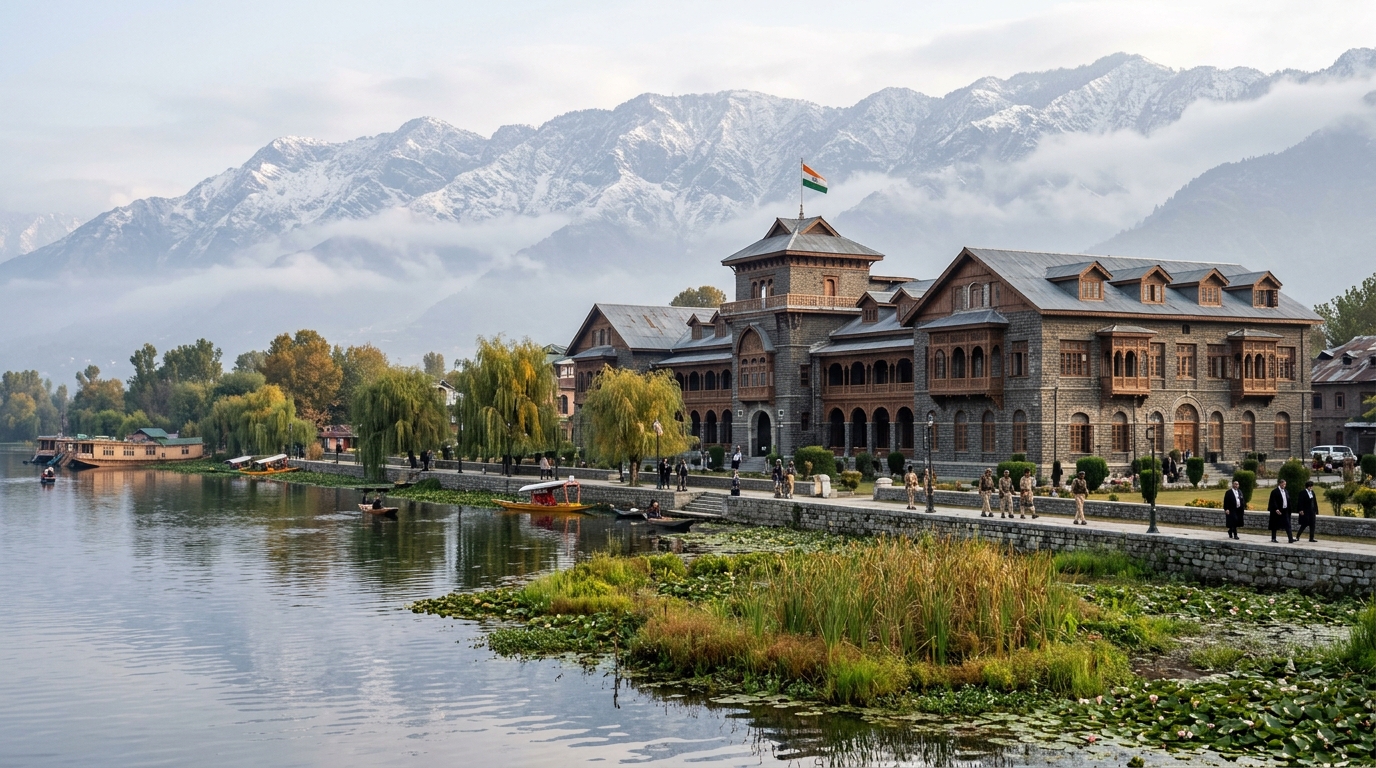
INAUGURAL EDITORIAL FOLIO · DESK & OBSERVATORY SYNTHESIS
Research Status & Non-Partisan Evidentiary Disclosure: Positioned immediately ahead of Selective Environmental Consciousness in Vol. 01 / No. 01, this special investigation establishes a substantial preliminary documentary baseline and fifteen-volume, seventy-five-chapter Monograph 06 framework across Kashmir, Jammu, Ladakh, Azad Jammu & Kashmir, and Gilgit-Baltistan (2000–2026). Original 2024 J&K manifestos (JKNC, PDP, BJP), Dialogue Earth (2024), CAG Report No. 4 of 2025, Ladakh constitutional milestones through September 2026, AJ&K 2021 academic manifesto study (University of the Punjab), AJ&K P&D’s 2019 sustainable development report, AJ&K 2026 election schedules (July 27, August 2 & August 10), Gilgit-Baltistan’s June 7, 2026 election & SDPI analysis, and UNDP GLOF-II records (411 structures across GB & KP) have been verified. Complete 2000–2026 historical manifesto retrieval, constituency-level legislative archives, party-wise implementation audits, and visual verification of two 2024 manifesto PDFs (whose indexed text was accessible) remain incomplete. Zero political parties are endorsed, opposed, or ranked.
Five-Year Manifestos in a Century-Scale Landscape
Every election promises roads, jobs, tourism, and prosperity—yet every livelihood across the Western Himalayas rests upon rivers, glaciers, soils, forests, and wetlands that outlast any cabinet.
Every election season across the Western Himalayas arrives wrapped in the vocabulary of acceleration. From Srinagar and Jammu to Leh and Kargil, from Muzaffarabad and Mirpur to Gilgit, Skardu, and Hunza, party manifestos and campaign rallies compete to promise wider highways, all-weather tunnels, record tourist arrivals, new hydropower megawatts, industrial estates, mineral royalties, subsidized electricity, and public employment. Political organizations seek the mandate of mountain citizens whose everyday survival—drinking water, paddy and orchard harvests, winter warmth, pastoral grazing, houseboat and trekking income, and safety from catastrophic floods—depends directly upon living watersheds, glaciers, forests, karewas, springs, and wetlands.
Yet open the manifestos placed before voters over the past quarter-century (2000–2026) and ask four elementary physical questions. When political parties promise to double or triple tourist arrivals, do they establish site-specific water, sewage, and alpine carrying capacities? When they promise industrial corridors and mineral employment, do they quantify winter inversion air-shed loads and riverbed replenishment limits? When they promise mountain expressways and run-of-the-river hydropower cascades, do they account for cumulative slope destabilization and downstream river dewatering? Above all, what happens to their environmental pledges once ballots are counted and portfolios are distributed?
Political terms are temporary; environmental consequences endure for generations. A cabinet completes its five-year tenure decades before a deodar sapling forms closed forest canopy. A legislator leaves office long before an incised gravel riverbed or a tunnelled fault zone reveals its full hydrogeological toll. A ribbon is cut beside a lakefront promenade while raw domestic sewage continues entering the water unseen beneath it.
Positioned immediately ahead of Selective Environmental Consciousness in our Inaugural Edition—and anchored by our fifteen-volume, seventy-five-chapter Monograph 06 research programme and Kashmir EcoWatch’s permanent Environmental Manifesto and Governance Observatory—this special investigation examines electoral politics across all five Western Himalayan regions under one unbroken rule: no political party is excluded, and no political party is judged by a different evidentiary standard.
Substantial preliminary investigation and 15-volume publication framework. Original 2024 J&K manifestos, statutory audits, and 2024–2026 policy analyses are documented below; complete 2000–2026 manifesto retrieval, constituency legislative records, and visual verification of two 2024 PDFs (whose indexed text was accessible) remain ongoing.
“If every political party can explain what it intends to build during the next five years, should it not also explain what it intends to preserve for the next hundred?”
Part I (Sections 1 & 2) — What Parties Promised in Kashmir, Jammu and Ladakh
Auditing the 2024 Jammu & Kashmir Assembly manifestos and distinguishing Ladakh’s September 2026 hill-council expansion from Sixth Schedule constitutional protection.
An evidence-led audit must begin with original party texts rather than campaign speeches or partisan summaries. Across Kashmir and Jammu during the landmark autumn 2024 Legislative Assembly elections, primary documentary review—corroborated by Dialogue Earth’s independent 2024 election analysis—reveals sharp variations in how major parties articulated ecological commitments. The Jammu & Kashmir National Conference (JKNC) pledged renewable energy expansion, residential solar power, afforestation, pollution reduction, waste management, and "responsible mineral exploration." The Jammu & Kashmir Peoples Democratic Party (PDP) included 13 numbered commitments under its environmental protection and sustainability section—spanning urban wetland and rural stream restoration, degraded forest rehabilitation, community forestry, curbing illegal logging and encroachment, satellite/drone/GIS forest-health monitoring, climate-resilient plantation, cleaner transport, Dal Lake restoration, and climate research.
The Bharatiya Janata Party’s (BJP) 2024 J&K manifesto featured a dedicated chapter on environmental and natural resource management—addressing lake rejuvenation, wind energy, medicinal plant cultivation, and forest conservation—alongside ambitious highway, industrial, and religious/leisure tourism expansion. Meanwhile, manifestos identified for the Indian National Congress (INC), Jammu & Kashmir Apni Party, and Awami National Conference require complete line-by-line environmental clause extraction in our archival registry. Across every reviewed text, however, one methodological distinction governs scientific credibility: promising an activity (planting trees or launching a lake drive) is fundamentally different from committing to a measurable ecological outcome (establishing a specified area of surviving native forest at five years or achieving verified winter STP nutrient removal).
Ladakh demands a distinct analytical lens because its environmental politics turns directly upon local democratic authority over land, water, minerals, and cultural rangelands. Tracing six milestones from 2019 to September 2026—BJP’s 2019 Lok Sabha commitment regarding Sixth Schedule protection, the 2020 Leh and 2023 Kargil Hill Council polls, the 2024 Lok Sabha campaign, the 2025 constitutional negotiations, and the September 2026 promulgation expanding Autonomous Hill Development Councils across all eight Ladakh districts—exposes a critical institutional distinction. Administrative hill development councils operating within Union Territory executive oversight are not constitutionally equivalent to Sixth Schedule legislative protection over land and resources under Article 244.
To evaluate Ladakh fairly, our investigation examines registered electoral parties (BJP, Congress, JKNC, PDP) and independent parliamentary/council representatives alongside the Leh Apex Body (LAB) and Kargil Democratic Alliance (KDA)—explicitly classifying LAB and KDA as political and civil-society coalitions rather than electoral parties. Benchmarked against MoEFCC climate vulnerability records and a 2026 parliamentary committee’s warnings on sanitation, waste, and responsible tourism, every political actor in Ladakh faces eight concrete empirical tests: glacier-dependent water security, visitor carrying capacity, commercial borewell abstraction, hotel sewage compliance, utility-scale solar land footprints, high-pass slope stability, cold-desert habitat conservation, and actual statutory resource powers.
PART I · LADAKH ELECTORAL & CONSTITUTIONAL CHRONOLOGY (2019–2026)
Six documented milestones linking constitutional governance debates to cold-desert environmental protection
| Electoral or Political Milestone | Documented Environmental & Governance Relevance |
|---|---|
| 2019 Lok Sabha elections | BJP manifesto commitment concerning Sixth Schedule protection for Ladakh |
| 2020 Leh Hill Council elections | Constitutional safeguards connected to land, employment, and fragile cold-desert environmental protection |
| 2023 Kargil Hill Council elections | Local governance authority, water security, and regional development priorities |
| 2024 Lok Sabha elections | Environmental protection, Sixth Schedule constitutional safeguards, and local representation featured prominently in the campaign |
| 2025 constitutional & administrative negotiations | Ministry of Home Affairs High-Powered Committee debates concerning land protection, employment, and regional governance |
| September 2026 | Announcement / promulgation expanding Autonomous Hill Development Councils across all Ladakh districts (distinct from Sixth Schedule constitutional protection under Article 244) |
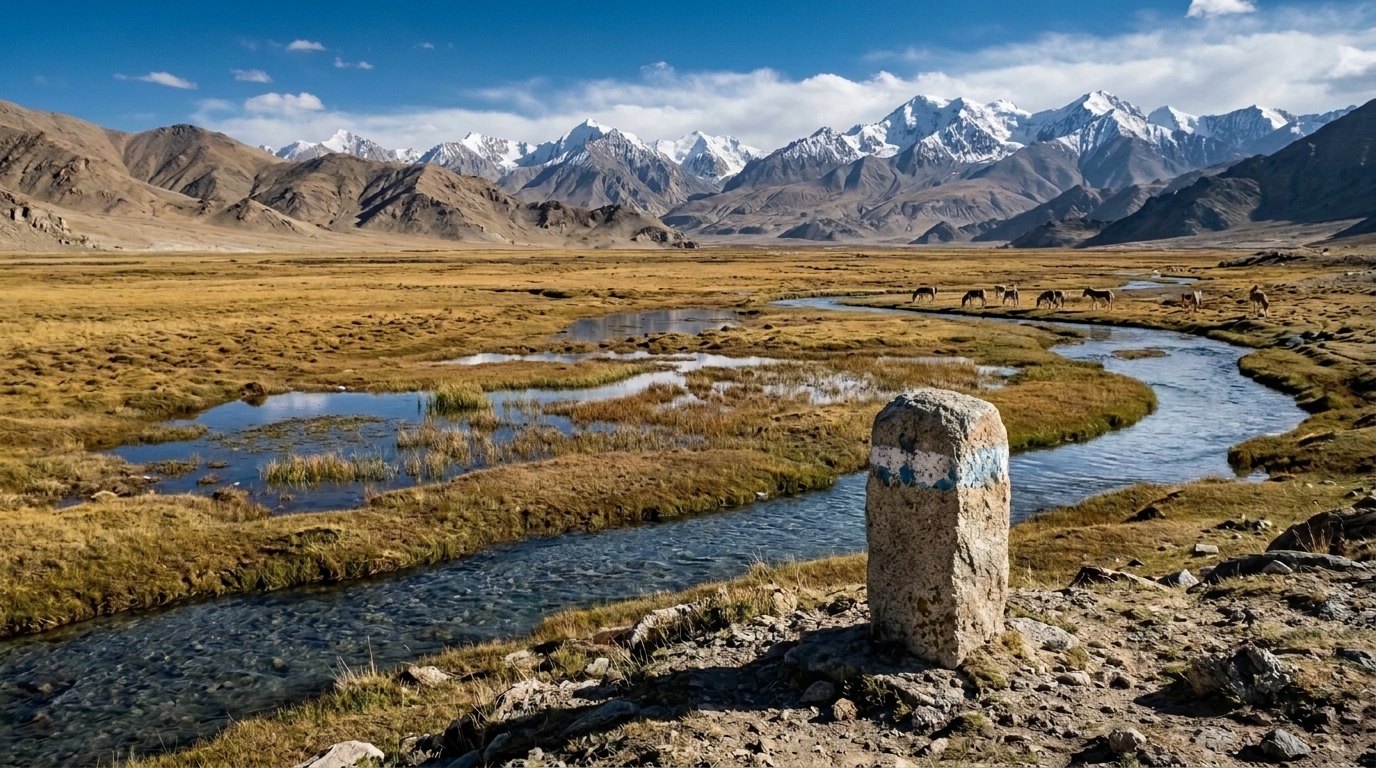
Part I (Sections 3 & 4) — Azad Jammu & Kashmir and Gilgit-Baltistan Through 2026
From the 2021 AJ&K manifesto baseline and Neelum–Jhelum river dewatering to Gilgit-Baltistan’s June 7, 2026 election and GLOF-II field realities.
Across the Line of Control in Azad Jammu & Kashmir (AJ&K) and Gilgit-Baltistan (GB), electoral politics confronts equally acute Himalayan hazards—and requires identical documentary precision regarding primary versus secondary sources. For AJ&K’s 2021 general election, a published University of the Punjab study reconstructed key party commitments: Pakistan Tehreek-e-Insaf (PTI) emphasized clean drinking water, forestry, climate projects, agriculture, fisheries, and Mangla Dam-related development; Pakistan Muslim League-Nawaz (PML-N) prioritized motorways, infrastructure, and socioeconomic growth; and the Pakistan Peoples Party (PPP) highlighted public welfare and basic necessities, while complete environmental texts for the All Jammu & Kashmir Muslim Conference, Jamaat-e-Islami AJ&K, Jammu Kashmir Peoples Party, and independents require primary archival retrieval. Ahead of AJ&K’s phased 2026 Legislative Assembly election cycle (recorded across July 27, August 2, and August 10, 2026), PML-N representatives indicated to Dawn that climate adaptation and forest conservation would feature in their manifesto—a pledge requiring verification against the final published text.
Yet AJ&K already possesses one of the Western Himalayas’ sharpest empirical tests of political-development accountability: the Neelum–Jhelum hydropower diversion. Although hydropower is universally marketed in party platforms as clean renewable energy, AJ&K’s own Planning and Development Department acknowledged in its 2019 Sustainable Development Report that diverting the Neelum River above Muzaffarabad sharply reduced instream river flows through the capital, aggravating drinking-water insecurity, urban sewage concentration, microclimatic warming, and aquatic habitat loss. Any party promising new hydropower megawatts across Himalayan gorges must be audited against actual downstream environmental-flow compliance.
Further north in Gilgit-Baltistan—home to the greatest concentration of non-polar glaciers on Earth—voters went to the polls on June 7, 2026. An important contemporary policy analysis published on June 7, 2026 through the Sustainable Development Policy Institute (SDPI) examined climate-related campaign commitments: documenting PPP’s emphasis on sustainable tourism and conservation (with its Hunza chapter addressing waste management and glacier monitoring), PML-N’s concentration on roads, tourism, and digital infrastructure with less explicit climate-adaptation detail, and PTI-associated independents’ focus on political governance despite earlier plantation legacies. Crucially, SDPI attributed four systemic omissions across the campaign documents it reviewed: weak climate budgeting, insufficient resilient-infrastructure standards, thin agricultural adaptation plans, and inadequate glacier-hazard governance.
At the same time, fair journalism must record positive physical implementation where it exists—without misattributing credit. Across 24 glaciated valleys spanning Gilgit-Baltistan and Khyber Pakhtunkhwa, published project records from the UNDP-supported, Green Climate Fund-financed GLOF-II programme document the construction of 411 small-scale flood-protection structures alongside community early-warning systems. While those 411 structures span both GB and KP and cannot be credited solely to Gilgit-Baltistan or claimed by any single political party, they demonstrate how coordinated international, state, and village action can build tangible hazard buffers.
PART I · THE NEELUM–JHELUM HYDROPOWER & RIVER ACCOUNTABILITY MATRIX
Seven ground-level verification tests connecting energy and infrastructure pledges to river survival in AJ&K
| Political & Development Commitment | Required Ground-Level Verification |
|---|---|
| Hydropower development | Minimum downstream environmental flow compliance below diversion barrages |
| Electricity generation | Local ecological costs versus fiscal royalty and power distribution benefits |
| Drinking-water security | Reliable municipal and spring water quantity and quality in Muzaffarabad and Neelum |
| River conservation | Measured instream discharge, municipal sewage dilution, and coldwater aquatic habitat |
| Forest conservation | Satellite-verified canopy cover and forest health across Neelum and Jhelum valleys |
| Mountain roads | Seismic-zone slope cuts, landslide reactivation, and river sediment loading |
| Tourism development | Valley wastewater interception, solid waste, and seasonal carrying capacity |
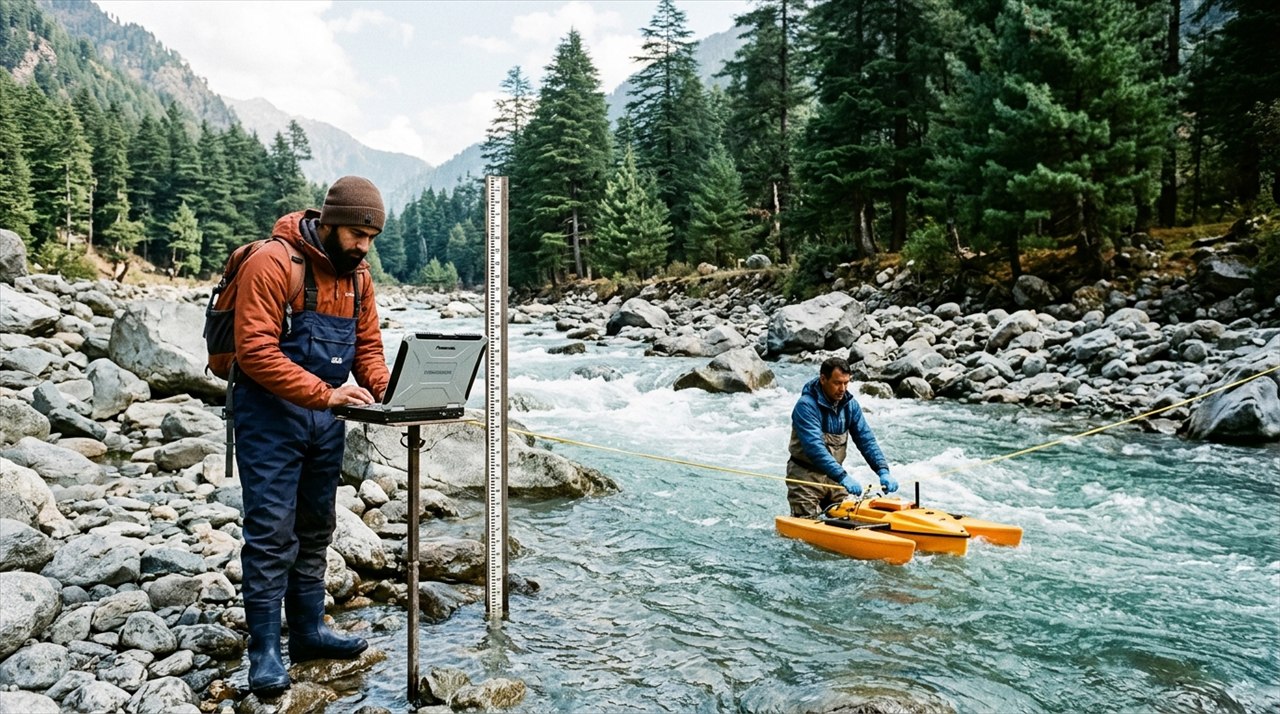
Parts II, III & IV — Twenty-Six Years of Cycles, Thirty Policy Domains and Three Anchor Cases
Why a single election cycle is never enough—testing all verifiable parties across 30 environmental subjects and three documented regional baselines.
A single election manifesto is a photograph taken on the eve of polling; environmental governance is a twenty-six-year film. Parties revise slogans, enter unexpected coalitions, inherit depleted treasuries, lose power, and return to opposition benches blaming their successors for projects they themselves initiated. Monograph 06 therefore reconstructs every principal electoral cycle from 2000 through 2026: the 2002, 2008, 2014, and 2024 J&K Assembly elections and 2004–2024 parliamentary polls; Ladakh’s 2004–2024 Lok Sabha and LAHDC cycles through September 2026; AJ&K’s 2001, 2006, 2011, 2016, 2021, and July–August 2026 Assembly elections; and Gilgit-Baltistan’s 2009, 2015, 2020, and June 7, 2026 Assembly elections—indexing 15 party cohorts in Kashmir and Jammu, 9 political/coalition entities in Ladakh, 9 in AJ&K, and 9 in Gilgit-Baltistan while keeping historical, renamed, and dissolved organizations methodologically distinct.
Rather than judging manifestos only on the handful of topics parties choose to highlight, our archive codes every accessible document across thirty standardized environmental policy domains: air pollution, transboundary atmospheric transport, drinking water, wastewater, solid waste, lakes, wetlands, rivers, glaciers, snow resources, glacial lake hazards, floodplains, forests, wildlife, migratory birds, biodiversity, mining, Karewas and geological heritage, agriculture, horticulture, tourism carrying capacity, pilgrimage management, road and tunnel cumulative EIA, hydropower e-flows, renewable-energy siting, urban planning, predictive disaster management, climate financing, scientific research infrastructure, and environmental justice. Methodological fairness requires distinguishing the absence of a subject from an accessible manifesto pamphlet from its absence across a party’s wider legislative or administrative record.
Three independently documented empirical cases anchor our ground-reality comparison across jurisdictions: (1) in Jammu and Kashmir, CAG of India Report No. 4 of 2025 (period ended March 2022) documenting untreated sewage entering 50 of 63 examined lakes (44 in Kashmir, 6 in Jammu); (2) in Azad Jammu & Kashmir, the 2019 official sustainable development report documenting reduced Neelum River flows and drinking-water stress around Muzaffarabad after hydropower diversion; and (3) across Gilgit-Baltistan and Khyber Pakhtunkhwa, UNDP GLOF-II records documenting 411 flood-protection structures whose long-term hazard-reduction durability now warrants independent tracking.
THREE DOCUMENTED REGIONAL ANCHOR BASELINES · PART IV
CAG Report No. 4 of 2025 covers an audit sample of 63 lakes (44 Kashmir, 6 Jammu affected) for the period ended March 2022. AJ&K Neelum River findings derive from the 2019 P&D Sustainable Development Report. UNDP GLOF-II structures span 24 valleys across both Gilgit-Baltistan and Khyber Pakhtunkhwa and are not attributable solely to GB or any single political party.
PART II · HISTORICAL ELECTORAL CYCLES UNDER INVESTIGATION (2000–2026)
Multi-cycle electoral scope across Kashmir, Jammu, Ladakh, Azad Jammu & Kashmir, and Gilgit-Baltistan
| Region & Legislative Tier | Principal Electoral Cycles Examined |
|---|---|
| Kashmir and Jammu (Assembly) | 2002, 2008, 2014, 2024 Assembly elections (plus relevant pre-2000 policy baselines) |
| Kashmir and Jammu (Parliamentary) | Lok Sabha parliamentary elections from 2004–2024 |
| Ladakh (Parliamentary) | Lok Sabha elections from 2004–2024 |
| Ladakh (Autonomous Hill Councils) | Leh and Kargil LAHDC elections + September 2026 8-district council expansion |
| Azad Jammu & Kashmir | 2001, 2006, 2011, 2016, 2021, and 2026 Assembly elections (July 27, August 2 & August 10, 2026 phases) |
| Gilgit-Baltistan | 2009, 2015, 2020, and June 7, 2026 Legislative Assembly elections |
Parts V & VI — Internal Manifesto Contradictions and Constitutional Jurisdiction
When page twelve of a manifesto undermines page forty—and why fair accountability must map who actually held legal power to act.
Read almost any contemporary Himalayan election manifesto from cover to cover and its deepest ecological vulnerability lies not in what is omitted, but in the unexamined collision between its economic chapters and its environment chapter. On page twelve, a party pledges to double tourist footfall, fast-track four-lane mountain highways, expand minor-mineral block auctions for youth employment, and commission run-of-the-river hydropower stations; on page forty, the same party pledges to conserve fragile alpine meadows, protect native deodar forests, safeguard irrigation kuhls, and restore living rivers.
Those twin goals are not inherently irreconcilable—human communities need dignified employment, safe roads, electricity, and housing. Yet their physical compatibility depends entirely upon location, engineering design, cumulative ecological limits, and enforceable caps. Promising mass tourism without publishing valley-wise water and STP ceilings, promising highways without slope-susceptibility exclusions and muck containment, or promising expanded riverbed mining without annual cobble-replenishment audits turns the green chapter of a manifesto into decorative stationery.
At the same time, credible political journalism must enforce rigorous jurisdictional fairness. An opposition party on legislative benches cannot be held culpable for executive budget diversions in the manner of a ruling cabinet. Conversely, an elected regional administration or Autonomous Hill Development Council may lack statutory jurisdiction over centrally controlled national highways, strategic tunnels, federal hydropower corporations, or post-2019 Union Territory reserved subjects—just as a legislator raising starred assembly questions possesses scrutiny power rather than treasury execution authority. Our eleven-actor Jurisdiction and Responsibility Matrix separates governing parties, coalition partners, opposition benches, MLAs, MPs, federal/central ministries, regional administrations, hill councils, municipalities, pollution regulators, and contractors so responsibility always tracks actual legal power.
PART V & PART VI · MANIFESTO CONTRADICTIONS & JURISDICTIONAL FAIRNESS
Testing internal development-versus-conservation coherence while assigning accountability strictly by statutory competence
| Development Pledge / Institutional Actor | Accompanying Green Pledge & Scientific / Jurisdictional Test |
|---|---|
| Increase tourist arrivals vs. Protect fragile ecosystems | What is the maximum sustainable visitor capacity per valley and season? |
| Construct new highways vs. Conserve forests | How many hectares of native canopy and wildlife corridor will be fragmented? |
| Expand mining employment vs. Protect natural resources | What are the replenishment-verified annual boulder and clay extraction limits? |
| Expand hydropower generation vs. Protect living rivers | What continuous seasonal and diurnal environmental flows will be legally maintained? |
| Expand urban infrastructure vs. Protect wetlands | Which mapped floodplains and Ramsar buffers are strictly off-limits to construction? |
| Increase horticultural productivity vs. Protect biodiversity | How will M9 summer groundwater pumping and pollinator-harming sprays be capped? |
| Governing political party | Cabinet orders, departmental budgets, statutory appointments, and executive implementation |
| Coalition partner | Assigned ministerial portfolio decisions and collective cabinet approvals |
| Opposition party | Assembly/parliamentary questions, statutory amendments, committee scrutiny, and costed policy alternatives |
| Member of legislature (MLA) | Constituency interventions, local area development funds, cut-motions, and voting records |
| Member of parliament (MP) | Federal parliamentary questions, standing-committee advocacy, and central-project oversight |
Parts VII & VIII — Follow the Money (INR & PKR) and the Legislative Record
Sanctioned versus spent conservation budgets, ecological return per crore, and measuring what elected representatives actually did in assemblies and parliaments.
A manifesto promise without a budget line is a press release; a budget announcement without verified expenditure and ecological measurement is fiscal theatre. Across eleven public-expenditure categories—lake conservation, cold-climate sewage treatment, solid-waste processing, native forest restoration, air-quality monitoring, climate adaptation, glacier research, disaster risk reduction, biodiversity protection, university research grants, and regulatory staffing—our investigation traces four distinct fiscal stages: amount promised, amount sanctioned in annual budgets, amount actually released by finance departments, and audited utilization on the ground.
Cross-border fiscal rigour requires strict accounting discipline: maintaining original Indian Rupee (INR) and Pakistani Rupee (PKR) figures separately without arbitrary exchange-rate conflation, computing inflation-adjusted real expenditure series across 2000–2026, and stripping out double-counting where federal or central grants (such as AMRUT, NCAP, CAMPA, Namami-type river outlays, or federal PSDP/GCF transfers) pass through regional budgets. Above all, money spent is never confused with nature healed: plantation crores are judged by five-year surviving native canopy; dredging crores by permanent bathymetric storage retained; and STP crores by winter ammoniacal-nitrogen and phosphorus loads actually prevented.
Parallel to fiscal audits runs Part VIII: Legislative Environmental Accountability. Rather than treating political parties as monoliths, our archive documents every accessible elected representative’s individual legislative footprint across nine verifiable indicators—questions asked, bills introduced, statutory amendments proposed, floor speeches, committee work, constituency interventions, EIA demands, ministerial replies obtained, and post-question field follow-up. Fairness cuts both ways: an MLA or MP who persistently questions river pollution or unpermitted mining earns factual archival recognition for raising the alarm, yet that speech is never recorded as river recovery until physical water-quality telemetry confirms improvement.
- •Starred and unstarred environmental questions raised in legislative assemblies and national parliaments
- •Private-member or government environmental bills introduced, co-sponsored, or supported
- •Statutory environmental protection amendments proposed during legislative debates
- •Substantive floor speeches addressing watershed, forest, air, cryosphere, or hazard governance
- •Participation and attendance in legislative committees on environment, public accounts, and estimates
- •Documented constituency-level interventions on local sewage, mining, springs, waste, or forest encroachment
- •Formal written requests demanding independent Environmental Impact Assessments or public hearings
- •Official ministerial and regulatory responses obtained and placed on the public record
- •Post-question follow-up actions and independently measured field outcomes (distinguishing speech from recovery)
PART VII · PUBLIC EXPENDITURE VS. MEASURABLE ECOLOGICAL OUTCOME
Eight fiscal-accountability rules separating contractor expenditure from verified environmental recovery
| Public Expenditure Category | Meaningful Ecological Performance Indicator |
|---|---|
| Money spent on plantation | Independently verified 3- and 5-year surviving native forest area and canopy density |
| Money spent on lake dredging | Net bathymetric storage volume permanently maintained after catchment silt control |
| Money spent on sewage treatment | Measured reduction in BOD, ammoniacal nitrogen, and orthophosphate entering waterbodies |
| Money spent on flood protection | Verified increase in floodway conveyance/detention and reduction in exposed households |
| Money spent on air monitoring | QA/QC-validated station uptime and documented emission-reduction interventions |
| Money spent on wetland restoration | Recovered seasonal hydroperiod, open-water area, and migratory waterbird carrying capacity |
| Money spent on wildlife conservation | Intact corridor connectivity and stable/recovering threatened species populations |
| Money spent on environmental research | Peer-reviewed open datasets and documented translation into binding regulatory rules |
Parts IX & X — The Western Himalayan Environmental Manifesto Protocol (WHEMP) & Permanent KEW Observatory
Ten voluntary components turning vague green slogans into auditable commitments—backed by twelve permanent KEW tracking modules.
Criticism alone never rewrites the next election’s manifesto. To offer every political party, hill-council slate, and independent candidate across Kashmir, Jammu, Ladakh, Azad Jammu & Kashmir, and Gilgit-Baltistan a constructive, non-partisan standard ahead of future polls, Himalayan Dispatch proposes the Western Himalayan Environmental Manifesto Protocol (WHEMP). Under WHEMP, every environmental commitment in a party manifesto should disclose ten explicit elements: (01) current environmental baseline, (02) defined problem, (03) supporting scientific evidence, (04) quantitative biophysical target, (05) implementation method, (06) capital and O&M financial allocation, (07) constitutionally competent responsible institution, (08) calendar deadline, (09) independent verification protocol, and (10) open public reporting.
See how WHEMP transforms political accountability in practice. Instead of writing "We will protect Dal Lake," a manifesto commits to publishing annual basin nutrient loads, winter STP removal performance, and independently audited trophic indicators. Instead of "We will increase forest cover," a party specifies native species hectare targets verified by geo-tagged three- and five-year survival audits. Instead of "We will promote sustainable tourism," a platform commits to statutory valley carrying capacities backed by cold-climate water and sewage caps. Readers can stress-test sample manifesto language interactively using the WHEMP Commitment Evaluator embedded immediately below this chapter.
To sustain this work permanently across electoral decades, Kashmir EcoWatch establishes the Western Himalayan Environmental Manifesto and Governance Observatory (/governance/environmental-manifesto-observatory)—comprising twelve permanent modules across all five regions and thirty policy domains, and tracking every documented pledge across eleven evidence-based statuses from "Documented promise" and "Funding released" to "Outcome verified," "Outside jurisdiction," or "Evidence unavailable," accompanied by an open Institutional Right of Response for every party and authority.
We close with the defining truth that unites all fifteen volumes and seventy-five proposed chapters of Monograph 06: political terms pass in sixty months, while a stripped karewa, a dewatered Himalayan river, or a vanished glacier shapes human life for centuries. Recognising documented achievements fairly, exposing unfulfilled slogans calmly, respecting jurisdictional boundaries scrupulously, and asking every contender for public office not merely what they intend to build over the next five years—but what living inheritance they intend to preserve for the next hundred.
PART IX · WHEMP — TEN MANDATORY COMPONENTS & MEASURABLE ALTERNATIVES
Proposed voluntary protocol for measurable, jurisdictionally honest environmental commitments across all political parties
| WHEMP Component / Conventional Slogan | Required Disclosure / Proposed Auditable Commitment |
|---|---|
| 01. Environmental baseline | What is the current, independently measured condition of the target ecosystem? |
| 02. Defined problem | What specific physical, chemical, or institutional driver will be addressed? |
| 03. Scientific evidence | What peer-reviewed or statutory research supports the proposed intervention? |
| 04. Quantitative target | What measurable biophysical improvement (not merely activity count) is promised? |
| 05. Implementation method | Through what engineering, legal, and ecological mechanism will it be fulfilled? |
| 06. Financial allocation | What is the estimated capital and O&M cost (in INR/PKR) and funding source? |
| 07. Responsible institution | Which authority holds actual constitutional and statutory jurisdiction to deliver it? |
| 08. Implementation deadline | By what specific calendar milestone within the electoral term will it be delivered? |
| 09. Independent verification | How will ecological survival or pollution reduction be audited independently? |
| 10. Public reporting | Where will citizens access machine-readable annual progress and expenditure records? |
| Slogan: "We will protect Dal Lake." | WHEMP: Publish annual basin nutrient loads, winter STP removal efficiency, and independently measured trophic/bathymetric recovery indicators. |
| Slogan: "We will increase forest cover." | WHEMP: Establish hectare-specific native species restoration targets and publish geo-tagged 3-year and 5-year survival audits. |
| Slogan: "We will improve air quality." | WHEMP: Publish source-apportionment emissions baselines, seasonal PM2.5 reduction targets, and reference-grade sensor QA/QC audits. |
| Slogan: "We will promote sustainable tourism." | WHEMP: Legally notify valley-specific visitor carrying capacities and enforce cold-climate water, sewage, and construction caps. |
“Political terms are temporary. Environmental consequences can last for generations. That is why environmental commitments require continuity beyond electoral cycles.”

PART IX · WHEMP INTERACTIVE DIAGNOSTIC WORKBENCH
Western Himalayan Environmental Manifesto Protocol (WHEMP) Evaluator
“We will protect Dal Lake.”
Publish annual basin nutrient loads, winter STP removal efficiency, and independently measured trophic/bathymetric recovery indicators.
Proposed accountability framework; zero political parties are endorsed, opposed, or ranked.
DOCUMENTARY SOURCES & FURTHER READING
| Source | Documentary relevance |
|---|---|
| Election Commission of India | Official election records, schedules, and political party participation (J&K and Ladakh) |
| J&K National Conference Manifesto 2024 | Original 2024 J&K Assembly election manifesto document |
| BJP J&K Manifesto 2024 (Sankalp Patra) | Original 2024 J&K Assembly manifesto containing dedicated environment & natural-resource chapter |
| PDP Manifesto 2024 (Peoples’ Manifesto) | Original 2024 J&K Assembly manifesto containing 13 numbered environmental commitments |
| Comptroller and Auditor General (CAG) of India | Independent public expenditure and lake/forest conservation performance audits (including Report No. 4 of 2025) |
| PRS Legislative Research | Independent legislative, bill, and state/UT budget analysis |
| AJ&K Election Commission | Regional electoral rolls, party registrations, and polling records (2001–2026) |
| AJ&K Legislative Assembly | Official legislative history, assembly debates, and 2026 phased election records (July 27, Aug 2 & Aug 10) |
| AJ&K Planning and Development Department | Regional statistics and 2019 sustainable development report documenting Neelum–Jhelum flow impacts |
| Gilgit-Baltistan Election Commission | Regional election schedules (including June 7, 2026 general election) and candidate records |
| Auditor General of Pakistan | Independent public project, forestry, and environmental expenditure audits |
| UNDP Pakistan (GLOF-II Programme) | Published project documentation on 411 flood-protection structures across 24 valleys in GB & KP |
| Sustainable Development Policy Institute (SDPI) & Dialogue Earth | Independent policy analyses of 2026 Gilgit-Baltistan and 2024 J&K campaign commitments |
EDITORIAL PUBLICATION METADATA & 10-STAGE GATE LEDGER
| Gate | Status | Record / Scope |
|---|---|---|
| 01 · Commissioned | completed | Himalayan Dispatch Founding Masthead |
| 02 · Research in progress | completed | Himalayan Dispatch Research & Observatory Desk |
| 03 · Manuscript draft | completed | Assigned Author / Editorial Desk |
| 04 · Evidence verification | completed | Cross-checked against Election Commission of India records, 2024 JKNC / PDP (13 environmental commitments) / BJP (dedicated environment chapter) manifestos, Dialogue Earth (2024), Ladakh 2019–Sept 2026 hill-council & Sixth Schedule records, MoEFCC climate platform & 2026 parliamentary committee notes, University of the Punjab (2021 AJ&K manifesto study), AJ&K P&D Sustainable Development Report (2019), AJ&K Legislative Assembly (2026 cycle: July 27, Aug 2, Aug 10), Gilgit-Baltistan Election Commission & SDPI (June 7, 2026), CAG Report No. 4 of 2025, and UNDP Pakistan GLOF-II reports. |
| 05 · Scientific review (where applicable) | pending | Strictly separates documented manifesto text from secondary academic/policy attributions, distinguishes activity counts from verified ecological outcomes, preserves original INR and PKR budget denominations without cross-currency conflation, and enforces 11-actor jurisdictional fairness. |
| 06 · Editorial review | completed | Founding Editor-in-Chief Desk Review |
| 07 · Copyright and ethics review | completed | Every political party, coalition (LAB, KDA), independent representative, and public agency across all five regions is examined under one non-partisan evidentiary standard with permanent right of response; all visual plates use governed institutional KEW assets. |
| 08 · Administrator approval | in progress | Staged on localhost at Stage 08 awaiting Founding Administrator review and approval. |
| 09 · Published | pending | — |
| 10 · Post-publication corrections | not applicable | — |
| Attribute | Final assignment |
|---|---|
| Publication | Himalayan Dispatch |
| Edition placement | Vol. 01 / No. 01 · Positioned immediately before Selective Environmental Consciousness |
| Companion monograph | Monograph 06 — When Politics Promises Green (15 Thematic Volumes · 75 Proposed Chapters) |
| Rubric | SPECIAL INVESTIGATION · ELECTORAL ACCOUNTABILITY · ENVIRONMENTAL GOVERNANCE · POLITICAL ECOLOGY · PUBLIC EXPENDITURE |
| Headline | When Politics Promises Green |
| Subtitle | Political Manifestos, Environmental Commitments and Ground Realities Across the Western Himalayas |
| Byline | Dr. Fayaz Ahmad Khan & Himalayan Dispatch Environmental Governance, Legislative Affairs and Public Accountability Desk |
| Geographical coverage | Kashmir · Jammu · Ladakh · Azad Jammu & Kashmir · Gilgit-Baltistan |
| Investigation period | 2000–2026 (including 2024 J&K/Ladakh and June–August 2026 GB/AJ&K cycles) |
| Proposed policy standard | Western Himalayan Environmental Manifesto Protocol (WHEMP · 10 Components) |
| Permanent KEW companion | Western Himalayan Environmental Manifesto & Governance Observatory (/governance/environmental-manifesto-observatory) |
| Research & verification status | Stage 08 Pre-Release Preliminary Investigation & 75-Chapter Framework · Complete Manifesto Archive, Constituency Records & Two Visual PDF Verifications Pending |

Founding Editor-in-Chief
Dr. Fayaz Ahmad Khan
Founder of Kashmir EcoWatch and Founding Editor-in-Chief of Himalayan Dispatch; writes on alpine hydrology, cryospheric thresholds, disaster resilience, and mountain commons across the Western Himalayas.
View Portfolio & Approved Commissions →NEXT IN THIS EDITION · SPECIAL INVESTIGATION · POLITICAL ECOLOGY · ENVIRONMENTAL ETHICS · UNIVERSAL ACCOUNTABILITY
Selective Environmental Consciousness
By Dr. Fayaz Ahmad Khan & Himalayan Dispatch Political Ecology and Environmental Accountability Desk · 29 min read