How Many People Can a Cold Desert Sustain?
Tourism, Urbanization, Infrastructure Expansion and the Ecological Carrying Capacity of Ladakh
INAUGURAL EDITORIAL FOLIO · DESK & OBSERVATORY SYNTHESIS
Scientific Investigation Architecture, Livelihood Fairness & Research Protocol Transparency: Investigation 02 of 'Ladakh's Ecological Frontiers' synthesizes peer-reviewed Trans-Himalayan hydrogeological, cryospheric, architectural, and waste-management literature with 2026 parliamentary committee findings on Ladakh's tourism, urbanization, water scarcity, and waste challenges and the June 2026 Ladakh administration restrictions on single-use plastics and littering. The seven quantitative protocols in Chapter VII are explicitly framed as Proposed Original Scientific Experiments designed for execution across the companion 45-chapter issue and the KEW Ladakh Cold-Desert Cryosphere & Ecology Observatory. Throughout this investigation, the dignity and economic rights of local Ladakhi homestay families, hospitality workers, drivers, guides, porters, farmers, and Changpa pastoralists are strictly upheld; analytical scrutiny is directed squarely at uncalibrated infrastructure planning, unmetered commercial resource extraction, and regulatory governance gaps.
COLD-DESERT HYDROLOGICAL & SANITATION MULTIPLIER PROFILE · LEH BENCHMARK
Per-Capita Daily Freshwater Extraction Across Vernacular and Commercial Regimes (LPCD)
Benchmark comparison of per-capita water demand (litres per capita per day) from traditional chakdon dry-sanitation households through flush-equipped commercial accommodations in Leh.
Replacing zero-water chakdon composting toilets with cistern-flush bathrooms, heated showers, and daily hotel laundry multiplies per-person water extraction four-fold to eight-fold during the May–September window when village yura channels require snowmelt for single-season irrigation.
The Oasis Illusion in a Rain-Shadow Desert
Why green barley fans along the Indus conceal narrow hydrological margins—and why 2026 governance warnings mark an inflection point.
Seen from an aircraft banking between the Stok Kangri massif and the Ladakh Range in July, Leh appears deceptively abundant. Irrigated terraces of barley, willow groves, and apricot orchards fan outward from meltwater streams, framed by whitewashed guesthouses, solar heaters, and paved highway loops. To a summer visitor arriving under crisp alpine skies, these emerald ribbons can resemble a resilient mountain valley capable of absorbing unlimited hotels, cafés, SUV convoys, and utility corridors. Step fifty metres beyond the outermost gravity irrigation channel, however, and the oasis vanishes abruptly into sun-scorched granite grit, talus, and hyper-arid desert.
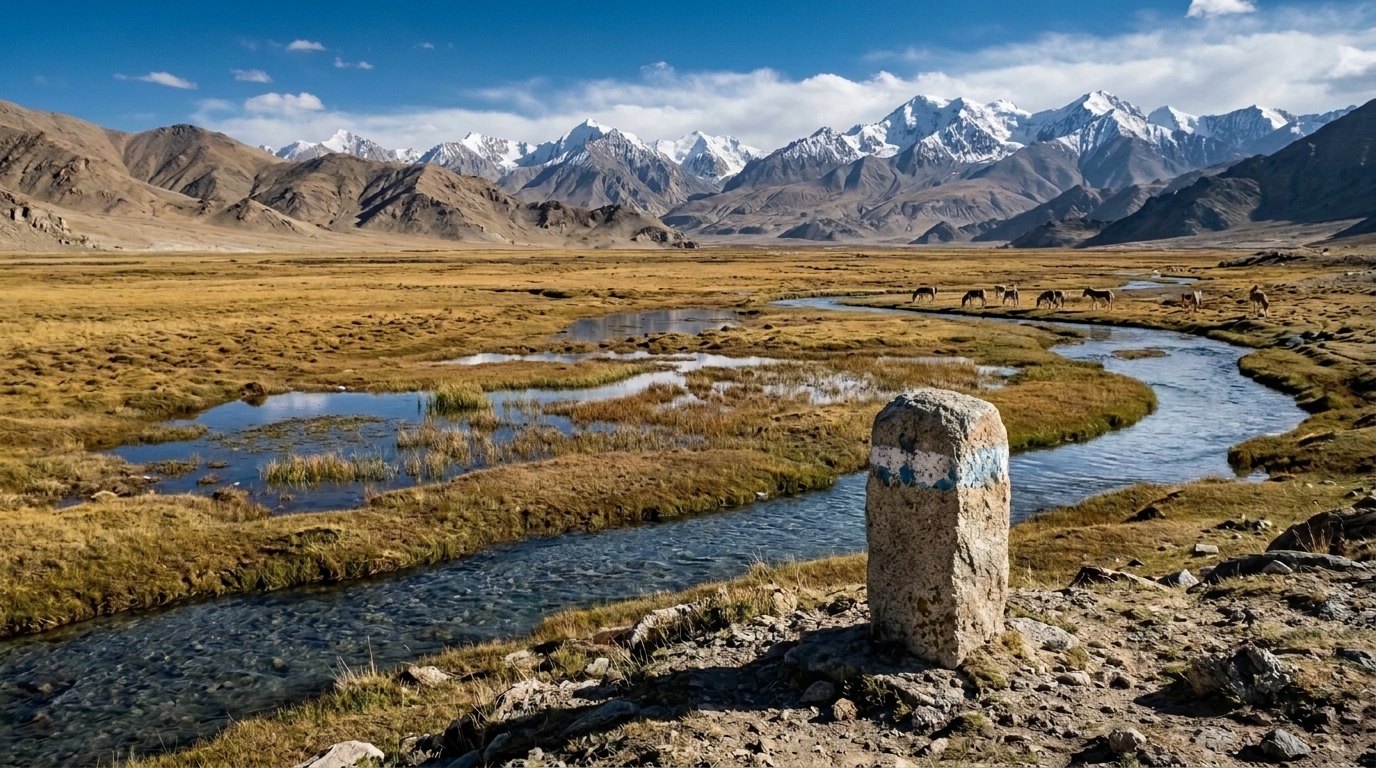
Ladakh lies in the deep orographic rain shadow north of the Great Himalayan Range, which blocks most of the Indian summer monsoon before it crosses Zojila or Rohtang. Across the central Indus corridor around Leh, mean annual precipitation hovers near ninety to one hundred and fifteen millimetres, while winter temperatures plunge twenty to thirty degrees below freezing across six to eight months of biological dormancy. Soils are skeletal, coarse, and poor in organic carbon; microbial decomposition in open dumpsites and septic soak pits slows drastically for most of the year; and nearly every drop of dependable summer water originates not from local rain, but from winter snowpacks, seasonal permafrost thaw, and small high-altitude cirque glaciers perched above five thousand metres.
In 2026, two public reckonings brought the collision between cold-desert biophysics and rapid economic transformation into national focus. First, a **2026 parliamentary committee** report formally identified growing tourism, rapid urbanization, acute water scarcity, and waste management as significant challenges threatening Ladakh’s fragile ecosystem. Shortly thereafter, in **June 2026**, the **Ladakh administration** announced strengthened restrictions on single-use plastics and littering across tourist corridors and high-altitude wetlands. Both interventions acknowledged what Ladakhi hydrologists, traditional water stewards, and municipal engineers have warned for years: development designed around lowland urban assumptions is pressing against non-negotiable cryospheric and assimilative ceilings.
This second investigation of Ladakh’s Ecological Frontiers examines that collision across fifteen interconnected domains—from borewell proliferation and flush-sanitation multipliers in Leh to year-round Himalayan tunnels and gigawatt-scale solar parks on Changthang’s pastoral commons. At its core stands a central research hypothesis: *"Conventional infrastructure and tourism planning may overestimate Ladakh's development capacity by failing to account for seasonal freshwater availability, waste assimilation limits and ecosystem recovery rates."* Asking how many people a cold desert can sustain is not an argument against Ladakhi prosperity; it is an inquiry into the physical conditions under which Ladakh’s oases can remain habitable.
TRANS-HIMALAYAN COLD-DESERT BIOPHYSICAL CONSTRAINTS · LEH BASELINE
Synthesizes Leh climatological normals (~3,500 m ASL), May–September visitor arrival concentration, cold-region biological kinetics below 5 °C, and published per-capita water-use surveys comparing dry-sanitation households against flush hotels.
Family-run Ladakhi homestays, local guesthouses, taxi cooperatives, guides, cooks, and porters rely on a brief warm season to fund household survival, winter fuel, and education in an extreme climate. Scrutinizing carrying capacity never faults local hospitality workers earning dignified livelihoods; it audits planning regimes that license water-intensive commercial expansion without aquifer metering, cryogenic sewage treatment, or basin visitor thresholds.
From Restricted Frontier to Mass Seasonal Destination
How five decades of tourism growth compressed half a million annual arrivals into a five-month meltwater window.
For nearly three decades after 1947, Ladakh remained closed to non-resident leisure travel as a high-altitude borderland flanked by sensitive frontiers. When Leh first opened to regulated visitors in 1974, just 527 tourists—predominantly international mountaineers, scholars, and long-stay trekkers—entered the Indus valley. Those early visitors walked footpath networks, stayed weeks in village homes, ate local barley *tsampa* and seasonal greens, and used vernacular dry sanitation and bucket washing, exerting negligible metabolic pressure on village streams.
Over the ensuing half-century, visitation transformed in scale, speed, and resource intensity. Annual arrivals stayed between twelve thousand and twenty-five thousand through the 1980s and 1990s before surging after 2010—propelled by domestic cinema filmed at Pangong Tso, expanded jet flights into Leh’s Kushok Bakula Rimpochee Airport, widened mountain highways, social-media circuits, and post-2019 Union Territory infrastructure investment. By the mid-2020s, peak annual arrivals exceeded half a million visitors, shifting from multi-week trekkers to motorized four-to-six-night itineraries.
Annual arrival totals, however, conceal the metric that governs cold-desert stress: seasonal demographic compression. Leh and Kargil districts together hold roughly three lakh permanent civilian residents across vast valleys, while Leh town’s permanent population stands near thirty-five to forty-five thousand. With eighty-five to ninety percent of leisure arrivals packed between mid-May and September, summer daily transient populations in Leh town, Hunder–Diskit, and the Pangong–Tso Moriri circuit rival or outnumber permanent residents.
Crucially, this visitor surge coincides with peak agricultural water demand. From May through August, village water masters (*churpons*) ration snowmelt hour by hour through ancestral *yura* gravity channels to irrigate single-crop barley, wheat, peas, fodder alfalfa (*ol*), and apricot orchards before autumn frost. Unlike monsoonal hill stations where July tourism arrives alongside heavy summer rain, Ladakh’s tourist peak pits maximum hotel pumping and laundry discharge directly against the narrowest window of agricultural survival.
“Annual arrival totals flatter cold-desert planners by spreading five months of metabolic shock across twelve months of calendar paper.”
Concrete Over Barley: Urban Land-Use Transformation and High-Altitude Architecture
As agricultural terraces give way to multi-storey hotels, imported cement replaces centuries of passive-solar earthen thermal design.
Walk down from Shanti Stupa through Changspa and Sankar into central Leh, or survey Kargil’s Suru river terraces, and urbanization is etched across former field walls. Historically, Ladakhi settlements clustered on rocky, non-arable hillslopes and ridge spurs—visible at Leh Palace, Thiksey, and Chemrey—preserving scarce, gently sloping alluvial soils watered by gravity channels exclusively for crops and willow-poplar *tokpo* buffers. Every irrigated plot represented generations of stone clearing, levelling, and organic soil building.
Over the past two decades, rising commercial land values across Changspa, Karzoo, Upper Tukcha, Shenam, Skara, and Choglamsar turned barley plots and orchards into multi-storey hotels, guesthouses, cafés, and paved parking aprons. Multi-temporal satellite records show Leh’s impervious built-up footprint expanding several-fold since the late 1990s, disproportionately consuming vegetated oasis fans rather than barren gravel. Sealing irrigated terraces under concrete and asphalt triggers a dual hydrological penalty: summer snowmelt can no longer infiltrate fields to recharge shallow valley-fill aquifers, while rare convective cloudbursts—such as the devastating August 2010 flash flood and recurring 2020s rainstorms—accelerate across sealed surfaces into destructive debris flows.
Equally consequential is how new structures are built. Vernacular Ladakhi architecture evolved as a masterful cold-desert thermal system: thick walls of sun-dried mud brick (*paga*) or rammed earth (*gyapak*), flat roofs of poplar beams, willow twigs (*talu*), and compacted clay (*markalak*), and south-facing solar apertures. Enhanced since the 1980s with passive-solar Trombe walls and sunspaces, earthen buildings buffer minus-twenty-degree winters using minimal fuel and virtually zero imported embodied carbon.
Contemporary commercial hotels and public buildings instead rely overwhelmingly on reinforced cement concrete frames, fired bricks, aluminium-glass façades, and uninsulated concrete slabs hauled hundreds of kilometres by diesel trucks across high passes. Because concrete conducts heat rapidly, uninsulated hotel blocks shed daytime warmth after sunset, requiring heavy diesel boilers, kerosene *bukharis*, or electric heating while suffering severe freeze-thaw spalling. Even where façades add decorative timber cornices (*shingtsak*), replacing local earth with trucked cement locks towns into chronic energy, riverbed aggregate-mining, and carbon liabilities.
The Subterranean Deficit: Alluvial Aquifers and the Borewell Proliferation
Beneath Leh’s surface channels, thousands of unmetered submersible pumps draw down glacial-outwash groundwater with unmeasured recharge.
Groundwater extraction in Ladakh carries far steeper risks than on monsoonal plains because of Leh’s subsurface architecture. The town rests atop an intermontane wedge of glacial moraines, glacio-fluvial cobbles, granitic sands, and discontinuous silt lenses shed from the Ladakh batholith and the small niche glaciers flanking Khardung La, notably the Phuche and Khardung snowfields. Rather than tapping a deep, regionally continuous aquifer recharged by monsoon rain, Leh’s wells draw from compartmentalized valley-fill pockets recharged almost solely by seasonal snowmelt percolating along *tokpo* stream beds, artificial glaciers and ice stupas, and flood-irrigated fields.
Historically, groundwater surfaced naturally where coarse upper-fan gravels met finer sediments or bedrock sills, feeding perennial springs (*chumiks*) and stone-lined *zing* ponds. Custom protected *chumiks* with strict cleanliness taboos against soap or latrine waste, while daytime stream flows followed transparent *churpon* schedules. Winter domestic water was carried manually from unfrozen spring spouts, placing a natural ceiling on consumption.
Booming hotel bed capacity broke that surface-water balance. Municipal piped schemes—dependent on high-head Indus river lift pumps and spring intakes—could not supply twenty-four-hour pressurized water to upper-fan hotels during summer peaks. In response, hotels, commercial complexes, institutions, and urban households drilled downward. Field surveys and municipal estimates indicate well over a thousand—and across greater Leh multiple thousands—of private and commercial borewells and handpumps operating almost entirely without flow meters, extraction limits, or piezometric monitoring.
When hundreds of submersible pumps run simultaneously from May through September to fill rooftop hotel tanks, localized drawdown cones develop beneath Upper Leh, Changspa, Karzoo, and Shenam. Neighbourhoods reliant on ancestral *chumiks* report dwindling discharge or seasonal drying, pushing ordinary families toward tanker deliveries. Because Khardung’s small high-elevation glaciers are simultaneously shrinking under regional warming, heavy summer pumping risks mining multi-decadal cryospheric storage faster than winter snowfall can replenish it.
Leh’s glacio-fluvial gravel-and-cobble deposits have high vertical permeability and minimal clay filtration, allowing effluent from unlined hotel soak pits to migrate rapidly downward toward shallow groundwater horizons tapped by adjacent borewells and springs.
Flush Hotels, Chakdon Sanitation, Waste Limits and Cold-Desert Carrying Capacity
How replacing zero-water composting toilets with cistern-flush bathrooms multiplied water extraction, strained sewage networks, and exposed the limits of plastic bans alone.
Nowhere is the clash between cold-desert ecology and imported hospitality norms clearer than inside the bathroom. Traditional Ladakhi homes solved hyper-arid water scarcity and nutrient-poor soils simultaneously through the *chakdon* (or *depon*), a two-storey dry composting toilet. Household members added a scoop of dry earth and ash (*sa*) through an upper-floor drop-hole after each use; in the ground-floor vault, dry mountain air desiccated excreta without consuming a drop of snowmelt, yielding pathogen-reduced spring compost (*lud*) essential for barley terraces. Water remained in the stream, nutrients returned to cropland, and blackwater outfalls did not exist.
Commercial tourism inverted that closed loop. Visitors accustomed to metropolitan hotels expect cistern-flush toilets, pressurized hot showers, and daily laundering of heavy linens. Whereas Ladakhi households using *chakdon* sanitation historically required twenty to forty litres per capita per day (LPCD)—and hill-town municipal norms budget fifty-five to seventy LPCD—field audits across Leh’s flush hotels document guest water consumption between 150 and 300+ LPCD. Each flush-hotel guest thus imposes a four-fold to eight-fold per-capita water multiplier over vernacular norms, extracted overwhelmingly from unmetered borewells.
Every kilolitre pumped into hotel tanks immediately returns as blackwater and detergent-laden greywater. Across much of Leh, Kargil, Diskit, and lakeside camp corridors, establishments discharge effluent into unlined soak pits or septic vaults dug into porous glacial gravels, elevating nitrate and fecal-coliform contamination risks for nearby borewells and *chumiks*. While Leh’s fecal-sludge treatment plant (developed with BORDA and LEDeG support) and expanding sewerage lines represent crucial progress, cold-desert sewage engineering confronts severe constraints: shallow sewer pipes freeze in winter, microbial treatment kinetics slow sharply below five degrees Celsius, and a five-month summer hydraulic surge alternates with seven months of minimal flow.
Solid waste exhibits the same absence of natural assimilation. As underscored by the **2026 parliamentary committee** report on Ladakh’s water and waste challenges and addressed in part by the **June 2026 Ladakh administration** announcement strengthening restrictions on single-use plastics and littering, mass motorized travel brought millions of PET bottles, multilayered wrappers, tetra-packs, and wet wipes into a cold, high-UV climate where winter freezes halt biodegradation and intense sunlight shatters exposed plastics into microplastics. Unmanaged organic food waste around dumpsites like Bombgarh and camp clusters has also fuelled surging populations of free-ranging feral dogs that prey on wild ungulates and endangered ground-nesting black-necked cranes at Tso Kar and Tso Moriri.
The June 2026 plastic and anti-littering restrictions—building on community water-refill initiatives like Leh’s Dzomsa stations—are necessary steps, yet plastic bans alone cannot secure carrying capacity. Under Liebig’s law of the minimum, cold-desert carrying capacity is fixed by whichever seasonal threshold fails first: summer aquifer recharge without drawdown, insulated fecal-sludge and greywater treatment without groundwater pollution, reverse-logistics waste export out of the Himalaya, or disturbance-free buffers around closed endorheic lakes like Pangong Tso and Tso Moriri. Without borewell metering, modernized odourless *chakdon* and greywater mandates, winter-ready sewage capacity, and binding destination visitor caps, banning plastic bottles addresses only the most visible symptom of overshoot.
“Conventional infrastructure and tourism planning may overestimate Ladakh's development capacity by failing to account for seasonal freshwater availability, waste assimilation limits and ecosystem recovery rates.”
LADAKH COLD-DESERT SCIENTIFIC HYPOTHESIS & CARRYING-CAPACITY WORKBENCH
Cryospheric Water Timing, Seasonal Visitor Stress & Cold-Desert Ecological Functions
Parametric scenario explorer grounded in the 2026 cryospheric synthesis (0.21–0.37 m w.e./yr mass loss; ~0.02°C/yr warming), 2026 parliamentary carrying-capacity warnings, June 2026 plastic restrictions, September 2026 avian concern records (65 species), and 2025 Changthang permafrost microbiome findings. Illustrative planning model pending the 21 proposed field experiments.
Central Hypothesis 02: Conventional infrastructure and tourism planning may overestimate Ladakh’s development capacity by failing to account for seasonal freshwater availability, waste assimilation limits and ecosystem recovery rates.
Seasonal Pressure Ratio
0.40×
Visitors per local resident
Peak Freshwater Demand
5.71 MLD
Visitor share: 57%
Sewage & Solid Waste
4.57 MLD
Solid waste: 28.8 t/day
Reflects the 2026 parliamentary committee concern: flush-toilet hotel borewells in Leh, Nubra, and Pangong extract alluvial groundwater at 3×–5× traditional dry-compost (*chakdon*) household consumption, while sub-zero winter temperatures slow microbial sewage and landfill assimilation.
Tunnels, Black Carbon and Year-Round Connectivity Across the High Passes
What diesel combustion at five thousand metres and all-weather Zojila and Shinku La tunnels mean for Ladakh’s winter recovery fallow.
At Khardung La (5,359 m) or Chang La (5,360 m) on a July morning, long queues of tourist SUVs, motorcycles, and freight trucks idle in air holding thirty-five to fifty percent less oxygen than at sea level. Under low oxygen partial pressure, internal-combustion engines—especially heavy diesel trucks hauling construction materials and backup hotel generators—suffer incomplete combustion, emitting elevated loads of black carbon soot, nitrogen oxides, and $ ext{PM}_{2.5}$. Trapped beneath steep winter and nocturnal valley inversions or deposited directly onto nearby snowfields and cirque glaciers, black carbon darkens ice surfaces, lowers albedo, and accelerates premature melt across the very snowpacks sustaining valley streams.
Concurrently, highway expansion across NH-1, the Leh–Manali corridor, the Shyok–Pangong route, and the Nimmu–Padum–Darcha axis through Zanskar has involved intensive rock blasting across fractured slopes and permafrost zones. Where excavated muck is inadequately retained by gabion structures, debris spills into narrow *tokpo* tributaries, smothering benthic habitats and riparian willows.
Even more transformative is the engineering end of winter isolation through the all-weather **Zojila Tunnel** corridor on the Srinagar–Kargil–Leh highway and the **Shinku La Tunnel** beneath the 5,091-metre pass into Zanskar. For permanent residents of Kargil, Drass, Zanskar, and Leh, twelve-month road connectivity fulfills an indisputable humanitarian necessity: emergency winter medical evacuation, reliable food and fuel supplies, and relief from five months of snowbound isolation.
Yet planners must confront the ecological corollary: historically, winter pass closure served as Ladakh’s involuntary ecological recovery fallow. Half a year without mass external visitation allowed stressed alluvial aquifers to stabilize, spared wildlife in Hemis, Changthang, and Zanskar from motorized disturbance during lean winter foraging, and avoided running uninsulated hotel plumbing at minus twenty degrees. Opening Zojila and Shinku La to unregulated winter leisure convoys before building cryogenic insulated sewerage, winter water budgets, clean-vehicle mandates, and seasonal wildlife quiet zones risks stretching a five-month stress into a twelve-month deficit—particularly across Zanskar’s fragile village valleys.
Solar Megawatts on Pastoral Commons: The Paradox of Green Infrastructure in Changthang
Why Ladakh’s extraordinary solar irradiance is neither spatially boundless nor ecologically free on high-elevation rangelands.
With over three hundred clear-sky days a year, direct normal solar irradiance exceeding 2,000 $\text{kWh/m}^2\text{/yr}$, and cool temperatures that enhance photovoltaic efficiency, Ladakh sits at the centre of multi-gigawatt utility-scale solar park and battery-storage plans across high plateaus such as Pang, linked to long-distance high-voltage transmission corridors. Policy maps routinely classify these vast plateaus as "barren wasteland" awaiting productive enclosure.
In Trans-Himalayan ecology, however, "wasteland" is an administrative misnomer. High-altitude steppes and *tsokha* sedge wetlands across Changthang, More Plains, Rupshu, and Hanle sustain semi-nomadic *Changpa* pastoralists—whose rotational *rebo* camps produce world-renowned *pashmina* wool—alongside irreplaceable cold-desert fauna including *kiang* (Tibetan wild ass), Tibetan gazelle (*goa*), argali, Pallas’s cat, Eurasian lynx, snow leopard, and black-necked cranes.
Fencing tens of thousands of acres for utility solar arrays without pastoral and ecological co-design creates four acute pressures: perimeter fences sever ungulate migrations and lock *Changpa* herds out of vital winter emergency pastures during severe *kha-rag* snowstorms; grading desert pavement destroys slow-growing *Caragana* and *Eurotia* shrubs that need decades to recover, generating dust plumes across panels and snowpacks; wet-washing millions of modules risks tapping scarce desert water unless waterless robotic dry-cleaning is mandated; and overhead transmission lines across Tso Kar, Tso Moriri, and Hanle risk lethal crane collisions while unshielded lighting threatens the Hanle Dark Sky Reserve. Distributed rooftop solar and local grid decarbonization are vital, whereas megawatt export parks require strict rangeland exclusion zoning and *Changpa* *goba* consent.
Seven Experiments to Measure What Ladakh Can Actually Sustain
Moving from qualitative alarm to sub-basin equations: a seven-part research protocol for cold-desert carrying capacity.
Conventional master plans repeatedly overestimate Ladakh’s development headroom because they rely on annual mainstem river averages and nominal bed targets rather than seasonal sub-basin bottlenecks. Upper Leh hotels cannot gravity-draw mainstem Indus water flowing hundreds of metres below; closed basins like Pangong Tso and Tso Moriri have zero river outlets to flush nutrients; and biological sewage plants lose nitrification capacity in sub-zero winters.
Rigorous planning therefore requires a minimum-limiting-factor model for each destination $d$ and month $t$: $CC_{\text{effective}}(d, t) = \min\big(CC_{\text{water}},\; CC_{\text{wastewater}},\; CC_{\text{solid-waste}},\; CC_{\text{cryosphere-carbon}},\; CC_{\text{habitat}},\; CC_{\text{socio-cultural}}\big)$. Building on the **2026 parliamentary committee** findings and **June 2026 Ladakh administration** anti-plastic directives, we formulate seven **Proposed Original Scientific Experiments** below to anchor the companion 45-chapter issue and the KEW Ladakh Cold-Desert Cryosphere & Ecology Observatory.
PROPOSED ORIGINAL SCIENTIFIC EXPERIMENTS · INVESTIGATION 02 RESEARCH PROTOCOL
Proposed Original Scientific Experiments: Seven Quantitative Protocols to Establish Cold-Desert Carrying Capacity Thresholds Across Ladakh
| Proposed Original Scientific Experiment | Methodology, Sensor / Field Inputs & Decision Metric |
|---|---|
| 01. Historical built-up area expansion mapping | Multi-epoch classification of Corona KH-4B (1960s–1970s), Landsat (1990–2026), and 10 m Sentinel-2 optical scenes across Leh, Kargil, Diskit–Hunder, Padum, and lakeshore buffers to quantify conversion of irrigated barley terraces and permeable recharge fans into impervious hotel and urban surfaces. |
| 02. Tourist-to-resident seasonal pressure index | Integrates airport arrivals, NH-1 / Manali–Leh / Shinku La check-post counts, permit logs, and seasonal occupancy against ward/village populations—PSI(d,t) = (V_daily(d,t) × w_resource) / P_resident(d)—capturing summer compression and post-tunnel winter surges. |
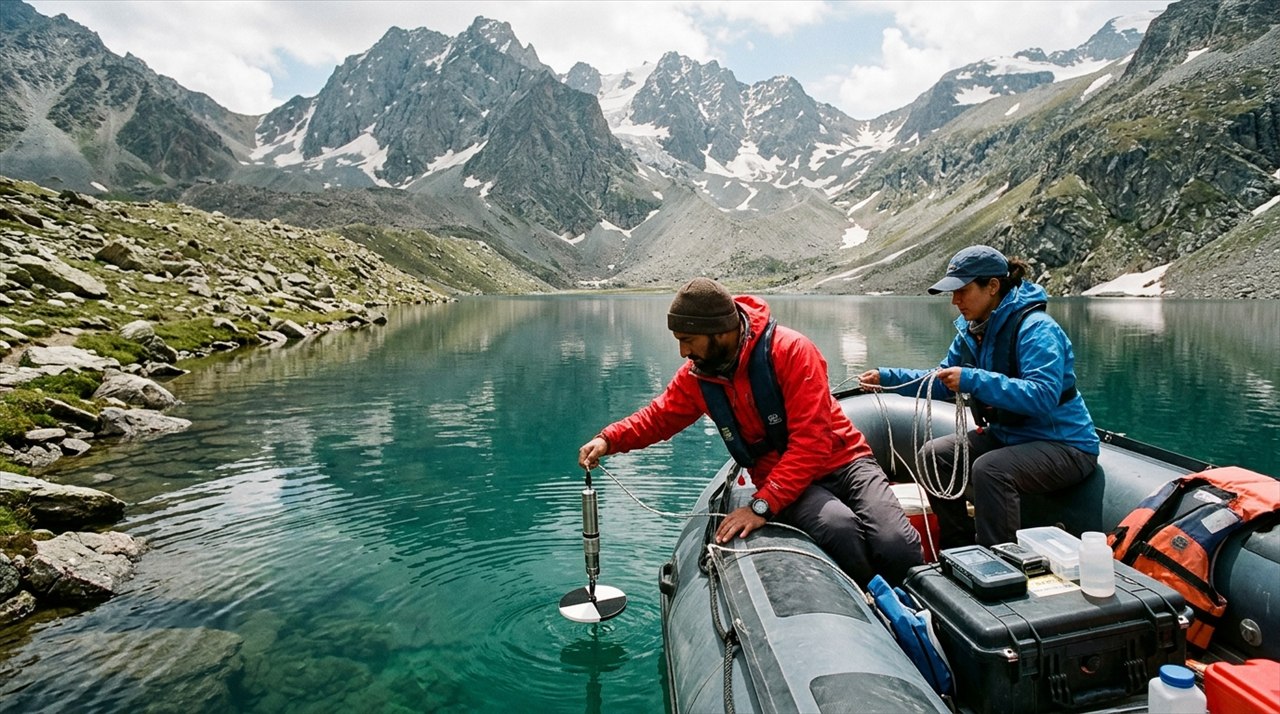
| 03. Regional water demand and availability modelling | Couples MODIS/VIIRS snowmelt and cirque-glacier runoff curves with chumik spring gauging and ultrasonic metering across stratified flush hotels, vernacular chakdon homes, municipal lift lines, and yura channels to quantify summer piezometric overdraft. |
| 04. Solid waste generation projections | Seasonal waste-composition audits across hotels, homestays, camps, and dumpsites (tracking pre- and post-June 2026 plastic restriction cohorts), modelling UV microplastic fragmentation, organic-waste feral-dog subsidies, and reverse-logistics backhaul capacity. |
| 05. Satellite-based infrastructure footprint assessment | Sentinel-1 InSAR and optical mapping of highway cut-slopes, Zojila and Shinku La tunnel portals, riparian muck disposal, transmission corridors, and Changthang utility-solar fences overlaid against Changpa pastures and crane/ungulate habitats. |
| 06. Tourism carbon footprint modelling | Life-cycle inventory combining aviation, altitude-adjusted vehicular black carbon / NOx / PM2.5 emissions (3,500–5,360 m), winter heating fuels, and embodied-plus-operational carbon of reinforced concrete hotels versus passive-solar earthen architecture. |
| 07. Destination-specific ecological carrying capacity assessment | Synthesizes Experiments 01–06 into CC_effective(d,t) = min(CC_water, CC_wastewater, CC_waste, CC_cryosphere, CC_habitat, CC_social) across Leh, Kargil–Suru, Nubra, Pangong Tso, Tso Moriri–Tso Kar, Hanle, and Zanskar to set dynamic bed and permit caps. |
Governing Within the Hydrological Horizon: Thresholds for a Living Cold Desert
Why protecting Ladakhi livelihoods requires binding water, sanitation, energy, and visitor guardrails before the meltwater margin closes.
For a millennium, Ladakhi society endured inside a rain-shadow desert by treating scarcity as a foundational rule of design. Ancestral *churpon* water schedules, stone *zings*, zero-water *chakdon* composting vaults, passive-solar earthen walls, and rotational *Changpa* pastures were precision adaptations to ninety millimetres of precipitation and five warm months. Replacing those closed loops with unmetered deep borewells, cistern-flush hotels, uninsulated concrete blocks, year-round diesel convoys, and fenced rangeland solar parks without ecological guardrails borrows short-term growth on credit from retreating mountain ice.
Translating the **2026 parliamentary committee** warning and the **June 2026 Ladakh administration** plastic and anti-littering restrictions into durable ecological security requires six sustainable development thresholds. First, statutory sub-basin groundwater law must mandate digital metering on all commercial hospitality borewells, progressive seasonal water tariffs, protected *chumik* spring-sheds, and moratoria on water-intensive hotel licensing in drawdown wards. Second, cold-desert building and sanitation codes should incentivize odourless solar-ventilated *chakdon* systems, decentralized insulated greywater recycling, passive-solar earthen envelopes, and operational cryogenic sewage treatment *before* new commercial beds open in Leh, Kargil, Diskit, or Padum.
Third, waste management must pair single-use plastic bans with Extended Producer Responsibility (EPR) deposit-refund backhaul that physically exports non-recyclables out of Ladakh alongside wildlife-proof organic composting that ends feral-dog subsidies. Fourth, dynamic telemetry-linked destination visitor caps and strict lakeshore construction setbacks must protect Pangong Tso, Tso Moriri, Hanle, Nubra, and post-tunnel Zanskar. Fifth, Zojila and Shinku La mobility corridors require clean-fleet transitions, slope muck-containment audits, and winter wildlife quiet zones. Sixth, governance must keep value in local hands—privileging Ladakhi village homestays, local transport and guiding cooperatives, agricultural oases, and *Changpa* pastoralist consent over speculative enclave resorts. A cold desert can welcome the world and sustain thriving mountain communities—provided its laws count every summer drop of meltwater as honestly as the mountain itself.
- •Sub-Basin Borewell Metering & Spring-Shed Protection: Meter commercial hotel borewells, safeguard chumik recharge cones, and tie accommodation permits to verified snowmelt and piezometric stability.
- •Cold-Climate Sanitation & Passive-Solar Codes: Incentivize modernized zero-water chakdon toilets, insulated greywater reuse, cryogenic sewage treatment, and passive-solar earthen construction.
- •Dynamic Destination Caps & Pastoral Co-Governance: Enforce science-based visitor ceilings across closed lake basins and post-tunnel valleys alongside EPR waste backhaul and Changpa-approved renewable siting.
DOCUMENTARY SOURCES & FURTHER READING
| Source | Documentary relevance |
|---|---|
| Parliament of India — 2026 Parliamentary Committee Report on Environmental Challenges, Tourism, Urbanization, Water Scarcity & Waste Management in Ladakh | Identifies rapid tourism expansion, unplanned urbanization, water scarcity, and solid and liquid waste accumulation as major structural challenges confronting Ladakh’s fragile cold-desert ecosystem. |
| Administration of Union Territory of Ladakh — June 2026 Directives Strengthening Restrictions on Single-Use Plastics and Littering | Official June 2026 UT Ladakh administrative announcement tightening bans and enforcement against single-use plastics and corridor littering across tourist destinations and high-altitude wetlands. |
| Ladakh Ecological Development Group (LEDeG) & BORDA — Leh Urban Groundwater, Spring-Shed (Chumik) & Fecal-Sludge Management Studies | Documents private commercial borewell proliferation across Leh’s alluvial fan, per-capita water multipliers between vernacular chakdon dry toilets and flush hotels, and high-altitude fecal-sludge treatment performance. |
| Census of India & Department of Tourism, UT Ladakh — District Demographic Baselines and Seasonal Tourist Arrival Statistics (1974–2026) | Provides resident population baselines for Leh and Kargil districts alongside historical visitor arrival series from Ladakh’s 1974 opening through mid-2020s seasonal peaks. |
| Ministry of Road Transport & Highways (NHIDCL) & Border Roads Organisation (BRO) — Zojila Tunnel and Shinku La Tunnel Project Dossiers | Technical parameters for all-weather tunnel connectivity along NH-1 (Zojila) and the Nimmu–Padum–Darcha / Zanskar axis (Shinku La), underpinning analysis of year-round mobility and winter ecological recovery. |
| Solar Energy Corporation of India (SECI) & Wildlife Institute of India (WII) — Changthang Rangeland Ecology, Ungulate Corridors & High-Altitude Renewable Infrastructure Studies | Provides empirical baselines on Changpa pastoral commons, black-necked crane wetlands, kiang and Tibetan gazelle movement corridors, and spatial ecological constraints on utility-scale solar and transmission footprints. |
EDITORIAL PUBLICATION METADATA & 10-STAGE GATE LEDGER
| Gate | Status | Record / Scope |
|---|---|---|
| 01 · Commissioned | completed | Himalayan Dispatch Founding Masthead |
| 02 · Research in progress | completed | Himalayan Dispatch Research & Observatory Desk |
| 03 · Manuscript draft | completed | Assigned Author / Editorial Desk |
| 04 · Evidence verification | completed | Cross-checked against 2026 parliamentary committee findings on Ladakh tourism, urbanization, water scarcity, and waste management; June 2026 UT Ladakh single-use plastic and anti-littering directives; Census of India & UT Ladakh Tourism arrival series; LEDeG / BORDA / IIT & DIHAR studies on Leh groundwater borewells, chakdon composting toilets, and fecal-sludge management; NHIDCL / BRO Zojila and Shinku La tunnel engineering briefs; and peer-reviewed Changthang rangeland ecology and high-altitude black-carbon literature. |
| 05 · Scientific review (where applicable) | pending | Fifteen cold-desert research domains, per-capita water and nutrient mass-balance multipliers, minimum-limiting-factor carrying-capacity equations, and seven Proposed Original Scientific Experiments internally verified; independent external Stage 05 hydrogeological and cold-region environmental engineering review pending prior to formal public release. |
| 06 · Editorial review | completed | Founding Editor-in-Chief Desk Review |
| 07 · Copyright and ethics review | completed | Explicitly protects the livelihood dignity of Ladakhi homestay hosts, hospitality workers, transport cooperatives, and pastoral communities while auditing planning and regulatory frameworks; avoids unverified parcel-specific accusations; labels all Proposed Original Scientific Experiments transparently; and uses only verified illustrative archival plates. |
| 08 · Administrator approval | in progress | Staged at Stage 08 (editorial_approval) as Investigation 02 of Special Scientific Issue 'Ladakh's Ecological Frontiers', paired with Chapter IV's interactive Carrying Capacity workbench and the KEW Ladakh Cold-Desert Observatory. |
| 09 · Published | pending | — |
| 10 · Post-publication corrections | not applicable | — |
| Attribute | Final assignment |
|---|---|
| Publication | Himalayan Dispatch |
| Special Issue & Folio Placement | Special Scientific Issue · Ladakh's Ecological Frontiers · Investigation 02 (Companion to the 45-Chapter Monograph & KEW Ladakh Cold-Desert Observatory) |
| Rubric & Classification | Ladakh Scientific Investigation II · Tourism, Urbanization & Ecological Carrying Capacity |
| Byline | Dr. Fayaz Ahmad Khan & Himalayan Dispatch Ladakh Cryosphere, Cold-Desert Ecology, Carrying Capacity and Geospatial Intelligence Desk |
| Geographic Scope | Leh · Kargil · Nubra · Pangong Tso · Tso Moriri · Hanle · Zanskar (Trans-Himalayan Cold-Desert Basins, 2,800–5,400 m ASL) |
| Narrative Structure | Nine-Section Longform Scientific Investigation (Prologue, Chapters I–VII & Epilogue) · Interactive Carrying Capacity Workbench Mounted at Chapter IV |
| Central Research Hypothesis | Conventional infrastructure and tourism planning may overestimate Ladakh's development capacity by failing to account for seasonal freshwater availability, waste assimilation limits and ecosystem recovery rates. |
| Empirical & Governance Anchors | 2026 Parliamentary Committee Report on Ladakh Tourism, Urbanization, Water & Waste; June 2026 UT Ladakh Single-Use Plastic & Anti-Littering Restrictions; 15 Cold-Desert Domains & 7 Proposed Original Scientific Experiments |
| Permanent KEW Infrastructure | KEW Ladakh Cold-Desert Cryosphere & Ecology Observatory (/earth-human-impact/ladakh-cold-desert-observatory · 12 Permanent Modules) |
| Publication Gate Status | Stage 08 · Pre-Release Special Issue Investigation Folio Awaiting Administrator Approval (Local Hospitality Livelihood Dignity & Prospective Experiment Transparency Active) |

Founding Editor-in-Chief
Dr. Fayaz Ahmad Khan
Founder of Kashmir EcoWatch and Founding Editor-in-Chief of Himalayan Dispatch; writes on alpine hydrology, cryospheric thresholds, disaster resilience, and mountain commons across the Western Himalayas.
View Portfolio & Approved Commissions →NEXT IN THIS EDITION · LADAKH SCIENTIFIC INVESTIGATION III · HIGH-ALTITUDE WETLANDS, WILDLIFE CORRIDORS & ALPINE RANGELANDS
The Desert Is Not Empty
By Dr. Fayaz Ahmad Khan & Himalayan Dispatch Ladakh Cryosphere, Cold-Desert Ecology, Carrying Capacity and Geospatial Intelligence Desk · 19 min read