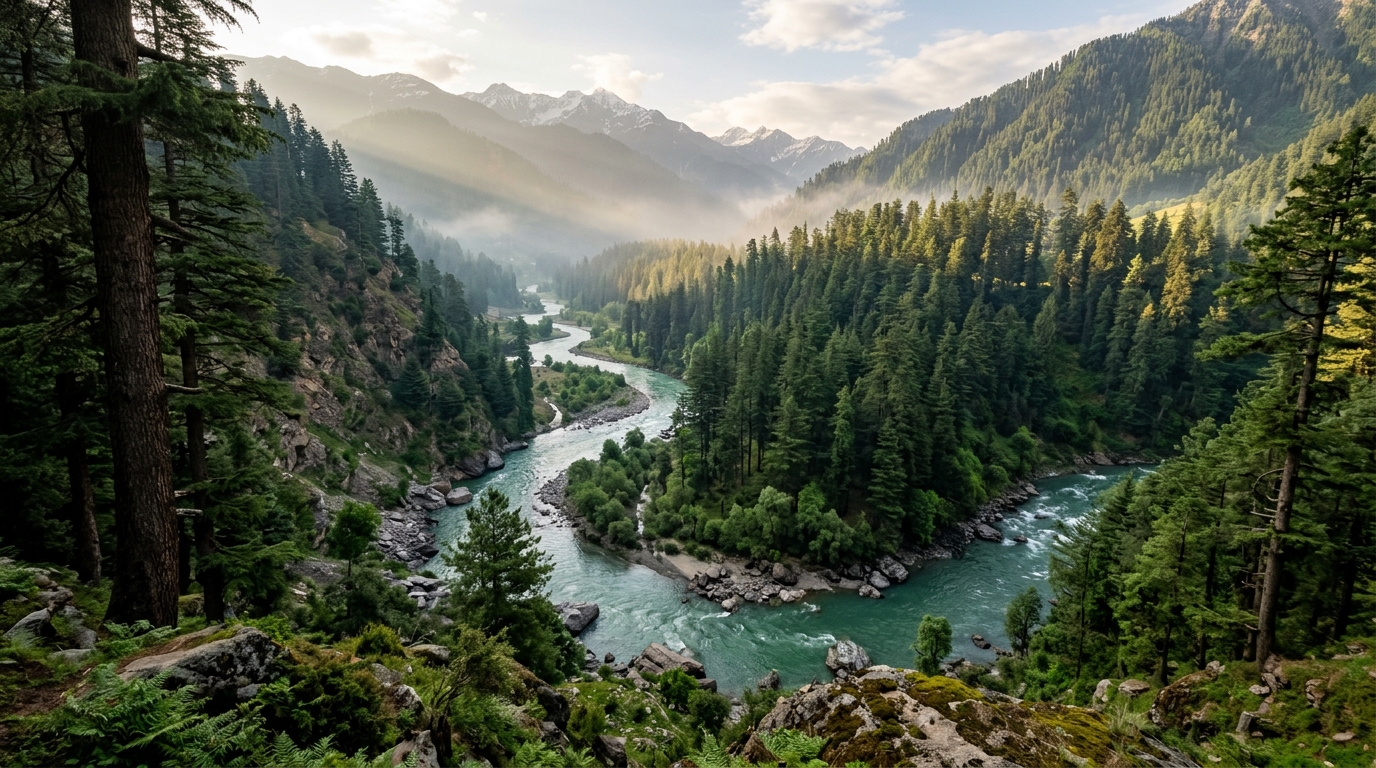
VERINAG · DODA · SHANKARACHARYA HILLS · WESTERN HIMALAYAS19 MIN READ
The Price of Protecting Paradise
The forgotten guardians of Kashmir's forests, the lives sacrificed in defence of nature, the families left behind, and the unfinished responsibility of a society that inherited their ecological legacy.
GANGBAL & NUNDKOL CIRQUES · MOUNT HARAMUKH, 3,570 M18 MIN READ
When Mountains Speak, Who Is Listening?
An exploration of fragile landscapes, human ambition and the ecological future of the Himalayas.
SHEHR-E-KHAS (SRINAGAR) · BRARI NAMBAL, MARPLAN & KHUSHALSAR21 MIN READ
The Water We Have Forgotten
A longform environmental feature on Srinagar’s lost canals, drowned ghats, and hydraulic memory.
DAL–NIGEEN LAKE SYSTEM · TELBAL CATCHMENT · SRINAGAR · WESTERN HIMALAYAS30 MIN READ
The Mathematics of a Dying Lake
Decades of Conservation, Crores of Expenditure and the Unresolved Engineering of Dal Lake
DAKSUM · BRINGI · PIR PANJAL & KISHTWAR MONTANE BELTS12 MIN READ
The People Who Guard the Forest
Altitudinal commons, Forest Rights Act transitions, women’s hearth labor, and manual autumn wildfire defense across the montane watersheds of Jammu and Kashmir.
RAMBIARA · VISHAV · ROMSHI · DOODHGANGA & SINDH CORRIDORS22 MIN READ
Gravel, Concrete, and the Vanishing Floodplain
An investigative statutory, judicial, and fluvial-geomorphology dossier on mechanized riverbed mining, channel incision, and coldwater habitat loss across Kashmir’s mountain tributaries.
UPPER JHELUM, LIDDER, SINDH & ZANSKAR FRINGE · >2,800 M A.S.L.19 MIN READ
Thirty-Eight Winters of Snowline Retreat
Reading an upward shift of 242 ± 22 meters in the end-of-ablation snowline across the Upper Jhelum and Zanskar fringe—and why honest cryospheric cartography begins with its error bars.
UPPER INDUS · JHELUM · CHENAB · ZANSKAR · KARAKORAM SYNTHESIS15 MIN READ
“A Glacier Does Not Negotiate With Five-Year Plans”
A twelve-part constructed editorial dialogue testing Himalayan hydropower schedules, flood zoning, and water treaties against four decades of peer-reviewed cryospheric physics.
KASHMIR · JAMMU · LADAKH · AZAD JAMMU & KASHMIR · GILGIT-BALTISTAN · WESTERN HIMALAYAS49 MIN READ
Journalism at a Crossroads
Why the Western Himalayas Need a New Direction in Journalism: Beyond Political Patronage, Institutional Dependency, Press Release Journalism and the Boundaries of Conventional Reporting
INDIA · PAKISTAN · KASHMIR · JAMMU · LADAKH · AZAD JAMMU & KASHMIR · GILGIT-BALTISTAN16 MIN READ
South Asia’s Environmental Vanguard
India and Pakistan’s Environmental Giants: Extraordinary Minds and the Lessons They Hold for Kashmir
HAZRATBAL · SRINAGAR BOWL & CHENAB–JHELUM INFRASTRUCTURE CORRIDORS23 MIN READ
When the Mountain Rejects the Engineer
An independent response to RECLAIM 2026, NIT Srinagar.
AWANTIPORA · JHELUM FLOODPLAIN, WULAR & PIR PANJAL COMPARTMENTS24 MIN READ
Nature Is Not a Contractor
An independent response to the International Conference on Nature-Based Solutions, IUST.