Journalism at a Crossroads
Why the Western Himalayas Need a New Direction in Journalism: Beyond Political Patronage, Institutional Dependency, Press Release Journalism and the Boundaries of Conventional Reporting

INAUGURAL EDITORIAL FOLIO · DESK & OBSERVATORY SYNTHESIS
Evidentiary Distinction, Institutional Fairness & Self-Scrutiny Disclosure: Positioned immediately after the Founding Manifesto (Dispatch 16) in Vol. 01 / No. 01, Dispatch 17 distinguishes strictly between documented press-freedom testimonies and official fact-finding reports—including Committee to Protect Journalists (CPJ) documentation from February, June, and September 2019, Reuters Institute at the University of Oxford analyses, Press Council of India reports (May 2021 and September 2022), Freedom House (2023), and Freedom Network assessments across Gilgit-Baltistan and Azad Jammu & Kashmir (June 2025, September 2025, and November 20, 2026)—and unresolved empirical questions requiring primary archival, financial, and editorial evidence. The eight-period 1947–2026 chronology, the ₹100 lakh media-house financial dependency scenario, the 20 specialized reporting desks, the 16-module Media Transparency Observatory, the 15-indicator Five-Region Journalism Census, the 20-principle Integrity Charter, the 15-programme 2027–2035 Development Initiative, and the 15-volume, 90-chapter Monograph 15 are presented explicitly as proposed research frameworks and institutional recommendations rather than established findings of collusion or currently operational bodies. Himalayan Dispatch subjects itself—including its institutional relationship with Kashmir EcoWatch—to the identical transparency and critical-scrutiny standards proposed for the wider regional press.
The Region Has Changed. Has Its Journalism?
Why decades of personal courage under conflict and pressure now confront a mountain crisis demanding both intellectual advancement and institutional independence.
For decades, journalism across the Western Himalayas has operated under exceptionally difficult circumstances. Political conflict, restrictions on access to public information, prolonged economic uncertainty, security anxieties, institutional pressures, and acute personal risk have shaped every stage of the profession’s evolution across the mountains. Reporters and editors have worked simultaneously under pressure from political establishments, administrative authorities, armed groups, commercial interests, and, at decisive moments, the very media organizations employing them. Many regional journalists have demonstrated extraordinary courage under pressures that observers working in stable metropolitan newsrooms can scarcely appreciate. Any honest inquiry into the future of journalism in these mountains must begin by recognizing their endurance and honouring their contribution to public memory.
Yet recognition of past and present sacrifice cannot blind us to a profound historical shift unfolding across the landscape itself. The Western Himalayas are undergoing biophysical, infrastructural, and institutional transformations that outstrip the habits of conventional daily reporting. Glaciers across the Greater Himalaya and Karakoram are retreating and thinning. Rivers are being dammed, tunnelled, and diverted through fragile rock masses. Mountain slopes are being blasted and excavated for widened highways and railway alignments. Sub-alpine and temperate forests are being fragmented or submerged beneath reservoirs. Valley wetlands and urban lakes are shrinking from within. Dedicated scientific institutions are evolving and, in documented instances, deteriorating or losing research continuity. Human settlements are expanding rapidly onto active floodplains, unstable colluvial fans, and liquefaction-prone basins, while vast public sums are committed to engineering programmes whose long-term ecological consequences rarely receive sustained independent scrutiny.
Across Kashmir, Jammu, Ladakh, Azad Jammu & Kashmir, and Gilgit-Baltistan, society now confronts interacting hazards and governance choices spanning active tectonics, transboundary winter air pollution, hydropower allocation, biodiversity loss, spring and groundwater depletion, agricultural climate vulnerability, and hospital and lifeline preparedness. Such processes do not erupt and conclude between a morning press briefing and an evening bulletin. They accumulate silently across years and decades, demanding a journalism equipped to read scientific evidence, audit public ledgers, reconstruct historical baselines, and stay with an inquiry long after official ceremonies end.
Even the highest technical specialization, however, is insufficient on its own. Beyond breaking news, political statements, press conferences, and institutional publicity lies an extraordinary landscape of unexplored scientific questions, forgotten environmental histories, unexamined public expenditure, and emerging threats to human civilization—yet how independently can journalism investigate those realities when the institutions employing journalists are themselves vulnerable to political pressure, administrative influence, and financial dependency? A reporter may possess rigorous scientific literacy, documentary persistence, and personal fearlessness, yet remain unable to publish a completed investigation because an employing media house fears losing government advertisements, administrative access, or commercial patronage. Placed immediately after our Founding Manifesto (Dispatch 16), this seventeenth dispatch argues that the renewal of Western Himalayan journalism rests upon two inseparable foundations: intellectual advancement and institutional independence.
COMPANION MONOGRAPH 15 & PROPOSED FIVE-REGION RESEARCH ARCHITECTURE
Summarizes the proposed underlying research repository (15 thematic volumes, 90 chapters across Kashmir, Jammu, Ladakh, Azad Jammu & Kashmir, and Gilgit-Baltistan), 20 proposed specialist reporting desks, 20 voluntary integrity principles, and 15 professional development programmes (2027–2035). All institutional architectures represent proposed recommendations rather than currently operational bodies.
“A journalist may possess scientific understanding, intellectual competence and investigative courage, yet remain unable to publish findings because of institutional pressures. Therefore, the transformation of journalism must begin with two fundamental objectives: intellectual advancement and institutional independence.”
Understanding the Mountain System Beyond Daily Politics
Why representing one of Earth’s most complex mountain environments requires twelve domains of specialist literacy—and moving from single-day events to multi-decade systems.
The Western Himalayas are not merely a contested political map partitioned by ceasefires, constitutional reorganizations, and administrative secretariats. They constitute one of the planet’s most intricate, tightly coupled mountain environmental systems—an elevational continuum where crustal convergence, seasonal snowpacks, monsoon and western-disturbance moisture pathways, river cascades, forest belts, karewa tablelands, and densely settled alluvial valleys interact continuously. Political reporting remains indispensable to any democratic or accountable society, and nothing in this investigation diminishes the duty to cover elections, legislatures, constitutional rights, or public administration. Politics, however, is only one dimension of regional existence. A society cannot understand its own survival if its public conversation remains overwhelmingly absorbed by immediate political statements while the physical and institutional systems sustaining life in the mountains receive sporadic, superficial attention.
To represent this region faithfully, journalism must cultivate working competence across twelve interconnected regional dimensions: tectonic instability (requiring literacy in earthquake science, fault slip deficits, and structural vulnerability); cryospheric transformation (glaciers, seasonal snow, permafrost degradation, and moraine-dammed glacial lakes); river systems (fluvial hydrology, sediment transport, and downstream environmental flows); mountain ecosystems (forest ecology, wildlife corridors, and native biodiversity); atmospheric systems (western disturbances, valley-inversion pollution transport, and climate variability); agriculture (soil science, temperate horticulture, and food security); energy (hydropower engineering, tariff and power-sharing agreements, and energy justice); infrastructure (slope engineering, tunnel geology, and disaster resilience); public finance (budgetary allocations, procurement, and audited expenditure outcomes); governance (statutory mandates, environmental laws, and regulatory enforcement); cultural heritage (historical gardens, vernacular architecture, traditional ecological knowledge, and living heritage); and public health (airborne, waterborne, and occupational environmental exposures).
Cultivating literacy across those twelve domains transforms how a newsroom perceives reality: it shifts the unit of reporting from the isolated event to the underlying system. Breaking news performs a vital civic service by alerting citizens that Dal Lake smells foul after a warm spell, that a forest compartment burned above a highway, that rockfall severed the Ramban gorge, or that winter power cuts lengthened to ten hours. Yet when coverage stops once the traffic clears or the ribbon is cut, citizens remain perpetually surprised by recurring crises whose structural causes were never examined.
System-based investigative journalism begins precisely where conventional event reporting files its final paragraph. Rather than merely recording that an event occurred, it reconstructs the nutrient budgets, pre-construction geological assessments, glacier mass-balance trajectories, power-allocation contracts, tree-felling permissions, post-conference implementation ledgers, bathymetric space recoveries, seismic building codes, statutory land-use authorizations, and laboratory relocations that produced the event. Both daily reporting and systemic investigation are necessary; a society fed exclusively on the first, however, remains chronically informed about symptoms while remaining uninformed about causes.
PARADIGM SHIFT · FROM CONVENTIONAL EVENT REPORTING TO SYSTEM-BASED INVESTIGATION
Thirteen diagnostic contrasts illustrating how system-level journalism investigates causes, permissions, budgets, and measurable outcomes behind daily headlines
| Conventional Event Reporting | System-Based Investigative Journalism |
|---|---|
| Dal Lake is polluted | Which pollution sources and sub-catchments contribute the greatest dissolved and particulate nutrient loads? |
| A forest fire occurred | What fuel-load, micro-climatic, ecological, and compartment-management conditions contributed to ignition and spread? |
| A landslide blocked a highway | Were slope geology, toe-cutting thresholds, and drainage stability adequately assessed before construction began? |
| A glacier has retreated | What are its multi-decadal mass-balance trends, meltwater timing shifts, and downstream community consequences? |
| Electricity curtailment announced | Who contractually receives the hydroelectric power generated within the region’s dammed river basins? |
| Chinars were removed | What do historical tree inventories, campus or road master plans, and statutory felling permissions reveal? |
| A university organized a conference | Which published policy or ecological recommendations from previous conferences were actually implemented? |
| Government sanctioned conservation funds | What independently measurable ecological outcomes resulted from decades of previous conservation expenditure? |
| Illegal structures were demolished | How much hydrologically connected ecological space was physically excavated and recovered afterward? |
| An earthquake occurred | How structurally vulnerable are hospitals, schools, bridges, and dense settlements to future seismic events? |
| Environmental activists protested | What independently verifiable legal, administrative, or ecological outcomes followed their intervention? |
| A protected landscape was developed | Which institutions authorized the land-use transformation, when, and under what statutory provisions? |
| A scientific laboratory was relocated | What happened to its instrumentation, long-term monitoring series, and original research capabilities? |
Adequate coverage of the Western Himalayas spans (01) Tectonic instability, (02) Cryospheric transformation, (03) River systems, (04) Mountain ecosystems, (05) Atmospheric systems, (06) Agriculture, (07) Energy, (08) Infrastructure, (09) Public finance, (10) Governance, (11) Cultural heritage, and (12) Public health—requiring reporters who understand the mountain as deeply as they understand the political circumstances surrounding it.
The Journalism That Asks the Second Question — and Beyond Press Releases
Advancing through the five-question investigative sequence across ten Himalayan Dispatch inquiries—and distinguishing public relations from independent verification.
Every durable public-interest investigation is governed by a disciplined sequence of five questions. The first question establishes what happened—the indispensable baseline of accurate observation. Too often in regional reporting, inquiry halts there. The second question asks why it happened, tracing physical mechanisms and institutional incentives beneath the surface incident. The third investigates who held statutory, financial, or operational responsibility. The fourth tests whether the official explanation offered to the public withstands independent documentary and scientific examination. And the fifth—almost universally neglected in fast-cycle media—returns months or years later to establish whether promised corrective action produced measurable results on the ground.
Look across the flagship environmental investigations assembled in this Inaugural Issue of Himalayan Dispatch, and the power of asking the second through fifth questions becomes concrete. None of those ten inquiries could have been conducted by summarizing speeches or quoting rival spokespersons alone. Auditing why Dal Lake continues to eutrophy despite decades of capital expenditure, reconstructing what happened to Kashmir’s dedicated aquatic laboratory at Habak, tracing how historical lake surfaces became walled real estate, documenting how protected wildlife territory on the Zabarwan spur became a golf course, counting heritage Chinars amid campus concrete in Naseem Bagh, calculating who captures hydropower megawatts while mountain valleys endure winter darkness and submerged forests, evaluating multi-hazard preparedness across locked Himalayan fault segments, measuring how twenty-five years of academic papers reach local communities, testing green political manifestos against post-election budgets, and holding civic environmentalism to a non-selective standard all require historical reconstruction, primary filings, quantitative literacy, and unhurried persistence.
That methodological standard brings us face to face with one of the most pervasive habits weakening regional media: press release journalism. Government directorates maintain public information offices; universities employ public relations officers; political parties staff communication cells; private corporations circulate promotional handouts; and non-governmental environmental groups issue media advisories celebrating their campaigns. Every one of those institutions possesses a legitimate right to address the public and state its record. Yet institutional communication and journalism perform fundamentally different civic functions.
A university press release communicates what the university administration wishes society to applaud; independent journalism additionally establishes what society needs to know about the university’s research rigour, campus ecology, and public accountability. The identical principle applies to government departments, private developers, political parties, activist coalitions, and media houses themselves. Printing official handouts beneath an engraved newspaper masthead does not automatically turn institutional messaging into independent journalism. Journalism begins in the arduous work performed after the handout arrives: checking procurement files against announced budgets, inspecting field sites without ceremonial escorts, testing scientific methodologies, tracking whether promised jobs or restored wetlands materialized, and examining shortcomings alongside achievements.
- •The Mathematics of a Dying Lake — Why does ecological deterioration persist despite decades of conservation expenditure?
- •The Laboratory That Kashmir Lost — What happened to the scientific infrastructure established to understand aquatic degradation?
- •The Art of Encroachment — How did historical water surfaces become consolidated land and permanent property?
- •The National Park That Became a Golf Course — How was previously protected land reassigned for recreational development?
- •The Chinars in the Shadow of Concrete — What happened to the living heritage of Naseem Bagh during institutional expansion?
- •The Price of Power — Who receives hydropower benefits and who bears its environmental costs?
- •The Western Himalayas Are Sitting on a Time Bomb — Are institutions adequately preparing for interacting natural hazards?
- •Who Are We Researching For? — How effectively does scientific knowledge reach society?
- •When Politics Promises Green — What happened after environmental commitments were made?
- •Selective Environmental Consciousness — Are environmental principles consistently applied across institutions and political affiliations?
BOUNDARY OF THE PROFESSION · INSTITUTIONAL COMMUNICATION VS. INDEPENDENT JOURNALISM
Ten structural distinctions separating official public relations narratives from independent journalistic verification
| Institutional Communication | Independent Journalism |
|---|---|
| Announces a project | Investigates its ecological, social, and economic necessity alongside viable alternatives |
| Reports expenditure | Examines procurement integrity, financial accountability, and measurable field outcomes |
| Celebrates an achievement | Independently verifies the baseline data and durability of the claimed achievement |
| Announces scientific research | Examines study methodology, sample limits, uncertainty bounds, and practical significance |
| Publicizes a conference | Investigates whether resolutions and policy recommendations achieved subsequent implementation |
| Reports ecological restoration | Measures physically and biologically whether water, forest, or soil conditions improved |
| Highlights enforcement activity | Establishes whether underlying violations actually declined and damaged commons were restored |
| Announces employment opportunities | Investigates over subsequent years whether promised local employment materialized fairly |
| Publishes environmental commitments | Examines statutory, budgetary, and operational compliance with those commitments |
| Declares institutional success | Investigates both verified achievements and unacknowledged institutional shortcomings |
“Public relations communicates an institution’s preferred narrative. Independent journalism investigates whether that narrative corresponds with reality.”
The Microphone Is Not a Professional Qualification
Valuing the democratic openings of citizen reporting while insisting upon twelve non-negotiable standards of verification, human dignity, and restraint.
Over the past decade and a half, inexpensive smartphones, mobile broadband—whenever unrestricted—and digital video platforms have opened remarkable possibilities for citizen documentation and public participation across the Western Himalayas. Residents in remote mountain tehsils can film uncollected waste, illegal riverbed mining, road-cut slope failures, snowbound clinic closures, or unannounced tree felling that might otherwise never reach a metropolitan news desk. Communities affected by dam tunnels or urban flooding can voice grievances directly in their own mother tongues, and historically marginalized groups can address wider audiences without awaiting gatekeeper permission. Those democratic contributions are real and deserve explicit recognition.
At the same time, professional candour requires stating an uncomfortable truth: possessing a lapel microphone, a high-definition camera, a Facebook or YouTube page, or hundreds of thousands of online followers does not automatically confer journalistic qualification. Across digital feeds in the region, the boundary between public-interest reporting and performative spectacle has grown dangerously blurred. Unverified allegations are broadcast in real time before basic facts are checked; ordinary shopkeepers, junior employees, students, or families are ambushed on camera for viral outrage; complex scientific or epidemiological claims are asserted without consulting a single qualified specialist; and personal religious, political, or cultural preferences are routinely offered as substitutes for independently verifiable evidence.
Authentic journalism is defined neither by state accreditation cards nor by digital virality, but by adherence to twelve interlocking professional responsibilities: verification prior to publication, disclosure of conflicts of interest, preservation of human dignity, proportionality between genuine public interest and manufactured controversy, scientific accuracy, a meaningful right of response before damaging claims are published, respect for personal privacy where no overriding public interest exists, transparent correction of factual errors, clear articulation of why an inquiry matters to society, professional restraint that refuses to substitute theatrical anger for evidence, nuanced cultural understanding, and ethical consistency across comparable cases.
Journalism can—and must—question cabinet ministers, administrative secretaries, religious endowments, university vice-chancellors, corporate contractors, and entrenched social practices with fearless rigour. Yet fearless scrutiny never requires degrading human beings for audience entertainment. Public humiliation of individuals is the antithesis of public accountability, and performative shouting frequently masks an absence of documentary homework. Whether a reporter works for a century-old print daily, an independent digital periodical, or a one-person regional channel, legitimacy rests on the same quiet foundation: the verifiable strength of the evidence, never the decibel level of its delivery.
ETHICAL ARCHITECTURE · TWELVE PRINCIPLES OF PROFESSIONAL JOURNALISTIC CONDUCT
Practical responsibilities distinguishing disciplined public-interest journalism from performative digital spectacle
| Professional Principle | Practical Responsibility |
|---|---|
| 01 · Verification | Authenticate primary facts, documents, dates, and identities before publication |
| 02 · Independence | Maintain autonomy and disclose relevant personal, financial, or institutional conflicts of interest |
| 03 · Human dignity | Avoid ambush theatrics, personal degradation, and unnecessary public humiliation |
| 04 · Proportionality | Distinguish genuine systemic public interest from sensationalized or manufactured controversy |
| 05 · Scientific accuracy | Consult qualified domain expertise and represent empirical uncertainty faithfully |
| 06 · Fairness | Provide scrutinized individuals and institutions a meaningful, timely right of response |
| 07 · Privacy | Avoid unjustified exposure of private citizens where no compelling public interest is at stake |
| 08 · Accountability | Acknowledge and correct factual errors promptly, prominently, and transparently |
| 09 · Public interest | Establish clearly why an investigation matters to civic welfare, law, or ecological survival |
| 10 · Professional restraint | Refuse to substitute moralizing anger, rumour, or volume for authenticated evidence |
| 11 · Cultural understanding | Interpret regional languages, livelihoods, and social practices within their proper historical context |
| 12 · Ethical consistency | Apply comparable evidentiary and ethical standards across comparable institutional circumstances |
“The credibility of an investigation should arise from the strength of its evidence, not the loudness of its delivery.”
The Political Establishment–Media House Nexus (1947–2026)
Separating individual reporter courage from media-house vulnerability—and tracing documented advertising bans, press-freedom testimonies, and official inquiries across eight historical eras.
No serious analysis of Western Himalayan journalism can treat editorial freedom merely as a test of an individual reporter’s personal bravery. A correspondent in Srinagar, Jammu, Leh, Muzaffarabad, or Gilgit may possess impeccable integrity, deep archival command, and willingness to take personal risks—yet whether that reporter’s investigation ever reaches readers depends upon an institutional chain comprising desk editors, managing editors, media proprietors, legal counsel, major advertisers, and the financial solvency of the publishing house. There is thus a foundational structural distinction between the conscience of an individual journalist and the institutional independence of a media organization.
Political and administrative influence over newsrooms rarely needs to announce itself through a signed censorship order. Across modern media systems, constraint operates far more effectively through quiet structural levers: heavy reliance on state advertising budgets, discretionary access to official briefings, allotment or cancellation of government accommodation, accreditation renewals, delayed settlement of public advertising bills, commercial pressures on proprietors’ allied business ventures, precarious short-term journalist employment, and the silent anticipation of institutional reprisal. Over time, the most potent restrictions never need to be spoken aloud. Reporters and sub-editors absorb an unwritten map of which departments, proprietors, contractors, or political figures are institutionally sensitive, which inquiries will stall on an editor’s desk, and which questions jeopardize newsroom survival. That internalized boundary is self-censorship—and understanding it requires shifting scrutiny from the lone reporter to the political, administrative, and economic architecture surrounding the newsroom.
To examine how political authority and media economics have interacted across generations without partisan selectivity, Monograph 15 proposes an eight-period historical research framework spanning 1947 to 2026: from post-Partition newspaper patronage and licensing (1947–1988), through the acute physical peril and multi-actor coercion of early armed conflict (1989–1996), commercial and print expansion alongside growing state advertising outlays (1997–2007), mass civil unrest and publication interruptions (2008–2010), deepening fiscal dependency (2011–2018), constitutional reorganization, prolonged communication blackouts, and restructured media regulations (2019–2020), accreditation, survival, and newsroom attrition pressures (2021–2024), to contemporary political-economic relationships (2025–2026). Evidentiary honesty requires emphasizing that these eight eras constitute a proposed historical research framework for archival investigation—not an assertion of established collusion across every administration or newspaper.
Why such a multi-decade inquiry is warranted is demonstrated by primary records already on the public record. In June 2019, Kashmir Times executive editor Anuradha Bhasin testified to the Committee to Protect Journalists (CPJ) that a central government advertising ban dating back to 2010 had cost the newspaper approximately 30 percent of its funding, illustrating that fiscal pressure predated the events of August 2019 by nearly a decade. Earlier, in February 2019, CPJ documented the abrupt withdrawal of Jammu and Kashmir government advertisements from two leading Srinagar dailies, Greater Kashmir and Kashmir Reader; by September 2019, CPJ reported that Kashmir’s news media faced an existential operational and financial crisis amid sweeping communication restrictions. Official statutory bodies took cognizance as well: the Press Council of India conducted dedicated fact-finding inquiries into regional media conditions, adopting formal reports in May 2021 and September 2022, while Freedom House’s 2023 assessment documented continuing press-freedom and information constraints. Together, these documented episodes establish across multiple administrations why the fiscal and regulatory nexus binding political establishments and media houses demands rigorous, non-partisan historical accounting.
PROPOSED HISTORICAL CHRONOLOGY · POLITICAL POWER & MEDIA INSTITUTIONS (1947–2026)
Eight-period proposed research framework for examining political patronage, conflict pressures, advertising dependency, and editorial autonomy
| Historical Period | Principal Investigative Focus |
|---|---|
| 1947–1988 | Post-Partition political patronage, early newspaper ownership structures, licensing, and institutional relationships |
| 1989–1996 | Eruption of armed conflict, lethal threats and coercion from multiple state and non-state actors, and journalistic survival |
| 1997–2007 | Print and regional media expansion, negotiated political access, and growing reliance on government advertising |
| 2008–2010 | Mass political unrest, curfews, communication and distribution restrictions, and heightened editorial pressures |
| 2011–2018 | Structural financial dependency, central and state advertising disputes (including post-2010 restrictions), and institutional influence |
| 2019–2020 | Constitutional and administrative transformation, prolonged communication restrictions, and introduction of the 2020 Media Policy |
| 2021–2024 | Editorial independence constraints, accreditation and accommodation changes, newsroom contraction, and institutional survival |
| 2025–2026 | Contemporary political relationships, elected-and-administrative governance dynamics, media economics, and professional freedom |
Follow the Money: Who Finances the Media?
Mapping fifteen instruments of potential institutional influence and modelling why a 55% government-advertising share leaves a newsroom structurally exposed.
Editorial independence cannot be evaluated seriously while newsroom balance sheets remain opaque. Serious journalism is expensive: a credible publication must pay regular salaries to reporters and editors, fund multi-week travel into mountain districts, purchase satellite scenes and statutory filings, retain qualified legal counsel, maintain printing or digital infrastructure, and insure staff working in hazardous terrain. When a substantial share of the revenue sustaining those operations flows from the very government directorates, political campaigns, universities, or corporate contractors that the publication is supposed to scrutinize, a structural conflict of interest arises.
Within the conceptual political economy of regional media, institutional leverage can travel through at least fifteen distinct financial and administrative instruments: annual government display and tender advertising; political campaign advertising; allotment or eviction from government press accommodation; journalist accreditation approvals and renewals; major private commercial advertising contracts; public-works or supply contracts held by businesses affiliated with media proprietors; public or advisory appointments granted to media owners; undisclosed sponsored content; preferential interview or briefing access; abrupt advertising withdrawals; newsprint, power, or tax subsidies; opaque changes in legal or beneficial ownership; chronic arrears in government or corporate ad payments that keep cash-strapped publishers supplicant; documented political donations; and proprietors’ parallel real-estate, hospitality, educational, or contracting ventures.
Intellectual fairness demands an unambiguous caveat here: receiving government advertisements, occupying legally allotted public accommodation, holding press accreditation, or carrying corporate commercials does not by itself establish journalistic corruption or editorial surrender. In small mountain economies with modest private consumer markets, public-sector notices—tenders, public-health advisories, recruitment notifications, disaster alerts—naturally represent a significant stream of legitimate media revenue. The public-interest question is not whether state or commercial money exists, but whether allocation rules are objective, publicly audited, non-retaliatory, and separated by an enforceable institutional firewall from editorial coverage.
To see why excessive revenue concentration imperils editorial courage even without overt malice, consider a transparent hypothetical financial dependency scenario—explicitly constructed to illustrate structural arithmetic rather than to describe any existing newspaper. Suppose a regional media house operates on ₹100 lakh in total annual revenue, of which 55 percent (₹55.0 lakh) derives from government advertising while 45 percent (₹45.0 lakh) comes from circulation, private ads, and other sources. If an administrative dispute or policy shift triggers an 80 percent reduction in government advertising, the publication immediately loses ₹44.0 lakh—wiping out 44.0 percent of its entire annual revenue at a stroke and leaving just ₹56.0 lakh to cover payroll, rent, legal defence, and reporting costs. No newsroom losing nearly half its gross income overnight can sustain multi-month investigative reporting without severe institutional strain. The interactive workbench directly below allows readers to test how varying government-advertising shares and withdrawal severities reshape newsroom survival—and how internal safeguards and revenue diversification reduce that vulnerability.
CONCEPTUAL MEDIA POLITICAL ECONOMY · FIFTEEN FINANCIAL & ADMINISTRATIVE INSTRUMENTS
Potential pathways of institutional leverage over media organizations and the primary documentary evidence required to audit each pathway fairly
| Potential Instrument of Influence | Primary Documentary Evidence Required for Investigation |
|---|---|
| 01 · Government advertising | Annual department-wise and media-house-wise release orders and expenditure ledgers |
| 02 · Political campaign advertising | Election expenditure filings, party media disbursements, and beneficiary publications |
| 03 · Government accommodation | Official press-enclave and housing allotment, rent, and cancellation orders |
| 04 · Accreditation | Written criteria, committee minutes, approval counts, rejections, and renewal timelines |
| 05 · Commercial advertising | Major corporate advertisers, rate-card parity, and long-term sponsorship contracts |
| 06 · Government contracts | Public tender and procurement awards involving businesses linked to media proprietors |
| 07 · Institutional appointments | Statutory board, university, or advisory appointments held by proprietors or senior editors |
| 08 · Sponsored reporting | Presence or absence of clear reader labels distinguishing paid promotional copy from reporting |
| 09 · Preferential access | Patterns of exclusive institutional access, official briefings, and public-agency partnerships |
| 10 · Advertising withdrawal | Written administrative reasons for suspension and longitudinal before/after editorial comparisons |
| 11 · Public subsidies | Eligibility rules, allocation records, and utilization audits for media support schemes |
| 12 · Ownership transfers | Corporate registry filings showing shifts in legal shareholding and beneficial control |
| 13 · Financial arrears | Ageing schedules of unpaid government and commercial advertising bills owed to publishers |
| 14 · Political donations | Publicly documented electoral or party financial contributions involving media owners |
| 15 · Related businesses | Disclosed real-estate, construction, tourism, education, or industrial holdings of proprietors |
Illustrative model (not an assessment of any existing publication): Annual media-house revenue = ₹100 lakh · Government advertising share = 55% (₹55.0 L) · Hypothetical reduction in government advertising = 80% → Revenue potentially lost = ₹44.0 L (44.0% of total annual revenue lost) · Remaining annual revenue = ₹56.0 L (56.0% retained). Demonstrates mathematically why revenue diversification is a precondition for durable editorial autonomy.
INTERACTIVE POLITICAL ECONOMY & NEWSROOM GOVERNANCE WORKBENCH
Media House Financial Dependency, Revenue Diversification & Internal Safeguards
Hypothetical financial scenario and voluntary institutional governance diagnostic. Models single-source revenue vulnerability and editorial firewall safeguards without alleging misconduct by any specific publication.
HYPOTHETICAL FINANCIAL SCENARIO · NOT AN ASSESSMENT OF AN EXISTING NEWSPAPER
Receiving government or commercial advertising does not independently establish journalistic misconduct. This model illustrates why narrow revenue concentration creates structural vulnerability when institutional advertising is abruptly reduced.
Revenue potentially lost
₹44.0 L
44.0% lost
Remaining annual revenue
₹56.0 L
56.0% retained
Pre-shock govt ad base
₹55.0 L
Non-govt: ₹45.0 L
Loss of 30% or more of annual operating revenue threatens payroll continuity, field reporting budgets, and legal defence capacity unless reserve or diversified revenues exist.
Caught Between Political Power and Media Ownership — and Successive Administrations
Why society must investigate who holds authority to kill an unpublished story—and apply identical evidentiary scrutiny to the 2020 Media Policy and earlier 2010 and 2019 precedents.
Inside the everyday hierarchy of media production, the working reporter frequently stands near the bottom of an asymmetric pyramid of institutional power. Six distinct stakeholders shape what the public ultimately reads: the political establishment wields influence, public access, and patronage networks; civil administration controls advertising budgets, press accreditation, and regulatory enforcement; the media proprietor commands corporate ownership, hiring, firing, and capital allocation; the editor exercises gatekeeping authority over assignments, framing, and publication; the individual journalist depends upon salary continuity, legal backing, and source access; and the general public depends upon the integrity of the entire chain for accurate knowledge of its own society.
That hierarchy forces a series of searching questions that conventional media criticism almost never asks because it judges journalists solely by published pages. Has a Western Himalayan reporter completed a rigorously documented investigation that the employing media house declined to publish? When a story was held back, was it rejected for legitimate professional reasons—insufficient corroboration, defamatory overreach, unverified documents—or because its findings discomforted a major advertiser, political patron, or allied commercial interest? Have reporters been quietly steered away from scrutinizing institutions financially tied to their proprietors? Have submitted drafts been softened after external telephone calls, or have persistent reporters faced beat reassignments, withheld wages, or non-renewal of contracts? Because an unpublished investigation leaves virtually no trace in public archives, answers cannot be inferred from newspaper clippings alone; they require authenticated internal correspondence, protected interviews, and documented case histories.
Crucially, external administrative pressure must be examined with the same non-partisan rigour across successive governments and constitutional eras. A pivotal contemporary case requiring dispassionate documentary analysis is Jammu and Kashmir’s 2020 Media Policy, which introduced comprehensive mechanisms for government communication, media empanelment, advertising distribution, background verification, and official evaluation of certain categories of published content. Officially, the administration stated that the policy aimed to promote professional standards, modernize public outreach, and counter misinformation and fake news. Simultaneously, independent press-freedom researchers—including analyses published by the Reuters Institute for the Study of Journalism at the University of Oxford alongside CPJ and Press Council submissions—raised serious concerns that broad administrative discretion over content evaluation and empanelment could chill critical reporting and tighten state leverage over newsroom revenues.
Rather than trading ideological slogans over the 2020 Media Policy, a credible investigation must test its original clauses, subsequent operational revisions, and real-world enforcement against seven concrete evidentiary benchmarks—while applying the exact same audit backward to the documented central advertising ban of 2010 cited by Kashmir Times and the February 2019 state advertising withdrawals from Greater Kashmir and Kashmir Reader. Political pressure on journalism does not become acceptable when exercised by an administration one favours, nor uniquely intolerable only under an establishment one opposes. Professional credibility depends upon holding every government, party, and administrative period to one invariant standard.
EVIDENTIARY POLICY AUDIT · EXAMINING KASHMIR’S 2020 MEDIA POLICY & HISTORICAL PRECEDENTS
Seven empirical questions and primary records required to evaluate administrative advertising and media-regulation regimes across successive governments
| Investigative Question | Required Documentary Evidence |
|---|---|
| 01 · Were advertising criteria consistently applied? | Complete year-by-year, media-wise government advertising allocation and rate ledgers |
| 02 · Were publications given written reasons for adverse decisions? | Dated administrative suspension, de-empanelment, or rejection orders and official correspondence |
| 03 · Were independent appeal mechanisms available? | Records of administrative or judicial appeals filed by publications and their reasoned outcomes |
| 04 · Did advertising withdrawals correspond with editorial criticism? | Synchronized financial disbursement timelines paired with historical content analysis prior to action |
| 05 · Were comparable publications treated comparably? | Audited circulation/readership metrics, eligibility filings, and comparative allocation ratios |
| 06 · Did media coverage change following administrative action? | Longitudinal before-and-after content coding of investigative depth and institutional scrutiny |
| 07 · Were individual journalists affected professionally? | Documented employment terminations, beat removals, accreditation denials, and legal proceedings |
(01) Political establishment: influence, public access, and political relationships · (02) Administration: advertising allocations, accreditation, and regulatory authority · (03) Media proprietor: corporate ownership, employment, and financial decisions · (04) Editor: assignment gatekeeping, editorial direction, and publication approval · (05) Journalist: professional security, salary continuity, and source access · (06) General public: civic dependence upon accurate and independent information.
“Before blaming a journalist for what was never published, society should investigate who possessed the authority to prevent its publication.”
Across the Political Boundary: Five-Region Media Accountability
Applying one consistent evidentiary standard across Kashmir, Jammu, Ladakh, Azad Jammu & Kashmir, and Gilgit-Baltistan—grounded in 2025–2026 transboundary documentation.
Just as western disturbances, Indus tributary floods, black-carbon plumes, and Himalayan fault ruptures cross lines of control without pausing at border posts, an honest investigation into Western Himalayan journalism cannot practice selective geographical accountability. A recurring weakness of polarized regional commentary is to magnify press restrictions on one side of the political divide while romanticizing or ignoring structural media constraints on the other. If Himalayan Dispatch claims to serve the entire Western Himalayan mountain system, its scrutiny of political patronage, advertising coercion, and newsroom precarity must extend symmetrically across all five constituent regions: Kashmir, Jammu, Ladakh, Azad Jammu & Kashmir, and Gilgit-Baltistan.
Recent primary documentation from across the Line of Control underscores why transboundary parity is empirically essential. In June 2025, Pakistan’s independent press-freedom watchdog Freedom Network published a dedicated assessment of media freedoms in Gilgit-Baltistan, identifying acute financial dependence on government advertising, delayed or irregular wages, limited training infrastructure, and precarious working conditions as major structural barriers to independent public-interest journalism across Gilgit and Baltistan. Three months later, in September 2025, Freedom Network released a parallel assessment for Azad Jammu & Kashmir, documenting censorship pressures, intimidation and harassment of reporters, restrictive legal and regulatory hurdles, and constraints originating from both governmental authorities and non-state actors.
Most recently, on November 20, 2026, Freedom Network published a comprehensive national assessment—Coercion and Censorship: Stifling Public-Interest Journalism—encompassing Pakistan’s wider media landscape alongside Azad Jammu & Kashmir and Gilgit-Baltistan. That November 2026 report specifically highlighted economic coercion, selective allocation and weaponization of official advertising, and the quiet suppression of sensitive public-interest stories among its central findings. Read alongside the CPJ, Reuters Institute, and Press Council of India documentation for Jammu and Kashmir, the transboundary parallel is unmistakable: across vastly different constitutional regimes, heavy reliance on state advertising budgets and insecure journalist employment repeatedly emerge as twin levers constraining independent mountain reporting.
Equivalence of ethical standard, however, never means flattening distinct regional realities into caricatures. In Kashmir, inquiry must examine political conflict legacies, state advertising dependence, regulatory restrictions, and ownership ties; in Jammu, political affiliations, commercial cross-ownership, and differential institutional access; in Ladakh, the economics of tiny high-altitude media markets across Leh and Kargil, vast travel distances, and reliance on public outreach funds; in Azad Jammu & Kashmir, political and non-state pressures, regulatory barriers, and fragile local newspaper revenues; and in Gilgit-Baltistan, acute government-ad dependency, contractual precarity, and restricted access to public records regarding infrastructure, mining, and hydropower. Journalism does not become automatically free merely because it operates under a different flag; every region requires empirical verification rather than presumption.
TRANSBOUNDARY PARITY · FIVE-REGION MEDIA ACCOUNTABILITY FRAMEWORK
Principal institutional, economic, and professional inquiries across all five Western Himalayan reporting regions
| Reporting Region | Principal Investigative Focus |
|---|---|
| 01 · Kashmir | Political and security pressures, government advertising dependency, regulatory restrictions, and proprietor–institution relationships |
| 02 · Jammu | Political party affiliations, media cross-ownership, commercial and real-estate interests, and differential institutional access |
| 03 · Ladakh | Viability of small high-altitude media markets, administrative access across Leh and Kargil, specialist resources, and financial sustainability |
| 04 · Azad Jammu & Kashmir | Governmental and non-governmental pressures, censorship, legal and regulatory obstacles, and local newspaper economics (Freedom Network, Sept 2025 & Nov 2026) |
| 05 · Gilgit-Baltistan | Heavy dependence on government advertising, journalist employment precarity, wage insecurity, and access to public project information (Freedom Network, June 2025 & Nov 2026) |
Environmental Consequences of Institutional Dependency and Selective Attention
How financial and political entanglements shape which ecological crises receive sustained investigation—and ten historical transformations awaiting retrospective media audit.
Here the political economy of media converges directly with the founding environmental mandate of Himalayan Dispatch. Why should a periodical devoted to glaciers, lakes, forests, rivers, air quality, and mountain hazards devote a flagship investigation to media ownership and government advertising? Because environmental destruction in the Western Himalayas rarely occurs in an institutional vacuum. Almost every major ecological controversy in these mountains requires investigating the very government departments, engineering corporations, universities, municipal regulators, property developers, and public contractors that possess the financial or administrative power to reward, sustain, or penalize regional media organizations.
Consider ten recurring arenas of regional environmental transformation and the actors each inquiry must scrutinize: Dal Lake conservation (government departments, engineering agencies, and dredging/sewerage contractors); the fate of the Habak ecological laboratory (historical administrations and institutional leadership); the conversion of part of Sálim Ali National Park (political administrations and tourism/development agencies); construction pressures around Naseem Bagh’s heritage Chinars (university administration and campus infrastructure planners); Himalayan hydropower projects (central and regional governments, generating corporations, and tunnelling contractors); forest land diversion (statutory clearance authorities and commercial beneficiaries); urban lake and wetland encroachment (property developers, enforcement wings, and local intermediaries); winter air pollution (pollution control boards, brick kilns, industries, and scientific agencies); academic environmental research (universities and public funding councils); and disaster vulnerability (town planners, road engineers, and commercial builders).
Now place a financially vulnerable newspaper inside that institutional web. Imagine a regional daily receiving substantial admission, tender, and convocation advertising from a university while its reporter investigates heritage tree loss or unimplemented research on that same campus. Imagine a broadcaster dependent on state information-department releases while probing why crores of public conservation expenditure left a lake’s phosphorus balance unclosed. Imagine a publication carrying full-page real-estate and construction advertisements while investigating floodplain infill or slope destabilization. Once again, the existence of an advertising relationship is a potential conflict of interest, never automatic proof of editorial misconduct—yet without public conflict disclosures and internal firewalls, citizens have no way to judge whether silence or brevity reflects scarce newsroom resources or quiet institutional accommodation.
To distinguish legitimate resource limits, legal caution, or security constraints from improper political or commercial selectivity, Monograph 15 proposes a ten-indicator longitudinal content-analysis protocol paired with retrospective media reconstructions of ten landmark regional environmental stories—from Sálim Ali National Park, Habak, Dal Lake, and Naseem Bagh to hydropower submergence, floodplain occupation, repeated statutory audit warnings, conservation outlays, seismic-gap warnings, and forgotten conference declarations. Crucially, that historical reconstruction must honour the courageous regional reporters who did document those transformations in real time despite daunting pressures—while asking candidly whether sustained institutional follow-up matched the gravity of what was being lost.
- •Retrospective Case 01 · Historical media reporting on the conversion of part of Sálim Ali National Park into a golf course.
- •Retrospective Case 02 · Coverage of the deterioration and displacement of Habak’s dedicated limnological infrastructure.
- •Retrospective Case 03 · Multi-decade reporting on the progressive spatial and ecological transformation of Dal Lake.
- •Retrospective Case 04 · Journalistic scrutiny of incremental construction pressures within Naseem Bagh’s Chinar precinct.
- •Retrospective Case 05 · Reporting on forest diversion, tunnel muck disposal, and reservoir submergence tied to hydropower.
- •Retrospective Case 06 · Coverage of historical Jhelum, Tawi, Indus, and tributary floodplain encroachment prior to major floods.
- •Retrospective Case 07 · Newsroom follow-up on repeated Comptroller and Auditor General and statutory environmental audit findings.
- •Retrospective Case 08 · Independent verification of public expenditure outcomes across flagship conservation programmes.
- •Retrospective Case 09 · Public translation and sustained follow-up on peer-reviewed warnings regarding Himalayan tectonic vulnerability.
- •Retrospective Case 10 · Post-event tracking of environmental resolutions emerging from university and government conferences.
CONTENT-ANALYSIS METHODOLOGY · TESTING FOR SELECTIVE EDITORIAL ATTENTION
Ten empirical indicators designed to distinguish resource or security constraints from political or commercial selectivity in environmental coverage
| Content-Analysis Indicator | Investigative Purpose |
|---|---|
| 01 · Coverage frequency | Measures which public agencies, corporations, or ecological sites receive sustained vs. fleeting scrutiny |
| 02 · Article depth | Distinguishes original documentary field reporting from brief event or handout summaries |
| 03 · Follow-up reporting | Tracks which announced inquiries, court orders, or restoration pledges vanish without subsequent audit |
| 04 · Political consistency | Tests whether comparable environmental decisions receive comparable scrutiny across rival administrations |
| 05 · Advertising relationships | Examines whether relevant public, academic, or corporate financial ties are disclosed to readers |
| 06 · Government vs. private violations | Evaluates whether state-agency infractions and private commercial encroachments face equivalent examination |
| 07 · Publication prominence | Analyzes front-page, lead-bulletin, or buried placement of major environmental findings |
| 08 · Source diversity | Measures representation of affected mountain communities and independent scientists alongside officials |
| 09 · Documentary evidence | Checks whether statutory orders, maps, audits, and primary datasets are cited and made accessible |
| 10 · Corrections and responses | Assesses whether publications print institutional replies and transparent factual amendments |
“When a protected landscape disappears, the historical investigation should examine not only the institutions that authorized its transformation but also whether the public was adequately informed while that transformation was occurring.”
Scientific, Geospatial, Preventive and Archival Journalism
Building twenty proposed specialist beats, a six-stage geospatial investigative workflow, pre-disaster preventive reporting, and an institutional memory archive.
If institutional independence liberates a newsroom to ask hard questions, scientific, geospatial, preventive, and archival method gives journalists the tools to answer them with unimpeachable rigour. A reporter investigating winter haze in Srinagar or Muzaffarabad does not need a doctorate in atmospheric physics, yet must clearly grasp the difference between a gravimetric PM2.5 filter measurement, a composite Air Quality Index, an aerosol optical depth satellite retrieval, and a dispersion-model estimate. A correspondent covering Himalayan energy must never confuse installed megawatt capacity on a project plaque with firm winter power actually delivered to regional households. A journalist covering seismic risk must separate long-term tectonic slip-deficit hazard and building liquefaction vulnerability from pseudoscientific date prediction. And a reporter auditing lake conservation must know why crores spent, cubic metres dredged, or tonnes of weeds harvested do not by themselves prove ecological recovery. To cultivate that depth progressively through partnerships among reporters, scientists, engineers, jurists, and economists, we propose twenty specialized journalistic desks—explicitly as domains of professional specialization to be built over time, not a claim that twenty staffed teams already exist today.
Alongside scientific literacy, the next decisive frontier for Western Himalayan reporting is geospatial journalism. When historical trigonometrical survey sheets, revenue cadastral maps, declassified reconnaissance photography, multi-spectral and radar satellite time series, and field GPS observations are combined inside a six-stage investigative workflow—(1) historical reconstruction, (2) independent geographical observation, (3) calibrated scientific interpretation with uncertainty bounds, (4) institutional verification against permits and title records, (5) reproducible public-interest publication, and (6) multi-year follow-up—a reporter investigating lake infill, forest fragmentation, heritage garden loss, glacier retreat, floodplain occupation, reservoir submergence, urban sprawl, protected-area roads, riverbed mining, expanding glacial lakes, channel constriction, or slope instability no longer depends solely on duelling verbal claims. Satellite pixels never independently prove legal ownership, mens rea, or statutory violation—those conclusions require authenticated administrative and judicial records—but remote sensing anchors public debate in independently measurable physical geography.
Armed with scientific and geospatial literacy, mountain journalism can make an overdue ethical pivot from reactive disaster coverage to preventive journalism. Why should unsafe multi-storey construction on soft lacustrine sediments become front-page news only after an earthquake fells wards? Why should choked flood-spill channels command prime time only when water overtops embankments, or hospital seismic resilience be audited only after emergency wards crack, or moraine-dammed lakes draw national cameras only after an outburst flood sweeps away bridges and turbines? Preventive journalism translates hazard science into calm, non-alarmist public accountability—auditing building codes, floodplain drainage, dam-safety instrumentation, avalanche zoning, slope cutting, water-security projections, wildfire preparedness, lifeline backups, power-allocation equity, and crop climate adaptation while time still remains to prevent catastrophe.
Finally, slow mountain journalism must serve as society’s institutional memory. Across the Western Himalayas, governments change, secretaries transfer, agencies are renamed, laboratories move, and paper files vanish in floods or basement reorganizations, allowing each decade to announce fresh master plans as though history began yesterday. By systematically preserving twelve classes of primary records—from original project DPRs, administrative sanctions, Environmental Impact Assessments, financial approvals, and contractor tenders to construction chronologies, dissenting scientific notes, court filings, official replies, multi-epoch satellite plates, independent audits, and post-project ecological measurements—a journalistic archive becomes more than a morgue of expired headlines. It ensures that a new generation never has to rediscover from scratch every ecological mistake paid for by the generation before it.
PROPOSED PROFESSIONAL SPECIALIZATION · TWENTY MOUNTAIN JOURNALISM DESKS
Twenty proposed domains of specialist reporting competence designed for progressive development across the Western Himalayas
| Proposed Specialist Desk | Principal Reporting Domain |
|---|---|
| 01 · Academic Accountability | Research quality, bibliometric integrity, and vernacular public knowledge dissemination |
| 02 · Agricultural Science | Climate adaptation, soil health, horticulture transitions, and mountain food security |
| 03 · Atmospheric Science | Valley air pollution, transboundary aerosols, climate trends, and extreme weather |
| 04 · Biodiversity | Threatened wildlife, forest structure, alpine meadows, and ecological connectivity |
| 05 · Community and Livelihoods | Pastoralists, boatmen, smallholders, environmental justice, and economic vulnerability |
| 06 · Critical Infrastructure | Hospital, school, bridge, highway, and lifeline disaster resilience and interdependence |
| 07 · Cryosphere | Glacier mass balance, snowline dynamics, mountain permafrost, and glacial-lake hazards |
| 08 · Energy and Hydropower | Hydroelectric generation, royalty and power allocation, cumulative river impacts, and energy justice |
| 09 · Environmental Economics | Conservation budgets, procurement audits, and long-term ecological opportunity costs |
| 10 · Environmental Engineering | Sewage treatment plants, settling basins, dredging physics, and restoration technologies |
| 11 · Environmental Health | Particulate, heavy-metal, waterborne, and occupational exposure consequences |
| 12 · Environmental Jurisprudence | Statutory clearances, tribunal orders, regulatory enforcement, and judicial accountability |
| 13 · Geospatial Intelligence | Historical cartography, multi-spectral/SAR satellite observations, and land-system change |
| 14 · Hydrology | River discharge, flood hydraulics, springshed recharge, groundwater, and watershed integrity |
| 15 · Limnology | Nutrient stoichiometry, bathymetry, trophic state, and wetland ecosystem recovery |
| 16 · Living Heritage | Heritage Chinars, Mughal and vernacular gardens, sacred groves, and cultural landscapes |
| 17 · Media Ownership & Political Economy | Editorial independence, public advertising ledgers, newsroom contracts, and ownership transparency |
| 18 · Public Governance | Departmental mandates, interagency coordination, and statutory compliance audits |
| 19 · Tectonics and Geology | Crustal strain, liquefaction susceptibility, slope failures, and engineering geology |
| 20 · Transboundary Environmental Systems | Shared Indus–Jhelum–Chenab hydrology, airsheds, migratory flyways, and cross-border hazards |
Preventive journalism shifts reporting across ten domains—examining structural seismic vulnerability before earthquakes, floodplain capacity before floods, dam safety before failures, avalanche zoning, slope geology, future water security, wildfire risk, hospital resilience, power allocation, and crop adaptation before crisis strikes ("A society should not require a disaster before its vulnerabilities become newsworthy"). Archival journalism preserves twelve primary record classes—project proposals, authorizations, EIAs, financial sanctions, procurement files, construction chronologies, scientific objections, court records, official replies, satellite time series, independent audits, and long-term ecological outcomes ("A new generation should not have to rediscover every environmental mistake made by the previous generation").
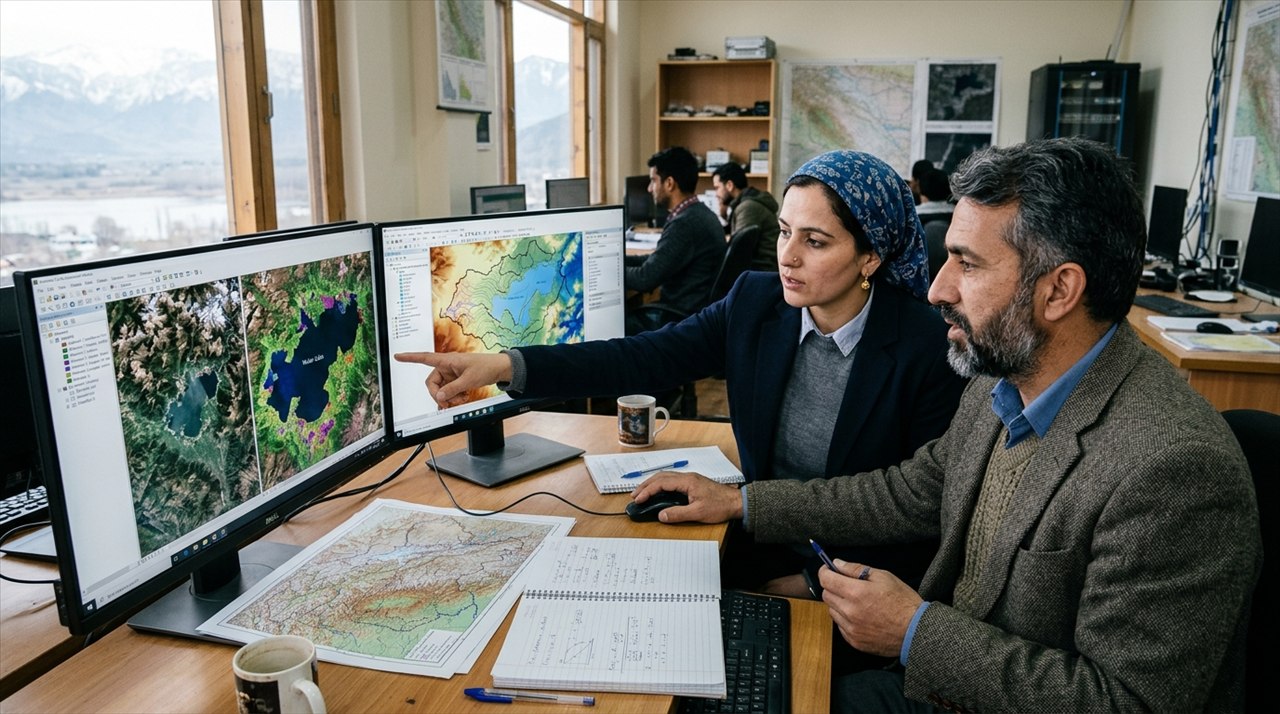
Global Models, Professional Capacity and Protecting the Journalist Inside the Media House
Learning critically from nine international investigative institutions, building capacity without humiliating predecessors, and establishing fourteen internal newsroom safeguards.
Western Himalayan journalists do not have to invent investigative and environmental journalism in isolation, nor should they wait passively for visiting international correspondents to parachute into Srinagar, Leh, or Skardu to interpret their own mountains to the world. Across the global press landscape, nine diverse institutions offer instructive organizational, methodological, and financial lessons: the Center for Investigative Reporting (sustained documentary investigations), the Global Investigative Journalism Network (cross-border investigative methods and peer training), the International Consortium of Investigative Journalists (collaborative multi-jurisdiction document inquiries), Mongabay (dedicated biodiversity and environmental beat reporting), ProPublica (rigorous public-interest accountability partnerships), the Pulitzer Center (grant support for complex underreported fieldwork), the Reuters Institute for the Study of Journalism (empirical scholarship on media economics and trust), the Society of Environmental Journalists (specialist peer networks), and Inside Climate News (multi-year climate and energy investigations). None of those models should be copied mechanically into Himalayan legal and economic conditions, yet studying them shows how a scientifically complex mountain region can generate original investigations of first-rank international significance.
Demanding global-calibre reporting from regional journalists without confronting their everyday material constraints, however, would be morally hollow. Professional courage cannot be lectured into existence from comfortable distance without acknowledging personal risk; months of archival excavation cannot reasonably be expected from a reporter simultaneously required to file four daily spot-news stories on an irregular salary without legal cover or health insurance. As Dispatch 19 ("South Asia’s Environmental Vanguard") illustrates through pioneers across the subcontinent, intellectual independence and specialist mastery are forged across arduous, often lonely decades. Constructive renewal therefore replaces scorn toward earlier generations with twelve practical capacity-building responses: shared investigative grants, university–journalist science partnerships, open documentary repositories, GIS and remote-sensing training, collaborative reporting networks, institutional editorial firewalls, diversified revenue streams, written employment contracts, field-safety protocols, international fellowships, multilingual science translation, and independent pre-publication legal counsel.
Equally vital—and far less discussed in regional press circles—is protecting the journalist inside the media house itself. Press freedom is indivisible: a proprietor or chief editor cannot credibly invoke constitutional press liberty against government interference while exercising arbitrary internal censorship, withholding earned salaries, denying written contracts, or killing verified stories to protect commercial or political relationships. Media ownership carries a civic trust that extends beyond commercial solvency.
To operationalize internal newsroom fairness, Monograph 15 proposes fourteen internal institutional safeguards—ranging from written employment contracts, a binding editorial independence charter, strict separation of advertising sales from editorial decisions, and public conflict-of-interest registers to confidential grievance channels, ring-fenced investigative budgets, written evidentiary or legal reasons whenever a completed investigation is declined, legal defence, source-protection protocols, specialist training, punctual salary payments, editorial appeal mechanisms, hazardous-assignment insurance, and transparent public corrections. None of these safeguards strips editors of legitimate authority: editors have an affirmative duty to reject poorly corroborated claims, factual errors, unfair personal attacks, and privacy intrusions. Their purpose is simply to separate legitimate editorial standards review from improper political, commercial, or personal suppression.
INTERNAL NEWSROOM GOVERNANCE · FOURTEEN SAFEGUARDS FOR WORKING JOURNALISTS
Proposed institutional protections ensuring professional security and distinguishing legitimate editorial judgment from improper internal interference
| Proposed Internal Safeguard | Institutional Purpose |
|---|---|
| 01 · Written employment contracts | Establishes clear professional terms, notice protections, and financial security for staff journalists |
| 02 · Independent editorial charter | Protects verified public-interest reporting against improper external or proprietor interference |
| 03 · Separation of advertising and editorial functions | Maintains a structural firewall preventing commercial or state ad sales from shaping coverage |
| 04 · Conflict-of-interest disclosure | Requires transparent declaration of proprietor, editor, and reporter institutional ties |
| 05 · Confidential grievance mechanisms | Provides safe internal reporting channels protecting staff against workplace retaliation |
| 06 · Independent investigative funding | Dedicates ring-fenced reporting resources insulated from single-advertiser pressure |
| 07 · Transparent story rejection procedures | Records clear evidentiary, methodological, or legal reasons when completed stories are declined |
| 08 · Legal assistance | Supplies qualified pre-publication vetting and legal defence during public-interest inquiries |
| 09 · Source protection | Enforces digital and operational security safeguarding confidential whistleblowers and records |
| 10 · Professional development | Supports structured training in scientific, geospatial, financial, and environmental-law reporting |
| 11 · Regular salary payments | Reduces acute economic precarity through timely, predictable remuneration |
| 12 · Editorial appeal procedures | Allows independent internal review of contested story modifications or non-publication decisions |
| 13 · Safety insurance | Provides medical, trauma, and emergency coverage during hazardous mountain or conflict assignments |
| 14 · Public corrections policy | Strengthens public trust through permanent, non-defensive factual amendments |
Studies organizational lessons from the Center for Investigative Reporting, GIJN, ICIJ, Mongabay, ProPublica, Pulitzer Center, Reuters Institute, Society of Environmental Journalists, and Inside Climate News—paired with twelve regional capacity responses addressing investigative funding, scientific literacy, public-record access, GIS skills, isolation, political/commercial pressure, employment contracts, safety, international exposure, regional languages, and legal aid.
Measuring Journalism, Diversifying Revenue and the 2027–2035 Development Initiative
Proposing a sixteen-module Media Transparency Observatory, a fifteen-indicator Journalism Census, twelve revenue pathways, and a four-phase professional roadmap.
Moving regional media debate from coffee-house conjecture to verifiable public knowledge requires permanent empirical infrastructure. We therefore recommend establishing a dedicated public-interest research programme—the Western Himalayan Media Transparency & Editorial Independence Observatory—structured around sixteen interconnected modules: a Media House Registry, Ownership Transparency, Government Advertising Ledger, Political Relationship Disclosures, Commercial Interest Registry, Editorial Independence Charter, Press Freedom Documentation, Journalist Employment Conditions, Editorial Interference Records, Public Expenditure Investigation, Media Content Analysis, Professional Safety, Environmental Reporting Archive, Corrections and Accountability, Investigative Journalism Registry, and Public Interest Outcomes. Across twelve core datasets, the proposed Observatory would compile only legally documented corporate filings, public advertising allocations, voluntary disclosures, verified press-freedom incidents, and ethically conducted interviews—strictly prohibiting the assignment of presumed political loyalties to journalists, refusing to publish unsubstantiated allegations as institutional facts, and safeguarding confidential sources.
Paired with institutional transparency, can we measure the quality of regional journalism empirically rather than trading subjective impressions of whether newspapers have "declined"? Monograph 15 proposes a longitudinal Five-Region Journalism Census built on representative sampling, explicit coding rules, and independent inter-coder review across fifteen measurable indicators—separating original reporting from opinion columns, wire syndication, paid advertisements, and verbatim press releases. Crucially, no publication would ever be assigned an arbitrary "integrity score" based on its constitutional stance or editorial philosophy; the census measures observable journalistic practices such as primary documentary support, specialist scientific depth, community and expert source diversity, follow-up continuity, multilingual accessibility, and transparent corrections.
Because ethical resolve cannot survive indefinitely on a fragile balance sheet, Chapter XXII of our framework pairs transparency with twelve alternative financial models capable of reducing single-source advertising dependency: reader subscriptions, community membership programmes, investigative research grants, international co-reporting partnerships, specialist analytical newsletters, documentary productions, transparent philanthropic endowments, university science-communication partnerships, data-journalism research services, regional syndication, project-specific crowdfunding, and collaborative reporting consortia across newsrooms. None of these twelve pathways is a magic bullet or a guaranteed livelihood, and each—including international philanthropy, foundation grants, and subscriber communities—introduces its own potential conflicts requiring explicit disclosure and editorial firewalls. Financial independence never means operating without money; it means ensuring no single funder can dictate investigative conclusions.
To translate these analytical proposals into durable human capability over the coming decade, we outline a proposed fifteen-programme Western Himalayan Journalism Development Initiative spanning four implementation phases between 2027 and 2035: establishing foundational charters, media inventories, documentary archives, and pilot science-journalism academies (2027–2028); expanding geospatial, environmental-law, public-expenditure, and preventive mountain-disaster fellowships (2029–2030); forging cross-regional collaborative reporting networks and shared scientific repositories (2031–2032); and building sustainable independent publishing institutions whose Himalayan investigations contribute directly to global scientific and civic understanding (2033–2035). Every milestone in this roadmap is explicitly conditional upon securing transparent funding, qualified mentors, legal assessment, and credible institutional partnerships.
- •Phase I (2027–2028 · Establishing the Foundations) — Develop the voluntary Integrity Charter, five-region media inventory, historical environmental archive, and pilot Scientific Journalism Academy modules.
- •Phase II (2029–2030 · Professional Specialization) — Launch Geospatial Journalism, Environmental Law Reporting, Public Expenditure Investigation, and Mountain Disaster Journalism fellowships alongside multilingual science programmes.
- •Phase III (2031–2032 · Regional Collaboration) — Build Science–Journalism Partnerships, the Independent Investigative Research Fund, Public Records Research Centre, Media Ownership Transparency Initiative, and Journalist Employment Protection frameworks.
- •Phase IV (2033–2035 · International Contribution) — Expand International Environmental Journalism Exchanges, the Regional Journalism Impact Observatory, and financially resilient independent public-interest publishing models.
EMPIRICAL MEDIA METRICS · PROPOSED FIFTEEN-INDICATOR FIVE-REGION JOURNALISM CENSUS
Measurable longitudinal indicators evaluating journalistic practice across Kashmir, Jammu, Ladakh, Azad Jammu & Kashmir, and Gilgit-Baltistan without political scoring
| Research Indicator | Empirical Measurement Protocol |
|---|---|
| 01 · Original investigative reporting | Proportion of published news items grounded in independent field or documentary research |
| 02 · Press release reproduction | Proportion of articles reproducing government, academic, corporate, or NGO handouts without independent verification |
| 03 · Scientific reporting | Frequency, methodological accuracy, and specialist depth of environmental and earth-science coverage |
| 04 · Documentary evidence | Percentage of accountability stories citing verifiable primary filings, audits, maps, or court records |
| 05 · Source diversity | Representation of independent domain scientists and affected local communities alongside official voices |
| 06 · Environmental continuity | Count of multi-part or multi-year investigations tracking slow-onset ecological transformations |
| 07 · Financial transparency | Public availability of institutional ownership, governance, and funding conflict disclosures |
| 08 · Political consistency | Comparable analytical scrutiny applied to comparable institutional actions across administrations |
| 09 · Regional representation | Geographical distribution of original reporting beyond capital cities into remote mountain districts |
| 10 · Follow-up investigations | Share of major accountability stories receiving documented six-month and multi-year follow-up |
| 11 · Corrections | Presence, accessibility, and frequency of transparent factual corrections and clarifications |
| 12 · Public accessibility | Availability of complex scientific and public-interest findings across regional languages |
| 13 · Professional protection | Documented existence of written employment contracts, legal support, and field-safety coverage |
| 14 · Editorial independence | Published editorial charters alongside substantiated records of internal or external interference |
| 15 · Public-interest outcomes | Independently documented statutory, judicial, administrative, or ecological responses following publication |
The Integrity Charter, Self-Scrutiny of Himalayan Dispatch and Research Limitations
Adopting a twenty-principle voluntary charter, subjecting Himalayan Dispatch and Kashmir EcoWatch to a fourteen-point self-audit, and stating seven explicit research limitations.
There would be zero intellectual or moral credibility in questioning the ownership opacity, financial dependencies, and editorial compromises of regional media houses while exempting Himalayan Dispatch from the identical examination. Before inviting a single newspaper, broadcaster, or digital newsroom across the Western Himalayas to adopt our proposed twenty-principle Western Himalayan Journalism Integrity Charter, Himalayan Dispatch binds itself publicly to those twenty commitments—and emphasizes plainly that the Charter is a proposed voluntary professional standard whose worth depends entirely on daily practice, never an accredited or legally binding international treaty.
Applying universal accountability inward begins with full institutional candour regarding our own architecture. Himalayan Dispatch must publicly disclose its governance, ownership, funding arrangements, and potential conflicts of interest, and its institutional relationship with Kashmir EcoWatch (KEW) must remain transparent in every folio. Whenever a Himalayan Dispatch investigation examines a scientific dataset, observatory model, conservation initiative, institutional partnership, or published area estimate produced by Kashmir EcoWatch itself—as we have already demonstrated in auditing KEW’s own historical Dal Lake surface-area figures—the editorial desk must possess both the mandate and the procedural independence to critique KEW’s work without deference.
Accordingly, our proposed fourteen-requirement Himalayan Dispatch Publication Standard commits every investigation to accessible primary documents wherever legally permissible, reproducible scientific methodology, identifiable data provenance, authenticated chronology, independently checked calculations, strict separation of allegations from adjudicated findings, meaningful institutional right of response, explicit research-limitation notices, honest distinction between documentary photographs and illustrative visual plates, ownership and funding disclosure, protection against improper interference, permanent corrections, and multi-year follow-up. Himalayan Dispatch does not declare itself morally or intellectually superior to existing regional newspapers whose reporters have laboured under far harsher daily pressures; nor should it proclaim standards beyond its verified capacity to execute. Our governing rule is simple: the first institution examined under the principles proposed by Himalayan Dispatch must always be Himalayan Dispatch itself.
To house the long-horizon archival, legal, financial, and content-analysis research required across all five regions while keeping this magazine investigation cohesive and readable, Companion Monograph 15 organizes fifteen thematic volumes and ninety proposed chapters—spanning post-1947 press history (Volumes I–II), the political establishment–media house nexus, advertising patronage, and media ownership (Volumes III–V), citizen journalism and press-release critique (Volumes VI–VII), scientific, geospatial, and preventive disaster journalism (Volumes VIII–X), environmental selectivity and journalist protection (Volumes XI–XII), and global models, ethics, and the 2027–2035 roadmap (Volumes XIII–XV). In strict fidelity to Principle 11 (Transparent Uncertainty) and Principle 20 (Universal Accountability), we close our evidentiary ledger by stating explicitly the seven major empirical conclusions that available public sources do not yet establish—defining the exact research agenda awaiting verification.
- •Research Limitation 01 — Available documentary evidence does not yet establish a comprehensive five-region media ownership and beneficial-interest census.
- •Research Limitation 02 — Publicly accessible records do not yet establish the exact current government-advertising financial dependency ratio of every regional media house.
- •Research Limitation 03 — Cited press-freedom reports do not establish specific political patronage arrangements involving named individual proprietors.
- •Research Limitation 04 — Existing public archives do not establish the number of independently researched public-interest stories prevented from publication inside newsrooms.
- •Research Limitation 05 — Available testimony does not yet quantify the empirical prevalence of internal editorial interference across regional media organizations.
- •Research Limitation 06 — Current evidence does not establish a direct causal relationship between political or advertising pressure and every instance of limited environmental reporting.
- •Research Limitation 07 — A comparative, statistically representative five-region content census of Western Himalayan journalism remains an uncompleted research task under Monograph 15.
VOLUNTARY PROFESSIONAL COVENANT · WESTERN HIMALAYAN JOURNALISM INTEGRITY CHARTER
Twenty proposed principles applied first to Himalayan Dispatch itself prior to wider regional advocacy
| No. & Principle | Editorial & Institutional Commitment |
|---|---|
| 01 · Verifiable truth | Establish findings through independently examinable primary evidence |
| 02 · Editorial independence | Protect reporting against improper external political, administrative, and internal proprietor influence |
| 03 · Political independence | Apply equivalent evidentiary standards across all political parties, administrations, and boundaries |
| 04 · Financial transparency | Disclose relevant institutional funding, grants, advertising policies, and commercial relationships |
| 05 · Ownership transparency | Identify legal ownership, beneficial control, and editorial governance structures publicly |
| 06 · Scientific integrity | Represent peer-reviewed findings, physical units, and methodological limits accurately |
| 07 · Documentary accountability | Preserve and cite original statutory, judicial, cartographic, and financial records supporting stories |
| 08 · Historical continuity | Examine institutional and ecological developments consistently across successive administrations |
| 09 · Geographical accuracy | Respect mountain watershed realities, elevation gradients, and five-region geographical precision |
| 10 · Quantitative accuracy | Independently verify equations, percentages, unit conversions, and statistical claims |
| 11 · Transparent uncertainty | Distinguish established empirical facts explicitly from hypotheses and unresolved questions |
| 12 · Human dignity | Refuse ambush spectacle, personal humiliation, and gratuitous targeting of individuals |
| 13 · Right of response | Provide scrutinized institutions and individuals meaningful pre- and post-publication reply opportunities |
| 14 · Presumption of innocence | Distinguish formal allegations, audits, and FIRs rigorously from adjudicated misconduct |
| 15 · Conflict-of-interest disclosure | Declare relevant personal, academic, institutional, and Kashmir EcoWatch relationships openly |
| 16 · Source protection | Safeguard confidential sources, whistleblowers, and sensitive pre-publication material |
| 17 · Journalistic employment protection | Uphold fair contracts, safety, and internal autonomy for individual reporters and contributors |
| 18 · Public accessibility | Translate complex scientific and legal findings into clear, accessible regional and public prose |
| 19 · Transparent corrections | Acknowledge and correct factual or mathematical errors permanently and prominently |
| 20 · Universal accountability | Subject Himalayan Dispatch itself to the identical critical scrutiny applied to external institutions |
Monograph 15 structures 90 proposed chapters across Volumes I–XV: Historical Evolution (Chs 01–06), Conflict & Administrative Change (07–12), Political Establishment–Media House Nexus (13–18), Government Advertising & Patronage (19–24), Media Ownership & Editorial Control (25–30), Citizen Journalism & Human Dignity (31–36), Beyond Press Releases (37–42), Scientific & Environmental Journalism (43–48), Geospatial & Data Investigations (49–54), Preventive Disaster Intelligence (55–60), Environmental Selectivity (61–66), Media Transparency & Journalist Protection (67–72), Global Models & Economic Pathways (73–78), Ethics & Accountability (79–84), and 2027–2035 Direction (85–90). Governed by Himalayan Dispatch’s 14-requirement Publication Standard (primary evidence, reproducible methodology, data provenance, chronology, quantitative checks, allegation distinction, institutional replies, limitations disclosure, visual honesty, ownership/KEW transparency, funding clarity, editorial firewall, permanent corrections, and sustained follow-up).
Who Will Investigate the Institutions That Employ the Investigators?
Why witnessing regional history is no longer enough—and why every stakeholder in the public sphere shares responsibility for independent mountain journalism.
Across the past eight decades, the Western Himalayas have lived through wave upon wave of political transformation. Governments have risen and fallen; mass movements have surged and receded; constitutional arrangements and administrative boundaries have been redrawn; new directorates and authorities have been inaugurated; and aging promises of prosperity and conservation have been steadily replaced by fresh declarations. Throughout every one of those upheavals, regional journalists have stood on cold streets, outside courtrooms, along flooded embankments, and in remote mountain valleys as indispensable witnesses to history.
Yet in an era of accelerating cryospheric loss, dammed watersheds, shrinking wetlands, toxic winter inversions, and accumulating seismic strain, merely witnessing events as they pass is no longer sufficient. Journalism across these mountains must also investigate the institutional, financial, and scientific conditions under which regional history—and future risk—are being produced. It requires the intellectual competence to interrogate complex scientific warnings without reducing them to slogans, the institutional autonomy to examine powerful state and corporate actors without fear of fiscal strangulation, the archival memory to connect today’s crisis with twenty-year-old approvals, and the economic resilience to keep asking legitimate public-interest questions long after those questions become politically inconvenient.
That burden cannot ethically be placed upon the shoulders of individual reporters alone. Media proprietors must examine their own commercial and political entanglements; editors must defend verified investigative reporting inside the newsroom; political establishments must respect critical scrutiny as a civic asset rather than hostility; civil administrations must govern public advertising through transparent, non-retaliatory rules; private advertisers must recognize that buying space confers zero authority over news columns; scientists must share empirical truth beyond gated journals; citizens must learn to separate rigorous reporting from institutional publicity and loud digital spectacle; and journalists themselves must build the specialist skills these changing mountains demand.
The Western Himalayas do not merely need more newspapers, portals, or studio microphones; they need more independent media institutions. They do not merely need reporters covering the arrival of floods, landslides, and winter blackouts; they need journalists empowered to investigate structural vulnerabilities before disasters strike, and to verify what actually happened on the ground long after green declarations faded. The future of journalism across Kashmir, Jammu, Ladakh, Azad Jammu & Kashmir, and Gilgit-Baltistan should never be decided by which political establishment a publication pleases, which administration finances its pages, or which powerful institution grants it ceremonial access—it should be decided by the rigour of its evidence, the independence of its inquiries, and the dignity of its conduct. For generations, journalists have investigated the relationship between political power and public institutions. Is it not time to investigate the relationship between political power and the very institutions that employ the journalists themselves?
“For generations, journalists have investigated the relationship between political power and public institutions. Is it not time to investigate the relationship between political power and the very institutions that employ the journalists themselves?”
DOCUMENTARY SOURCES & FURTHER READING
| Source | Documentary relevance |
|---|---|
| Committee to Protect Journalists (CPJ), June 2019 — Kashmir Times Testimony on Central Government Advertising Restrictions | Documents testimony by Kashmir Times executive editor Anuradha Bhasin that a central government advertising ban dating back to 2010 resulted in the newspaper losing approximately 30% of its funding. |
| Committee to Protect Journalists (CPJ), February 2019 — Withdrawal of J&K Government Advertisements from Two Srinagar Dailies | Documents the February 2019 stopping of state government advertisements to Greater Kashmir and Kashmir Reader and examines its financial implications for newsroom operations. |
| Committee to Protect Journalists (CPJ), September 2019 — Kashmir’s News Media Faces Existential Crisis | Examines the acute professional, communication, financial, and institutional pressures confronting regional newsrooms and working journalists in late 2019. |
| Reuters Institute for the Study of Journalism, University of Oxford — Historical Analysis of Kashmir’s Changing Media Environment | Analyzes post-2019 structural shifts in regional reporting, newsroom constraints, and press-freedom concerns surrounding Jammu and Kashmir’s 2020 Media Policy. |
| Press Council of India — Official Fact-Finding Reports of the Council (Including May 2021 and September 2022 Regional Media Inquiries) | Official statutory fact-finding investigations into regional media working conditions, accreditation, government advertising, and institutional pressures adopted in May 2021 and September 2022. |
| Freedom House (2023) — Freedom in the World Assessment: Press Freedom and Information Restrictions | Provides comparative international documentation of press-freedom conditions, regulatory constraints, and information-access restrictions. |
| Freedom Network, June 2025 — Media Freedoms in Gilgit-Baltistan Assessment Report | Documents heavy newsroom dependence on government advertising, precarious journalist employment conditions, and information-access challenges across Gilgit-Baltistan. |
| Freedom Network, September 2025 — State of Media Freedom in Azad Jammu & Kashmir Report | Examines censorship, harassment, legal obstacles, and editorial pressures originating from governmental and non-governmental actors in Azad Jammu & Kashmir. |
| Freedom Network, November 20, 2026 — Coercion and Censorship: Stifling Public-Interest Journalism Report | Assesses Pakistan’s wider media environment—explicitly encompassing Azad Jammu & Kashmir and Gilgit-Baltistan—documenting economic coercion, selective advertising practices, and suppression of public-interest stories. |
EDITORIAL PUBLICATION METADATA & 10-STAGE GATE LEDGER
| Gate | Status | Record / Scope |
|---|---|---|
| 01 · Commissioned | completed | Himalayan Dispatch Founding Masthead |
| 02 · Research in progress | completed | Himalayan Dispatch Research & Observatory Desk |
| 03 · Manuscript draft | completed | Assigned Author / Editorial Desk |
| 04 · Evidence verification | completed | Cross-checked against CPJ testimonies and documentation (Feb 2019 Greater Kashmir & Kashmir Reader advertising withdrawal; June 2019 Kashmir Times executive editor Anuradha Bhasin testimony on ~30% funding loss following a central government advertising ban dating to 2010; Sept 2019 existential media crisis report), Reuters Institute Oxford analysis of post-2019 press conditions and the 2020 Media Policy, Press Council of India reports adopted in May 2021 and September 2022, Freedom House (2023), and Freedom Network reports for Gilgit-Baltistan (June 2025), Azad Jammu & Kashmir (Sept 2025), and Pakistan-wide coercion/censorship including AJ&K and GB (Nov 20, 2026). |
| 05 · Scientific review (where applicable) | pending | Media political-economy sensitivity arithmetic (₹100 L × 55% × 80% = ₹44.0 L lost; ₹56.0 L retained), longitudinal content-analysis coding dimensions, 6-stage geospatial verification workflow, and 15-indicator census sampling rules internally verified; external Stage 05 media-economics and empirical journalism specialist review pending prior to formal release. |
| 06 · Editorial review | completed | Founding Editor-in-Chief Desk Review |
| 07 · Copyright and ethics review | completed | Distinguishes structural institutional vulnerability from individual reporter blame, presumes no unverified collusion, strips all tracking query parameters from external source URLs, discloses Kashmir EcoWatch institutional ties transparently, and uses only verified illustrative archival plates. |
| 08 · Administrator approval | in progress | Staged at Stage 08 (editorial_approval) as Dispatch 17 in Vol. 01 / No. 01 alongside Companion Monograph 15 and the Western Himalayan Media Transparency & Editorial Independence Observatory. |
| 09 · Published | pending | — |
| 10 · Post-publication corrections | not applicable | — |
| Attribute | Final assignment |
|---|---|
| Publication | Himalayan Dispatch |
| Edition & Folio Placement | Vol. 01 / No. 01 · The Inaugural Issue · Dispatch 17 (Immediately following Dispatch 16 Founding Manifesto and preceding Dispatch 18 Academic Accountability & Dispatch 19 South Asia’s Environmental Vanguard) |
| Rubric & Classification | Special Editorial Investigation · Political Economy of Media · Journalistic Independence · Scientific Literacy · Media Ownership · Investigative Accountability · Public Interest |
| Byline | Dr. Fayaz Ahmad Khan & Himalayan Dispatch Editorial Independence, Media Political Economy, Scientific Communication and Investigative Journalism Desk |
| Geographic & Temporal Scope | Kashmir · Jammu · Ladakh · Azad Jammu & Kashmir · Gilgit-Baltistan · Western Himalayas (1947–2026 Historical Framework & 2027–2035 Development Roadmap) |
| Narrative Scope & Reading Duration | Fourteen-Section Special Investigation (Prologue, Chapters I–XII & Epilogue) · Approximately 49 minutes estimated reading duration |
| Companion Research Monograph | Monograph 15: "Journalism at a Crossroads" (15 Proposed Thematic Volumes · 90 Research Chapters · 20 Specialist Desks · 20 Integrity Principles · 15 Development Programmes) |
| Proposed Public-Interest Observatory | Western Himalayan Media Transparency & Editorial Independence Observatory (/himalayan-dispatch/media-transparency-observatory · 16 Proposed Modules & 15-Indicator Five-Region Census) |
| Self-Scrutiny & KEW Disclosure | 14-Requirement Himalayan Dispatch Publication Standard · Full Disclosure & Critical Independence Regarding Kashmir EcoWatch Institutional Relationship |
| Publication Gate Status | Stage 08 · Pre-Release Edition Folio Awaiting Administrator Approval (Strict Separation of Documented Press-Freedom Testimonies from Unresolved Empirical Questions) |

Founding Editor-in-Chief
Dr. Fayaz Ahmad Khan
Founder of Kashmir EcoWatch and Founding Editor-in-Chief of Himalayan Dispatch; writes on alpine hydrology, cryospheric thresholds, disaster resilience, and mountain commons across the Western Himalayas.
View Portfolio & Approved Commissions →NEXT IN THIS EDITION · SPECIAL SCIENTIFIC INVESTIGATION · ACADEMIC RESEARCH · KNOWLEDGE DISSEMINATION · SCIENTIFIC IMPACT ACCOUNTABILITY
Who Are We Researching For? The World Knows Our Mountains. Do We?
By Dr. Fayaz Ahmad Khan & Himalayan Dispatch Scientific Research, Academic Affairs and Knowledge Accountability Desk · 17 min read