Six Years of Warnings, and Kashmir Still Cannot Breathe
An independent inquiry into the Peoples' Environmental Council air-quality webinars (2020–2026) and the governance of Kashmir's winter airshed.
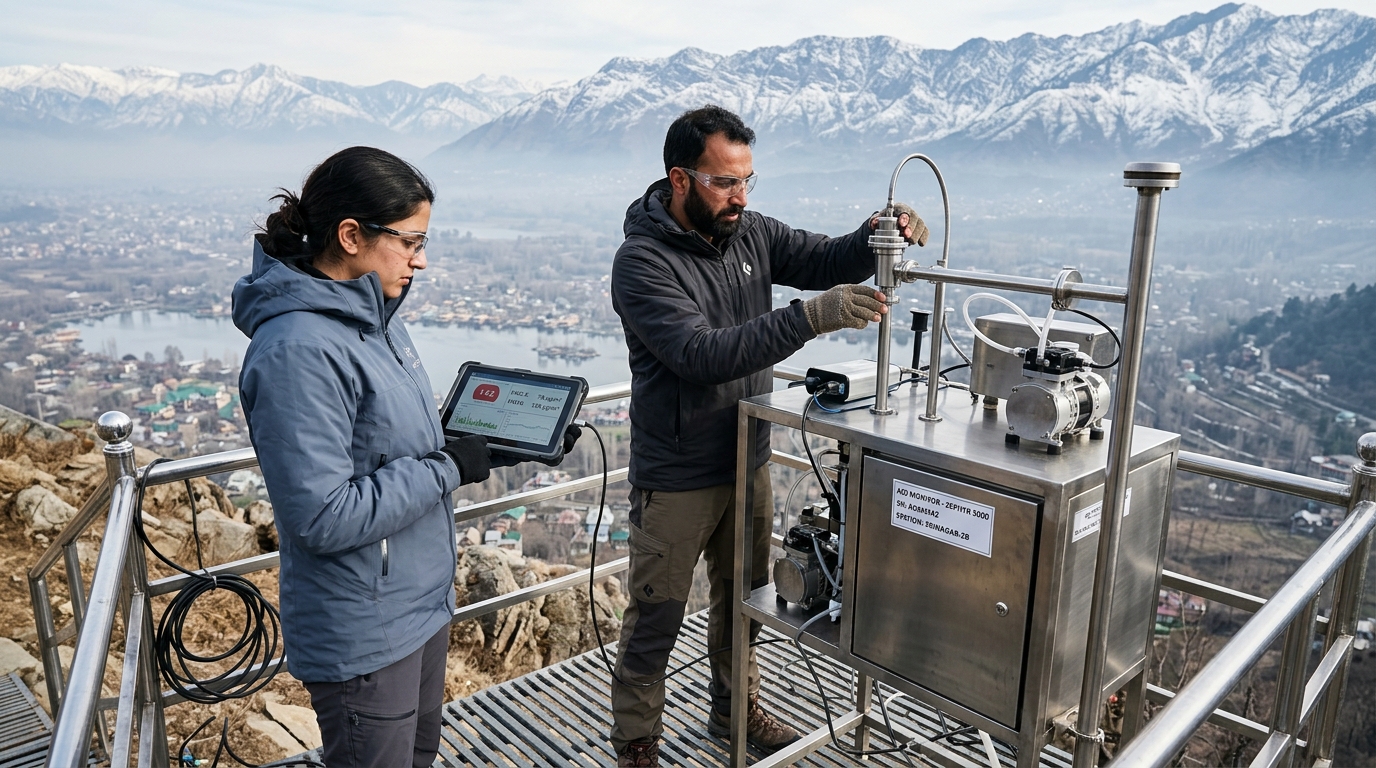
Every Harud, the Same Blue-Grey Ceiling
Six autumns of civic warning have kept Kashmir’s lung crisis in public view—yet the evening air over Srinagar still tastes of charred leaves, damp timber, and kiln coal.
By four-thirty on a November afternoon in Srinagar, before streetlamps flicker along the Jhelum bund or rush-hour minibuses clear the bottlenecks at Jahangir Chowk and Hyderpora, the sky performs a familiar seasonal contraction. Across residential lanes from Rajbagh and Rawalpora to Soura, sweepers and householders touch matches to heaped pyramids of dry Chinar and poplar foliage. Fifteen kilometres south and west across the karewa terraces of Pulwama, Shopian, and Budgam, thin ribbons of grey-white smoke curl upward from pruned apple-orchard twigs and the tall stacks of early-firing brick kilns, while east of Pampore a pale calcareous veil hangs above the limestone quarries and clinker rotary kilns of Khrew and Wuyan. As solar heating fades from the valley floor and katabatic cold air slides down the Pir Panjal and Zabarwan flanks, those disparate plumes merge into a single acrid ceiling trapped two hundred metres overhead.
On Sunday, November 8, 2026, precisely as the annual autumn haze settled across the Kashmir Valley, the Peoples’ Environmental Council (PEC), a voluntary Srinagar-based non-profit citizen trust chaired by Dr. Khurshid A. Salman and convened by Sakib Qadri under the scientific patronage of earth scientist Prof. Shakil A. Romshoo, hosted its latest public deliberation: “Breathe Easy This Harud | Autumn Air Pollution in Kashmir & Lung Health.”
I had the privilege of being invited to participate in this important deliberation. Unfortunately, I was concluding an extended international journey that had taken me from the United States through Turkey, Kashmir and Mumbai, and was in transit back to the United States at the time of the event. Consequently, I was unable to join the proceedings. Nevertheless, I sincerely appreciate the invitation and commend PEC for bringing together an impressive interdisciplinary panel to examine Kashmir’s atmospheric and public health challenges.
Across digital screens, PEC assembled a distinguished interdisciplinary roster: Prof. Shakil A. Romshoo examining valley meteorology and cryospheric linkages; senior pulmonologist Prof. Parvaiz A. Koul, former Director of SKIMS Soura, whose landmark clinical and population-based investigations documented chronic airflow limitation affecting approximately 16 to 19 percent of adults above forty in studied populations, including Bandipora, with domestic biomass smoke among the associated risk factors; Prof. Gazala Habib of IIT Delhi, a leading authority on Indian carbonaceous aerosol characterization; Dr. Sabeena Sultan, Scientist-B at the Jammu and Kashmir Pollution Control Committee (J&K PCC); Prof. Tariq Rasool of SKUAST-Kashmir; and Dr. Mudasir Ahmad of the University of Kashmir.
The convergence of such distinguished expertise represents an important opportunity to move Kashmir’s atmospheric discourse beyond seasonal public concern towards sustained scientific investigation, interdisciplinary collaboration, regulatory accountability and measurable improvements in air quality and public health.
Fairness demands beginning with an unambiguous recognition of civic merit. Between 2020 and 2026, PEC sustained six consecutive years of public webinars, citizen advisories, and expert roundtables on air quality without treasury grants, statutory laboratories, or coercive policing powers. During winters when official bulletins treated valley smog as harmless seasonal mist, PEC kept obstructive lung disease, school-hour particulate spikes, and autumn biomass burning on the public record. In an administrative culture where voluntary technical forums often dissolve after an inaugural press release, six years of unpaid convening represents genuine public-spirited perseverance.
Yet genuine respect for civic effort requires asking the harder institutional question that six autumns of repetition now make unavoidable. Over the exact span in which expert webinars multiplied, medical warnings sharpened, and National Clean Air Programme (NCAP) crores flowed into municipal accounts, autumn and winter breathing conditions across the Kashmir Valley did not demonstrably heal. Why does environmental knowledge continue to accumulate across Kashmir’s screens and seminar halls while clean air remains increasingly uncertain?
This inquiry evaluates publicly documented Peoples' Environmental Council (PEC) webinar notices, confirmed panellist rosters (including the November 8, 2026 "Breathe Easy This Harud" forum), published peer-reviewed research of participating scientists, and circulated civic advisories from 2020 to 2026. Unpublished webinar recordings and internal trust correspondence are not assumed, and zero fabricated spoken remarks are attributed to named participants. Institutional scrutiny is applied symmetrically across four levels—01 Scientific institutions, 02 Government regulators, 03 Civil society & observatories (including PEC and Kashmir EcoWatch itself), and 04 Citizens & communities—recognizing PEC's non-governmental resource limits before examining why deliberative forums lack statutory enforcement traction.
Six Years on the Ledger: Has Kashmir’s Air Improved or Deteriorated Since 2020?
Srinagar’s slide from fourth to twenty-sixth under Swachh Vayu Sarvekshan exposes the gap between summer municipal checklists and winter particulate loads.
To ask whether Kashmir’s air has improved since PEC convened its first pandemic-era air-quality dialogues in 2020 is immediately to confront a split ledger—one written in municipal expenditure slides, the other written in winter hospital wards and national comparative audits. Designated a non-attainment city under the Ministry of Environment, Forest and Climate Change’s National Clean Air Programme (NCAP)—which set a revised national target of reducing particulate concentrations by up to 40 percent by 2025–26 relative to 2017–18 baselines—Srinagar received substantial clean-air disbursements channeled primarily through urban local body and smart-infrastructure procurement.
For a brief window, administrative self-assessment produced premature triumphalism. In the 2023 edition of MoEFCC’s Swachh Vayu Sarvekshan among Million-Plus (Category-I) cities, Srinagar was ranked fourth nationwide, celebrated on official hoardings for procuring mechanical road sweepers, mobile mist-spraying tankers, paved pedestrian shoulders, and green-belt kerbing. Within thirty-six months, however, that administrative mirage dissolved. As national evaluation criteria tightened scrutiny over continuous ambient data completeness, biomass and municipal solid-waste burning controls, and measurable winter particulate trends, Srinagar plunged from 4th place in 2023 to 21st in 2025, and slipped further to 26th among Category-I cities in 2026.
Why did mechanical sweepers and summer water-sprinklers fail to defend Srinagar’s air? Because procurement followed civil-engineering convenience rather than seasonal emission physics. Water-mist cannons cannot operate on sub-zero January mornings in Bemina or Lal Chowk without glazing asphalt in black ice, and vacuum sweepers designed for coarse summer road grit (PM10) barely touch sub-micron secondary organic and carbonaceous aerosols (PM2.5) pouring out of domestic heating flues, orchard fires, and peri-urban kilns between October and February.
Peer-reviewed atmospheric and epidemiological measurements across the region corroborate what municipal rankings reluctantly registered. Source-profiling investigations in the Kashmir Himalaya establish tight statistical associations between winter fine-particulate surges and acute respiratory infections across valley clinics (Wani et al., 2021). Multi-season aerosol monitoring at Western Himalayan sites records persistent winter black-carbon mass concentrations exceeding 4 µg/m³ under stagnant inversions alongside pre-monsoon combustion and traffic spikes approaching 14 µg/m³ (Bawari et al., 2026), while recent trace-element receptor studies in regional PM2.5 identify coal, biomass, crustal dust, and hexavalent chromium inhalation hazards exceeding acceptable lifetime carcinogenic thresholds (Najar et al., 2026). Evaluated across 2020–2026, Kashmir’s winter airshed has not undergone structural decontamination; it has merely acquired pricier summer street-cleaning machinery.
“Spending clean-air grants on summer water-sprinklers while leaving winter solid-fuel heating, orchard smoke, and kiln combustion untouched turned clean-air accounting into a seasonal sleight of hand.”
The Instrumentation Paradox: Sparse Official Stations, Fog-Biased Optical Nodes, and KEW’s Own Limits
Why an official screen in Rajbagh can read “Moderate” at the exact hour neighbourhood consumer apps scream “Hazardous.”
Nothing corrodes public trust—or muddies well-intentioned civil-society webinars—more severely than Kashmir’s unresolved metrological schism. Log onto three different air-quality portals on a foggy November morning in Srinagar, and a citizen is confronted with three irreconcilable atmospheres. An official Continuous Ambient Air Quality Monitoring Station (CAAQMS) feed at Rajbagh may report a calm “Moderate” National Air Quality Index (NAQI) near 115; private crowd-sourced optical sensor dashboards in Shalateng, Hyderpora, or Kanipora simultaneously flash alarming purple banners between 340 and 480; while global satellite-assimilated reanalysis maps paint the entire district a uniform, bland amber.
Both official complacency and sensationalist panic thrive inside this metrological confusion because few commentators explain the physics governing each instrument class. Official regulatory monitoring under J&K PCC and CPCB suffers from acute spatial scarcity and archival opacity. Positioning a lone reference station inside a tree-buffered institutional enclave like Rajbagh cannot represent freight-choked Parimpora, kiln-downwind Chadoora, or cement-dusted Khrew, while manual gravimetric high-volume samplers under the National Air Quality Monitoring Programme (NAMP) yield filter weights weeks or months after an acute smog episode—locked inside non-machine-readable PDFs rather than live public APIs.
Yet the consumer-grade low-cost optical particle counters (AirGradient, PurpleAir, Plantower nephelometers, and commercial aggregator nodes) increasingly cited in media headlines and citizen forums carry an equally serious, opposite winter flaw: unheated inlet hygroscopic bias. Low-cost laser nephelometers do not weigh dry aerosol mass; they infer PM2.5 from 90-degree light scattering assuming fixed particle density and refractive index. During Kashmir’s Harud and Chillai Kalan radiation fogs, when nocturnal and morning relative humidity routinely sits between 85 and 98 percent, hygroscopic ammonium sulfate, nitrate, and water-soluble organic particles absorb ambient moisture via kappa-Köhler deliquescence. Swollen into microscopic water droplets, aerosols scatter two to three-and-a-half times more laser light without any proportional rise in toxic dry mass—artificially vaulting uncalibrated optical AQI scores past 400 unless dynamically corrected against a co-located heated Beta Attenuation Monitor (BAM) or gravimetric reference sampler (Mushtaq et al., 2024).
A rigorous accountability inquiry must turn this exact metrological mirror upon Kashmir EcoWatch itself. As documented transparently inside our platform’s own source architecture (air-quality-registry.ts), Kashmir EcoWatch operates zero physical CPCB-certified CAAQMS hardware stations. Our reference observation layer ingests three non-regulatory community AirGradient optical nodes (Srinagar GND-SGR-01, Jammu GND-JMU-01, and Leh GND-LEH-01)—explicitly flagged in code with is_ground_truth: false as “Non-Regulatory Community Screening”—paired against forty-four 0.1-degree (roughly 11-kilometre) Copernicus Atmosphere Monitoring Service (ECMWF CAMS) reanalysis grid cells. While CAMS gridded physics avoids local fog-droplet artifacts, an 11-kilometre grid cell smears steep valley-floor micro-inversions across surrounding mountain ridges, systematically underpredicting neighbourhood smoke pockets (yielding, for example, a 45.0 µg/m³ valley-core climatological model baseline where ground screening registers 68.4 µg/m³ or far higher during stagnation). Neither PEC’s voluntary webinars nor Kashmir EcoWatch’s dual-track digital observatory can manufacture regulatory truth out of thin air until J&K PCC deploys a dense, humidity-calibrated, open-API reference network.
Under non-exemption rules, Kashmir EcoWatch explicitly discloses its own verification ceiling in src/data/air-quality-registry.ts: KEW maintains 0 direct CPCB CAAQMS API feeds, relying on 3 community AirGradient optical nephelometers (is_ground_truth: false) and 44 ECMWF CAMS 0.1° (~11 km) gridded reanalysis cells. Unheated community optical sensors are vulnerable to winter fog hygroscopic overestimation, whereas 11 km CAMS grids smooth away acute street- and village-level biomass plumes. Civil-society platforms can expose this delta, but cannot replace statutory NABL/BAM reference co-location.
Inside the Emission Cauldron: Local Winter Fires vs. Transboundary Drift
Isotopic and trace-element fingerprints show why blaming distant plains cannot absolve combustion inside the Valley.
Whenever autumn visibility collapses across Srinagar and Anantnag, a predictable blame game surfaces in public commentary: officials point southward toward post-monsoon paddy-stubble fires across Punjab and Pakistan’s Indus plains or westward toward arid dust transport, while urban critics blame rural orchardists and rural residents point back at city diesel fleets. Modern receptor modelling and stable-carbon isotope chemistry allow atmospheric science to replace guesswork with quantitative source partitioning.
Transboundary aerosol transport across the Pir Panjal passes is physically real during specific synoptic windows. Long-term satellite and ground analyses confirm massive October–November greenhouse-gas and fine-particulate plumes from northwestern Indian crop-residue burning (Romana et al., 2026), and extratropical western disturbances interact dynamically with regional winter pollution plumes across northern India (Xie et al., 2026). Elevated free-tropospheric aerosol layers advected through topographic saddles such as Banihal and the Jhelum gorge measurably raise regional background turbidity before winter snows seal the passes.
Once nocturnal surface inversions decouple the 1,600-metre Kashmir Valley floor from free-tropospheric winds, however, the air breathed inside homes, schoolyards, and bazaar corridors is overwhelmingly dominated by local combustion and crustal resuspension. Stable carbon isotope characterization from India’s COALESCE aerosol network demonstrates how C3 woody biomass, residential solid-fuel heating, and fossil combustion leave distinct isotopic signatures in ambient PM2.5 (Paul et al., 2025), while elemental deposition studies across the Western Himalayas separate local anthropogenic fuel-ash and vehicular wear from distant lithogenic dust (Dar et al., 2024; Najar et al., 2026).
Walk through the Valley’s winter energy economy and every local source announces itself. Chronic winter electricity curtailment—driven by run-of-river hydropower generation dropping two-thirds during freezing Himalayan baseflow while peak heating demand surges—forces hundreds of thousands of households onto solid carbon: unvented or leaky sheet-metal bukhari stoves burning damp willow, poplar, or lignite; subterranean domestic and mosque hamam chambers consuming cordwood; charcoal-filled kangri braziers held beneath pherans; and open street-corner warming fires. It is this intimate domestic–ambient combustion continuum that pulmonologist Prof. Parvaiz A. Koul’s epidemiological research placed on the clinical map—demonstrating chronic obstructive pulmonary airflow limitation in 16 to 19 percent of adults over forty in Bandipora, including striking burdens among non-smoking rural women exposed to decades of poorly ventilated biomass smoke, alongside elevated pediatric lower respiratory infection risks linked nationwide to PM2.5 exposure (Roy et al., 2026). Layer onto domestic heating the autumn burning of orchard prunings and urban leaves, Budgam and Pulwama brick kilns, cold-start diesel commercial vehicles grinding through congested corridors, resuspended silt from trenched urban roads, and alkaline clinker dust from Khrew and Wuyan, and the Valley manufactures more than enough local poison to choke itself without importing a single gram from Ludhiana.
The Inversion Alibi: Confusing the Lid on the Pot with the Fire Underneath
Why invoking mountain meteorology without tightening winter emission caps naturalizes a preventable public-health injury.
In nearly every official press note and public seminar convened since 2020, “temperature inversion” has served as the master explanatory noun for Kashmir’s winter smog. Physically, the mechanism is textbook mountain boundary-layer meteorology. Ringed on all sides by the Pir Panjal and Greater Himalayan ranges rising 2,000 to 3,000 metres above the alluvial floor, the oval Kashmir basin acts during calm, clear Harud and Chillai Kalan nights as a radiative cooling bowl. Cold, dense katabatic air drains down surrounding snow-clad slopes and slides beneath warmer air aloft, clamping a thermal lid roughly 100 to 250 metres above ground. With near-zero surface wind speeds, the atmospheric ventilation coefficient—the product of mixing height and average transport wind—routinely plunges well below 2,000 m²/s, compared against the 6,000 m²/s threshold needed for healthy horizontal and vertical dispersion.
Simultaneously, rapid urbanization across Srinagar has altered surface thermal budgets (Murtaza et al., 2023), while decadal warming across Jammu and Kashmir (Gopikrishnan et al., 2026) increasingly replaces cleansing early-winter wet snowfalls with prolonged dry, stagnant November–December high-pressure spells.
Yet accurate meteorology becomes a dangerous governance alibi whenever officials treat inversion as the cause of pollution rather than its physical multiplier. A temperature inversion emits zero micrograms of particulate matter or black carbon. Seal a clean alpine basin beneath a 150-metre inversion and residents breathe crisp cold air. Inversion is the lid on the pot; human combustion and industrial dust are the fire underneath.
In rational mountain airshed regimes, a predictable collapse in winter ventilation legally compels a proportional cut in permitted mass emissions. When the mixing box shrinks fivefold between August and December, allowing kilns, cement plants, and solid-fuel boilers to emit at summer rates guarantees a fivefold surge in ground-level concentrations. Treating winter inversions as an act of geography rather than a statutory trigger for emission rationing turns atmospheric physics upside down.
From Valley Chimneys to Kolahoi’s Ice: Black Carbon and the Cryospheric Feedback Loop
What stagnates in Srinagar’s lungs in December darkens the snowpack feeding Kashmir’s rivers in April.
One of the vital scientific contributions of PEC’s deliberations—reflecting Prof. Shakil A. Romshoo’s dual engagement with atmospheric observation and Himalayan glaciology—has been insisting that Kashmir’s air pollution does not end at the hospital spirometer. Unlike sulfate aerosols that scatter incoming sunlight, black carbon (soot) and light-absorbing organic brown carbon generated by incomplete burning of damp orchard wood, domestic firewood, brick-kiln coal, and older diesel engines are potent short-lived climate forcers.
When daytime upslope valley breezes or passing western disturbances lift trapped valley-floor haze across the subalpine timberline, carbonaceous particles scavenge onto fresh snow crystals and glacier accumulation zones across Gulmarg, Sonamarg, the Pir Panjal cirques, Hoksar, Machoi, and the benchmark Kolahoi Glacier above Pahalgam. Cryospheric radiative-transfer research demonstrates that when black-carbon particles become internally coated by secondary organic or inorganic shells during atmospheric aging—precisely what occurs inside Kashmir’s humid, smoke-filled winter boundary layer—their snow-albedo reduction and radiative forcing efficiency amplify by factors of 1.1 to 1.8 times relative to uncoated soot (Pu et al., 2021; Chelluboyina et al., 2026).
Darkened snow absorbs solar radiation that clean snow would reflect back to space, accelerating snow-grain metamorphism and triggering premature spring melt. Direct, geodetic, and simulated glaciological records on Kolahoi Glacier document steep, accelerating mass loss across the Lidder headwaters (Shukla & Ali, 2016; Romshoo et al., 2023), mirrored by continuous negative mass balances of −0.35 to −0.39 metres water equivalent per year on Hoksar Glacier (Romshoo et al., 2022) and basin-wide CMIP6 projections of shrinking cryospheric storage across the Upper Indus system (Abdullah et al., 2025).
Follow that hydrological chain back downslope and a tragic circular irony emerges. Premature spring snowmelt depletes late-summer August–September streamflows across Jhelum tributaries, forcing paddy farmers in Pulwama, Anantnag, and Shopian to abandon gravity-irrigated rice for rain-fed apple orchards (Rashid et al., 2020)—whose unchipped autumn prunings are then burned every November, sending fresh black carbon back upslope onto the very glaciers whose summer meltwater sustains the Valley.
Why Orchardists Still Strike the Match: Agronomic Deadlines and Failed Circular Logistics
Moralizing at farmers via urban webinars cannot defeat autumn smoke until chipping, biochar, and briquetting beat the cost of a matchbox.
Every November, social media and urban talk shows discover rural smoke anew, condemning apple growers in Shopian, Kulgam, Pulwama, and Baramulla or urban custodians beneath Srinagar’s Chinars for setting leaf and twig piles ablaze. District Magistrates dutifully issue prohibitory orders under Section 144 CrPC (now Section 163 BNSS), threatening fines against open agricultural burning. Yet within forty-eight hours of every circular, thousands of small fires reappear across orchard terraces at dusk. Why?
Because prohibitory orders ignore the agronomic clock and labour economics governing more than 1.6 lakh hectares of temperate horticulture in Kashmir. Between late October harvest and the first heavy December snowfall, an apple grower faces a narrow sanitary window. Fallen foliage harbouring overwintering pseudothecia of Venturia inaequalis (apple scab) and pruned branches carrying canker lesions must be cleared from orchard floors before winter dormancy; leaving infected woody debris unmulched invites explosive fungal pressure the following spring, requiring even heavier fungicide spraying. Simultaneously, agricultural day-labour wages peak during post-harvest grading and pruning, and hauling bulky, thorny twig bundles down steep, mud-slick karewa footpaths without mechanized access is financially ruinous for a two-kanal smallholder.
PEC panellists—including horticultural and environmental scientists from SKUAST-Kashmir and the University of Kashmir—have repeatedly identified viable technical alternatives. Mobile power-take-off (PTO) tractor wood-chippers paired with urea-assisted composting rapidly break down leaf litter and fine twigs into organic orchard mulch; low-cost flame-cap and retort pyrolysis kilns convert woody prunings into stable agricultural biochar with minimal smoke; chopped hardwood and leaf substrates support winter oyster (Pleurotus) and button mushroom enterprises; and mechanical briquetting presses densify pruned apple wood and Chinar leaves into high-calorific fuel logs ideal for domestic hamams and institutional boilers.
Why have those proven technologies remained scattered pilot demonstrations rather than valley-wide practice? Because no agency built the reverse-logistics market. Subsidized chippers under departmental horticulture schemes remain far too scarce for peak November demand, locked behind cumbersome individual subsidy portals rather than deployed as ward- and panchayat-level mobile custom-hiring fleets. Nor has the administration established a guaranteed minimum procurement price per quintal of delivered orchard pruning biomass or mandated 25 percent biomass-briquette co-firing in government offices, hospital boilers, and security-camp heating tenders. So long as a matchbox costs two rupees and hauling twigs to a non-existent collection depot costs four thousand, preaching civic awareness over Zoom will never extinguish Harud smoke.
Pajakh Plumes and Cement Fallout: The Compliance Mirage in Brick Kilns and Khrew
Converting a kiln chimney on paper means little when wet high-sulfur fuel, karewa clay excavation, and absent stack telemetry go unchecked.
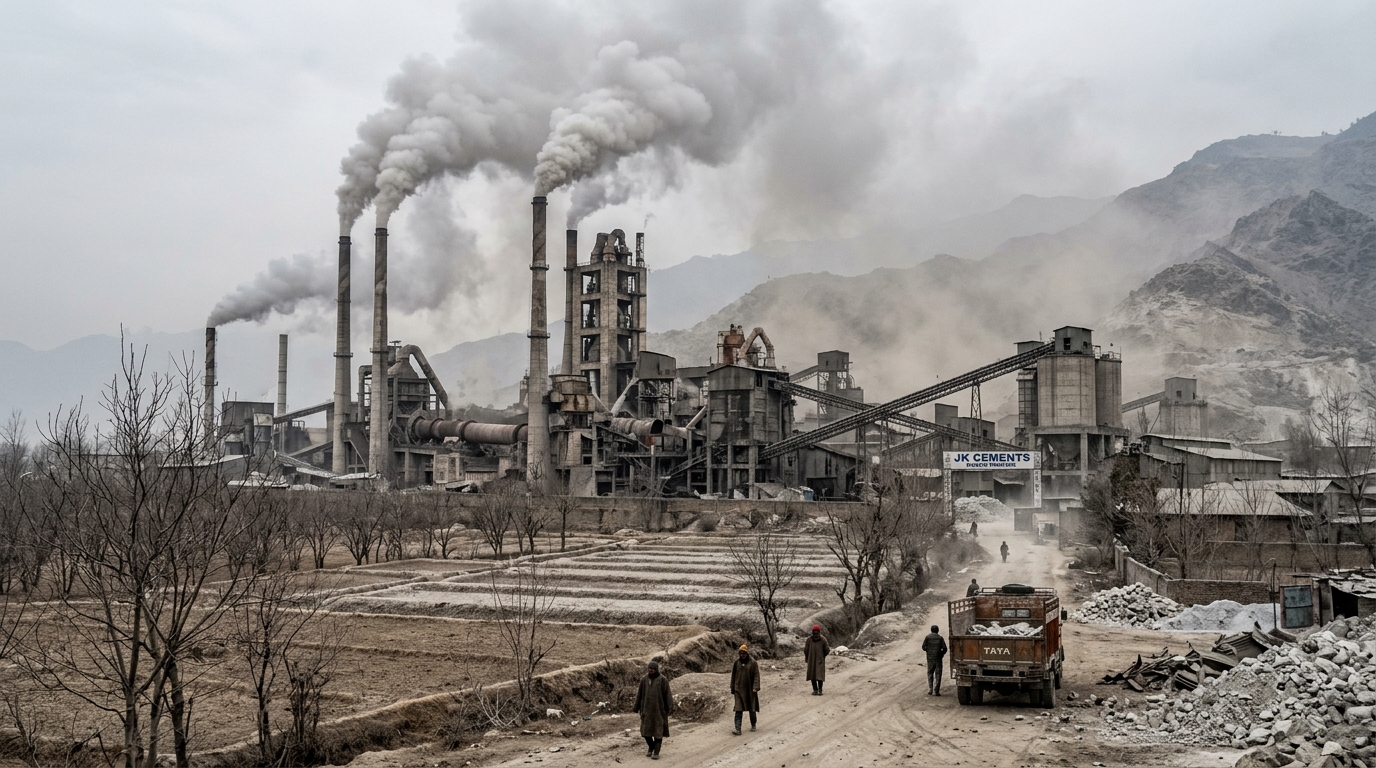
Turn from dispersed rural bonfires to stationary point sources, and the gap between statutory notifications and field enforcement widens further. Across Budgam district—Chadoora, Ichgam, Ompora, Dreygam, and Magam—as well as Pulwama and Anantnag, hundreds of brick kilns (pajakhs) ring Srinagar’s upwind southern and western perimeter, while east of Pampore the Khrew–Wuyan industrial cluster concentrates rotary cement kilns, limestone mines, and stone crushers.
On paper, India’s brick-kiln regulatory regime underwent a major overhaul on February 22, 2022, when MoEFCC notified G.S.R. 143(E) under the Environment (Protection) Act, 1986—mandating that existing Fixed Chimney Bull’s Trench Kilns (FCBTKs) convert within two years to Induced-Draft Zig-Zag technology, vertical shaft kilns, or clean gaseous fuels, while capping stack particulate matter at 250 mg/Nm³ (normalized to 4 percent CO2) and prohibiting operation without valid J&K PCC Consent to Operate. Litigation before the National Green Tribunal Principal Bench (including Original Application No. 89/2021, tracked in Kashmir EcoWatch’s judicial registry as kew-case-008) reinforced siting buffer norms near orchards, habitations, and karewa scarps.
Field combustion science, however, exposes why paper “zig-zag conversion certificates” frequently fail to deliver clean air. Comparative stack-emission analyses between zig-zag and traditional FCBTK kilns demonstrate that zig-zag airflow geometry reduces particulate and black-carbon emissions only when paired with continuous induced-draft fan operation, crushed dry coal of controlled sulfur/ash content, and disciplined single-man stoking intervals (Hasnain et al., 2026). When kiln operators—facing thin margins or lax autumn–spring inspections—burn high-sulfur coal fines, petroleum coke, wet sawmill waste, or unsegregated scrap, incomplete smouldering returns, depositing heavy metals into surrounding soils and shallow groundwater around J&K brick-kiln belts (Mohan et al., 2024) while stripping irreplaceable Pleistocene karewa loess for brick earth (Maske, 2026).
Parallel enforcement gaps afflict the Khrew cement and stone-crushing belt. Agronomic field investigations around Khrew document measurable alkalinization, crust formation, and nutrient disruption in agricultural and saffron soils exposed to chronic cement-dust fallout (Rasheed et al., 2025), alongside biochemical foliar stress in trees bordering central Kashmir stone crushers (Hamid et al., 2023). Although major cement plants are nominally required to operate electrostatic precipitators or baghouse filters linked to Continuous Emission Monitoring Systems (CEMS), raw hourly CEMS stack streams from Khrew and Wuyan are not published on a citizen-accessible public dashboard allowing independent verification during nocturnal filter bypasses or power fluctuations.
The Missing Transmission Belt: Auditing Six Years of Recommendations Across Four Tiers
Why sensible advice from webinars evaporates between the closing vote of thanks and the winter secretariat file.
Place the recurring recommendations voiced across PEC’s 2020–2026 webinars side by side—300-metre zero-burning clean-air zones around schools and hospitals, suspension of outdoor dawn school assemblies during heavy inversion mornings, ward-level Chinar leaf composting, subsidized orchard wood-chippers, strict brick-kiln and cement stack enforcement, reliable winter electricity to curb dirty heating, and dense neighbourhood AQI displays—and a striking realization emerges: almost none of these proposals is technically exotic or fiscally impossible. Why, then, do the same panellists find themselves repeating virtually identical pleas in November 2026?
Because in Jammu and Kashmir’s governance architecture, no statutory transmission belt connects a civil-society deliberation—even one attended by a sitting J&K PCC scientist or university vice-chancellor—to an enforceable departmental docket. When an official participates in a Sunday webinar, their remarks carry zero binding commitment upon the Housing and Urban Development Department, the Srinagar Municipal Corporation, the Power Development Department, or District Magistrates. No statute requires J&K PCC to log citizen-forum technical dossiers under Section 17 of the Air Act, publish a sixty-day compliance scorecard, or explain why NCAP funds bought mechanical sweepers instead of winter heating retrofits and reference BAM stations.
Yet intellectual honesty forbids laying the entire burden at the Secretariat’s door. Clean-air stagnation in Kashmir is co-produced across all four tiers of environmental responsibility. First, regional scientific institutions—the University of Kashmir, SKUAST-Kashmir, NIT Srinagar, and SKIMS—have generated valuable diagnostic papers, yet university research remains fragmented across short-term extramural grants rather than sustaining an open, continuous chemical source-apportionment observatory or engineering affordable low-emission retrofits for domestic Kashmiri bukharis and hamams. Second, government agencies—J&K PCC, SMC, Horticulture, Power Development, and district administrations—suffer from opaque data silos, misaligned NCAP spending, thin winter inspection cadres, and winter power-curtailment schedules that actively push families toward firewood and charcoal.
Third, civil society and independent observatories—including PEC and Kashmir EcoWatch—must confront their own structural limits. PEC deserves lasting credit for keeping public conscience awake, yet episodic autumn webinars without a permanent year-round compliance tracker, coordinated Right to Information audits of NCAP/CEMS ledgers, or formal statutory petitions risk settling into a comforting annual Harud ritual—articulating concern every November while winter proceeds unchanged. Equally, digital platforms like Kashmir EcoWatch must resist treating uncalibrated community optical feeds or coarse 11-kilometre satellite grids as substitutes for physical instrumentation advocacy. Fourth, citizens and neighbourhood institutions cannot claim pure victimhood while sweeping garden leaves into evening bonfires, burning plastic packaging in peri-urban lanes, idling diesel SUVs outside schools, or firing damp timber inside unvented flues that poison their own neighbours’ bedrooms.
IMPLEMENTATION AUDIT · PEC WEBINAR PROPOSALS (2020–2026)
Six-year tracking audit comparing recurring public-interest recommendations from Peoples' Environmental Council air-quality deliberations against administrative and ground reality across the Kashmir Valley.
| Recurring Webinar Recommendation (2020–2026) | 2026 Ground & Statutory Implementation Reality in Kashmir |
|---|---|
| 300-metre Clean-Air / Zero-Burning Buffer Zones around tertiary hospitals (SKIMS, SMHS, Chest Diseases) and schools | Unnotified under Air Act §19; open leaf burning, diesel minibus idling, and solid-fuel commercial dhabas persist directly outside hospital gates (mirroring unpoliced acoustic buffers in High Court PIL No. 34/2019). |
| Mandatory suspension of outdoor dawn school assemblies and strenuous PT during severe autumn/winter inversion mornings | Ad-hoc individual private-school discretion only; no automated J&K PCC–School Education Department NAQI health-advisory protocol exists. |
| Scale-up of mobile orchard wood-chippers, Chinar leaf composting, biochar pyrolysis, and briquetting to end Harud smoke | Isolated SKUAST-K pilots and token municipal compost pits; absence of panchayat custom-hiring chipper fleets or government briquette buyback tariffs leaves open burning dominant. |
| Dense, calibrated, real-time public AQI network across all 10 Kashmir Valley districts and industrial hotspots | Official CAAQMS remains sparse and urban-centric; public relies on unheated low-cost optical nodes prone to 85–98% RH fog inflation or coarse 11 km CAMS grids (including KEW’s non-regulatory screening layer). |
| Strict Zig-Zag brick-kiln fuel/stack enforcement and real-time Khrew/Wuyan cement baghouse transparency | Paper conversion certificates issued under 2022 MoEFCC rules without continuous stack telemetry, winter fuel-sulfur audits, or public CEMS streaming. |
| Clean winter domestic heating transition (uninterrupted metered power, insulated housing, low-emission vented stoves) | Zero NCAP allocation toward household heating substitution; winter peak-hour power curtailments continue locking households into firewood, lignite, and kangri charcoal. |
01 Science: Strong pulmonary and glaciological diagnostics, weak continuous open speciation and domestic stove engineering. 02 Government: NCAP funds diverted to summer sweepers, opaque CEMS/CAAQMS logs, winter power cuts driving biomass use. 03 Civil Society (PEC & KEW): Admirable unpaid awareness and digital synthesis, but webinars lack statutory follow-through dockets and KEW lacks physical reference BAM hardware. 04 Citizens: Routine domestic leaf/waste burning and unvented wet-wood combustion despite known neighbourhood respiratory harm.
How Enclosed Mountain Valleys Elsewhere Conquered Winter Inversion Smog
Why Alpine Switzerland, Utah’s Wasatch Front, and Chile’s Santiago Basin regulate inversions as binding emission ceilings.
Whenever defenders of the status quo argue that an enclosed cold mountain basin cannot achieve clean winter air, comparative governance provides a decisive rebuttal across three analogous winter-inversion regions.
In Switzerland’s Alpine valleys, the federal Ordinance on Air Pollution Control (LRV) is wired directly to the NABEL monitoring network: cantons enforce particulate type-approval and chimney inspections for domestic wood boilers, prohibit open garden or orchard burning while providing municipal chipping pickups, and mandate baghouse filtration across cement and quarry plants.
Across Utah’s snow-ringed Salt Lake and Cache valleys—where multi-day cold-air pools trap haze beneath 200-metre lids—regulators pair federal BAM stations with calibrated community sensors to trigger legally binding “Mandatory Action” days. When forecasted ventilation drops below stagnation thresholds, non-essential solid-fuel burning halts and industrial facilities execute pre-filed winter curtailment plans.
Closer to Kashmir’s socioeconomic realities, Chile’s Andean foothill cities (Temuco, Osorno, and Coyhaique) enacted Atmospheric Decontamination Plans combining municipal dry-firewood certification (<25 percent moisture, halving PM2.5 per unit heat), subsidies replacing leaky sheet-metal stoves with certified pellet heaters and home insulation, and inversion-episode industrial caps. Every successful mountain airshed proved the same rule: you cannot legislate away topography, so you must calibrate sensors, subsidize clean warmth, collect biomass mechanically, and cap winter combustion by law.
The Himalayan Dispatch Proposal: The RASS-CAF Clean-Air Governance Architecture
Six enforceable pillars to align sensor metrology, source apportionment, orchard circularity, and statutory accountability.
To move Kashmir past a seventh consecutive autumn of unanswered webinars, clean-air reform must be engineered within existing Indian statutory powers—specifically Section 16(2), Section 17, and Section 19 of the Air (Prevention and Control of Pollution) Act, 1981 (empowering Air Pollution Control Area fuel/appliance rules and joint laboratory accreditation) alongside Section 3 and Section 5 of the Environment (Protection) Act, 1986. Building on these legal foundations, Himalayan Dispatch advances the Regional Atmospheric Source-Apportionment, Sensor-Validation and Clean-Air Accountability Framework (RASS-CAF).
First, RASS-CAF resolves the instrumentation crisis by establishing a Valley-to-Cryosphere Reference & Calibration Network: installing heated-inlet CPCB-grade BAM/TEOM reference stations across all ten Kashmir districts—including industrial/kiln receptors at Khrew, Chadoora, Pulwama, Sopore, and Anantnag plus a high-altitude black-carbon observatory at Gulmarg/Pahalgam—and co-locating low-cost optical sensors at each reference site to publish a live, open-source Kashmir Relative-Humidity Hygroscopic Correction Equation. Overnight, both J&K PCC’s spatial blind spots and consumer apps’ fog-inflated panic scores give way to NABL-traceable neighbourhood telemetry.
Second, RASS-CAF institutes a Bi-Seasonal Chemical Source-Apportionment Mandate, requiring J&K PCC, the University of Kashmir, SKUAST-Kashmir, and national partner laboratories to publish open autumn (Harud) and deep-winter (Chillai Kalan) receptor profiles (quantifying exact shares of orchard biomass, domestic firewood/coal, brick kilns, cement/quarry dust, diesel exhaust, and transboundary inflow), legally barring municipal agencies from spending >15 percent of NCAP/clean-air grants on summer road-sweeping or beautification when winter combustion drives >70 percent of health-damaging PM2.5.
Third, RASS-CAF replaces futile Section 163 burn bans with a Circular Orchard & Chinar Biomass Guarantee (ward-level FPO wood-chipper custom-hiring fleets, biochar kilns, and mandatory 25 percent apple-wood briquette procurement for government/hospital heating), pairs it with an Inversion-Triggered Graded Winter Response Protocol whenever valley ventilation drops below 2,000 m²/s, links SKIMS/GMC pulmonary COPD surveillance to targeted winter electric-tariff lifelines and stove-insulation grants, and creates a Statutory Civil-Society Deliberation Docket compelling J&K PCC and SMC to publish a point-by-point sixty-day compliance audit in response to formal technical submissions from civic bodies such as PEC.
PROPOSED ADVANCEMENT · RASS-CAF GOVERNANCE & TECHNICAL MATRIX
The 6 Pillars of the Regional Atmospheric Source-Apportionment, Sensor-Validation and Clean-Air Accountability Framework (RASS-CAF) for the Kashmir Valley Airshed.
| RASS-CAF Pillar & Technical Mechanism | Statutory Hook, Fiscal Re-Allocation & Verifiable Outcome Metric |
|---|---|
| 1. Heated-Inlet Reference Telemetry & Optical RH-Calibration Grid (10 District BAMs + Alpine BC Node) | Air Act 1981 §17(1)(g)–(h); funded via 20% NCAP/J&K PCC Consent-fee earmark; open JSON API streaming raw gravimetric/BAM PM2.5, RH, and dynamic f(RH)-calibrated neighbourhood optical feeds. |
| 2. Bi-Seasonal Chemical Receptor Source-Apportionment Ledger (Harud & Chillai Kalan Speciation) | Joint J&K PCC–University of Kashmir–SKUAST-K NABL consortium; measures OC/EC, levoglucosan, δ13C, Cr(VI), and Ca2+ cement tracers; legally ties clean-air capital budgets to top 3 winter emission sources. |
| 3. Inversion-Triggered Graded Winter Emission Protocol (Ventilation Coefficient < 2,000 m²/s) | Notified under Air Act §19(3)–(5) & EPA 1986 §5; triggers mandatory outdoor school-assembly suspension (>150 NAQI), 300m hospital clean zones, live Khrew CEMS baghouse audits, and priority winter domestic power feeders. |
| 4. Circular Orchard Pruning & Municipal Foliage Value-Chain Guarantee | Horticulture & SMC convergence budget; deploys panchayat tractor-PTO wood-chipper fleets, decentralized biochar kilns, mushroom-substrate hubs, and 25% biomass-briquette procurement in UT institutional boilers. |
| 5. Verified Zig-Zag Kiln Combustion & Clean Domestic Heating Equity Transition | Enforces MoEFCC G.S.R. 143(E) via stack/fuel-sulfur audits and dry-biomass (<20% moisture) standards, paired with winter lifeline heating tariffs and vented pellet/insulated-room subsidies for high-risk rural wards. |
| 6. Statutory Civil-Society Deliberation-to-Docket Transmission Mechanism & Spirometry Registry | Mandates a published 60-day J&K PCC / SMC compliance response to accredited civic-scientific submissions (such as PEC technical dossiers), benchmarked against SKIMS/GMC winter respiratory admission trends. |
Before a Seventh Autumn Repeats the Script
Public awareness has done its honourable duty; only calibrated measurement, circular economics, and binding winter law can clear the bowl.
Night settles early over Srinagar in late November. Beneath the sodium glow of streetlamps along Residency Road, Bemina, and Soura, you can watch the Valley’s invisible ceiling materialize in the headlight beams—a slow, suspended drift of wood-tar droplets, pulverized karewa silt, kiln soot, and exhaust particulates hanging motionless at chest height, entering the bronchioles of toddlers asleep under quilts, orchard labourers returning from Shopian terraces, and elderly COPD patients reaching for nebulizers before dawn.
For six consecutive years, the Peoples’ Environmental Council and the physicians, glaciologists, agronomists, and atmospheric chemists who answered its invitations refused to let Kashmir normalize that haze. In a public sphere easily distracted by louder crises, sustaining an unpaid six-year vigil for human lungs and mountain snowpacks is no small civic achievement. Nothing in this inquiry counsels abandoning public deliberation.
Yet six years is long enough to prove where awareness alone hits granite. Knowledge accumulates while clean air grows more uncertain whenever diagnostics remain trapped in webinars, monitoring remains split between sparse official enclaves and fog-blinded consumer gadgets, clean-air budgets buy summer street-sweepers instead of winter heating and orchard chippers, and regulators treat predictable mountain inversions as nature’s fault.
The true tribute to six years of warnings will not be a seventh webinar repeating the same slides next November. It will be an open public ledger showing calibrated winter PM2.5 and black carbon falling year after year across every district of the Valley—proving that Kashmir’s institutions finally chose to govern the fire beneath the lid.
“Temperature inversion is merely the lid on the mountain bowl; human governance decides how much smoke we trap underneath it.”
DOCUMENTARY SOURCES & FURTHER READING
| Source | Documentary relevance |
|---|---|
| Najar et al. (2026), Environmental Science and Pollution Research — Western Himalayan PM2.5 Trace Elements & Risk | Co-authored with Prof. Gazala Habib; quantifies trace-element receptor sources in Western Himalayan PM2.5 and Cr(VI) inhalation cancer risk. |
| Wani et al. (2021), Environmental Science and Pollution Research — Air Pollution Source Profiling & Acute Respiratory Infections | Establishes source profiles of ambient air pollution and statistical links with acute respiratory infections in the Kashmir Himalayan region. |
| Bawari et al. (2026), Environmental Monitoring and Assessment — Seasonal Dynamics & Radiative Impact of Western Himalayan Aerosols | Documents winter black carbon (>4 µg/m³) under shallow mountain inversions and fire-influenced aerosol radiative forcing. |
| Paul et al. (2025), Scientific Reports — COALESCE Network Stable Carbon Isotope Aerosol Apportionment | Uses stable carbon isotope ratios to partition biomass combustion and fossil-fuel sources in ambient PM2.5 across India. |
| Mushtaq et al. (2024), Environmental Monitoring and Assessment — Ground-Based vs. Satellite Air Pollutant Accuracy | Evaluates methodological accuracy, calibration requirements, and health-hazard estimation across satellite and ground PM2.5/PM10 sensors. |
| Pu et al. (2021), The Cryosphere — Coated Black Carbon Enhancement of Snow Albedo Reduction | Demonstrates 1.1–1.8x amplification of snow-albedo reduction and radiative forcing caused by coated black carbon in snowpacks. |
| Romshoo, Abdullah, Murtaza & Bhat (2023), Journal of Hydrology — Kolahoi Glacier Mass Balance Studies | Direct, geodetic, and simulated mass-balance record of Kolahoi Glacier in the Kashmir Himalaya. |
| Rashid, Majeed, Aneaus & Pelto (2020), Water — Glacier Retreat, Streamflow Depletion & Horticultural Shift | Links Kashmir glacier retreat to depleting summer streamflows and downstream conversion from irrigated paddy to apple orchards. |
| Hasnain et al. (2026), International Journal of Analytical Chemistry — Zig-Zag vs. Bull’s Trench Brick Kiln Stack Emissions | Demonstrates how fuel quality and combustion management govern real-world emission reductions in retrofitted zig-zag brick kilns. |
| Mohan et al. (2024), Heliyon — Heavy Metal Contamination Around Brick Kilns in Jammu and Kashmir | Quantifies heavy-metal pollution indices in groundwater surrounding brick-kiln clusters in Jammu and Kashmir. |
| Rasheed, Sofi, Bhat & Hussain (2025), SKUAST Journal of Research — Khrew Cement Dust Soil Impacts | Documents physicochemical soil alteration and alkalinization caused by industrial cement dust fallout around Khrew, Kashmir Valley. |
| Murtaza, Shafai, Shahid & Romshoo (2023), Environmental Science and Pollution Research — Srinagar Urban Land & Thermal Dynamics | Examines spatio-temporal urban expansion and surface thermal regime shifts across Srinagar City. |
| Xie et al. (2026), Science Advances & Roy et al. (2026), Archives of Public Health — Winter PM2.5 Dynamics & LRI Burden | Establishes synoptic winter PM2.5 severity drivers across northern India alongside systematic PM2.5 respiratory health burden. |
| Kashmir EcoWatch Air Quality Intelligence Architecture & NCAP / Air Act Statutory Records | KEW dual-track community AirGradient + 44-unit ECMWF CAMS registry (0 physical CAAQMS sensors), MoEFCC Swachh Vayu Sarvekshan rankings, and G.S.R. 143(E) kiln rules. |
EDITORIAL PUBLICATION METADATA & 10-STAGE GATE LEDGER
| Gate | Status | Record / Scope |
|---|---|---|
| 01 · Commissioned | completed | Himalayan Dispatch Founding Masthead |
| 02 · Research in progress | completed | Himalayan Dispatch Research & Observatory Desk |
| 03 · Manuscript draft | completed | Assigned Author / Editorial Desk |
| 04 · Evidence verification | completed | Cross-checked against documented Peoples' Environmental Council webinar records (2020–Nov 8, 2026), MoEFCC Swachh Vayu Sarvekshan Category-I rankings (2023–2026), MoEFCC Brick Kiln Notification G.S.R. 143(E) (2022), Air (Prevention and Control of Pollution) Act 1981, KEW air-quality-registry.ts telemetry architecture, KEW PIL docket OA No. 89/2021 (PB), and 13 peer-reviewed aerosol, cryosphere, brick-kiln, and epidemiological studies with verified DOIs. |
| 05 · Scientific review (where applicable) | pending | Boundary-layer ventilation physics, kappa-Kohler hygroscopic optical sensor bias under radiation fog, stable-carbon aerosol isotope apportionment, coated black-carbon snow-albedo forcing, and zig-zag kiln combustion stoichiometry internally audited; independent external Stage 05 atmospheric specialist sign-off pending prior to post-pre-release release. |
| 06 · Editorial review | completed | Founding Editor-in-Chief Desk Review |
| 07 · Copyright and ethics review | completed | Applies strict non-exemption fairness across scientific institutions, government agencies, civil society (crediting PEC's voluntary public service while auditing structural limits across both PEC and Kashmir EcoWatch), and citizens. Archival visual plates carry institutional Kashmir EcoWatch Visual Archive credits with zero synthetic personas. |
| 08 · Administrator approval | in progress | Stage 08 Pre-Release Edition Folio staged on localhost for Founding Administrator review prior to production release. |
| 09 · Published | pending | — |
| 10 · Post-publication corrections | not applicable | — |
| Attribute | Final assignment |
|---|---|
| Publication | Himalayan Dispatch |
| Volume / Issue | Vol. 01 / No. 01 · The Inaugural Issue |
| Series Rubric | Civil Society & Environmental Accountability Series (Part I · Clean Air Governance) |
| Civic Initiative Examined | Peoples' Environmental Council (PEC, Srinagar) Air-Quality Webinars (2020–2026), including 'Breathe Easy This Harud' (Nov 8, 2026) |
| Byline | The Editorial Board & Himalayan Dispatch Atmospheric & Data Desk |
| Primary Department | Editorials |
| Associated Departments | Data Journalism · Investigative Journalism |
| Proposed Governance Framework | Regional Atmospheric Source-Apportionment, Sensor-Validation and Clean-Air Accountability Framework (RASS-CAF · 6 Pillars) |
| Publication Gate Status | Stage 08 · Pre-Release Edition Folio Awaiting Administrator Approval |
Earth Observation, Cryosphere & Statistical Graphics Desk
Himalayan Dispatch · Data & Cartography Desk
Translates multi-decadal satellite Earth observation, elevation-band hypsometry, and peer-reviewed cryospheric datasets into reproducible visual essays.
View Portfolio & Approved Commissions →NEXT IN THIS EDITION · SPECIAL SCIENTIFIC INVESTIGATION · CLIMATOLOGY · TRANSBOUNDARY ATMOSPHERIC INTELLIGENCE
The Atmosphere Has No Borders: The Air We Breathe, the Numbers We Cannot Trust
By Dr. Fayaz Ahmad Khan & Himalayan Dispatch Atmospheric Science and Geospatial Intelligence Desk · 26 min read