The Desert Is Not Empty
High-Altitude Wetlands, Wildlife Corridors, Alpine Rangelands and the Ecological Integrity of Ladakh's Cold Desert
INAUGURAL EDITORIAL FOLIO · DESK & OBSERVATORY SYNTHESIS
Three-Tier Scientific Architecture, Indigenous Pastoral Dignity & Sensitive-Species Protection: Investigation III of Special Issue 'Ladakh's Ecological Frontiers' pairs this longform field-and-systems synthesis with the 45-chapter issue research framework and the permanent 12-module KEW Ladakh Cold-Desert Cryosphere & Ecology Observatory (/earth-human-impact/ladakh-cold-desert-observatory). Empirical analysis integrates peer-reviewed Trans-Himalayan ecology, Ramsar Information Sheets for Tso Moriri and Tso Kar, 2025 peer-reviewed PubMed Central (PMC) metagenomic research on Changthang permafrost-affected soil microbiomes, and the September 2026 environmental assessment report identifying 65 bird species in Ladakh of high conservation concern. Customary Changpa pastoral governance is evaluated alongside wildlife connectivity without scapegoating mobile herders for industrial or infrastructural land conversion.
The Colonial Mirage of Nothingness
Why an administrative vocabulary forged for lowland plough agriculture still misreads four thousand metres of living rock, ice, marsh, and steppe.
Seen from an aircraft window banking east of Leh or through the windshield of a convoy climbing past Tanglang La onto the Rupshu plains, eastern Ladakh presents an optical illusion that has misled lowland administrators for nearly two centuries. No deodar canopy softens the scarp; no terraced paddy gleams across the valley floor. Wind-scoured alluvial fans spill from slate-purple ridges into pale basins rimmed with white evaporite salts, and for ten months of the year the ground looks locked in mineral sleep. Nineteenth-century revenue surveyors, trained to equate ecological worth with taxable timber and irrigated grain, entered a blunt shorthand onto their settlement sheets—ghair mumkin, uncultivable waste, barren wasteland—and bequeathed that verdict to modern infrastructure planners.
Walk two hundred paces off the tarmac toward the frost-heaved hummocks bordering Startsapuk Tso or the braided meltwater threads feeding Hanle, however, and the illusion of emptiness collapses at every spatial scale. Beneath a crust of desert pavement, cold-adapted bacteria and archaea fix atmospheric nitrogen and stabilize ancient organic carbon along the thawing boundary of mountain permafrost. Across emerald ribbons of Carex and Kobresia sedge no wider than a village lane, black-necked cranes tend island nests while bar-headed geese fatten for trans-Himalayan flight. Upslope on shale talus that matches the coat of a snow leopard to the shade of lichened gneiss, blue sheep, Tibetan argali, and herds of kiang track a fleeting sixty-day flush of alpine protein alongside the cashmere-bearing flocks of mobile Changpa pastoralists.
Two recent scientific benchmarks expose just how dangerously official land-use categories lag behind biological reality. First, 2025 peer-reviewed research archived in PubMed Central (PMC) documented remarkably rich microbial diversity within Changthang’s permafrost-affected soils—demonstrating complex psychrophilic biochemical networks operating in substrates routinely dismissed as sterile gravel. Second, a September 2026 report examining an environmental assessment across the Union Territory identified 65 bird species in Ladakh as being of high conservation concern amid compounding pressures from linear infrastructure expansion, unregulated mass tourism, free-ranging dogs proliferating around uncollected organic waste, and rapid cryospheric warming.
Investigation III of Ladakh’s Ecological Frontiers confronts the category error uniting every bulldozer cut, chain-link enclosure, wetland camp, and unmitigated powerline across the Trans-Himalaya. At its core stands a single testable proposition: "Landscapes conventionally classified as barren or unproductive may perform critical ecological functions that remain inadequately represented in infrastructure planning and environmental assessments."
LADAKH COLD-DESERT ECOLOGICAL INTEGRITY · EMPIRICAL BASELINE LEDGER
Synthesizes the September 2026 report on Ladakh’s avian conservation assessment (65 high-concern bird species), Ramsar wetland designations in Changthang (~4,522–4,530 m), and 2025 peer-reviewed metagenomic documentation of Changthang permafrost-affected soil communities.
In accordance with Kashmir EcoWatch ethical field standards, exact breeding-island, denning-rock, and winter-refuge coordinates for black-necked cranes, snow leopards, Tibetan gazelles, wolves, and Pallas’s cats are withheld throughout this investigation and aggregated only to landscape-basin scale.
Orogeny, Rain Shadow, and the Living Skin of Permafrost
How tectonic uplift, hyper-aridity, and sub-zero soil microbiomes engineered Ladakh’s cold-desert biodiversity.
To understand why Ladakh’s ecosystems are simultaneously tough against winter cold and brittle under mechanical disturbance, one must begin with the collision of India and Eurasia. As the Greater Himalayan and Zanskar ranges rose across the southern flank of the Indus suture zone, they erected an atmospheric wall that intercepts the summer southwest monsoon, starving the leeward plateaus of Rupshu, Changthang, and Aksai Chin to fewer than 80 to 120 millimetres of annual precipitation. Moisture arrives predominantly as winter and spring snow carried by Mediterranean-origin Westerly disturbances. Above 4,200 metres, thin air admits intense ultraviolet radiation while thin cloud cover permits fierce nocturnal radiative cooling—driving winter temperatures below minus thirty degrees Celsius and subjecting skeletal regolith to hundreds of freeze-thaw oscillations each year.
Evolution under this regime selected against tall woody trunks and favoured miniature, subsurface, and physiological engineering. Cushion plants such as Thylacospermum caespitosum, Acantholimon lycopodioides, and Arenaria bryophylla form dense hemispherical domes that trap windblown silt, buffer root-zone temperatures by up to ten degrees above ambient wind chill, and nurse secondary herbs within their micro-canopies. Across gravel bajadas, dwarf shrubs of Caragana versicolor, Krascheninnikovia ceratoides (Eurotia), and Artemisia allocate three to five times more biomass below ground than above it, anchoring friable slopes during brief July snowmelt surges.
Yet the deepest refutation of cold-desert sterility lies below even the finest root hairs. In 2025, peer-reviewed research published in PubMed Central (PMC) profiled the microbial diversity of permafrost-affected soils across Changthang, revealing taxonomically rich assemblages of Actinomycetota, Pseudomonadota, Acidobacteriota, Chloroflexota, Bacteroidota, cold-adapted Archaea, and oligotrophic fungi stratified across the seasonally thawed active layer and underlying perennially frozen ground. These psychrotolerant guilds synthesize antifreeze exopolysaccharides, fix scarce nitrogen, solubilize mineral phosphorus from freshly weathered granite and limestone, and regulate methane oxidation and organic carbon storage. What looks to an earthmover like dead scree is a living biogeochemical reactor accumulated at millimetre-per-century rates.
Built atop that microbial and cushion-plant foundation is an extraordinary high-altitude biodiversity inventory: specialized cold-desert reptiles such as the viviparous toad-headed agama (Phrynocephalus theobaldi) and Himalayan rock agama, endemic high-elevation bumblebees (Bombus spp.) and Parnassius Apollo butterflies adapted to gale-force pollination windows, medicinal herbs including Rhodiola imbricata and Arnebia euchroma, more than three hundred recorded bird species spanning resident Tibetan snowcock and Hume’s ground tit to trans-hemispheric waders, and India’s richest intact guild of Paleoarctic-Tibetan large mammals. Strip away twenty centimetres of topsoil for a highway borrow pit or level an alluvial fan for an unassessed solar array, and centuries of microbial crust and root-mat succession cannot simply be replanted in a monsoon nursery.
Closed Basins of Salt, Meltwater, and Wings
Inside Tso Moriri, Tso Kar, Pangong Tso, black-necked crane nurseries, and the 65 high-concern bird species of a stressed Central Asian Flyway.
In an arid rain-shadow plateau, water is ecological gravity: wherever fault-bounded depressions capture glacial and permafrost meltwater, biological productivity concentrates a hundredfold above the surrounding steppe. Eastern Ladakh’s closed endorheic lakes—Tso Moriri, the Tso Kar complex, and Pangong Tso, complemented by braided riverine marshes at Hanle, Chushul, Loma, and Nyoma—operate not as isolated scenic postcards, but as a single hydrologically and ornithologically coupled wetland archipelago.
At roughly 4,522 metres in Rupshu, Ramsar-listed Tso Moriri fills a deep tectonic trough fed primarily by the Phirse Phu and Korzok Phu streams. Although its deep pelagic waters are oligotrophic and mildly brackish, its northern and southern inflow deltas build lush Carex-Kobresia sedge fens that host major breeding congregations of bar-headed geese (Anser indicus), brown-headed and Pallas’s gulls, ferruginous ducks, and nesting pairs of the revered black-necked crane (Grus nigricollis)—the flagship species central to Buddhist Changpa cultural ethics. Northwest across Polokongka La at roughly 4,530 metres, the Tso Kar Wetland Complex (designated a Ramsar site in 2020) pairs freshwater Startsapuk Tso with hypersaline Tso Kar across an evaporite plain of mirabilite, borax crusts, and geothermal seeps. That sharp salinity gradient within a single basin lets freshwater sedge emergents, brackish amphipod beds, and salt-pan steppe birds coexist side by side, making Tso Kar Ladakh’s most productive breeding amphitheatre for black-necked cranes, ruddy shelducks, great crested grebes, horned larks, and Tibetan sandgrouse.
Northward across Chang La, the 134-kilometre transboundary ribbon of Pangong Tso (~4,250 metres) illustrates how cryospheric instability and unplanned tourism squeeze littoral life from opposite directions. Accelerated summer glacier wastage and erratic cloudburst runoff have raised water levels in endorheic Tibetan-Ladakhi basins over recent decades, submerging gently sloping western gravel spits and brackish reed beds even as dense seasonal tent colonies, concrete cafés, generator pads, and tyre ruts press downward toward the water’s edge—eliminating the narrow shoreline buffer needed by moulting waterfowl and shoreline invertebrates.
Together with the Indus, Shayok, Suru, and Nubra river corridors, these basins form high-altitude refuelling rungs along the Central Asian Flyway, where migrants crossing between Siberian tundras and peninsular Indian wetlands must replenish lipid reserves at oxygen partial pressures barely half those at sea level. That flyway architecture is now flashing warning lights. In September 2026, reporting on a comprehensive environmental assessment revealed that 65 bird species in Ladakh are now classified as being of high conservation concern. Ground-nesting cranes, geese, plovers, finches, and larks face a four-way vice: unseasonal glacial-melt surges flooding low mud-island nests in June; off-road sport-utility vehicles carving tracks across wet sedge meadows for closer wildlife photographs; overhead powerlines slicing mist-shrouded valley approaches; and packs of free-ranging dogs—sustained year-round by uncollected food waste outside tourist camps, roadside eateries, and garrison dumps—swimming into shallow marshes to devour eggs and flightless chicks.
Apex Predators and Steppe Hooves: The Trans-Himalayan Corridor Web
Why snow leopards, kiang, argali, Tibetan gazelle, Ladakh urial, bharal, and ibex depend on continuous, unfenced gradients from cliff to valley floor.
Follow a ridgeline camera-trap transect from the Rumbak and Markha gorges of Hemis National Park northward toward the Shyok-Nubra confluence and the Karakoram Wildlife Sanctuary, or eastward into the rolling hills of Hanle, and a crucial spatial truth emerges: no single protected area in Ladakh is large enough, or topographically complete enough, to secure its large mammals in isolation. Snow leopards (Panthera uncia) occupy vast, overlapping home ranges that routinely span hundreds of square kilometres across broken cliffs, ridgeline saddles, and talus spurs. While steep rocky massifs supply daytime bedding ledges and ambush terrain, sub-adult dispersal and winter prey tracking force cats across broad, low-vegetation valley bottoms and inter-mountain passes—the very terrain where highways, townships, fenced solar parks, and aggregate crushers expand fastest.
Sustaining this apex carnivore guild—alongside the Tibetan wolf (Canis lupus chanco), Eurasian lynx (Lynx lynx isabellinus), red fox, and the elusive Pallas’s cat (Otocolobus manul), which hunts pikas across stony steppe hollows—is an astonishingly partitioned assemblage of six wild ungulate species. On precipitous slate and limestone crags across central and western Ladakh, bharal or blue sheep (Pseudois nayaur) and Asiatic ibex (Capra sibirica) form the primary wild prey foundation that buffers domestic sheep and Pashmina goats from severe winter depredation.
Step outward onto the open wind-planed plateaus and gently graded river benches, however, and four specialized ungulates occupy niches acutely exposed to human land conversion. Herds of kiang or Tibetan wild ass (Equus kiang) thunder across Stipa-Caragana plains in Changthang, migrating seasonally between summer hillslopes and winter sedge margins. Higher on undulating, open scree ridges roam Tibetan argali (Ovis ammon hodgsoni), the world’s largest wild sheep, sensitive to livestock disturbance and barrier fencing. Clinging to a handful of remnant gravel plains in easternmost Changthang is the critically localized Tibetan gazelle or goa (Procapra picticaudata), whose tiny Ladakh population teeters near regional extirpation whenever winter forage is fenced off or fawns are chased down by free-ranging dogs.
Equally vulnerable at lower elevations between roughly 2,600 and 4,000 metres is the endemic Ladakh urial (Ovis vignei vignei). Unlike cliff-dwelling ibex, urial favour gentle alluvial terraces flanking the Indus and Shayok rivers—precisely the ribbon of flat land commandeered for four-lane highway realignment, roadside ribbon bazaars, orchards, military cantonments, and industrial plots. Genetic and camera-trap evidence across central and eastern Ladakh underscores that snow leopards, wolves, lynx, and wild ungulates survive not inside disconnected fortress reserves, but across permeable multi-use landscapes linking Hemis, Zanskar, Sham, Karakoram, and Changthang. Protecting high-elevation crags inside sanctuary maps while severing valley-bottom benches turns connected metapopulations into stranded genetic islands.
Dismantling the "Barren Wasteland" Classification
How a nineteenth-century revenue fiction erases permafrost carbon vaults, Ramsar hydrological sponges, and Trans-Himalayan wildlife corridors from environmental review.
Why do multi-thousand-hectare land allotments across Ladakh repeatedly sail past ecological scrutiny that would trigger statutory alarm in a forested Himalayan valley? The answer sits inside revenue maps and national remote-sensing land-cover legends that classify more than four-fifths of Ladakh under variants of "barren rocky/stony waste" or "unculturable wasteland." Forged under colonial agrarian taxation to distinguish irrigated barley plots in Leh or Kargil from untaxed common rangeland, the label was later imported uncritically into the Wastelands Atlas of India and modern green-energy and industrial land-bank portals. When a landscape is legally pre-certified as empty waste, converting ten thousand hectares of high plateau at Pang or carving wide borrow pits beside Tso Kar appears on paper to carry zero ecological opportunity cost.
Set that administrative fiction beside contemporary field data across three interlocking strata, and its scientific bankruptcy becomes unmistakable. First, in the subsurface stratum, the 2025 PMC Changthang permafrost-soil microbiome findings prove that gravel-armoured cold-desert soils host active cold-adapted bacterial, archaeal, and fungal consortia that store cryospheric soil carbon, regulate active-layer moisture retention, and mineralize nutrients for sparse alpine turf. Stripping desert pavement triggers wind deflation, accelerates permafrost thaw slumping, and liberates stored greenhouse gases. Second, in the hydrological stratum, seemingly dry upslope scree cones and seasonal snow-patch hollows function as slow-release subterranean cisterns that feed the sweet-water springs and Carex-Kobresia marshes of Ramsar wetlands like Tso Moriri and Tso Kar through late summer; compacting or diverting those recharge fans starves breeding marshes kilometres downstream.
Third, in the landscape-movement stratum, sparse Stipa steppes, low Caragana saddles, and gentle Indus alluvial benches register near-zero Normalized Difference Vegetation Index (NDVI) values during dry autumn satellite passes—making them look lifeless on coarse desktop screenings—yet serve as obligatory winter feeding grounds and movement corridors for kiang, argali, Tibetan gazelle, Ladakh urial, snow leopards, and 65 high-conservation-concern bird species. An environmental impact framework calibrated to count trees per hectare is structurally blind to a cold desert whose life is underground, seasonal, microbial, and migratory.
Every finding across this special issue therefore converges on our governing research hypothesis: "Landscapes conventionally classified as barren or unproductive may perform critical ecological functions that remain inadequately represented in infrastructure planning and environmental assessments." Until statutory clearances replace tree-density thresholds with cold-desert functional metrics—permafrost active-layer integrity, spring-to-marsh hydrological connectivity, dark-sky radiance ceilings, and ungulate corridor permeability—modernization in Ladakh will keep mistaking intact ecosystems for blank paper.
Directly beneath Chapter IV, readers can inspect the KEW Ladakh Ecological Frontiers Workbench (initialized to Cold-Desert Ecological Integrity) to compare colonial wasteland classifications against empirical permafrost microbiome, Ramsar marsh, rangeland productivity, and corridor connectivity layers.
“Landscapes conventionally classified as barren or unproductive may perform critical ecological functions that remain inadequately represented in infrastructure planning and environmental assessments.”
LADAKH COLD-DESERT SCIENTIFIC HYPOTHESIS & CARRYING-CAPACITY WORKBENCH
Cryospheric Water Timing, Seasonal Visitor Stress & Cold-Desert Ecological Functions
Parametric scenario explorer grounded in the 2026 cryospheric synthesis (0.21–0.37 m w.e./yr mass loss; ~0.02°C/yr warming), 2026 parliamentary carrying-capacity warnings, June 2026 plastic restrictions, September 2026 avian concern records (65 species), and 2025 Changthang permafrost microbiome findings. Illustrative planning model pending the 21 proposed field experiments.
Central Hypothesis 03: Landscapes conventionally classified as barren or unproductive may perform critical ecological functions that remain inadequately represented in infrastructure planning and environmental assessments.
DOCUMENTED ECOLOGICAL FUNCTIONS OVERLOOKED BY “WASTELAND” LABELS
- •Cryoturbated soil microbial diversity (documented in 2025 PMC research) regulating high-altitude carbon and nitrogen cycling
- •Subsurface seasonal thaw moisture buffering sedge meadows (Carex / Kobresia) critical for Changpa Pashmina herds and wild ungulates
- •Permafrost active-layer hydrology sustaining peripheral seepages around endorheic basins
Infrastructure & EIA Vulnerability: Surface grading, blacktop thermal absorption, and solar-array piling accelerate active-layer thaw and irreversible turf desiccation.
Changpa Transhumance and the Pashmina Commons
Inside the co-evolved rotational grazing architecture of Changthang—and how border compression, herd shifts, and winter ice crusts strain rangeland regeneration.
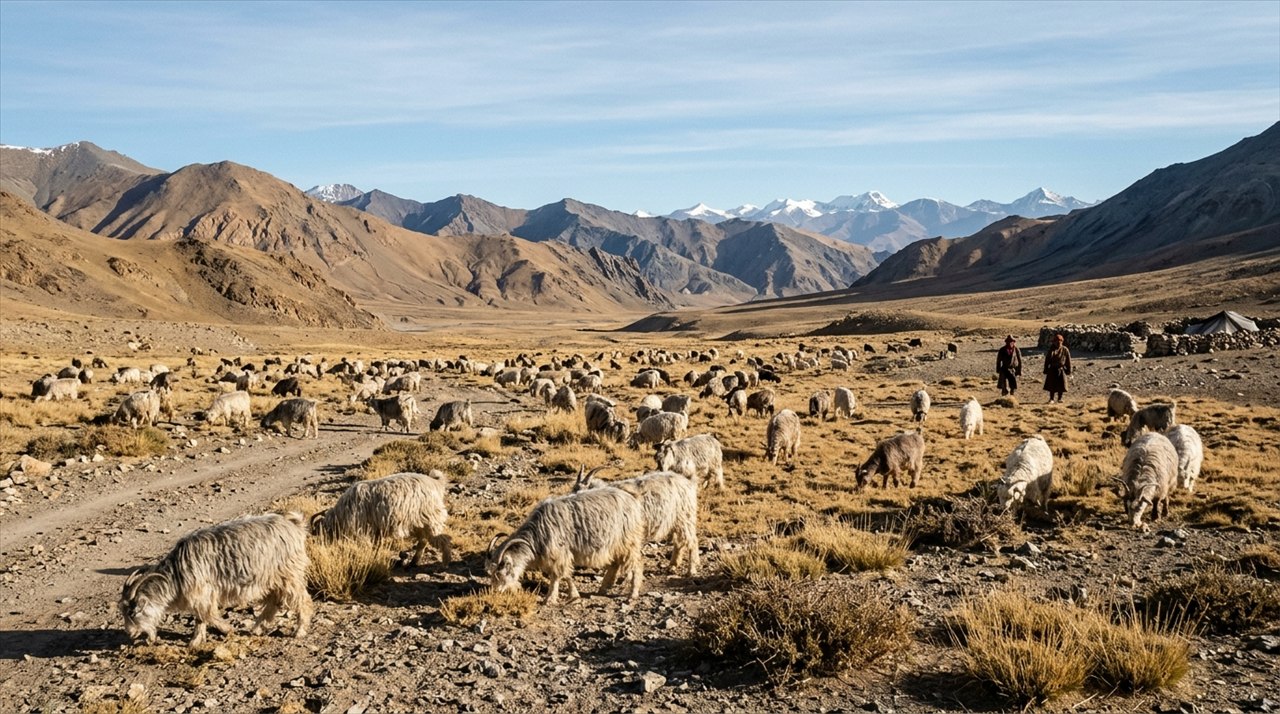
Nor has Changthang ever been a "wilderness" devoid of human thought. For centuries, the nomadic and semi-nomadic Changpa communities of Rupshu, Kharnak, Korzok, Samad Rokchen, Chushul, and Nyoma have inhabited these 4,300-to-5,200-metre basins through one of the planet’s most sophisticated high-altitude transhumant systems. Living in woven yak-hair rebo tents and moving camps eight to twelve times a year under pasture calendars coordinated by customary village councils headed by the goba, Changpa herders matched livestock pressure to micro-topographic phenology: dispersing sheep, yaks, horses, and Changra goats across high, breezy summer valleys as snow receded, while resting sheltered sedge-meadow basins (spang) untouchably through summer so standing cured forage remained banked for lethal January and February blizzards. In doing so, rotational mobility prevented root-mat trampling around summer waterbird nests, recycled dung nutrients into oligotrophic soils, and maintained open movement corridors shared with kiang and bharal.
Out of that biocultural partnership emerged Geographic Indication-recognized Ladakh Pashmina (lena)—the ultra-fine eleven-to-fourteen-micron undercoat grown by the Changra goat solely as physiological insulation against dry Changthang winter cold plunging below minus thirty degrees Celsius. Unlike intensive lowland feedlots, authentic Pashmina depends directly on rangeland ecological integrity: diverse Caragana, Eurotia, and Stipa browse in autumn builds body condition, clean snowmelt streams prevent parasitic load, and reserved Kobresia-Carex turf carries pregnant does through late winter before spring combing.
Over the past six decades, however, externally imposed shocks and market shifts have pushed this delicate non-equilibrium grazing commons toward localized thresholds. Border closures following 1962 ended access to traditional winter pastures across western Tibet and brought displaced pastoral families and flocks onto a compressed land base; subsequent security buffers along eastern frontier valleys further narrowed seasonal flexibility. Simultaneously, rising cash demand for raw Pashmina fibre relative to coarse sheep wool incentivized herders to increase total livestock numbers and shift herd composition steeply toward goats—animals whose sharp hooves and close-cropping bite exert heavier mechanical pressure on slow-growing sedge root mats than mixed yak-sheep-goat herds.
Climate volatility now compounds pasture compression. Warmer early winters followed by sudden wet Westerly snowstorms create khazang—dense ice crusts sealing low sedge turf beneath impenetrable glaze and triggering mass livestock starvation episodes—while erratic summer drought stunts primary forage regrowth and shrinks ephemeral snowmelt springs along migration routes. Meanwhile, out-migration of younger households from areas like Kharnak toward Leh reduces family labour for distant rotational moves, concentrating remaining flocks closer to roadheads and lakeside marshes where winter forage competition with kiang and trampling near waterbird nesting edges intensify unless customary rotational commons receive institutional backing.
Wires, Asphalt, Fences, Dogs, and Artificial Light
Mapping the five compounding vectors of habitat fragmentation across protected areas, Ramsar buffers, and India’s first Dark Sky Reserve at Hanle.
Across Changthang, Hemis, and the Karakoram approaches, ecological degradation rarely arrives as a single catastrophic clear-cut; it accumulates as a lattice of linear barriers and subsidized disturbances. First come widened, high-speed all-weather highways engineered on raised embankments and steep retaining walls without wildlife underpasses—converting gentle Indus urial terraces and Rupshu kiang crossings into roadkill corridors and acoustic barriers. Second comes a proliferation of chain-link, barbed-wire, and concertina fencing erected around departmental plantations, pasture enclosures, solar installations, and security perimeters. Adapted to millions of years without vertical obstacles, galloping kiang, argali, and Tibetan gazelles routinely misjudge wire lines, suffering fatal entanglement or exclusion from wind-cleared winter ridges.
Overhead stretches a third vector: medium-voltage distribution feeders and planned high-voltage renewable-energy evacuation corridors crossing flat basin floors between Pang, Tso Kar, Nyoma, and Leh. Strung across low-visibility mist and dusk flight paths along the Central Asian Flyway, unmarked conductors pose severe collision and electrocution hazards for heavy-bodied black-necked cranes, bar-headed geese, steppe eagles, upland buzzards, and lammergeiers—directly intensifying mortality risks highlighted in the September 2026 report on Ladakh’s 65 high-conservation-concern bird species.
Fourth, and ecologically most insidious at ground level, is Ladakh’s subsidized free-ranging dog crisis. Uncollected food waste from mushrooming tourist tent camps, highway dhabas, homestay clusters, and military or construction kitchens supports high-density packs of feral and semi-owned dogs across 4,500-metre landscapes where winter starvation once precluded domestic canids. Operating in coordinated packs, these dogs outnumber Tibetan wolves, chase down Tibetan gazelles and urial lambs, displace snow leopards from ungulate kills, harass grazing kiang, and systematically plunder ground-nesting colonies at Tso Kar, Tso Moriri, and Hanle. Fifth is artificial light at night (ALAN): unshielded white LED floodlights on camps, towers, and vehicle convoys erode nocturnal predator-prey concealment and threaten the pristine Bortle-1 night sky surrounding Digpa-ratsa Ri (~4,500 m) inside the Hanle Dark Sky Reserve, demonstrating how astronomical preservation and nocturnal cold-desert ecology share an identical stake in darkness.
These five pressures expose critical governance gaps across Domain 14—Protected Areas and Ramsar obligations. While Hemis National Park, Karakoram Wildlife Sanctuary, and Changthang Cold Desert Wildlife Sanctuary encompass vast paper acreage, periodic boundary-rationalisation proposals and project exemptions risk excising valley-floor corridors precisely where biodiversity concentrates, while Tso Moriri and Tso Kar still await enforceable basin-wide hydro-ecological buffer rules matching India’s statutory wise-use commitments under the Ramsar Convention.
Seven Field Experiments and a Trans-Himalayan Restoration Strategy
Moving from reactive mitigation to functional landscape planning through seven original KEW scientific protocols and pastoral co-governance.
Protecting Ladakh’s cold desert without freezing local livelihoods requires replacing piecemeal, project-by-project clearances with a unified Regional Ecosystem Restoration Strategy (Domain 15) grounded in cold-desert biophysics. Its first pillar must be statutory retirement of the "barren wasteland" classification in infrastructure siting: before any mega-solar park, industrial estate, highway alignment, or tourism zone is allotted land, multi-season ecological screening must map permafrost active-layer carbon and microbial crusts, upslope snowmelt recharge fans feeding Ramsar marshes, avian flyway approaches, and wild ungulate winter corridors.
Its second pillar targets physical de-fragmentation and subsidized-predator control. Across Changthang and Indus river terraces, hazardous barbed and chain-link fencing outside essential winter fodder reserves should be systematically dismantled or retrofitted to wildlife-permeable smooth-wire heights, paired with wide-span highway underpasses on mapped urial and kiang trails. Every powerline within ten kilometres of Tso Kar, Tso Moriri, Pangong Tso, Hanle, and Chushul marshes requires undergrounding or high-visibility UV/glow avian flight diverters and raptor-safe insulator spacing. Simultaneously, civil, tourism, and defence authorities must enforce sealed organic-waste containment alongside humane Animal Birth Control–Anti-Rabies (ABC-ARV) campaigns to break the waste-to-dog predation subsidy.
Its third pillar centres Changpa pastoralists and Hanle-Korzok residents as primary ecological stewards rather than conservation adversaries: financing community-managed winter emergency fodder banks against khazang ice-crust disasters, expanding predator-proof livestock corrals, rewarding rotational sedge-meadow rest through premium ecological traceability for Ladakh Pashmina, capping lakeside camp footprints outside Ramsar wet-meadow buffers, and scaling Hanle Dark Sky Reserve warm-spectrum shielded-lighting standards across Changthang.
Because credible policy demands baseline numbers independent of developer consultants, this investigation anchors seven Proposed Original Scientific Experiments inside our companion 45-chapter issue and the KEW Ladakh Cold-Desert Cryosphere & Ecology Observatory—integrating multi-decadal satellite hydro-optics, paired grazing exclosures, eDNA and permafrost soil assays, telemetry-informed circuit modelling, and spatial conflict audits across all fifteen cold-desert domains.
PROPOSED ORIGINAL SCIENTIFIC EXPERIMENTS · LADAKH COLD-DESERT RESEARCH PROGRAMME
Seven Proposed Original Scientific Experiments designed for standardized execution under Ladakh’s Ecological Frontiers and the KEW Ladakh Cold-Desert Cryosphere & Ecology Observatory
| Proposed Original Scientific Experiment | Standardized Field, Remote-Sensing & Analytical Protocol |
|---|---|
| 01 · Historical wetland extent change detection | Multi-sensor time-series analysis (declassified CORONA/Hexagon, Landsat 5–9, Sentinel-1 SAR & Sentinel-2 MSI, 1970s–2026) normalized for seasonal snowmelt timing to quantify open-water expansion/shrinkage and emergent Carex-Kobresia marsh inundation across Tso Moriri, Tso Kar, Pangong Tso, and Hanle. |
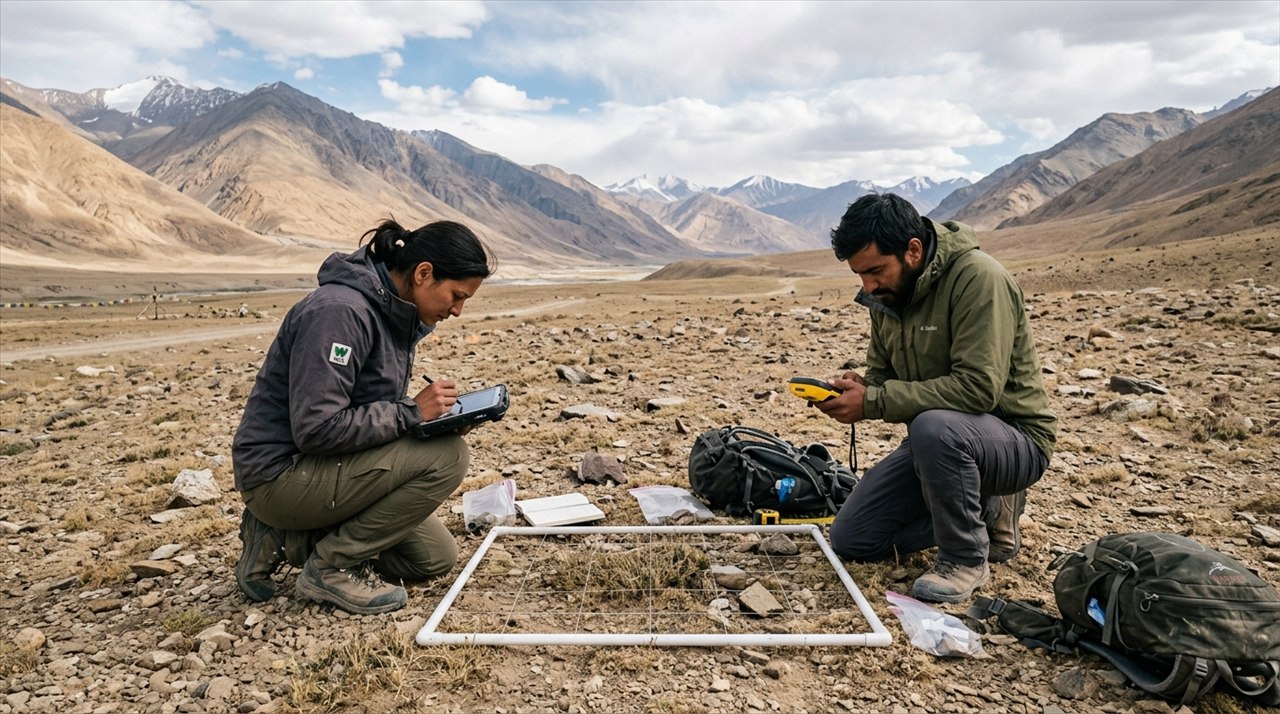
| 02 · Alpine rangeland productivity assessment | Coupled Sentinel-2/PlanetScope phenology indices (NDVI, SAVI & NDWI) calibrated against clipped above- and below-ground biomass quadrats and 2025-type permafrost active-layer soil moisture/microbiome cores across Stipa steppe, Caragana scrub, and spang sedge meadows. |
| 03 · Wildlife habitat suitability modelling | Ensemble species distribution modelling (MaxEnt, Random Forest & hierarchical occupancy) across seasonal elevations for snow leopard, kiang, Tibetan argali, Tibetan gazelle, Ladakh urial, and black-necked crane—with sensitive breeding/denning coordinates strictly masked from public outputs. |
| 04 · Landscape connectivity and fragmentation analysis | Omniscape and Circuitscape resistance-surface modelling across Hemis, Karakoram, Sham, and Changthang quantifying pinch-points where highways, perimeter fencing, solar enclosures, and ribbon settlements constrict carnivore dispersal and ungulate winter migration. |
| 05 · Grazing pressure versus vegetation regeneration assessment | Replicated split-plot livestock-and-wild-ungulate exclosure cages paired with rotational Changpa grazing transects to measure Kobresia turf recovery, root-mat compaction, soil C:N stoichiometry, and forage partitioning under varying Changra goat-to-sheep herd ratios. |
| 06 · Lake water quality and salinity trend analysis | Matched pre-melt and post-monsoon limnological transects across Tso Moriri, Startsapuk Tso–Tso Kar, and Pangong Tso measuring electrical conductivity, major ions, dissolved oxygen, nutrient loading near camp clusters, microplastics, and benthic macroinvertebrate bioindicators. |
| 07 · Infrastructure–biodiversity conflict mapping | Geospatial risk-overlay auditing avian powerline collision zones (prioritizing Ladakh’s 65 high-concern bird species), fence entanglement hotspots, organic-waste dumps subsidizing free-ranging dog packs, off-road meadow rutting, and VIIRS night-light encroachment around the Hanle Dark Sky Reserve. |
Learning to Read Silence Before We Pave It
At dusk between Hanle’s dark-sky dome and Tso Kar’s salt-rimmed sedges, a final reckoning with what lowland eyes call empty.
Stand on the wind-swept gravel shoulder below Digpa-ratsa Ri at Hanle as copper twilight drains behind the Zanskar crest, and the Trans-Himalaya offers no theatrical plea for its own survival. No chainsaw echoes across a falling forest; no black factory plume stains the horizon. Instead, the Milky Way ignites with fierce clarity over darkened astronomical domes, a pair of black-necked cranes bugles once from a reed-fringed braid in the valley floor, and frost crystals tighten silently around soil pores where cold-loving microbes have cycled nitrogen since the Pleistocene.
That quietness has always been Ladakh’s vulnerability. Because its richness hides underground in permafrost microbiomes and deep root mats, concentrates briefly inside narrow sedge ribbons around salt lakes, travels on quiet hooves across gravel saddles, and overhead rides thin air along the Central Asian Flyway, an impatient century keeps mistaking restraint for absence. Sixty-five bird species sliding toward peril, gazelles turning back from wire fences, marshes squeezed between rising glacial water and diesel generators, and ancestral Pashmina pastures locked beneath winter ice crusts are all symptoms of one refusal to look closely.
To govern Ladakh wisely in an age of climate disruption and frontier infrastructure requires retiring forever the colonial word wasteland. The cold desert was never empty. Only our categories were—and there is still just enough unbroken horizon left to rewrite them before asphalt, wire, and floodlight finish their work.
“The cold desert was never empty. Only our categories were—and there is still just enough unbroken horizon left to rewrite them.”
DOCUMENTARY SOURCES & FURTHER READING
| Source | Documentary relevance |
|---|---|
| September 2026 Environmental Assessment Report on Ladakh Avifauna (65 Bird Species of High Conservation Concern) | Documents the environmental assessment reported in September 2026 identifying 65 bird species in Ladakh of high conservation concern due to infrastructure expansion, unregulated tourism, free-ranging dogs around uncollected waste, and climate change. |
| 2025 Peer-Reviewed Metagenomic Study on Microbial Diversity in Changthang Permafrost-Affected Soils (Indexed in PubMed Central / PMC) | Establishes rich prokaryotic, archaeal, and fungal diversity and cold-adapted biogeochemical cycling within Changthang permafrost-affected soils, refuting assumptions that low-vegetation cold-desert regolith is biologically barren. |
| Ramsar Sites Information Service — Tso Moriri (Site No. 1213) & Tso Kar Wetland Complex (Site No. 2443) Official Dossiers | Provides international wetland boundaries, hydrological regimes, salinity gradients, black-necked crane and bar-headed goose breeding baselines, and wise-use conservation obligations for Changthang’s two designated Ramsar complexes. |
| Wildlife Institute of India (WII) & Nature Conservation Foundation (NCF) — Trans-Himalayan Snow Leopard, Wild Ungulate & Free-Ranging Dog Ecological Studies | Synthesizes field ecology on snow leopard landscape connectivity, kiang, argali, Tibetan gazelle, Ladakh urial, bharal, and ibex niche partitioning, and wildlife-dog-livestock interactions across Changthang, Hemis, and Sham. |
| Department of Wildlife Protection, UT of Ladakh & Indian Institute of Astrophysics — Hanle Dark Sky Reserve Notification & Astro-Ecology Guidelines | Documents India’s first Dark Sky Reserve around the Indian Astronomical Observatory at Hanle (Digpa-ratsa Ri) and shielded warm-spectrum artificial-light mitigation protocols. |
| Department of Rural Development / Sheep Husbandry, UT of Ladakh & Geographical Indications Registry — Ladakh Pashmina & Changthang Pastoral Livelihood Records | Provides institutional baselines on Changra goat populations, GI-tagged Ladakh Pashmina production, winter khazang fodder emergencies, and Changpa transhumant rangeland management. |
EDITORIAL PUBLICATION METADATA & 10-STAGE GATE LEDGER
| Gate | Status | Record / Scope |
|---|---|---|
| 01 · Commissioned | completed | Himalayan Dispatch Founding Masthead |
| 02 · Research in progress | completed | Himalayan Dispatch Research & Observatory Desk |
| 03 · Manuscript draft | completed | Assigned Author / Editorial Desk |
| 04 · Evidence verification | completed | Cross-checked against the September 2026 environmental assessment report documenting 65 high-conservation-concern bird species in Ladakh, 2025 peer-reviewed research indexed in PubMed Central (PMC) on microbial diversity in Changthang permafrost-affected soils, Ramsar Secretariat dossiers for Tso Moriri (Site No. 1213) and Tso Kar Wetland Complex (Site No. 2443), Wildlife Institute of India and Nature Conservation Foundation Trans-Himalayan ungulate and snow leopard literature, and Indian Astronomical Observatory Hanle Dark Sky Reserve notifications. |
| 05 · Scientific review (where applicable) | pending | Fifteen-domain cold-desert ecological matrix, permafrost-to-flyway trophic coupling, Changpa rangeland disequilibrium dynamics, and seven Proposed Original Scientific Experiments internally audited; independent external Stage 05 Trans-Himalayan wildlife and rangeland specialist review pending prior to formal release. |
| 06 · Editorial review | completed | Founding Editor-in-Chief Desk Review |
| 07 · Copyright and ethics review | completed | Enforces strict redaction of sensitive nesting and denning GPS coordinates, upholds indigenous Changpa pastoralists’ customary tenure dignity, strips tracking parameters from documentary links, and captions all plates explicitly as illustrative Kashmir EcoWatch Visual Archive references. |
| 08 · Administrator approval | in progress | Staged at Stage 08 (editorial_approval) as Investigation 03 of Special Scientific Issue 'Ladakh's Ecological Frontiers'. |
| 09 · Published | pending | — |
| 10 · Post-publication corrections | not applicable | — |
| Attribute | Final assignment |
|---|---|
| Publication | Himalayan Dispatch |
| Special Issue & Folio Placement | Special Scientific Issue · Ladakh's Ecological Frontiers · Investigation 03 (Paired with Investigations 01, 02, 04 & 05) |
| Rubric & Classification | Ladakh Scientific Investigation III · High-Altitude Wetlands, Wildlife Corridors & Alpine Rangelands |
| Byline | Dr. Fayaz Ahmad Khan & Himalayan Dispatch Ladakh Cryosphere, Cold-Desert Ecology, Carrying Capacity and Geospatial Intelligence Desk |
| Geographic & Altitudinal Scope | Changthang · Hemis · Karakoram · Tso Kar · Tso Moriri · Pangong Tso · Hanle (~2,600 m Indus Urial Terraces to >5,500 m Nival Ridges) |
| Narrative Structure & Reading Duration | Nine-Section Scientific Investigation (Prologue, Chapters I–VII & Epilogue) · Approximately 19 minutes estimated reading duration |
| Core Research Domains Covered | 15 Trans-Himalayan Domains (Cold-Desert Evolution, Biodiversity Inventory, Permafrost Microbiomes, Ramsar Lakes, Central Asian Flyway, Carnivore & Ungulate Corridors, Changpa Pashmina Commons, Fragmentation, Dark Skies & Restoration) |
| Companion Issue & Observatory | Complete 45-Chapter Ladakh's Ecological Frontiers Issue & 12-Module KEW Ladakh Cold-Desert Cryosphere & Ecology Observatory (/earth-human-impact/ladakh-cold-desert-observatory) |
| Interactive Workbench Integration | LadakhEcologicalFrontiersWorkbench (defaultTab="ecological_integrity") mounted beneath Chapter IV |
| Publication Gate Status | Stage 08 · Pre-Release Special Scientific Folio Awaiting Administrator Approval (Sensitive-Species Coordinate Redaction Active) |

Founding Editor-in-Chief
Dr. Fayaz Ahmad Khan
Founder of Kashmir EcoWatch and Founding Editor-in-Chief of Himalayan Dispatch; writes on alpine hydrology, cryospheric thresholds, disaster resilience, and mountain commons across the Western Himalayas.
View Portfolio & Approved Commissions →NEXT IN THIS EDITION · LADAKH SCIENTIFIC INVESTIGATION I · CRYOSPHERE, PERMAFROST & COLD-DESERT WATER SECURITY
When the Glaciers Stop Giving
By Dr. Fayaz Ahmad Khan & Himalayan Dispatch Ladakh Cryosphere, Cold-Desert Ecology, Carrying Capacity and Geospatial Intelligence Desk · 14 min read