Why the Western Himalayas Demand Slow, Fearless Journalism
On founding an independent periodical against disaster-cycle amnesia—and why our inaugural edition prints its own unfinished verification ledger in plain sight.
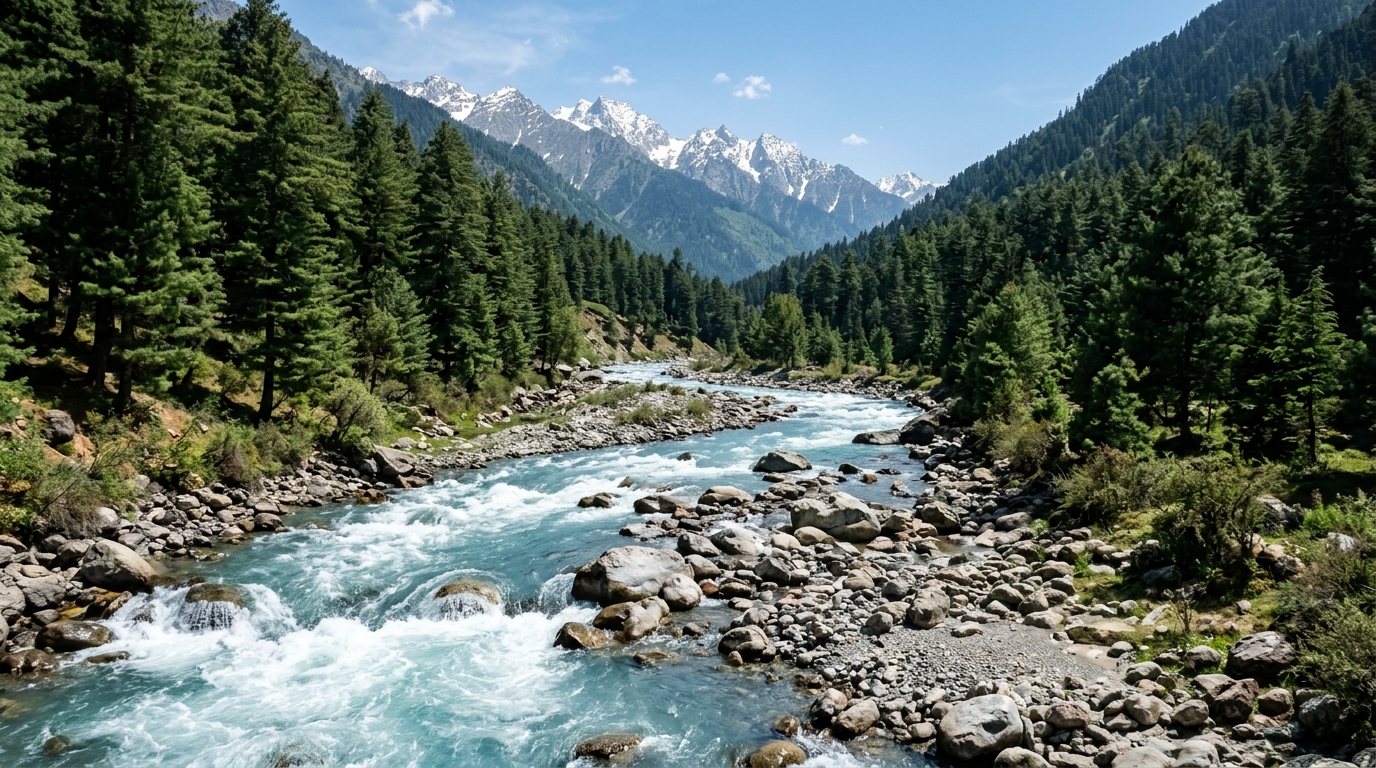
Against Breaking-News Amnesia in a Geological Landscape
Catastrophe headlines arrive for forty-eight hours; the processes that script them unfold silently across decades.
Whenever a monsoon-fed cloudburst severs a highway bench along the Chenab gorge, or murky floodwater rises against embankment stones in Srinagar, cameras arrive for forty-eight hours and depart on the third morning. What breaking news almost never stays to examine are the twenty quiet years that rehearsed the disaster long before the first raindrop fell: the Plio-Pleistocene karewa recharge tableland excavated for fill, the reedbed spill basin narrowed hectare by hectare into consolidated plots, the birch treeline thinned above an avalanche gully, the tributary cobble armor scooped below canal intakes at midnight, and the late-September snowline creeping silently upslope across high cirques.
Himalayan Dispatch was not founded to add one more breathless alert to an already noisy digital feed. As recorded in our founding history, for nearly two years the founder of Kashmir EcoWatch sought consistent space within established media rooms to place empirical observations and uncomfortable ecological questions from the Western Himalayas before the public. Some letters went unanswered; others drew polite assurances that never materialized. Meanwhile, glaciers did not pause their downwasting for editorial convenience, and springsheds did not postpone their drying until a newsroom found column inches. Slow journalism is our institutional answer to that silence: not slow out of complacency, but slow out of fidelity to geological, hydrological, and human complexity.
A mountain basin remembers what daily headlines forget. Groundwater depletion beneath apple-growing tablelands, internal phosphorus recycling on dredged lake beds, micro-climatic warming inside urban heat islands, and the incremental constriction of wildlife corridors between Dachigam, Tral, and the Sindh valley rarely announce themselves on a single Tuesday afternoon. Covering such transformations requires returning to the same gauging staff, forest compartment, and village spring across consecutive seasons—pairing immediate Daily Dispatches with unhurried monthly editions capable of holding four decades of evidence in view at once.
“Environmental degradation does not wait for editorial approval. When silence persisted for two years, building a rigorous public record of our own became a civic duty.”
Watersheds Older Than Administrative Lines
Reading Kashmir, Jammu, Ladakh, AJ&K, Gilgit, and Baltistan as a single living ecological continuum.
On administrative maps, the Western Himalayas are partitioned by contested lines, district gazettes, and separate statutory jurisdictions. On a watershed or atmospheric map, no such partition exists. Meltwater emerging beneath Kolahoi and Verinag joins the Jhelum, breathes through the floodplain sponge of Wular, and plunges through the Uri–Muzaffarabad gorge toward Mangla as one unbroken river system. Glaciers across Ladakh, Baltistan, Zanskar, and Gilgit feed the same Upper Indus lifeline; winter Western Disturbances and boundary-layer black-carbon plumes cross the Pir Panjal without presenting passports; migratory waterbirds descending along the Central Asian Flyway require intact winter reedbeds across the entire valley chain.
Reporting honestly across Kashmir, Jammu, Ladakh, Azad Jammu & Kashmir, Gilgit, and Baltistan demands intellectual courage without geopolitical partisanship. Himalayan Dispatch holds no brief for any government, party, or territorial lobby; we respect the diverse peoples, languages, legal realities, and lived histories of every region we cover while refusing to pretend an ecosystem stops at a checkpoint. Just as importantly, we tell readers the truth about our own institutional footprint: operating from our United States publishing imprint in coordination with established distributed correspondent desks for Kashmir, Jammu, and Ladakh, while transparently marking our AJ&K, Gilgit, and Baltistan bureaus as reporting beats in establishment rather than claiming brick-and-mortar street offices we do not occupy.
That distinction is not hostile to existing journalism; it is an invitation to fellowship across divides. When a moraine lake swells in the Shyok or Warwan headwaters, when a surging glacier blocks a valley road in Hunza, or when seismic fault geometry threatens slopes from Ramban to Muzaffarabad, downstream households share an identical physical vulnerability. Treating the Western Himalayas as an interconnected ecological home allows scientists, correspondents, and citizens across every jurisdiction to compare notes before hazards outrun governance.
Scientific Uncertainty as a Public Trust
Error bars, sensor limits, and model assumptions belong in the story—not hidden behind false certainty.
Popular environmental writing often fears uncertainty, worrying that if a journalist admits a one-sigma vertical margin of ±22 meters or explains why cloud shadow complicates an autumn satellite pass, public urgency will evaporate. We believe the exact opposite. In a region where communities have repeatedly watched overconfident engineering promises collapse against mountain physics, nothing builds durable civic trust faster than intellectual candor.
Paired alongside the scientific observatories of Kashmir EcoWatch yet editorially autonomous in voice, Himalayan Dispatch treats methodological transparency as a literary obligation. When a figure comes from a peer-reviewed field study with a verified DOI, we cite it directly; when a series represents a multi-sensor observatory synthesis awaiting external specialist audit, we label it plainly and publish the underlying CSV so any independent researcher can test our arithmetic. Reporting negative findings, archival discrepancies in forestry memorial rolls, or high-altitude data gaps above four thousand meters is not a weakness of our journalism; it is the reason our journalism can be trusted.
Equally vital, we refuse to sensationalize isolated weather anomalies into apocalyptic clickbait or flatten nuanced ecological trade-offs into morality plays. If mechanical lake dredging restores open-water mirror area in one basin while disturbing benthic macroinvertebrates or leaving upstream catchment siltation unresolved, our pages report both halves of the ledger. Readers in mountain regions live daily inside complex trade-offs between livelihood and conservation; they deserve prose mature enough to tell the whole truth.
Independence, Firewalls, and the Dignity of Sources
Zero extractive underwriting, strict protection for vulnerable witnesses, and unromanticized respect for mountain knowledge.
Editorial fearlessness is impossible if a periodical’s ledger is underwritten by the very interests reshaping the watershed. Himalayan Dispatch accepts zero commercial sponsorship or native advertising from riverbed mining syndicates, unpermitted real-estate ventures, polluting industrial kilns, or partisan political patrons, and enforces an absolute firewall between institutional administration and line-by-line factual conclusions.
That independence exists to protect those who carry the heaviest risk on the ground. Across these mountains, the first person to notice illegal timber felling, nighttime spoil dumping into a trout stream, or unsafe working conditions on a steep forest compartment is rarely a tenured spokesperson—it is a daily-wage forest watcher, a junior site engineer, a boatman, or a seasonal shepherd. Our newsroom protects confidential source records using authenticated AES-256-GCM encryption at rest while recommending out-of-band channels for Tier III whistleblowers, withholds confidential assignments from public previews until safety and right-of-reply obligations are met, and honors vernacular pastoral and agrarian knowledge across Kashmiri, Gojri, Pahari, Dogri, Ladakhi, Balti, and Shina communities without ever romanticizing hardship—or fabricating composite quotes in a living person’s mouth.
At the same time, fearlessness never excuses unfairness. Every investigative inquiry conducted under our masthead is bound by a strict right-of-reply protocol: agencies, contractors, and institutions named in documentary findings receive clear, timely opportunities to respond prior to publication, and their substantive replies are recorded fairly alongside the physical evidence. Accountability journalism draws its moral force from procedural fairness, never ambush.
Himalayan Dispatch permanently prohibits synthetic personas, composite interviewees, and unverified field quotations. Where scholarship is synthesized into Q&A form, it is explicitly labeled as a Constructed Editorial Dialogue.
Visual Honesty, AI Governance, and the Corrections Covenant
Never faking a camera lens, never disguising an illustration as forensic proof, and never burying an honest mistake.
In an era when synthetic imagery can conjure photorealistic blizzards or glacier caves in seconds, an environmental magazine must draw an unmistakable ethical line between decorative illustration and documentary proof. Within our newsroom governance registry, every visual asset undergoes binary metadata inspection for camera EXIF records and C2PA/SynthID provenance containers. We never fabricate focal lengths, shutter speeds, capture dates, or field photographer credits; where thematic illustrations or monochrome visual studies accompany an essay, we never present them as forensic site evidence of a specific person, violation, or martyrdom incident.
The same ethic governs our prose after publication. No newsroom investigating forty-year datasets, fragmented departmental archives, and complex mountain hydrology will be infallible. What separates an accountable institution from propaganda is what happens the hour an error or ambiguity comes to light. Every clarification, empirical update, or factual correction in Himalayan Dispatch is timestamped, signed by our standards desk, appended permanently to the article folio, and indexed in our public Corrections Register without silent deletion.
Readers also possess standing recourse beyond the editors who commissioned a piece. Through our Public Editor and Reader Inquiries gateway, scientists, community members, and affected families may challenge a characterization, submit missing archival records, or petition for an independent standards review—knowing that substantive critiques will be answered on the record rather than buried in an inbox.
Beginning With Self-Accountability: The Ten-Stage Gate
Why Volume 01 / Issue 01 refuses to wear a verification badge it has not yet independently earned.
Turn to the foot of any folio in this inaugural edition and you will find something unconventional: a ten-stage publication gate ledger—tracking every manuscript from Stage 01 (Commissioned) and Stage 04 (Evidence Verification) through Stage 05 (Scientific Review), Stage 07 (Copyright & Ethics Review), Stage 08 (Administrator Approval), Stage 09 (Published), and Stage 10 (Post-Publication Corrections). You will also notice that our pre-release folios sit candidly at Stage 08 rather than displaying an unearned scientific-review seal before external certification is complete.
We built the system that way on purpose. An environmental periodical asking forest departments to reconcile historical sacrifice rolls, asking hydropower planners to respect cryospheric uncertainty, and asking municipal authorities to enforce wetland law must hold itself to an equally unforgiving mirror first. No story in Himalayan Dispatch can display a verified review badge until independent external review records are genuinely logged and completed. We offer Volume 01 to readers in the Himalayas and across the world in that spirit: patient in craft, exact in evidence, open to correction, and committed to ensuring that silence never again becomes the default condition of ecological truth.
If you are a glaciologist with field stakes above four thousand meters, a district reporter walking an incised riverbed, a forest family preserving the memory of a fallen guardian, a photographer working patiently in natural light, or a student testing satellite archives against village testimony, this room was built so you will not have to wait two years for someone to write back. The pages ahead belong to the watershed, and to the truth.
- •Evidence before rhetoric: every quantitative claim traces to primary peer-reviewed literature, statutory filings, or downloadable open datasets with explicit uncertainty bounds.
- •Zero synthetic witness: no invented scholars, composite interviewees, or fabricated camera EXIF metadata may ever appear under the Himalayan Dispatch imprint.
- •Earned verification only: public Stage 05 and fact-check badges unlock strictly upon completed independent review—never by self-certification.
DOCUMENTARY SOURCES & FURTHER READING
| Source | Documentary relevance |
|---|---|
| Our Story — When Silence Became the Reason to Speak | Canonical founding record detailing the two years of unanswered media outreach that led to the establishment of Himalayan Dispatch. |
| Himalayan Dispatch Editorial Charter & Standards | Binding commitments on editorial independence, transboundary ecological scope, right of reply, and conflict-of-interest firewalls. |
| Ethics, Visual Provenance & Governance Architecture | Public documentation of our 10-stage publication gate workflow, visual asset truthfulness rules, and source-protection safeguards. |
| Public Corrections & Clarifications Register | Permanent, non-erasable public ledger of post-publication clarifications, corrections, and archival updates. |
EDITORIAL PUBLICATION METADATA & 10-STAGE GATE LEDGER
| Gate | Status | Record / Scope |
|---|---|---|
| 01 · Commissioned | completed | Himalayan Dispatch Founding Masthead |
| 02 · Research in progress | completed | Himalayan Dispatch Research & Observatory Desk |
| 03 · Manuscript draft | completed | Assigned Author / Editorial Desk |
| 04 · Evidence verification | completed | Founding institutional charter cross-checked against /our-story, /editorial-charter, /ethics-governance, Visual Asset Governance Policy, and the 10-stage HDN gate architecture. |
| 05 · Scientific review (where applicable) | not applicable | Editorial or curatorial essay; empirical citations cross-checked under Stage 04. |
| 06 · Editorial review | completed | Founding Editor-in-Chief Desk Review |
| 07 · Copyright and ethics review | completed | Hero plate verified against hdn-gov-media-09 (Kashmir EcoWatch Visual Archive); zero fabricated field photography metadata or synthetic contributor credits. |
| 08 · Administrator approval | in progress | Pre-release Inaugural Edition closing manifesto awaiting Founding Administrator issue-wide release sign-off. |
| 09 · Published | pending | — |
| 10 · Post-publication corrections | not applicable | — |
| Attribute | Final assignment |
|---|---|
| Document Classification | Founding Editorial Manifesto · Signed by Dr. Fayaz Ahmad Khan for the Masthead |
| Transboundary Reporting Scope | Kashmir, Jammu, Ladakh, AJ&K, Gilgit & Baltistan Watershed & Air-Shed Continuum |
| Stage 05 Applicability | Not Applicable (Editorial Manifesto · Citations Verified Under Stage 04) |
| Publication Gate Status | Stage 08 Pre-Release Folio · Awaiting Founding Administrator Release Sign-Off |

Founding Editor-in-Chief
Dr. Fayaz Ahmad Khan
Founder of Kashmir EcoWatch and Founding Editor-in-Chief of Himalayan Dispatch; writes on alpine hydrology, cryospheric thresholds, disaster resilience, and mountain commons across the Western Himalayas.
View Portfolio & Approved Commissions →NEXT IN THIS EDITION · SPECIAL EDITORIAL INVESTIGATION · POLITICAL ECONOMY OF MEDIA · JOURNALISTIC INDEPENDENCE · SCIENTIFIC LITERACY · MEDIA OWNERSHIP · INVESTIGATIVE ACCOUNTABILITY · PUBLIC INTEREST
Journalism at a Crossroads
By Dr. Fayaz Ahmad Khan & Himalayan Dispatch Editorial Independence, Media Political Economy, Scientific Communication and Investigative Journalism Desk · 49 min read