Calm November High-Pressure Ridges Trigger Sharp Evening PM2.5 Spikes Across the Srinagar Bowl
In the absence of early wet western disturbances, nocturnal radiative cooling caps valley air below 300 meters—turning biomass smoke, kiln plumes, and commuter exhaust into a dense dusk lid.
BY Himalayan Dispatch · Data & Cartography Desk
EDITORIAL & SYNTHESIS DISCLOSURE
Inaugural Editorial Desk & Observatory Synthesis: Compiled from Kashmir EcoWatch diurnal particulate baselines and published boundary-layer meteorology literature.
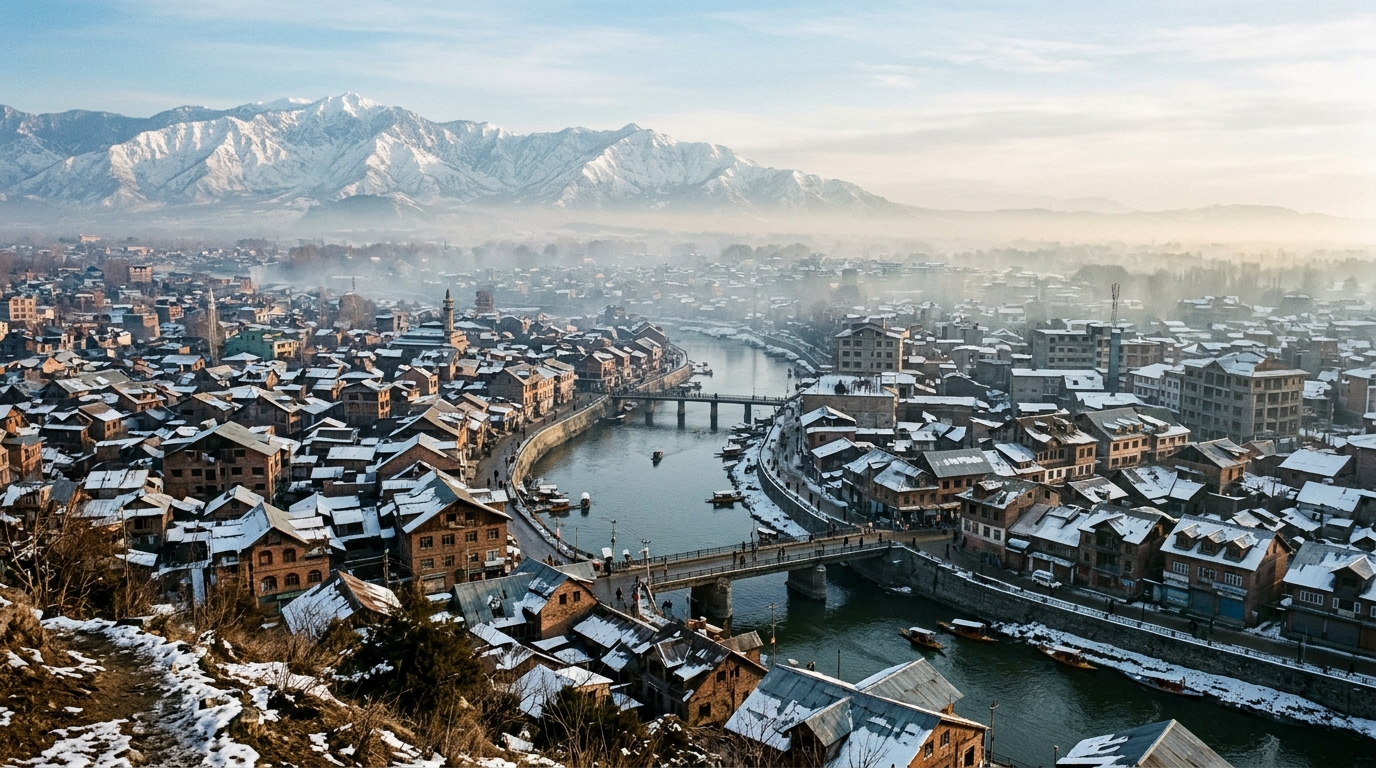
Every clear November evening in the Kashmir Valley performs a textbook demonstration of mountain boundary-layer physics. As soon as sunset drains warmth from the valley floor, cold air slides down the surrounding Pir Panjal and Zabarwan slopes, pooling beneath a warmer layer aloft like a glass lid over a bowl.
Beneath that lid, emissions that might disperse across a flat plain—twig and leaf burning in orchards, domestic heating stoves, diesel freight bottlenecks, and construction dust—accumulate within a shallow breathing zone barely two to three hundred meters deep.
Diurnal station traces reviewed by Himalayan Dispatch’s Data Desk show afternoon air quality briefly appearing moderate during peak solar mixing, only to deteriorate steeply within ninety minutes of dusk—underscoring why 24-hour averages often mask acute evening respiratory exposure.
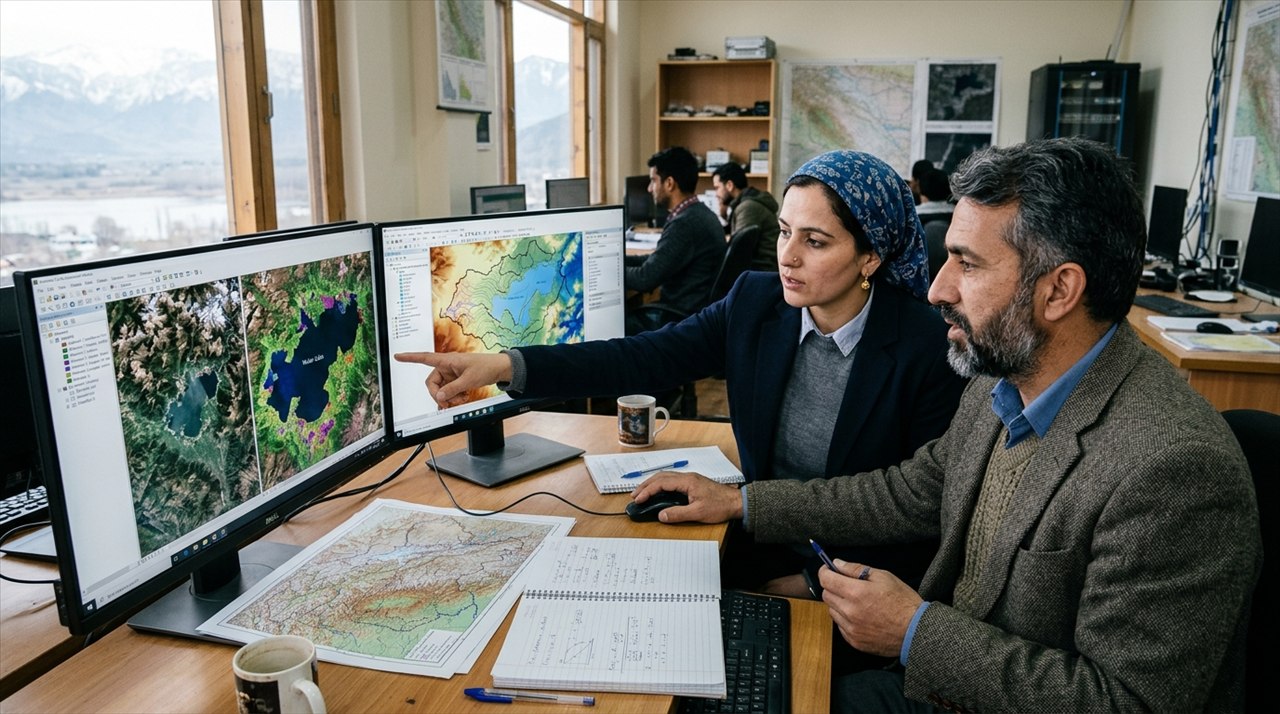
Earth Observation, Cryosphere & Statistical Graphics Desk
Himalayan Dispatch · Data & Cartography Desk
Translates multi-decadal satellite Earth observation, elevation-band hypsometry, and peer-reviewed cryospheric datasets into reproducible visual essays.
RECENT DAILY DISPATCHES