Executive Scientific Synthesis & Agro-Chemical Context
Multi-Compartment Fate Modelling, Spray-Drift Physics, Soil-Water Residue Pathways, Occupational Neuro-Toxicological Risk, and IPM Substitution in Kashmir Apple Orchards
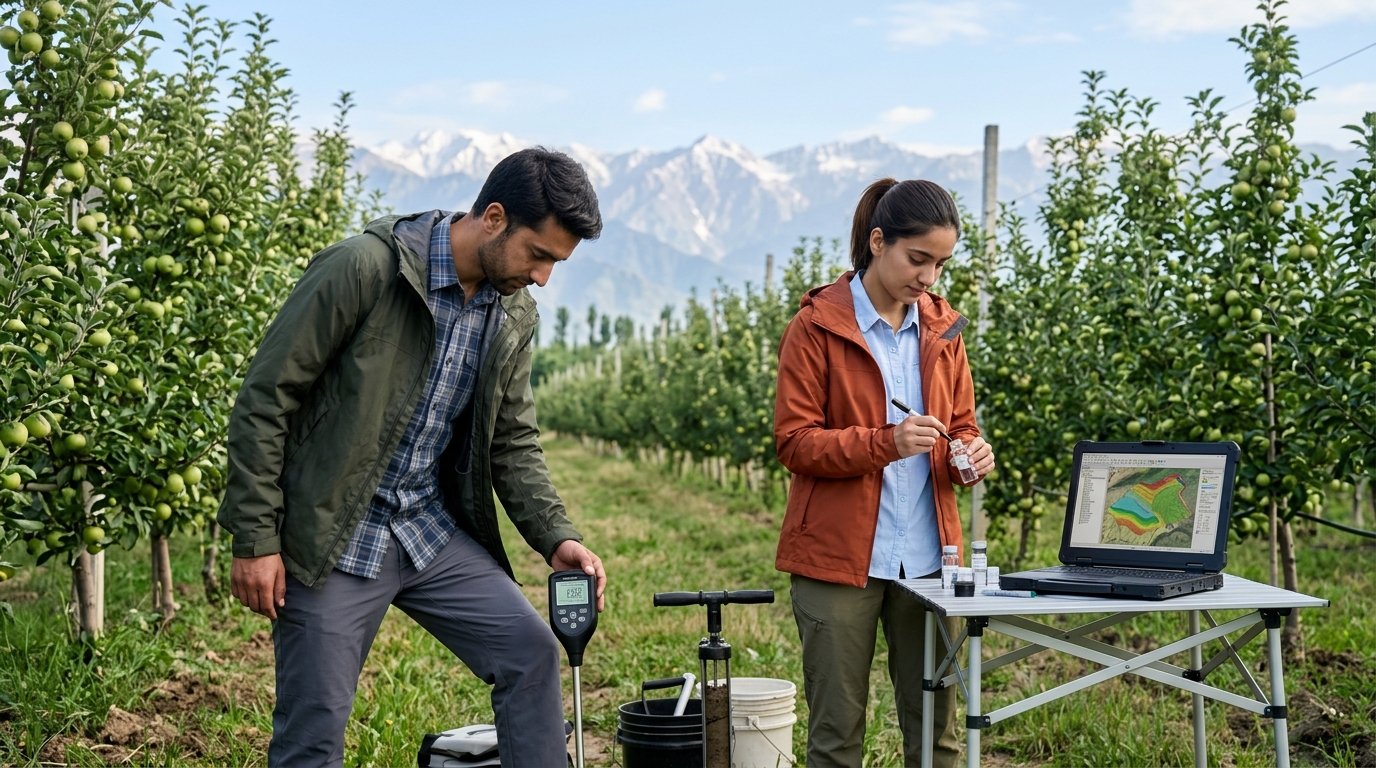
Kashmir Valley produces roughly 75% of India’s temperate apple harvest across an orchard footprint exceeding 165,000 hectares, concentrated heavily along the Pleistocene Karewa plateaus of Shopian, Pulwama, Kulgam, and Budgam and the alluvial-lacustrine plains of Baramulla and Sopore . Over the past two decades, warming spring minimum temperatures, unseasonal April-May convective hail and rain episodes, and dense monocultural stands of scab-susceptible Red Delicious cultivars have driven a marked intensification of prophylactic agrochemical applications, rising from 7--9 sprays per season in the early 2000s to 12--16 foliar applications in intensive commercial blocks [2, 7].
This chemical regime introduces thousands of metric tonnes of formulated dithiocarbamate fungicides (mancozeb, propineb, zineb), sterol-demethylation-inhibiting triazoles (difenoconazole, hexaconazole, myclobutanil), multi-site contact fungicides (captan, dodine), organophosphate insecticides (chlorpyrifos, dimethoate), neonicotinoids (imidacloprid, thiacloprid), and synthetic acaricides annually into a topographically enclosed mountain basin [1, 7]. Because orchards directly abut snowmelt-fed gravel-bed streams, village homesteads, and apicultural foraging corridors, off-target spray drift and surface wash-off create tightly coupled ecotoxicological and public-health externalities [1, 3, 6].