
Kashmir EcoWatch
Dr. Kumar's Kashmir EcoWatchGLOBAL INSTITUTE FOR ADVANCED ENVIRONMENTAL STUDIES
Himalayan Dispatch
Environmental Awareness, Education, Participation & Action

KEW Western Himalayan
Student Action Hub

Environmental Awareness, Education, Participation & Action — uniting Kashmir EcoWatch's official Environmental Calendar of UN and regional observances with the Outdoor Classroom curriculum, practical fieldwork guides, and empirical student project topics across Jammu, Kashmir & Ladakh.

Student Field Observance
February 2
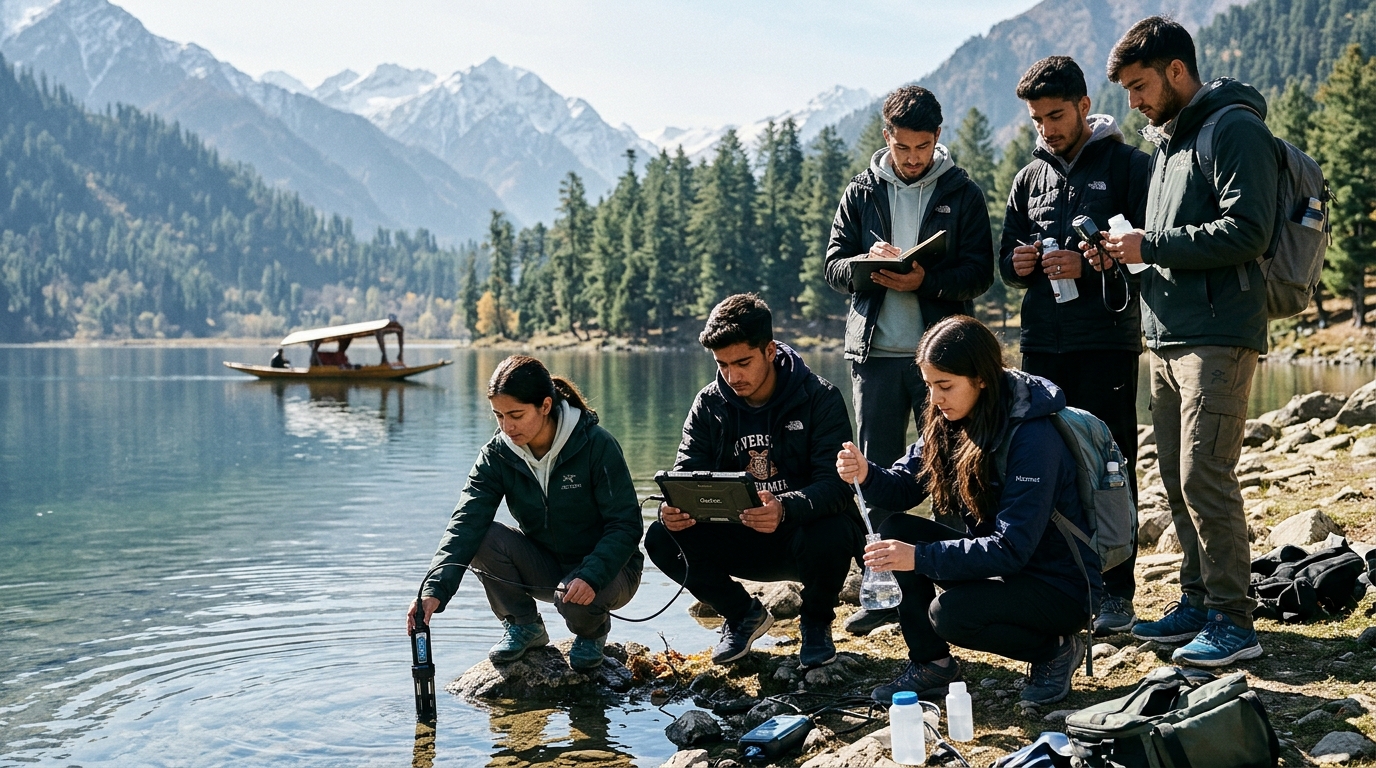
World Wetlands Day

World Wetlands Day

Ramsar Observance

Migratory waterfowl census, student water telemetry & wetland audits

Hokersar & Wular BasinsOutdoor Lab
Dec11
Next Upcoming ObservanceClimate & Atmosphere

International Mountain Day

Himalayan Ridge Ecology, High-Altitude Cryosphere & Mountain Communities

ANNUAL OBSERVANCES
16

Official UN, national & regional dates

STUDENT PROJECT TOPICS
60+

Empirical field & classroom exercises

STUDENT ENGAGEMENT
Valley-Wide

School & college youth participating

OUTDOOR CLASSROOM
4 Pillars

Tours, labs, surveys & local wisdom

Month:
Level:
Environmental Calendar

Observance Timeline & Student Action Guides

Showing 17 of 17 environmental dates

Jan14–30
Biodiversity & WildlifeGovernment of India (MoEFCC / DST / AWBI)

Animal Welfare Fortnight

Official Date: January 14–30 (Annual Date Range)Official Observance — Regional Historical Claim Pending Documentation

Compassion, Winter Habitat Care & Native Himalayan Fauna Protection

Dedicated two-week national campaign instituted by the Animal Welfare Board of India (AWBI). In the Western Himalayas, it highlights compassionate coexistence, anti-poaching vigilance, and humane winter assistance for birds and working animals stranded during sub-zero Chillai Kalan freezes.

Kashmir Ecological Relevance:Humane winter assistance during Chillai Kalan freezes, migratory bird protection, feral animal welfare in snowbound districts, and equine health.
Historical Context (ESRO / eIEN Kashmir):Documentation Pending

Formally recorded in organizational accounts as observed by the Council for Wildlife Protection & Research (CWPR / ESRO) since 2004, prioritizing winter feeding buffer zones in lower Dachigam. [Historical claim, documentation pending archival verification].

Record: Historical claim; 2004–2007 CWPR activity logs pending primary archival indexing.Authority Reference
Mammals Intelligence
Feb2
Water & WetlandsUnited Nations (UN GA)

World Wetlands Day

Official Date: February 2 (Fixed Calendar Date)Verified International Observance

Ramsar Wetland Stewardship & Migratory Waterfowl Basins

Commemorates the 1971 Ramsar Convention on Wetlands (endorsed by UN GA Resolution 75/317). In Kashmir, it honors the officially designated Ramsar sites: Hokersar Wetland Reserve (1,354 hectares / 13.54 km² under Ramsar Information Sheet RIS #1570, with seasonal high-water inundation historically reaching up to 13.75 km²), Wular Lake (18,900 ha), Shallabugh, and Hygam, which sustain millions of migratory waterfowl along the Central Asian Flyway.

Kashmir Ecological Relevance:Hokersar (Ramsar Site #1570, 1,354 ha), Wular (18,900 ha), Shallabugh, and Hygam reserves sustaining millions of Central Asian Flyway waterfowl.
Historical Context (ESRO / eIEN Kashmir):Documented Archive

A cornerstone annual event in Kashmir environmental education since 2002. ESRO and local universities conducted annual waterbird censuses and wetland health audits. [Field reports pending unified archival cataloging].

Record: Annual waterbird censuses documented in university and wildlife department records; early ESRO audit reports pending archival compilation.Authority Reference
Wetlands Intelligence
Feb28
Civic & Disaster PreparednessGovernment of India (MoEFCC / DST / AWBI)

National Science Day

Official Date: February 28 (Fixed Calendar Date)Verified National Observance

Empirical Ecological Inquiry, Climate Science & Remote Sensing

Designated by the Government of India in 1986 to commemorate the discovery of the Raman Effect by Sir C.V. Raman. In Kashmir, it focuses student inquiry on Western Himalayan environmental physics, hydrology, satellite remote sensing, and cryosphere sciences.

Kashmir Ecological Relevance:Himalayan cryospheric science, automated weather station networks, glacier ablation telemetry, and environmental chemistry.
Historical Context (ESRO / eIEN Kashmir):Documented Archive

Promoted by eIEN Kashmir Environmental Information System (EIS) to bridge empirical laboratory instrumentation with high-school student science fairs. [Science outreach archives indexed].

Record: Documented in Indian Department of Science and Technology records since 1986; eIEN Kashmir science fair archives indexed.Authority Reference
Research Library & Science
Mar21
Forests & HeritageUnited Nations (UN GA)

International Day of Forests

Official Date: March 21 (Fixed Calendar Date)Verified International Observance

Temperate Conifers, Subalpine Birch & Ridge Stability

Officially proclaimed as the International Day of Forests by the UN General Assembly in 2012 (Resolution 67/200; historically observed as World Forestry Day by FAO since 1971). Celebrates the temperate coniferous belts of Deodar (*Cedrus deodara*), Kail (*Pinus wallichiana*), Fir (*Abies pindrow*), and Birch (*Betula utilis*) that protect fragile Himalayan watersheds from severe erosion.

Kashmir Ecological Relevance:Temperate coniferous belts of Deodar (*Cedrus deodara*), Kail (*Pinus wallichiana*), Fir (*Abies pindrow*), and Birch (*Betula utilis*) stabilizing mountain slopes.
Historical Context (ESRO / eIEN Kashmir):Documented Archive

Organized under the Council for Forest Protection & Research (CFPR / ESRO) with school-led seed-ball dispersal along degraded Pir Panjal slopes. [Historical claim, documentation pending archival verification].

Record: UN General Assembly Resolution 67/200; CFPR / ESRO seed-ball distribution claims pending register verification.Authority Reference
Forest Ecosystems
Mar22
Water & WetlandsUnited Nations (UN GA)

World Water Day

Official Date: March 22 (Fixed Calendar Date)Verified International Observance

Springsheds, Glacial Runoff & Jhelum River Basin Health

Established by UN General Assembly Resolution 47/193 in 1993. Highlights the critical freshwater security of the Kashmir Valley. The River Jhelum basin is fed by precipitation, seasonal snowmelt, Greater Himalayan and Pir Panjal glaciers (including the Kolahoi glacier system), and thousands of perennial karst groundwater springs (*Naags*). Trans-Himalayan ranges like the Karakoram drain northward and eastward into the Indus and Shyok systems, rather than directly into the Kashmir Valley's Jhelum basin.

Kashmir Ecological Relevance:River Jhelum basin hydrology, seasonal snowmelt, Greater Himalayan/Pir Panjal glacial replenishment (Kolahoi basin), and karst spring recharge.
Historical Context (ESRO / eIEN Kashmir):Documented Archive

Core annual fixture in eIEN Kashmir and ESRO programs, including a reported survey of 150+ historic springs in Anantnag, Pulwama, and Srinagar between 2005 and 2007. [Historical claim, documentation pending archival verification].

Record: UN GA Resolution 47/193; 2005–2007 audit of 150+ historic springs cited in eIEN bulletins pending primary dataset publication.Authority Reference
Springs & Aquifers
Apr18
Forests & HeritageICOMOS & UNESCO

International Day for Monuments and Sites (World Heritage Day)

Official Date: April 18 (Fixed Calendar Date)Verified International Observance

Heritage Chinar Trees (Booni), Karst Springs & Cultural Ecology

Proposed by the International Council on Monuments and Sites (ICOMOS) in 1982 and approved by the UNESCO General Conference in 1983. In Kashmir, it honors living bio-cultural heritage: centuries-old Oriental Plane (*Platanus orientalis* / *Booni*) trees planted during Sultanate and Mughal eras, sacred karst springs, historic Mughal water channels, and vernacular wooden architecture.

Kashmir Ecological Relevance:Living bio-cultural heritage: centuries-old Oriental Plane (*Platanus orientalis* / *Booni*) trees, historic spring sanctums, and water architecture.
Historical Context (ESRO / eIEN Kashmir):Documented Archive

Marked the anniversary of the Chinar Conservation Network (CCN / ESRO) 2006 census of heritage trees and preservation advocacy against illicit felling. [Historical claim, documentation pending archival verification].

Record: Approved by UNESCO 22nd General Conference (1983) upon ICOMOS 1982 proposal; CCN Chinar census registers pending archival digitization.Authority Reference
Heritage & Reserves
Apr22
Civic & Disaster PreparednessUnited Nations (UN GA)

Earth Day / International Mother Earth Day

Official Date: April 22 (Fixed Calendar Date)Verified International Observance

Valley-Wide Cleanups, Zero-Waste Living & Planet vs. Plastics

Originating in 1970 and formally designated by the United Nations General Assembly in 2009 as International Mother Earth Day (Resolution 63/278). In Kashmir, it mobilizes hundreds of educational institutions to combat single-use non-biodegradable plastics and restore communal slopes.

Kashmir Ecological Relevance:Valley-wide anti-polythene student mobilization, riverbank cleanups, and waste audits in sensitive tourist hill stations.
Historical Context (ESRO / eIEN Kashmir):Documented Archive

Spearheaded by ESRO since 2003 with student rallies in Lal Chowk and Dal Lake shikara cleanup flotillas. [Archived press clippings indexed; full photographic register pending digitization].

Record: UN GA Resolution 63/278 designating International Mother Earth Day; contemporary local press coverage of ESRO 2003 student rallies.Authority Reference
Waste Monitoring
May22
Biodiversity & WildlifeUnited Nations (UN GA)

International Day for Biological Diversity

Official Date: May 22 (Fixed Calendar Date)Verified International Observance

Endemic Species, Ethnobotany & Spring Montane Awakening

Officially designated by the United Nations General Assembly on May 22 (Resolution 55/201) to commemorate the adoption of the agreed text of the Convention on Biological Diversity (Nairobi, 22 May 1992). In Kashmir, late May marks peak spring emergence, montane wildflowers, and alpine ecosystem revitalization across Pir Panjal slopes.

Kashmir Ecological Relevance:Over 120 endemic medicinal plant taxa (*Saussurea*, *Arnebia*), Hangul deer calving season, and Palearctic-Oriental transition biodiversity.
Historical Context (ESRO / eIEN Kashmir):Documented Archive

Annual benchmark for eIEN Kashmir Biodiversity Conservation Network (BCN) publications and student biodiversity report cards. [Biodiversity working papers indexed].

Record: UN GA Resolution 55/201 commemorating adoption of the text of the Convention on Biological Diversity (22 May 1992); eIEN BCN dossiers.Authority Reference
Priority Biodiversity
Jun5
Civic & Disaster PreparednessUnited Nations (UN GA)

World Environment Day

Official Date: June 5 (Fixed Calendar Date)Verified International Observance

The Apex UN Environmental Observance Across All School Hubs

Established by the UN General Assembly in 1972 on the first day of the Stockholm Conference on the Human Environment (Resolution 2994 (XXVII)). The premier global platform for public outreach, celebrated universally across educational institutes in Jammu & Kashmir in partnership with academic and governmental bodies.

Kashmir Ecological Relevance:Valley-wide school environmental summits, eco-club awards, and baseline state-of-environment evaluations.
Historical Context (ESRO / eIEN Kashmir):Documented Archive

Celebrated annually by ESRO, universities, and schools with Valley-wide environmental conclaves, awards for eco-clubs, and annual state-of-environment reporting. [Student awards registers archived].

Record: UN GA Resolution 2994 (XXVII) of 1972 (Stockholm Conference opening day); university and school event registers documented.Authority Reference
NGO Impact & Action
Jun17
Forests & HeritageUnited Nations (UN GA)

Desertification and Drought Day

Official Date: June 17 (Fixed Calendar Date)Verified International Observance

Karewa Terraces Protection, Soil Erosion & Watershed Stabilization

Proclaimed by the UN General Assembly in 1994 (Resolution 49/115) to mark the adoption of the UN Convention to Combat Desertification (UNCCD). Focuses on soil conservation and the protection of Kashmir's ancient Pleistocene Karewa (*Wudur*) plateaus from destructive clay excavation and uncontrolled topsoil loss.

Kashmir Ecological Relevance:Protection of ancient Pleistocene Karewa (*Wudur*) plateaus from clay excavation, soil erosion, and saffron land conversion.
Historical Context (ESRO / eIEN Kashmir):Documented Archive

Championed in the ESRO 2007 State Environmental Impact Assessment report to highlight karewa destruction in Budgam and Pulwama for construction fill. [Historical claim, documentation pending archival verification].

Record: UN GA Resolution 49/115 of 1994; ESRO 2007 State Environmental Impact Assessment report pending document indexing.Authority Reference
Landslide & Soil Risk
Jul1–7
Forests & HeritageGovernment of India (MoEFCC / DST / AWBI)

Van Mahotsav Week

Official Date: July 1–7 (Annual Date Range)Official Observance — Regional Historical Claim Pending Documentation

Annual Tree Planting Festival & Indigenous Sapling Aftercare

India's national tree-planting festival, initiated in July 1950 by Union Minister K.M. Munshi. In temperate Kashmir, while early July affords school participation before summer vacations, high summer temperatures and moisture deficits mean sapling survival depends strictly on species choice, elevation, soil moisture, and post-planting aftercare. Student activities emphasize aftercare survival audits and autumn/spring dormant planting windows rather than raw planting counts alone.

Kashmir Ecological Relevance:Temperate Western Himalayan tree planting; emphasizes aftercare survival over raw sapling totals; cautions against summer planting without irrigation.
Historical Context (ESRO / eIEN Kashmir):Documentation Pending

Core fixture of school eco-club calendars in Kashmir; reported 20,000+ saplings planted by youth between 2003 and 2007. [Historical claim, documentation pending archival verification].

Record: Initiated nationally in 1950 by K.M. Munshi; claimed 20,000+ sapling plantings by ESRO (2003–2007) pending register verification.Authority Reference
Plants & Flora Directory
Jul11
Civic & Disaster PreparednessUnited Nations (UN GA)

World Population Day

Official Date: July 11 (Fixed Calendar Date)Verified International Observance

Carrying Capacity, Ecological Footprints & Urban Valley Sprawl

Established by the Governing Council of the UNDP in 1989 (and reaffirmed by UN GA Resolution 45/216). Examines the pressure of expanding human settlement, tourism inflows, and infrastructure urbanization on the fragile and finite valley ecosystem of Kashmir.

Kashmir Ecological Relevance:Ecological carrying capacity in sensitive alpine resorts (Gulmarg, Pahalgam, Sonamarg) and urban valley sprawl encroaching onto paddy land.
Historical Context (ESRO / eIEN Kashmir):Documented Archive

Featured in eIEN Kashmir research papers analyzing carrying capacity of hill resorts like Gulmarg and Pahalgam during peak tourist seasons. [Academic working papers cited].

Record: UN GA Resolution 45/216 of 1990; eIEN Kashmir carrying-capacity research papers archived.Authority Reference
Environmental Stress
Sep16
Climate & AtmosphereUnited Nations (UN GA)

World Ozone Day (International Day for the Preservation of the Ozone Layer)

Official Date: September 16 (Fixed Calendar Date)Verified International Observance

Atmospheric Physics, UV Protection in High Altitudes & Montreal Protocol

Designated by the UN General Assembly in 1994 (Resolution 49/114) to commemorate the signing of the Montreal Protocol on Substances that Deplete the Ozone Layer (1987). Atmospheric physics establishes that solar ultraviolet (UV) irradiance increases by approximately 10% to 12% per 1,000 meters of elevation under clear-sky conditions (Blumthaler et al., 1997; WHO/WMO). Consequently, high-altitude Western Himalayan elevations (2,500m to 3,500m, such as Gulmarg and Sonamarg) experience 20% to 30% higher UV-B flux compared to sea-level baselines, intensifying the need for atmospheric ozone layer monitoring and sun safety education.

Kashmir Ecological Relevance:Stratospheric ozone monitoring and UV elevation gradient (+10% to 12% per 1,000m) affecting high-altitude Himalayan human health.
Historical Context (ESRO / eIEN Kashmir):Documented Archive

Covered by Climate Action Network Kashmir (CANK / ESRO) in scientific briefings on solar radiation indices in Ladakh and Kashmir. [Atmospheric data papers archived].

Record: UN GA Resolution 49/114 of 1994; CANK solar irradiance briefings archived.Authority Reference
Air & Atmosphere
Oct2–8
Biodiversity & WildlifeGovernment of India (MoEFCC / DST / AWBI)

National Wildlife Week

Official Date: October 2–8 (Annual Date Range)Official Observance — Regional Historical Claim Pending Documentation

Kashmir Hangul Rut, Endangered Western Tragopan & Camera Trapping

Celebrated across India annually from October 2 to 8 (instituted by the National Board for Wildlife). In Kashmir, this window coincides with the peak autumn rutting and roar season of the critically endangered Kashmir Stag (Hangul, *Cervus hanglu hanglu*, IUCN Red List Critically Endangered, assessed 2017) in Dachigam National Park, Overa-Aru, and the Shikargah conservation corridor.

Kashmir Ecological Relevance:Autumn roar and rutting season of Kashmir Stag or Hangul (*Cervus hanglu hanglu*, IUCN Critically Endangered, assessed 2017) in Dachigam.
Historical Context (ESRO / eIEN Kashmir):Documentation Pending

Premier wildlife milestone established by ESRO / CWPR in 2004, including the famous Dachigam Hangul Call student excursions and conservation pledge ceremonies. [Historical claim, documentation pending archival verification].

Record: Government of India Wildlife Week notifications; ESRO Dachigam student excursion records pending archival verification.Authority Reference
Dachigam & Wildlife
Oct5
Civic & Disaster PreparednessUnited Nations (UN GA)

World Habitat Day

Official Date: First Monday in October (October 5, 2026) (First Monday in October (Dynamic))Verified International Observance

Sustainable Mountain Towns, Vernacular Architecture & Urban Wetlands

Designated by the United Nations General Assembly in 1985 (Resolution 40/202 A) to be observed on the first Monday of October (October 5 in 2026; October 4 in 2027). Reflects on the state of our towns and cities, advocating for eco-sensitive mountain urbanism, preservation of vernacular timber *Dhajji Dewari* structures, and urban lake protection in Srinagar and district towns.

Kashmir Ecological Relevance:Sustainable mountain urbanism, traditional earthquake-resistant *Dhajji Dewari* / *Taq* timber architecture, and urban wetland sponge preservation.
Historical Context (ESRO / eIEN Kashmir):Documented Archive

Examined in ESRO sustainable settlements documentation highlighting sewage encroachment into Dal and Anchar lakes. [Urban planning working papers cited].

Record: UN GA Resolution 40/202 A of 1985; eIEN Kashmir urban lake encroachment working papers.Authority Reference
Lakes & Urban Waters
Oct13
Civic & Disaster PreparednessUnited Nations (UN GA)

International Day for Disaster Risk Reduction

Official Date: October 13 (Fixed Calendar Date)Verified International Observance

Earthquake Drills, Flash Flood Preparedness & Multi-Hazard Resilience

Designated by the United Nations General Assembly on October 13 (Resolution 64/200; UNDRR) to promote a global culture of risk awareness and disaster reduction. In Kashmir, situated in Seismic Zone V and vulnerable to catastrophic flash flooding (as seen in the historic September 2014 deluge) and high-altitude avalanches, this day focuses on student emergency drills, multi-hazard risk mapping, and community early warning systems.

Kashmir Ecological Relevance:Seismic Zone V earthquake preparedness, Jhelum River flash flood modeling, winter snow avalanche safety, and community drills.
Historical Context (ESRO / eIEN Kashmir):Documented Archive

Formulated following the catastrophic October 2005 Muzaffarabad-Kashmir earthquake, when ESRO launched disaster safety modules in schools. [Historical claim, documentation pending archival verification]. (October 2 remains recognized internally as a local community preparedness campaign date, while October 13 is the official UN observance).

Record: UN GA Resolution 64/200; replaces earlier unverified October 2 listing. Regional ESRO post-2005 earthquake school safety modules noted.Authority Reference
Hazard Intelligence
Dec11
Climate & AtmosphereUnited Nations (UN GA)

International Mountain Day

Official Date: December 11 (Fixed Calendar Date)Verified International Observance

Himalayan Ridge Ecology, High-Altitude Cryosphere & Mountain Communities

Proclaimed by the United Nations General Assembly in December 2002 (Resolution 57/245) with annual observances commencing in 2003, International Mountain Day highlights the vital importance of mountains for freshwater, clean energy, food, and biodiversity. For Kashmir, nestled in the Western Himalayas, it honors the Pir Panjal and Great Himalayan ranges that govern regional climate and sustain valley life.

Kashmir Ecological Relevance:Pir Panjal and Great Himalayan ridge ecology, high-altitude permafrost, winter snow accumulation, and transhumant pastoralist routes.
Historical Context (ESRO / eIEN Kashmir):Documented Archive

A central milestone for ESRO mountain education programs, focusing on subalpine snow cover, avalanche risk mapping, and transhumant pastoralist cultural heritage. [High-altitude trek logs archived].

Record: Designated by UN GA Resolution 57/245 in December 2002, observed annually since 2003 (FAO lead); high-altitude student trek logs archived.Authority Reference
Cryosphere Observatory
EXPANDED PEDAGOGICAL FRAMEWORK • ESRO / eIEN KASHMIR REVIVAL

Outdoor Classroom (OD)Western Himalayan Field Science Program

Pioneered by the Environment and Service Research Organization (ESRO) and eIEN Kashmir (2002–2006) and revived in 2026 as a complete 8-stage experiential learning lifecycle. Connecting school and college science curricula with empirical wetland audits, forest biodiversity transects, and digital competency certification.

Curriculum & Coursework Support

Assisting students in high schools and undergraduate colleges with empirical field data collection, scientific project methodologies, and coursework compilation.

Eco-Park & Protected Area Study Tours

Structured educational excursions to Dachigam, Overa-Aru, Gulmarg, Hokersar, and agricultural research stations designed to build practical conservation skills.

Real-World Laboratory Diagnostics

Hands-on water chemistry testing (pH, dissolved oxygen, turbidity), tree girth measurements, and GPS coordinates mapping.

Intergenerational Ecological Stewardship

Connecting traditional oral ecological wisdom from village elders with modern conservation science and digital sensor monitoring.

Are You a School Principal, Teacher, or Student Eco-Club Leader?

Connect your classroom with Kashmir EcoWatch live spatial layers, request student field kit checklists, or schedule an educational study tour to Kashmir's protected wetlands and parks.