Executive Synthesis: The Topsoil-Combustion-Construction Trilemma
Material Flow Accounting of Karewa and Alluvial Topsoil Stripping, Fixed-Chimney Bull’s Trench Versus Induced-Draught Zig-Zag Combustion Emissions, Peri-Kiln Phyto-Soil Degradation, and Low-Carbon Masonry Alternatives Across Budgam and South Kashmir
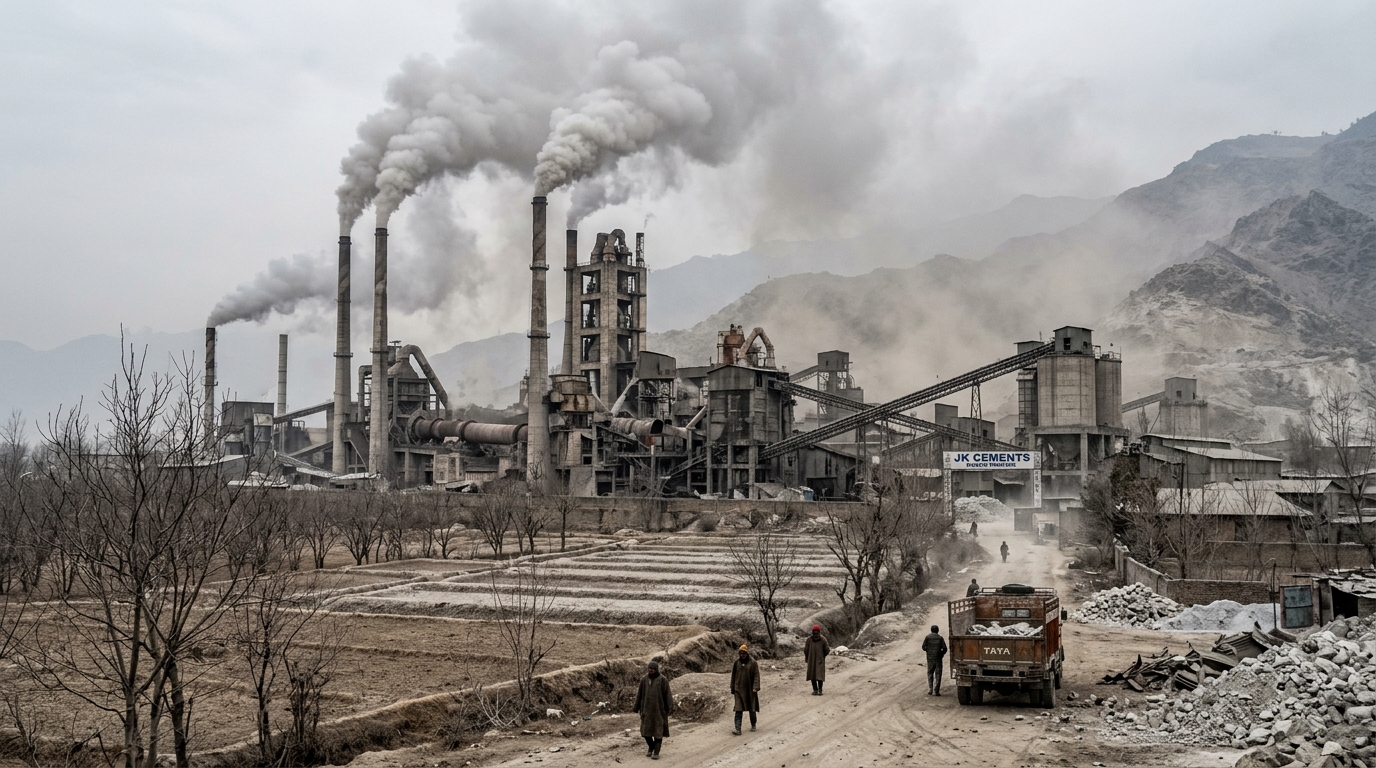
Across the Kashmir Valley, accelerated residential building, highway corridor commercialization, and institutional expansion consume roughly 1.2 to 1.6 billion fired clay bricks annually, produced by an estimated 280–320 seasonal kilns heavily concentrated in Budgam (Chadoora, Bugam, Chattergam, Ompora), Pulwama, and Anantnag . Because traditional kiln operators locate directly atop fine-grained Plio-Pleistocene Karewa silty-clay plateaus and Jhelum alluvial loams to minimize raw-clay haulage costs, brick manufacturing physically consumes the exact prime agricultural soils supporting Kashmir’s paddy, vegetable, apple, almond, and GI-tagged saffron economies .
Synthesizing peer-reviewed South Asian stack emission measurements , empirical Kashmir crop-phytotoxicity assays , orbital kiln-detection methodologies , and statutory CPCB G.S.R. 143(E) norms , this dossier demonstrates a dual industrial-ecology crisis: legacy Fixed-Chimney Bull’s Trench Kilns (FCBTKs) emit ~640–780 mg/Nm^3 stack particulate matter and 0.18 g black carbon/kg brick while stripping ~305–315 tonnes of fertile soil per 100,000 solid bricks. Resolving both impacts simultaneously requires coupling mandatory zig-zag combustion retrofits with structural transition toward hollow blocks and dredged-silt / tunnel-spoil masonry substitutes .