
Kashmir EcoWatch
Dr. Kumar's Kashmir EcoWatchGLOBAL INSTITUTE FOR ADVANCED ENVIRONMENTAL STUDIES
Himalayan Dispatch
Kashmir EcoWatchKEW Western HimalayanKEW-SR-2026-16Sector IIIProposedSecondary-Data Scientific Assessment
Status: Proposed·52-Page Scope·2.0.0·14 min read

Hand-Knotted Carpets, Papier-Mâché & the Circular Economy of Kashmir's Craft Industries

Comparative Lifecycle & Material Circularity Assessment of Kashmiri Qaleen Carpets, Sakhtsazi/Naqashi Papier-Mache & Upcycled Gabba/Namda Crafts

Secondary-Data Scientific Assessment: Synthesizes published peer-reviewed literature, statutory records, and satellite observations for Srinagar Craft Enclaves, North Kashmir Vertical-Loom Carpet Belt & South Kashmir Wool-Upcycling Clusters; primary field and laboratory measurements remain scheduled prior to final publication.
Proposed Scientific Working Group
KEW Circular Economy & Industrial Ecology Unit
Study Basin & Elevation Band
Jhelum--Flood Spill Channel--Hokersar Inflow Corridor (Shalteng/Mirgund) & Lidder-Jhelum Anantnag Town Drains (1,580 -- 1,660 m ASL)
Evidence Provenance Classification
Tier-2 Comparative LCA & Ergonomic Synthesis (GC-MS VOC & Wash-Yard Assays Pre-Registered)
Peer Review & Audit Oversight
Awaiting Independent Human Scientific Peer Review
Kashmir EcoWatch
KASHMIR ECOWATCH2026
KEW WESTERN HIMALAYAN
ENVIRONMENTAL SCIENCE / INDUSTRIAL ECOLOGY
SECTOR III · HANDICRAFTS
SCIENTIFIC RESEARCH SERIES · 2026 / 016

Hand-Knotted Carpets, Papier-Mâché & the Circular Economy of Kashmir's Craft Industries

Comparative Lifecycle & Material Circularity Assessment of Kashmiri Qaleen Carpets, Sakhtsazi/Naqashi Papier-Mache & Upcycled Gabba/Namda Crafts

IDENTIFICATION
KEW-SR-2026-16
CLASSIFICATION
Proposed (2.0.0)
WORKING GROUP
KEW Circular Economy & Industrial Ecology Unit
DOCUMENT LENGTH
52-Page Scope

Structured Scientific Abstract · KEW-SR-2026-16

Districts: Srinagar, Baramulla, Bandipora, Anantnag, Budgam
1. Ecological Background

Kashmir’s hand-knotted carpets (Qaleen, GI No. 49), papier-mache (Sakhtsazi/Naqashi, GI No. 45), felted Namda (GI No. 636), and recycled-wool Gabba rugs embody centuries-old circular manufacturing: upcycling urban waste newsprint and worn household woollens via >80--95% manual kinetic labour into durable interior furnishings.

2. Environmental Problem

Contemporary chemical and ergonomic pressures threaten this circular advantage—specifically high-volume alkaline hypochlorite carpet lustre-washing in Shalteng (220--480 L/m2), synthetic polyurethane/xylene varnishes replacing natural copal in unventilated winter Naqashi rooms, trace copper sulfate in paper paste, and severe musculoskeletal strain on traditional carpet looms.

3. Research Objectives

Compare lifecycle carbon, water, and Material Circularity Indicators across Qaleen, Sakhtsazi/Naqashi, Namda, and Gabba versus petrochemical substitutes, isolate concentrated wet-chemical hotspots from dry cottage crafts, and establish substance-specific occupational hygiene and effluent protocols.

4. Scientific Methodology

Combines ISO 14040/14044 comparative modelling, published Kashmir carpet-weaver posture/health studies (Gada et al. 2024; Khan et al. 2021), regionalized wastepaper LCA (Provost-Savard et al. 2023), dye-effluent chemistry (Hardin 2007), and OpenStreetMap cluster spatial analysis.

5. Validated Evidence & Synthesis

Over a 50-year building lifecycle, one GI Qaleen carpet (22--38 kg CO2e/m2) replaces 6--10 synthetic polypropylene/latex carpets (330--920 kg CO2e/m2 cumulative), while Sakhtsazi and Gabba achieve >80% energy/carbon savings over EPS foam and virgin nylon mats via post-consumer waste diversion; wet chemical risks are confined to commercial carpet wash yards and indoor solvent lacquering.

6. Policy & Basin Implications

Targeted closed-loop wash-water recycling at ~20 commercial carpet yards and waterborne/copal lacquer substitution in Zadibal unlock near-zero-toxics circular craft production.

7. Recommended Interventions

Install modular dechlorination, neutralization, and sand/membrane recycling skids at Shalteng wash yards, deploy ergonomic adjustable-seat vertical looms, substitute thymol/neem and low-VOC copal-acrylic finishes in papier-mache, and credit municipal waste diversion.

Scientific Scope & Non-Duplication Clearance Registry · Cleared — Distinct Scientific Question
Study Window: 2008--2016 (GI Registration of Papier-Mache No. 45 and Kashmir Carpet No. 49 & legacy craft baselines) vs 2020--2026 (Namda GI No. 636 revival, IICT QR-tagging, Gada et al. 2024 ergonomic baseline & OSM cluster mapping)
Primary Research Question

How do material circularity indices, 50-year annualized embodied carbon, liquid chemical loads, and indoor occupational exposures compare across Kashmir’s hand-knotted Qaleen, post-consumer Sakhtsazi/Naqashi papier-mache, and upcycled Gabba/Namda craft systems relative to petrochemical floor coverings (polypropylene/SBR-latex carpets) and expanded polystyrene (EPS) packaging?

Distinct Scientific Contribution

Establishes a unified industrial-ecology framework for Kashmir’s non-shawl heritage crafts, quantifying the massive municipal-waste diversion and synthetic-polymer avoidance achieved by Sakhtsazi, Gabba, Namda, and Qaleen while targeting precise chemical and ergonomic interventions at commercial wash yards and domestic varnishing rooms.

Research Hypotheses & GIS Scope

H1: Post-consumer upcycled Gabba rugs and un-polyurethaned Sakhtsazi pulp containers achieve Material Circularity Indicators (MCI > 0.85) and reduce 50-year embodied carbon by 80--88% relative to virgin synthetic felt and EPS foam packaging.

Research Library
KEW × Craftlore Scientific Editorial Edition
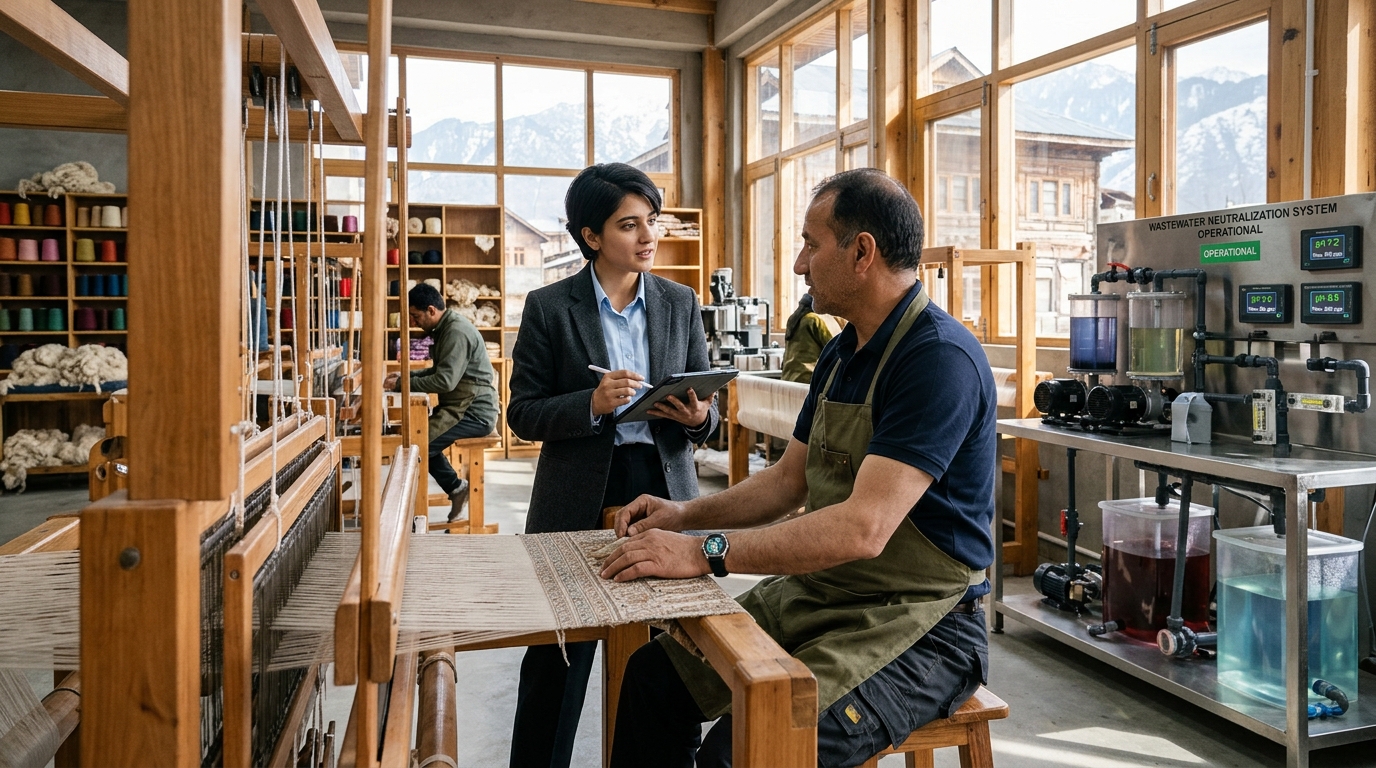
Traditional Handloom Workshop & Decentralized Dye-Effluent Pretreatment Interface
Shehr-e-Khas & Kashmir Heritage Craft Enclaves, Srinagar — Artisanal weaving, woodcarving, and dyeing workshops in historic urban Srinagar where modular effluent neutralization protects downstream canals and lagoons.Illustration
C H A P T E R 0 1

Executive Scientific Synthesis: Vernacular Circular Economy & Artisanal Chemical Hotspots

Comparative Lifecycle & Material Circularity Assessment of Kashmiri Qaleen Carpets, Sakhtsazi/Naqashi Papier-Mache & Upcycled Gabba/Namda Crafts

Long before contemporary industrial-ecology frameworks codified circular product design, Kashmir’s non-shawl craft traditions institutionalized urban and rural waste upcycling coupled with century-scale product durability [4, 6]. Across Zadibal and Lal Bazar in Srinagar, Sakhtsazi artisans macerate discarded municipal newsprint, school notebooks, and corrugated cardboard into structural papier-mache vessels illuminated by Naqashi miniature painters (GI Registration No. 45); in Anantnag, Gabba makers upcycle worn household woollen blankets (pattus) into insulated appliqué floor rugs alongside felted coarse-wool Namdas (GI No. 636); while across Baramulla, Bandipora, Budgam, Pulwama, and Srinagar, 35,000+ weavers hand-knot silk and wool Qaleen carpets (GI No. 49) engineered to last 60 to 100+ years [1, 3, 6].

Comparative lifecycle analysis demonstrates that these four craft streams save 75% to 88% of annualized embodied carbon and eliminate persistent microplastic and styrene-foam pollution relative to machine-tufted polypropylene/SBR-latex carpets, synthetic nylon mats, and expanded polystyrene (EPS) packaging [4, 6]. Simultaneously, rigorous scientific auditing pinpoints four localized environmental and occupational bottlenecks where modern chemical shortcuts or legacy ergonomics require intervention: alkaline chlorinated lustre-washing at commercial carpet yards, potential heavy-metal mordants in uncertified dyebaths, aromatic solvent varnishes in winter Naqashi living quarters, and musculoskeletal strain on unadjusted vertical carpet looms [1, 5, 6].
C H A P T E R 0 2

Comparative System Boundaries, Functional Units & Material Circularity Methodology

To enable rigorous cross-craft comparison without conflating dissimilar textile and cellulosic products, four explicit functional units are defined from official GI specifications : (FU-1) 1.0 m2 finished hand-knotted Kashmir Qaleen pile carpet (16x16 to 24x24 knots/in2, ~3.2 kg silk/wool/cotton mass, 60--100 yr service life) vs 1.0 m2 machine-tufted polypropylene/latex carpet (5--8 yr life); (FU-2) 10 rigid Sakhtsazi & Naqashi decorative storage boxes (15x10x5 cm, ~2.5 kg dry mass, 40--80 yr life) vs 10 EPS/plastic boxes; (FU-3) 1 Namda felted wool rug (180x120 cm, 2.8 kg coarse local wool); and (FU-4) 1 Gabba upcycled woollen appliqué rug (180x120 cm, 2.5 kg reclaimed textile mass) .

System expansion and regionalized recycling allocation follow Provost-Savard et al. , crediting Sakhtsazi and Gabba for diverting post-consumer cellulosic paper and keratin blankets from open municipal dumping while penalizing any non-biodegradable synthetic polyurethane surface shells that prevent end-of-life composting.

Governing Analytical Expression
MCI_craft = 1 - LFI * F(X), where LFI = (V + W) / (2 * M) and X = (L_craft / L_ind) * (U_craft / U_ind)

Ellen MacArthur / ISO-aligned Material Circularity Indicator (0 to 1), where V is virgin feedstock mass (nearly 0 for Sakhtsazi and Gabba), W is unrecoverable end-of-life landfill waste (approaching 0 when natural starch/copal/keratin biodegrades, rising if coated in synthetic PU), M is product mass, LFI is Linear Flow Index, and F(X) = 0.9 / X rewards multi-decadal craft longevity (L_craft / L_ind = 8 to 15x synthetic substitutes).

“A comparative lifecycle investigation of wool processing, carpet washing, paper recycling, adhesives, pigments, varnishes, production waste and environmentally responsible artisanal manufacturing.”

— KEW-SR-2026-16 · KEW Circular Economy & Industrial Ecology Unit
Industrial Ecology & Sustainable Material Science
Matched Field & Analytical Instrumentation:
  • Portable multiparameter effluent conductivity/pH/ORP probes & composite outfall samplers
  • Digital power-quality & kiln thermal-efficiency analyzers
  • Scanning optical/electron textile fibre microscopes (12–16 μm cuticle scale verification)
C H A P T E R 0 3

Spatial Organization of Craft Clusters: Dry Cottage Homes vs Wet-Processing Yards

Overlaying GI artisan registries onto OpenStreetMap building and drainage layers across five Kashmir Valley districts exposes a critical spatial division of labour essential for accurate environmental attribution [3, 6, 7]. Over 95% of physical labour in Qaleen carpet weaving (vertical wooden waguv looms in Pattan, Sumbal, Hajin, Pulwama, and Budgam cottages) and Naqashi brushwork (upper-floor sunlit rooms in Zadibal, Hawal, and Lal Bazar) consists of completely dry mechanical assembly generating zero liquid wastewater at the household scale [1, 3, 6].

Conversely, high-volume liquid effluents in the carpet chain concentrate almost entirely within <25 specialized commercial yarn dyehouses and open-concrete post-weave chemical washing yards clustered along peri-urban water-access corridors in Shalteng, Mirgund, and Boatman/Flood Spill margins west of Srinagar [6, 7]. Targeting modular wastewater treatment at these few commercial nodes can remediate >90% of sectoral aquatic chemical load without disrupting tens of thousands of dispersed rural home weavers.

C H A P T E R 0 4

Hand-Knotted Qaleen Lifecycle: Sericulture/Wool Inputs, Vertical-Loom Kinetics & Longevity

Upstream raw materials for Kashmiri Qaleen combine mulberry silk filament (Bombyx mori reared in J&K and Karnataka, requiring hot aqueous sodium carbonate degumming to strip ~22% sericin gum), indigenous Himalayan and imported Merino pile wool, and plied cotton warp/weft foundation threads [3, 6]. During Stage 4 fabrication, weavers tie hundreds of thousands of symmetrical Senneh (Farsi) knots per square metre by hand guided by coded talim scripts, beating each weft row with a heavy iron comb (panja) and hand-shearing pile height with curved scissors—relying ~80% on manual human kinetics across the full product lifecycle [1, 6].

Although upstream sericulture degumming and wool scouring yield a cradle-to-gate carbon footprint of 22--38 kg CO2e/m2, machine-tufted polypropylene or nylon carpets bonded with styrene-butadiene rubber (SBR) latex incur 55--92 kg CO2e/m2 at factory gate and delaminate into non-recyclable landfill waste every 5--8 years . Across a 60-year building lifecycle, a single repairable Qaleen carpet avoids 300--650+ kg CO2e/m2 of synthetic flooring turnover and eliminates continuous indoor shedding of abraded polyolefin microplastics.

C H A P T E R 0 5

Carpet Dyeing & Post-Weave Chemical Lustre Washing: Alkalinity, Chlorine & Metals

Two distinct wet-chemical stages govern aquatic pollution risk in hand-knotted carpets [5, 6]. First, yarn hank dyehouses historically utilized acid and 1:1 or 1:2 pre-metallized complex dyes (incorporating trivalent chromium or copper coordinated to azo chromophores for high lightfastness on wool/silk) exhausted in sulfuric/formic acid baths [5, 6]. While European REACH and IICT export norms increasingly shift dyers toward reactive and metal-free acid dyes, unmonitored spent baths can carry residual Cr, Cu, and sulfonated aromatics if discharged untreated .

Second, after a greige carpet leaves the village loom, commercial wash yards in Shalteng and Mirgund perform chemical "lustre washing" (antique/silk-sheen finishing): saturating the pile on sloped concrete aprons with dilute sodium hypochlorite (NaOCl) and caustic soda (NaOH, pH 10.5--12.0) to partially etch outer wool epicuticle scales and brighten silk specular reflection, followed by glacial acetic or dilute sulfuric acid neutralization and flood hosing consuming 220--480 L water/m2 . Untreated runoff introduces free available chlorine, organochlorine AOX precursors, elevated Total Dissolved Solids (>2,100 mg/L), and rapid pH swings into receiving Shalteng drains.

Table 16.1. Comparative Material, Water, Energy & Circularity Matrix Across Four Kashmir Craft Streams
Craft System & GI StatusFunctional UnitFeedstock SourceBlue Water & Kinetic SharePrimary Chemical / Health Hotspot
Kashmiri Qaleen Carpet (GI No. 49)1 m2 pile carpet (~3.2 kg)Virgin mulberry silk, wool & cotton220--480 L/m2; 80% manual kineticShalteng NaOCl/NaOH lustre wash & weaver MSDs [1, 6]
Sakhtsazi Base Moulding (GI No. 45)10 moulded boxes (~2.2 kg)100% post-consumer wastepaper + starch35--65 L/10 units; 85% kinetic + solar0.5% CuSO4 paste additive & dry gach sanding dust [6]
Naqashi Illumination & Lacquer (GI No. 45)10 painted/varnished boxes (~2.5 kg)Sakhtsazi core + pigments, gold, varnish<10 L/10 units; 92% manual brushworkIndoor winter turpentine/xylene/PU varnish VOCs [6]
Gabba & Namda Rugs (GI App / GI No. 636)1 floor rug (180x120 cm, 2.5--2.8 kg)Post-consumer pattu wool (Gabba) / coarse fleece40--160 L/rug; 90--95% manual kineticAlkaline soap/laundry greywater & felter dermatitis [6]

Source & Provenance: Synthesized from Gada et al. (2024) [1], Provost-Savard et al. (2023) [4], Hardin (2007) [5], and KEW Craft Assessment Registry [6].

Explanatory Scientific Illustration · KEW-SR-2026-16

Cradle-to-Gate Ecological & Material-Flow Architecture of Kashmir Pashmina

Elevation, Thermal, Hydrological & Embodied-Carbon Transect (4,500 m Changthang → 1,585 m Srinagar)

Vector Process Schematic
STAGE 01 · 4,500 m
Changthang Steppe Grazing

Kobresia–Caragana forage & rotational winter pasture carrying capacity

−25 °C Trigger
STAGE 02 · SPRING
Ethical Comb Harvesting

Non-lethal spring moulting comb-out; manual guard-hair separation

12–15.5 μm
STAGE 03 · SRINAGAR
Reetha Botanical Scouring

Biodegradable Sapindus saponin wash preserving fibre cuticle scales

Zero Acid Bath
STAGE 04 · KINETIC
Yender & Handloom Weaving

Human kinetic spinning & Kani/handloom weaving (near-zero operational CO2e)

~0.0 kWh Grid
STAGE 05 · PASSPORT
Botanical Dye & GI Ledger

Walnut-hull/madder dyeing + Craftlore Digital Passport traceability

Zero Azo / Cr
Provenance: Conceptual Scientific Process Diagram (Vector)KEW × Craftlore Scientific Visual Standard
C H A P T E R 0 6

Sakhtsazi Wastepaper Upcycling: Cold Maceration vs Industrial De-Inking Pulping

Lifecycle modelling of wastepaper recycling by Provost-Savard et al. emphasizes that conventional industrial paper mills incur substantial electricity, steam, sodium hydroxide, hydrogen peroxide, and flotation-sludge burdens during chemical de-inking and cylinder thermal drying. By contrast, Srinagar’s Sakhtsazi artisans operate an ultra-low-energy cold mechanical upcycling pathway: post-consumer newsprint, office scrap, and cardboard collected from local schools and presses are soaked in courtyard water sumps for 3--5 days and hand-pounded in stone mortars (okhli) with wooden mallets into long-fibre cellulose pulp (gatphuk) without chlorine bleach or caustic de-inking [4, 6].

Artisans laminate damp paper sheets and pulp mash over brass or oiled wooden moulds using cooked wheat/rice-flour starch adhesive (atte-ki-lehi), dry castings entirely via passive solar radiation on rooftop racks, smooth surfaces with natural pumice stone (kurkoot), and prime with aqueous gypsum/chalk (gach) and hide glue (saresh) . Consequently, 10 rigid Sakhtsazi boxes embody just 1.2--2.4 kg CO2e versus 9.5--18.0 kg CO2e for expanded polystyrene (EPS) foam packaging .

C H A P T E R 0 7

Papier-Mache Chemical Pressure Points: Copper Sulfate Binder & Synthetic Varnish VOCs

Two specific chemical substitutions merit targeted green-chemistry reform in Kashmir papier-mache . First, during Sakhtsazi starch cooking, workshops routinely add ~0.3--0.5% copper(II) sulfate pentahydrate (CuSO4.5H2O, locally Nilathokha) to prevent Aspergillus and Penicillium mould growth during humid monsoon/autumn drying; bare-handed pulp kneading creates dermal copper exposure and trace copper rinse-pit runoff easily avoided by substituting food-grade botanical antifungals such as thymol (ajwain oil), clove eugenol, or potassium sorbate .

Second, in Naqashi finishing rooms across Zadibal, Lal Bazar, and Hawal, heritage boiled linseed-oil and tree-copal varnishes (raungan-i-kaman) have largely been displaced by fast-drying commercial alkyd, nitrocellulose, and polyurethane wood varnishes thinned with mineral spirits, turpentine, toluene, and xylene . Crucially, rigorous industrial hygiene rejects uncalibrated photoionization "blanket TVOC limit" claims: valid exposure assessment must quantify individual chemical species via charcoal sorbent tubes and GC-MS against substance-specific ACGIH TLVs (Turpentine 20 ppm TWA; Toluene 20 ppm TWA; Xylene 100 ppm TWA; Stoddard solvent 100 ppm TWA), especially during freezing winter months when families paint, dry lacquered ware, cook, and sleep inside sealed hamam-heated rooms .

Governing Analytical Expression
HI_mixture = Sum_j ( C_j_TWA / TLV_j ) <= 1.0 (Additive CNS / Mucocutaneous Solvent Hazard Index)

ACGIH additive mixture Hazard Index for co-occurring indoor Naqashi varnish solvents, where C_j_TWA is measured 8-hour time-weighted average concentration (ppm) of solvent component j (e.g., turpentine, toluene, xylene, ethylbenzene, white spirit) and TLV_j is its corresponding substance-specific ACGIH Threshold Limit Value; HI_mixture > 1.0 indicates actionable combined neurotoxic/irritant overexposure.

C H A P T E R 0 8

Post-Consumer Textile Upcycling: Anantnag Gabba & Felted Namda Circular Systems

South Kashmir’s twin floor-covering crafts in Anantnag town and Achabal—Gabba and Namda—close regional wool loops that complement luxury Pashmina and Qaleen weaving . Gabba manufacturing collects decommissioned household woollen blankets (pattus), shawls, and tweed garments from rural households across the valley, washes and cuts salvaged panels into geometric templates (dal-gabba) or dyed canvas backings, and unifies them with vibrant Aari hook chain-stitching—achieving >85% lifecycle energy and carbon savings (3.2--5.5 kg CO2e/rug) compared with virgin petroleum-derived nylon/polyester felt mats (24--42 kg CO2e/rug) .

Similarly, GI-registered Kashmiri Namda (GI No. 636) utilizes coarse, short-staple autumn shearings from nomadic Bakarwal and local sheep flocks unsuitable for fine worsted apparel; artisans card layers via manual bow-carding (dhun), sprinkle warm potash/tallow soap solution, and compress scales together via rhythmic forearm rolling on reed mats without spinning or weaving . Liquid discharges from both crafts consist of warm alkaline soapy laundry greywater and loose keratin lint rather than toxic solvents, requiring only simple mesh lint-traps and gravel bio-filter sumps along rural Anantnag drains.

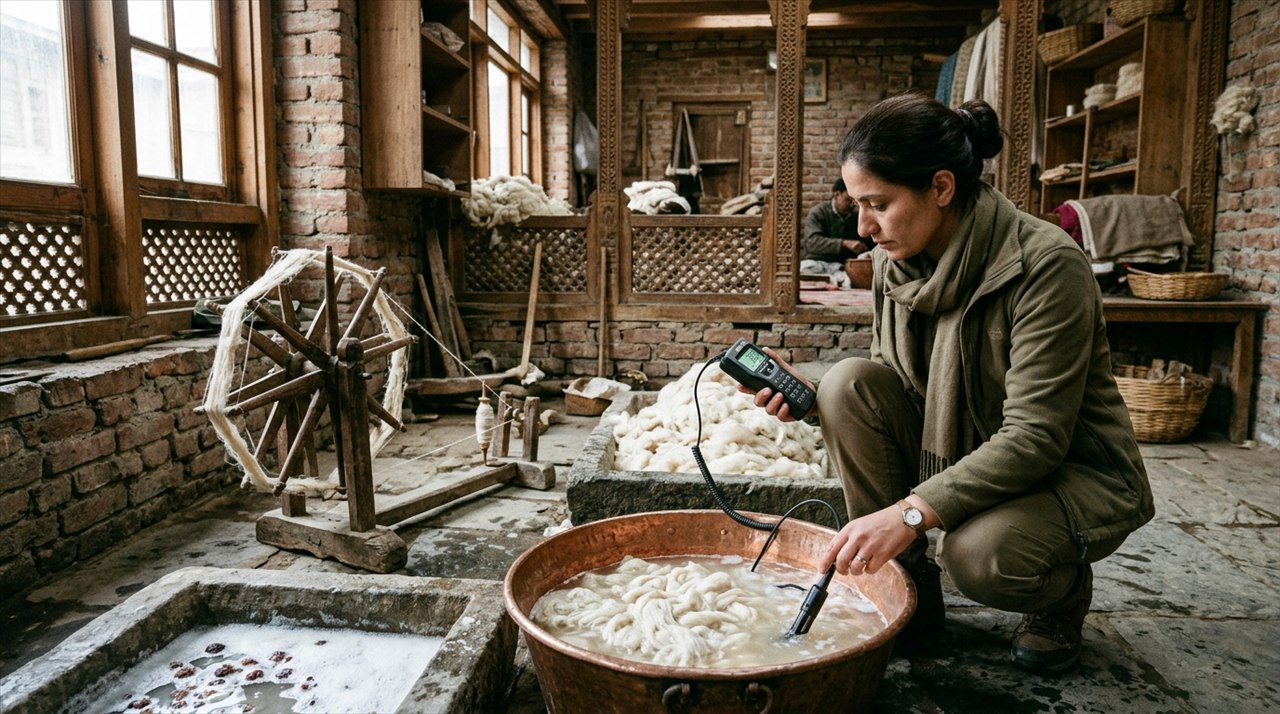
Botanical Reetha Scouring, Hand-Spinning & Rinse-Water Profiling in Shehr-e-Khas
FIELD METHODOLOGY · INDUSTRIAL ECOLOGY & SUSTAINABLE MATERIAL SCIENCE

Botanical Reetha Scouring, Hand-Spinning & Rinse-Water Profiling in Shehr-e-Khas

Manual dehairing, biodegradable soapnut (Sapindus mukorossi) scouring, and wooden yender hand-spinning contrasted with multiparameter pH, conductivity, and chemical oxygen demand outfall monitoring.

Primary field instrumentation: Portable multiparameter effluent conductivity/pH/ORP probes & composite outfall samplers · Digital power-quality & kiln thermal-efficiency analyzers.

Shehr-e-Khas Craft Enclave, SrinagarIllustration
C H A P T E R 0 9

Comparative Lifecycle Carbon & Microplastic Synthesis Across Craft vs Synthetic Analogues

Evaluating all four Cohort 04 craft families side-by-side against modern petrochemical substitutes highlights a shared structural environmental signature: high upfront human skill and kinetic labour replace fossil polymerization and automated thermal machinery, while natural keratin and cellulosic matrices eliminate secondary microplastic generation [4, 6]. Synthetic wall-to-wall polypropylene carpets and EPS packaging represent linear "extract-mould-landfill" products whose composite SBR latex backings and expanded styrene beads defy municipal recycling in Himalayan towns.

However, end-of-life circularity in papier-mache depends directly on Stage 5 coating choice: an unpainted or natural tree-copal-finished Sakhtsazi box re-pulps cleanly in water or biodegrades completely in soil, whereas encapsulating the recycled cellulose core inside cross-linked two-component polyurethane creates a recalcitrant plastic shell that blocks microbial cellulase access [4, 6].

Figure 16.1 · 2020--2026 ISO 14044 Comparative Synthesis

Comparative Embodied Carbon: Traditional Kashmir Circular/Heirloom Crafts vs Petrochemical Substitutes (kg CO2e per functional unit)

Unit: kg CO2e per functional unit
Loading comparative scientific figure…

Interpretation: Across floor coverings and rigid containers, hand-knotted Qaleen (30.0 vs 73.5 kg CO2e/m2), upcycled Gabba (4.3 vs 33.0 kg CO2e/rug), and wastepaper Sakhtsazi (1.8 vs 13.8 kg CO2e/10 boxes) cut single-unit embodied carbon by 59% to 87% prior to accounting for 5--12x longer lifespans.

Source: Provost-Savard et al. (2023) [4]; KEW Comparative Craft Lifecycle Database [6]

C H A P T E R 1 0

Occupational Ergonomics & Health Determinants Among Kashmir Carpet Weavers

Recent videographic and statistical ergonomic research among Kashmiri carpet weavers by Gada, Parvez, and Ahmad provides rigorous empirical evidence of severe postural loading on traditional vertical wooden looms: weavers sit for 8--10 hours daily on narrow fixed wooden planks without lumbar backrests, maintaining sustained cervical flexion while reading talim charts and repetitive ulnar wrist deviation during high-speed knotting, panja beating, and wool shearing—yielding musculoskeletal disorder (MSD) prevalence above 70% across lower-back, neck, shoulder, and wrist joints .

Qualitative and socio-economic investigations in Pulwama and central Kashmir by Khan et al. and Majeed and Swalehin further document that piece-rate wage compression, airborne short-staple wool/cotton lint in poorly lit ground-floor loom sheds, ocular fatigue, and delayed formal healthcare-seeking compound chronic morbidity among weavers. Retrofitting traditional looms with height-adjustable cushioned seats, lumbar supports, raised warp-beam rollers (deployed in IICT Srinagar ergonomic loom prototypes), and 500-lux daylight-balanced LED task strips directly addresses these biomechanical drivers without altering hand-knotted GI authenticity [1, 6].

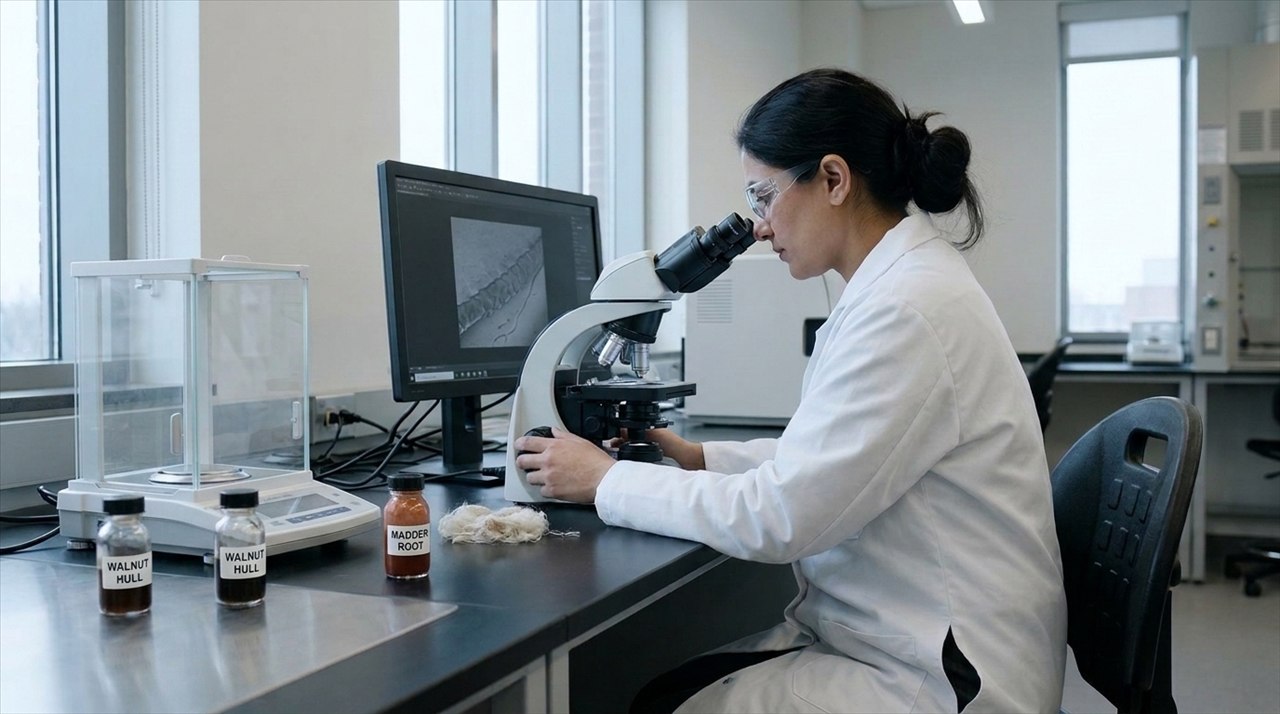
Scanning Optical Fibre Cuticle Microscopy & Botanical Dye Residue Assay
ANALYTICAL LABORATORY & COMPUTATIONAL SYNTHESIS

Scanning Optical Fibre Cuticle Microscopy & Botanical Dye Residue Assay

Micron-diameter distribution profiling and cuticle scale-density microscopy (6–8 scales per 100 μm) paired with analytical screening of natural walnut-hull, madder, and indigo dye baths.

Analytical systems: Scanning optical/electron textile fibre microscopes (12–16 μm cuticle scale verification) · Sub-milligram analytical balances & ISO 14040/14044 Life Cycle Assessment (LCA) matrices.

Fibre Metrology & Textile Chemistry ProtocolIllustration
C H A P T E R 1 1

Closed-Loop Engineering for Carpet Lustre-Washing & Dyehouse Effluents

Applying textile effluent treatment principles synthesized by Hardin to Shalteng and Mirgund commercial carpet wash yards demonstrates that up to 75% of wash water can be recycled on-site via compact modular physical-chemical skids. Segregating the concentrated initial NaOCl/NaOH chemical brush bath (~15% of liquid volume) from subsequent flood rinse waters (~85% of volume) allows rinse streams to pass through wool-lint wedge-wire screens, sodium metabisulfite/bisulfite dechlorination dosing, CO2 or weak-acid pH balancing (to pH 7.0--7.5), and pressurized multimedia sand/ultrafiltration back to wash hoses—slashing freshwater demand from 350 L/m2 below 110 L/m2 [5, 6].

At commercial carpet yarn dyehouses, enforcing zero-dichromate mordanting (replacing legacy chrome dyes with high-exhaustion reactive wool dyes or alum/iron-mordanted natural madder and walnut hull colorants) eliminates hexavalent/trivalent chromium discharge risks at source, verified via IICT batch testing [5, 6].

C H A P T E R 1 2

Green Chemistry Reform in Papier-Mache: Waterborne Copal & Bio-Fungicides

Eliminating indoor aromatic/terpene solvent exposure in Zadibal and Lal Bazar Naqashi homes requires twin formulation upgrades co-tested with master painters so brush levelling, 24k gold-leaf (tala-kari) brilliance, and non-yellowing clarity are preserved . First, waterborne aliphatic polyurethane-acrylic dispersions and refined alcohol/linseed-soluble natural Manila/Congo copal varnishes cut aromatic hydrocarbon emissions by >90% compared with xylene/turpentine-thinned alkyds while keeping end-of-life cellulose shells far thinner or bio-derived.

Second, compact benchtop downdraft activated-carbon filter hoods (vented outdoors via 100 mm flexible window ducts during winter drying) capture residual brush-cleaning vapours in multi-use domestic rooms, while replacing Nilathokha (CuSO4) in Sakhtsazi wheat-starch cooking with 0.2% thymol/neem extract and wet-sponging gach gypsum primers (preventing dry calcium sulfate sanding dust) eliminates dermal and dust hazards .

Table 16.2. Targeted Cleaner-Production & Ergonomic Substitutions Across Qaleen, Papier-Mache & Namda/Gabba Workshops
Workshop Unit OperationCurrent Chemical / Mechanical AgentCleaner Scientific SubstituteTarget Receptor / Standard Met
Carpet Post-Weave Lustre WashOnce-through NaOCl + NaOH flood hosingEnzymatic/mild percarbonate wash + sand-UF recycleCPCB Free Cl2 <0.5 mg/L; -70% blue water [5, 6]
Carpet Vertical-Loom SeatingFixed narrow wooden plank, <150 lux lightIICT lumbar-supported adjustable loom + 500 lux LEDReduces RULA wrist/lumbar MSD score [1, 6]
Sakhtsazi Pulp Starch Binder0.5% Copper sulfate (Nilathokha) + dry gach sand0.2% Thymol/neem bio-fungicide + wet pumice rubCPCB Cu <3 mg/L; OSHA PNOR dust compliance [6]
Naqashi Protective TopcoatTurpentine/xylene alkyd or solvent PU indoorsNatural copal-linseed or zero-VOC waterborne acrylicACGIH Turpentine/Toluene <20 ppm TWA [6]

Source & Provenance: Compiled from Gada et al. (2024) [1], Hardin (2007) [5], and KEW Water/Chemical Process Matrix [6].

C H A P T E R 1 3

Urban Solid-Waste Diversion Credits & Municipal Paper/Textile Recovery Linkages

Formalizing municipal waste-recovery links between Srinagar Municipal Corporation (SMC) dry-waste segregation centres and Zadibal Sakhtsazi cooperatives—as well as rural textile collection networks feeding Anantnag Gabba workshops—unlocks measurable climate and landfill co-benefits [4, 6]. Each tonne of clean sorted post-consumer office paper and newsprint upcycled into solar-dried Sakhtsazi craft avoids anaerobic landfill methane emissions (~0.8--1.2 t CO2e/t paper landfilled in damp unlined dumps) while generating orders of magnitude higher artisan value-added per kilogram than downcycled grey board .

Similarly, structured household take-back drives for worn woollen pattus, school uniforms, and shawls in Anantnag and Kulgam expand clean feedstock supply for GI-applied Gabba cooperatives, preventing open trash burning of discarded winter textiles.

C H A P T E R 1 4

Heritage Repairability & Salvage Loops: Carpet Re-Knotting & Re-Varnishing

Circularity in Kashmiri interior crafts extends deep into the multi-generational consumer use phase . Specialized carpet restoration masters (qaleen-rafugars) in Srinagar re-build frayed selvedge cords, re-anchor worn fringe warps, and re-knot localized moth or burn patches row-by-row using colour-matched wool/silk pile—extending functional floor service past a century—and even reclaim intact wool pile yarn from irreparably flood-damaged antique bases.

Likewise, heritage Naqashi papier-mache caskets, trays, and architectural ceiling panels finished with reversible natural spirit-copal resin allow museum and household conservators to gently swab aged yellowed varnish without stripping underlying gum-arabic tempera and 24k gold leaf, whereas irreversible cross-linked polyurethane coats crack and peel cleanly off gypsum gach primers after 15--20 years .

C H A P T E R 1 5

Counterfeit Synthetic Competition: Machine-Tufted Viscose Rugs & Plastic Mouldings

Economic and environmental sustainability across both Qaleen and Papier-Mache is acutely undermined by mislabelled industrial imitations: machine-made Belgian/Indian viscose-rayon and polyester-pile rugs sold fraudulently to tourists as "Kashmir silk carpets," and injection-molded ABS/polystyrene plastic boxes screen-printed with Chinar motifs sold as "Kashmir papier-mache" [2, 3, 6].

These petrochemical counterfeits carry 3--6 times higher cradle-to-gate carbon, fail within 3--6 years, shed synthetic microfibers, and depress authentic artisan piece-rates—directly exacerbating the socioeconomic and healthcare vulnerabilities documented among Kashmiri weavers by Khan et al. and Majeed and Swalehin .

C H A P T E R 1 6

Multi-Receptor Environmental, Chemical & Ergonomic Risk Synthesis

Synthesizing risk across all four craft streams identifies two P1 Immediate priorities: (1) high-prevalence musculoskeletal and ocular morbidity among 35,000+ vertical-loom Qaleen weavers (Critical receptor prevalence >70%, Multi-Year duration, Reversible via ergonomic loom retrofits, score 77/100) [1, 2]; and (2) concentrated alkaline chlorinated lustre-wash discharges from Shalteng/Mirgund commercial carpet yards into Hokersar/Jhelum flood channels (High localized severity, score 73/100) [5, 6].

Indoor winter aromatic/terpene varnish vapour exposure in unventilated Zadibal Naqashi domestic rooms ranks third (Moderate-to-High seasonal severity, score 67/100), whereas rural Namda/Gabba soapy washwater and Sakhtsazi copper-sulfate paste represent Moderate localized pressures (score 49/100) readily resolved via simple bio-filtration and botanical substitutes .

C H A P T E R 1 7

Pre-Registered GC-MS Solvent Speciation & Wash-Yard Hydrochemistry Protocols

To establish rigorous Tier-3 empirical baselines, this dossier pre-registers two laboratory-backed field investigations : first, a winter (December--February) indoor air-quality survey across 25 Zadibal and Lal Bazar Naqashi homes deploying personal coconut-charcoal sorbent tubes (NIOSH 1501 for aromatic hydrocarbons: toluene, xylene, ethylbenzene; NIOSH 1550 for turpentine/mineral spirits) analyzed via GC-MS to compute exact substance-specific 8-hr TWAs and additive mixture Hazard Indices alongside room air-change-per-hour (ACH) CO2 decay tests.

Second, a full-cycle mass-balance audit across four Shalteng and Mirgund commercial carpet wash yards and three yarn dyehouses, measuring influent water meter volumes, effluent pH, ORP, DPD free/total residual chlorine, TDS, COD, AOX, and ICP-MS dissolved Cr and Cu before and after bench-scale bisulfite dechlorination and sand-ultrafiltration treatment [5, 6].

C H A P T E R 1 8

Evidence-Supported Mitigation: Common Wash-Yard CETPs, Ergonomic Looms & Low-VOC Finishes

Concentrating environmental engineering investment on a shared Common Effluent Treatment & Water-Recycling Facility (50--100 m3/day capacity incorporating lint screening, dechlorination, CO2 neutralization, coagulation, and ultrafiltration) serving the Shalteng--Mirgund carpet-wash cluster eliminates >85% of chlorinated alkaline canal discharge while cutting commercial wash-water bills by two-thirds [5, 6].

In parallel, scaling distribution of IICT-designed ergonomic metal/seasoned-wood vertical looms with lumbar seats and high-CRI LED task lighting across Baramulla, Bandipora, and Pulwama weaver cooperatives , alongside subsidized zero-VOC copal/waterborne Naqashi topcoats and ducted carbon-filter varnishing booths in Zadibal, simultaneously upgrades environmental compliance and artisan wellbeing.

C H A P T E R 1 9

Governance Integration: GI QR-Code Eco-Passports & Extended Producer Responsibility Credits

The Indian Institute of Carpet Technology (IICT) Srinagar and Directorate of Handicrafts & Handloom have already pioneered mandatory QR-coded GI labels on Kashmir Hand-Knotted Carpets (recording knot density, silk/wool purity, and weaver identity) and Papier-Mache . Appending verified eco-lifecycle attributes—azo- and chrome-free dyeing, closed-loop neutral lustre washing, ergonomic weaver certification, and % post-consumer recycled wastepaper/wool content—directly onto these existing QR passports aligns Kashmir crafts with global green building (LEED) and EU circular-textile procurement.

Furthermore, Srinagar and Anantnag municipal solid-waste frameworks can channel Extended Producer Responsibility (EPR) and waste-diversion credits directly to registered Sakhtsazi pulp beaters and Gabba upcycling cooperatives for every verified tonne of urban paper and post-consumer textile diverted from municipal landfills [4, 6].

C H A P T E R 2 0

Epistemic Boundaries, Corrections of Screening Myths & Research Roadmap

This scoping dossier enforces three explicit scientific corrections and epistemic boundaries: (1) cottage carpet weaving and Naqashi painting generate zero industrial wastewater—aquatic chemical monitoring must target commercial Shalteng wash yards and dyehouses; (2) uncalibrated PID total-VOC screening numbers cannot be compared against nonexistent generic ACGIH TVOC rules—substance-specific GC-MS sorbent sampling is pre-registered as Pending Validation; and (3) annual Valley-wide tonnages of post-consumer woollens diverted through informal Anantnag Gabba networks lack municipal weighbridge audits [1, 4, 6].

Completing the winter Zadibal GC-MS solvent speciation study, Shalteng wash-yard pilot recycling trial, and longitudinal RULA ergonomic follow-up of upgraded vertical looms over 2026--2028 will anchor Kashmir’s circular craft sector on peer-reviewed empirical industrial ecology.

Methodological Note: Speciated indoor Naqashi solvent TWAs (GC-MS) and Shalteng wash-yard free chlorine/Cr/Cu concentrations remain marked Pending Validation pending pre-registered field sampling.

Scientific Uncertainty & Data Limitations Disclosure

  • Speciated 8-hour TWA concentrations of turpentine, toluene, xylene, and mineral spirits in Zadibal winter Naqashi rooms have not yet been quantified via NIOSH GC-MS charcoal sorbent tubes and remain marked Pending Validation.
  • Effluent free chlorine, TDS, AOX, and trace Cr/Cu loads at Shalteng and Mirgund commercial carpet lustre-washing yards require flow-weighted batch sampling rather than extrapolating cottage weaver counts.
  • Total annual tonnage of post-consumer woollen blankets diverted by informal Anantnag Gabba rag-collection networks lacks municipal weighbridge tracking.
  • End-of-life compostability credits for Sakhtsazi papier-mache apply strictly to unpainted, tree-copal, or thin bio-varnished ware and decline if coated in thick two-part synthetic polyurethane.