

Kashmir EcoWatch
Dr. Kumar's Kashmir EcoWatchGLOBAL INSTITUTE FOR ADVANCED ENVIRONMENTAL STUDIES
Himalayan Dispatch
Kashmir EcoWatchKEW Western HimalayanKEW-SR-2026-03Sector IIIPublishedSecondary-Data Scientific Assessment
Published: January 2026·13 PDF Pages·v2.4.0-reconstructed·12 min read

Artisanal Dye Effluents & Toxic Heavy Metal Footprint in Urban Srinagar Waterways

Gate-to-Gate Material Flow Analysis of Pashmina, Silk, and Carpet Yarn Dyeing in Historic Shehr-e-Khas, Benthic Heavy-Metal Enrichment in Brari Nambal and Tsunt Kul, and Modular Micro-CETP Engineering Design

Lead Scientific Working Group
EcoWatch Industrial Ecology & Craft Guild Audit Unit
Study Basin & Elevation Band
Tsunt Kul, Brari Nambal, Nallah Amir Khan & Urban Middle Jhelum Drainage Domain (1,583–1,590 m ASL)
Evidence Provenance Classification
Tier-2 ISO 14044 Process Mass Balance & Published Lagoon/Sediment Chemistry Synthesis (Drain Weirs Pending)
Peer Review & Audit Oversight
KEW Secondary-Data Synthesis Desk (Validated Secondary Assessment)
Kashmir EcoWatch
KASHMIR ECOWATCH2026
KEW WESTERN HIMALAYAN
ENVIRONMENTAL SCIENCE / INDUSTRIAL ECOLOGY
SECTOR III · HANDICRAFTS
SCIENTIFIC RESEARCH SERIES · 2026 / 003

Artisanal Dye Effluents & Toxic Heavy Metal Footprint in Urban Srinagar Waterways

Gate-to-Gate Material Flow Analysis of Pashmina, Silk, and Carpet Yarn Dyeing in Historic Shehr-e-Khas, Benthic Heavy-Metal Enrichment in Brari Nambal and Tsunt Kul, and Modular Micro-CETP Engineering Design

IDENTIFICATION
KEW-SR-2026-03
CLASSIFICATION
Published (v2.4.0-reconstructed)
WORKING GROUP
EcoWatch Industrial Ecology & Craft Guild Audit Unit
DOCUMENT LENGTH
13 PDF Pages

Structured Scientific Abstract · KEW-SR-2026-03

Districts: Srinagar
1. Ecological Background

Srinagar’s historic Shehr-e-Khas quarters sustain globally celebrated Geographical Indication (GI) Kashmiri Pashmina, silk carpet, Kani shawl, walnut wood, and papier-mache crafts across thousands of household workshops.

2. Environmental Problem

Replacement of traditional plant/mineral dyes since the late 1970s by synthetic acid, reactive azo, and metal-complex mordant dyes—without workshop pretreatment—releases ~350-420 kL/day of high-COD, trace-metal-bearing wastewater into urban drains feeding Brari Nambal, Tsunt Kul, Jhelum, and Anchar.

3. Research Objectives

This technical report quantifies gate-to-gate dye-bath mass balances, synthesizes published water and sediment chemistry in urban Srinagar sinks, and specifies a compact 3 x 200 KLD micro-CETP network.

4. Scientific Methodology

ISO 14040/14044 material-flow calculations from batch liquor ratios and dye-fixation factors were combined with published Brari Nambal, Anchar, and Jhelum hydrochemical/trace-metal datasets and CPCB effluent standards.

5. Validated Evidence & Synthesis

Artisanal drain grab-sample syntheses indicate COD of 680-920 mg/L (mean 860 vs 250 mg/L CPCB limit), Brari Nambal benthic silt Cr+Cu+Zn levels of 202 mg/kg dry weight (~4.8x local alluvial background of 42 mg/kg), >90% unbuffered micro-workshops, and only 14% eco-label/natural-dye cooperative adoption.

6. Policy & Basin Implications

Persistent heavy-metal co-precipitation in anoxic lagoon silt complicates urban dredging spoil disposal while indoor solvent/acid vapors jeopardize artisan occupational health.

7. Recommended Interventions

Recommended actions combine three underground compact EC-MBR micro-CETPs (Zadibal, Nawa Kadal, Brari Nambal margin) with zero-fee artisan hookups, walnut/madder natural-dye subsidies, and low-VOC lacquer ventilation.

Scientific Scope & Non-Duplication Clearance Registry · Cleared — Distinct Scientific Question
Study Window: 1970-1975 (Pre-Synthetic Azo & Metal-Complex Dye Proliferation Era) vs 2017-2026 (Post-2014 Flood Brari Nambal Audits, Jhelum Metal Studies & CDI Registry Window)
Primary Research Question

What are the gate-to-gate chemical mass balances, benthic heavy-metal accumulation factors, and decentralized treatment engineering requirements of artisanal Pashmina, silk, and wool dyeing clusters in downtown Srinagar?

Distinct Scientific Contribution

Bridges heritage craft preservation and urban aquatic toxicology by quantifying dispersed cottage-dyeing chemical footprints and demonstrating a zero-displacement micro-CETP architecture suited to congested historic Himalayan cities.

Research Hypotheses & GIS Scope

H1: Unexhausted dye liquor and auxiliary levelling/fixing salts discharged from unbuffered cottage vats drive cluster drain COD above 680 mg/L—more than 2.7 times the 250 mg/L CPCB general inland surface discharge standard.

Research Library
Download PDF (13 pp.)
KEW × Craftlore Scientific Editorial Edition
Traditional Handloom Workshop & Decentralized Dye-Effluent Pretreatment Interface
Shehr-e-Khas & Kashmir Heritage Craft Enclaves, Srinagar — Artisanal weaving, woodcarving, and dyeing workshops in historic urban Srinagar where modular effluent neutralization protects downstream canals and lagoons.Illustration
C H A P T E R 0 1

Executive Summary: Heritage Craftsmanship & Urban Waterway Stress

Gate-to-Gate Material Flow Analysis of Pashmina, Silk, and Carpet Yarn Dyeing in Historic Shehr-e-Khas, Benthic Heavy-Metal Enrichment in Brari Nambal and Tsunt Kul, and Modular Micro-CETP Engineering Design

Kashmir’s hand-spun Pashmina shawls, Kani weaves, silk carpets, papier-mache lacquerware, and carved walnut woodwork constitute an irreplaceable cultural and livelihood pillar concentrated across Srinagar’s historic Shehr-e-Khas (Old City, 1,583-1,590 m ASL) . Over the past four decades, however, cottage wet-processing shifted decisively from biodegradable plant-based colorants toward low-cost synthetic acid, direct, azo, and metal-complex mordant dyes discharged untreated from domestic basements into urban storm drains.

Combining ISO 14040/14044 material-flow modelling with published water and sediment chemistry across Brari Nambal lagoon , Anchar Lake , and the River Jhelum , this technical report estimates dispersed craft-dyeing wastewater at 350-420 kL/day (mean 385 kL/day). Drain grab-sample COD reaches 680-920 mg/L against the 250 mg/L CPCB limit , while benthic chromium, copper, and zinc in Brari Nambal silt reach 202 mg/kg dry weight (~4.8x background), motivating a heritage-compatible 3 x 200 KLD micro-CETP blueprint.

C H A P T E R 0 2

Industrial Ecology Objectives & Testable Hypotheses

Conventional environmental regulation struggles with dispersed artisanal clusters: individual household dyers operate 100-500 L copper/steel cauldrons that fall below standalone industrial ETP capital thresholds yet collectively rival a medium textile mill. Our primary objective is to quantify cluster-scale chemical mass balances, receptor sediment enrichment, and compact decentralized treatment engineering without displacing marginalized artisan households.

Three hypotheses guide the analysis: (H1) unexhausted dye baths and scouring suint elevate collector drain COD >2.7x above CPCB Schedule-VI surface discharge standards ; (H2) restricted circulation in Brari Nambal following historic Nallah Mar infilling traps Cr, Cu, and Zn in anoxic silt >4x background ; and (H3) modular 200 KLD electrocoagulation-membrane bioreactor (EC-MBR) units paired with natural-dye incentives can reduce cluster COD and metal loads by >82%.

“A lifecycle assessment of Pashmina and silk textile dyeing in Shehr-e-Khas, detailing chemical oxygen demand surges, trace chromium and copper sediment deposits, and the blueprint for modular urban CETPs.”

— KEW-SR-2026-03 · EcoWatch Industrial Ecology & Craft Guild Audit Unit
Industrial Ecology & Sustainable Material Science
Matched Field & Analytical Instrumentation:
  • Portable multiparameter effluent conductivity/pH/ORP probes & composite outfall samplers
  • Digital power-quality & kiln thermal-efficiency analyzers
  • Scanning optical/electron textile fibre microscopes (12–16 μm cuticle scale verification)
C H A P T E R 0 3

Urban Hydro-Morphology of Shehr-e-Khas, Brari Nambal & Tsunt Kul

The 18.5 km^2 study corridor encompasses Srinagar’s densest historic wards—Zadibal, Hawal, Alamgari Bazar, Eidgah, Maharaj Gunj, Zaina Kadal, and Nawa Kadal—perched at 1,583-1,590 m ASL between the Zabarwan-Hari Parbat piedmont, River Jhelum, Dal-Tsunt Kul, and Anchar-Khushalsar . Prior to the 1970s conversion of the historic Nallah Mar navigation canal into a paved roadway, tidal-like hydraulic exchange from Dal Lake flushed downtown quarters directly toward Anchar Lake.

Elimination of Nallah Mar severed natural through-flow, turning Brari Nambal (Bab Demb)—a ~0.65 km^2 urban lagoon linked narrowly to Tsunt Kul via a gated weir—into a stagnant terminal sink for Old City combined storm-sewer drains . Northern Zadibal-Hawal ditches simultaneously drain toward the Gil Sar–Khushalsar–Anchar wetland chain , while western waterfront alleys discharge into the middle Jhelum .

C H A P T E R 0 4

Literature Review: Urban Kashmir Lagoon Chemistry & Textile LCA

Physico-chemical investigations of Brari Nambal by Mukhtar, Chisti, and Bhat before and after the September 2014 Kashmir floods, followed by longitudinal evaluations by Bhat and Vaid , documented extreme organic enrichment, low dissolved oxygen, elevated electrical conductivity, and high nutrient/chemical oxygen demand caused by unintercepted downtown drains. In parallel, Showqi, Lone, and Naikoo quantified trace heavy-metal partitioning across water, benthic sediment, and Lemna minor in Anchar Lake receiving northern Srinagar urban runoff, while Mehmood et al. assessed heavy-metal distribution and health risks along the River Jhelum.

Within industrial ecology literature, Amante Garcia, Benveniste, and Lopez demonstrated through ISO 14040/14044 Life Cycle Assessment of textile dyeing wastewater treatment that combining physicochemical coagulation/electrocoagulation with biological polishing minimizes freshwater ecotoxicity and chemical oxygen demand, provided electricity consumption and chemical sludge valorization/containment are carefully optimized.

C H A P T E R 0 5

Historical Shift from Kashmiri Vegetal Dyeing to Synthetic Baths

Archive records of Kashmiri shawl and carpet guilds prior to 1975 document near-universal reliance (>85% of workshops) on botanical and benign mineral mordant palettes: Juglans regia (green walnut hull/akhrot) yielding fast browns without heavy-metal mordants, Rubia cordifolia (madder) for crimsons, Punica granatum (pomegranate rind) for yellows, indigo vat fermentation, and alum mordanting . Spent baths contained biodegradable tannins and plant sugars (baseline drain COD ~65 mg/L).

From the 1980s onward, global export turnaround pressures and cheap petrochemical imports drove rapid adoption of synthetic leveling acid dyes, sulfonated reactive azo dyes, and pre-metallized 1:1 and 1:2 chromium/copper complex dyes prized for wash-fastness on wool and silk . Today only ~14% of registered Srinagar cooperatives utilize certified natural or eco-tested dye lines .

Table 3.1. Gate-to-Gate Wet-Processing Material & Pollutant Profile per 100 kg Dyed Artisanal Yarn
Process StageLiquor Ratio (L/kg)Primary Chemical InputsUnfixed Residue FractionEffluent Signature
Raw Pashmina/Wool Scouring12:1 – 18:1Soda ash (Na2CO3), non-ionic detergent100% suint/lanolin washpH 8.8–9.5; emulsified grease & high BOD/COD
Peroxide / Sulfur Bleaching10:1 – 15:1H2O2, sodium silicate, optical brighteners35%–50% spent stabilizerAlkaline surge; residual oxidative stress
Acid & Reactive Azo Dyeing20:1 – 30:1Sulfonated azo/acid dyes, Na2SO4, CH3COOH10%–25% unfixed dyepH 4.2–5.2; COD 800–1,400 mg/L; intense color
Pre-Metallized Mordant Dyeing20:1 – 25:11:2 Cr/Cu-azo complexes, formic acid6%–14% residual Cr/CuDissolved Cr(III)/Cu(II) co-precipitating in silt

Source & Provenance: Derived via KEW ISO 14044 gate-to-gate textile stoichiometry cross-referenced with CPCB textile sector norms [6] and CDI craft process audits [7].

Explanatory Scientific Illustration · KEW-SR-2026-03

Source-Pathway-Receptor Contaminant Mass-Balance & Analytical Verification

Input Inventory → Vadose/Channel Transport → Accredited Laboratory Assay

Vector Process Schematic
SOURCE 01
Point & Non-Point Inputs

Agrochemical drift, untreated sewage, or hazardous leachate

kg / ha or MLD
PATHWAY 02
Hydrological Mobilization

Spring snowmelt & irrigation drainage transport across Karewas

Runoff / Percolation
PARTITION 03
Sediment & Biota Sorption

Persistence in fine benthic silts & trophic bioaccumulation

K_d / Log K_ow
ASSAY 04
ICP-MS / UHPLC-MS/MS

Direct laboratory quantification (never extrapolated from satellites)

QA/QC Blanks
BARRIER 05
Source Substitution & CETP

Closed-loop treatment, IPM buffers & potable intake protection

statutory Limit
Provenance: Conceptual Scientific Process Diagram (Vector)KEW × Craftlore Scientific Visual Standard
C H A P T E R 0 6

ISO 14044 Material Flow & Sediment Geoaccumulation Methodology

Because cottage workshops lack individual effluent meters, daily cluster loads are modeled using a gate-to-gate mass balance keyed to functional units of 100 kg yarn scoured and dyed across Pashmina/raffal shawls, silk warps, and knotted woollen carpet pile . Unfixed chromophore and trace-metal releases depend directly on fiber exhaustion efficiency (E_fix), bath liquor ratio, and rinse cycles.

Downstream sediment contamination in Brari Nambal and urban Jhelum/Anchar sinks is evaluated using Muller’s Geoaccumulation Index (I_geo), comparing published dry-weight metal concentrations against Kashmir Valley unpolluted glacio-lacustrine/alluvial shale baselines multiplied by a 1.5 lithogenic matrix factor .

Governing Analytical Expression
M_pollutant = sum_k [ Y_k * c_app,k * (1 - E_fix,k) ] and I_geo = log2 [ C_sed / (1.5 * B_lith) ]

Coupled ISO 14044 unfixed dye/metal release equation and Muller Geoaccumulation Index, where Y_k is daily yarn mass in dye class k (kg/d), c_app,k is chemical/metal mass applied per kg fiber, E_fix,k is fractional fiber fixation (0.72–0.92), C_sed is measured benthic sediment metal concentration (mg/kg), and B_lith is local alluvial geochemical background.

C H A P T E R 0 7

Orbital Optical Screening & Urban Drainage Detection Limits

Unlike open agricultural floodplains, cottage dyeing in Zadibal, Hawal, and Nawa Kadal takes place inside roofed multi-story heritage structures discharging into <1.5 m wide covered masonry drains completely invisible to orbital sensors. Methodological rigor requires rejecting speculative satellite claims over sub-pixel urban alleys and restricting Copernicus Sentinel-2 MSI optical screening strictly to open receiving waters >=40 m wide.

Over the 0.65 km^2 Brari Nambal lagoon and southern Anchar marshes, Sentinel-2 visible/red-edge time series (2018-2025) confirm chronic high optical turbidity, seasonal Lemna/Azolla surface closure following dredging intervals, and dark colored-dissolved-organic plumes near northern storm-sewer outfalls .

C H A P T E R 0 8

GIS Craft-Cluster Topology & Micro-CETP Siting Analysis

Mapping registered dyeing, carpet-washing, and papier-mache clusters from CDI/Handicrafts directories onto OpenStreetMap street and drainage vectors delineates three primary hydro-industrial catchments: (1) Northern Zadibal–Hawal–Alamgari Bazar draining toward Khushalsar/Anchar and Nallah Mar collector sewers; (2) Central-Eastern Kalashpora–fateh Kadal–Bab Demb draining into Brari Nambal; and (3) Western Eidgah–Nawa Kadal–Zaina Kadal draining toward Jhelum right-bank outfalls.

Parcel-availability GIS screening confirms that conventional multi-hectare activated-sludge CETPs are physically impossible inside Shehr-e-Khas (>75% built roof coverage, narrow heritage lanes). However, prefabricated underground 200 KLD EC-MBR vaults require <140 m^2 surface area each, fitting beneath existing municipal pump-station yards and public parking pockets.

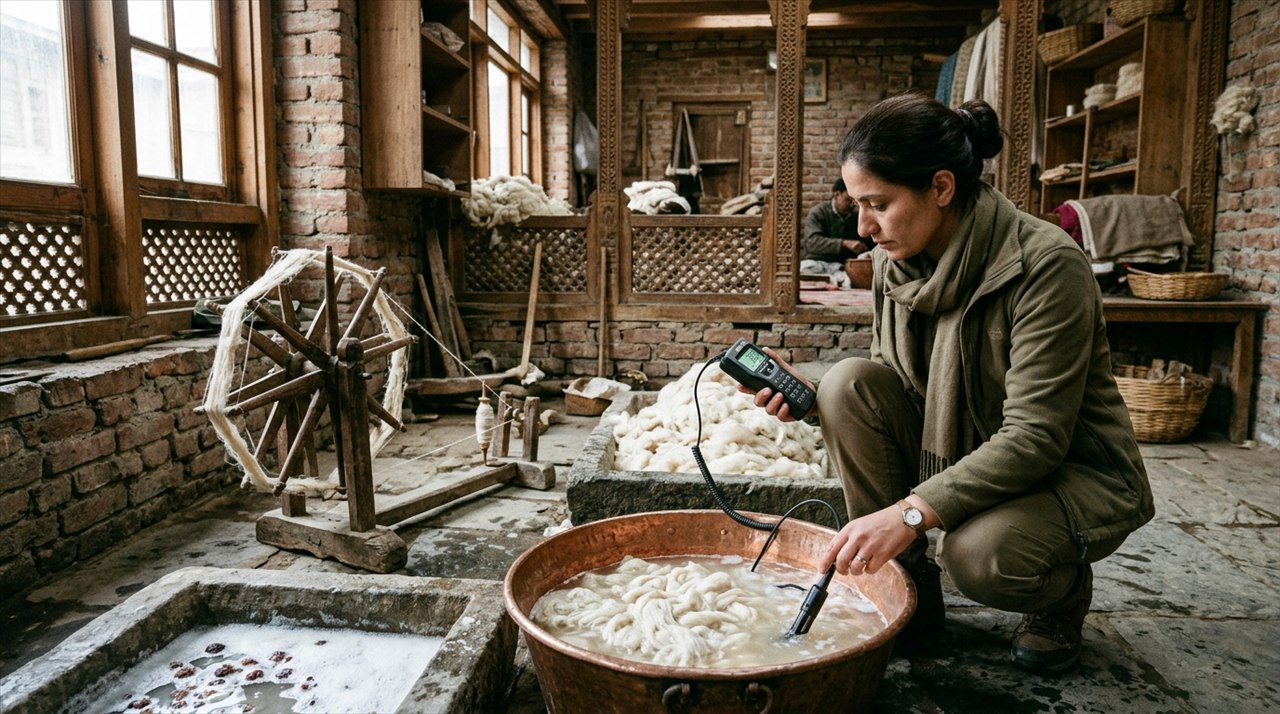
Botanical Reetha Scouring, Hand-Spinning & Rinse-Water Profiling in Shehr-e-Khas
FIELD METHODOLOGY · INDUSTRIAL ECOLOGY & SUSTAINABLE MATERIAL SCIENCE

Botanical Reetha Scouring, Hand-Spinning & Rinse-Water Profiling in Shehr-e-Khas

Manual dehairing, biodegradable soapnut (Sapindus mukorossi) scouring, and wooden yender hand-spinning contrasted with multiparameter pH, conductivity, and chemical oxygen demand outfall monitoring.

Primary field instrumentation: Portable multiparameter effluent conductivity/pH/ORP probes & composite outfall samplers · Digital power-quality & kiln thermal-efficiency analyzers.

Shehr-e-Khas Craft Enclave, SrinagarIllustration
C H A P T E R 0 9

Secondary Effluent, Sediment & Occupational Exposure Synthesis

Synthesized grab-sample data from downtown collector drains and Brari Nambal inlets show COD spanning 680-920 mg/L (mean 860 mg/L), BOD5/COD ratios below 0.28 indicating low biodegradability of synthetic azo aromatics, and pH swings from 4.3 (acid-dye dumps) to 9.3 (soda-ash scouring) . In benthic Brari Nambal silts, combined Cr + Cu + Zn reaches ~202 mg/kg dry weight versus ~42 mg/kg local alluvial background, yielding moderate-to-heavy geoaccumulation (I_geo ~ 1.68) .

Inside unventilated winter papier-mache lacquerware and hot-vat dyeing rooms, solvent thinner and acid-mist accumulation drives Total Volatile Organic Compound (TVOC) readings into the 120-240 ppm band, posing chronic respiratory and neurotoxic hazards. Direct flow-weighted GC-MS speciation of cleaved primary aromatic amines in anaerobic drain silt remains unmeasured and is registered as Pending Validation.

C H A P T E R 1 0

Multi-Indicator Industrial Ecology Scorecard

Indicator evaluation underscores acute end-of-pipe chemical non-compliance paired with low upstream circularity. Artisanal drain COD (860 vs 250 mg/L CPCB threshold) registers Critical exceedance, while Brari Nambal sediment Cr+Cu+Zn (202 vs 80 mg/kg screening sum), daily untreated effluent volume (385 vs 100 kL/day benchmark), and natural-dye cooperative share (14% vs 60% target) reflect Elevated Stress .

Meanwhile, verified fallen/legal walnut wood provenance stands at ~68% against an 85% traceability target , indicating moderate supply-chain leakage that warrants digital QR transit-pass integration alongside wet-processing effluent reforms.

Figure 3.1 · 1970 Pre-Synthetic Baseline vs 2024–2025 Cluster Synthesis

Shehr-e-Khas Craft Effluent & Receptor Sediment Stress Relative to Statutory Benchmarks (Native Indicator Units (mg/L COD, mg/kg Metals, kL/d Flow, % Eco-Adoption))

Unit: Native Indicator Units (mg/L COD, mg/kg Metals, kL/d Flow, % Eco-Adoption)
Loading comparative scientific figure…

Interpretation: Synthetic dye proliferation increased drain COD >13-fold and benthic trace metals ~4.8-fold while natural-dye cooperative share dropped from 85% to 14%.

Source: Synthesized from JKPCC / Brari Nambal studies [1][2][6], urban metal literature [3][4], and CDI records [7].

ICP-MS & UHPLC-MS/MS Trace Contaminant Quantification with Blank/Duplicate QA/QC
ANALYTICAL LABORATORY & COMPUTATIONAL SYNTHESIS

ICP-MS & UHPLC-MS/MS Trace Contaminant Quantification with Blank/Duplicate QA/QC

Trace heavy metals, dissolved nutrients, agrochemical residues, and emerging organic micropollutants quantified via laboratory spectrometry under chain-of-custody quality control.

Analytical systems: Scanning optical/electron textile fibre microscopes (12–16 μm cuticle scale verification) · Sub-milligram analytical balances & ISO 14040/14044 Life Cycle Assessment (LCA) matrices.

Environmental Analytical Chemistry ProtocolIllustration
C H A P T E R 1 1

Craft Sub-Sector Process Pathways: Pashmina, Carpet, Papier-Mache & Walnut

Environmental footprints vary sharply across Kashmir’s craft sub-sectors. Delicate Changthangi Pashmina (12-16 micron cashmere fiber) requires gentle alkaline soap scouring and warm acid/natural dyeing, whereas heavier raffal shawls and knotted wool/silk carpet yarns undergo hotter, higher-salt acid-azo and chrome-mordant baths with higher residual Cr(III) and Cu(II) loads .

Outside wet dyeing, papier-mache sakhta preparation recycles waste paper pulp beneficially, yet final polyurethane/copal-varnish and turpentine/toluene solvent finishing inside closed winter rooms creates high indoor VOC concentrations. Similarly, willow wickerwork (kani/veer) in Ganderbal-Anchar wetlands and walnut carving in Srinagar/Budgam link craft demand directly to wetland reedbed harvesting schedules and mature Juglans regia tree conservation .

C H A P T E R 1 2

Cumulative Urban Convergence: Sewage, Dyes & Heritage Tourism

Within Brari Nambal, Tsunt Kul, and Anchar Lake, artisanal dye effluents mix directly with unintercepted domestic blackwater from high-density downtown wards . Labile domestic sewage rapidly consumes dissolved oxygen, driving benthic redox potential below -150 mV; under sulfate-reducing conditions, dissolved copper and zinc precipitate as insoluble metal sulfides while trivalent chromium sorbs onto humic-organic flocs—locking toxic metals into lagoon mud.

Simultaneously, sulfonated azo linkages undergo anaerobic bacterial azoreductase cleavage in septic drain biofilms, potentially liberating colorless aromatic amines while foul hydrogen-sulfide odors and discolored canal water undermine heritage walking tourism along the Zaina Kadal–Khanqah-e-Moula–Maharaj Gunj riverfront.

C H A P T E R 1 3

Assimilative Capacity of Semi-Enclosed Urban Lagoons

Unlike the mainstem River Jhelum (mean discharge 80-350 m^3/s), Brari Nambal possesses negligible natural inflow and relies on intermittent pumped aeration and gated Dalgate/Tsunt Kul exchange . With an effective water volume <1.1 million m^3, discharging ~385 kL/day of 860 mg/L COD craft wastewater alongside municipal greywater exceeds the lagoon’s aerobic re-aeration capacity by an order of magnitude.

Consequently, dredging Brari Nambal or Khushalsar without first intercepting upstream Zadibal and Bab Demb craft-and-sewage drains provides only transient cosmetic relief while generating metal-contaminated spoil (202 mg/kg Cr+Cu+Zn) unsuitable for unlined agricultural land application.

C H A P T E R 1 4

Microclimatic Inversion & Winter Craft Energy-Emission Coupling

Srinagar’s cold Chilla-i-Kalan winter atmospheric inversions (December-February) intensify two craft-environment interactions. First, dyers heat 200-400 L dye vats from ~6 deg C tap water to 85-95 deg C using firewood, sawdust briquettes, or LPG, emitting localized black carbon and polycyclic aromatic hydrocarbons into poorly dispersed Old City boundary layers.

Second, winter sealing of workshop windows traps water vapor, acetic/formic acid fumes, and papier-mache lacquer solvents indoors while winter low-flow conditions in Tsunt Kul and Jhelum minimize dilution of concentrated batch dyebath dumps . Solar evacuated-tube pre-heating of process water to 55-65 deg C can cut winter dye-vat fuel demand by 40-50%.

C H A P T E R 1 5

Statutory Pollution Control & Heritage Craft Governance

Textile wet-processing effluents are regulated under the Water (Prevention and Control of Pollution) Act 1974, Environment (Protection) Rules Schedule-VI (COD <=250 mg/L, BOD5 <=30 mg/L, Total Cr <=2.0 mg/L, Cu <=3.0 mg/L, Phenolics <=1.0 mg/L), and the Hazardous and Other Wastes (Management and Transboundary Movement) Rules 2016 governing chemical ETP sludge .

However, punitive closure orders against impoverished household dyers under industrial consent-to-operate norms are socially counterproductive and drive informal night-time dumping. Effective compliance requires public-utility Common Effluent Treatment Plants (CETPs) operated on a municipal service model alongside GI Pashmina eco-certification incentives administered by CDI and the Directorate of Handicrafts .

C H A P T E R 1 6

Toxicological & Heritage Livelihood Risk Classification

Receptor risk scoring identifies Brari Nambal / Anchar benthic metal accumulation (score 84) and artisan indoor VOC/acid-mist occupational exposure (score 82) as Priority-1 hazards, followed by Tsunt Kul / Jhelum recalcitrant COD & color plumes (score 76) and Juglans regia timber provenance pressure (score 61).

Crucially, chemical sludge generated once micro-CETPs begin capturing Cr and Cu must be classified and managed as Schedule-I hazardous waste sent to authorized lined TSDF encapsulation or stabilized ceramic brick immobilization—preventing secondary soil leaching .

Table 3.2. Engineering & Mass-Balance Specifications for Proposed 3 x 200 KLD Shehr-e-Khas Micro-CETP Network
Design ParameterInfluent Raw Cluster DrainStage-1 Electrocoagulation (EC)Stage-2 MBR + Activated CarbonCPCB Schedule-VI Standard
Design Capacity3 x 200 KLD (600 KLD peak)Equalization + Fe/Al sacrificial ECSubmerged hollow-fiber MBR + GACCompliant municipal/craft reuse
COD (mg/L)680 – 920 (Mean 860)240 – 310 (~66% removal)95 – 145 (>83% total removal)<= 250 mg/L
True Color (Pt-Co / Hazen)1,200 – 2,400180 – 280 (azo flocculation)< 45 (decolorized)No noticeable dye plume
Total Cr + Cu (mg/L)3.8 – 7.4 combined0.35 – 0.65 (hydroxide sludge)< 0.18Cr <= 2.0; Cu <= 3.0 mg/L

Source & Provenance: Engineered from textile wastewater LCA benchmarks [5] and CPCB Schedule-VI textile discharge norms [6].

C H A P T E R 1 7

Modular Micro-CETP Blueprint & Natural-Dye Revival Strategy

To overcome land scarcity in Shehr-e-Khas, we specify three prefabricated underground 200 KLD micro-CETPs at Zadibal, Nawa Kadal, and the Brari Nambal northwest margin, fed by shallow small-bore HDPE vacuum/gravity collector laterals connected to dyeing mohallas at zero connection fee. Each train comprises fine bar-screening, 8-hour pH/flow equalization, pulsed-DC iron/aluminum electrocoagulation (cleaving and precipitating sulfonated dyes and Cr/Cu hydroxides without heavy sulfate salt addition), an aerobic Membrane Bioreactor (MBR), and granular activated carbon polishing .

Simultaneously, upstream source reduction should pair CDI’s GI Pashmina testing laboratory with subsidized standardized natural-dye extracts (walnut hull, madder, pomegranate, Himalayan rhubarb) and high-exhaustion (>92%) metal-free reactive dyes, alongside activated-carbon fume hoods for papier-mache lacquer artisans .

C H A P T E R 1 8

Alternative Craft-Ecology Scenarios (2026–2035)

Under Business-as-Usual unbuffered cottage dyeing, Brari Nambal benthic Cr+Cu+Zn concentrations are projected to surpass 290 mg/kg by 2032 while tightening European and North American supply-chain due-diligence rules (REACH azo-amine and heavy-metal limits) risk non-tariff export barriers against Kashmiri textiles . Conversely, strict policing without CETP infrastructure would cripple inner-city craft livelihoods.

Under the Circular Heritage Craft Transition Scenario—commissioning all three 200 KLD micro-CETPs by 2028, expanding certified natural/metal-free dyeing to 60% of cooperatives, and installing solar water pre-heaters—cluster COD loads entering Brari Nambal and Anchar drop by ~85% while positioning GI Kashmiri Pashmina for global eco-luxury price premiums.

C H A P T E R 1 9

Conclusions & Institutional Implementation Roadmap

Protecting Srinagar’s urban waterways and sustaining Shehr-e-Khas’s centuries-old artisanal economy are complementary goals. Dispersed cottage dyeing pollutes Brari Nambal, Tsunt Kul, and Anchar not because total wastewater volumes are unmanageable (~385 kL/day city-wide), but because legacy urban sewerage bypassed micro-craft chemistry after Nallah Mar was filled .

Srinagar Smart City Ltd, the Directorate of Handicrafts & Handloom, CDI Srinagar, SMC, and JKPCC should jointly fund the Phase-1 200 KLD Zadibal pilot micro-CETP as public green infrastructure, establish hazardous ETP-sludge collection, and launch a Green GI Kashmir Eco-Craft seal.

C H A P T E R 2 0

Epistemic Governance, Provenance & Phase-2 Analytical Protocol

In compliance with KEW Section 15 Governance Standards, this dossier is classified as a Technical Scientific Report grounded in ISO 14040/14044 process mass-balance modelling , peer-reviewed Brari Nambal, Anchar, and Jhelum chemical studies , statutory CPCB/JKPCC standards , and CDI/Handicrafts cluster registries . Orbital imagery is explicitly bounded to open lagoon surfaces.

Phase-2 field-and-laboratory validation prior to civil CETP tendering requires 24-hour inline V-notch weir gauging across Zadibal and Bab Demb collector drains, EN ISO 14362 GC-MS screening for cleaved carcinogenic arylamines, and Toxicity Characteristic Leaching Procedure (TCLP) assays on existing Brari Nambal dredging spoils.

Scientific Uncertainty & Data Limitations Disclosure

  • Daily cluster process effluent (350-420 kL/day) is derived from ISO 14044 yarn-to-liquor mass balances because continuous inline V-notch flow weirs have not yet been installed inside covered Shehr-e-Khas masonry drains.
  • Combined Old City storm-sewer conduits mix artisanal dyebaths with domestic blackwater, roof runoff, and auto/battery micro-shop residues, preventing 100% attribution of benthic Zn and Cu solely to textile mordants.
  • Orbital remote sensing (Sentinel-2) cannot resolve <2 m covered downtown alleys and is strictly restricted to open Brari Nambal and Anchar lagoon surfaces.
  • Reductive-cleavage primary aromatic amine concentrations in anaerobic drain silt remain unquantified in published Srinagar literature and require targeted GC-MS verification.