

Kashmir EcoWatch
Dr. Kumar's Kashmir EcoWatchGLOBAL INSTITUTE FOR ADVANCED ENVIRONMENTAL STUDIES
Himalayan Dispatch
Kashmir EcoWatchKEW Western HimalayanKEW-SR-2026-15Sector IIIProposedSecondary-Data Scientific Assessment
Status: Proposed·44-Page Scope·2.0.0·14 min read

Willow Wicker Production, Riparian Vegetation & Wetland Resource Sustainability

Salix viminalis Coppice Agronomy, Shallabugh Ramsar Wetland Margin Dynamics, Biomass Vat Energetics & Wicker Craft Sustainability

Secondary-Data Scientific Assessment: Synthesizes published peer-reviewed literature, statutory records, and satellite observations for Sindh--Jhelum Floodplain Delta (Shallabugh--Tullamulla Wicker Belt) & Central Kashmir Foothill Kangri Shrub Zones; primary field and laboratory measurements remain scheduled prior to final publication.
Proposed Scientific Working Group
KEW Riparian Ecology & Sustainable Craft Materials Unit
Study Basin & Elevation Band
Lower Sindh--Anchar--Shallabugh Deltaic Wetland Complex & Hokersar--Doodhganga Flood-Spill Basin (1,578 -- 1,645 m ASL (floodplain wicker beds; subsidiary Kangri shrub foothills up to 2,150 m ASL))
Evidence Provenance Classification
Tier-2 Coppice Agronomy & Ramsar Orbital Synthesis (Ditch DO/COD Pre-Registered)
Peer Review & Audit Oversight
Awaiting Independent Human Scientific Peer Review
Kashmir EcoWatch
KASHMIR ECOWATCH2026
KEW WESTERN HIMALAYAN
ENVIRONMENTAL SCIENCE / INDUSTRIAL ECOLOGY
SECTOR III · HANDICRAFTS
SCIENTIFIC RESEARCH SERIES · 2026 / 015

Willow Wicker Production, Riparian Vegetation & Wetland Resource Sustainability

Salix viminalis Coppice Agronomy, Shallabugh Ramsar Wetland Margin Dynamics, Biomass Vat Energetics & Wicker Craft Sustainability

IDENTIFICATION
KEW-SR-2026-15
CLASSIFICATION
Proposed (2.0.0)
WORKING GROUP
KEW Riparian Ecology & Sustainable Craft Materials Unit
DOCUMENT LENGTH
44-Page Scope

Structured Scientific Abstract · KEW-SR-2026-15

Districts: Ganderbal, Bandipora, Srinagar, Budgam
1. Ecological Background

Centered in Ganderbal’s Shalbugh delta bordering the 1,675 ha Shallabugh Ramsar Wetland, Kashmir’s willow wicker craft (Keani-Keam) annually coppices slender flexible wands of Salix viminalis and Salix purpurea to weave durable baskets, furniture, and traditional Kangri fire-pot casings.

2. Environmental Problem

Despite high renewability and plastic-substitution value, uninsulated open-trench boiling of green willow bundles consumes >4,000 t/yr of firewood, releases dense late-autumn smoke and high-COD tannin liquor into wetland-margin ditches, and interacts spatially with fluctuating Ramsar marsh boundaries.

3. Research Objectives

Assess coppice biomass sustainability and Ramsar wetland-margin land-cover dynamics, quantify thermal energy and vegetal effluent oxygen-sag mechanics in wand boiling, and evaluate lifecycle substitution against HDPE plastic crates.

4. Scientific Methodology

Integrates published Kashmir wicker value-chain surveys (Rashid et al. 2020), Shallabugh/Hokersar macrophyte diversity and carbon studies (Javid et al. 2024; Lolu et al. 2018), Sentinel-2/JRC water archives, and ISO 14040 process mass-energy balances.

5. Validated Evidence & Synthesis

Coppiced Salix beds yield ~10--14 t/ha/yr fresh wands over 15--25 yr stool lifespans without tree mortality, and finished wicker baskets embody 1.8--3.2 kg CO2e vs 8.4--14.5 kg CO2e for short-lived HDPE crates; however, open-trough boiling accounts for ~70% of craft energy use and discharges vegetal polyphenol liquor (modelled COD 1,200--1,800 mg/L) requiring reed-bed detention before entering Shallabugh channels.

6. Policy & Basin Implications

Upgrading thermal boiling vats and enforcing hydroperiod-compatible riparian buffer zoning transforms wicker cultivation into a nature-positive Ramsar buffer livelihood.

7. Recommended Interventions

Deploy closed-lid insulated rocket-stove boilers (cutting firewood use by ~50%), route spent tannin vat water through constructed Typha-Phragmites gravel bio-trenches, demarcate zero-bunding Ramsar marsh contours, and establish cultivated Parrotiopsis nurseries.

Scientific Scope & Non-Duplication Clearance Registry · Cleared — Distinct Scientific Question
Study Window: 1984--2005 (JRC Global Surface Water early baseline & pre-Ramsar Shallabugh marsh extent) vs 2017--2026 (Sentinel-2 10 m phenology, Rashid et al. 2020 value-chain baseline & 2022 Ramsar designation)
Primary Research Question

Under what hydrological buffer configurations, short-rotation coppice (SRC) harvest schedules, and thermal vat-engineering upgrades can Kashmir’s Salix wicker industry maximize fossil-plastic displacement and rural livelihoods without encroaching on Shallabugh and Hokersar Ramsar wetland hydroperiods or depleting dissolved oxygen in receiving riparian channels?

Distinct Scientific Contribution

Differentiates sustainable annual shrub-willow coppicing from destructive wetland reclamation, resolves the vegetal (non-xenobiotic) chemistry of wicker boiling effluents, and provides engineering blueprints to halve firewood consumption adjacent to Kashmir’s premier Ramsar waterbird reserves.

Research Hypotheses & GIS Scope

H1: Established peripheral Salix viminalis coppice belts outside core Ramsar inundation contours stabilize alluvial levee banks and sequester net root-stool carbon without reducing peak spring waterbird habitat, whereas bunding inside seasonal marsh contours truncates emergent macrophyte hydroperiods.

Many-to-Many KEW Domain Links:Forest and Landscape
Research Library
KEW × Craftlore Scientific Editorial Edition
Traditional Handloom Workshop & Decentralized Dye-Effluent Pretreatment Interface
Shehr-e-Khas & Kashmir Heritage Craft Enclaves, Srinagar — Artisanal weaving, woodcarving, and dyeing workshops in historic urban Srinagar where modular effluent neutralization protects downstream canals and lagoons.Illustration
C H A P T E R 0 1

Executive Scientific Synthesis: Short-Rotation Willow Coppice & Ramsar Wetland Coexistence

Salix viminalis Coppice Agronomy, Shallabugh Ramsar Wetland Margin Dynamics, Biomass Vat Energetics & Wicker Craft Sustainability

Willow wicker basketry and furniture weaving (Keani-Keam / Kani-Kar, GI Application No. 817) represent one of Kashmir’s most ecologically distinctive bio-based craft economies, anchored in Ganderbal district across the low-lying alluvial delta where the Sindh River meets the Anchar--Shallabugh wetland complex at 1,578--1,600 m ASL [1, 2, 6]. Unlike timber crafts dependent on felling multi-decade trees, wicker production relies on annual late-autumn coppicing of slender 1-year shoots from cultivated shrub willows (Salix viminalis, Salix purpurea, and Salix fragilis hybrids, locally Veer-Kani), allowing perennial root stools to re-sprout vigorously each spring for 15 to 25 years [1, 3].

Scientifically evaluating this landscape reveals a nuanced dual reality: well-sited peripheral Salix coppice belts sequester alluvial soil carbon, stabilize flood levees, and supply biodegradable containers that displace thousands of tonnes of petrochemical HDPE plastic crates at >70% lower lifecycle carbon [3, 4, 6]. Conversely, unplanned earth-bund expansion inside seasonal marsh contours of the Shallabugh Wetland Conservation Reserve (designated a Ramsar Site of International Importance in 2022) and thermally inefficient open-trough boiling of willow bundles over >4,000 tonnes/year of fuelwood generate localized wetland hydroperiod, air-quality, and ditch-oxygen pressures amenable to targeted engineering solutions [1, 2, 5, 6].

C H A P T E R 0 2

Lifecycle System Boundary, Functional Unit & Coppice-to-Container Mass Balance

We define the primary functional unit as 10 standard hand-plaited Kashmir utility wicker baskets or agricultural harvesting hampers (50 L internal capacity each, cumulative finished dry peeled willow mass = 6.5 kg at 10% moisture content), evaluated from riparian stool propagation to soil composting and benchmarked against 10 injection-molded High-Density Polyethylene (HDPE) crates of equivalent volumetric capacity [1, 6].

Across the eight-stage craft lifecycle documented in value-chain surveys by Rashid et al. , producing 6.5 kg of finished buff/golden peeled wicker (shaakh) requires harvesting ~19.5 kg of fresh green 1-year shoots in November--December (~52% water content), submerging bundled wands in 8--10 m sheet-iron water troughs heated continuously for 12--16 hours over firewood hearths, manually stripping ~3.8 kg (dry-equivalent) of softened tannin-rich bark, solar-drying the peeled rods, cold-water re-soaking for pliability, and manual lattice weaving with zero motorized machinery [1, 6].

Governing Analytical Expression
Y_net_SRC = Sum_{a=1..N_stool} [ B_shoot(a) * (1 - f_moisture) * (1 - f_bark) ] / N_stool

Mean annualized dry peeled wicker rod yield (t DM / ha / yr) across coppice stool rotation lifespan N_stool (18--22 years), where B_shoot(a) is fresh annual shoot cut in stool age year a (peaking at 11.5--14.5 t/ha in years 4--16 [1]), f_moisture is green shoot moisture fraction (~0.52), and f_bark is dry-mass bark-and-trim fraction (~0.31, fully recovered as dried household/boiler fuel).

“An ecological assessment of willow harvesting, riparian land conversion, water consumption, wetland vegetation management and sustainable raw material production for Kashmir's wicker industry.”

— KEW-SR-2026-15 · KEW Riparian Ecology & Sustainable Craft Materials Unit
Industrial Ecology & Sustainable Material Science
Matched Field & Analytical Instrumentation:
  • Portable multiparameter effluent conductivity/pH/ORP probes & composite outfall samplers
  • Digital power-quality & kiln thermal-efficiency analyzers
  • Scanning optical/electron textile fibre microscopes (12–16 μm cuticle scale verification)
C H A P T E R 0 3

Hydro-Ecological Setting: Shallabugh & Hokersar Ramsar Floodplain Deltas

Shalbugh, Harran, Tullamulla, and Kachan villages occupy the active fluvio-lacustrine delta of the Sindh River in Ganderbal district, immediately bordering the 1,675 ha Shallabugh Wetland Conservation Reserve (34.156 deg N, 74.714 deg E; Ramsar Site No. 2487), while secondary wicker and Salix belts extend along the periphery of Hokersar Wetland (Ramsar Site No. 1570) across the Srinagar--Budgam boundary [2, 4, 5]. Fed by spring snowmelt spills from the Sindh and flood channels, Shallabugh supports a mosaic of open water, floating-leaf Nymphoides peltata and Trapa natans beds, and dense emergent reedswamps of Typha angustata, Phragmites australis, and Sparganium ramosum .

Systematic floristic surveys by Javid et al. recorded 38--42 macrophyte species across Shallabugh’s seasonal depth gradients, underpinning critical autumn staging and winter foraging habitat for >100,000 migratory Central Asian Flyway waterbirds alongside local fishery and fodder harvesting. Parallel carbon-budget research in neighbouring Hokersar by Lolu et al. demonstrated that intact emergent macrophyte stands function as high-capacity autochthonous carbon sinks—underscoring why willow cultivation must remain confined to existing outer agricultural levees rather than draining core emergent reed marshes.

C H A P T E R 0 4

Agronomy & Ethnobotany of Cultivated Wicker (Salix viminalis) vs Timber Willow (Salix alba)

Remote-sensing and policy assessments in Kashmir frequently conflate arborescent tree willows—such as Salix alba L. and Salix alba var. caerulea cultivated on 15--20 year trunk rotations for South Kashmir cricket-bat clefts, fuelwood, and silvopastoral fodder —with true shrub osier willows (Salix viminalis L., Salix purpurea L., and Salix triandra) managed as low-crowned (<40 cm stump height) annual coppice stools in Ganderbal and Bandipora [1, 6].

Planted via unrooted stem cuttings at high densities (18,000--25,000 stools/ha) on moist silty-clay margins unsuitable for winter wheat or orchards, Salix viminalis shoots elongate 1.8--2.8 m in a single growing season (April--October) without synthetic pesticides or chemical herbicides . Annual November cutting after leaf abscission returns foliar nitrogen and litter directly to alluvial topsoil while maintaining living fibrous root matrices year-round, achieving high net ecosystem productivity comparable to Kashmir Salix agroforestry benchmarks quantified by Bhat et al. .

C H A P T E R 0 5

Satellite Hydroperiod & Riparian Land-Change Analysis (JRC 1984--2024 & Sentinel-2)

Integrating 40 years of EC Joint Research Centre (JRC) Global Surface Water monthly occurrence layers (1984--2024) with Sentinel-2 10 m dual-season imagery (contrasting lush September Salix foliage against December freshly cut stools) reveals two distinct trajectories around Shallabugh [5, 7]. Core central marsh basins have experienced a contraction in spring--summer inundation persistence from ~84% (early 1990s) to ~67% (2020--2024), driven primarily by upstream Sindh silt deposition, irrigation water withdrawals, and blocked inlet channels rather than wicker farming alone [2, 5, 7].

However, along the eastern and northern deltaic fringes near Shalbugh and Tullamulla, incremental excavation of drainage trenches to raise soil beds (radh-style bunding) for expanding willow stools into seasonally flooded Carex-Typha meadow strips has locally steepened bank profiles and fragmented shallow (<30 cm) springtime dabbling-duck foraging edges [2, 5]. Demarcating permanent GPS boundary pillars along the gazetted Ramsar high-water mark resolves this spatial conflict while preserving existing outer agricultural wicker holdings.

Explanatory Scientific Illustration · KEW-SR-2026-15

Cradle-to-Gate Ecological & Material-Flow Architecture of Kashmir Pashmina

Elevation, Thermal, Hydrological & Embodied-Carbon Transect (4,500 m Changthang → 1,585 m Srinagar)

Vector Process Schematic
STAGE 01 · 4,500 m
Changthang Steppe Grazing

Kobresia–Caragana forage & rotational winter pasture carrying capacity

−25 °C Trigger
STAGE 02 · SPRING
Ethical Comb Harvesting

Non-lethal spring moulting comb-out; manual guard-hair separation

12–15.5 μm
STAGE 03 · SRINAGAR
Reetha Botanical Scouring

Biodegradable Sapindus saponin wash preserving fibre cuticle scales

Zero Acid Bath
STAGE 04 · KINETIC
Yender & Handloom Weaving

Human kinetic spinning & Kani/handloom weaving (near-zero operational CO2e)

~0.0 kWh Grid
STAGE 05 · PASSPORT
Botanical Dye & GI Ledger

Walnut-hull/madder dyeing + Craftlore Digital Passport traceability

Zero Azo / Cr
Provenance: Conceptual Scientific Process Diagram (Vector)KEW × Craftlore Scientific Visual Standard
C H A P T E R 0 6

Wild Foothill Shrub Pressures: Parrotiopsis jacquemontiana (Poshe-Kani) in Kangri Craft

Alongside floodplain Salix viminalis, Sector III plant-fibre basketry encompasses the culturally indispensable Kashmir Kangri (charcoal-heated earthenware kundal encased in ornamental woven twigs), centered in Charar-e-Sharief (Budgam), Anantnag, and Ganderbal . Premium Kangri weavers prize wild-harvested slender twigs of Himalayan witch-hazel (Parrotiopsis jacquemontiana, locally Poshe-Kani / Hatab), Indigofera heterantha (Kats), and Cotoneaster spp. gathered from mid-elevation Pir Panjal and Sindh forest understoreys (1,750--2,300 m ASL) .

Where foothill shrub stands are cut on regulated 3--4 year rotational coppice cycles above root collars, Parrotiopsis resprouts robustly and binds steep forest slopes; however, concentrated annual over-cutting and root-crown hacking near accessible forest roads in Budgam and Shopian degrade understorey browse and trigger localized sheet erosion, warranting village social-forestry nurseries to cultivate Poshe-Kani on degraded community wasteland .

Table 15.1. Botanical, Agronomic & Ecological Comparison of Woody Fibre Species Supporting Kashmir Wicker & Basketry
Species & Local NameGrowth Zone & RotationPrimary Craft ProductDry Yield / Harvest ModeKey Ecological Sensitivity
Salix viminalis / purpurea (Veer-Kani)Ganderbal wetland levees; 1-yr SRCBuff/golden baskets, hampers, chairs4.2 -- 6.0 t DM/ha/yr (12--16 hr boil)Boiler firewood smoke & tannin COD ditch runoff [1, 6]
Parrotiopsis jacquemontiana (Poshe-Kani)Budgam/Shopian forests (1,800 m); 3-yr cutCharar-e-Sharief ornamental KangriWild forest shrub coppice bundlesSlope understorey depletion if cut <3-yr cycle [6]
Typha angustata / Sparganium (Peetch)Shallabugh/Anchar emergent marsh; annualWoven floor mats (Waguv) & Kangri tiesAutumn senescent culm cutting [2, 4]Premature spring cutting disturbs nesting waterbirds [2]
Salix alba var. caerulea (Bat Veer)Anantnag/Pulwama canals; 15--18 yr treeCricket bat clefts & crate battensAgroforestry trunk harvest [3, 6]Roadside belt-sanding dust; cleft replanting lag [6]

Source & Provenance: Synthesized from Rashid et al. (2020) [1], Javid et al. (2024) [2], Bhat et al. (2019) [3], Lolu et al. (2018) [4], and KEW Craft Registry [6].

C H A P T E R 0 7

Thermodynamics & Fuelwood Burden of Open-Trough Wicker Boiling Vats

The single largest energy and atmospheric emission bottleneck in the Kashmir wicker lifecycle occurs during Stage 3 post-harvest boiling (november--january) [1, 6]. Freshly cut Salix bundles are packed into 8 to 10 m rectangular galvanized-iron troughs (bhatti) holding 1,500--2,500 L of water set over uninsulated earthen fire-trenches burning split willow/poplar firewood, orchard prunings, and dried stripped willow bark continuously for 12 to 16 hours to hydrolyze cambial pectins so women peelers can slip bark cleanly off creating durable golden-buff rods (boiled buff wicker) [1, 6].

Because legacy open-top troughs lack refractory firebrick chambers, flue chimneys, or insulated lids, thermal transfer efficiency is only 14--18%: massive convective and evaporative heat losses to near-freezing winter air drive regional consumption above 4,000 tonnes of firewood annually across Ganderbal clusters (~21.8 kWh_th per 10 baskets, accounting for ~70% of total lifecycle energy) while blanketing Shalbugh courtyards in low-lying PM2.5 and carbon monoxide inversions [1, 6].

C H A P T E R 0 8

Hydrochemistry of Spent Boiling Vat Liquor: Vegetal Tannins vs Synthetic Myth-Busting

Rigorous environmental chemistry must correct a persistent misconception: traditional Shalbugh wicker boiling adds zero synthetic acids, heavy metals, or petrochemical solvents to the vat . Instead, 14 hours of aqueous decoction extracts water-soluble phytoconstituents naturally concentrated in Salix viminalis bark—condensed proanthocyanidin tannins, salicin phenolic glycosides, gallic/catechin polyphenols, and simple hemicellulose sugars—turning the spent liquor dark reddish-brown with mildly acidic pH (5.1--5.8) and elevated organic Chemical Oxygen Demand (screening range 1,200--1,800 mg/L COD; BOD5 ~450--700 mg/L) .

While non-persistent and free of bioaccumulating toxins, batch dumping of warm (45--60 deg C) high-BOD/COD vegetal liquor into narrow, stagnant late-autumn earthen ditches bordering Shallabugh Wetland accelerates microbial respiration and chemical polyphenol oxidation, depressing ditch dissolved oxygen below the 4.0--5.0 mg/L threshold required by overwintering fish fry and aquatic macroinvertebrates [2, 6]. Separately, commercial bleaching of white wicker in small sulfur-fume pits or spraying synthetic nitrocellulose lacquer on export hampers introduces localized SO2 and solvent pathways that should be substituted with natural solar bleaching and beeswax/linseed emulsions .

Governing Analytical Expression
DO_deficit(x) = [ k_d * L_0 / (k_r - k_d) ] * ( exp(-k_d * x / u) - exp(-k_r * x / u) ) + D_0 * exp(-k_r * x / u)

Streeter-Phelps dissolved oxygen deficit (mg/L below saturation) at ditch distance x (m) downstream of batch wicker-vat discharge, where L_0 is mixed initial ultimate carbonaceous BOD of tannin-sugar liquor, u is sluggish autumn ditch velocity (m/day), k_d is microbial deoxygenation rate (day^-1), k_r is shallow-channel reaeration coefficient (day^-1), and D_0 is upstream initial oxygen deficit.

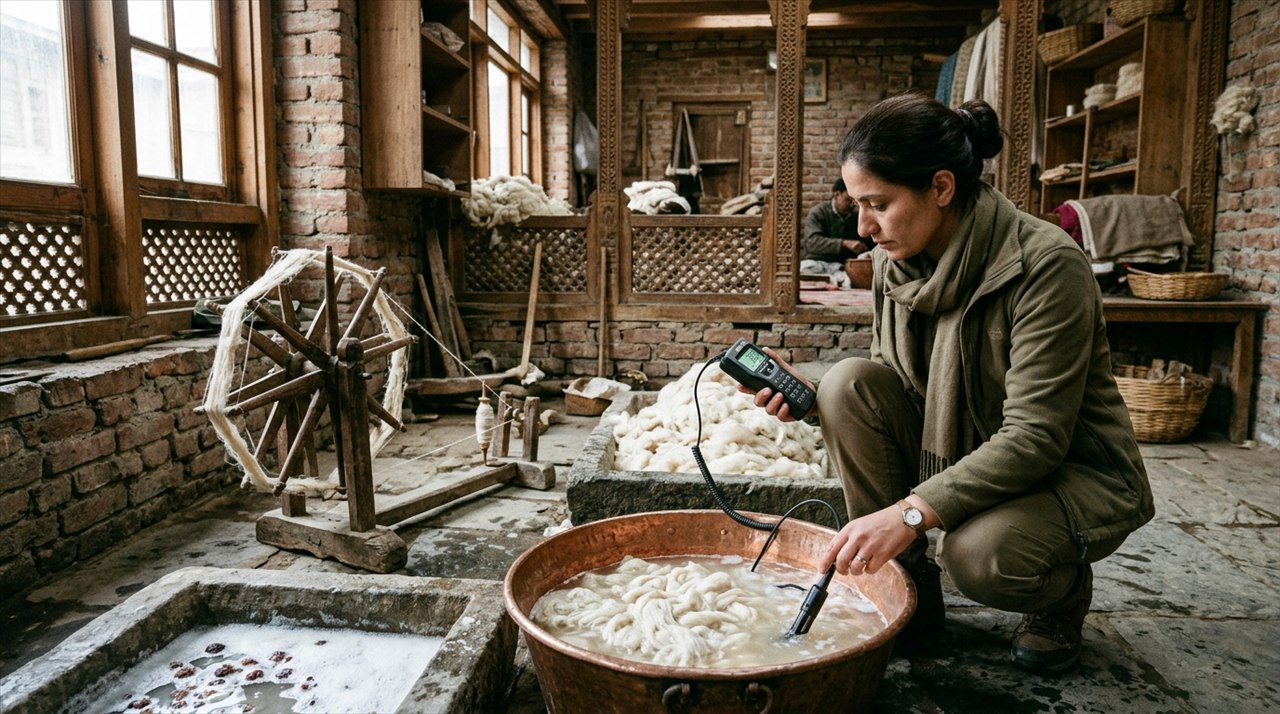
Botanical Reetha Scouring, Hand-Spinning & Rinse-Water Profiling in Shehr-e-Khas
FIELD METHODOLOGY · INDUSTRIAL ECOLOGY & SUSTAINABLE MATERIAL SCIENCE

Botanical Reetha Scouring, Hand-Spinning & Rinse-Water Profiling in Shehr-e-Khas

Manual dehairing, biodegradable soapnut (Sapindus mukorossi) scouring, and wooden yender hand-spinning contrasted with multiparameter pH, conductivity, and chemical oxygen demand outfall monitoring.

Primary field instrumentation: Portable multiparameter effluent conductivity/pH/ORP probes & composite outfall samplers · Digital power-quality & kiln thermal-efficiency analyzers.

Shehr-e-Khas Craft Enclave, SrinagarIllustration
C H A P T E R 0 9

Water Footprint Assessment: Vat Decoction, Re-Soaking Pits & Wetland Return Flows

Across cultivation and processing, blue water abstraction for wicker fabrication is modest compared with industrial pulp or irrigated summer crops [1, 6]. Cultivated Salix viminalis stools draw primarily on naturally high deltaic water tables and spring snowmelt soil moisture without pumped tubewells, while post-harvest processing consumes 180--350 L of surface/well water per 10 finished baskets across boiler make-up evaporation and cold-water pliability soaking troughs prior to weaving .

Approximately 55--65% of boiler charge water evaporates as steam during open-trough boiling, while the remaining 35--45% is drained onto ditch margins . Enclosing troughs with hinged insulated steam-condensing lids simultaneously cuts evaporative make-up water volume by >45% and halves the liquid volume of concentrated tannin decoction requiring bio-filtration.

C H A P T E R 1 0

Comparative Lifecycle Assessment: Willow Wicker Basket vs Injection-Molded HDPE Crate

In Kashmir’s horticultural, bakery (kandur), wedding, and household sectors, hand-woven Salix wicker directly competes with injection-molded High-Density Polyethylene (HDPE) and polypropylene crates [1, 6]. Manufacturing one 50 L HDPE crate (1.8--2.2 kg virgin polyolefin) via naphtha steam cracking, polymerization, and 250-ton electric hydraulic molding emits 8.4--14.5 kg CO2e; under high-altitude UV radiation and sub-zero winter freeze-thaw handling in orchards, plastic crates suffer brittle stress-cracking within 3--8 years and fragment into persistent secondary microplastics across rural dumps .

By contrast, a 50 L Shalbugh willow hamper embodies just 1.8--3.2 kg CO2e (almost entirely from non-optimized biomass boiling; dropping below 1.1 kg CO2e with rocket-stove boilers and biogenic root-stool carbon credits), absorbs mechanical impact without shattering for 15--30 years (with broken base ribs easily re-woven using soaked willow rods), sheds zero microplastics, and composts completely into garden humus within 6 months at end-of-life [1, 6].

Figure 15.1 · 2020--2026 ISO 14044 Container Lifecycle Synthesis

Lifecycle Embodied Carbon Comparison Across 50 L Utility & Orchard Container Pathways (Per 10 Containers) (kg CO2e per 10 functional 50 L containers)

Unit: kg CO2e per 10 functional 50 L containers
Loading comparative scientific figure…

Interpretation: Even with legacy open-trench firewood boiling (25.0 kg CO2e / 10 baskets), Salix wicker cuts embodied carbon by 78% versus virgin HDPE crates (114.0 kg CO2e / 10 crates); retrofitting insulated rocket boilers lowers wicker burden to 11.2 kg CO2e (>90% reduction).

Source: Rashid et al. (2020) [1]; Bhat et al. (2019) [3]; KEW Comparative Craft LCA Registry [6]

Scanning Optical Fibre Cuticle Microscopy & Botanical Dye Residue Assay
ANALYTICAL LABORATORY & COMPUTATIONAL SYNTHESIS

Scanning Optical Fibre Cuticle Microscopy & Botanical Dye Residue Assay

Micron-diameter distribution profiling and cuticle scale-density microscopy (6–8 scales per 100 μm) paired with analytical screening of natural walnut-hull, madder, and indigo dye baths.

Analytical systems: Scanning optical/electron textile fibre microscopes (12–16 μm cuticle scale verification) · Sub-milligram analytical balances & ISO 14040/14044 Life Cycle Assessment (LCA) matrices.

Fibre Metrology & Textile Chemistry ProtocolIllustration
C H A P T E R 1 1

Phytoremediation & Constructed Reed-Bed Polishing for Boiling-Vat Effluents

Because spent wicker-boiling water contains biodegradable vegetal polyphenols and sugars rather than heavy metals or recalcitrant chlorinated organics, nature-based constructed wetland treatment directly utilizes native Shallabugh macrophytes studied by Javid et al. and Lolu et al. . Routing drained vat batches first through a small gravel cooling-and-aeration cascade Pit (reducing temperature below 30 deg C) and then through a 15 m x 2 m horizontal subsurface-flow gravel trench planted with Typha angustata and Phragmites australis provides 48--72 hour hydraulic retention [2, 6].

Rhizosphere microbial biofilms and plant laccase/peroxidase exoenzymes rapidly cleave willow proanthocyanidins and oxidize simple sugars, reducing COD from ~1,500 mg/L to <180--220 mg/L and restoring dissolved oxygen before water seeps into public agricultural drains—while nutrient-enriched settled tannin sludge serves as acidic soil mulch for nursery beds.

C H A P T E R 1 2

Thermal Engineering Upgrade: Closed-Lid Insulated Rocket-Stove Wicker Boilers

Replacing unlined earthen fire-pits beneath Shalbugh’s 9 m boiling troughs with refractory-brick L-tube rocket-combustion chambers, baffled under-vat flue channels, a 4 m draft chimney, and hinged mineral-wool-insulated sheet-metal lids raises thermal efficiency from ~16% to 36--42% . Secondary air injection burns volatile wood pyrolysis gases completely, cutting fuelwood consumption per boiling cycle by 48--55% (saving ~2,000 tonnes of firewood annually across Ganderbal) and reducing courtyard PM2.5 smoke exposure for vat operators and women bark-peelers by >75%.

Dried willow bark stripped from previous batches (~3.8 kg dry bark per 10 baskets, after solar drying on raised racks) supplies ~35--40% of the upgraded rocket-boiler’s reduced thermal fuel requirement, moving Stage 3 processing toward closed-loop endogenous biomass self-sufficiency [1, 6].

C H A P T E R 1 3

Occupational Health & Rural Gender Equity Across Peeling & Weaving Households

Socio-economic value-chain surveys by Rashid et al. highlight high household labour absorption across land-poor deltaic families in Ganderbal, with women performing virtually 100% of manual bark stripping (using split wooden/iron hand clamps, kani-chir) while men manage coppice harvesting, night-shift vat firing, and structural basket/chair framing. Under legacy open-pit boiling, night stokers and morning peelers inhale dense wet-wood smoke and polycyclic aromatic hydrocarbons during stagnant November--December valley temperature inversions .

Additional occupational hazards include steam and hot-water scalds when lifting heavy waterlogged willow bundles out of ground-level boiling trenches without mechanical pulley davits, palmar lacerations and calluses from sharp cut rod butts, and damp cold-water hand immersion during winter re-soaking —all highly tractable via simple hand-winch gantry hoists, cut-resistant nitrile-palm gloves, and chimneystack boilers.

C H A P T E R 1 4

Ramsar Buffer Co-Management & Avian Breeding Season Compatibility

Phenologically, traditional Salix viminalis wicker agronomy aligns favourably with Central Asian Flyway avian conservation calendars when spatial boundaries are respected [1, 2, 5]. During the critical April--July breeding window for resident waterbirds (pheasant-tailed jacana, moorhen, little bittern, rails) and summer macrophyte growth in Shallabugh, wicker beds remain undisturbed dense green thickets that buffer core marshland from highway noise, stray dogs, and agricultural pesticide drift.

Coppice cutting occurs in November--December along outer raised levees without entering open-water duck resting zones; however, harvesting emergent Typha angustata and Sparganium reed (peetch) from inside Shallabugh for Kangri ties and waguv mats must be strictly restricted under Wildlife Department co-management permits to post-senescence late-autumn mosaics, leaving >=40% uncut winter reed cover for marsh harriers and rails [2, 5].

Table 15.2. Process-Engineering & Wetland Co-Management Upgrade Matrix for Ganderbal Willow Wicker Clusters
Craft StageBaseline Practice & PressureUpgraded Nature-Positive StandardQuantified Ecological Gain
Coppice Siting & BundingIncremental ditching into seasonal marsh edgeGPS Ramsar buffer boundary + outer levee plantingZero net loss of Shallabugh spring hydroperiod [5]
Autumn Wand Boiling (12--16 hr)Open earthen trench; ~16% thermal efficiencyInsulated closed-lid rocket-flue vat + hoist~50% firewood saving (~2,000 t/yr) & -75% PM2.5 [6]
Spent Tannin Vat DrainageDirect hot batch dump into low-flow ditchCooling cascade + Typha-Phragmites gravel trench>80% COD reduction; ditch DO maintained >=5 mg/L
Wicker Bleaching & CoatingSulfur-pit SO2 bleaching & solvent lacquerSolar UV buff curing + natural linseed/beeswaxEliminates SO2 gas & preserves 6-mo soil compostability

Source & Provenance: Compiled from Rashid et al. (2020) [1], Javid et al. (2024) [2], Ramsar RSIS Site No. 2487 [5], and KEW Wicker Process Database [6].

C H A P T E R 1 5

Hydroclimatic Vulnerability: Autumn Droughts, Flood Siltation & Stool Vigour

Climate projections and recent autumn precipitation deficits across the Sindh catchment create opposing hydrological extremes for Ganderbal wicker growers [5, 7]. Prolonged September--November droughts lower shallow groundwater tables beneath raised willow bunds, stunting late-season wand diameter uniformity and leaving receiving drainage ditches nearly dry when November boiling vats discharge—magnifying localized COD concentration spikes.

Conversely, extreme late-spring rain-on-snow floods down the Sindh spillway deposit thick coarse sand splays over low-lying Shalbugh coppice stools and accelerate Shallabugh basin aggradation [2, 5]. Maintaining vegetated outer Salix viminalis filter strips acts as a biomechanical sediment trap protecting the inner Ramsar marsh while sustaining flexible shoot growth.

C H A P T E R 1 6

Multi-Receptor Ecological & Industrial Risk Synthesis

Risk evaluation across Ganderbal and Budgam ranks seasonal hydroperiod contraction and peripheral marsh bunding around Shallabugh Wetland as the top landscape-level ecological risk (High severity, Multi-Decadal duration, Partially Reversible, score 76/100), requiring strict spatial demarcation between outer agricultural Salix levees and gazetted Ramsar marsh contours [2, 5, 7].

At the village cluster scale, open-trench firewood combustion (~4,000+ t/yr fuelwood and acute winter-inversion PM2.5 exposure, score 66/100) and episodic late-autumn ditch oxygen depletion from untreated tannin decoction (score 61/100) constitute Moderate-to-High pressures that are rapidly reversible through low-cost common-facility thermal and reed-bed engineering [1, 6].

C H A P T E R 1 7

Pre-Registered Hydrochemical, Thermal & Shrub-Coppice Field Protocols

To replace screening COD estimates with peer-review-grade empirical hydrochemistry, this dossier pre-registers a two-season (September pre-boiling baseline vs November--December peak boiling) water-quality diagnostic across six Shalbugh and Harran drainage ditches entering the eastern Shallabugh buffer . Paired sondes and grab samples at 0 m (vat outlet), 100 m, 300 m, and wetland-edge confluence will quantify temperature, pH, EC, luminescent DO, BOD5, COD, total phenolics (Folin-Ciocalteu), and benthic macroinvertebrate family biotic indices.

Simultaneously, Water Boiling Tests (WBT 4.2.3 protocol) with portable PM2.5/CO flue loggers will benchmark three legacy open-trough furnaces against a prototype refractory rocket-chamber closed-lid vat at CDI/Shalbugh Common Facility Centre, alongside 10 m x 10 m coppice regrowth plots in Charar-e-Sharief Parrotiopsis foothill stands.

C H A P T E R 1 8

Evidence-Supported Interventions: Green Wicker Procurement & Eco-Boiler Retrofits

Scaling sustainable wicker production delivers immediate plastic-pollution abatement across Jammu & Kashmir if paired with institutional procurement reform [1, 6]. Substituting just 25% of annual plastic horticultural harvest crates, municipal waste bins, and tourism packaging in Kashmir with GI-tagged Shalbugh willow containers avoids hundreds of tonnes of imported virgin HDPE while anchoring rural wetland-buffer employment.

Coupling 80% capital subsidies under the J&K Handicrafts & Handloom Policy for cluster-shared closed-lid rocket-stove boilers and constructed Typha-Phragmites bio-filtration trenches in Shalbugh, Harran, and Tullamulla ensures production expansion halves rather than increases local firewood and ditch-oxygen loads [1, 6].

C H A P T E R 1 9

Institutional Governance: Ramsar Wise-Use Integration & GI No. 817 Standards

Governance alignment requires bridging the J&K Department of Wildlife Protection (Wetlands Division, statutory custodian of Shallabugh and Hokersar Ramsar Sites), SKUAST-Kashmir Faculty of Forestry (elite high-yield Salix viminalis clone selection and Parrotiopsis nursery propagation), and the Directorate of Handicrafts & Handloom / JKPCC [1, 3, 5, 6].

Incorporating a "Ramsar Wise-Use Buffer Certified" clause into the Kashmir Willow Wicker GI specification (GI Application No. 817)—verifying that wands originate from registered outer-levee stools outside core marsh contours, boiled in chimneyed low-smoke vats with reed-bed effluent polishing, and finished without synthetic polyurethane—creates a globally distinctive wetland-positive craft label [5, 6].

C H A P T E R 2 0

Epistemic Limitations, Data Gaps & Priority Research Agenda

Three primary empirical limitations are explicitly recorded in this dossier: (1) receiving-ditch dissolved-oxygen sag profiles and polyphenol attenuation rates downstream of Shalbugh boiling vats have not yet been measured in published field campaigns and remain classified Pending Validation; (2) 30 m historical Landsat water layers partially under-detect shallow water beneath dense late-summer Typha canopies; and (3) quantitative harvest volumes of wild foothill Parrotiopsis jacquemontiana twigs lack systematic Forest Department coupe accounting [2, 6, 7].

Executing the pre-registered November--December Shalbugh ditch hydrochemistry survey, rocket-vat thermal trials, and UAV LiDAR micro-topographic mapping of the Shallabugh boundary over 2026--2027 will complete a comprehensive empirical baseline for sustainable riparian craft management.

Methodological Note: Receiving-ditch COD and DO sag indicators are marked Pending Validation pending seasonal pre- vs post-boiling field sampling along Shalbugh canals.

Scientific Uncertainty & Data Limitations Disclosure

  • Downstream ditch dissolved-oxygen sag curves and polyphenol COD attenuation rates in Shalbugh canals have not yet been measured via pre/post-boiling field sondes and are flagged Pending Validation.
  • JRC 30 m historical water layers underestimate shallow water beneath dense emergent Typha-Phragmites stands in August--September without SAR backscatter fusion.
  • Annual firewood consumption across informal household boiling pits (~4,000+ t/yr) carries +/- 20% uncertainty due to variable inclusion of stripped willow bark and orchard prunings.
  • Wild foothill harvest volumes of Parrotiopsis jacquemontiana (Poshe-Kani) for Kangri encasements lack formal Forest Department compartment weighing records.