Kashmir EcoWatch
Dr. Kumar's Kashmir EcoWatchGLOBAL INSTITUTE FOR ADVANCED ENVIRONMENTAL STUDIES
Himalayan Dispatch
Western Himalayan Field Science & Environmental Education Program
KEW Western Himalayan

ODOutdoor ClassroomEvery School an Environmental Observatory. Every Student a Guardian of Nature.

A structured field-learning program connecting curriculum objectives, real Western Himalayan ecosystems, calibrated field science activities, and measurable student competencies across Kashmir's ten districts.

Historical Program Heritage • ESRO & eIEN Kashmir (2002–2006)

The Outdoor Classroom (OD) was originally pioneered in the Kashmir Valley between 2002 and 2006 by the Environment and Service Research Organization (ESRO) and the electronic Environmental Information Network (eIEN Kashmir). Its foundational premise was to liberate environmental education from passive textbook memorization and transform Kashmir's lakes, wetlands, forests, and springs into living outdoor laboratories.

Archival Verification Standard: Historical claims regarding pioneering activities and school rosters are preserved from original ESRO field bulletins (2002–2006) and eIEN Kashmir records, maintained for open historical study.
100% Tuition-Free Educational Commitment

Democratizing Himalayan Field Science for Every Kashmiri Student

Kashmir EcoWatch provides all digital curriculum modules, teacher guides, student field sheets, GIS spatial layers, data verification, and digital certificates completely free of charge to all recognized schools, colleges, and university departments. Participating institutions arrange their own field transportation and physical sampling equipment.

Curriculum Programs8 ProgramsWetlands to Cryosphere
Curriculum Levels5 TiersClass 6 to Research Mentor
Phase 1 Pilot Hubs20 Institutions1 School + 1 College / District
Adopted Ecosystems20 LaboratoriesHokersar, Dal, Lidder, Verinag
Pedagogical Architecture

The 8-Stage Outdoor Learning Lifecycle

A comprehensive enrollment → preparation → fieldwork → analysis → assessment → certification pipeline.

Step 1 of 8Primary Actor: Principal / Head of Institution & Designated Educator

Register Institution & Appoint Mentor

The school or college formally registers with Kashmir EcoWatch, designates an Eco-Club Coordinator, and establishes an active institutional profile.

Operational Requirements & Protocols:
  • Principal signs the non-exclusive Outdoor Classroom Educational Partnership covenant
  • Designation of at least one Science/Geography faculty member as certified Field Mentor
  • Establishment or registration of the Student Eco-Club charter (minimum 10 students)
  • Agreement to comply with student privacy safeguards and parental consent guidelines
Key Output / Deliverable:Institutional Charter & Verified School Portal Access Code
Scientific Disciplines

Eight Scientific Field-Learning Programs

Every program equips students with teacher guides, student field sheets, calibration steps, and safety procedures.

Wetlands

Wetland Ecology & Waterbird Science

Ramsar Sponges, Migratory Waterfowl Censuses & Aquatic Infilling Dynamics

Core Field Activity:Fixed-radius point count of wintering waterbirds from designated watchtowers
Key Destination:Hokersar Wetland Reserve
Forests

Forest Biodiversity & Himalayan Silviculture

Coniferous Canopies, Basal Area Transects & Endemic Ungulate Habitats

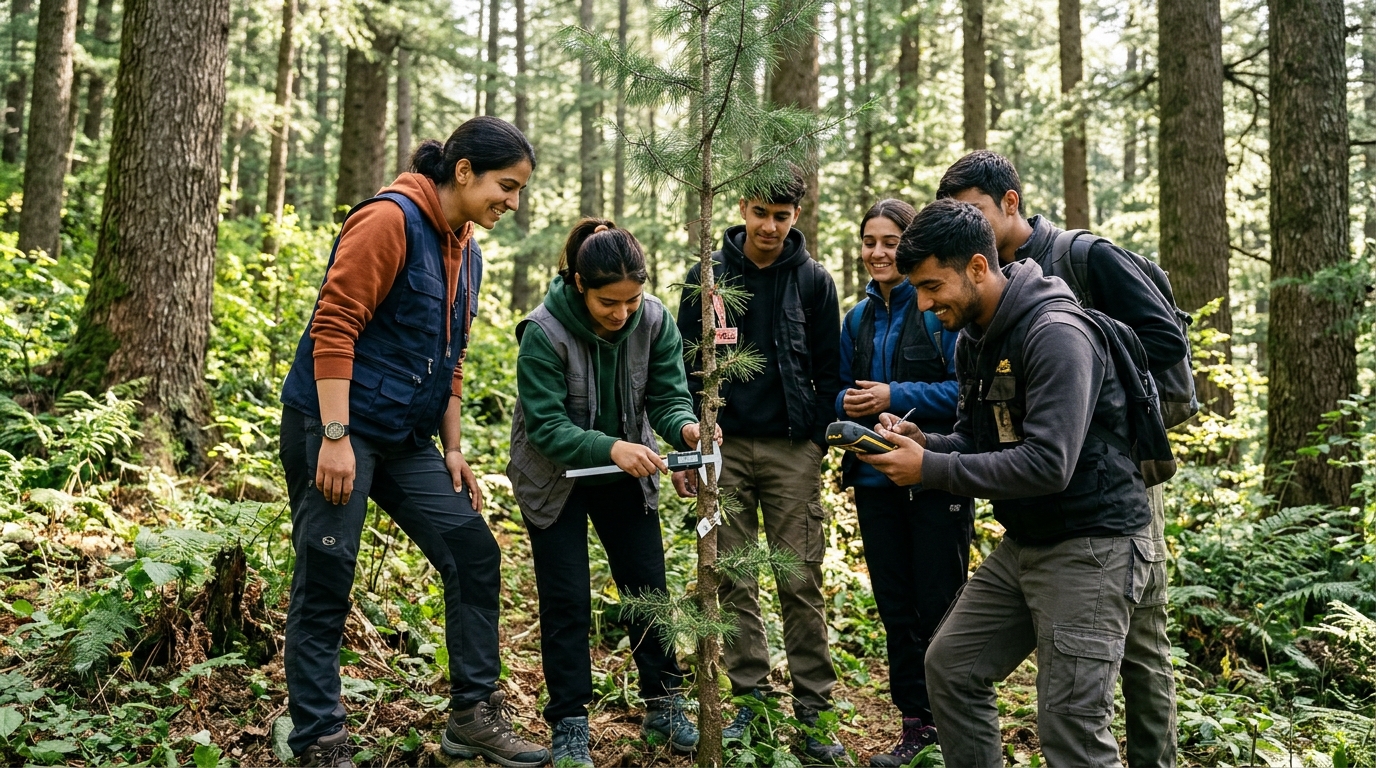
Core Field Activity:20m × 20m permanent forest study plot layout with biodegradable boundary cord
Key Destination:Dachigam National Park - Lower Riverine Belt
Water

River Corridors & Karst Springshed Hydrology

Stream Velocity, Karst Spring Discharges & Benthic Bioindicator Indexes

Core Field Activity:Wetted width and depth profiling using surveyor tape and calibrated wading rod
Key Destination:Lidder River Hydrological Transect - Pahalgam
Cryosphere

Glacier Downwasting & Himalayan Cryosphere Change

Snout Retreat Differencing, Supraglacial Debris & Snowline Monitoring

Core Field Activity:Moraine ridge walk tracing past glacier extent milestones documented in archival surveys
Key Destination:Thajiwas Glacier Foreland & Moraines - Sonamarg
Agriculture

Agricultural Agroecosystems & Soil Health

Paddy-to-Orchard Conversion, Saffron Karewas & Agrochemical Runoff

Core Field Activity:Soil coring to 20cm depth and soil profile horizon description
Key Destination:Pampore Saffron Heritage Karewa Plateau
Urban

Urban Ecology, Air Quality & Civic Metabolism

PM2.5 Sensor Transects, Urban Heat Islands & Municipal Solid Waste Audits

Core Field Activity:Walking air quality transect with portable PM2.5 / PM10 air sensor linked to mobile GPS
Key Destination:Old City Srinagar Heritage Corridor & Dal Inlets
Geology

Karewa Geomorphology & Himalayan Earth Systems

Lacustrine Sediments, Tectonic Uplift, Fossils & Brick Kiln Excavation Scars

Core Field Activity:Geological stratigraphic column logging: measuring and sketching vertical scarp layers
Key Destination:Chadoora & Nagam Karewa Escarpments
Citizen Science

Conservation Field Telemetry & Community Bio-Blitz

GPS Sightings, Red Data Book Species Audits & Participatory Monitoring Blitzes

Core Field Activity:Synchronous 2-hour institutional Bio-Blitz across 4 student teams (Birds, Botany, Insects, Herpetofauna)
Key Destination:Campus Biodiversity Observatory
Permanent Field Laboratories

Adopt-an-Ecosystem Program

Each institution adopts one nearby site as its permanent field science observatory under a non-exclusive educational monitoring covenant.

KEW-OD-WET-001Wetland • Budgam / Srinagar

Hokersar Wetland Reserve (Queen of Wetlands)

Elevation: 1584m•Health Index: 68/100
Adopting Schools:
•Govt Boys Higher Secondary School, Soibugh (Hokersar Waterbird Guardians)
•Delhi Public School, Athwajan (Wetland Sponges Youth Circle)
View Site TelemetryBaseline: 2002
KEW-OD-LAK-002Lake • Srinagar

Dal Lake - Hazratbal & Gagribal Basins

Elevation: 1583m•Health Index: 58/100
Adopting Schools:
•Govt College for Women, M.A. Road Srinagar (Dal Limnology Action Group)
•Tyndale Biscoe School, Srinagar (Watermanship & Lake Watch Club)
View Site TelemetryBaseline: 1985
KEW-OD-LAK-003Lake • Bandipora

Wular Lake - Banyari Delta & Southern Shoreline

Elevation: 1578m•Health Index: 52/100
Adopting Schools:
•Govt Degree College, Bandipora (Wular Freshwater Research Circle)
View Site TelemetryBaseline: 1986
KEW-OD-FOR-004Forest • Srinagar

Dachigam National Park - Lower Riverine Belt

Elevation: 1720m•Health Index: 82/100
Adopting Schools:
•Burn Hall School, Srinagar (Hangul Heritage Eco-Force)
View Site TelemetryBaseline: 1981
KEW-OD-SPR-005Spring • Anantnag

Verinag Karst Spring & Jhelum Source Complex

Elevation: 1876m•Health Index: 79/100
Adopting Schools:
•Govt Degree College, Dooru (Verinag Springshed Observatory)
View Site TelemetryBaseline: 2005
KEW-OD-RIV-006River • Anantnag

Lidder River Corridor - Pahalgam to Aru

Elevation: 2130m•Health Index: 74/100
Adopting Schools:
•Govt Higher Secondary School, Pahalgam (Lidder River Custodians)
View Site TelemetryBaseline: 2004
Pedagogical Progression

Five Tiered Curriculum Levels

Age-appropriate scaffolding ensuring rigorous scientific development from Class 6 through university faculties.

Foundation11–13 Years

Classes 6–8 (Middle School)

Sensory observation, qualitative nature journaling, morphological taxonomy, and basic natural history of Kashmir.

Core Competencies:
  • •Maintaining an empirical field notebook with date, weather, and habitat notes
  • •Distinguishing resident from migratory waterfowl using field identification keys
Intermediate14–15 Years

Classes 9–10 (Secondary School)

Instrumental environmental diagnostics, quantitative sampling transects, and environmental conservation statutes.

Core Competencies:
  • •Operating digital handheld multiparameter water pens (pH, Electrical Conductivity, TDS)
  • •Measuring tree diameter at breast height (DBH) and calculating basal area
Advanced16–17 Years

Classes 11–12 (Higher Secondary / Senior Secondary)

Empirical environmental chemistry, geospatial mapping, and scientific hypothesis testing using Kashmir EcoWatch datasets.

Core Competencies:
  • •Conducting Winkler titration for Dissolved Oxygen (DO) and calculating Biochemical Oxygen Demand (BOD5)
  • •Soil chemical profiling (Nitrogen, Phosphorus, Potassium, organic carbon percentage)
Undergraduate18–22 Years

Degree Colleges & University Undergraduates

Landscape-scale ecological research design, watershed hydrology, environmental impact analysis, and open data science.

Core Competencies:
  • •Hydrological gauging using velocity-area methods and flume calibrations
  • •Bioindicator assessment using Ephemeroptera, Plecoptera, Trichoptera (EPT) index
ResearchProfessional Mentors

School Educators, College Faculty & Research Scientists

Field safety leadership, instrument calibration oversight, data quality verification, and intergenerational oral history documentation.

Core Competencies:
  • •Supervising institutional field trip safety plans and legal permits under Wildlife Protection Act
  • •Reviewing and certifying student observation submissions before public ingestion
Empirical Telemetry

Recent Student Field Science Submissions

Every observation is reviewed by the designated school teacher and validated by EcoWatch data scientists before open publication.

ID: STU-BUD-014EcoWatch Verified

Hokersar Wetland Reserve (Watchtower 2)

Date: 2026-11-04•School: GHSS-SOIBUGH
Measured Parameters:
Water Temperature (°C):11.4
pH Level:7.6
Secchi Depth (cm):48

"Large early arrival of winter waterfowl observed in northern marsh zone. Secchi depth improved slightly following autumn settling. High reed encroachment observed near village boundary."

Verified: Dr. Tariq Ahmad (EcoWatch Limnologist)View Data →
ID: STU-SRI-089EcoWatch Verified

Dal Lake (Hazratbal Basin Station D-3)

Date: 2026-10-28•School: GCW-SRINAGAR
Measured Parameters:
Water Temperature (°C):14.2
pH Level:8.1
Dissolved Oxygen (mg/L):5.8

"Late autumn macrophyte senescence visible. LCMA de-weeding machines active in navigation channel. Dissolved oxygen adequate in open water but drops to 3.4 mg/L in floating garden channels."

Verified: K. M. Qureshi (EcoWatch Hydro-Chemistry Unit)View Data →
ID: STU-ANG-027EcoWatch Verified

Verinag Main Octagonal Karst Spring Pool

Date: 2026-10-20•School: GDC-DOORU
Measured Parameters:
Spring Discharge Rate (L/min):4820
Water Temperature (°C):12.8
pH Level:7.3

"Stable thermal signature typical of deep karst aquifer. Discharge measured via downstream rectangular weir. Elder interview confirmed that historical discharge remained constant during severe 1999 drought."

Verified: Er. N. A. Khan (EcoWatch Groundwater Unit)View Data →
Student Safeguards & Field Safety Architecture
1. Minor Privacy & Anonymization

No minor student personal identifiers, phone numbers, or private records are ever published. All student contributions are indexed strictly via institutional anonymized tokens (e.g. STU-DPS-042).

2. Authorized Institutional Sign-Off

Every field visit requires registered institutional clearance, written parental/guardian consent, a certified faculty field supervisor, and a pre-approved emergency response protocol.

3. Protected Area Compliance

Adoption implies an educational monitoring commitment, not administrative management or unrestricted access. All entries into Wildlife Sanctuaries adhere to J&K Wildlife Protection Department permits.