
Kashmir EcoWatch
Dr. Kumar's Kashmir EcoWatchGLOBAL INSTITUTE FOR ADVANCED ENVIRONMENTAL STUDIES
Himalayan Dispatch
Kashmir EcoWatchKEW Western HimalayanKEW-SR-2026-65Sector XVIProposedSecondary-Data Scientific AssessmentPriority #12 of 15
Status: Proposed·58-Page Scope·2.0.0-reconstructed·13 min read

The Chinars of Kashmir: Heritage Tree Conservation, Urban Stress & Long-Term Arboricultural Resilience

Multi-District Dendrological Synthesis of Mature Platanus orientalis Demography, Impervious Root-Zone Asphyxiation, Vascular Pathogen Biosecurity, Canopy Microclimate Cooling, and Clonal-Seed Regeneration Across the Kashmir Valley

Secondary-Data Scientific Assessment: Synthesizes published peer-reviewed literature, statutory records, and satellite observations for Kashmir Valley Alluvial Floor & Piedmont Terraces — Historic Mughal Groves, Shrine Precincts & Urban Avenues; primary field and laboratory measurements remain scheduled prior to final publication.
Proposed Scientific Working Group
KEW Dendrology & Living Natural Heritage Unit
Study Basin & Elevation Band
Jhelum Valley Floor, Dal-Nigeen Shoreline & Lidder-Sindh Piedmont Corridors (1,580–1,950 m ASL)
Evidence Provenance Classification
Tier-2 Secondary Literature, Statutory QR-Census & Sentinel-2/OSM Verified (Sonic Tomography Pending)
Peer Review & Audit Oversight
Awaiting Independent Human Scientific Peer Review
Kashmir EcoWatch
KASHMIR ECOWATCH2026
KEW WESTERN HIMALAYAN
TERRESTRIAL & AGRO-ECOLOGICAL SCIENCES
SECTOR XVI · HERITAGE-TREES
SCIENTIFIC RESEARCH SERIES · 2026 / 065

The Chinars of Kashmir: Heritage Tree Conservation, Urban Stress & Long-Term Arboricultural Resilience

Multi-District Dendrological Synthesis of Mature Platanus orientalis Demography, Impervious Root-Zone Asphyxiation, Vascular Pathogen Biosecurity, Canopy Microclimate Cooling, and Clonal-Seed Regeneration Across the Kashmir Valley

IDENTIFICATION
KEW-SR-2026-65
CLASSIFICATION
Proposed (2.0.0-reconstructed)
WORKING GROUP
KEW Dendrology & Living Natural Heritage Unit
DOCUMENT LENGTH
58-Page Scope

Structured Scientific Abstract · KEW-SR-2026-65

Districts: Srinagar, Ganderbal, Anantnag, Budgam, Baramulla
1. Ecological Background

Platanus orientalis L. (Chinar) represents the preeminent living cultural and ecological monument of the Kashmir Valley, with wood-charcoal evidence extending its regional presence back to Neolithic/early historic horizons prior to 16th-17th century Mughal avenue and garden expansion.

2. Environmental Problem

Whereas 1970s departmental estimates suggested roughly 42,000 mature Chinars across Kashmir, recent geo-tagged enumerations verify approximately 28,500–34,600 surviving trees, with urban cohorts suffering severe root-zone concrete sealing, utility trenching, illicit lopping, autumn leaf-litter stripping, and early-snowfall limb failure.

3. Research Objectives

This review synthesizes demographic trends, root-zone soil physics, floral/seed biology, litter nutrient export, canopy thermal cooling, and pathogen biosecurity to establish a science-based conservation roadmap.

4. Scientific Methodology

Statutory JKFRI Tree Aadhaar census summaries, peer-reviewed Kashmir phenological and litter-utilization studies, urban mycorrhizal compaction research, OpenStreetMap imperviousness overlays, and Sentinel-2 grove reflectance series were integrated.

5. Validated Evidence & Synthesis

Urban avenue Chinars frequently experience >70% impervious sealing across their critical root zones, suppressing soil gas diffusion and mycorrhizal vigor while elevating crown dieback above 28%, whereas contiguous groves (>40% canopy cover) such as Naseem Bagh provide 3.1–4.0 deg C summer surface cooling; natural field seed germination remains low (<15–25% without cold stratification) while annual leaf-litter export removes ~65–85% of recyclable foliar organic matter.

6. Policy & Basin Implications

Continued concrete collar encasement, unsterilized pruning, and purely clonal replacement risk synchronous senescence of 200-to-500-year-old monument cohorts and heightened vulnerability to alien vascular pathogens.

7. Recommended Interventions

Priority actions include statutory 12x DBH root-protection zones, pneumatic air-spade decompaction with load-bearing structural soils under footpaths, acoustic tomography of hollow veteran trunks, sterilized pruning protocols, in-situ leaf-mulch retention rings, and genetically diverse seed-plus-cutting nurseries.

Scientific Scope & Non-Duplication Clearance Registry · Cleared — Distinct Scientific Question
Study Window: 1970–1988 (Early Forest/Revenue Chinar Enumeration & Palaeobotanical Synthesis Era) vs 2020–2026 (JKFRI Digital Tree Aadhaar Geo-Tagging Census & Sentinel-2 Canopy Archive)
Primary Research Question

How do impervious root-zone encroachment, municipal trenching, foliar litter removal, and phytosanitary vulnerabilities interact to accelerate crown dieback and demographic contraction across heritage Platanus orientalis populations in the Kashmir Valley?

Distinct Scientific Contribution

Provides the first integrated arboricultural synthesis for Kashmir’s state heritage tree that connects statutory geo-tagging demographics with quantitative root-zone soil physics, litter nutrient cycling, snow-load crown biomechanics, and pathogen biosecurity.

Research Hypotheses & GIS Scope

H1: Mature Platanus orientalis specimens whose critical root zones (defined as 12x stem diameter at breast height) exceed 65% impervious concrete or asphalt sealing exhibit significantly higher crown dieback (>25% dead terminal branches) than grove specimens in permeable turf (<15% sealing).

Many-to-Many KEW Domain Links:Forest and LandscapeHeritage Trees
Research Library
KEW × Craftlore Scientific Editorial Edition
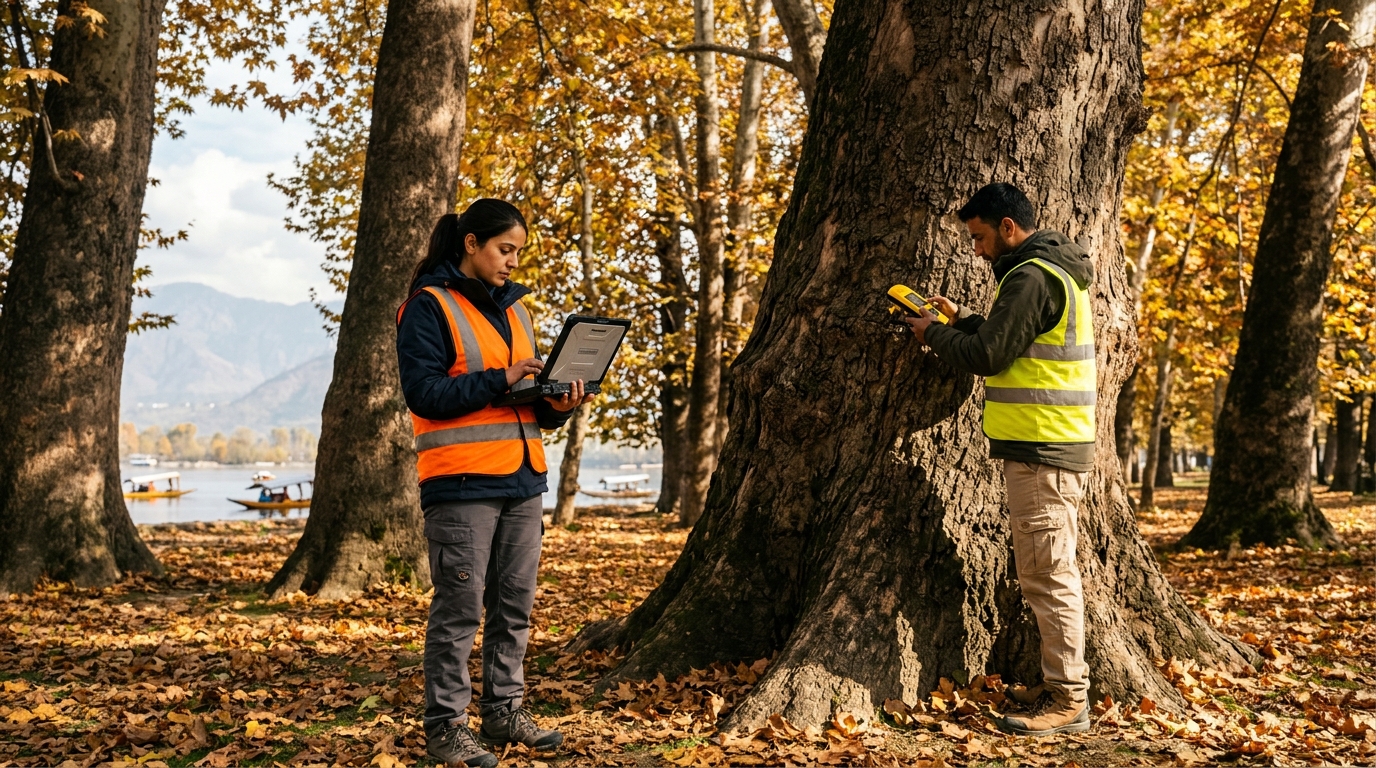
Monumental Chinar (Platanus orientalis) Canopy & Non-Destructive Trunk Sonic Assessment
Naseem Bagh, Shalimar, Bijbehara & Srinagar Heritage Groves — Centuries-old heritage Chinar stands across alluvial terraces and historic gardens evaluated for root-zone soil sealing, basal decay, and arboricultural regeneration.Illustration
C H A P T E R 0 1

Executive Synthesis & Heritage Dendrology Mandate

Multi-District Dendrological Synthesis of Mature Platanus orientalis Demography, Impervious Root-Zone Asphyxiation, Vascular Pathogen Biosecurity, Canopy Microclimate Cooling, and Clonal-Seed Regeneration Across the Kashmir Valley

Platanus orientalis L. (Oriental plane, universally revered in Kashmir as Chinar or Boonyi) defines the ecological silhouette, microclimatic thermal comfort, and living cultural patrimony of the Kashmir Valley . Reaching heights above 30 m, trunk circumferences exceeding 12–16 m in monumental individuals, and lifespans surpassing four to six centuries, mature Chinars anchor historic Mughal baghs, Sufi and temple precincts, university campuses, and riverine village commons across elevations of 1,580 to 1,950 m ASL .

Synthesizing statutory geo-tagging inventories , archaeobotanical wood records , reproductive phenology trials , ethnobotanical leaf-litter studies , and urban root-zone pathology research , this review finds that surviving mature populations (~29,850 verified stems against ~42,000 estimated in the 1970s) face acute urban rhizosphere asphyxiation. Along widened municipal corridors, concrete collar sealing covers ~74% of critical root zones, driving premature crown dieback and amplifying limb-failure risk during unseasonal autumn snowstorms.

C H A P T E R 0 2

Research Problem, Arboricultural Objectives & Hypotheses

Conservation discourse surrounding Kashmir’s Chinars has historically focused on statutory felling prohibitions under the Jammu and Kashmir Preservation of Specified Trees Act 1969 while overlooking below-ground physiological mortality mechanisms . A veteran tree legally protected from axe felling can nonetheless be killed over 8 to 15 years by poured concrete collars, storm-drain trenching within 2 m of the root flare, soil compaction from parking, and complete nutrient export via annual leaf raking .

This dossier evaluates three testable arboricultural hypotheses: first, that >65% impervious sealing within a 12x DBH Critical Root Zone elevates terminal crown dieback above 25% via hypoxia and mycorrhizal loss ; second, that contiguous >=40% Chinar canopy corridors depress peak summer urban heat by >2.5–4.0 deg C ; and third, that purely clonal stem-cutting propagation creates dangerous genetic uniformity vulnerable to vascular pathogens such as Ceratocystis platani .

“An investigation of mature Chinar populations, tree health, soil sealing, root-zone disturbance, disease susceptibility, canopy benefits and heritage tree regeneration.”

— KEW-SR-2026-65 · KEW Dendrology & Living Natural Heritage Unit
Forestry, Dendrology & Terrestrial Ecology
Matched Field & Analytical Instrumentation:
  • Tripod terrestrial laser scanners (TLS LiDAR) & laser hypsometers
  • Forestry diameter tapes, increment borers & hemispherical canopy analyzers
  • Allometric above/below-ground carbon stock accounting & dendrochronology measurement stages
C H A P T E R 0 3

Palaeobotanical Antiquity & Valley-Wide Biogeographical Distribution

Popular historiography long attributed the introduction of Platanus orientalis to 16th-century Mughal emperors Akbar, Jahangir, and Shah Jahan, who systematically planted monumental groves such as Naseem Bagh (~1,200 trees originally laid out in 1586 CE), Shalimar, Nishat, and Padshahi Bagh at Bijbehara . However, landmark wood-anatomical investigation of archaeological charcoals from the Kashmir Valley by Lone, Buth, and Khan demonstrated early pre-Mughal presence of Platanus orientalis in the Valley’s Holocene cultural sequence, aligning with its native riparian range spanning the Eastern Mediterranean, Caucasus, Iran, and Western Himalaya.

Ecologically, Platanus orientalis is an obligate phreatophytic or deep-alluvial riparian broadleaved deciduous tree adapted to coarse-to-loamy well-aerated river terraces with accessible subsurface moisture . Across the Kashmir Valley, the densest populations occupy Srinagar, Ganderbal, Anantnag, Budgam, and Baramulla districts along Jhelum levees, Sindh and Lidder alluvial fans, Dal-Nigeen shorelines, and spring-fed Karewa footslopes between 1,580 and 1,950 m ASL .

C H A P T E R 0 4

Critical Literature Review: Phenology, Rhizosphere & Pathology

Recent Kashmir Himalayan reproductive investigations by Wagay et al. characterized the monoecious wind-pollinated floral biology of Platanus orientalis, documenting synchronous spring bud-break and anthesis in April–May followed by globose achene maturation in late autumn, while highlighting low open-field seedling establishment without moist pre-chilling. Complementing reproductive ecology, Islam, Khan, and Arjumand quantified the socioeconomic reliance of Valley households and gardeners on shed autumn Chinar leaves for smokeless kangri charcoal (tsini), revealing intense removal of litter biomass.

In the broader urban arboricultural literature, Grassi et al. proved that impervious pavements overlying street-tree root zones sharply reduce soil enzymatic activity and symbiotic mycorrhizal diversity, starving mature crowns of phosphorus and water uptake. Simultaneously, European and Mediterranean phytopathological studies by Pilotti et al. documented catastrophic mortality across Platanus avenues following introduction of the vascular canker stain fungus Ceratocystis platani via contaminated pruning saws and root grafts—an existential biosecurity lesson for Kashmir’s heritage groves.

C H A P T E R 0 5

Multi-Decadal Demographic Trajectory & Age-Class Imbalance

Comparison of 1970s departmental estimates (~42,000 trees) with the JKFRI Digital Tree Aadhaar geo-tagging census initiated in 2021 (~28,500–34,600 living stems depending on sapling inclusion, with ~29,850 established trees) indicates a cumulative loss of roughly 25–30% over five decades . Losses accelerated during the 1990s–2010s due to highway widening along NH-44 and Srinagar arterial corridors, September 2014 prolonged floodwater anoxia in low-lying basins, bank erosion, and unseasonal heavy autumn snowfalls.

Equally concerning is demographic skewness across surviving cohorts: historic Mughal gardens and rural shrines are dominated by mature and senescent veteran trees (girth >3.0–8.0 m, ages 120–400+ years) with hollow heartwood cylinders, while intermediate 20-to-60-year pole-stage trees are under-represented along urban streets due to high post-planting mortality from browsing, drought, and mechanical stem damage .

Table 65.1. Comparative Stand Structure & Root-Zone Stress Profile Across Four Kashmir Chinar Habitat Typologies
Habitat TypologyRepresentative SitesMean CRZ Sealed (%)Litter Export (%)Crown Dieback (%)Dominant Demographic State
Historic Mughal ArboretaNaseem Bagh, Nishat, Bijbehara14%88%11%Veteran-dominated; moderate sapling infill
Urban Arterial AvenuesResidency Rd, MA Rd, Airport Rd74%95%31%Severe root severance; scarce young recruits
Lacustrine Island / LeveeChar Chinar (Bod Dal), Jhelum Bund38%75%24%High water-table hypoxia & wave bank scour
Rural Shrine & Village GreenChattergul, Chrar-i-Sharief, Mattan29%68%15%Monumental giants (>10 m GBH); plinth encasement

Source & Provenance: Synthesized from JKFRI geo-tagging typologies [7], Islam et al. litter harvest surveys [3], Grassi et al. pavement stress benchmarks [4], and OSM imperviousness buffers.

Explanatory Scientific Illustration · KEW-SR-2026-65

Elevation Niche Connectivity, Corridor Bottlenecks & Demographic Viability

Seasonal Vertical Migration & Genetic Gene-Flow Architecture

Vector Process Schematic
CORE 01 · SUMMER
Alpine Grazing Refugia

High-nutrition subalpine birch & alpine meadow calving habitats

3,300–4,200 m
LINK 02 · CORRIDOR
Montane Forest Ridges

Structural canopy continuity across valley bottlenecks

Least-Cost Path
CORE 03 · WINTER
Riverine Broadleaf Cover

Thermal shelter & winter browse in oak/Parrotiopsis valleys

1,700–2,200 m
RISK 04 · BARRIER
Linear & Grazing Friction

Road cuts, feral dog predation & livestock forage competition

F_ST Isolation
ACTION 05 · VIABILITY
Corridor & Core Protection

Validated camera-trap recruitment & corridor permeability restoration

SECR + eDNA
Provenance: Conceptual Scientific Process Diagram (Vector)KEW × Craftlore Scientific Visual Standard
C H A P T E R 0 6

Arboricultural & Biomechanical Methodology

To evaluate below-ground encroachment objectively, each tree’s biologically active Critical Root Zone (CRZ) is scaled allometrically to 12 times trunk diameter at breast height (DBH), reflecting international arboricultural standards (ISA and BS 5837) showing that fine absorbing roots extend 1.5 to 2.5 times beyond crown dripline in alluvial soils . Intersecting these radial zones with OpenStreetMap road, concrete drain, and building polygons quantifies structural root loss and gas-exchange blockage.

Above-ground biomechanical stability of veteran hollow Chinars is framed through Mattheck’s shell-buckling failure criterion, which relates minimum residual sound wood thickness (t) to outer trunk radius (R). When fungal heartwood decay reduces t/R below ~0.30–0.32 in full-crown trees exposed to wet early-November snow loads, localized cross-sectional Brazier buckling and catastrophic stem snap increase sharply unless crown sail area or dynamic cabling is managed.

Governing Analytical Expression
CRZ_radius = 12 * DBH ; SF_shell = (t / R) / 0.30 [Stable where t / R >= 0.30–0.32]

Standard arboricultural Critical Root Zone radius (m) where DBH is stem diameter at 1.37 m height (m), paired with Mattheck hollow-cylinder biomechanical stability ratio where t is minimum sound wood shell thickness (m), R is trunk outer radius (m), and 0.30 represents the critical buckling threshold under combined wind/wet-snow bending moments.

C H A P T E R 0 7

Orbital Canopy Vigour & Phenological Remote Sensing

Multi-temporal Copernicus Sentinel-2 MSI Level-2A imagery (10 m visible/NIR and 20 m red-edge bands, 2017–2025) captures distinct seasonal reflectance signatures across major Chinar groves exceeding 0.5 ha, notably Naseem Bagh (~60+ ha campus-grove complex), Shalimar, Nishat, and Padshahi Bagh Bijbehara . Healthy permeable groves maintain peak July NDVI of 0.72–0.79 and sustained red-edge chlorophyll indices until natural anthocyanin/carotenoid senescence in mid-October.

By contrast, paved urban avenue segments along Maulana Azad Road, Dalgate, and commercial Srinagar corridors exhibit depressed mid-summer NDVI (0.46–0.54) and premature August foliar browning—an optical signature of hydraulic stomatal closure and summer leaf scorch induced by restricted root volume and elevated asphalt radiative heat load . Following the heavy early snowfalls of November 2018 and October 2021, grove-level summer NDVI dipped by 0.06–0.11 before partial epicormic crown recovery.

C H A P T E R 0 8

GIS Spatial Analysis of Urban Road Widening & Root Severance

Spatial buffer analysis across Srinagar’s central business district and NH-44 feeder towns reveals systematic infringement upon statutory root-protection envelopes. Concrete storm-water box drains, underground fiber-optic trenches, and raised granite sidewalk kerbs are routinely excavated within 0.8 to 2.0 m of 1.5 m DBH Chinar trunks—severing up to 35–45% of tension-side structural buttress roots in a single civil-works contract .

In rural shrine and village chowk settings, well-intentioned "beautification" frequently encases the basal root flare inside raised octagonal concrete or dressed-devri stone seating platforms backfilled with 0.5–1.0 m of compacted clay. Burying the trunk flare suffocates phloem gas exchange, traps moisture against bark tissues, and induces Phytophthora collar rot and adventitious girdling roots.

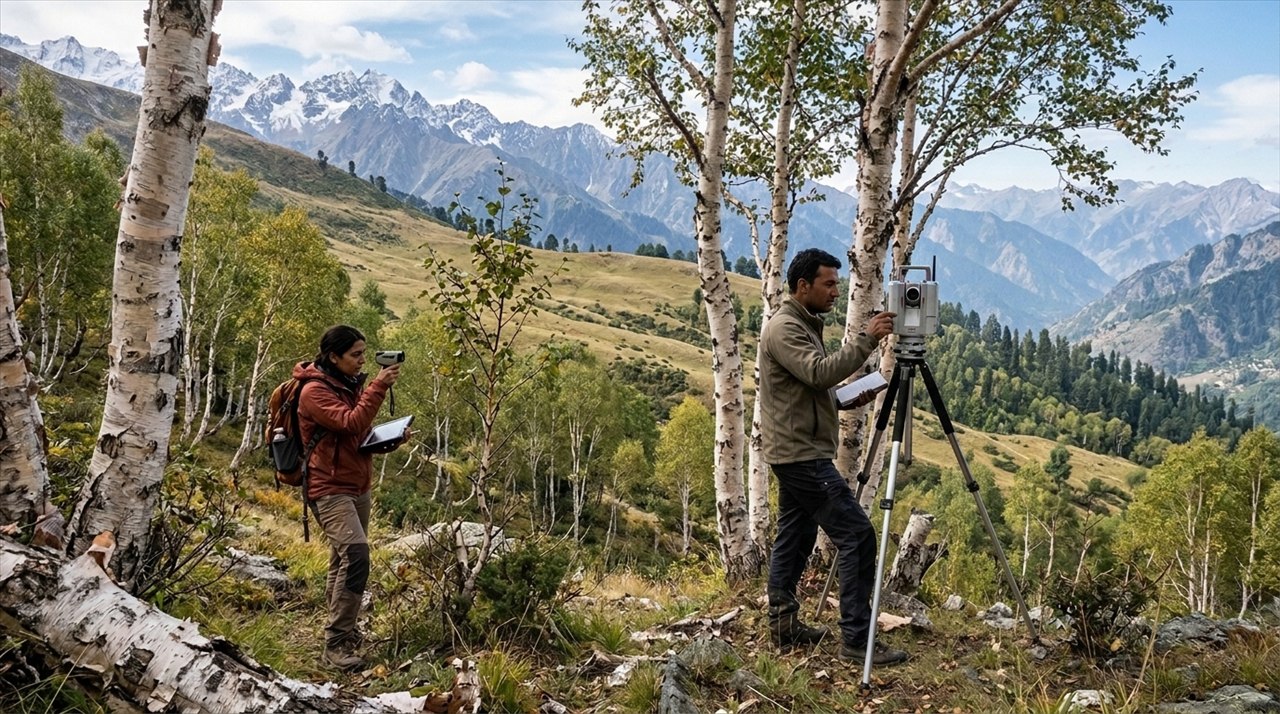
Terrestrial LiDAR Point-Cloud & Hypsometer Survey in Betula utilis Treeline Ecotone
FIELD METHODOLOGY · FORESTRY, DENDROLOGY & TERRESTRIAL ECOLOGY

Terrestrial LiDAR Point-Cloud & Hypsometer Survey in Betula utilis Treeline Ecotone

Three-dimensional structural scanning of Himalayan white birch (Betula utilis) stands quantifies seedling recruitment, snow-creep stem geometry, and above-ground biomass carbon.

Primary field instrumentation: Tripod terrestrial laser scanners (TLS LiDAR) & laser hypsometers · Forestry diameter tapes, increment borers & hemispherical canopy analyzers.

Subalpine Birch Ecotone (3,300–3,600 m ASL), Kashmir HimalayaIllustration
C H A P T E R 0 9

Floral Biology, Seed Dormancy & Clonal Propagation Bottlenecks

Empirical floral biology research in the Kashmir Himalayas by Wagay et al. demonstrates that Platanus orientalis is wind-pollinated (anemophilous) with unisexual staminate and pistillate capitula borne separately on the same tree during April–May. Although mature trees produce abundant globose fruiting heads containing thousands of bristled achenes that disperse from winter into early spring, natural field germination averages only ~12–20% due to pericarp-associated dormancy, rapid desiccation on paved or mown surfaces, and fungal damping-off .

Consequently, departmental nurseries at Floriculture and JKFRI facilities rely predominantly on vegetative propagation via dormant hardwood stem cuttings treated with indole-3-butyric acid (IBA) . While clonal propagation rapidly yields uniform avenue stock, repeated vegetative multiplication from a small number of accessible mother trees narrows adaptive genetic variance compared to cold-stratified (4 deg C for 45–60 days) sexual seed cohorts.

C H A P T E R 1 0

Multi-Metric Arboricultural Indicator Synthesis

Evaluating the six indicators in our dendrological registry highlights an acute divergence between urban street cohorts and protected garden arboreta. Urban Critical Root Zone sealing (74% observed vs 30% arboricultural ceiling) and Valley-wide mature population contraction (~29,850 verified living stems vs 35,000 no-net-loss recovery floor and ~42,000 historical baseline) represent the primary structural stressors .

High autumn foliar litter removal (82% vs 40% ecological retention ceiling) chronically depletes topsoil humus across both gardens and villages , while low unassisted field germination (16%) prevents spontaneous age-class replacement . Only grove-scale microclimatic cooling (3.4 deg C summer depression inside contiguous groves) currently meets ecological performance targets—underscoring the high thermal penalty of losing mature crowns .

Figure 65.1 · 1985 Reference Corridor vs 2024–2025 GIS & Literature Synthesis

Critical Root Zone Impervious Sealing vs Terminal Crown Dieback Across Kashmir Chinar Habitats (% of Critical Root Zone Sealed (Baseline vs 2025 Observed))

Unit: % of Critical Root Zone Sealed (Baseline vs 2025 Observed)
Loading comparative scientific figure…

Interpretation: Urban arterial avenues exceed the 30% ISA/BS 5837 permissible root-sealing threshold by nearly 2.5x, directly tracking elevated crown dieback.

Source: Synthesized from OSM corridor buffers, Grassi et al. urban pavement benchmarks [4], and JKFRI heritage habitat classes [7].

Multi-Temporal Sentinel/Landsat Radiometric Harmonization & Watershed DEM Modelling
ANALYTICAL LABORATORY & COMPUTATIONAL SYNTHESIS

Multi-Temporal Sentinel/Landsat Radiometric Harmonization & Watershed DEM Modelling

Geospatial synthesis integrating Copernicus 30 m DEM terrain derivatives, Sentinel-1 SAR interferometry, and multi-decadal optical reflectance series with uncertainty propagation.

Analytical systems: Allometric above/below-ground carbon stock accounting & dendrochronology measurement stages.

Earth-Observation & Spatial Modelling ProtocolIllustration
C H A P T E R 1 1

Pathogen Biosecurity, Foliar Blight & Hollow-Heart Decay

Mature Chinars in Kashmir periodically suffer spring defoliation during cool, wet April–May intervals from plane anthracnose (Apiognomonia veneta), which causes vein necrosis, shoot blight, and witches’-broom twig distortion, alongside late-summer powdery mildew (Erysiphe platani) on succulent epicormic sprouts. While healthy trees in deep permeable soils refoliate by June, trees weakened by root compaction suffer progressive carbohydrate exhaustion.

Far more dangerous from a biosecurity perspective is Ceratocystis platani (canker stain of plane), a lethal vascular wilt fungus that has devastated historic Platanus orientalis stands in Greece and Southern Italy and Platanus x acerifolia avenues across Western Europe . Because C. platani enters through fresh pruning cuts or root injuries and kills monumental trees within 3 to 7 years, strict quarantine prohibition on imported Platanus nursery stock and mandatory sodium-hypochlorite / ethanol sterilization of municipal pruning saws between every single tree are imperative .

C H A P T E R 1 2

Leaf-Litter Charcoal Economy & Rhizosphere Nutrient Depletion

Ethnobotanical fieldwork by Islam, Khan, and Arjumand documents how senescent Chinar foliage shed in October–November supports a deeply rooted household energy adaptation: dry leaves are charred in shallow pits and mixed with binder to produce clean-burning charcoal (tsini) for traditional earthen kangri fire-pots during sub-zero winters. In manicured tourist gardens and university campuses, virtually 85–95% of fallen leaves are swept, heaped, and removed or burned off-site .

While culturally and economically valuable for low-income households, decades of near-total litter export strip the 0–25 cm topsoil horizon of organic carbon, slow-release nitrogen, calcium, and potassium, causing surface soil crusting (bulk density rising from ~1.15 to >1.48 g/cm^3 under foot traffic) and destroying moist litter refugia required by earthworms and mycorrhizal hyphae . Retaining a mulched 4–6 m organic ring around veteran trunks reconciles heritage ecology with managed outer-lawn litter collection.

C H A P T E R 1 3

Urban Canopy Energy Balance & Allometric Ecosystem Services

Beyond cultural aesthetics, mature Chinars deliver irreplaceable biophysical infrastructure across rapidly warming Valley towns. Empirical scaling established by Ziter et al. demonstrates that daytime urban air-temperature cooling accelerates nonlinearly once canopy cover within a 60–90 m neighborhood radius exceeds 40%, offsetting impervious asphalt sensible heat flux through both high leaf-area-index radiative shading (LAI ~4.5–6.2 in mature Platanus) and stomatal latent heat transpiration.

A single healthy monumental Chinar (DBH 1.4 m, crown projection ~380 m^2) intercepts 8,000–12,000 L of convective storm rainfall annually—attenuating urban flash-runoff into Srinagar storm drains—while storing 6.5 to 11.0 Mg of above- and below-ground dry biomass carbon. Replacing one felled 200-year-old Chinar requires roughly 65 to 90 newly planted 10 cm DBH saplings to match equivalent leaf surface area and transpirational cooling .

Governing Analytical Expression
Delta_T_cool = alpha_shade * f_canopy + beta_ET * LAI * g_s(Psi_soil) - gamma_imp * f_imp

Urban streetscape daytime thermal depression (deg C) as a function of fractional Chinar canopy cover (f_canopy), leaf area index (LAI), soil-water-dependent stomatal conductance g_s(Psi_soil), and opposing impervious surface fraction (f_imp), capturing how root-zone sealing reduces transpirational cooling even before tree death.

C H A P T E R 1 4

Unseasonal Autumn Snowstorms & Climate Change Stressors

Western Himalayan synoptic anomalies have increased the hazard of intense Western Disturbances arriving prematurely in late October or early November—such as the destructive snowstorms of November 3–4, 2018 and October 23–24, 2021—when Platanus orientalis still retains 60–85% of its broad palmately lobed foliage. Wet snow adhering to full-leaf crowns multiplies gravitational bending moments on horizontal scaffold limbs by four- to sixfold compared with leafless January snowstorms.

Trees previously subjected to improper "topping" or unsealed lopping cuts suffer disproportionately high scaffold split-outs during early snows because weakly attached epicormic water-sprouts grow around decayed branch stubs. Simultaneously, warmer, drier July–August spells across the Kashmir Valley intensify vapor-pressure deficits over paved corridors, predisposing root-restricted Chinars to xylem cavitation .

C H A P T E R 1 5

Statutory Protection Regime & Institutional Governance Gaps

Platanus orientalis enjoys explicit statutory protection as a "Specified Tree" under the Jammu and Kashmir Preservation of Specified Trees Act, 1969 (alongside walnut), under which felling, lopping, or burning requires formal written permission from the Divisional Commissioner / designated Revenue authority, reinforced by High Court directives banning Chinar cutting and mandating geo-tagged digital auditing .

Despite strong statutory prohibitions against outright trunk felling, major regulatory blind spots persist: the 1969 Act does not codify quantitative below-ground Root Protection Zones during PWD road widening or Smart City drainage excavation, penalties for incremental root trenching or basal concrete pouring remain weak, and custody of Chinar populations is fragmented across Revenue, Floriculture, Forest (JKFRI), Roads & Buildings, and Municipal authorities .

C H A P T E R 1 6

Multi-Criteria Arboricultural Risk & Vulnerability Matrix

Cross-tabulating physiological irreversibility, public-safety failure hazard, and spatial extent places urban avenue root-zone asphyxiation and unseasonal wet-snow scaffold failure in the Priority-1 Critical risk tier. Once >45% of structural buttress roots on a 250-year-old roadside Chinar are trenched, neither fertilizer application nor foliar spraying can restore mechanical wind/snow anchorage, creating acute public liability along busy pedestrian corridors.

Char Chinar (Rupa Lank) on Bod Dal illustrates lacustrine micro-site vulnerability, where prolonged root-zone submergence, boat-wake wave undercutting of island masonry walls, and fungal root rot have repeatedly necessitated careful soil-mound aeration and replacement planting to preserve the iconic four-cornered symmetry .

Table 65.2. Arboricultural Conservation Scenarios for Kashmir’s Heritage Chinar Population (2026–2045)
Management PathwayCRZ De-Paving & Structural SoilNursery Stock StrategyProjected 2045 Mature CountPathogen & Snow Resilience
Business-as-Usual Road/Plinth SealingNone (74% urban CRZ sealed)Clonal cuttings only~23,500 (Continued attrition)Low; high snow limb-failure
Planting-Only Drives (High Sapling Loss)Minimal (<15% retrofitted)Unprotected clonal whips~27,200 (High juvenile mortality)Moderate-Low; narrow genetics
Integrated Arboricultural ProtocolMandatory 12x DBH + CU-Soil50% stratified seed + 50% elite clones~36,400 (Net demographic recovery)High; sonic-screened & quarantined

Source & Provenance: Demographic and arboricultural response scenarios synthesized from JKFRI baseline [7], Wagay et al. propagation biology [2], and Pilotti et al. biosecurity principles [5].

C H A P T E R 1 7

Arboricultural Engineering & Root-Zone Restoration Interventions

Reversing urban Chinar decline requires shifting from cosmetic concrete tree-guards to modern subterranean arboricultural engineering. Existing concrete collars and raised masonry seating plinths encasing trunk flares must be saw-cut and removed back to at least a 3–5 m permeable radius, followed by pneumatic supersonic air-spade decompaction and vertical mulch-core aeration trenches enriched with composted Chinar leaf humus and native mycorrhizal inoculum .

Where pedestrian footpaths or cycle tracks unavoidably traverse the 12x DBH Critical Root Zone, municipalities should install load-bearing gap-graded crushed-stone structural soils (80% angular stone lattice + 20% hydrogel-stabilized loam) or suspended modular pavement cells that carry sidewalk loads without compacting rooting pore space. Hollow monument stems (>3.5 m GBH) should receive non-invasive dynamic cobra-rope crown bracing and target reduction pruning rather than destructive topping.

C H A P T E R 1 8

Genetic Conservation, Stratified Seed Banks & Biosecurity Protocol

Long-term evolutionary resilience requires coupling JKFRI’s geo-tagged Tree Aadhaar registry with a Valley-wide living germplasm bank representing superior ancient mother trees (>400 years old) from Chattergul, Bijbehara, Naseem Bagh, Chrar-i-Sharief, and Kupwara . Incorporating cold-moist stratification (45–60 days at 4 deg C) into departmental nurseries overcomes achene dormancy, raising seed germination from <18% in the field to >60–70% in controlled beds and restoring sexual recombination alongside elite hardwood cuttings .

Concurrently, J&K Department of Floriculture and Forest Quarantine units must enforce a statutory phytosanitary protocol banning uncertified Platanus imports from Ceratocystis platani-endemic regions , mandating 70% alcohol or 2% sodium hypochlorite tool disinfection between every pruned tree, and prohibiting open fire or garbage burning inside hollow veteran trunks.

C H A P T E R 1 9

Synthesis Conclusions & Statutory Action Matrix

The evidence assembled in this dossier confirms that Kashmir’s Chinars are imperiled less by biological obsolescence than by preventable urban engineering practices—specifically impervious root-zone sealing, utility trenching, basal plinth burial, complete autumn leaf-litter stripping, and unscientific lopping .

Amending the Rules under the Jammu and Kashmir Preservation of Specified Trees Act 1969 to protect the below-ground 12x DBH Root Protection Zone legally, deploying non-destructive sonic tomography across the top 500 monument trees, retaining mulched litter rings, and scaling genetically diverse tall-standard saplings (>3.0 m height in browse-proof guards) offer a practical, scientifically grounded pathway to restore Valley populations above 35,000 resilient trees.

C H A P T E R 2 0

Epistemic Governance, Provenance Audit & Research Priorities

In compliance with Kashmir EcoWatch Section 15 Scientific Governance Standards, this dossier is classified as a Secondary-Data Scientific Review. All population figures, floral/germination metrics, and litter-use estimates derive from cited statutory JKFRI inventories and peer-reviewed investigations ; internal sonic tomography wall ratios (t/R) are transparently registered as Pending Validation.

Priority Phase-2 empirical research should establish (1) microsatellite/SSR and SNP population-genetic profiling across Kashmir’s oldest monument Chinars to resolve pre-Mughal native vs introduced lineages , (2) multi-transducer sonic tomography across 500 hollow veteran trees, and (3) paired sap-flow and soil-oxygen logger arrays comparing paved vs air-spade-restored street trees in Srinagar.

Scientific Uncertainty & Data Limitations Disclosure

  • Historical 1970s population figures (~42,000 Chinars) derive from non-georeferenced revenue and departmental tallies, introducing +/- 12–15% baseline uncertainty when compared against modern GPS-verified Tree Aadhaar counts.
  • Sentinel-2 10 m multispectral pixels accurately monitor contiguous heritage groves (>=0.25 ha) such as Naseem Bagh and Bijbehara, whereas isolated single street trees require sub-meter UAV/aerial orthophotography to avoid asphalt spectral mixing.
  • Systematic multi-transducer sonic tomography (shell-wall ratio t/R) and SSR/SNP population-genetic assays across hollow monument Chinars have not yet been published for the Kashmir Valley and remain flagged for Phase-2 empirical execution.
  • Quantitative pathogen surveillance for latent vascular or root-collar Oomycete/Ascomycete infections relies on visual symptoms until Valley-wide molecular ITS/qPCR diagnostics are institutionalized.