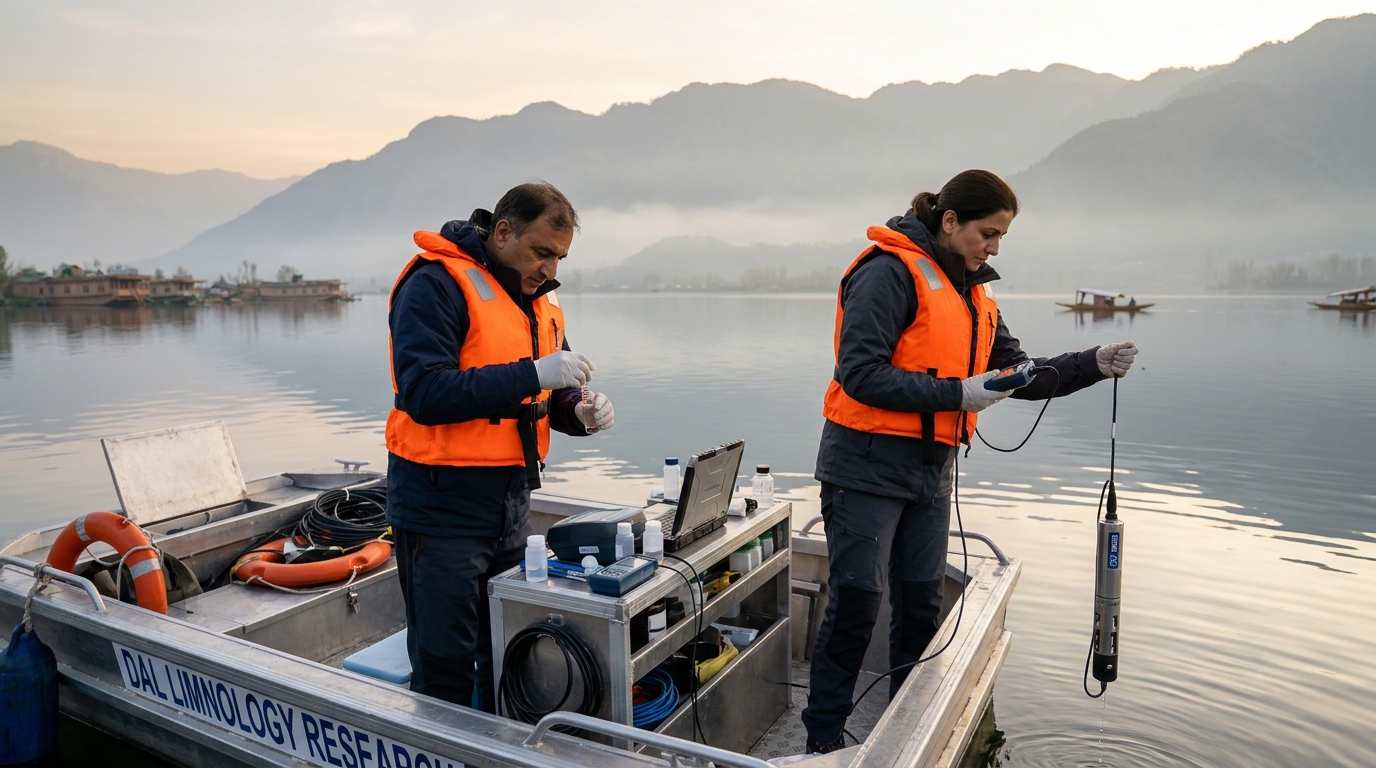
Executive Synthesis: Phytoplankton Shifts & Emergent Bloom Risks
Seasonal Phytoplankton Community Succession, Buoyant Cyanobacterial Proliferation (Microcystis, Dolichospermum, Oscillatoria), Cyanotoxin Biosynthesis Pathways, and Multi-Receptor Ecotoxicological Risks Across Kashmir Valley Lakes
Across the lakes of the Kashmir Valley, phytoplankton communities serve as high-turnover biological integrators of solar irradiance, thermal stratification, flushing residence time, and dissolved nutrient stoichiometry . Historically, sub-Himalayan valley lakes between 1,578 and 1,587 m ASL exhibited classic cold-temperate seasonal bimodality dominated by siliceous diatoms (Bacillariophyceae: Navicula, Cymbella, Synedra, Fragilaria) during cool, well-mixed spring and autumn seasons and diverse desmids/chlorophytes during early summer .
Synthesizing contemporary phycological investigations across Nigeen , Anchar , Manasbal , and Wular with multi-year Sentinel-2 red-edge and MODIS/VIIRS thermal records , this dossier documents an intensifying July–September shift toward bloom-forming Cyanophyceae (Microcystis aeruginosa, Oscillatoria/Planktothrix, Anabaena/Dolichospermum, Merismopedia) and organic-pollution-indicative Euglenophyceae. Where summer surface temperatures exceed 25 deg C for ~49 days/yr and sewage-derived orthophosphate depresses DIN:SRP mass ratios near 6.8, cyanobacterial relative abundance climbs to 29%–46.5%, creating unmonitored cyanotoxin exposure pathways for fisheries, waterbirds, and drinking-water infrastructure .