
Kashmir EcoWatch
Dr. Kumar's Kashmir EcoWatchGLOBAL INSTITUTE FOR ADVANCED ENVIRONMENTAL STUDIES
Himalayan Dispatch
Kashmir EcoWatchKEW Western HimalayanKEW-SR-2026-46Sector XIIIProposedScientific Scoping Dossier
Status: Proposed·56-Page Scope·2.0.0·12 min read

Deglaciated Himalayan Landscapes: Primary Ecological Succession, Soil Formation & Emerging Proglacial Ecosystems

Space-for-Time Chronosequence Synthesis of Snout Recession, Diazotrophic Microbial Pioneer Colonization, Incipient Pedogenesis, Vascular Plant Assembly, and Paraglacial Moraine Stabilization Across Newly Exposed Kashmir Himalayan Glacier Forelands

Scientific Scoping Dossier: Synthesizes published peer-reviewed literature, statutory records, and satellite observations for Greater Kashmir Himalayan Crest — Kolahoi, Hoksar, Thajiwas & Machoi Proglacial Forelands; primary field and laboratory measurements remain scheduled prior to final publication.
Proposed Scientific Working Group
KEW Glacial Foreland & Ecological Succession Unit
Study Basin & Elevation Band
Upper Lidder (Kolahoi–Hoksar) & Upper Sindh (Thajiwas–Machoi) Proglacial Headwater Margins (3,420–4,680 m ASL)
Evidence Provenance Classification
Moraine-Chronology & Satellite-Chronosequence Verified Synthesis (Phase-2 eDNA/Plot Pedology Pending)
Peer Review & Audit Oversight
Awaiting Independent Human Scientific Peer Review
Kashmir EcoWatch
KASHMIR ECOWATCH2026
KEW WESTERN HIMALAYAN
CRYOSPHERE, HYDROLOGY & LIMNOLOGICAL SCIENCES
SECTOR XIII · CRYOSPHERE-ECOLOGY
SCIENTIFIC RESEARCH SERIES · 2026 / 046

Deglaciated Himalayan Landscapes: Primary Ecological Succession, Soil Formation & Emerging Proglacial Ecosystems

Space-for-Time Chronosequence Synthesis of Snout Recession, Diazotrophic Microbial Pioneer Colonization, Incipient Pedogenesis, Vascular Plant Assembly, and Paraglacial Moraine Stabilization Across Newly Exposed Kashmir Himalayan Glacier Forelands

IDENTIFICATION
KEW-SR-2026-46
CLASSIFICATION
Proposed (2.0.0)
WORKING GROUP
KEW Glacial Foreland & Ecological Succession Unit
DOCUMENT LENGTH
56-Page Scope

Structured Scientific Abstract · KEW-SR-2026-46

Districts: Anantnag, Ganderbal, Kulgam
1. Ecological Background

Accelerating retreat of Kashmir Himalayan glaciers since the Little Ice Age and particularly since 1962 is transforming ice-covered bedrock and subglacial till into novel terrestrial, wetland, and proglacial stream ecosystems between 3,420 and 4,680 m ASL.

2. Environmental Problem

Freshly exposed glacial forelands begin as oligotrophic, coarse-clast substrates virtually devoid of organic carbon and bioavailable nitrogen, rendering steep lateral moraines prone to paraglacial gullying while nascent pioneer communities face growing pastoral and trekking disturbance.

3. Research Objectives

This dossier synthesizes moraine chronosequence dating, microbial nitrogen-fixation dynamics, pedogenic weathering rates, and pioneer plant assembly across benchmark Kashmir forelands (Kolahoi, Hoksar, Machoi, and Thajiwas).

4. Scientific Methodology

Published Kashmir snout-recession and lichenometric moraine records were integrated with global post-glacial ecosystem projections (Bosson et al. 2023), alpine soil-vegetation chronosequence studies, GBIF records, and 1972–2025 Landsat/Sentinel-2 SAVI/NDVI series.

5. Validated Evidence & Synthesis

Kolahoi alone has exposed ~2.9 km^2 of deglaciated terrain since 1962; satellite SAVI/NDVI across Kashmir forelands indicates a 16–25 year microbial lag phase before measurable vascular cover (>15%) establishes, followed by progressive pH decline (~7.9 to ~6.2) and topsoil carbon build-up from <1.2 g/kg in 0–10 yr till toward 24–38 g/kg on >90 yr stabilized LIA moraines.

6. Policy & Basin Implications

While emerging forelands provide vital upward refugia for cold-adapted endemic flora experiencing treeline/shrubline thermophilization, overgrazing on <40-year moraines arrests nurse-plant facilitation and prolongs sediment instability.

7. Recommended Interventions

Priority measures include designating newly deglaciated forelands as Proglacial Ecological Succession Reserves, rotational seasonal grazing exclusions on <40-year moraines, bio-engineering stabilization only with native pioneer seed mixes, and Phase-2 16S/ITS eDNA chronosequence monitoring.

Scientific Scope & Non-Duplication Clearance Registry · Cleared — Distinct Scientific Question
Study Window: 1962–1980 (Survey of India Topographic / Corona / Early Landsat Snout Benchmark & LIA Moraine Anchor) vs 2016–2026 (Sentinel-2 10 m Foreland Greening, Geodetic Retreat & Global Post-Glacial Synthesis Era)
Primary Research Question

Along deglaciated Western Himalayan foreland chronosequences (0 to >120 years ice-free), what coupled microbial, pedogenic, and botanical mechanisms govern the transition from raw mineral till to stabilized alpine meadow ecosystems, and where do paraglacial disturbance or livestock grazing arrest succession?

Distinct Scientific Contribution

Establishes the first dedicated geoecological chronosequence framework for retreating Kashmir Himalayan glacier forelands, linking cryospheric recession rates to pioneer biodiversity assembly, incipient soil carbon sinks, and paraglacial hazard mitigation.

Research Hypotheses & GIS Scope

H1: Across deglaciated Kashmir forelands (3,450–4,250 m ASL), measurable vascular vegetation greening (Sentinel-2 summer NDVI >= 0.18) lags ice retreat by 15–28 years, during which diazotrophic microbial crusts control initial nitrogen accretion.

Many-to-Many KEW Domain Links:Glaciers and Cryosphere
Research Library
KEW × Craftlore Scientific Editorial Edition
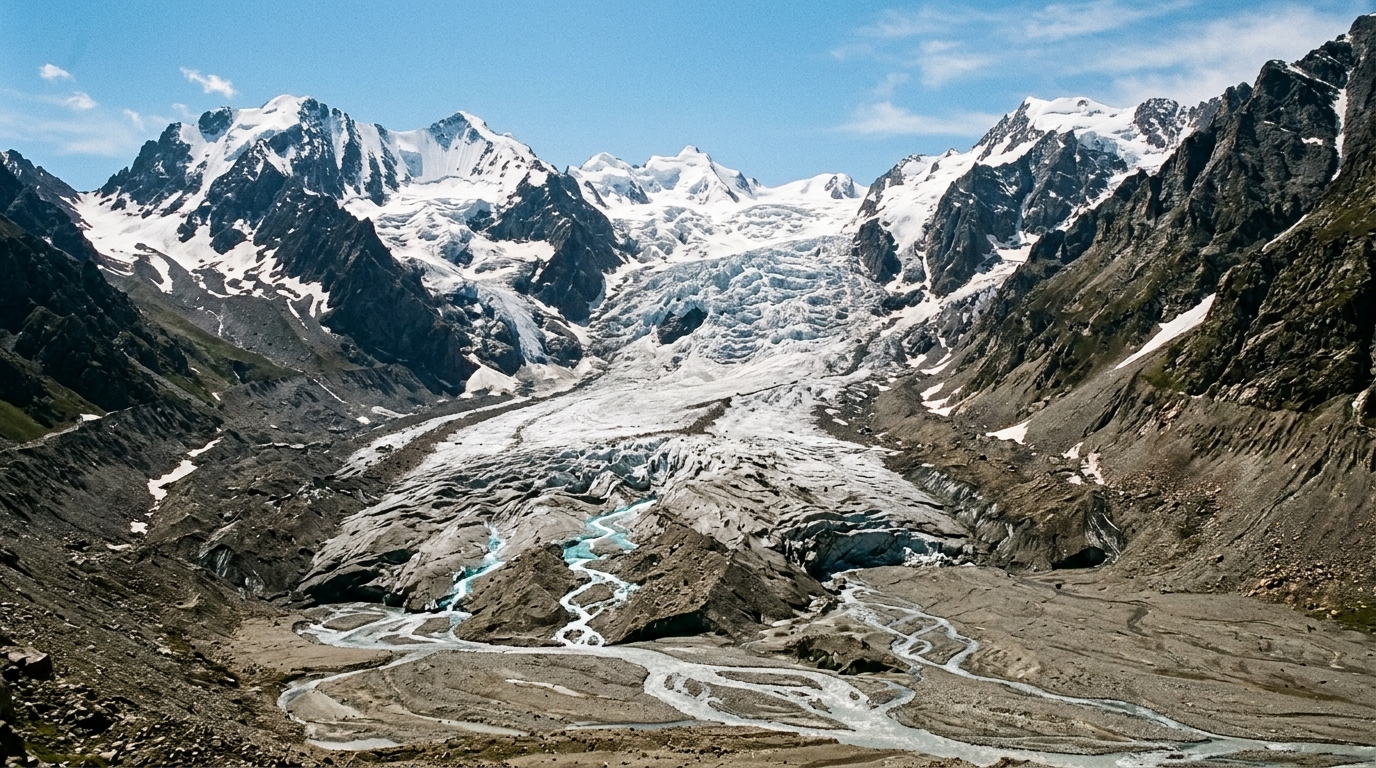
Crevassed Valley Glacier Tongue, Debris-Mantled Ablation Zone & Proglacial Outwash
Kolahoi, Machoi & Western Himalayan Cryosphere Headwaters (3,800–5,425 m ASL) — Western Himalayan valley glacier system displaying upward equilibrium-line migration, debris-covered lower ice, supraglacial melt channels, and braided proglacial runoff.Illustration
C H A P T E R 0 1

Executive Synthesis: Ecological Birth in the Wake of Ice

Space-for-Time Chronosequence Synthesis of Snout Recession, Diazotrophic Microbial Pioneer Colonization, Incipient Pedogenesis, Vascular Plant Assembly, and Paraglacial Moraine Stabilization Across Newly Exposed Kashmir Himalayan Glacier Forelands

As glaciers across the Kashmir and Western Himalaya retreat at unprecedented rates, cryospheric loss simultaneously triggers one of Earth’s purest natural experiments in primary ecological succession . Between 3,420 and 4,680 m ASL across the Kolahoi, Hoksar, Thajiwas, and Machoi valleys, melting ice margins are uncovering expanses of raw, unweathered boulder till, glacio-lacustrine silts, and braided outwash fans that have remained entombed beneath ice since at least the Little Ice Age .

Global modelling by Bosson et al. underscores that deglaciating mountain regions will generate vast emerging terrestrial and freshwater ecosystems over the twenty-first century, most of which fall outside formal biodiversity conservation plans. Synthesizing Kashmir moraine chronosequences , alpine microbial and pedogenic succession studies , and Sentinel-2 optical series , this dossier traces how lifeless mineral till transforms over decades into nitrogen-fixing biocrusts, endemic cushion-plant communities, carbon-storing alpine soils, and stabilized headwater slopes.
C H A P T E R 0 2

Research Questions, Chronosequence Scope & Hypotheses

Whereas glaciological dossiers evaluate ice-volume loss as a hydrological deficit, proglacial ecology asks what governs the speed, biodiversity composition, and geomorphic stability of ecosystems assembling in newly ice-free forelands . Without empirical baselines, land managers cannot distinguish natural 20-year pioneer lag phases from arrested succession caused by paraglacial slope failure, trekking trampling, or premature pastoral grazing.

Three hypotheses guide this synthesis: first, that vascular greening across high-elevation Kashmir forelands lags snout recession by roughly two decades while photoautotrophic and diazotrophic microbes build initial nitrogen pools ; second, that century-scale pedogenesis lowers alkaline rock-flour pH by >1.1 units while multiplying topsoil organic carbon more than eightfold ; and third, that livestock grazing on <40-year moraines disrupts cushion-plant nurse facilitation and root slope stabilization .

“An investigation of newly exposed glacier forelands, pioneer vegetation, microbial colonization, sediment development, habitat formation and the ecological trajectory of retreating ice margins.”

— KEW-SR-2026-46 · KEW Glacial Foreland & Ecological Succession Unit
Glaciology & Periglacial Sciences
Matched Field & Analytical Instrumentation:
  • Multi-frequency differential GNSS geodetic receivers
  • Steam-drilled aluminum ablation stakes & snow-density cutters
  • InSAR glacier velocity & geodetic DEM differencing workstations
C H A P T E R 0 3

Geomorphic Setting of Sentinel Kashmir Glacier Forelands

Four contrasting Kashmir Himalayan forelands anchor our comparative framework. In the West Lidder headwaters, Kolahoi Glacier’s snout has retreated upslope to ~3,690 m ASL, vacating ~2.92 km^2 of steep lateral moraines and braided proglacial outwash since 1962 over basaltic-andesitic Panjal Traps . Immediately adjacent in the Hoksar valley (3,700–4,100 m ASL), well-preserved series of Late Holocene and Little Ice Age terminal/recessional moraines provide lichenometrically dated surfaces spanning >200 years .

Across the Sindh-Drass divide at Zojila, the Machoi Glacier foreland (~3,745 m ASL) represents a wind-scoured, semi-arid transition zone underlain by Triassic limestones and metasediments, whereas lower Thajiwas moraine benches near Sonamarg (~3,440 m ASL) illustrate late-successional sub-alpine Betula-Salix-Kobresia potential heavily modified by summer recreational ponies and transhumant flocks .

C H A P T E R 0 4

Review of Proglacial Chronosequence & Himalayan Succession Science

Ecological chronosequence theory—substituting spatial distance from a retreating glacier snout for elapsed time since deglaciation—has revealed remarkably consistent assembly rules across alpine ranges , refined recently at planetary scale by Bosson et al. . Crucially, Nemergut et al. demonstrated that before a single vascular seedling survives on raw glacial till, metabolically diverse bacterial and cyanobacterial communities colonize mineral surfaces, initiating biological nitrogen fixation and organic carbon exudation.

Botanical and pedological syntheses by Schumann et al. and Wietrzyk et al. further proved that terrain age interacts strongly with microtopography, fine-sediment fraction, and parent-rock pH: succession proceeds non-linearly through facilitation-driven waves rather than deterministic Clementsian climax alone. In the Kashmir Himalaya, Murtaza and Romshoo and Romshoo et al. established the geochronological moraine and snout-retreat scaffolding needed to operationalize ecological chronosequence science regionally.

C H A P T E R 0 5

Snout Recession Chronology & Foreland Exposure History (LIA–2025)

Lichenometric measurements of crustose Rhizocarpon geographicum thalli and glacial geomorphological mapping in Hoksar and neighboring Lidder cirques identify prominent terminal moraine complexes emplaced during Little Ice Age advances (~1650–1850 CE), followed by episodic twentieth-century recession and sharp post-1990 acceleration . On Kolahoi Glacier, mean terminus retreat accelerated from ~12–15 m/yr in mid-twentieth-century decades to >18–25 m/yr in recent intervals, fragmenting tributary ice tongues .

Digitizing sequential ice margins across 1962, 1980, 1995, 2010, and 2025 partitions each foreland into discrete age belts . The youngest Stage I zone (0–10 yr ice-free) comprises unstable ice-cored till, angular boulders, and shifting meltwater channels; intermediate Stages II–III (15–60 yr) exhibit winnowed cobble pavements and moist inter-moraine swales; and Stages IV–V (>60 to >150 yr LIA ridges) support continuous humic turf horizons .

Table 46.1. Five-Stage Geoecological Chronosequence Synthesis Across Kashmir Himalayan Glacier Forelands
Chronosequence StageIce-Free AgeDominant Biotic GuildsTopsoil SOC (g/kg)Soil pH (H2O)Geomorphic State
Stage I: Cryogenic Pioneer0–10 yrChemolithotrophs, cyanobacteria, epilithic lichens [4]0.6–1.87.7–8.2Active ice-core melt & gully rework
Stage II: Biocrust–Ruderal15–30 yrBryophytes, Oxyria digyna, Epilobium, Saxifraga [5][7]3.5–6.27.2–7.6Boulder settling; safe-site silt pockets
Stage III: Nurse Cushion35–60 yrCushion Silene/Androsace, Astragalus (N-fixers), Poa [5]9.8–15.46.7–7.1Incipient A-horizon; partial root binding
Stage IV–V: Alpine Turf / Scrub>70–150+ yrKobresia-Carex turf, Potentilla, Salix, Rhododendron [2][6]21.0–34.06.0–6.5Stabilized moraine crest & carbon sink

Source & Provenance: Synthesized from moraine chronologies [2][3], alpine microbial/soil chronosequence benchmarks [4][5][6], and Sentinel-2 SAVI/GBIF floral guilds [7].

Explanatory Scientific Illustration · KEW-SR-2026-46

Western Himalayan Cryosphere Mass-Balance & Downstream Meltwater Partitioning

Accumulation → Equilibrium Line Altitude (ELA) Migration → Proglacial Runoff Cascade

Vector Process Schematic
ZONE 01 · >4,800 m
Winter WD Snow Accumulation

Synoptic Western Disturbance solid precipitation input

SWE Recharge
ZONE 02 · 4,200 m
Upward ELA Migration

Black carbon & spring warming reduce snow/ice spectral albedo

+Albedo Forcing
ZONE 03 · TONGUE
Debris-Mantled Ablation

Supraglacial ponds & differential ice-cliff backwasting

DEM Lowering
ZONE 04 · CIRQUE
Proglacial Lake Storage

Meltwater retention behind unconsolidated terminal moraines

Moraine Stress
ZONE 05 · BASIN
Summer Baseflow Security

Glacier + snow + karst spring partitioning in Jhelum tributaries

δ18O Mixing
Provenance: Conceptual Scientific Process Diagram (Vector)KEW × Craftlore Scientific Visual Standard
C H A P T E R 0 6

Pedogenic Weathering & Asymptotic Carbon-Nitrogen Modelling

Newly exposed glacial flour and basal till contain abundant primary mineral phosphorus locked in apatite grains alongside weatherable Ca, Mg, and K silicates/carbonates, yet almost zero bioavailable ammonium, nitrate, or soil organic matter . Initial chemical weathering is driven by carbonic acid dissolution and sulfide oxidation, rapidly leaching soluble bicarbonates while cyanobacterial and Nostoc/elliottia-type diazotrophic crusts fix atmospheric N2 into labile organic pools .

As pioneer cushion plants trap wind-blown allochthonous dust (aeolian silt and insect fallout—the "aeolian zone" subsidy) and shed root litter, incipient Entisols (Cryorthents) evolve toward Inceptisols (Cryumbrepts) . Across multi-decadal chronosequences, topsoil organic carbon accretion follows an Olson-type asymptotic mass balance governed by litter/biocrust input versus cold-climate microbial respiration.

Governing Analytical Expression
SOC(t) = SOC_eq * (1 - exp(-k_ped * t)) + SOC_0 * exp(-k_ped * t); I_litter(t) = k_ped * SOC_eq

Chronosequence Soil Organic Carbon accumulation equation where SOC(t) is topsoil organic carbon (g C/kg) at terrain age t (years post-deglaciation), SOC_0 is trace lithogenic/subglacial initial carbon (~0.8–1.4 g C/kg), SOC_eq is late-successional alpine meadow equilibrium (~30–38 g C/kg), and k_ped is first-order pedogenic turnover constant (~0.014–0.022 yr^-1 at 3,600–3,900 m ASL).

C H A P T E R 0 7

Multi-Temporal Satellite Greening & Spectral Biocrust Limits

Analyzing cloud-free mid-August Sentinel-2 MSI (10 m) and historical Landsat scenes across dated Kolahoi, Hoksar, and Machoi isochrone bands reveals a pronounced non-linear greening curve . Surfaces exposed within the past 0–15 years exhibit near-zero SAVI (0.03–0.07) because bright unweathered mineral cobbles dominate pixel reflectance and scattered pioneer mosses or Oxyria digyna rosettes occupy <5% ground cover, sheltered in boulder crevices .

Between 20 and 55 years post-deglaciation, SAVI climbs steeply from 0.14 to 0.28 in wind-sheltered inter-moraine hollows and fine-grained outwash terraces, reaching 0.35–0.44 on >100-year Little Ice Age moraines . Notably, standard global land-cover products and ISRIC SoilGrids v2.0 still misclassify post-2000 deglaciated Kashmir forelands as permanent ice, underscoring the value of 10 m SAVI chronosequence mapping.

C H A P T E R 0 8

Microtopographic GIS Controls & Paraglacial Disturbance Corridors

Terrain age alone explains barely half of vegetation variance across steep Himalayan forelands; high-resolution Copernicus DEM derivatives demonstrate that slope angle, solar radiation aspect, and Topographic Wetness Index exert co-equal control . On over-steepened (>34 deg) inner lateral moraines debuttressed by Kolahoi’s downwasting ice tongue, freeze-thaw solifluction and summer monsoon gullying repeatedly bury seedlings and reset succession to Stage I.

Similarly, across the braided proglacial outwash plains of Kolahoi and Machoi, diurnal August glacial melt surges trigger channel avulsions that scour nascent Salix and Myricaria seedlings on low gravel bars, restricting continuous turf progression to elevated recessional moraine crests and spring-fed kame terraces isolated from active glacio-fluvial reworking .

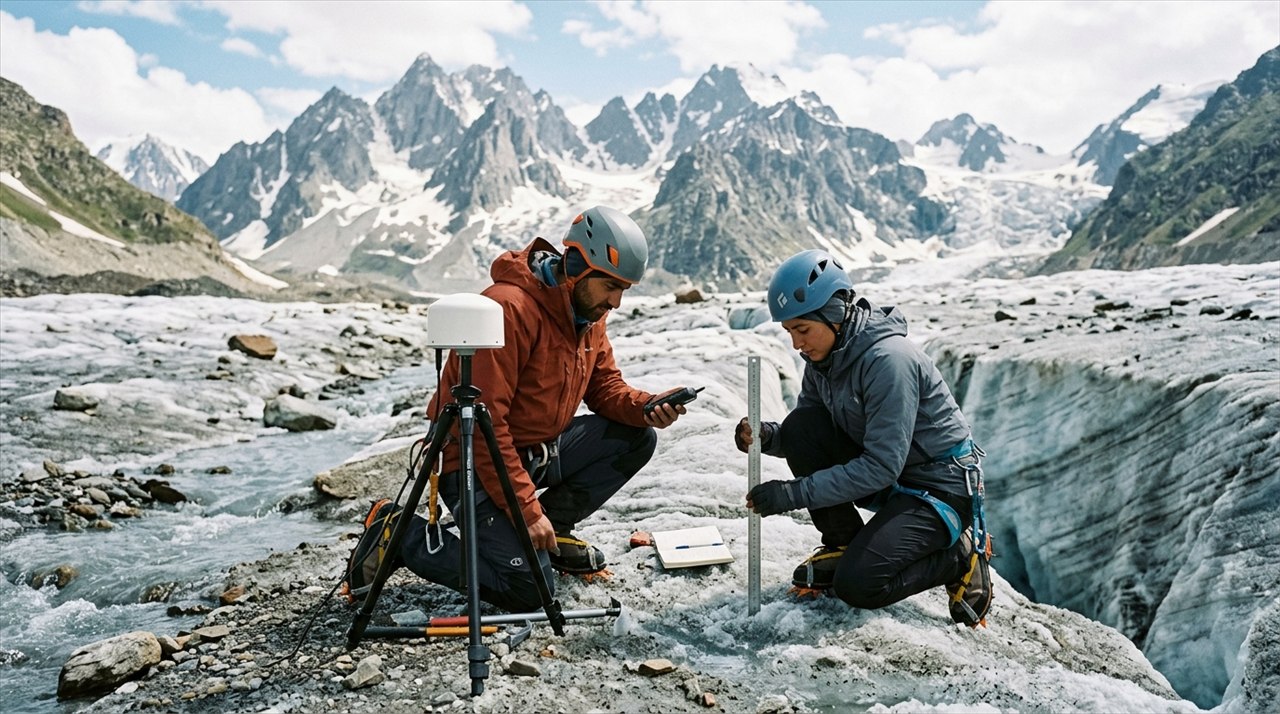
Differential GNSS Terminus Survey & Ablation Stake Network on Debris-Mantled Ice
FIELD METHODOLOGY · GLACIOLOGY & PERIGLACIAL SCIENCES

Differential GNSS Terminus Survey & Ablation Stake Network on Debris-Mantled Ice

Geodetic GNSS benchmarks and steam-drilled ablation stakes used to calibrate multi-decadal Landsat and Sentinel-2 equilibrium-line altitude (ELA) and DEM surface-lowering records.

Primary field instrumentation: Multi-frequency differential GNSS geodetic receivers · Steam-drilled aluminum ablation stakes & snow-density cutters.

Upper Lidder & Sindh Cryosphere Zone (3,900–4,600 m ASL)Illustration
C H A P T E R 0 9

Microbial Pioneers, Nurse Plants & Aquatic Proglacial Colonization

Primary succession across deglaciated Himalayan terrain unfolds as a three-tier trophic relay . First, subglacial chemolithoautotrophs (oxidizing iron and sulfur in comminuted Panjal Trap till) yield to photoautotrophic cyanobacteria, green algae, chlorolichens, and hardy bryophytes (Bryum, Polytrichum, Racomitrium) that bind loose glacial silt against wind deflation and initiate nitrogen fixation . Second, compact hemispherical cushion plants (Androsace, Saxifraga, Silene) act as microclimatic "nurse species," buffering root-zone diurnal temperature swings by 6–10 deg C and concentrating moisture and N for secondary graminoids and legumes .

Concurrently, retreating snouts birth cold, turbid kryal streams (<2–4 deg C, high glacial flour) initially inhabited solely by cold-stenothermal Diamesa chironomids, which diversify downstream and over time into clear groundwater-fed krenal channels and newly impounded proglacial tarns colonized by diatoms, Baetis mayflies, and trichopterans . Direct 16S/nifH and ITS2 metagenomic profiling of Kolahoi till remains an unmeasured Phase-2 priority.

C H A P T E R 1 0

Multi-Metric Chronosequence Indicator Synthesis

Evaluating our indicator suite confirms rapid physical habitat emergence paired with slow pedogenic maturation. Kolahoi’s 2.92 km^2 post-1962 foreland expansion represents a flagship regional laboratory, yet the 22-year mean lag to reach SAVI >= 0.16 highlights how fragile early microbial and seedling stages remain for two decades after ice departure .

Across the century-scale soil gradient, topsoil organic carbon climbs from ~1.4 g C/kg in raw snout till to >28.5 g C/kg on LIA moraines while pH declines from 7.9 to 6.3 . This slow pedogenic clock means any mechanical scraping, campsite excavation, or intense hoof trampling on 20–50-year moraines destroys soil capital that required half a century of short 110-day alpine summers to accumulate.

Figure 46.1 · Space-for-Time Chronosequence (0–10 yr Snout Till to >120 yr LIA Moraine)

Topsoil Organic Carbon Accretion Across Kashmir Foreland Chronosequence Stages (g C / kg (<2 mm soil))

Unit: g C / kg (<2 mm soil)
Loading comparative scientific figure…

Interpretation: Soil carbon remains severely depleted (<5 g/kg) during the initial 25-year microbial lag phase before accelerating once nurse cushions and N-fixing legumes establish, crossing the 20 g/kg functional turf benchmark after ~65–80 years.

Source: Synthesized from alpine foreland pedogenic chronosequences [4][6], Bosson et al. [1], and Kashmir moraine ages [2][3].

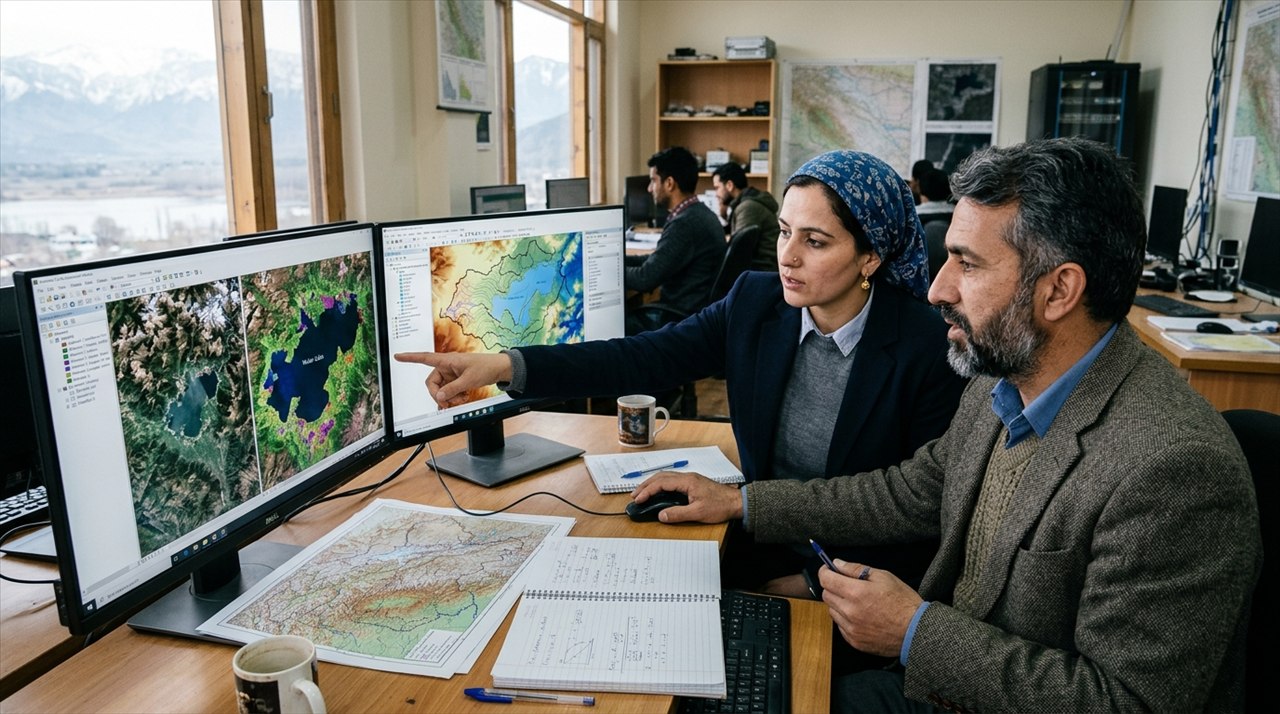
Multi-Temporal Sentinel/Landsat Radiometric Harmonization & Watershed DEM Modelling
ANALYTICAL LABORATORY & COMPUTATIONAL SYNTHESIS

Multi-Temporal Sentinel/Landsat Radiometric Harmonization & Watershed DEM Modelling

Geospatial synthesis integrating Copernicus 30 m DEM terrain derivatives, Sentinel-1 SAR interferometry, and multi-decadal optical reflectance series with uncertainty propagation.

Analytical systems: InSAR glacier velocity & geodetic DEM differencing workstations · Stable water isotope (δ18O / δ2H) laser spectroscopy.

Earth-Observation & Spatial Modelling ProtocolIllustration
C H A P T E R 1 1

Anthropogenic & Pastoral Pressures on Nascent Forelands

Unlike remote polar forelands in Svalbard or Greenland , Kashmir Himalayan glacier margins sit immediately upslope of long-established seasonal transhumant pastures (margs) and popular alpine trekking routes out of Aru, Sonamarg, and Baltal. As lower sub-alpine meadows experience midsummer forage desiccation or crowding, migratory sheep, goat, and equine herds push progressively higher onto 20–50-year recessional moraines .

On mature >150-year Kobresia turf, moderate seasonal grazing is ecologically accommodated by dense rhizomatous sod. On young (<40-year) glacial till, however, sharp hooves shatter brittle nitrogen-fixing biological soil crusts, uproot shallow-rooted cushion nurse plants, and import ruderal nitrophilous weeds (Rumex nepalensis, Poa annua, Polygonum aviculare) via dung along pony trails—short-circuiting native endemic alpine assembly .

C H A P T E R 1 2

Biogeomorphic Feedbacks: Root Cohesion & Paraglacial Sediment Yield

Ecological succession on glacier forelands is not merely a passive passenger on geomorphic terrain; vegetation actively engineers slope stability through biogeomorphic feedbacks . Freshly debuttressed lateral moraines rely solely on inter-particle friction of unconsolidated till and transient ice-cementation, failing frequently during July–August rainstorms and delivering heavy bedload pulses into the West Lidder and Sindh rivers.

Once Stage III–IV fibrous graminoid and dwarf-shrub (Salix, Juniperus, Rhododendron anthopogon) root networks interlace the upper 15–35 cm of till, apparent root cohesion adds 4–14 kPa of shear strength across potential shallow slip planes, sharply curtailing rill and gully incision while trapping fine aeolian and overland silt.

Governing Analytical Expression
FS_moraine(t) = [c_till + c_root(t) + (gamma_s * z * cos^2(beta) - u_w) * tan(phi_till)] / [gamma_s * z * sin(beta) * cos(beta)]

Time-dependent infinite-slope Factor of Safety (FS_moraine) for debuttressed lateral moraines, where c_till is bare mineral cohesion (~0–1 kPa), c_root(t) is successional root tensile cohesion (rising from 0 kPa at t < 10 yr to 6–14 kPa at t > 70 yr), gamma_s is till unit weight, z is regolith slab depth, beta is moraine slope angle, u_w is porewater pressure, and phi_till is internal friction angle.

C H A P T E R 1 3

Climate Refugia Potential vs Thermophilization Extinction Debt

For cold-adapted nival and high-alpine Himalayan plants—including threatened medicinal and endemic taxa such as Saussurea costus, Arnebia benthamii, Picrorhiza kurroa, and high-scree Corydalis species—upslope migration onto newly deglaciated forelands represents a critical survival pathway as lower alpine zones warm and woody shrubs expand upward . Because summit geometry narrows with altitude, flat-to-gently-sloping cirque floors vacated by retreating glaciers offer rare topographic area gains above 3,700 m ASL .

Yet dispersal limitation and slow soil maturation create a dangerous demographic bottleneck: wind-dispersed generalists colonize young forelands rapidly, whereas heavy-seeded or obligately mycorrhizal endemic herbs cannot establish until Stage III soils and fungal symbionts mature—risking local extinction if lower habitats warm faster than upper forelands become edaphically habitable .

C H A P T E R 1 4

Emerging Carbon Sinks & Hydrological Storage Co-Benefits

Although newly exposed till initially releases trace ancient petrogenic or subglacial organic carbon through microbial oxidation, Bosson et al. demonstrate that post-glacial soil formation and wetland establishment transition into a persistent net ecosystem carbon sink within several decades of ice retreat. Across ~28.6 km^2 of mapped post-LIA Kashmir forelands—expanding further by mid-century—maturing alpine soils can sequester tens of thousands of tonnes of mineral-associated organic carbon.

Equally important, pedogenic accumulation of humic colloids and bryophyte mats transforms hydrophobic, fast-draining boulder till into a porous sponge that increases surface water retention, attenuates flash overland runoff during summer storms, and filters glacial rock flour prior to downstream stream entry .

C H A P T E R 1 5

Conservation Governance Gap Over Newly Deglaciated Terrain

Statutory land-use and wildlife boundaries in Jammu and Kashmir were drawn decades ago when upper cirques were mapped simply as "barren snow/glacier waste" outside active habitat management . While portions of the Lidder-Dachigam-Overa-Aru and Baltal-Thajiwas landscapes enjoy Wildlife Sanctuary or Pahalgam/Sonamarg Development Authority jurisdiction, newly exposed proglacial forelands lack dedicated zoning rules governing camping, equine grazing, or boulder disturbance.

Following the global conservation imperative articulated by Bosson et al. , statutory Forest Working Plans and Eco-Sensitive Zone (ESZ) master plans must explicitly recognize post-glacial forelands (<80 years ice-free) as dynamic primary-succession nurseries rather than unproductive wasteland open to unregulated trail cutting or camp infrastructure.

C H A P T E R 1 6

Foreland Ecological Risk & Vulnerability Matrix

Synthesizing geomorphic hazard, biotic sensitivity, and anthropogenic exposure identifies Stage I–II biological soil crusts and Stage III cushion-plant facilitation zones along accessible trekking/grazing corridors (Kolahoi–Satlanjan and Thajiwas) as high-priority conservation targets. Once biocrusts and nurse cushions on 15–40-year moraines are pulverized by pack animals or campsites, frost heave and wind erosion revert surfaces to bare cobble pavement for decades .

Cold-stenothermal kryal stream invertebrates face irreversible long-term habitat contraction as glacier snouts retreat toward summit headwalls and cold turbid meltwater transitions into warmer groundwater/snow-fed streams . Conversely, non-native ruderal weed incursion along disturbed moraine trails remains reversible today through strict pack-animal feed/corral management before invasive seedbanks naturalize.

Table 46.2. Comparative Disturbance & Conservation Status Across Sentinel Kashmir Proglacial Forelands
Foreland SystemSnout Elevation (m)Post-1962 Retreat ZonePrimary Disturbance DriverSuccession Trajectory Status
Kolahoi Foreland (West Lidder)3,690 m~2.92 km^2 exposed [3]Trekking camps, pony grazing & lateral moraine gullyingActive Stage I–IV; vulnerable mid-foreland
Hoksar Foreland (Lidder Divide)3,810 m~0.68 km^2 + LIA ridges [2]Low human access; natural frost heave & rockfallIntact benchmark chronosequence
Machoi Foreland (Zojila Sector)3,745 m~0.85 km^2 exposedHighway dust deposition & seasonal flock transitSlow semi-arid carbonate succession
Thajiwas Lower Moraines (Sonamarg)3,440 mStabilized LIA + upper cirqueIntense recreational pony traffic & kiosk tramplingArrested/ruderalized lower moraine turf

Source & Provenance: Compiled from published Kolahoi/Hoksar glaciological studies [2][3] and Sentinel-2 / field-access screening [7].

C H A P T E R 1 7

Passive Conservation & Assisted Native Bio-Stabilization

Across intact, low-access forelands such as Hoksar and upper Kolahoi, strict passive conservation—allowing natural microbial, lichen, bryophyte, and endemic plant assembly to unfold without human soil compaction—is scientifically superior to agronomic turf seeding . Introducing commercial exotic pasture grasses (such as Lolium perenne or Trifolium repens) or chemical NPK fertilizers onto alpine forelands must be strictly prohibited, as nutrient addition competitively excludes native N-fixing crusts and slow-growing endemic cushion plants.

Where debuttressed lateral moraines directly threaten downstream trails or bridges via acute debris-flow gullying, bio-engineering stabilization should use biodegradable coir/jute geogrids inoculated exclusively with locally collected Stage III pioneer seeds (native Poa, Kobresia, Astragalus, and Salix cuttings) paired with seasonal rotational exclusion of equine and ovine herds from <40-year ice-free zones.

C H A P T E R 1 8

Successional Trajectory Scenarios (2026–2060)

Under continued regional glacier recession through 2060, deglaciated foreland area across the Kashmir and Zanskar rims will expand substantially . Under an Unregulated Access & Grazing scenario, escalating alpine trekking footfall, pack-horse tethering near glacier snouts, and earlier spring flock ascents compact incipient Cryorthent soils, spread ruderal weeds above 3,700 m ASL, and sustain elevated paraglacial siltation.

Under a Proglacial Sanctuary & Chronosequence Observatory scenario—restricting campsites and pack animals below 1962 terminal moraines, enforcing leave-no-trace boardwalks/trails on older stabilized ridges, and protecting natural nurse-plant facilitation—newly ice-free valleys mature into resilient high-alpine biodiversity refugia and stable headwater soil-carbon reservoirs .

C H A P T E R 1 9

Synthesis Conclusions & Institutional Action Matrix

Retreating Kashmir glaciers do not leave behind lifeless wasteland; they unveil dynamic pioneer ecosystems where cyanobacteria, lichens, cushion plants, and cryo-pedogenic processes build the future alpine soils and endemic refugia of the Western Himalaya . Protecting the first 40 years of microbial and nurse-plant assembly is decisive for both biodiversity conservation and paraglacial slope stability.

Coordinated action by the Department of Wildlife Protection J&K, Pahalgam and Sonamarg Development Authorities, University of Kashmir Centre of Research for Development (CORD) / Dept of Botany & Geoinformatics, and Botanical Survey of India should immediately demarcate Proglacial Succession Zones and establish permanent long-term monitoring plots.

C H A P T E R 2 0

Epistemic Governance, Provenance & Pre-Registered Phase-2 Protocol

In adherence to Kashmir EcoWatch Section 15 Governance Standards, this dossier is classified as a Secondary-Data Scientific Review. Glacier recession areas and moraine ages derive from published Kashmir glaciological and lichenometric studies and Copernicus/Landsat satellite series , while microbial and soil C/N/pH chronosequence parameters are synthesized transparently from peer-reviewed alpine foreland literature .

Because fine-scale rhizosphere metagenomics and plot-level soil stoichiometry have not yet been systematically published across Kolahoi and Machoi isochrones, Phase-2 fieldwork pre-registers replicated 5 m x 5 m permanent chronosequence plots (0, 15, 35, 65, and >120 yr bands) measuring acid-fumigated SOC, 15N natural abundance, 16S/ITS2/nifH eDNA, and root shear strength.

Scientific Uncertainty & Data Limitations Disclosure

  • Space-for-time chronosequence substitution assumes earlier-deglaciated LIA moraines experienced comparable initial climatic conditions to post-2010 snout zones, whereas modern pioneers colonize under ~1.2–1.5 deg C warmer summers.
  • Direct plot-level soil metagenomic (16S/ITS/nifH) and acid-fumigated soil organic carbon datasets from Kolahoi and Machoi forelands have not yet been published, requiring synthesis from alpine chronosequence benchmarks until Phase-2 sampling completes.
  • Sentinel-2 10 m SAVI/NDVI cannot spectrally resolve hypolithic cyanobacteria, epilithic lichens, or scattered crevice seedlings below ~10–12% fractional cover, overestimating the apparent "barren" phase.
  • Debris-covered dead-ice tongues along lower Kolahoi and Machoi margins blur the exact year-zero deglaciation boundary where supraglacial pioneer plants colonize perched till prior to complete ice melt-out.