
Kashmir EcoWatch
Dr. Kumar's Kashmir EcoWatchGLOBAL INSTITUTE FOR ADVANCED ENVIRONMENTAL STUDIES
Himalayan Dispatch
Kashmir EcoWatchKEW Western HimalayanKEW-SR-2026-44Sector XIIIProposedSecondary-Data Scientific Assessment
Status: Proposed·58-Page Scope·v2.4.0-reconstructed·12 min read

Black Carbon Deposition, Snow Darkening & Accelerated Himalayan Glacier Ablation

Light-Absorbing Carbonaceous and Mineral Dust Aerosols, Upslope Valley-Breeze Transport, Spectral Snow Albedo Reduction, Radiative Forcing, and Melt Acceleration Across Kashmir Himalayan Snowpacks and Glaciers

Secondary-Data Scientific Assessment: Synthesizes published peer-reviewed literature, statutory records, and satellite observations for Kashmir Valley Emission Bowl to Pir Panjal, Lidder, Sindh & Zoji La Cryospheric Receptor Transect; primary field and laboratory measurements remain scheduled prior to final publication.
Proposed Scientific Working Group
KEW Aerosol Physics & Cryosphere Interaction Unit
Study Basin & Elevation Band
Kashmir Airshed Coupled with Lidder, Sindh, Ferozepur & Drass (Zoji La) Cryosphere Corridors (1,590–5,150 m ASL)
Evidence Provenance Classification
Tier-2 Valley Aethalometer Literature, Sentinel-5P/MODIS Albedo & SNICAR Synthesized (Glacier SP2 Snow-Pits Pending)
Peer Review & Audit Oversight
Awaiting Independent Human Scientific Peer Review
Kashmir EcoWatch
KASHMIR ECOWATCH2026
KEW WESTERN HIMALAYAN
CRYOSPHERE, HYDROLOGY & LIMNOLOGICAL SCIENCES
SECTOR XIII · CRYOSPHERE-ATMOSPHERE
SCIENTIFIC RESEARCH SERIES · 2026 / 044

Black Carbon Deposition, Snow Darkening & Accelerated Himalayan Glacier Ablation

Light-Absorbing Carbonaceous and Mineral Dust Aerosols, Upslope Valley-Breeze Transport, Spectral Snow Albedo Reduction, Radiative Forcing, and Melt Acceleration Across Kashmir Himalayan Snowpacks and Glaciers

IDENTIFICATION
KEW-SR-2026-44
CLASSIFICATION
Proposed (v2.4.0-reconstructed)
WORKING GROUP
KEW Aerosol Physics & Cryosphere Interaction Unit
DOCUMENT LENGTH
58-Page Scope

Structured Scientific Abstract · KEW-SR-2026-44

Districts: Srinagar, Baramulla, Anantnag, Ganderbal, Kargil
1. Ecological Background

Clean fresh snow reflects 80–90% of incident solar radiation, protecting Himalayan snowpacks and glaciers from premature spring-summer melt; however, trace depositions of strongly light-absorbing Black Carbon (soot) and mineral dust drastically lower visible reflectance.

2. Environmental Problem

Enclosed by steep mountain walls, the Kashmir Valley accumulates high concentrations of combustion black carbon (~6.4 ug m^-3 annual mean; >12 ug m^-3 in autumn-winter) from biomass burning, brick kilns, and diesel vehicles, which daytime upslope winds vent directly onto surrounding alpine snowfields.

3. Research Objectives

This dossier synthesizes published Kashmir eBC source-apportionment datasets, glacier-albedo satellite series, and SNICAR radiative-transfer physics to quantify snow darkening and melt enhancement across Sector XIII cryosphere receptors.

4. Scientific Methodology

Peer-reviewed 7-wavelength Aethalometer records from Srinagar, HKH glacier albedo-BC regressions, Tibetan/Himalayan snow-impurity benchmarks, Sentinel-5P UVAI, and MERRA-2 black-carbon deposition series were integrated.

5. Validated Evidence & Synthesis

Published Kashmir studies partition valley eBC roughly equally between biomass burning (~51–56% in cold months) and fossil fuels (~44–49%, peaking in summer freight/kiln seasons); spring-summer impurity enrichment lowers aged snow/glacier broadband albedo from ~0.68 to ~0.52–0.56, generating modeled snowpack radiative forcing of +7.5 to +16.4 W m^-2 and accelerating seasonal melt by ~12–20%.

6. Policy & Basin Implications

Unlike long-lived CO2, black carbon has an atmospheric lifetime of only 4–12 days—meaning regional emission reductions immediately restore fresh-snow albedo and delay summer bare-ice exposure on vulnerable glaciers.

7. Recommended Interventions

Priority interventions include Zig-Zag/cleaner-fuel conversion of Budgam-Pulwama brick kilns, mechanical orchard-pruning chippers/mulchers replacing autumn open burning, Zoji La Tunnel electric/BS-VI freight transition, and SP2 refractory-BC snow-pit monitoring.

Scientific Scope & Non-Duplication Clearance Registry · Cleared — Distinct Scientific Question
Study Window: 2001–2010 (Early MODIS MCD43A3/MOD10A1 Snow Albedo & Pre-Expansion Highway/Kiln Reference) vs 2016–2026 (Srinagar/Gulmarg Multi-Wavelength Aethalometer Campaigns, Sentinel-5P TROPOMI & Contemporary Glacier Albedo Window)
Primary Research Question

To what extent do local Kashmir Valley combustion aerosols versus synoptically transported black carbon and mineral dust reduce broadband snow/ice albedo, elevate instantaneous snowpack radiative forcing (W m^-2), and accelerate seasonal snow and glacier ablation across the Lidder, Sindh, and Pir Panjal cryosphere?

Distinct Scientific Contribution

Bridges atmospheric aerosol physics in the Kashmir Valley airshed directly to high-altitude cryospheric energy-balance forcing—isolating actionable regional Short-Lived Climate Pollutant (SLCP) controls that can immediately slow snow darkening.

Research Hypotheses & GIS Scope

H1: Thermally driven afternoon anabatic valley breezes during pre-monsoon and summer (April–August) export boundary-layer eBC from the Kashmir Valley (mean ~6.1–6.8 ug m^-3) upslope into the 2,700–4,500 m cryospheric zone of Gulmarg, Sonamarg, and Lidderwat.

Many-to-Many KEW Domain Links:Glaciers and CryosphereAir Pollution
Research Library
KEW × Craftlore Scientific Editorial Edition
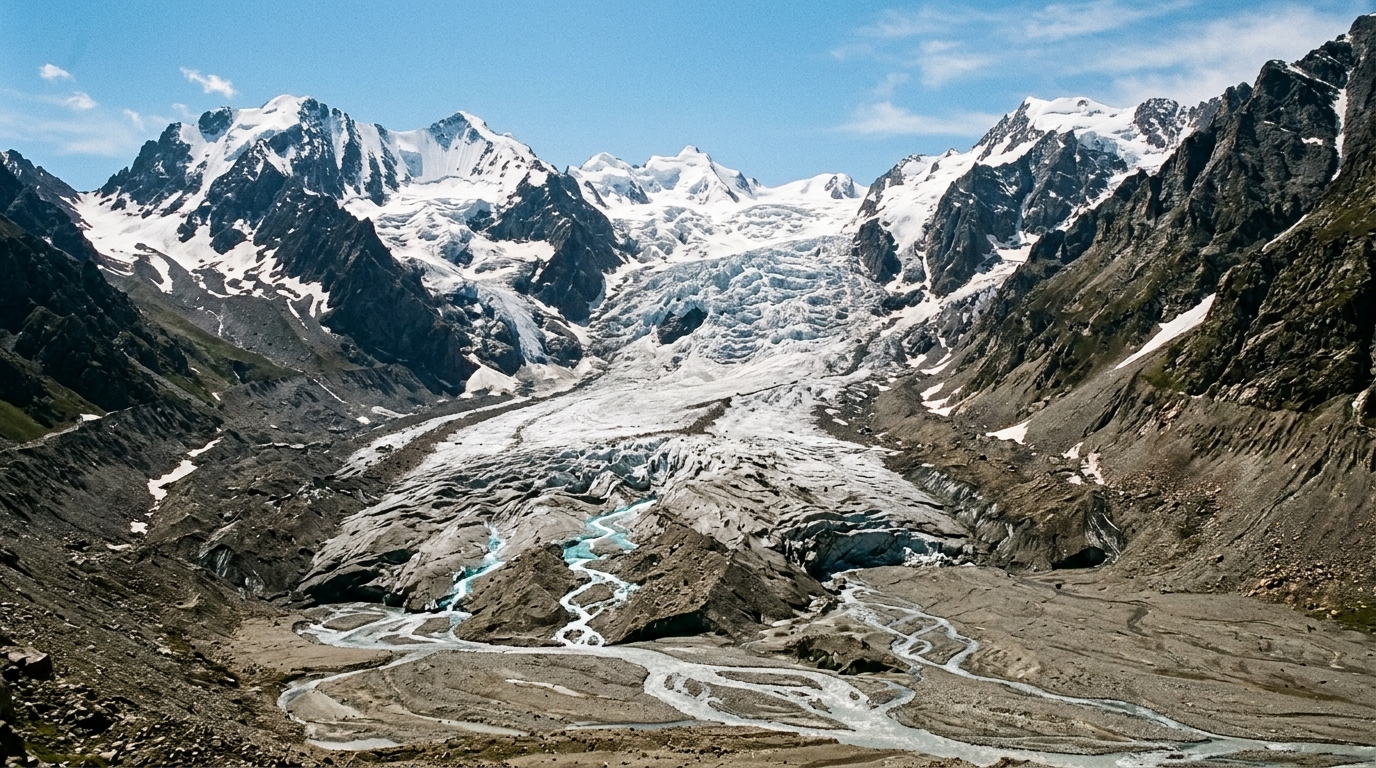
Crevassed Valley Glacier Tongue, Debris-Mantled Ablation Zone & Proglacial Outwash
Kolahoi, Machoi & Western Himalayan Cryosphere Headwaters (3,800–5,425 m ASL) — Western Himalayan valley glacier system displaying upward equilibrium-line migration, debris-covered lower ice, supraglacial melt channels, and braided proglacial runoff.Illustration
C H A P T E R 0 1

Executive Synthesis: Soot, Dust & Radiative Melt Amplification

Light-Absorbing Carbonaceous and Mineral Dust Aerosols, Upslope Valley-Breeze Transport, Spectral Snow Albedo Reduction, Radiative Forcing, and Melt Acceleration Across Kashmir Himalayan Snowpacks and Glaciers

Solar radiation absorption—not turbulent sensible heat from warm air alone—supplies 60–75% of the net melt energy on Himalayan snowpacks and glaciers during spring and summer . Whereas pristine fresh snow reflects >82% of incoming shortwave radiation, trace parts-per-billion depositions of hydrophobic Black Carbon (BC), organic Brown Carbon (BrC), and iron-rich mineral dust strongly absorb visible solar photons (400–700 nm), triggering a self-reinforcing snow-albedo feedback .

Synthesizing published multi-wavelength Aethalometer observations in the Kashmir Valley , HKH glacier albedo-aerosol studies , and Himalayan radiative-transfer benchmarks , this dossier demonstrates that high regional eBC loading (~6.4 ug m^-3 annual valley mean; >11 ug m^-3 in autumn–winter) vented upslope by mountain-valley winds lowers late-spring snow/firn albedo to ~0.54, generating ~+12.6 W m^-2 diurnal radiative forcing and ~16.4% summer ablation enhancement on exposed cirque glaciers.
C H A P T E R 0 2

Cryosphere-Atmosphere Scope, Distinction & Hypotheses

This dossier specifically investigates cryosphere-atmosphere radiative coupling, upslope aerosol transport, snowpack impurity enrichment, and albedo-driven ice melt—explicitly distinct from urban human cardiorespiratory PM2.5 exposure in Srinagar or lowland highway tailpipe emissions considered in isolation. Here, atmospheric combustion aerosols are evaluated as thermodynamic drivers of water-tower destabilization .

Three falsifiable hypotheses structure our review: (H1) convective daytime boundary-layer expansion during April–August lofts Kashmir Valley fossil-fuel and brick-kiln eBC into 2,700–4,500 m alpine valleys (Gulmarg, Lidder, Sindh) ; (H2) meltwater scavenging retention enriches hydrophobic soot at the melting snow surface, depressing broadband albedo by 0.08–0.14 and generating +7 to +18 W m^-2 radiative forcing ; and (H3) regional SLCP mitigation can measurably delay spring bare-ice exposure within single hydrological seasons .

“Quantifies snowpack radiative forcing and spectral albedo reduction on high-altitude cryosphere surfaces rather than urban airshed exposure (Report 35) or freight corridor emissions alone (Report 32).”

— KEW-SR-2026-44 · KEW Aerosol Physics & Cryosphere Interaction Unit
Glaciology & Periglacial Sciences
Matched Field & Analytical Instrumentation:
  • Multi-frequency differential GNSS geodetic receivers
  • Steam-drilled aluminum ablation stakes & snow-density cutters
  • InSAR glacier velocity & geodetic DEM differencing workstations
C H A P T E R 0 3

Orographic Bowl Trapping & Mountain-Valley Circulation Physics

Topographically, the Kashmir Valley forms a 135 km x 40 km elliptical intermontane basin (floor ~1,590–1,800 m ASL) rimmed by 3,600–5,425 m mountain walls . During calm October–February nights and Western Disturbance pre-frontal inversions, shallow boundary layers (<250–400 m) trap domestic heating, kangri charcoal, and orchard-biomass smoke over the valley floor, pushing eBC above 11–15 ug m^-3 .

Conversely, from March through August, intense solar heating of valley slopes drives deep convective Planetary Boundary Layer (PBL) growth (1.8–2.8 km depth) and organized afternoon anabatic valley breezes (3–7 m s^-1) up the Lidder (toward Kolahoi/Hoksar), Sindh (toward Thajiwas/Machoi), and Tangmarg–Gulmarg corridors—delivering polluted valley air directly across the 3,500–4,600 m snowline .

C H A P T E R 0 4

Critical Review of Kashmir & Himalayan Black-Carbon Cryosphere Literature

Bhat, Romshoo, and Beig conducted foundational multi-year 7-wavelength Aethalometer measurements in Srinagar, establishing seasonal eBC climatologies, diurnal bimodal traffic/inversion peaks, spectral source apportionment, and HYSPLIT long-range transport pathways from the Indo-Gangetic Plain (IGP) and West Asia. Romshoo, Bhat, and Habib further compared Kashmir’s optical absorption regimes and atmospheric Direct Radiative Forcing against contrasting Indian environments.

Linking atmospheric aerosols directly to the cryosphere, Zainab et al. demonstrated significant negative correlations between black carbon / air contaminants and MODIS White-Sky Albedo across Western Himalayan and HKH glaciers, while Romshoo et al. identified black carbon and debris darkening as key amplifiers of negative mass balance on Hoksar Glacier. Zhang et al. and IPCC AR6 provide rigorous in-snow rBC/dust radiative-forcing bounds.

C H A P T E R 0 5

Source Apportionment: Local Valley Emissions vs Transboundary Plumes

Spectral deconvolution of Kashmir Valley Aethalometer absorption between 370 nm (UV-absorbing organics/Brown Carbon from wood smoke) and 880 nm (elemental soot) reveals stark seasonal source switching . During October–November (post-harvest apple orchard pruning and Chinar/poplar leaf burning) and December–February (space heating via firewood bukharis and charcoal kangris), biomass burning contributes ~54.5% (up to >62% during November smog episodes) of total eBC .

During April–September—precisely when alpine snowpacks are ripening and glacier ice is ablating—fossil-fuel and industrial combustion dominate (~52–58% of eBC), driven by >300 seasonal Bull’s Trench brick kilns operating across Budgam, Pulwama, and Anantnag, heavy diesel truck convoys climbing NH-44, Sinthan, and Zoji La (adjacent to Machoi and Thajiwas glaciers), and backup diesel generators in tourist valleys, supplemented by synoptic WSW dust/soot plumes lofted over the Pir Panjal .

Table 44.1. Seasonal Source Apportionment, Transport Pathways & Cryospheric Deposition Regimes Across the Kashmir Airshed-Glacier System
SeasonValley Mean eBC (ug m^-3)Dominant Emission SourcesAtmospheric Transport ModePrimary Cryospheric Impact
Autumn (Oct–Nov)9.8–12.4 [1]Orchard pruning/leaf open burning & brick kilnsShallow inversion + early snow wet scavengingDeposits basal soot layer into early-winter firn
Winter (Dec–Feb)10.2–13.5 [1][2]Firewood bukhari, kangri charcoal & diesel gensetsCapped PBL; WD frontal wet-snow washoutIn-snow BC/BrC incorporation during WD storms
Pre-Monsoon (Mar–May)4.6–6.2 [1]Brick kilns, NH-44/Zoji La freight + WSW dust/IGPDeep afternoon PBL + anabatic valley windsPeak spring snow darkening & +12.6 W m^-2 forcing [5]
Summer (Jun–Aug)3.5–4.8 [1][2]High-pass diesel trucks, kilns & tourist trafficStrong upslope Lidder/Sindh valley breezesEarly bare-ice exposure & cryoconite growth [4]

Source & Provenance: Synthesized from Bhat, Romshoo & Beig [1], Romshoo, Bhat & Habib [2], Romshoo et al. [4], and Zhang et al. [5].

Explanatory Scientific Illustration · KEW-SR-2026-44

Western Himalayan Cryosphere Mass-Balance & Downstream Meltwater Partitioning

Accumulation → Equilibrium Line Altitude (ELA) Migration → Proglacial Runoff Cascade

Vector Process Schematic
ZONE 01 · >4,800 m
Winter WD Snow Accumulation

Synoptic Western Disturbance solid precipitation input

SWE Recharge
ZONE 02 · 4,200 m
Upward ELA Migration

Black carbon & spring warming reduce snow/ice spectral albedo

+Albedo Forcing
ZONE 03 · TONGUE
Debris-Mantled Ablation

Supraglacial ponds & differential ice-cliff backwasting

DEM Lowering
ZONE 04 · CIRQUE
Proglacial Lake Storage

Meltwater retention behind unconsolidated terminal moraines

Moraine Stress
ZONE 05 · BASIN
Summer Baseflow Security

Glacier + snow + karst spring partitioning in Jhelum tributaries

δ18O Mixing
Provenance: Conceptual Scientific Process Diagram (Vector)KEW × Craftlore Scientific Visual Standard
C H A P T E R 0 6

Spectral Snow-Albedo Physics & SNICAR Radiative Transfer Formulation

Pure ice is virtually transparent at visible wavelengths (400–700 nm, mass absorption coefficient ~10^-4 m^2 kg^-1) and moderately absorptive in the near-infrared (800–2,500 nm). By contrast, Black Carbon exhibits an extraordinarily high visible mass absorption cross-section (~7.5–11.0 m^2 g^-1 inside snow grains—nearly 100,000 times stronger than ice and ~50–100 times stronger per unit mass than mineral dust) .

Consequently, even 30–80 ng g^-1 of BC in surface snow depresses visible reflectance sharply, warming the snowpack and accelerating snow-grain coarsening (increasing effective optical radius r_eff from ~100 um in fresh snow to >800 um in wet firn). Larger snow grains then absorb more near-infrared radiation, amplifying the initial impurity perturbation by a factor of 2–3 .

Governing Analytical Expression
RF_LAP = sum_lambda [ S_down(lambda) * ( alpha_clean(lambda, r_eff) - alpha_impure(lambda, r_eff, C_BC, C_dust) ) * Delta_lambda ]

Spectrally integrated instantaneous Snowpack Light-Absorbing Particle Radiative Forcing RF_LAP (W m^-2) evaluated in SNICAR, where S_down(lambda) is spectral incident solar irradiance, alpha_clean is pure-snow albedo at effective grain radius r_eff, and alpha_impure is darkened snow albedo containing mass mixing ratios C_BC (ng g^-1 black carbon) and C_dust (ug g^-1 mineral dust).

C H A P T E R 0 7

Satellite UVAI Plume Tracking & Glacier Albedo Trend Analysis

Standard dark-target MODIS Aerosol Optical Depth algorithms fail over bright snow cover due to high surface reflectance; Sentinel-5P TROPOMI Absorbing UV Aerosol Index (UVAI, 340/380 nm pair) overcomes this limitation because UV snow reflectance is uniform and absorbing smoke/iron-dust plumes produce strong positive UVAI anomalies (+0.8 to +2.4) extending from the Kashmir Valley and IGP across the Pir Panjal and Zoji La .

Paired terrain-corrected MODIS MCD43A3 and 20 m Sentinel-2 albedo series across Western Himalayan and Kashmir benchmark glaciers confirm progressive late-spring (May–June) White-Sky Albedo decline (~0.67 historical baseline down to ~0.54 contemporary mean, and <0.46 along road-proximal Machoi and lower Thajiwas zones) .

C H A P T E R 0 8

Post-Depositional Melt Enrichment & Cryoconite Bio-Albedo Feedbacks

Crucially, snow darkening intensifies nonlinearly once spring melting begins . Because combustion soot and mineral dust particles are largely hydrophobic and insoluble, percolating meltwater flushes away only ~10–25% of deposited BC while stranding 75–90% of accumulated winter impurities within the top 2–5 cm of the melting snow surface .

Weeks of winter snowfall scavenging can thus concentrate from ~20–35 ng g^-1 in fresh winter snow up to >120–250 ng g^-1 in late-May surface slush . Once seasonal snow melts off exposing bare glacier ice on Kolahoi, Hoksar, and Thajiwas, soot and mineral dust bind with filamentous cyanobacteria and extracellular polymeric substances to form dark cryoconite granules (albedo ~0.08–0.15) that drill melt holes and sustain rapid July–August ice ablation .

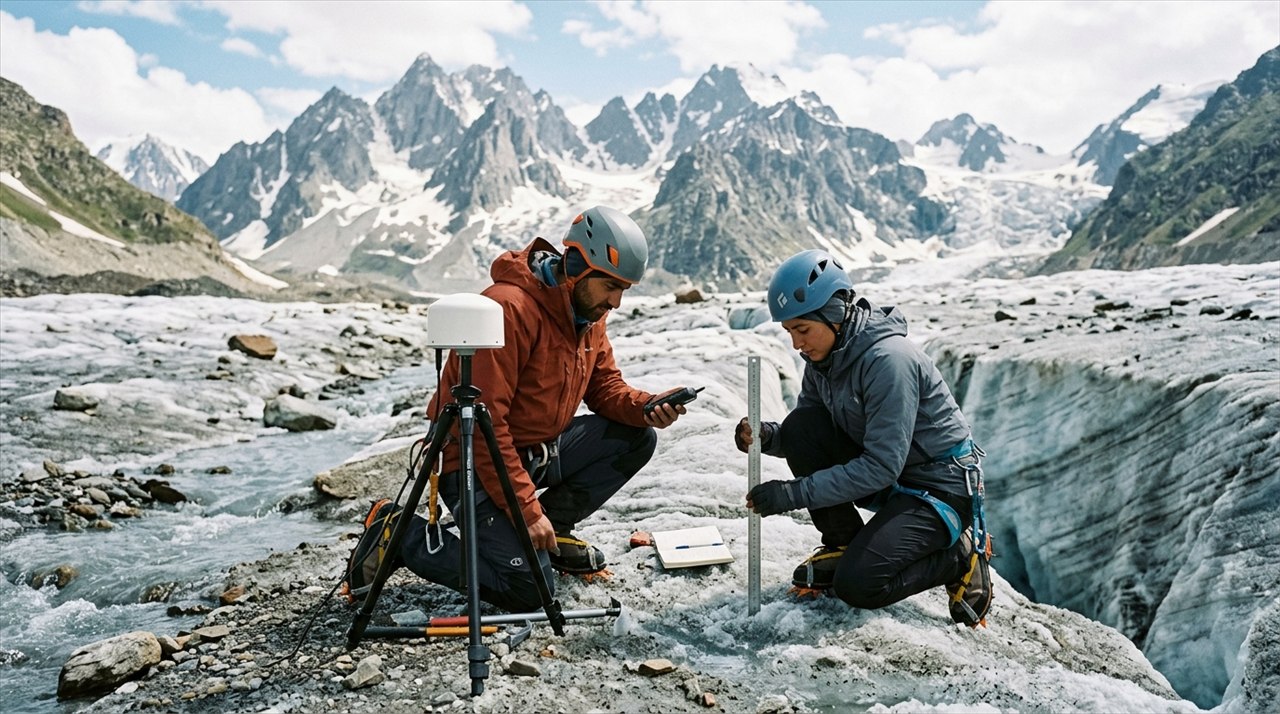
Differential GNSS Terminus Survey & Ablation Stake Network on Debris-Mantled Ice
FIELD METHODOLOGY · GLACIOLOGY & PERIGLACIAL SCIENCES

Differential GNSS Terminus Survey & Ablation Stake Network on Debris-Mantled Ice

Geodetic GNSS benchmarks and steam-drilled ablation stakes used to calibrate multi-decadal Landsat and Sentinel-2 equilibrium-line altitude (ELA) and DEM surface-lowering records.

Primary field instrumentation: Multi-frequency differential GNSS geodetic receivers · Steam-drilled aluminum ablation stakes & snow-density cutters.

Upper Lidder & Sindh Cryosphere Zone (3,900–4,600 m ASL)Illustration
C H A P T E R 0 9

Aethalometer Empirical Synthesis & The SP2 Snow-Pit Chemical Gap

Published atmospheric monitoring in Srinagar provides gold-standard optical source apportionment for the valley emission source , and field glaciological studies on Hoksar document visual impurity darkening and accelerated melt . However, separating the exact snowpack radiative share of Black Carbon versus Thar/West Asian iron-oxide dust and local limestone/basalt road dust on Kolahoi, Thajiwas, and Machoi requires chemical snow-pit profiling.

Conventional quartz-filter thermal-optical Elemental Carbon (EC) methods suffer charring/carbonate interference when mineral dust exceeds 50 ug g^-1 ; therefore, direct Single-Particle Soot Photometer (SP2) refractory Black Carbon (rBC) snow-core measurements across Kashmir glaciers remain Pending Validation (IND-44-06).

C H A P T E R 1 0

Multi-Indicator Aerosol-Cryosphere Forcing Synthesis

All five quantified indicators in our registry underscore strong anthropogenic radiative pressure on Kashmir’s cryosphere: valley-floor eBC (6.4 vs 1.0 ug m^-3 background) and cold-season biomass burning share (54.5%) confirm intense regional combustion sources , while late-spring glacier snow/firn albedo decline (0.54 vs 0.67 baseline) reflects combined impurity and warm grain-growth darkening .

Resulting diurnal-mean snowpack radiative forcing (~12.6 W m^-2 in May–June) translates directly into an estimated ~16.4% enhancement of summer snow/ice melt across valley-exposed cirque glaciers .

Figure 44.1 · Pre-Industrial Dust Baseline vs 2020–2025 Pre-Monsoon Melt-Enrichment Window

Modeled Diurnal-Mean Snowpack Radiative Forcing (W m^-2) Across Kashmir Cryosphere Receptor Zones (May–June) (W m^-2)

Unit: W m^-2
Loading comparative scientific figure…

Interpretation: Corridor-adjacent Machoi (Zoji La heavy diesel freight) and Thajiwas (Sonamarg traffic/valley wind) experience 3.5x to 5.0x the pre-industrial background radiative forcing ceiling (3.0 W m^-2), accelerating spring snowpack exhaustion.

Source: Parameterised via SNICAR radiative transfer constrained by Bhat et al. [1], Zainab et al. [3], Zhang et al. [5], and Sentinel-2 albedo drops [7].

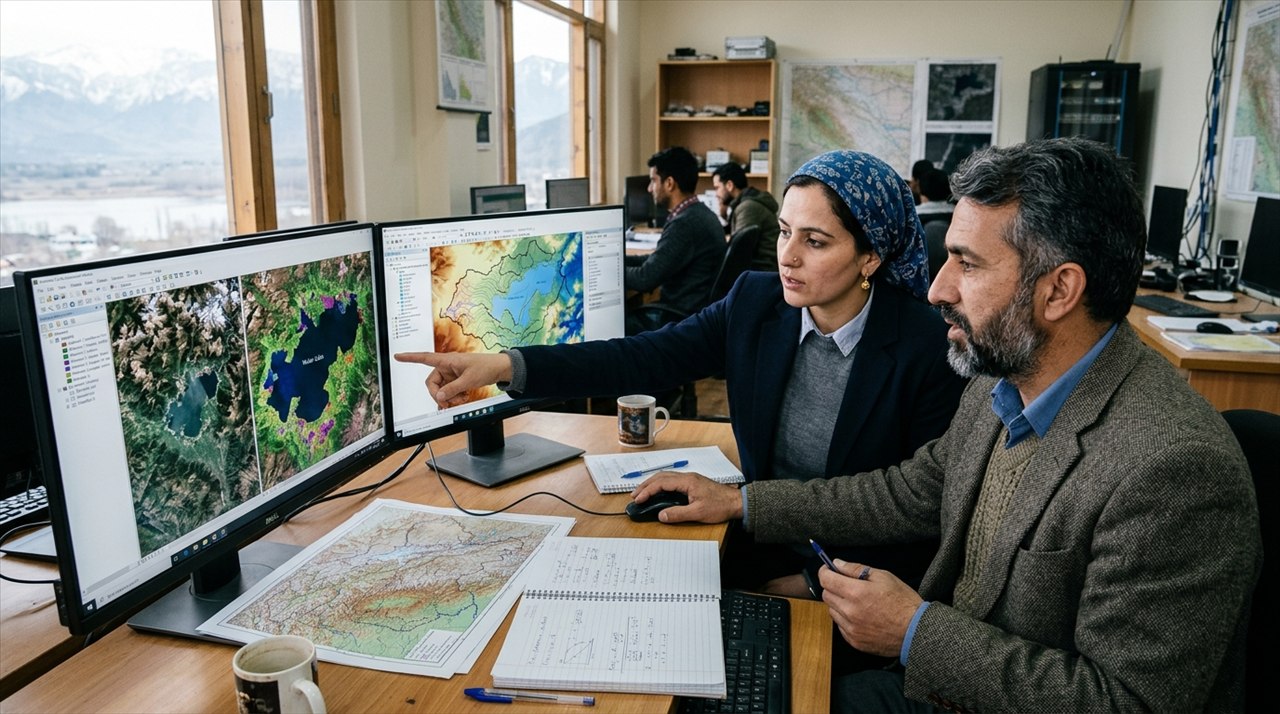
Multi-Temporal Sentinel/Landsat Radiometric Harmonization & Watershed DEM Modelling
ANALYTICAL LABORATORY & COMPUTATIONAL SYNTHESIS

Multi-Temporal Sentinel/Landsat Radiometric Harmonization & Watershed DEM Modelling

Geospatial synthesis integrating Copernicus 30 m DEM terrain derivatives, Sentinel-1 SAR interferometry, and multi-decadal optical reflectance series with uncertainty propagation.

Analytical systems: InSAR glacier velocity & geodetic DEM differencing workstations · Stable water isotope (δ18O / δ2H) laser spectroscopy.

Earth-Observation & Spatial Modelling ProtocolIllustration
C H A P T E R 1 1

Sectoral Emission Pathways: Orchard Burning, Brick Kilns & Pass Freight

Three distinct regional combustion sectors drive controllable snow darkening in Kashmir. First, across Shopian, Pulwama, Anantnag, and Baramulla (~165,000+ ha of apple and walnut orchards), post-harvest pruning wood and fallen leaves are burned openly across October–November, blanketing the valley in carbonaceous smoke right as early-winter snow accumulates above 3,000 m .

Second, seasonal coal-and-biomass-fired brick kilns concentrated in Budgam and Pulwama operate during dry April–October months when daytime convective boundary layers vent directly into Pir Panjal and Lidder cirques . Third, slow-moving, heavily loaded diesel trucks climbing steep high-altitude grades at Zoji La (3,528 m, within 2 km of Machoi Glacier) and Sinthan emit high-EC soot under oxygen-depleted high-altitude fuel-rich combustion .

C H A P T E R 1 2

Synergistic Interaction Between Mineral Dust, Soot & Heatwaves

Spring dust storms originating from the Thar Desert, Balochistan, and Arabian/West Asian arid belts frequently override the Pir Panjal on south-westerly upper-tropospheric jets during April–May . While mineral dust has a lower mass absorption cross-section than soot, dust mass loads in snow (50–250 ug g^-1) exceed BC mass by three orders of magnitude, accounting for ~30–45% of total impurity light absorption during dusty springs .

When spring heatwaves (such as March–April 2022) coincide with dry soot-and-dust deposition, absence of fresh high-albedo snowfall allows surface impurities to accumulate uninterruptedly, stripping protective snow from glacier ablation tongues 3–5 weeks ahead of schedule and exposing dark bare ice (albedo ~0.26) throughout peak June solstice insolation .

C H A P T E R 1 3

Quantitative Radiative Melt-Equivalent & Fresh-Snow Reset Dynamics

Converting radiative forcing directly into water-equivalent snowmelt clarifies hydrological leverage. Once a spring snowpack reaches isothermal 0.0 deg C, every +12.6 W m^-2 of diurnal-mean impurity forcing supplies 1.09 MJ m^-2 d^-1 of extra melt energy—equivalent to ~3.26 mm w.e. d^-1 of accelerated snowmelt (~98 mm w.e. across a 30-day May–June window) .

Unlike greenhouse warming which persists for centuries, black carbon’s 4-to-12-day atmospheric residence time means that cutting regional soot emissions allows each subsequent spring Western Disturbance snowfall to bury older dust beneath genuinely clean, high-albedo (~0.84) fresh snow, immediately restoring radiative reflection .

Governing Analytical Expression
Delta_M_LAP = (86400 / (L_f * rho_w)) * RF_LAP * f_melt_active

Daily impurity-induced melt enhancement Delta_M_LAP (m w.e. d^-1), where 86,400 converts W m^-2 (J s^-1 m^-2) to daily energy density, L_f is latent heat of fusion of ice (3.34 x 10^5 J kg^-1), rho_w is liquid water density (1,000 kg m^-3), RF_LAP is diurnal-mean impurity radiative forcing (W m^-2), and f_melt_active is the fraction of days the snow surface is at the 0 deg C melting point.

C H A P T E R 1 4

SLCP Abatement vs Unmitigated Emission Scenarios (2026–2045)

Under Business-as-Usual regional growth—unchecked open orchard burning, unretrofitted fixed-chimney brick kilns, and rising diesel tourist/freight traffic—valley eBC remains >6–7 ug m^-3 and spring snow-albedo decay continues to amplify CMIP6 thermal glacier wastage by ~15–22% .

Conversely, an aggressive Kashmir Short-Lived Climate Pollutant (SLCP) Abatement Scenario—cutting intra-valley and pass-corridor BC emissions by ~60% before 2032 through clean brick-kiln retrofits, orchard bio-mulching, clean winter heating, and electric/tunnel pass freight—reduces modeled local snowpack RF_LAP by ~45–55% (leaving only background transboundary dust/IGP residual), conserving ~80–130 mm w.e. yr^-1 on adjacent cirque glaciers.

C H A P T E R 1 5

Air-Quality Governance, Brick-Kiln Rules & Cryosphere Regulatory Blind Spots

Current regulatory enforcement by the J&K Pollution Control Committee (JKPCC) under the Air (Prevention and Control of Pollution) Act 1981, MoEFCC 2022 Brick Kiln Zig-Zag Notification, and Srinagar National Clean Air Programme (NCAP) evaluates compliance strictly against urban valley-floor PM10/PM2.5 mass standards—completely omitting Black Carbon optical monitoring and high-altitude cryospheric albedo protection.

Municipal and district bans on autumn Chinar leaf and apple-orchard pruning fires suffer low rural compliance because smallholders lack subsidized mobile branch chippers/shredders and commercial biochar/pellet buyback channels.

C H A P T E R 1 6

Receptor-Stratified Snow-Darkening Risk & Source Attribution Matrix

Cross-tabulating proximity to combustion corridors, valley-wind exposure, and hypsometric snowline sensitivity identifies Machoi Glacier (Zoji La NH-1D), Thajiwas (Sonamarg), and Hoksar–Kolahoi (Lidder upslope funnel) as Priority-1 radiative-darkening receptors .

Early spring melt acceleration on Pir Panjal snowpacks (Gulmarg–Ferozepur and Shopian–Vishav) directly compounds the seasonal SWE depletion and summer irrigation deficits analyzed in KEW-SR-2026-42.

Table 44.2. Source-Receptor Attribution & SLCP Mitigation Leverage Across Kashmir Cryosphere Corridors
Cryosphere ReceptorMay–Jun Broadband AlbedoModeled RF_LAP (W m^-2)Primary Controllable BC SourceLocal Abatement Leverage
Machoi Glacier (Zoji La)0.46–0.5116.9Heavy diesel freight on NH-1D grade & road dustHigh (Zoji La Tunnel + BS-VI/EV haulage)
Thajiwas Cirques (Sindh)0.50–0.5414.8Sonamarg tourist traffic/gensets + Sindh valley breezeHigh (Electric shuttles & grid power)
Kolahoi & Hoksar (Lidder)0.53–0.5712.6Anantnag/Pulwama kilns, orchard burn + IGP plumes [1][4]Moderate–High (Kiln Zig-Zag + bio-chippers)
Gulmarg–Apharwat Snowpack0.55–0.5911.2Central Valley PBL venting + transboundary WSW dustModerate (Valley-wide SLCP plan)

Source & Provenance: Synthesized from Bhat et al. [1], Zainab et al. [3], Romshoo et al. [4], and KEW SNICAR source-receptor screening.

C H A P T E R 1 7

Targeted Regional Black-Carbon Mitigation & Clean-Corridor Engineering

Delivering rapid cryospheric co-benefits requires targeting high-EC/BC emission sources across four pillars: (1) enforcing 100% conversion of Budgam, Pulwama, and Anantnag brick kilns to induced-draft Zig-Zag firing or compressed-stabilized earth blocks (cutting kiln BC emissions by ~60–70%); and (2) deploying Panchayat/FPO-shared tractor PTO orchard wood-chippers and biomass-briquette presses across Shopian, Pulwama, Baramulla, and Anantnag to eliminate October–November open pruning fires .

Along alpine cryosphere gateways, commissioning the all-weather Zoji La Tunnel with strict diesel particulate filter (DPF/BS-VI) enforcement removes slow uphill heavy-truck soot emissions directly beside Machoi Glacier, while reliable winter hydro/solar-storage grid supply and insulated housing reduce winter firewood and diesel-generator black carbon across Pahalgam, Sonamarg, and Srinagar .

C H A P T E R 1 8

Co-Benefits Across Urban Health & Cryospheric Water Security (2026–2040)

Black-carbon mitigation represents a classic "no-regrets" dual dividend for Jammu & Kashmir: every ton of eBC eliminated from brick kilns, orchard smoke, and diesel exhaust simultaneously lowers severe winter cardiorespiratory PM2.5 exposure for 7+ million Kashmir Valley residents while preserving spring snowpack albedo across Jhelum headwaters .

Under integrated NCAP-Cryosphere SLCP implementation, delaying spring snowpack isothermal darkening by 10–16 days buffers June–July river flows and slows committed cirque-glacier thinning while global decarbonization proceeds.

C H A P T E R 1 9

Synthesis Conclusions & Cryosphere-Airshed Action Matrix

Scientific evidence across atmospheric Aethalometer observatories, satellite spectral albedo archives, and glacier mass-balance studies demonstrates that Kashmir’s enclosed valley airshed exports substantial black carbon (~6.4 ug m^-3 source mean) onto adjacent Himalayan snow and ice, driving ~+12.6 W m^-2 spring radiative forcing and ~16.4% summer melt enhancement .

JKPCC, Department of Horticulture, Industries & Commerce (Brick Kiln Licensing), NHIDCL, and the University of Kashmir should formally link Valley Clean-Air Action Plans with Cryospheric Protection Zones—pairing immediate SLCP emission controls with SP2 snow-pit chemical monitoring.

C H A P T E R 2 0

Epistemic Governance, Radiative Uncertainties & Provenance Audit

In accordance with KEW Section 15 Scientific Governance Standards, this dossier is a Secondary-Data Scientific Review synthesizing published Kashmir Aethalometer studies , HKH glacier albedo-BC analyses , Himalayan snow-impurity radiative-transfer studies , and Sentinel-5P/MODIS/Sentinel-2 products . Direct SP2 refractory-BC snow-pit measurements on Kashmir glaciers are transparently flagged as Pending Validation (IND-44-06).

Principal scientific uncertainties include (1) +/- 30% spread in snowpack radiative forcing due to internal vs external soot-grain mixing states, (2) optical co-interference between West Asian iron-oxide dust and combustion soot in satellite visible bands, and (3) lack of continuous high-altitude (>3,800 m) Aethalometer + spectral albedometer co-location.

Scientific Uncertainty & Data Limitations Disclosure

  • Direct Single-Particle Soot Photometer (SP2) refractory Black Carbon (ng rBC g^-1) snow-pit profiles across Kolahoi, Thajiwas, Harmukh, and Machoi remain pending; in-snow radiative forcing relies on Kashmir valley Aethalometer concentrations, satellite albedo drops, and Himalayan snow-impurity literature bounds.
  • Co-deposited West Asian and Thar mineral dust (hematite/goethite) and local road dust absorb blue-visible solar wavelengths alongside combustion soot, creating +/- 30% attribution overlap in satellite broadband albedo retrievals.
  • Steep (>28 deg) north- and south-facing cirque walls introduce bidirectional reflectance (BRDF) and cast-shadow uncertainties (+/- 0.04 albedo units) even after 30 m DEM topographic normalization.
  • Coarse global/regional aerosol reanalysis grids (MERRA-2 at 0.5 x 0.625 deg) smooth narrow anabatic valley-breeze plumes funneling up the Lidder and Sindh gorges.