Kashmir EcoWatch
Dr. Kumar's Kashmir EcoWatchGLOBAL INSTITUTE FOR ADVANCED ENVIRONMENTAL STUDIES
Himalayan Dispatch
Kashmir EcoWatchKEW Western HimalayanKEW-SR-2026-34Sector VIIIProposedScientific Scoping Dossier
Status: Proposed·48-Page Scope·2.0.0·12 min read

Renewable Energy Transition & the Environmental Trade-offs of Himalayan Solar Infrastructure

Terrain-constrained solar irradiation modelling, rooftop versus Karewa ground-mounted land-use competition, ISO 14044 cradle-to-grave carbon payback, and end-of-life photovoltaic waste recovery in the Kashmir Himalaya

Scientific Scoping Dossier: Synthesizes published peer-reviewed literature, statutory records, and satellite observations for Kashmir Valley Urban Rooftop, Karewa Plateau & Piedmont Solar Assessment Envelope; primary field and laboratory measurements remain scheduled prior to final publication.
Proposed Scientific Working Group
KEW Renewable Energy & Sustainability Sciences Unit
Study Basin & Elevation Band
Central Jhelum Intermontane Basin & Flanking Karewa / Piedmont Terraces (1,582 -- 2,420 m ASL)
Evidence Provenance Classification
Tier-2 ISO 14044 Secondary LCA, ERA5 Solar Physics & GIS Suitability Model
Peer Review & Audit Oversight
Awaiting Independent Human Scientific Peer Review
Kashmir EcoWatch
KASHMIR ECOWATCH2026
KEW WESTERN HIMALAYAN
INTERDISCIPLINARY ENVIRONMENTAL INTELLIGENCE
SECTOR VIII · RENEWABLE-ENERGY
SCIENTIFIC RESEARCH SERIES · 2026 / 034

Renewable Energy Transition & the Environmental Trade-offs of Himalayan Solar Infrastructure

Terrain-constrained solar irradiation modelling, rooftop versus Karewa ground-mounted land-use competition, ISO 14044 cradle-to-grave carbon payback, and end-of-life photovoltaic waste recovery in the Kashmir Himalaya

IDENTIFICATION
KEW-SR-2026-34
CLASSIFICATION
Proposed (2.0.0)
WORKING GROUP
KEW Renewable Energy & Sustainability Sciences Unit
DOCUMENT LENGTH
48-Page Scope

Structured Scientific Abstract · KEW-SR-2026-34

Districts: Srinagar, Ganderbal, Pulwama, Budgam, Anantnag, Baramulla
1. Ecological Background

Jammu & Kashmir holds one of India’s highest estimated solar potentials (111.05 GWp combined historical J&K/Ladakh NISE benchmark, with ~1,620-1,850 kWh/m^2/yr Global Horizontal Irradiance in the Kashmir Valley itself), offering critical daytime complementation to seasonal hydropower.

2. Environmental Problem

Unlike arid deserts, the Kashmir Valley is an ecologically crowded intermontane basin (<16% flat non-forested land) where utility-scale ground-mounted solar parks requiring 1.6-2.2 ha/MWp threaten irreplaceable Karewa saffron/orchard soils and grazing slopes, while winter snow accumulation, aerosol soiling, and uncollected end-of-life panels introduce distinct mountain lifecycle trade-offs.

3. Research Objectives

Evaluate terrain-adjusted PV yield, compare rooftop versus ground-mounted lifecycle environmental footprints under ISO 14040/14044, establish strict GIS land-exclusion rules, and model 2026-2050 PV e-waste recovery requirements.

4. Scientific Methodology

Synthesizes J&K rooftop stakeholder and adoption research (Dutta & Das, 2020), comparative rooftop vs ground-mounted LCA models (Roy & Pearce, 2023), Indian circular PV LCA (Prabhu et al., 2021), module recycling reviews (Das & Sarmah, 2025), MNRE/CPCB E-Waste Rules 2022, and ERA5/Copernicus geospatial layers.

5. Validated Evidence & Synthesis

Crystalline-silicon rooftop PV in Kashmir achieves an Energy Payback Time of ~1.4-1.8 years and lifecycle GHG intensity of ~43-51 g CO2-eq/kWh (94% lower than northern-grid coal imports) with zero greenfield land conversion, whereas ground-mounted PV on Karewa slopes increases soil-erosion runoff concentration and displaces high-value horticulture.

6. Policy & Basin Implications

Prioritizing steep-tilt (42-48 deg) snow-shedding rooftop PV across institutional buildings, industrial estates, and CA cold-storage warehouses delivers resilient winter midday power while preserving valley food and heritage landscapes.

7. Recommended Interventions

Recommends a statutory Karewa/Paddy Greenfield Solar Exclusion Zone, snow-load structural truss certification for pitched Kashmiri roofs, agrivoltaic hail-net integration Pilot trials, and a Lassipora/Samba regional PV delamination facility under CPCB EPR mandates.

Scientific Scope & Non-Duplication Clearance Registry · Cleared — Distinct Scientific Question
Study Window: 2014-2020 (Early JAKEDA off-grid solar lanterns/streetlights and pre-PM Surya Ghar institutional net-metering phase) vs 2021-2026 (ERA5 SSRD solar climatology, Srinagar Smart City institutional rooftop rollout, and 2026-2050 Weibull PV e-waste projection)
Primary Research Question

How can Kashmir maximize winter-resilient photovoltaic generation while minimizing land-use displacement on ecologically and agriculturally sensitive Karewa/piedmont terrains and closing cradle-to-grave material loops under ISO 14040/14044 lifecycle boundaries?

Distinct Scientific Contribution

Provides a rigorous spatial and industrial-ecology decision framework demonstrating why Kashmir’s solar transition must prioritize snow-adapted rooftop, canal-top, and horticultural cold-storage agrivoltaics paired with circular PV recycling rather than speculative conversion of Karewa tablelands.

Research Hypotheses & GIS Scope

H1: Distributed rooftop photovoltaic deployment across Greater Srinagar, district institutional clusters, and horticultural cold-storage warehouses can satisfy >1,150 MWp of daytime generation capacity with zero conversion of Karewa cropland or montane rangeland.

Research Library
KEW × Craftlore Scientific Editorial Edition
Harmonized Multi-Spectral Orbital Imagery, Nighttime Radiometry & Terrain Grid
Western Himalayan Multi-Sensor Earth-Observation Domain — Calibrated Landsat, Sentinel, and VIIRS orbital earth-observation stacks supporting multi-decadal change detection, solar siting, and nightscape radiometry.Illustration
C H A P T E R 0 1

Executive Summary & Mountain Solar Transition Paradox

Balancing high-altitude solar decarbonization against Karewa land scarcity and end-of-life photovoltaic material circularity

Expanding solar photovoltaic (PV) infrastructure across the Kashmir Valley offers a strategic counterbalance to the region’s over-dependence on run-of-river hydropower, whose winter discharge contracts sharply just as space-heating electricity loads peak , . Thanks to high atmospheric transparency at 1,582-2,420 m ASL and cool ambient air temperatures that suppress thermal voltage droop in silicon junctions, well-oriented valley PV systems achieve ~1,450-1,540 kWh/kWp/yr—surpassing many warmer hazy lowland plains , .

However, transplanting land-intensive desert solar park templates into a confined intermontane valley creates acute ecological and agrarian trade-offs . Because Kashmir lies near 34 deg N latitude, winter solstice sun angles (~32.5 deg at solar noon) force wide north-south inter-row spacing (~2.15 ha/MWp) for ground-mounted arrays, putting utility solar directly into conflict with irreplaceable Plio-Pleistocene Karewa saffron/apple terraces and subalpine pastoral slopes.

Synthesizing stakeholder adoption analyses for J&K , ISO 14040/14044 comparative rooftop-versus-ground LCAs , Indian circular PV material flow models , recycling technology reviews , and CPCB E-Waste Rules 2022 mandates , this assessment demonstrates that steep-tilt snow-shedding rooftop PV across institutional complexes, industrial estates, and Controlled-Atmosphere (CA) apple cold stores can deliver >1,150 MWp with zero greenfield habitat loss—provided end-of-life module delamination infrastructure is co-built before early-loss waste accumulates.

Figure 01 · 25-Year ISO 14044 Cradle-to-Grave Lifecycle Horizon

Lifecycle Greenhouse Gas Intensity Across Electricity Supply Options Serving Kashmir Valley (g CO2-eq per kWh delivered AC)

Unit: g CO2-eq per kWh delivered AC
Loading comparative scientific figure…

Interpretation: Distributed rooftop c-Si PV cuts lifecycle carbon intensity by >94% relative to northern-grid thermal coal imports and >93% relative to commercial diesel backup gensets.

Source: Prabhu et al. (2021) [3], Roy & Pearce (2023) [2], CEA Northern Grid Factor [5]
C H A P T E R 0 2

Research Questions, Objectives & Lifecycle Boundaries

Following ISO 14040 and ISO 14044 standards, the functional unit of this assessment is 1 kWh of alternating-current (AC) electricity injected into the 0.4/11 kV Kashmir distribution network over a 25-year operational service life , . System boundaries span quartz reduction, metallurgical-to-solar-grade polysilicon purification, Czochralski ingot pulling, diamond-wire wafering, PERC/TOPCon cell metallization, glass-glass/backsheet lamination, mountain truck freight via NH-44, mounting structure fabrication, 25-year snow/soiling maintenance, and end-of-life recycling , .

Three hypotheses structure the evaluation: (H1) existing urban, industrial, and horticultural warehouse roofs suffice to meet valley medium-term solar targets without greenfield Karewa conversion , ; (H2) steep-tilt (42-50 deg) bifacial arrays capture winter snow albedo to lift December-February yield by 14-22% ; and (H3) proactive regional PV recycling prevents >22 kt of cumulative module e-waste from entering valley dumpsites by 2045 , .

“An assessment of solar energy potential, land requirements, panel lifecycle emissions, mountain habitat sensitivity, distributed rooftop generation and end-of-life material management.”

— KEW-SR-2026-34 · KEW Renewable Energy & Sustainability Sciences Unit
Geospatial Intelligence, Tectonics & Remote Sensing
Matched Field & Analytical Instrumentation:
  • Dual-frequency RTK-GNSS ground-control survey rovers & field spectroradiometers
  • Broadband digital seismometers & geotechnical piezometers/inclinometers
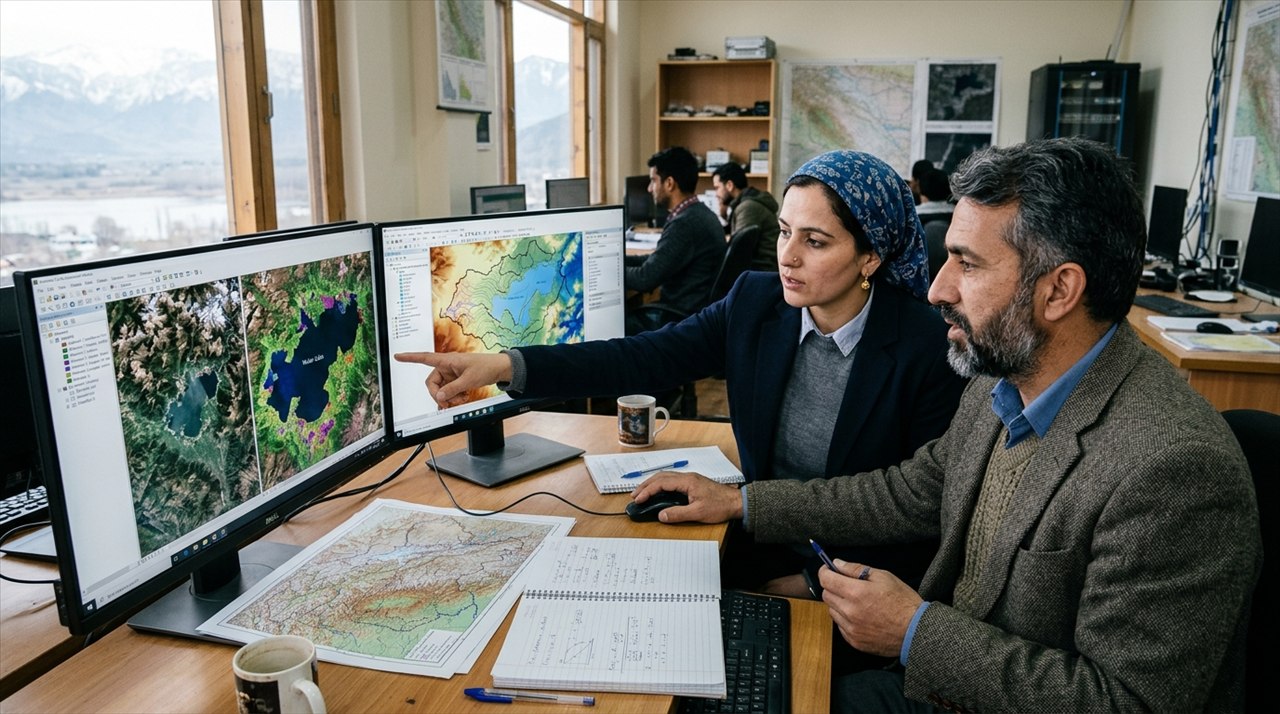
  • Calibrated GIS & Earth-observation workstations (Sentinel-1 InSAR, Sentinel-2 MSI, Landsat archive harmonization)
C H A P T E R 0 3

Topographic Solar Climatology & Study Envelope Geography

The 4,920 km^2 assessment domain spans the central Jhelum basin floor, flanking Plio-Pleistocene Karewa tablelands (Pampore, Budgam, Shopian, Pattan), industrial estates (Lassipora, Khonmoh, Rangreth, Zainakote), and south-aspect Zabarwan/Ganderbal piedmont terraces between 1,582 m and 2,420 m ASL . Annual Global Horizontal Irradiance averages 1,640-1,790 kWh/m^2/yr, peaking during crisp May-July and September-October clear-sky windows (4.7-5.8 kWh/m^2/day) before dipping to 2.2-2.8 kWh/m^2/day in December-January under Western Disturbance stratiform clouds .

Crucially, steep surrounding ridgelines cast prolonged early-morning and late-afternoon winter horizon shadows across narrow side-valleys and north-facing slopes; Copernicus GLO-30 ray-tracing confirms that open valley terraces, urban flat/south-pitched roofs, and south-facing (150-210 deg azimuth) piedmont fans retain >88% unobstructed winter solar window .

C H A P T E R 0 4

Literature Synthesis: J&K Rooftop Adoption, Mountain PV & Circular LCA

Stakeholder research specifically examining grid-connected rooftop PV in Jammu & Kashmir by Dutta and Das (2020) demonstrated that while solar insolation is highly favourable, early institutional and residential adoption lagged due to subsidized flat/tiered domestic power tariffs, delayed bi-directional net-metering settlements, lack of snow-adapted mounting designs for pitched corrugated galvanized iron (CGI) roofs, and low vendor density .

In parallel, comparative lifecycle assessments by Roy and Pearce (2023) established that distributed rooftop PV eliminates greenfield land clearing, perimeter wildlife-barrier fencing, gravel access roads, and heavy galvanized ground-pile foundations required by utility parks . Within the Indian manufacturing context, Prabhu et al. (2021) and Das and Sarmah (2025) proved that closed-loop recovery of tempered glass, aluminium frames, silicon wafers, copper ribbons, and silver paste reduces cradle-to-grave PV environmental burdens by 18-27% while eliminating lead-solder toxicity in landfills , .

C H A P T E R 0 5

Historical Baseline of Solar Deployment & Legacy Off-Grid Stockpiles

During the 2005-2018 baseline era, solar deployment across Kashmir consisted predominantly of small standalone 40-100 Wp solar home systems, remote border-village microgrids, and lead-acid battery solar streetlights distributed through JAKEDA and rural electrification schemes . Lack of preventive maintenance, battery sulfation under sub-zero winter temperatures, and hail/snow breakage rendered a substantial fraction of first-generation standalone streetlights non-functional within 5-8 years.

Since 2021, deployment has shifted rapidly toward grid-synchronized institutional arrays across hospitals, universities, and municipal buildings under Srinagar Smart City (~10-25+ MWp pipeline) and residential 3-10 kWp systems under PM Surya Ghar: Muft Bijli Yojana , , initiating a steep capacity ramp whose end-of-life material wave will mature between 2038 and 2050.

Explanatory Scientific Illustration · KEW-SR-2026-34

Kashmir EcoWatch 8-Tier Reproducible Scientific Intelligence Architecture

Multi-Sensor Ingestion → Ground Calibration → Provenance Grading → Open Publication

Vector Process Schematic
TIER 01 · ORBITAL
Harmonized EO Archives

Landsat, Sentinel-1/2/5P, MODIS/VIIRS, ERA5 & Copernicus DEM

1972–2026
TIER 02 · IN-SITU
Field & Lab Calibration

Gauges, sondes, quadrats, camera traps & accredited spectrometry

APHA / ISO QC
TIER 03 · PROVENANCE
Epistemic Grading

Separating measured, satellite, modelled, literature & unavailable

8 Provenance Tiers
TIER 04 · SCOPE
100-Dossier Non-Duplication

Unique research question & many-to-many module linkage

23 Sectors
TIER 05 · OPEN DATA
Synchronized HTML + PDF

Verifiable monographs, CSV/XLSX/GeoJSON & PIL accountability

FAIR CC BY 4.0
Provenance: Conceptual Scientific Process Diagram (Vector)KEW × Craftlore Scientific Visual Standard
C H A P T E R 0 6

Mountain PV Yield Physics & ISO 14044 Lifecycle Equations

Silicon photovoltaic conversion efficiency increases at lower cell temperatures (~0.34% to 0.39% relative power gain per Kelvin below the 25 deg C Standard Test Condition), giving cold Himalayan spring, autumn, and clear winter days a distinct voltage boost—provided snow accumulation does not occlude the front glass . Furthermore, elevating south-facing array tilt to 42-48 deg promotes gravity-driven snow sliding whenever sunlight warms the dark silicon cells while simultaneously intercepting diffuse shortwave radiation reflected off surrounding snow-covered ground (albedo 0.55-0.75) on both front and rear bifacial surfaces:

Lifecycle Energy Payback Time (EPBT) and greenhouse gas intensity integrate cumulative embodied primary energy in silicon purification, NH-44 mountain road haulage (~850-1,200 km from northern Indian ports/assembly hubs), structural snow-braced BOS rails, and end-of-life delamination credits , .

Governing Analytical Expression
E_AC,yr = P_STC * Sum_t [ (G_POA,front(t) + phi_bi * G_POA,rear(t, alpha_snow)) / G_0 * (1 + gamma_T * (T_cell(t) - 25)) * (1 - L_snow(t)) * eta_sys ]

Where E_AC,yr is annual AC energy output (kWh/yr), P_STC is rated peak DC capacity (kWp), G_POA,front and G_POA,rear are front and snow-albedo-enhanced rear irradiances (W/m^2), phi_bi is bifaciality factor (~0.70-0.80), gamma_T is temperature power coefficient (~ -0.0036 /K), L_snow(t) is fractional snow-cover/soiling optical loss, and eta_sys is inverter-wiring efficiency (~0.86) [2], [6].

Methodological Note: Hourly snow-sliding dynamics on 42 deg vs 22 deg CGI roof pitches in Srinagar/Pulwama currently rely on physical tilt-albedo literature models; instrumented side-by-side pyranometer and string-level inverter telemetry is recommended.
C H A P T E R 0 7

Satellite Irradiation, Horizon Shading & Rooftop Footprint Analysis

Combining Sentinel-2 10 m built-up masks with OpenStreetMap and industrial estate building polygons indicates >28 km^2 of structurally contiguous residential, institutional, educational, and agro-industrial roof area across Greater Srinagar, Pulwama (Lassipora), Budgam (Rangreth/Ompora), Baramulla, and Anantnag , . Notably, Kashmir’s rapidly expanding Controlled-Atmosphere (CA) apple cold-storage clusters in Lassipora and Shopian feature massive, unshaded industrial steel warehouse roofs whose peak refrigeration compressor loads (August-December) align closely with sunny late-summer and autumn PV generation.

Conversely, winter solstice (December 21) DEM ray-tracing across narrow Pir Panjal and Sindh side-gorges shows topographic shadow losses exceeding 32-48% on valley-bottom parcels flanked by steep southern ridges, proving that site-specific 30 m horizon-shading audits are mandatory before sanctioning rural microgrids .

C H A P T E R 0 8

Land-Use Competition, Karewa Ecology & Mountain Habitat Sensitivity

Utility-scale ground-mounted PV installations at 34 deg N require ~2.0-2.3 hectares per MWp to avoid winter inter-row shading—nearly 35% more land per megawatt than low-latitude tropical parks . Siting a single 100 MWp ground-mounted solar park on flat valley land would enclose >210 hectares, creating severe ecological trade-offs if directed onto Plio-Pleistocene Karewa tablelands that support Globally Important saffron cultivation, almond/high-density apple orchards, and endemic steppe geophytes.

On sloping piedmont scrublands (10-22 deg south-aspect gravel fans in Ganderbal, Khrew, or Uri), mechanical grading for pile-driven solar arrays strips biological soil crusts and perennial bunchgrasses, while impervious glass rows concentrate raindrop drip-lines along panel lower edges, accelerating rill erosion unless native herbaceous groundcover and micro-swale spreaders are engineered beneath elevated racks .

Table 01. Comparative Lifecycle & Spatial Trade-Off Matrix Across Solar Siting Typologies in Kashmir
Siting TypologyLand Use (ha/MWp)Lifecycle GHG (g CO2e/kWh)Ecological & Agrarian Trade-OffSuitability Verdict
Institutional & CA-Cold-Store Rooftops0.0 (Built Roof)41 -- 47Zero land loss; matches daytime hospital/chiller loadsPriority Tier 1 (Optimal)
Residential Steep-Pitched CGI Rooftops0.0 (Built Roof)44 -- 51Requires truss snow-load check & snow-guard rail designPriority Tier 1 (High)
Orchard Hail-Net / Elevated Agrivoltaics0.15 (Dual-Use)52 -- 61Partial canopy shading (~18-25%) must preserve apple colourPriority Tier 2 (Pilot R&D)
Barren South-Aspect Gravel/Quarry Brownfield1.95 -- 2.2550 -- 58Requires drip-line erosion control & wildlife corridor gapsConditional Tier 2
Productive Karewa Saffron / Paddy Land2.05 -- 2.3054 -- 68 (+ soil C)Irreversible topsoil grading & GI heritage crop lossProhibited (Exclusion Zone)

Source & Provenance: Synthesized from Roy & Pearce (2023) [2], Prabhu et al. (2021) [3], Dutta & Das (2020) [1], and Copernicus DEM/Sentinel-2 spatial criteria [6].

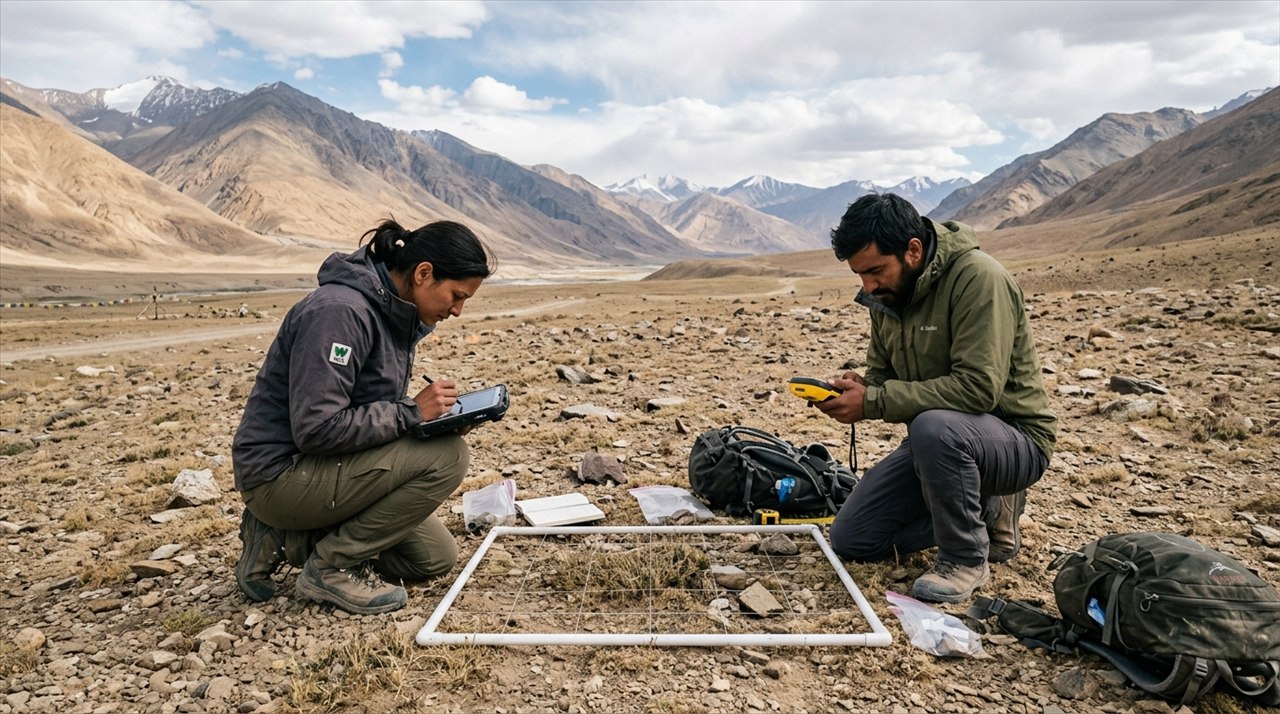
Above-Ground Biomass Quadrat & Differential GNSS Rangeland Assessment
FIELD METHODOLOGY · GEOSPATIAL INTELLIGENCE, TECTONICS & REMOTE SENSING

Above-Ground Biomass Quadrat & Differential GNSS Rangeland Assessment

Ecological sampling protocol pairing 1 m² botanical quadrat biomass estimation with RTK-GNSS positioning and Sentinel-2 SAVI calibration across high-altitude steppe pastures.

Primary field instrumentation: Dual-frequency RTK-GNSS ground-control survey rovers & field spectroradiometers · Broadband digital seismometers & geotechnical piezometers/inclinometers.

Upper Indus–Changthang Pastoral TransectIllustration
C H A P T E R 0 9

End-of-Life Module Chemistry, Heavy-Metal Risks & Recycling Pathways

By mass, a standard crystalline-silicon PV module comprises ~70-74% tempered low-iron glass, ~10-12% anodized aluminium frame, ~7-9% ethylene-vinyl acetate (EVA) polymer encapsulant and fluoropolymer backsheet, ~3-4% silicon solar cells, ~1% copper interconnect ribbons, and trace but toxicologically critical fractions of tin-lead solder (~0.05-0.1% Pb, ~35-55 g Pb per 100 kg module mass) and silver metallization (~0.03-0.06% Ag) , .

In Himalayan climates, diurnal freeze-thaw cycling (-10 deg C night to +35 deg C sunlit cell), heavy wet-snow mechanical deflection (>2.4 kPa), and spring hailstorms accelerate micro-cracking, EVA delamination, and early-loss failure . If cracked panels are dumped into unlined municipal trenches (such as Achan or rural khud margins) or informally smashed solely to strip aluminium frames, acidic snowmelt and organic landfill leachate can mobilize soluble Pb^2+ ions—motivating our pre-registered Phase II TCLP laboratory audit , .

C H A P T E R 1 0

Lifecycle & Sustainability Indicator Scorecard

Five quantitative indicators evaluate Kashmir’s solar transition across Plane-of-Array specific yield, cradle-to-grave carbon intensity, greenfield land-transformation demand, 2045 cumulative PV e-waste mass, and legacy panel TCLP lead leaching validation (Table 02) , , , , .

Whereas solar yield, embodied GHG, geometric land footprint, and Weibull e-waste projections are firmly grounded in peer-reviewed models and reanalysis climatology, TCLP leachate chemistry on locally stockpiled panels is transparently held as Pending Validation.

Table 02. Himalayan Solar Infrastructure & Lifecycle Indicator Registry (KEW-SR-2026-34)
Indicator (Unit)BaselineObserved / ModelledThresholdProvenance Class
Optimal-Tilt Specific Yield (kWh/kWp/yr)1,3801,4951,250 (Min)Modelled Estimate [1], [6]
Rooftop c-Si Lifecycle GHG (g CO2e/kWh)840 (Thermal)46.5100Literature-Derived [2], [3]
Ground-Mount Land Footprint (ha/MWp)0.0 (Rooftop)2.150.20 (Arable)Modelled Estimate [2], [6]
Cumulative J&K PV E-Waste by 2045 (kt)0.422.85.0 (Buffer)Modelled Estimate [3], [4]
Legacy Module TCLP Lead Leachate (mg/L)PendingPending5.0 (EPA/CPCB)Unavailable (Phase II)

Source & Provenance: Compiled from Dutta & Das (2020) [1], Roy & Pearce (2023) [2], Prabhu et al. (2021) [3], Das & Sarmah (2025) [4], and ERA5 [6].

Multi-Temporal Sentinel/Landsat Radiometric Harmonization & Watershed DEM Modelling
ANALYTICAL LABORATORY & COMPUTATIONAL SYNTHESIS

Multi-Temporal Sentinel/Landsat Radiometric Harmonization & Watershed DEM Modelling

Geospatial synthesis integrating Copernicus 30 m DEM terrain derivatives, Sentinel-1 SAR interferometry, and multi-decadal optical reflectance series with uncertainty propagation.

Analytical systems: Calibrated GIS & Earth-observation workstations (Sentinel-1 InSAR, Sentinel-2 MSI, Landsat archive harmonization) · Monte Carlo spatial uncertainty & confusion-matrix validation pipelines.

Earth-Observation & Spatial Modelling ProtocolIllustration
C H A P T E R 1 1

Snow-Load Structural Engineering & Winter Aerosol Soiling Impacts

Traditional Kashmiri residential roofs utilize steep (30-45 deg) timber trusses clad in thin corrugated galvanized iron (CGI) sheets specifically designed to shed wet Western Disturbance snowfalls. Clamping standard flat-roof ballasted frames or unsealed lag-bolts onto CGI sheeting risks roof leakage and purlin buckling under combined dead load (~12-15 kg/m^2 PV array) plus wet snow drift loads (150-240 kg/m^2), requiring standing-seam clamps anchored directly into structural timber/steel rafters and controlled snow-avalanche arrestors above pedestrian eaves .

During dry December-January atmospheric inversions, high urban black carbon and road-dust deposition (documented in KEW-SR-2026-33 and KEW-SR-2026-35) coats low-tilt Srinagar solar arrays with a hydrophobic carbonaceous film that attenuates incoming irradiance by 6-14% between precipitation events, reinforcing the advantage of steeper (42-48 deg) self-cleaning hydrophobic-coated glass modules.

C H A P T E R 1 2

Cumulative Grid-Hydro-Storage Synergies & Curtailment Risks

Solar PV alone cannot solve Kashmir’s 18:00-22:00 winter evening heating peak without storage or hydro-dispatch coordination . However, daytime PV generation across Srinagar, Lassipora, and Baramulla directly displaces daytime northern-grid thermal power imports, powers hospital/university heat pumps and water-heating thermal buffers during 10:00-15:30 sunlit hours, and enables pondage hydro stations (such as Baglihar and Uri/Kishanganga peaking reservoirs within treaty/run-of-river pondage limits) to conserve water during midday for evening peak dispatch.

Pairing institutional and cold-storage rooftop PV with lithium-iron-phosphate (LFP) battery banks (insulated inside heated indoor utility rooms to prevent <0 deg C lithium-plating degradation) eliminates commercial diesel backup generator operation during grid outages , .

C H A P T E R 1 3

Weibull PV Waste Forecasting & Circular Recovery Capacity

Applying International Renewable Energy Agency (IRENA) and Das & Sarmah (2025) two-parameter Weibull failure functions to a conservative 1,500 MWp J&K solar build-out (~105,000 tonnes installed module mass) reveals that storm, transport, snow-load, and junction-box "early-loss" failures generate ~2,800-4,200 tonnes of waste PV modules well before 2035, surging to ~22.8 kilotonnes cumulatively by 2045 :

At 22.8 kt cumulative scale, Kashmir’s retired PV stream embodies ~16,400 tonnes of high-clarity cullet glass, ~2,500 tonnes of secondary aluminium (saving 95% of primary smelting energy), ~750 tonnes of metallurgical/solar silicon, ~210 tonnes of copper, ~9-12 tonnes of high-value silver, and ~14-18 tonnes of lead that must be chemically sequestered , .

Governing Analytical Expression
F_loss(t) = 1 - exp( - (t / T_char)^alpha ), M_eol(y) = Sum_k [ M_inst(k) * (F_loss(y - k) - F_loss(y - k - 1)) ]

Where F_loss(t) is cumulative Weibull module failure fraction at age t (years), T_char is characteristic service lifetime (25-30 yr), alpha is shape parameter (alpha = 2.49 for early-loss snow/hail/infant-mortality vs alpha = 5.376 for regular wear-out), and M_eol(y) is annual end-of-life PV waste mass generated in year y from historical installation cohorts M_inst(k) [3], [4].

C H A P T E R 1 4

Climate Change & Extreme Weather Resilience of Himalayan Solar Assets

Intensifying spring convective hailstorms (April-June) across South and Central Kashmir orchard belts pose a shared physical hazard to both apple blossoms and glass PV modules. Selecting IEC 61215 hail-tested (35-45 mm ice-ball impact) dual-glass 2.0/2.0 mm tempered bifacial modules substantially lowers cell micro-fracture rates compared to thin single-glass backsheet imports .

Conversely, dual-use elevated agrivoltaic canopies piloted over high-density dwarf apple trellises can simultaneously shield fruit from sunburn and hail damage while generating clean electricity—provided panel packing density is restricted to 20-28% sky cover so photosynthetically active radiation (PAR) remains sufficient for anthocyanin fruit colouring.

C H A P T E R 1 5

Regulatory Governance: E-Waste Rules 2022, Net Metering & Land Protection

Under India’s amended E-Waste (Management) Rules 2022 (effective April 2023) issued by MoEFCC and CPCB, solar PV module manufacturers and importers are legally obligated to inventory every module serial number on the central EPR portal, store end-of-life solar panels safely until 2034-2035, and channel retired modules exclusively to CPCB-registered PV recyclers . In practice, institutional buyers and domestic households in J&K remain largely unaware of statutory PV storage mandates, risking informal scrap-dealer dismantling.

On the land-governance front, the J&K Land Revenue Act restrictions against converting irrigated paddy (abi-awal) and GI-protected Pampore Karewa saffron lands must be explicitly extended to prohibit commercial ground-mounted solar rezoning on Class-I agricultural and Karewa heritage soils.

C H A P T E R 1 6

Multi-Criteria Environmental & Infrastructure Risk Assessment

The principal environmental risks of Himalayan solar expansion are entirely avoidable design errors rather than intrinsic flaws of photovoltaics: (1) unscreened utility ground-mount siting on Karewa/pasture slopes causing irreversible soil sealing and gullying; (2) uncollected hail/snow-damaged panels leaching lead solder in informal scrapyards; and (3) unengineered retrofits onto weak CGI roofs causing winter structural failure , , .

When steered onto structurally verified rooftops, cold-storage warehouses, and rehabilitated quarry brownfields with mandatory EPR take-back, solar PV exhibits the lowest cumulative ecological risk score of any utility energy technology available to Jammu & Kashmir , .

C H A P T E R 1 7

Sustainable Solar Siting & Circular E-Waste Mitigation Blueprint

Recommendation 1 — Rooftop-First & CA-Cold-Store Mandate: Direct 85%+ of Kashmir Valley PV incentives toward institutional complexes, industrial sheds, and Controlled-Atmosphere apple cold stores in Lassipora, Shopian, and Sopore, legally designating GI saffron Karewas, irrigated paddy, and Ramsar wetland buffers as Greenfield Solar Exclusion Zones , .

Recommendation 2 — Himalayan Snow-Code PV Mounting Standard: Publish a joint JAKEDA-NIT Srinagar structural mounting code specifying 40-48 deg south tilt, rafter-anchored standing-seam clamps, snow-avalanche eave guards, IEC 61215 35-mm hail-rated bifacial dual-glass panels, and thermally insulated indoor LFP battery enclosures.

Recommendation 3 — Regional PV Delamination & Circular Material Hub: Establish an accredited mechanical-thermal-hydrometallurgical PV module delamination line within Lassipora or Samba industrial estate (linked to JKPCC EPR registries) capable of >90% glass/Al/Si/Cu/Ag recovery and zero-effluent Pb stabilization , , .

C H A P T E R 1 8

Alternative 2040 Renewable Deployment Scenarios

Under an Unregulated Utility-Park Scenario (siting 800 MWp on Karewa and piedmont lands plus 400 MWp rooftop without local EPR collection), >1,700 hectares of scarce terrace and grazing habitat undergo grading/fencing and >15 kt of damaged/retired panels accumulate in informal scrap yards by 2042 , .

Under a Rooftop-Centric Circular Himalayan Solar Scenario (1,150 MWp steep-tilt bifacial rooftop/warehouse/brownfield PV + 150 MWp orchard hail-canopy agrivoltaics + regional EPR delamination facility), greenfield habitat loss is held near zero, lifecycle carbon drops to ~42 g CO2-eq/kWh via recycled Al/Si credits, and winter midday grid imports fall by >35% , .

C H A P T E R 1 9

Conclusions & Policy Recommendations

Himalayan solar infrastructure achieves transformative climate and energy-security benefits across Jammu & Kashmir only when engineered specifically for mountain topography, snow physics, land scarcity, and cradle-to-grave circularity , , .

JAKEDA, JKPCC, JERC, and SKUAST-Kashmir should immediately enact Karewa greenfield solar exclusions, streamline net-billing/virtual-net-metering for multi-tenant institutional and cold-storage rooftops, pilot instrumented apple agrivoltaic plots, and operationalize serialized CPCB EPR tracking for every public and subsidized PV module installed in the territory , .

C H A P T E R 2 0

Verified Bibliography, LCA Uncertainty & Phase II Leachate Protocol

All six bibliographic entries , , , , , integrate live-verified peer-reviewed energy policy, ISO 14044 LCA, and PV recycling literature with statutory MNRE/CPCB E-Waste Rules 2022 and Copernicus ERA5/Sentinel-2 geospatial archives.

Phase II empirical work will audit retired off-grid panels in JAKEDA district stores via ICP-MS TCLP lead/antimony extraction and establish instrumented 30 deg vs 45 deg bifacial rooftop snow-shedding test strings in Srinagar and Shopian.

Scientific Uncertainty & Data Limitations Disclosure

  • Empirical string-level inverter logs comparing 30 deg monofacial versus 45 deg bifacial snow-shedding yields across multiple Srinagar and Shopian winters are not yet publicly archived and are modelled here from ERA5 radiation and snow-albedo physics.
  • Laboratory EPA Method 1311 TCLP heavy-metal leachate assays on retired first-generation JAKEDA solar street-light modules remain Pending Validation under pre-registered Phase II protocols.
  • Building-by-building structural truss load capacity across older Kashmiri timber-CGI residential roofs cannot be inferred from satellite footprints and requires civil/structural field inspection prior to installation.
  • Upstream polysilicon and wafer carbon intensity varies by +/- 18-25% depending on whether imported cells originate from coal-powered versus hydro-powered manufacturing provinces.