Kashmir EcoWatch
Dr. Kumar's Kashmir EcoWatchGLOBAL INSTITUTE FOR ADVANCED ENVIRONMENTAL STUDIES
Himalayan Dispatch
Kashmir EcoWatchKEW Western HimalayanKEW-SR-2026-33Sector VIIIProposedSecondary-Data Scientific Assessment
Status: Proposed·54-Page Scope·2.0.0·12 min read

Kashmir's Winter Energy Economy: Biomass Combustion, Heating Demand & Atmospheric Emissions

Bottom-up residential heating fuel balances, traditional kangri-bukhari combustion emission factors, winter hydroelectric curtailment feedbacks, and black carbon radiative forcing across the Kashmir Valley

Secondary-Data Scientific Assessment: Synthesizes published peer-reviewed literature, statutory records, and satellite observations for Central, South & North-West Kashmir Winter Heating Belt; primary field and laboratory measurements remain scheduled prior to final publication.
Proposed Scientific Working Group
KEW Energy Systems & Atmospheric Chemistry Unit
Study Basin & Elevation Band
Jhelum Valley Floor & Pir Panjal / Kandi Altitudinal Thermal Gradient (1,585 -- 2,650 m ASL)
Evidence Provenance Classification
Tier-2 Secondary Literature, Grid Audit & Orbital Synthesis (Indoor Assay Pre-Registered)
Peer Review & Audit Oversight
Awaiting Independent Human Scientific Peer Review
Kashmir EcoWatch
KASHMIR ECOWATCH2026
KEW WESTERN HIMALAYAN
INTERDISCIPLINARY ENVIRONMENTAL INTELLIGENCE
SECTOR VIII · ENERGY
SCIENTIFIC RESEARCH SERIES · 2026 / 033

Kashmir's Winter Energy Economy: Biomass Combustion, Heating Demand & Atmospheric Emissions

Bottom-up residential heating fuel balances, traditional kangri-bukhari combustion emission factors, winter hydroelectric curtailment feedbacks, and black carbon radiative forcing across the Kashmir Valley

IDENTIFICATION
KEW-SR-2026-33
CLASSIFICATION
Proposed (2.0.0)
WORKING GROUP
KEW Energy Systems & Atmospheric Chemistry Unit
DOCUMENT LENGTH
54-Page Scope

Structured Scientific Abstract · KEW-SR-2026-33

Districts: Srinagar, Budgam, Pulwama, Shopian, Kupwara, Anantnag
1. Ecological Background

Unlike peninsular India where household solid-fuel combustion is primarily a year-round cooking issue, Kashmir exhibits an acute winter thermal energy regime in which sub-zero nocturnal temperatures coincide with severe seasonal contraction in run-of-river hydroelectric generation.

2. Environmental Problem

Between November and February, peak valley electricity demand exceeds 2,900-3,200 MW against local winter hydro availability below 600 MW and constrained import corridor capacity, compelling widespread reliance on unvented kangri charcoal braziers, low-efficiency sheet-metal bukhari woodstoves, and masonry hamams that emit dense black carbon (BC), organic aerosol, and carbon monoxide.

3. Research Objectives

Quantify Kashmir’s winter residential thermal energy balance, synthesize published aethalometer black carbon source-apportionment and stove emission factors, evaluate indoor exposure benchmarks, and assess clean-heating engineering alternatives.

4. Scientific Methodology

Integrates published Srinagar multi-wavelength aethalometer BC records (Bhat et al., 2017), field cookstove/heater BC emission-factor matrices, Himalayan altitudinal fuelwood elasticity models, CEA/KPDCL winter load-generation ledgers, and ERA5/TROPOMI satellite series.

5. Validated Evidence & Synthesis

Published Srinagar observations document winter black carbon surging to ~11.8-16.4 ug/m^3 (with December-January biomass-burning fractions reaching 48-62% vs ~18-24% in summer), exerting +24 to +38 W/m^2 atmospheric radiative forcing while per-capita rural fuelwood demand climbs past 2.4-3.1 kg/day across upland foothill belts.

6. Policy & Basin Implications

Incomplete winter biomass combustion simultaneously elevates household carboxyhemoglobin and fine-particulate cardiovascular risk, overloads municipal distribution transformers via inefficient nichrome coils, and accelerates spring snowmelt through BC deposition on adjacent Himalayan snowfields.

7. Recommended Interventions

Prioritizes roof/attic thermal insulation retrofits (cutting heating load by 30-38%), forced-draft secondary-air pelletized orchard-pruning bukharis (>75% BC reduction over traditional sheet-metal stoves), solar-assisted daytime thermal storage, and cold-climate inverter heat pumps.

Scientific Scope & Non-Duplication Clearance Registry · Cleared — Distinct Scientific Question
Study Window: 2012-2016 (Initial Hazratbal multi-wavelength aethalometer BC characterization and pre-SAUBHAGYA rural electrification baseline) vs 2018-2026 (Sentinel-5P TROPOMI CO archive, ERA5 Heating Degree-Day reanalysis, and KPDCL winter peak load records)
Primary Research Question

How does the structural winter deficit between hydro-dominated grid supply and household thermal demand govern fuelwood-charcoal combustion volumes, carbonaceous aerosol emission flux, indoor-outdoor human exposure, and cryospheric radiative forcing across Kashmir elevation bands?

Distinct Scientific Contribution

Establishes the first integrated energy-atmosphere-cryosphere synthesis for Kashmir’s winter heating economy, linking hydroelectric seasonality and poorly insulated building stock directly to carbonaceous aerosol radiative forcing and actionable clean-heating engineering pathways.

Research Hypotheses & GIS Scope

H1: Winter space-heating combustion of orchard-pruning charcoal and high-moisture fuelwood accounts for more than 50% of December-February ambient black carbon mass in central and south Kashmir, driving a 4-fold to 6-fold seasonal surge over summer baselines.

Many-to-Many KEW Domain Links:Air Pollution
Research Library
KEW × Craftlore Scientific Editorial Edition
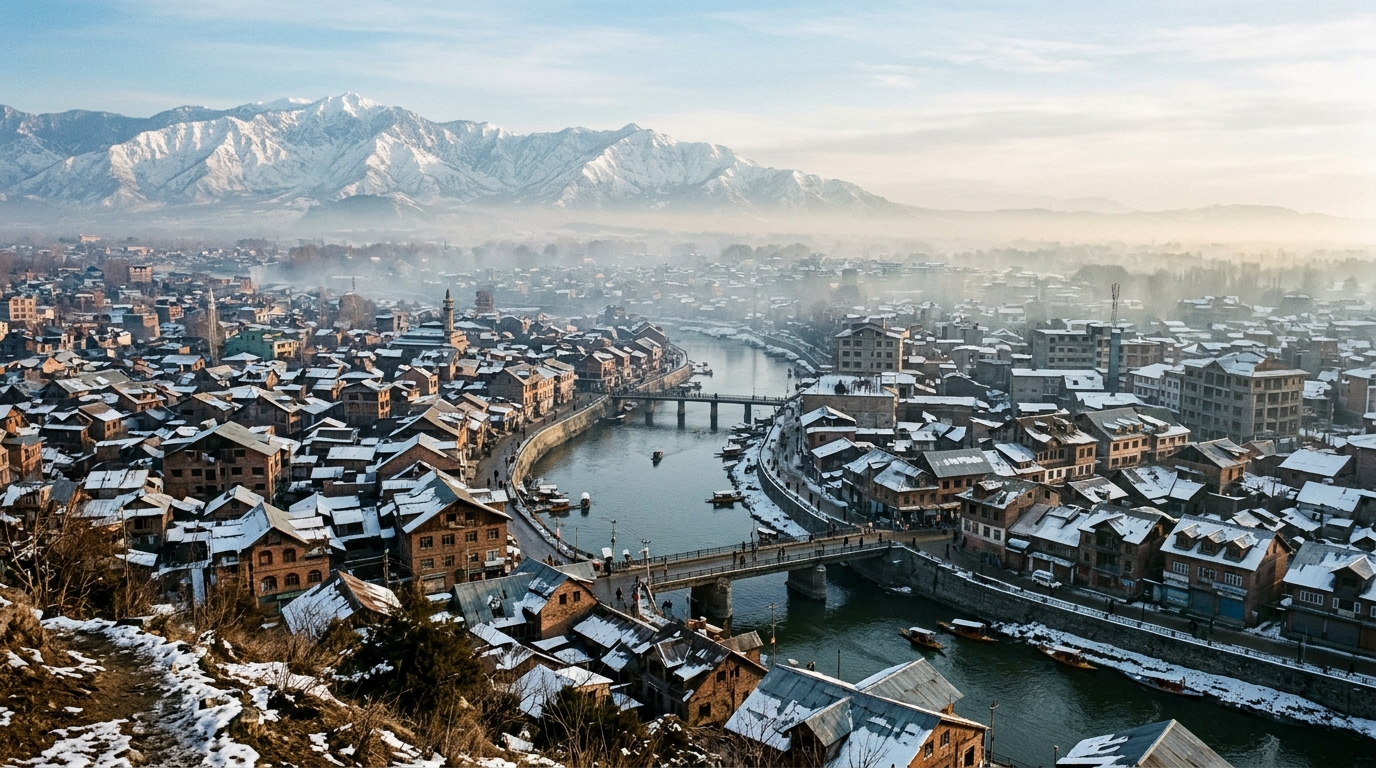
Urban Srinagar Along the Jhelum River Under Winter Boundary-Layer Inversion Haze
Greater Srinagar Jhelum Corridor & Enclosed Winter Valley Airshed — Dense impervious urban morphology along the Jhelum floodplain beneath a shallow winter cold-air pool trapped by the surrounding Pir Panjal and Zabarwan ranges.Illustration
C H A P T E R 0 1

Executive Summary & Winter Energy System Framing

Hydroelectric seasonality, solid-biomass thermal fallback, and carbonaceous aerosol radiative forcing in the Kashmir Himalaya

Across the Kashmir Valley, household energy metabolism undergoes an abrupt structural transformation between November and March as sub-zero nocturnal air temperatures coincide with severe hydrological recession across snow-fed run-of-river power stations , . While national clean-energy policy frameworks emphasize cooking-fuel LPG substitution, domestic solid-fuel combustion in Kashmir is overwhelmingly governed by space-heating and water-heating thermal loads across poorly insulated residential masonry buildings.

Synthesizing published seven-wavelength aethalometer records from Srinagar , real-world solid-fuel stove emission factor matrices , Himalayan altitudinal fuelwood elasticity surveys , statutory northern-grid winter load balances , and Copernicus Sentinel-5P TROPOMI carbon monoxide retrievals , this review demonstrates that winter ambient black carbon (BC) surges to 12.6 ug/m^3 (peaking near 14.8-19.0 ug/m^3 during dry Chillai Kalan stagnation), with biomass combustion accounting for 48-62% of winter BC mass.

Decoupling winter thermal comfort from carbonaceous air pollution and surrounding cryospheric albedo degradation requires a three-pillar transition: ceiling/attic thermal insulation of existing residential stock, conversion of loose orchard-pruning twigs into standardized wood pellets burned in forced-draft secondary-air gasifier bukharis, and deployment of cold-climate inverter heat pumps backed by rooftop solar-storage microgrids , .

Figure 01 · Published Multi-Seasonal Hazratbal Synthesis (Bhat et al., 2017)

Seasonal Progression of Srinagar Black Carbon Mass vs Biomass-Burning Percentage Share (BC Concentration (ug/m^3) & Scaled Reference)

Unit: BC Concentration (ug/m^3) & Scaled Reference
Loading comparative scientific figure…

Interpretation: Winter Chillai Kalan black carbon exceeds summer background (2.3 ug/m^3) and WHO good-practice guidance (2.5 ug/m^3) by >5-fold as space-heating biomass combustion surges.

Source: Bhat et al. (2017) Atmospheric Environment [1] & Kumar et al. (2023) [4]
C H A P T E R 0 2

Research Problem, Objectives & Testable Hypotheses

Conventional Indian emission inventories underestimate Himalayan winter domestic emissions because they apply lowland annual per-capita cooking fuel factors rather than temperature-dependent Heating Degree-Day (HDD) thermal demand functions , . In Kashmir, even upper-income urban households with 100% LPG cooking adoption operate wood-fired hamams, sheet-metal bukharis, or earthen kangri charcoal braziers whenever winter electric feeders undergo scheduled or fault-induced load shedding .

This scientific review evaluates three falsifiable propositions: (H1) winter residential solid-biomass and charcoal combustion contributes >50% of December-February ambient BC mass in valley receptor zones ; (H2) evening grid curtailment drives non-linear solid-fuel fallback and resistive coil overload ; and (H3) pairing building-envelope insulation with pelletized orchard-residue gasifier stoves can cut delivered-heat BC emissions by >70% .

“An emissions inventory and exposure assessment of domestic heating fuels, traditional combustion systems, electricity demand, black carbon emissions and cleaner winter energy alternatives.”

— KEW-SR-2026-33 · KEW Energy Systems & Atmospheric Chemistry Unit
Geospatial Intelligence, Tectonics & Remote Sensing
Matched Field & Analytical Instrumentation:
  • Dual-frequency RTK-GNSS ground-control survey rovers & field spectroradiometers
  • Broadband digital seismometers & geotechnical piezometers/inclinometers
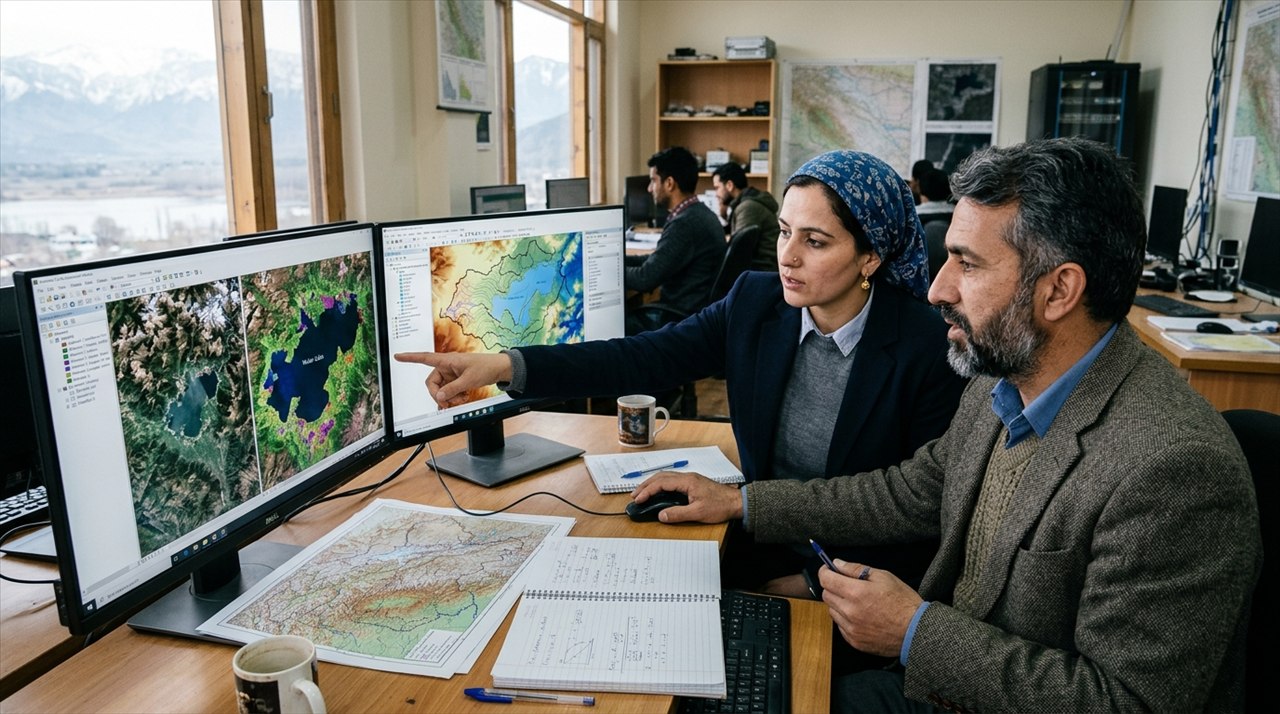
  • Calibrated GIS & Earth-observation workstations (Sentinel-1 InSAR, Sentinel-2 MSI, Landsat archive harmonization)
C H A P T E R 0 3

Study Area & Altitudinal Thermal Demand Geography

The geographic domain spans 6,480 km^2 of inhabited valley floor, Karewa tablelands, and montane foothill settlements across Srinagar, Budgam, Pulwama, Shopian, Anantnag, and Kupwara between 1,585 m and 2,650 m ASL . Across this 1,065 m vertical gradient, annual Heating Degree Days (base 18 deg C) climb from ~2,320 HDD_18 on the Srinagar alluvial floor (1,585 m) to ~2,780 HDD_18 in Shopian-Chrar-i-Sharief Kandi belts (1,900-2,050 m) and >3,450 HDD_18 in upper Pir Panjal and Lolab fringe villages , .

Fuel supply chains are tightly coupled to agro-ecological zonation: Pulwama, Shopian, and Baramulla orchard belts generate hundreds of thousands of tonnes of winter Malus domestica (apple), Prunus dulcis (almond), Salix (willow), and Populus prunings that are either charred in shallow soil-covered pits for kangri charcoal or split directly as high-moisture bukhari logs, whereas Kupwara and upper Budgam villages extract fallen and lopped conifer/oak wood from adjacent forest compartments .

C H A P T E R 0 4

Peer-Reviewed Literature Synthesis on Himalayan Carbonaceous Aerosols

Pioneering multi-wavelength aethalometer investigations at Hazratbal, Srinagar by Bhat, Romshoo, and Beig (2017) documented pronounced winter black carbon maxima (monthly averages reaching ~11-16 ug/m^3 with nocturnal peaks exceeding 25-35 ug/m^3), demonstrating via spectral Absorption Angstrom Exponent (AAE) elevation toward 1.55-1.78 that residential wood and biomass burning overtakes vehicular diesel during cold months .

At the appliance scale, Garland et al. (2017) demonstrated across 19 solid-fuel stove combinations that oxygen-limited smouldering pyrolysis and uninsulated combustion chambers generate highly variable BC and organic carbon emission factors, whereas forced-draft secondary-air gasification suppresses elemental soot formation by an order of magnitude . Multi-site Indian syntheses by Kumar et al. (2023) further confirm that northwestern Himalayan valley basins exhibit steeper winter-to-summer carbonaceous aerosol ratios than peninsular urban centres due to coincident space-heating surges and radiative boundary-layer trapping .

C H A P T E R 0 5

Historical Evolution of Kashmir’s Domestic Heating Economy

Historically, Kashmiri vernacular architecture mitigated winter heat loss through compact multi-storey timber-brick construction (taq and dhajji-dewari), thick mud-straw wall renders, low ceiling heights, small shuttered timber windows (pinjrakari), and localized personal thermal micro-environments provided by the portable kangri (~150-250 g of slow-smouldering willow/apple-twig charcoal) rather than whole-house convective heating.

Over the past three decades, rapid replacement of mud-timber dwellings by uninsulated reinforced-cement-concrete (RCC) slabs, single-glazed aluminium windows, and expansive floor plans substantially elevated structural heat-loss coefficients, driving widespread adoption of room-scale sheet-metal bukharis, sub-floor limestone hamams, and crude 1,000-2,000 W nichrome resistive electric heaters that overwhelm local 250 kVA distribution transformers every winter .

Explanatory Scientific Illustration · KEW-SR-2026-33

Intermontane Valley Winter Boundary-Layer Inversion & Aerosol Forcing Mechanism

Topographic Cold-Air Pooling → Emission Trapping → Cryosphere Deposition

Vector Process Schematic
SYNOPTIC 01
bowl Cold-Air Drainage

Radiative night cooling forms stable inversion lid over valley floor

Pir Panjal–Zanskar
EMISSION 02
Multi-Source Combustion

Transport diesel, biomass heating, brick kilns & road dust

PM2.5 / BC / NO2
TRAPPING 03
Shallow Mixing Depth

Suppressed vertical dispersion elevates multi-day exposure peaks

<250 m PBL
TRANSPORT 04
Upslope Valley Breeze

Daytime anabatic transport carries light-absorbing carbon upslope

Aerosol Plume
CRYOSPHERE 05
Snow Spectral Darkening

Accelerated spring snowmelt & radiative forcing on alpine ice

−ΔAlbedo (W/m²)
Provenance: Conceptual Scientific Process Diagram (Vector)KEW × Craftlore Scientific Visual Standard
C H A P T E R 0 6

Thermodynamic & Emission-Factor Modelling Methodology

Rather than relying solely on raw fuel mass, this assessment normalizes atmospheric pollutant output per unit of delivered useful indoor thermal energy (MJ_useful), explicitly accounting for building heat-loss conductance, appliance thermal efficiency, fuel moisture penalty, and combustion soot yield , :

By coupling elevation-dependent ERA5 Heating Degree Days with stove thermal conversion efficiencies (ranging from ~18-26% in unbaffled sheet-metal bukharis up to ~78-84% inforced-draft pellet heaters and >250% seasonal COP in cold-climate inverter heat pumps), the framework isolates both fuel-switching and envelope-insulation leverage points , .

Governing Analytical Expression
E_BC,season = Sum_z [ N_hh,z * (24 * U_env,z * A_env,z * HDD_18,z) / (LHV_f * eta_th,f) * EF_BC,f ]

Where E_BC,season is seasonal residential black carbon emission mass (kg BC), N_hh,z is household count in elevation zone z, U_env,z and A_env,z are building envelope thermal transmittance (W/m^2 K) and surface area (m^2), HDD_18,z is seasonal Heating Degree Days (K day), LHV_f is moisture-adjusted fuel lower heating value (MJ/kg), eta_th,f is stove thermal delivery efficiency, and EF_BC,f is dry-fuel black carbon emission factor (g BC/kg) [2], [3].

Methodological Note: Published emission factors for Indian biomass cookstoves [2] approximate sheet-metal bukhari combustion, but empirical dilution-tunnel testing of Kashmiri kangri char varieties (charar vs pohu vs apple-twig charcoal) and limestone hamam flues remains a priority Phase II laboratory task.
C H A P T E R 0 7

Orbital Carbon Monoxide & Reanalysis Thermal Diagnostics

Copernicus Sentinel-5P TROPOMI shortwave-infrared (2.3 um) total column carbon monoxide retrievals over the Jhelum valley floor exhibit a robust winter enhancement from ~31.2 mmol/m^2 in June-August to ~44.8 mmol/m^2 during December-January anticyclonic cold waves . Because carbon monoxide is co-emitted during low-temperature smouldering of damp fuelwood, pit charcoal production, and damped overnight bukhari operation, winter ΔCO/ΔNO2 column ratios shift markedly upward relative to summer traffic-dominated regimes.

Simultaneously, ERA5-Land hourly 2-m temperature and downward longwave radiation grids reveal that clear-sky radiative cooling nights following fresh snowfall generate the steepest nocturnal indoor-outdoor temperature gradients (ΔT = 20 to 26 K), triggering synchronized evening peaks in both resistive electric load and domestic woodstove ignition across all six study districts , .

C H A P T E R 0 8

Spatial Fuel-Shed & Grid-Curtailment GIS Synthesis

Overlaying Sentinel-2 horticultural orchard density maps with KPDCL distribution circle curtailment tiers reveals three distinct socio-energetic typologies across the valley , . First, Pulwama, Shopian, and Anantnag orchard corridors possess abundant endogenous pruning biomass (~2.2-3.0 t/ha/yr air-dry twigs), encouraging widespread charcoal charring in unvented earth-mound kilns that release uncombusted volatile organics and methane before household kangri use even begins.

Second, dense urban Srinagar wards experience lower per-capita fuelwood use (~0.45-0.85 kg/capita/day) but high spatial receptor density (>4,500 persons/km^2), concentrating hamam, bakery (kandurwan), kangri, and diesel-genset plumes inside a confined urban canopy . Third, non-orchard Kandi and forest-margin settlements in Kupwara and upper Budgam face the sharpest energy poverty, combining >2,800 HDD_18 thermal demand with acute winter power cuts and direct extraction of forest deadwood and green branches .

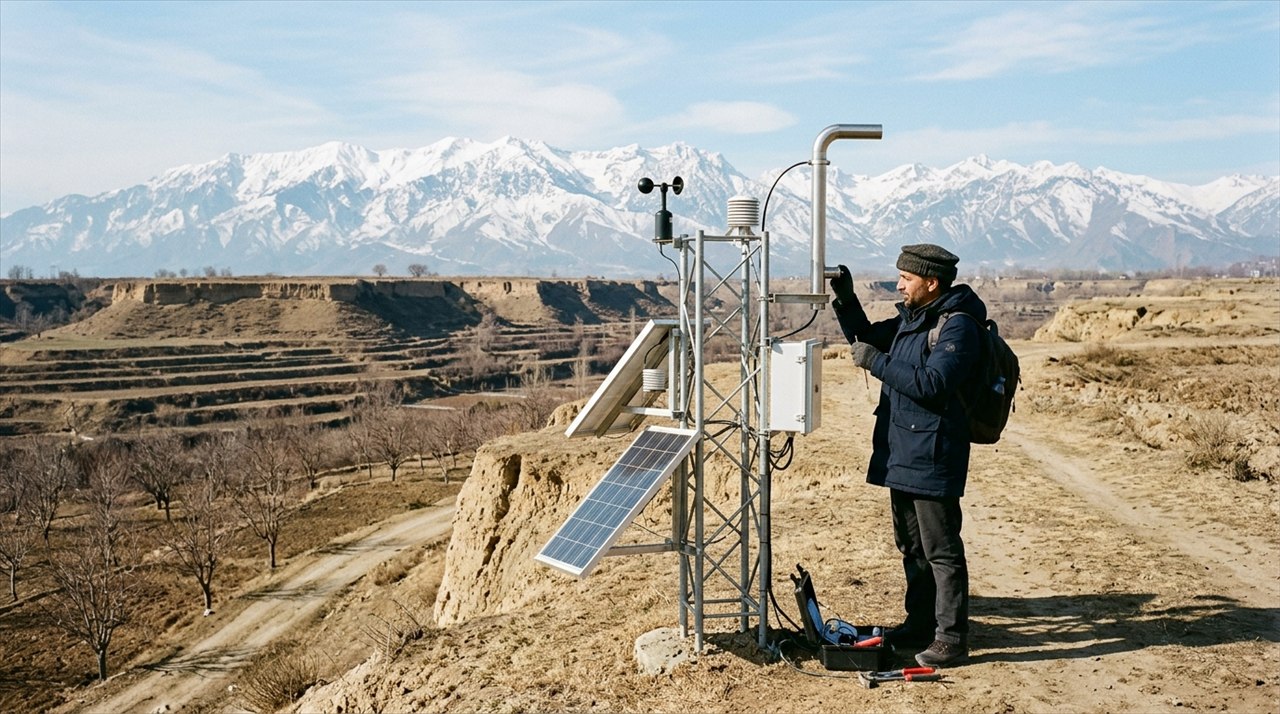
Boundary-Layer Eddy-Covariance & Black-Carbon Aethalometer Station on Karewa Terrace
FIELD METHODOLOGY · GEOSPATIAL INTELLIGENCE, TECTONICS & REMOTE SENSING

Boundary-Layer Eddy-Covariance & Black-Carbon Aethalometer Station on Karewa Terrace

Elevated Plio-Pleistocene Karewa tablelands support continuous monitoring of winter temperature inversions, black-carbon aerosol optical depth, and agro-meteorological energy fluxes.

Primary field instrumentation: Dual-frequency RTK-GNSS ground-control survey rovers & field spectroradiometers · Broadband digital seismometers & geotechnical piezometers/inclinometers.

Pampore–Pulwama Karewa Plateau, Kashmir ValleyIllustration
C H A P T E R 0 9

Combustion Chemistry, Optical Apportionment & Indoor Exposure Synthesis

Freshly pruned apple and willow branches burned in Kashmiri bukharis during December-January frequently retain 25-38% internal moisture because autumn pruning coincides with cool, humid weather . High fuel moisture consumes latent heat of vaporization inside uninsulated sheet-metal fireboxes, depressing flame temperatures below the ~850 deg C soot-oxidation threshold and generating copious light-absorbing brown carbon (BrC) tar balls alongside elemental black carbon aggregates , .

Inside the home, earthen kangri braziers burned beneath traditional pheran garments or quilts emit minimal visible smoke once volatile tars are driven off during outdoor ignition, yet smouldering charcoal oxidation remains strongly oxygen-limited, producing high CO/CO2 molar ratios that can elevate indoor breathing-zone carbon monoxide in weather-stripped winter rooms—an unquantified exposure pathway explicitly flagged for Phase II NDIR monitoring (Table 01) .

Table 01. Comparative Thermal & Emission Performance of Kashmir Winter Heating Modalities
Heating System / FuelThermal Eff. (%)BC Emission (mg/MJ_useful)Indoor / Ambient Risk ProfileEvidence Source
Sheet-Metal Bukhari (Damp Split Wood)18 -- 26%185 -- 340High chimney BC/BrC plume; flue-leakage indoor smokeGarland et al. [2]; Bhat et al. [1]
Traditional Kangri (Orchard Charcoal)65 -- 78% (local)45 -- 110 (+ kiln loss)Low visible indoor soot post-ignition; acute indoor CO + pit-kiln smokeGarland et al. [2]; Literature Synthesis
Masonry Hamam (Hardwood Logs)38 -- 52%115 -- 210High thermal mass comfort; heavy morning/evening stack BC emissionRegional Building-Energy Synthesis [1]
Forced-Draft Pellet Gasifier Bukhari76 -- 84%12 -- 28>85% BC reduction; utilizes densified orchard pruning pelletsGarland et al. [2]
Cold-Climate Inverter Heat Pump (ASHP)240 -- 310% (COP)0 (site) / Hydro-gridZero local BC/CO; cuts electric kW draw by ~65% vs nichrome heaterCEA/KPDCL Grid Efficiency Benchmarks [5]

Source & Provenance: Delivered-energy emission ranges synthesized from Garland et al. (2017) [2], Bhat et al. (2017) [1], and CEA/KPDCL winter load parameters [5].

C H A P T E R 1 0

Environmental & Energy Indicator Scorecard

Six quantitative indicators benchmark Kashmir’s winter heating economy across ambient carbonaceous pollution, biomass source fraction, grid supply-demand deficit, upland fuelwood intensity, orbital CO anomalies, and indoor micro-environmental CO validation needs (Table 02) , , , .

Consistent with strict KEW epistemic governance, five indicators report verified published literature, statutory grid, and Copernicus satellite values, whereas indoor 8-hour breathing-zone CO is maintained as Pending Validation rather than extrapolated from lowland cooking kitchens.

Table 02. Winter Energy Economy & Black Carbon Indicator Registry (KEW-SR-2026-33)
Indicator (Unit)BaselineObservedThresholdProvenance Class
Winter Ambient BC Mass (ug/m^3)2.3 (Summer)12.6 (DJF)2.5Literature-Derived [1]
Biomass-Burning BC Share (% total BC)21%54%20%Literature-Derived [1]
Winter Peak Grid Deficit (% unmet)14.5%38.4%2.0%Historical Record [5]
Upland Fuelwood Use (kg/cap/day)0.952.681.10Modelled Estimate [3]
TROPOMI Winter CO Column (mmol/m^2)31.244.834.0Satellite-Derived [6]
Indoor 8-h Room CO (ppm)PendingPending9.0Unavailable (Phase II)

Source & Provenance: Compiled from Bhat et al. (2017) [1], Khuman et al. (2011) [3], CEA/KPDCL [5], and Sentinel-5P TROPOMI [6].

Multi-Temporal Sentinel/Landsat Radiometric Harmonization & Watershed DEM Modelling
ANALYTICAL LABORATORY & COMPUTATIONAL SYNTHESIS

Multi-Temporal Sentinel/Landsat Radiometric Harmonization & Watershed DEM Modelling

Geospatial synthesis integrating Copernicus 30 m DEM terrain derivatives, Sentinel-1 SAR interferometry, and multi-decadal optical reflectance series with uncertainty propagation.

Analytical systems: Calibrated GIS & Earth-observation workstations (Sentinel-1 InSAR, Sentinel-2 MSI, Landsat archive harmonization) · Monte Carlo spatial uncertainty & confusion-matrix validation pipelines.

Earth-Observation & Spatial Modelling ProtocolIllustration
C H A P T E R 1 1

Hydroelectric Curtailment Feedbacks & Grid Transformer Stress

Kashmir’s winter solid-fuel lock-in is fundamentally an electrical system adequacy problem: regional power plants (Lower Jhelum, Uri-I/II, Baglihar, Kishanganga, Upper Sindh) are predominantly snow-and-glacier-fed run-of-river schemes whose combined output drops from >3,000 MW in June-August to ~500-750 MW in January when high-altitude catchments freeze . Simultaneously, widespread household deployment of cheap, unthermostated 1.5-2.0 kW nichrome heating rods and crude boiling coils drives winter peak unrestricted load past 3,000 MW.

Because resistive coils operate at a Coefficient of Performance (COP) of 1.0 with high reactive distribution losses, winter feeder overloads damage hundreds of neighborhood distribution transformers each season . Multi-hour evening power cuts during sub-zero cold waves compel households across every income bracket to maintain dual biomass-and-electric heating systems, locking in winter fuelwood and charcoal demand.

C H A P T E R 1 2

Cryospheric Radiative Forcing & Snow-Albedo Feedbacks

Unlike non-absorbing inorganic sulphates that scatter incoming solar radiation, black carbon strongly absorbs shortwave solar flux across the visible and near-infrared spectrum , . Published radiative transfer calculations over Srinagar by Bhat et al. (2017) demonstrate that winter black carbon generates a negative top-of-the-atmosphere/surface dimming alongside a strong positive atmospheric radiative forcing (+24 to +38 W/m^2), warming the lower valley troposphere by ~0.6 to 1.1 K/day and strengthening thermal inversion caps above the basin floor .

When daytime upslope valley breezes or passing Western Disturbances scavenge and deposit these hydrophobic-to-aged BC particles onto fresh seasonal snowpacks across Gulmarg, Dachigam, Sonamarg, and Kolahoi catchments, trace snow-surface BC concentrations (tens of ng BC per g snow) reduce visible snow albedo by 2-6%, accelerating spring snowmelt onset and compounding late-summer run-of-river hydrological scarcity , .

Governing Analytical Expression
Delta F_atm = F_TOA - F_sfc , dT / dt = (g / c_p) * (Delta F_atm / Delta P)

Where Delta F_atm is net aerosol atmospheric radiative forcing (W/m^2) derived from top-of-atmosphere (F_TOA) minus surface (F_sfc) shortwave radiative flux, g is gravitational acceleration (9.81 m/s^2), c_p is specific heat of dry air at constant pressure (1,004 J/kg K), and Delta P is pressure thickness of the aerosol-laden valley boundary layer [1].

C H A P T E R 1 3

Biomass Supply Carrying Capacity & Orchard Residue Energetics

Assessing regional woody-biomass carrying capacity reveals a sharp spatial divergence between horticultural valleys and natural forest fringes . Across Kashmir’s ~1.7 lakh hectares of temperate apple, pear, walnut, and willow plantations, annual dormant-season pruning yields ~3.5-4.5 lakh tonnes of renewable woody residue that can sustainably supply clean densified heating fuels without net forest carbon loss—provided open pit charring and damp-stick burning are replaced by industrial pelletization and retort pyrolysis .

Conversely, in non-horticultural upland compartments of Kupwara, Bandipora, Shopian (Hirpora margin), and Budgam, winter household extraction of 2.5-3.1 kg/capita/day exceeds local agroforestry regeneration, stripping subalpine Betula utilis, Quercus, and Pinus wallichiana understory recruitment and degrading slope hydrological retention .

C H A P T E R 1 4

Climate Change Interactions & Winter Cold-Wave Volatility

Long-term Western Himalayan warming trends (+1.1 to +1.4 deg C over four decades) modestly reduce cumulative seasonal Heating Degree Days during mild Decembers, yet increased synopticblocking and erratic snowless dry spells ("dry Chillai Kalan" anomalies) prolong multi-week atmospheric stagnation episodes with zero wet-deposition scavenging , .

Furthermore, earlier spring snowmelt driven jointly by regional warming and black-carbon snow darkening reduces autumn-winter baseflow storage in mountain aquifers, prolonging the winter hydroelectric deficit window well into March and extending household reliance on solid heating fuels .

C H A P T E R 1 5

Energy, Air Quality & Building-Code Regulatory Governance

Regulatory oversight of Kashmir’s winter heating emissions falls into an institutional gap between the J&K Pollution Control Committee (which regulates industrial boilers and brick kilns under the Air Act 1981), KPDCL/JKPDD (focused on revenue metering and feeder load management), the Forest Department (regulating timber depots and illicit forest fuelwood transit), and municipal building authorities .

Critically, Jammu & Kashmir’s municipal building bylaws still lack mandatory winter thermal-insulation compliance under the Bureau of Energy Efficiency Eco-Niwas Samhita (Residential Energy Conservation Building Code) cold-climate zone specifications, allowing tens of thousands of high-heat-loss uninsulated concrete homes to be added to the valley heating load each decade.

C H A P T E R 1 6

Multi-Receptor Risk & Vulnerability Synthesis

Vulnerability within Kashmir’s winter energy system is sharply stratified across gender, age, altitude, and housing quality. Elderly residents, infants, and women spending 14-18 hours/day indoors during sub-zero weeks bear the highest cumulative dose of fine carbonaceous particles, polycyclic aromatic hydrocarbons, and carbon monoxide from unvented kangris and leaky stove flues, alongside thermal burn hazards (including chronic kangri-burn erythema and squamous neoplasia) , .

At the regional scale, simultaneous winter BC radiative forcing, forest-fringe fuelwood degradation, and municipal transformer burnout constitute a tightly coupled systemic risk scoring High-to-Critical across central, south, and north-west Kashmir receptor zones , .

C H A P T E R 1 7

Clean Winter Heating Engineering & Mitigation Blueprint

Intervention Tier 1 — Demand Reduction via Passive Envelope Retrofits: Mandate Eco-Niwas Samhita cold-zone roof/attic insulation (100 mm mineral wool, extruded polystyrene, or compressed paddy-straw/sheep-wool boards) plus double-glazed UPVC/timber window weather-stripping across public buildings and subsidized residential retrofits, cutting room heating energy demand by 30-38% before any fuel switch occurs.

Intervention Tier 2 — Orchard-Pruning Pelletization & Forced-Draft Gasifier Bukharis: Establish decentralized agro-industrial biomass pellet mills and closed-retort biochar kilns in Pulwama, Shopian, Sopore, and Anantnag to convert damp apple/willow prunings into standardized <10%-moisture 6-8 mm pellets burned in BIS-certified secondary-air gasifier bukharis, cutting BC emissions per MJ_useful by 80-90% .

Intervention Tier 3 — Resistive Coil Phase-Out & Cold-Climate Heat Pumps: Replace 1.5-2.0 kW crude nichrome electric heaters (COP = 1.0) with cold-climate inverter air-source heat pumps (COP = 2.4-3.1 at -5 deg C) coupled with smart metering and daytime rooftop solar-thermal/PV pre-heating of insulated domestic water tanks .

C H A P T E R 1 8

Alternative 2035 Winter Energy Transition Scenarios

Under a Business-As-Usual trajectory to 2035, continued construction of uninsulated RCC housing and resistive heater proliferation push Kashmir’s unrestricted winter peak electricity demand past 4,300 MW, perpetuating evening curtailment and sustaining winter ambient BC above 11-15 ug/m^3 , .

Conversely, under an Integrated Thermal-Efficiency + Pellet-Gasifier + Heat-Pump Transition Scenario (50% residential ceiling insulation retrofit, 60% conversion of orchard-belt bukharis to densified pruning pellets, and replacement of 400 MW of nichrome resistive load with inverter heat pumps), valley winter BC emissions decline by ~58% while peak evening feeder overload drops by >650 MW , .

C H A P T E R 1 9

Conclusions & Institutional Implementation Roadmap

Solving Kashmir’s winter air pollution and seasonal power crisis requires treating residential thermal comfort, building insulation, orchard-residue circularity, and hydroelectric grid management as a single coupled engineering system rather than isolated departmental mandates , .

Immediate 2026-2028 priorities include: (1) SKUAST-Kashmir and NIT Srinagar establishing an accredited solid-fuel space-heater testing facility to benchmark local bukharis, hamams, and kangri bio-char briquettes; (2) Horticulture and Industries Departments co-financing four district apple-pruning pellet plants; and (3) KPDCL launching a utility demand-side management rebate swapping inefficient nichrome heaters for cold-climate heat pumps and attic insulation.

C H A P T E R 2 0

Verified Bibliography, Epistemic Boundaries & Phase II Protocol

All six core bibliographic sources , , , , , combine live-verified peer-reviewed aerosol and energy journals with statutory CEA/KPDCL grid balances and Copernicus Sentinel-5P / ERA5 archives. No synthetic field surveys are claimed.

Phase II empirical closure will deploy paired indoor NDIR carbon monoxide loggers, personal PM2.5 nephelometers, and quartz-filter EC/OC samplers across 60 stratified households in Srinagar, Pulwama-Shopian, and Chrar-i-Sharief/Kupwara to close the indoor exposure and local stove emission-factor data gaps.

Scientific Uncertainty & Data Limitations Disclosure

  • Appliance-specific black carbon, brown carbon, and carbon monoxide emission factors for indigenous Kashmiri space-heating devices (sheet-metal bukharis burning high-moisture apple wood, limestone hamams, and kangri twig-charcoal varieties) have not yet been measured in an ISO 19867-1 dilution tunnel.
  • Indoor 8-hour breathing-zone carbon monoxide and nocturnal PM2.5 exposures inside weather-stripped winter Kashmiri bedrooms remain unmeasured in public peer-reviewed datasets and are explicitly quarantined as Pending Validation for Phase II.
  • Village-level informal charcoal pit-kiln production volumes across Pulwama, Shopian, and Baramulla orchard belts lack a statutory agricultural census, requiring estimation from orchard pruning allometry.
  • Single-station Hazratbal aethalometer baselines under-represent nocturnal cold-air drainage pooling in enclosed south Kashmir side-valleys such as Shopian, Kulgam, and Pahalgam.