
Kashmir EcoWatch
Dr. Kumar's Kashmir EcoWatchGLOBAL INSTITUTE FOR ADVANCED ENVIRONMENTAL STUDIES
Himalayan Dispatch
Kashmir EcoWatchKEW Western HimalayanKEW-SR-2026-18Sector IVProposedSecondary-Data Scientific Assessment
Status: Proposed·54-Page Scope·2.1.0-reconstructed·13 min read

Saffron Cultivation, Karewa Soil Degradation & Climatic Vulnerability in Pampore

Plio-Pleistocene Karewa Loess-Palaeosol Degradation, Autumn Precipitation Erraticism, Topsoil Strip-Mining, and Ecophysiological Vulnerability of Crocus sativus L. Across the Pampore GIAHS Tableland

Secondary-Data Scientific Assessment: Synthesizes published peer-reviewed literature, statutory records, and satellite observations for Pampore–Khrew–Lethpora Karewa Tablelands (South-Central Kashmir Valley); primary field and laboratory measurements remain scheduled prior to final publication.
Proposed Scientific Working Group
KEW Soil Sciences & Agricultural Climate Adaptation Unit
Study Basin & Elevation Band
Right-Bank Middle Jhelum Karewa Terrace Domain (Pampore–Awantipora–Chrar-i-Sharief) (1,595 -- 1,780 m ASL)
Evidence Provenance Classification
Tier-2 Peer-Reviewed Pedo-Climatic Synthesis & Satellite Scar Audit (Pending Tier-3 Tensiometry)
Peer Review & Audit Oversight
Awaiting Independent Human Scientific Peer Review
Kashmir EcoWatch
KASHMIR ECOWATCH2026
KEW WESTERN HIMALAYAN
TERRESTRIAL & AGRO-ECOLOGICAL SCIENCES
SECTOR IV · AGRICULTURE
SCIENTIFIC RESEARCH SERIES · 2026 / 018

Saffron Cultivation, Karewa Soil Degradation & Climatic Vulnerability in Pampore

Plio-Pleistocene Karewa Loess-Palaeosol Degradation, Autumn Precipitation Erraticism, Topsoil Strip-Mining, and Ecophysiological Vulnerability of Crocus sativus L. Across the Pampore GIAHS Tableland

IDENTIFICATION
KEW-SR-2026-18
CLASSIFICATION
Proposed (2.1.0-reconstructed)
WORKING GROUP
KEW Soil Sciences & Agricultural Climate Adaptation Unit
DOCUMENT LENGTH
54-Page Scope

Structured Scientific Abstract · KEW-SR-2026-18

Districts: Pulwama, Budgam, Srinagar
1. Ecological Background

Pampore’s elevated Karewa tablelands (1,595–1,780 m ASL) represent an irreplaceable Quaternary geological and agricultural heritage system where deep, well-aerated aeolian loess-palaeosol silt-loams support world-renowned high-crocin Kashmiri saffron (Crocus sativus L.).

2. Environmental Problem

Historical J&K saffron area contracted from ~5,707 ha in 1996–97 to ~3,715 ha over subsequent decades while mean productivity stagnated at 1.8–2.9 kg/ha—well below the 5.0–6.0 kg/ha achievable potential—amid erratic late-summer rainfall, strip-mining of Karewa topsoils for infrastructure earthworks, peri-urban plotting, cement dust stress, and corm-rot outbreaks.

3. Research Objectives

This review synthesizes recent Karewa geochemical characterizations, multi-year Pampore yield-gap and weather-constraint analyses, CHIRPS autumn drought climatology, and remote sensing of Karewa plateau excavation to diagnose coupled soil-climate degradation mechanisms.

4. Scientific Methodology

We integrate peer-reviewed ICP/geochemical soil profiles (Ayoub et al., 2024), SKUAST-K Pampore agronomic constraint datasets (Nehvi et al., 2024), rhizosphere endophyte biology (Sharma et al., 2015), CHIRPS v2.0 August–October precipitation records, and Sentinel-1/2 surface disturbance indicators.

5. Validated Evidence & Synthesis

Saffron vitality depends critically on friable alkaline-neutral Dilpur silt-loams (pH 7.1–7.9, moderate CaCO3, rapid vertical drainage) and timely 60–85 mm August–September pre-bloom showers; uncoordinated heavy flooding or poorly timed irrigation triggers Fusarium corm rot, whereas mechanical stripping of 2–4 m loess caps permanently destroys saffron pedogenic suitability.

6. Policy & Basin Implications

Treating Pampore’s decline solely as an engineering hardware deficit overlooks irreversible Karewa geoheritage destruction, soil organic carbon depletion (<0.65%), and phenology-specific hydrothermal thresholds.

7. Recommended Interventions

Evidence-supported remedies combine statutory prohibition of Karewa earth-mining, phenology-calibrated precision mist/sprinkler scheduling (2–3 light autumn applications totaling 50–70 mm), certified >8 g fungicide/biocontrol-dressed corm renewal, and Khrew cement-kiln baghouse particulate enforcement.

Scientific Scope & Non-Duplication Clearance Registry · Cleared — Distinct Scientific Question
Study Window: 1995–2005 (Pre-National Saffron Mission acreage ~5,707 ha in J&K; pre-NH-44 widening Karewa plateau baseline) vs 2010–2025 (National Saffron Mission implementation window, GIAHS designation era, & 2020–2025 climate/yield audits)
Primary Research Question

How do Plio-Pleistocene Karewa soil physical-geochemical degradation, mechanical topsoil excavation, and shifting August–October hydrothermal regimes interact to depress Crocus sativus corm vigor, floral emergence, and spatial habitat integrity across the Pampore tableland?

Distinct Scientific Contribution

Integrates Quaternary Karewa pedogenesis, crop phenological bioclimatology, and anthropogenic land-excavation monitoring into a unified diagnostic framework explaining why engineering irrigation alone fails without protecting Karewa soil physical structure and phenology-specific moisture regimes.

Research Hypotheses & GIS Scope

H1: Cumulative August 15–September 30 precipitation deficits (<45 mm total) coupled with daytime land-surface temperature anomalies (>+1.8 deg C above 1981–2010 baseline) suppress Crocus sativus flower-bud differentiation and stigma yield by >35% in unirrigated Pampore Karewa plots.

Many-to-Many KEW Domain Links:Land and Earth Systems
Research Library
KEW × Craftlore Scientific Editorial Edition
Irrigated Paddy Terraces, Agrarian Soil Horizons & Tributary Return Channels
Kashmir Valley Agrarian Floodplain & Alluvial Terraces — Coupled paddy-horticultural floodplain landscape linking topsoil organic carbon, irrigation return flows, and downstream riverine water quality.Illustration
C H A P T E R 0 1

Executive Synthesis: Geoheritage, Pedology, and Agro-Climatic Fragility

Plio-Pleistocene Karewa Loess-Palaeosol Degradation, Autumn Precipitation Erraticism, Topsoil Strip-Mining, and Ecophysiological Vulnerability of Crocus sativus L. Across the Pampore GIAHS Tableland

Cultivated across the elevated flat-topped Karewa plateaus (Vudr) of Pampore for over two millennia, Kashmiri saffron (Crocus sativus L.) holds both Geographical Indication (GI) certification and FAO Globally Important Agricultural Heritage System (GIAHS) status, prized globally for exceptional crocin (>14–16%), picrocrocin, and safranal concentrations [2, 3, 5]. Unlike irrigated lowland Mediterranean or Iranian basins, Pampore’s heritage cultivation evolved as a finely balanced rainfed agroecosystem perched 25 to 90 m above the Jhelum floodplain on Plio-Pleistocene aeolian loess-palaeosol deposits [1, 5].

Today, this irreplaceable soil-crop complex faces convergent ecological and anthropogenic threats. Cultivated saffron area across Jammu & Kashmir declined from 5,707 ha in 1996–97 to ~3,715 ha in recent assessments, while average yields oscillate erratically around 1.5–2.8 kg/ha—roughly half the 5.0–6.0 kg/ha achievable potential demonstrated by SKUAST-Kashmir [2, 5]. Synthesizing 2024 Karewa geochemical studies , Pampore yield-gap weather analyses , and satellite earth-disturbance records , this dossier examines how soil stripping, autumn rainfall erraticism, and incomplete irrigation governance interact across Pampore.

C H A P T E R 0 2

Quaternary Stratigraphy and Pedogenesis of Pampore’s Karewa Tablelands

The Karewa Group of the Kashmir Basin comprises ~1,300 m of unconsolidated Plio-Pleistocene fluvio-lacustrine and glacio-lacustrine sediments uplifted along Pir Panjal thrust faults and capped by the Upper Karewa Dilpur Formation—an alternating sequence of wind-blown (aeolian) loessic silts and reddish-brown weathering palaeosols . Across Pampore (Lethpora, Dussu, Konibal, Namblabal, Chandhara, and Khrew), this uppermost loess-palaeosol mantle forms elevated, flat-topped plateaus dissected by steep dendritic gullies draining down to the Jhelum alluvial plain .

Geochemical characterization by Ayoub et al. (2024) demonstrates why these specific Upper Karewa horizons are uniquely suited to Crocus sativus: dominated by silt and very fine sand (68–78% silt+fine sand, 16–22% clay), moderate Chemical Index of Alteration (CIA ~62–70), neutral-to-mildly alkaline reaction (pH 7.1–7.9), disseminated pedogenic CaCO3, and well-supplied lithogenic K, Fe, Mn, and Zn derived from upper-crustal Himalayan provenance . Crucially, vertical macropore permeability prevents winter-spring root-zone waterlogging while silt micropores retain capillary moisture through summer corm dormancy.

“An investigation of precipitation variability, soil moisture stress, land conversion, topsoil removal, irrigation limitations and the ecological resilience of Kashmir's traditional saffron-growing landscapes.”

— KEW-SR-2026-18 · KEW Soil Sciences & Agricultural Climate Adaptation Unit
Environmental Analytical Chemistry & One Health
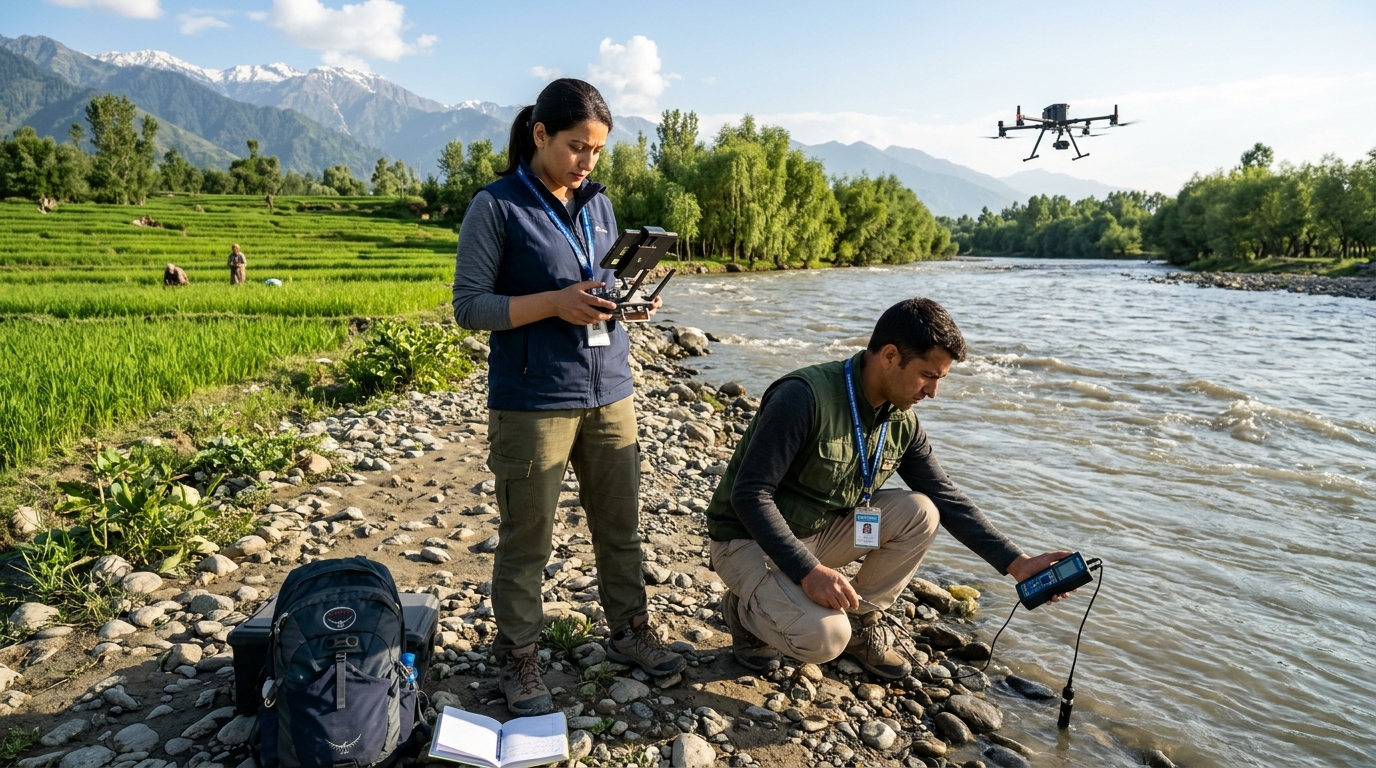
Matched Field & Analytical Instrumentation:
  • Amber borosilicate trace-organic grab samplers, solid-phase extraction (SPE) manifolds & cold-chain coolers
  • Calibrated Class-1 integrating sound-level meters (environmental acoustics)
  • ICP-MS (trace heavy metals), UHPLC-MS/MS & GC-MS (pesticides & emerging pharmaceuticals)
C H A P T E R 0 3

Ecobiology and Hysteranthous Phenology of Triploid Crocus sativus L.

As a sterile autotriploid geophyte (2n = 3x = 24), Crocus sativus produces no viable botanical seed and propagates exclusively via underground fleshy corms, exhibiting an inverted (hysteranthous) Mediterranean-type phenological calendar acutely sensitive to seasonal hydrothermal cues [2, 3]. Yasmin and Nehvi (2014) documented the intricate morpho-anatomical stages of Kashmir saffron: corms remain quiescent beneath hot, dry summer topsoil from late May through July while microscopic apical meristems transition from vegetative to floral differentiation in July–August .

Late-August and September cooling accompanied by timely pre-anthesis soil wetting (optimal 15 cm soil temperature 17–21 deg C and moderate matric moisture) triggers adventitious root emergence and rapid upward elongation of fragile perianth tubes, culminating in a synchronous 20-to-25-day purple flowering flush between mid-October and early November [2, 3]. Narrow grass-like photosynthetic leaves expand throughout late autumn, overwinter beneath snow cover, and drive daughter-corm assimilate bulking from March until foliar senescence in May .

C H A P T E R 0 4

Geochemical and Edaphic Controls on Corm Vitality and Secondary Metabolites

Recent multi-site pedo-geochemical profiling of Pampore saffron soils by Ayoub et al. (2024) confirms that undisturbed Upper Karewa topsoils possess balanced aluminosilicate mineralogy (SiO2, Al2O3, K2O, CaO, MgO, Fe2O3) free of geogenic heavy-metal toxicity, providing essential enzymatic cofactors (Fe, Mn, Zn, Cu) required for carotenoid cleavage pathways that synthesize crocin and safranal in developing stigmas . Calcium carbonate presence buffers rhizosphere pH against acidification and stabilizes silt micro-aggregates against surface crusting.

However, decades of continuous multi-year corm monoculture (traditional 8-to-12-year undisturbed planting cycles versus SKUAST-K’s recommended 4-year digging/grading rotation) without sufficient farmyard manure (FYM, 15–20 tonnes/ha) replenishment have depleted Soil Organic Carbon (SOC) below 0.60–0.75% across large tracts of Pampore [1, 2]. Depleted SOC degrades surface aggregate stability, promotes hard raindrop surface crusting (katr) in October that physically blocks delicate floral shoots from piercing the soil surface, and weakens native microbial endophyte diversity [2, 4].

Table 18.1. Edaphic and Geochemical Profile Comparison: Undisturbed Upper Karewa Saffron Topsoil vs Stripped Subsoil & Degraded Margins
Soil ParameterUndisturbed Heritage Topsoil (0-25 cm)Degraded / Crust-Prone Long-Cycle PlotExcavated / Stripped Lower Subsoil ScarAgronomic Consequence for Crocus sativus
Dominant Texture & Bulk DensityFriable Silt-Loam (1.26 -- 1.34 g/cm^3)Compacted Silt-Loam (1.39 -- 1.46 g/cm^3)Dense Calcareous Clay-Silt (>1.52 g/cm^3)High bulk density impedes floral-shoot emergence & daughter-corm expansion
Soil pH (1:2.5 Water)7.2 -- 7.8 (Optimal slightly alkaline)7.8 -- 8.3 (Elevated near Khrew dust)8.2 -- 8.6 (Marly carbonate exposure)pH >8.2 locks up bioavailable Fe, Zn & Mn needed for carotenoid synthesis
Soil Organic Carbon (SOC %)0.95 -- 1.35% (FYM-amended)0.52 -- 0.72% (Depleted)< 0.25% (Biologically sterile C-horizon)Low SOC cuts autumn moisture retention & suppresses beneficial endophytes
Internal Drainage & AerationWell-drained; zero perched waterSurface raindrop crusting (katr)Perched winter stagnation; poor aerationPerched moisture >48 hr triggers catastrophic Fusarium corm rot

Source & Provenance: Synthesized from Pampore Karewa geochemical and pedological characterizations in Ayoub et al. (2024) [1], Nehvi et al. (2024) [2], and SKUAST-K Saffron Research Station Pampore norms [5].

C H A P T E R 0 5

Climatic Vulnerability: August–October Precipitation Deficits and Thermal Stress

Comparative yield-gap and weather-impact analysis across Pampore’s saffron heritage site by Nehvi et al. (2024) identifies erratic late-summer/autumn precipitation and rising late-summer temperatures as the foremost abiotic drivers of yield instability . Under rainfed conditions, Crocus sativus requires ~65 to 85 mm of well-distributed rainfall across late August and September (coinciding with late monsoon tails or early western disturbances) to hydrate dormant corms at 15 cm depth and initiate floral scape elongation .

CHIRPS v2.0 time-series evaluation (1985–2025) over Pampore indicates heightened frequency of prolonged August 15–October 10 rainless spells (<35–45 mm total in drought years such as 1999–2003, 2018, and 2021), paired with late-summer daytime warming (+1.2 to +1.9 deg C) that accelerates evaporative drying of the upper 20 cm silt-loam [2, 6]. Conversely, unseasonal heavy downpours or early wet snow during peak flowering (October 25–November 10) lodge open tepals, slash stigma picking efficiency, and degrade crocin quality.

Figure 18.1 · 2014–2024 Multi-Season Synthesis

Decomposition of Saffron Stigma Yield across Management and Moisture Regimes in Pampore (kg/ha) (kg/ha Dry Stigma Yield)

Unit: kg/ha Dry Stigma Yield
Loading comparative scientific figure…

Interpretation: Closing the >3.0 kg/ha gap between drought-stressed traditional plots (1.55 kg/ha) and demonstrated potential (5.40 kg/ha) requires combining graded (>8 g) corm rejuvenation and organic soil conditioning with phenology-timed autumn sprinkler irrigations.

Source: Synthesized from Nehvi et al. (2024) Yield-Gap & Constraint Analysis in Pampore [2] and SKUAST-K NSM Demonstrations [5]

Explanatory Scientific Illustration · KEW-SR-2026-18

Source-Pathway-Receptor Contaminant Mass-Balance & Analytical Verification

Input Inventory → Vadose/Channel Transport → Accredited Laboratory Assay

Vector Process Schematic
SOURCE 01
Point & Non-Point Inputs

Agrochemical drift, untreated sewage, or hazardous leachate

kg / ha or MLD
PATHWAY 02
Hydrological Mobilization

Spring snowmelt & irrigation drainage transport across Karewas

Runoff / Percolation
PARTITION 03
Sediment & Biota Sorption

Persistence in fine benthic silts & trophic bioaccumulation

K_d / Log K_ow
ASSAY 04
ICP-MS / UHPLC-MS/MS

Direct laboratory quantification (never extrapolated from satellites)

QA/QC Blanks
BARRIER 05
Source Substitution & CETP

Closed-loop treatment, IPM buffers & potable intake protection

statutory Limit
Provenance: Conceptual Scientific Process Diagram (Vector)KEW × Craftlore Scientific Visual Standard
C H A P T E R 0 6

Mechanical Strip-Mining and Urban Encroachment on Karewa Geoheritage

Unlike reversible agronomic nutrient depletion, mechanical excavation of Pampore’s Karewa plateaus inflicts permanent geological destruction that requires tens of thousands of years of aeolian loess deposition to form naturally . Because Upper Karewa silts sit high above the flood-prone valley floor and compact readily into stable engineering fills, millions of cubic metres of Karewa earth have been strip-mined across Pulwama and Budgam over the past two decades to build raised highway embankments (NH-44 four-laning, Srinagar Ring Road), railway sub-grades, and valley-floor residential fills.

Sentinel-2 brightness and topographic scar audits across Lethpora, Galander, Chandhara, and Chadoora-Budgam outliers reveal steep vertical cut-faces (4 to 15 m high) carving directly into historical saffron plateaus . Strip-mining not only removes the biologically active loess-palaeosol horizon on excavated parcels, but also steepens adjacent terrace rims, lowering peripheral water-holding tension and triggering accelerated lateral gully retreat into neighboring cultivated saffron beds during spring snowmelt downpours.

C H A P T E R 0 7

RUSLE Soil Erosion Mechanics on Dissected Loessic Plateau Escarpments

Although central Karewa tableland interiors exhibit gentle slopes (1–4%), their dissected perimeter rims and traditional raised square saffron beds (1.5 x 1.5 m or 2 x 2 m plots separated by 20–30 cm drainage furrows) are highly susceptible to sheet, rill, and tunnel (piping) erosion because unconsolidated loess silt particles (2–50 um) possess high RUSLE soil erodibility factors (K ~ 0.042–0.056 t ha h / ha MJ mm) when depleted of organic binding agents [1, 6].

Because saffron beds must be kept weed-free via summer hoeing (June–September) prior to autumn bloom, the soil surface remains nearly bare (RUSLE cover factor C ~ 0.45–0.65) precisely when convective late-monsoon cloudbursts strike . Downslope furrow alignments along Karewa margins concentrate runoff into dispersive calcareous subsoils, incising deep ravines that drain valuable topsoil and dormant corms into lower Jhelum ditches.

Governing Analytical Expression
A_karewa = R * K_loess * LS * C_phen * P_bed

Revised Universal Soil Loss Equation (RUSLE) adapted for Pampore Karewa saffron plateaus, where A_karewa is annual soil loss (t/ha/yr), R is rainfall-runoff erosivity (MJ mm / ha h yr), K_loess is silt-rich Dilpur Formation erodibility (elevated where SOC < 0.7%), LS is topographic slope-length steepness (spiking >8x along excavated borrow-pit escarpments), C_phen is phenological vegetative cover factor (highest during bare July-October dormancy/hoeing), and P_bed reflects raised-bed contour vs downslope furrow orientation.

C H A P T E R 0 8

Rhizosphere Microbiome, Endophytes, and Corm-Rot Pathogenesis

Subterranean corm survival across multi-year planting cycles depends intimately on balanced rhizosphere microbial communities. Molecular and culture-dependent investigations of Kashmir saffron by Sharma, Kaul, and Dhar (2015) revealed a rich guild of culturable bacterial endophytes—dominated by Bacillus, Burkholderia, Pantoea, and Pseudomonas lineages—inhabiting healthy Crocus sativus corms, exhibiting indole-3-acetic acid (IAA) production, phosphate solubilization, siderophore secretion, and direct antifungal antagonism against soil-borne pathogens .

In degraded Pampore plots where farmers replant unsorted small (<5 g), bruised corms for 8–12 consecutive years without fungicidal/biocontrol dressing or organic compost, fungal corm rot caused primarily by Fusarium oxysporum f. sp. gladioli, Rhizoctonia crocorum, and Macrophomina phaseolina reaches 25–48% incidence [2, 4]. Crucially, corm rot explodes whenever poorly drained subsoils or excessive flood irrigation create warm anaerobic saturation (>22 deg C) around wounded mother corms, explaining why precision moisture control is biologically non-negotiable.

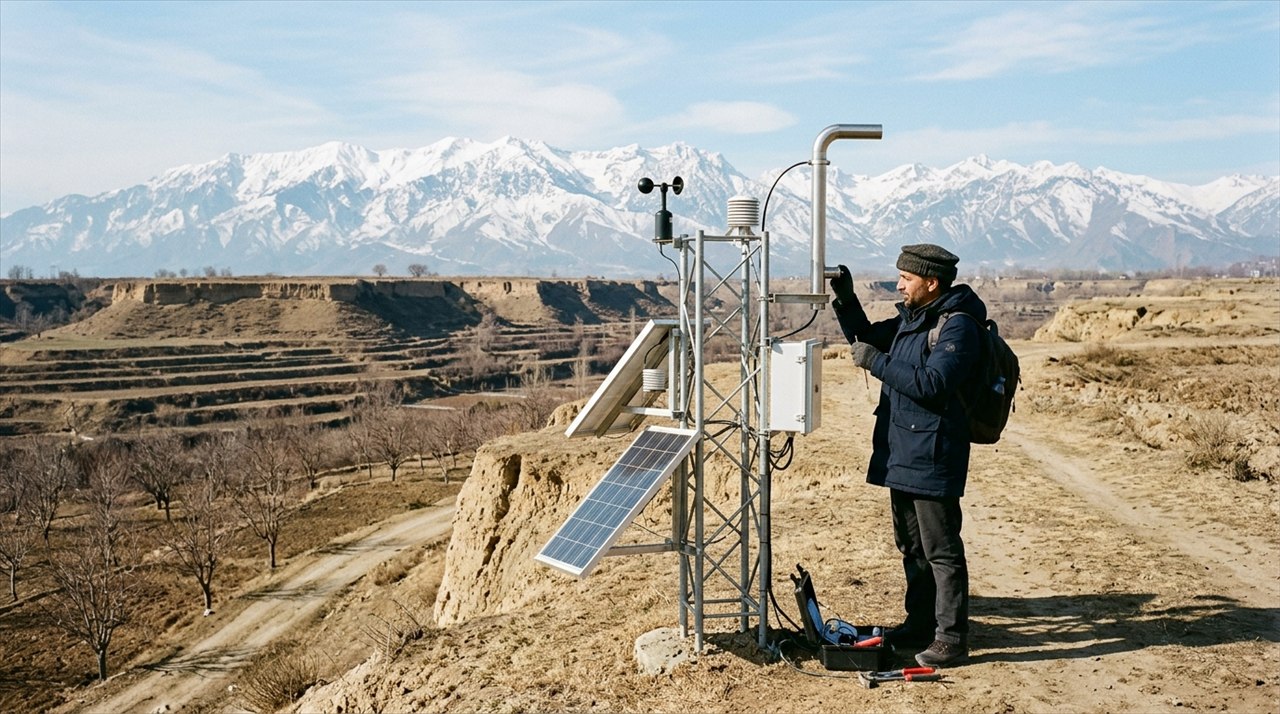
Boundary-Layer Eddy-Covariance & Black-Carbon Aethalometer Station on Karewa Terrace
FIELD METHODOLOGY · ENVIRONMENTAL ANALYTICAL CHEMISTRY & ONE HEALTH

Boundary-Layer Eddy-Covariance & Black-Carbon Aethalometer Station on Karewa Terrace

Elevated Plio-Pleistocene Karewa tablelands support continuous monitoring of winter temperature inversions, black-carbon aerosol optical depth, and agro-meteorological energy fluxes.

Primary field instrumentation: Amber borosilicate trace-organic grab samplers, solid-phase extraction (SPE) manifolds & cold-chain coolers · Calibrated Class-1 integrating sound-level meters (environmental acoustics).

Pampore–Pulwama Karewa Plateau, Kashmir ValleyIllustration
C H A P T E R 0 9

Industrial Air-Soil Interface: Khrew–Wuyan Cement Cluster Dust Stress

The northeastern flank of the Pampore saffron heritage zone (Khrew, Wuyan, Shar-i-Shali, and Ladhoo) directly abuts Kashmir’s largest Portland cement manufacturing and limestone quarrying cluster. Fugitive alkaline particulate emissions from rotary kilns, clinker grinding mills, and unpaved quarry haul roads disperse across downwind Karewa saffron villages under prevailing valley-breeze circulations, depositing calcium-oxide-rich dust onto topsoils and winter saffron foliage.

Alkaline cement dust fallout progressively shifts surface Karewa soil pH above 8.1–8.4, precipitating plant-available iron, zinc, and phosphorus into insoluble calcium complexes , while crusting the narrow stomata of overwintering Crocus sativus leaves between December and April. Because daughter-corm weight (>8–10 g required to differentiate 2–3 flowers the following October) depends entirely on winter-spring foliar photosynthesis [2, 3], chronic particulate shading directly starves next-season reproductive potential along the Khrew–Ladhoo margin.

C H A P T E R 1 0

Technical Audit of the National Saffron Mission (NSM) Irrigation Bottlenecks

Launched in 2010–11 (and subsequently extended under the Mission for Integrated Development of Horticulture) with an outlay exceeding INR 400 crore, the National Saffron Mission targeted corm-bed rejuvenation across 3,715 ha, establishment of the India International Kashmir Saffron Trading Centre (IIKSTC) at Dusoo Pampore for e-auction and ISO-3632 GI quality grading, and construction of >120 deep borewells coupled with pressurized overhead sprinkler networks across Pampore’s water-scarce tablelands [2, 5].

While IIKSTC revolutionized post-harvest stigma drying (cutting crocin degradation from traditional sun-drying) and GI price realization, field irrigation operationalization lagged severely [2, 5]. Fragmented micro-holdings (<0.15 ha split among multiple heirs), damage to lateral HDPE riser pipes during tractor/bullock hoeing, electromechanical pump maintenance gaps, electric feeder outages during peak September demand, and farmer apprehension that overhead sprinklers might induce corm rot left large fractions of bored wells underutilized during recent autumn droughts .

Table 18.2. Phenology-Calibrated Protective Irrigation & Agronomic Calendar for Pampore Karewa Saffron
Phenological StageCalendar WindowHydrothermal RequirementPrecision InterventionPathological / Edaphic Guardrail
Summer Corm Quiescence & MitosisJune 15 -- Aug 15Dry warm rest; weed-free aerated bedShallow crust breaking (hoeing) + 15 t/ha well-rotted FYM on renewal plotsStrictly avoid heavy summer irrigation (>25 deg C wet soil triggers Fusarium rot)
Floral Primordia Differentiation & SproutingAug 20 -- Sept 2550 -- 70 mm cumulative moisture; T_soil 17-21 deg C2 to 3 light sprinkler mistings (15-20 mm each at 12-15 day intervals) if rain failsMaintain matric tension -30 to -60 kPa; zero furrow ponding or runoff crusting
Pre-Emergence Crust Softening & AnthesisOct 05 -- Nov 1015 -- 20 mm early Oct wetting; dry sunny bloom daysLight pre-emergence misting + timely dawn flower picking & IIKSTC solar/tray dryingHalt overhead sprinkling once purple shoots pierce soil to prevent tepal rot
Vegetative Leaf Growth & Daughter-Corm BulkingNov 20 -- April 30Winter snowmelt moisture; high foliar PARFoliar micronutrient spray (Zn/B) + rodent control + zero grazing on green leavesKeep perimeter Karewa drainage furrows open during March snowmelt thaws

Source & Provenance: Synthesized from SKUAST-Kashmir Saffron Research Station (Konibal/Dusoo) agronomic protocols, Nehvi et al. (2024) [2], and Yasmin & Nehvi (2014) [3].

ICP-MS & UHPLC-MS/MS Trace Contaminant Quantification with Blank/Duplicate QA/QC
ANALYTICAL LABORATORY & COMPUTATIONAL SYNTHESIS

ICP-MS & UHPLC-MS/MS Trace Contaminant Quantification with Blank/Duplicate QA/QC

Trace heavy metals, dissolved nutrients, agrochemical residues, and emerging organic micropollutants quantified via laboratory spectrometry under chain-of-custody quality control.

Analytical systems: ICP-MS (trace heavy metals), UHPLC-MS/MS & GC-MS (pesticides & emerging pharmaceuticals) · Quantitative PCR (qPCR) for environmental antimicrobial resistance genes (ARGs).

Environmental Analytical Chemistry ProtocolIllustration
C H A P T E R 1 1

Orbital & Reanalysis Monitoring of Karewa Moisture and Land-Cover Shifts

Combining CHIRPS v2.0 precipitation grids with Sentinel-2 multi-spectral time series provides an objective observatory for separating reversible climatic yield dips from permanent Karewa habitat loss . On Sentinel-2 imagery, active saffron plots exhibit bare high-albedo silt reflectance from June through October followed by a subtle greenness rise (NDVI 0.25–0.36) from December through March as winter leaves emerge; plots converted to high-density apple or almond orchards develop strong June–September woody red-edge signatures (NDRE > 0.35) .

Simultaneously, unauthorized earth-mining pits and highway commercial fillings stand out starkly in SWIR/Red brightness anomalies where pale calcareous subsoils are exposed, allowing district enforcement officers to detect fresh >0.05 ha Karewa excavations within 5 days of cloud-free overpass. However, satellite C-band radar cannot substitute for 15 cm root-zone soil moisture probes, necessitating coupled ground-orbital telemetry.

C H A P T E R 1 2

Crop Competition: Almond Decline, Apple Encroachment, and Fallow Speculation

Historically, Pampore’s GIAHS landscape featured sparse, wide-spaced rainfed almond trees (Prunus dulcis) interplanted along Karewa field borders, casting negligible autumn shade while diversifying household income and anchoring plateau edges against wind and water erosion . Over the last 15 years, senescent almond groves have been uprooted, while irrigated pockets along western and southern Karewa margins (Budgam and Pulwama) have transitioned toward high-value apple orchards wherever deep borewells provide summer water.

More damaging still along the Lethpora–Galander–Pampore NH-44 corridor is speculative peri-urban fallowing: landowners halt labor-intensive 4-year corm digging and weeding in anticipation of commercial warehousing, educational institutional campuses, or residential colony development. Once saffron beds lie unweeded and unhoed for >3 years, perennial grasses, rodents, and soil compaction choke surviving corms, creating a de facto pathway around agricultural land-use restrictions.

C H A P T E R 1 3

Protected-Environment and Indoor Aeroponic Claims: Ecological Trade-Off Analysis

In response to climatic volatility, controlled-environment vertical/aeroponic saffron flowering trials have gained experimental attention in India. However, agronomic and physiological evidence confirms that soilless indoor forcing merely triggers a single season’s flower flush from pre-sized mother corms; without spending November–May planted in open, fertile soil under high solar irradiance to regenerate >8 g daughter corms, indoor-forced corms shrink below reproductive threshold after one cycle [2, 3].

Consequently, indoor forcing remains wholly dependent on healthy open-field Karewa corm nurseries and cannot replace Pampore’s 3,715 ha heritage soil ecosystem. Worse, diverting policy attention toward energy-intensive indoor rooms risks legitimizing neglect or real-estate conversion of the actual Geographical Indication (GI) Karewa terroir whose mineral geochemistry and diurnal autumn thermal amplitude impart Kashmiri saffron’s signature chemical profile [1, 5].

C H A P T E R 1 4

Statutory Protection of Karewa Geoheritage and GI Terroir Boundaries

Despite Geographical Indication registration (Kashmir Saffron GI Tag, 2020) and FAO GIAHS recognition, Pampore’s Karewa formations lack unified statutory designation as a Protected Geoheritage and Agricultural Reserve . Mining permits and "ordinary earth" extraction clearances granted for linear infrastructure projects have repeatedly treated 100,000-year-old loess-palaeosol sequences as expendable construction fill rather than non-renewable Class-I specialty agricultural soil .

Closing this legal vacuum requires notifying the core 320 km^2 Pampore–Khrew–Chadoora Upper Karewa saffron belt as an Eco-Sensitive Agro-Geoheritage Zone under the Environment (Protection) Act, 1986, paired with J&K Saffron Act enforcement prohibiting earth excavation, brick/cement expansion, and non-agricultural land-use conversion across mapped Dilpur Formation saffron cadastral polygons.

C H A P T E R 1 5

Biological Soil Rejuvenation: Bio-Consortia, Vermicompost, and Corm Grading

Restoring Pampore’s soil organic carbon from 0.68% back above the >1.1% threshold without inducing fungal rot requires well-stabilized organic amendments paired with native microbial biocontrol [2, 4]. Incorporating 15–20 t/ha of fully composted farmyard manure or 5 t/ha vermicompost enriched with Trichoderma viride / Trichoderma harzianum and native antagonistic Bacillus/Pseudomonas endophytes rebuilds silt-loam crumb porosity, elevates autumn moisture retention by 18–25%, and suppresses Fusarium oxysporum chlamydospores.

Simultaneously, strict adherence to a 4-to-5-year corm lifting cycle—sorting and replanting only healthy corms >8 g at 12–15 cm depth (500,000 corms/ha) on raised 2 x 2 m beds with clean perimeter drainage—eliminates overcrowded daughter-corm competition that currently depresses flowering percentages below 35% in >10-year unlifted fields [2, 5].

C H A P T E R 1 6

Multi-Hazard Risk Matrix for the Pampore Saffron Karewa System

Integrating irreversibility, spatial footprint, and yield impact across Pampore’s 29 heritage villages places mechanical Karewa topsoil strip-mining and NH-44 corridor urbanization in the highest long-term risk tier (cumulative score 91/100) because no agronomic intervention can resurrect a bulldozed loess plateau .

Among active saffron holdings, August–September drought stress compounded by non-operational NSM sprinkler laterals ranks as the primary acute productivity hazard (score 86/100), closely followed by corm-rot amplification in SOC-depleted, ungraded monoculture beds (score 79/100) and alkaline cement-dust deposition along the Khrew–Wuyan industrial interface (score 74/100) [2, 4].

C H A P T E R 1 7

Institutional Governance of Community Micro-Irrigation User Groups

Unlocking the sunk public investment in Pampore’s NSM deep borewells requires shifting from centralized departmental pump operation to village-level Saffron Water User Associations (SWUAs) supported by solar-hybrid pump retrofits and buried sub-plow-depth HDPE mainlines with removable quick-coupler micro-sprinkler risers [2, 5]. Removable risers allow unobstructed summer bullock/power-tiller weeding while enabling rapid deployment during the narrow 35-day August 20–September 25 floral initiation window.

Pairing SWUAs with automated SMS/app soil-moisture advisories issued jointly by SKUAST-K Saffron Research Station (Konibal) and IMD Srinagar ensures farmers apply exact 15–20 mm protective mistings rather than damaging flood irrigations.

C H A P T E R 1 8

Pre-Registered Field & Laboratory Validation Campaign (2026–2028)

To close empirical data gaps identified in Indicator IND-18-05, KEW outlines a pre-registered 18-plot sentinel monitoring transect spanning Lethpora, Dussu, Konibal, Chandhara, Namblabal, and the Khrew–Ladhoo cement perimeter. Each plot will pair continuous 15 cm granular-matrix soil matric potential and soil temperature loggers (30-minute intervals) with Bergerhoff passive dust-fall collectors analyzed monthly for pH, CaCO3, and trace elements.

At harvest, paired stigma samples will undergo ISO-3632 UV-Vis spectrophotometry and HPLC quantification of crocin, picrocrocin, and safranal at IIKSTC/SKUAST-K laboratories alongside qPCR quantification of soil Fusarium inoculum, directly testing Hypotheses H1 and H3 under field conditions.

C H A P T E R 1 9

Actionable Policy & Restoration Recommendations for GIAHS Resilience

Safeguarding Pampore’s GIAHS heritage demands a four-pillar intervention strategy: (1) immediate legal moratorium on "ordinary earth" excavation Permits across all mapped Upper Karewa Dilpur Formation saffron plateaus; (2) rehabilitation of underperforming NSM borewell commands via removable quick-coupler micro-sprinklers and dedicated solar-backed September power feeders; (3) subsidized public corm nurseries multiplying certified >8 g Fusarium-free mother corms with Trichoderma/endophyte bio-priming; and (4) continuous CEMS baghouse particulate enforcement at Khrew–Wuyan cement kilns.

Furthermore, expanding blockchain-verified GI tagging through IIKSTC Dusoo directly to smallholder grower collectives ensures price premiums (~INR 250,000–320,000/kg Grade-I Mongra saffron) accrue to active cultivators rather than intermediary traders, restoring economic viability against land-sale pressures [2, 5].

C H A P T E R 2 0

Scientific Uncertainties, Secondary-Data Provenance, and Limitations

This dossier is classified as a Secondary-Data Scientific Review: geochemical soil parameters, yield-gap ranges, and rhizosphere microbial findings are synthesized from peer-reviewed investigations conducted on Pampore Karewas [1, 2, 3, 4] and statutory NSM/GIAHS records , not claimed as primary KEW laboratory measurements. Village-level stigma yields carry reporting uncertainty because a substantial share of smallholder harvest still bypasses formal IIKSTC e-auctions through informal family trade networks.

Additionally, CHIRPS 5.3 km gridded rainfall smooths localized convective August showers across Pampore’s micro-topography, and C-band SAR backscatter senses only surface (0–5 cm) moisture rather than 15 cm corm-bed matric potential. Direct matric tensiometry and Khrew dust-deposition gradients remain explicitly flagged as Pending Validation (IND-18-05).

Scientific Uncertainty & Data Limitations Disclosure

  • All geochemical, microbial, and agronomic yield-gap metrics cited in this review derive from published peer-reviewed studies (Ayoub et al., 2024; Nehvi et al., 2024; Sharma et al., 2015) and statutory GIAHS/NSM records rather than primary KEW field sampling.
  • Subterranean corm-zone soil matric potential (12–18 cm depth) and continuous Khrew–Pampore cement-dust deposition fluxes remain unmeasured by KEW and are transparently recorded as Unavailable (IND-18-05) pending sentinel plot instrumentation.
  • Sentinel-2 10 m pixels face spectral mixing over narrow, sparse winter saffron leaf rows, requiring multi-seasonal phenological differencing to separate active low-density saffron beds from weedy fallow Karewa plots.
  • Informal direct-to-trader saffron sales outside the IIKSTC Dusoo e-auction platform introduce +/-12–18% uncertainty into official district stigma production totals.