Logarithmic Decibel Energy Addition
+3.0 dB for every doubling of identical sound energy.L_total = 10 · log10 [ ∑ 10^(L_i / 10) ]
Two independent 70 dB sources do not equal 140 dB. Because decibels are logarithmic measures of sound power, two equal sound pressures sum to exactly: 10 · log10(2 · 10^7) = 70 + 10 · log10(2) = 73.01 dB(A).
Equivalent Continuous Sound Level (LAeq,T)
Standard IEC 61672 metric for ambient environmental noise regulation.L_Aeq,T = 10 · log10 [ (1 / T) · ∑ (t_i · 10^(L_i / 10)) ]
The steady sound pressure level that, over a specified time interval T, contains the same total acoustic energy as the actual fluctuating sound under measurement.
Day-Evening-Night Level (Lden)
Primary metric used by the World Health Organization (WHO).L_den = 10 · log10 [ (12/24)·10^(Lday/10) + (4/24)·10^((Leve+5)/10) + (8/24)·10^((Lnight+10)/10) ]
Applies a +5 dB penalty to evening hours (18:00–22:00) and a +10 dB penalty to nighttime hours (22:00–06:00) to account for heightened human annoyance and nocturnal vulnerability.
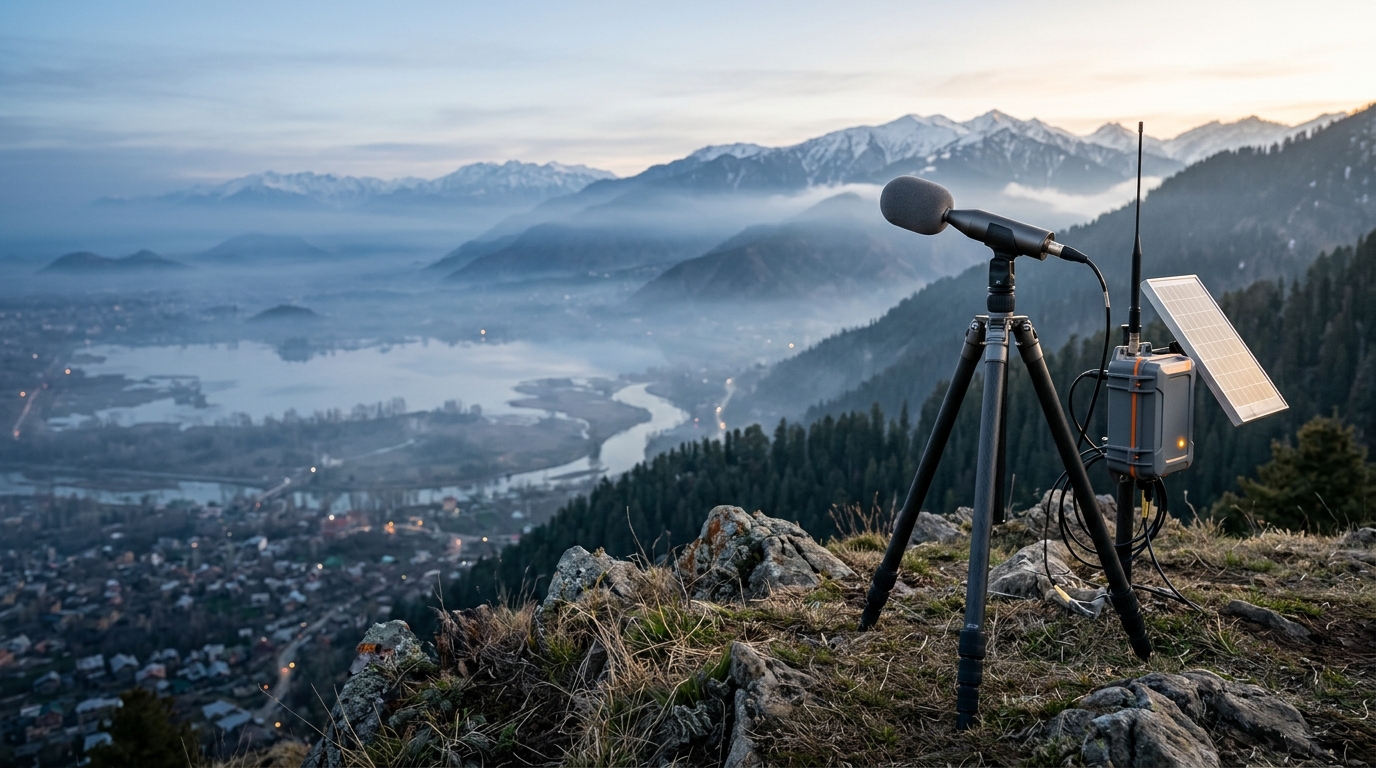
Mountain Valley Sound Propagation & Inversion Refraction
Calibrated under CNOSSOS-EU mountain acoustic terrain guidelines.L_p = L_w - 20 · log10(r) - 11 - A_atm - A_ground + C_inversion
In mountain valleys of Kashmir, winter ground-level cooling creates thermal inversions where temperature increases with height. Sound waves, which normally bend upward into cooler air, refract downward toward the valley floor, amplifying sound pressure by +6 to +8 dB across urban basins.