Kashmir EcoWatch
Dr. Kumar's Kashmir EcoWatchGLOBAL INSTITUTE FOR ADVANCED ENVIRONMENTAL STUDIES
Himalayan Dispatch
KEW-INV-0038 · ENVIRONMENTAL GOVERNANCE · v0.4 (Priority Scoping & Evidence Acquisition)

KEW Western HimalayanSecurity Force Transportation in Kashmir: Vehicular Emissions, Environmental Noise and Statutory Pollution Control Compliance

An independent assessment of institutional transportation, atmospheric emissions, environmental noise, public exposure and regulatory accountability

Critical Scoping · Statutory Exemption & Aggregate Emissions Audit
Scoping Transparency Notice — Critical Scoping · Statutory Exemption & Aggregate Emissions Audit

In accordance with KEW-EIAI implementation standards, KEW-INV-0038 is currently in Critical Scoping · Statutory Exemption & Aggregate Emissions Audit. It defines falsifiable scientific questions, geographic baselines, and initial verified literature anchors without asserting predetermined conclusions prior to full 24-section validation.

Documented Claims2
Unverified / Open1
Scoped Sciences6
Quantitative Findings1
Institutions Audited2
Single Master Record · 12 Derived Publication Outputs
Active View: Full Scientific Investigation (Scientists and researchers)
Showing 17 applicable sections
SECTION 01

Executive Summary & Scoping Mandate

An independent assessment of institutional transportation, atmospheric emissions, environmental noise, public exposure and regulatory accountability

BS-VI Exemption Rule
G.S.R. 547(E) 1 Aug 2019 (Qualifying)
MoRTH / PIB Notification
Revised PUC Mandate
G.S.R. 991(E) 13 Nov 2026
MoRTH Gazette Revision
Compliance Taxonomy
5 Tiers Exempt ≠ Noncompliant
KEW Legal-Epistemic Standard
Operational Privacy
100% Aggregate Zero Sensitive Data
Mandatory Scope Boundary

Central Scientific Question: Even where national-security manufacturing or registration exemptions are legally established (such as MVA Sec 60, G.S.R. 547(E) BS-VI exemptions, and 2023 age-expiry exemptions), which periodic emissions testing, maintenance, contractor PUC, and ambient noise rules remain legally applicable, and what operationally compatible environmental safeguards can protect Kashmir’s airshed, cryosphere, and public health?

Maintained as an active scoping / proposed scientific charter under KEW-EIAI governance. Distinguishes measured observations, historical baselines, statutory exemptions, and unverified hypotheses without fabricating fleet, emission, or decibel readings.

SECTION 02

Investigation Background

Addresses an essential completeness gap in regional emission and noise inventories: evaluates military, CAPF, police, specialized security, administrative, and civilian-contracted institutional vehicles strictly as an aggregate environmental and regulatory study — never examining operational deployments, routes, schedules, or individual vehicle identities.

Evaluates transportation, atmospheric inversions, industrial/domestic sources, and acoustic exposure as an interconnected valley-basin system rather than presuming a single dominant source across all seasons.

Portfolio Duplication Audit: Cleared — Cross-Module Accountability ComplementInstitutional & Security Transportation Compliance Series

Addresses an essential completeness gap in regional emission and noise inventories: evaluates military, CAPF, police, specialized security, administrative, and civilian-contracted institutional vehicles strictly as an aggregate environmental and regulatory study — never examining operational deployments, routes, schedules, or individual vehicle identities.

Governing Falsifiable Investigation Questions:
  1. Precisely which categories of armoured/specialized operational vehicles qualify for BS-IV/BS-VI type-approval exemptions under G.S.R. 485(E) (2017), G.S.R. 871(E) (2018), and G.S.R. 547(E) (2019), versus ordinary non-tactical administrative cars/buses and civilian-hired commercial vehicles that remain bound by standard CMVR Rule 115/116 and G.S.R. 991(E) (Nov 2026) PUC mandates?
  2. Do regional air-pollution emission inventories compiled for Srinagar/Kashmir account for aggregate institutional diesel consumption, or omit the sector entirely?
  3. What internal authorized smoke-opacity inspection, preventive engine maintenance, ultra-low-sulphur fuel, anti-idling, and non-emergency siren/horn discipline frameworks operate across MoD, MHA/CAPF, and J&K Police fleets?

SECTION 03

Geographic Coverage (10 Kashmir Districts)

Aggregate Publicly Accessible Corridors Across Kashmir Division (Zero Sensitive Routes, Deployments, Schedules, or Vehicle Identities)

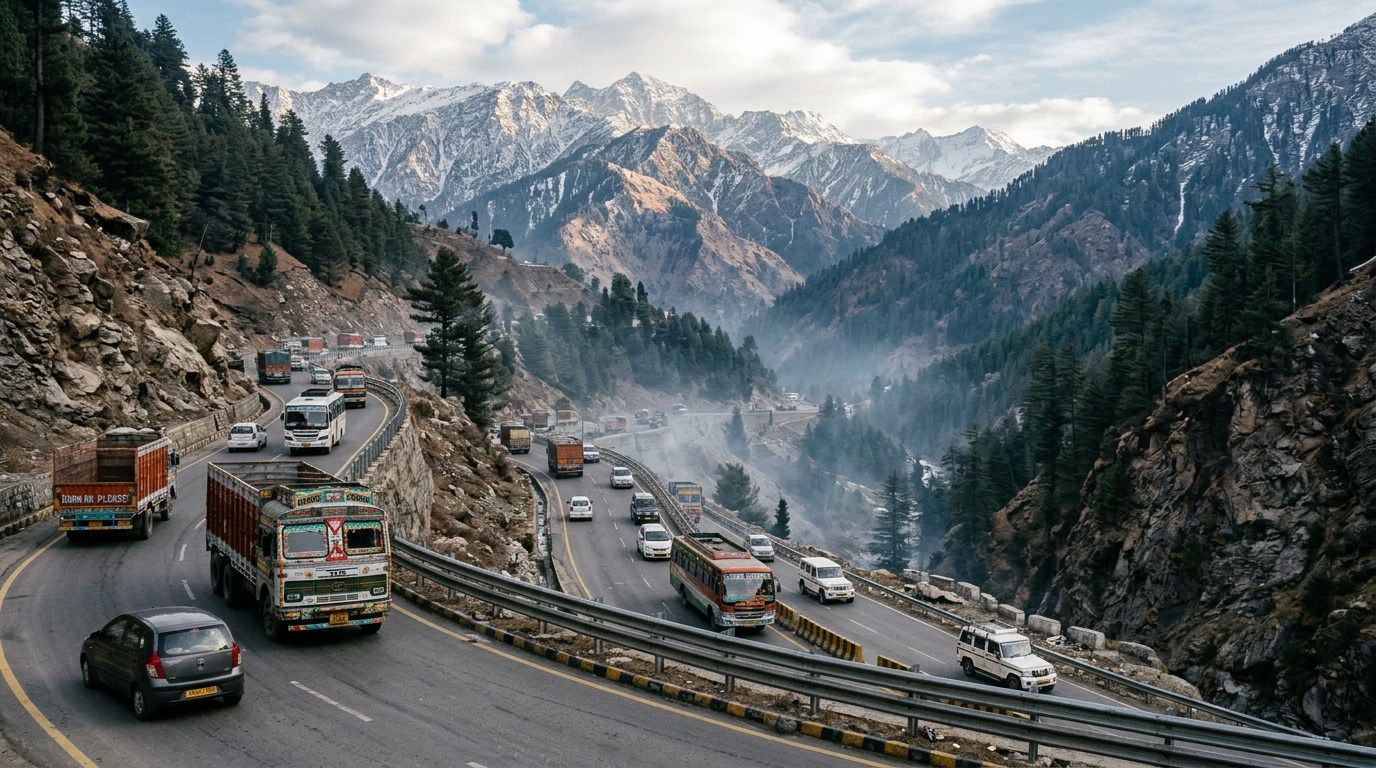
Covers proposed sampling corridors across Srinagar (Lal Chowk, Pantha Chowk, Parimpora, Nowgam), Ganderbal (Sonamarg corridor), Baramulla (Sopore, Pattan, Gulmarg corridor), Anantnag (Bijbehara, Pahalgam corridor), Pulwama (Pampore industrial/highway belt), Budgam (Airport & brick-kiln belt), Bandipora, Kupwara (Handwara), Kulgam, and Shopian (horticultural freight & Mughal Road) — treated strictly as candidate sampling sites until field-verified.

Valley Bowl Atmospheric Mixing LayerUrban Sensitive Receptors (Hospitals & Schools)Riparian/Wetland & Protected Wildlife CorridorsPir Panjal & Greater Himalayan Snowpack Albedo Zones
SECTION 04

Historical Chronology (1990–2026)

Separates historical baselines (e.g., 2013–2017 particulate studies) and cumulative vehicle registrations from contemporary 2026 conditions.

Chronological milestones anchor regulatory transitions (BS-IV, BS-VI, Noise Rules 2000, NCAP, G.S.R. 991(E) Nov 2026 PUC amendments).

PeriodMilestone / InterventionDocumented RecordSource
1988–2000
Motor Vehicles Act Sec 60, CMVR Rules 115–120 & Noise Rules 2000
Baseline
Established separate central defence vehicle registration alongside national exhaust, horn/siren, and ambient noise rules.REF-SEC-01
2017–2019
G.S.R. 485(E), G.S.R. 871(E) & G.S.R. 547(E) BS-IV / BS-VI Exemptions
Intervention
MoRTH notified specific BS-IV and BS-VI manufacturing exemptions for qualifying defence and specialized internal-security vehicles operating in demanding terrain.REF-SEC-02
2023
CMVR Amendment Rules Exempting Specialized Operational Vehicles from 15-Year Expiry
Intervention
Exempted qualifying specialized operational/armoured vehicles from automatic 15-year government-vehicle de-registration.REF-SEC-03
13 Nov 2026
G.S.R. 991(E) Revised PUC Certification Provisions Notified
Audit / Judicial
Updated national PUC testing frequency and compliance rules by vehicle age and emission category.REF-SEC-04
SECTION 05

Environmental & Regulatory Baseline

Legal vs Scientific Distinction: MoRTH notifications — including MVA 1988 Section 60, G.S.R. 485(E) (19 May 2017), G.S.R. 871(E) (13 Sep 2018), G.S.R. 547(E) (1 Aug 2019 BS-VI exemption for qualifying defence/security vehicles), and CMVR Amendment Rules 2023 (15-year government vehicle expiry exemption) — create lawful type-approval/retirement exemptions for qualifying specialized vehicles. A lawful exemption is never classified by KEW as regulatory noncompliance, yet atmospheric physics remains indifferent to legal status: emitted PM2.5, NOx, and black carbon still enter the enclosed Kashmir Valley inversion layer.

Compares verified measurements against enforceable Indian NAAQS / Noise Pollution Rules 2000 while referencing WHO guidelines strictly as health benchmarks.

SECTION 07

Scientific Disciplines & Governing Equations

Applies COPERT/ARAI fleet emission factors E_p = Σ N_i D_i EF_{i,p}, Positive Matrix Factorization (PMF), ERA5 boundary-layer physics, and logarithmic acoustic integration LAeq,T.

Explicitly prohibits scientifically invalid practices such as arithmetic averaging of decibel readings or substituting uncalibrated satellite columns for ground roadside monitoring.

6 Scoped Sciences · 1 Quantitative Findings Populated
Environmental LawApplied Environmental Sciences
Statutory Chain: Mandate → Clearance Condition → Monitoring Obligation → Documented Audit Record
Atmospheric ScienceChemical & Atmospheric Sciences
Albedo Radiative Forcing on Snow: RF_BC = S_0 · (1 - α_clean) · Δα_BC
Environmental EpidemiologyApplied Environmental Sciences
Concentration–Response Relative Risk: RR = exp[β · (C - C_0)]
ClimatologyChemical & Atmospheric Sciences
Glacier Surface Energy Balance: Q_M = R_net + Q_H + Q_LE + Q_G + Q_P
Environmental Data ScienceSpatial & Computational Sciences
Variance-Weighted Evidence Reconciliation: θ̂ = (Σ w_i θ_i) / Σ w_i, w_i = 1 / σ_i²
Ecological EconomicsApplied Environmental Sciences
Unit Nutrient/Sediment Abatement Cost: CE = NPV(Expenditure) / ΔLoad_abated
SECTION 09

Satellite, GIS Network & Ground-Validation Protocol

Couples Sentinel-5P TROPOMI, MODIS/VIIRS MAIAC AOD, ERA5 mixing height, and OpenStreetMap road networks with mandatory ground-station validation.

Satellite trace-gas and aerosol retrievals cannot replace calibrated CPCB/JKPCC ground CAAQMS or Class-1 sound-level meters.

Initialising KEW-EIAI Spatial Investigation Atlas...
SECTION 10

Hydrological Analysis

Evaluates highway embankment wetland severance and black-carbon snow-albedo meltwater forcing where applicable.

Examines road-culvert floodplain obstruction and cryospheric black-carbon deposition pathways.

SECTION 16

Institutional Accountability

Ministry of Road Transport & Highways, Ministry of Defence, Ministry of Home Affairs & J&K Home/Police MT (MoRTH / MoD / MHA / JKP); J&K Pollution Control Committee & J&K Motor Vehicles Department (JKPCC / MVD)

Separates statutory exemption, verified compliance, regulatory ambiguity, and unverified monitoring gaps without inferring noncompliance from missing public records.

Ministry of Road Transport & Highways, Ministry of Defence, Ministry of Home Affairs & J&K Home/Police MT (MoRTH / MoD / MHA / JKP)

Clarification Invited
Statutory Mandate:Defining clear statutory boundaries between exempt specialized tactical vehicles and non-exempt administrative/contracted fleets, maintaining internal emission/noise standards, and preventing unnecessary idling or horn/siren use.
Project & Financial Ownership:Institutional fleet environmental management policies & contractor transport clauses — Public mobility, NCAP/PRANA, highway, and regulatory enforcement budgets
Documented Audit / Scientific Findings:Statutory BS-IV/BS-VI and 15-year exemptions are documented in national gazettes, while public aggregate environmental reporting and contractor PUC verification records remain unavailable.
Official Institutional Response:National defence/CAPF cantonment greening and solar initiatives reported nationally; official clarification on internal PUC/maintenance standards and contractor clauses invited.

J&K Pollution Control Committee & J&K Motor Vehicles Department (JKPCC / MVD)

Clarification Invited
Statutory Mandate:Ensuring regional airshed emission inventories and hospital Silence-Zone acoustic assessments capture total aggregate mobile-source loading.
Project & Financial Ownership:Kashmir regional emission inventory & ambient air/noise networks — Public mobility, NCAP/PRANA, highway, and regulatory enforcement budgets
Documented Audit / Scientific Findings:VAHAN-only civilian registries exclude Section-60 and outside-registered vehicles from regional inventories.
Official Institutional Response:JKPCC operates ambient stations measuring total receptor concentrations regardless of source; inventory methodology clarification invited.
SECTION 17

Regulatory & Statutory Analysis

MVA 1988 Sec 60; CMVR Rules 115, 116, 119, 120; G.S.R. 485(E), 871(E), 547(E) & 991(E) (Nov 2026); Air Act 1981; EPA 1986; Noise Rules 2000.

Evaluates statutory instruments, Bharat Stage notifications, PUC mandates, and ambient air/noise rules.

Five-Tier Statutory Compliance & Exemption Assessment Matrix
Evaluated Sector / RequirementStatutory InstrumentCompliance ClassificationLegal & Scientific BasisRequired Institutional Evidence
Qualifying Specialized Defence & Armoured Internal-Security Vehicles — BS-IV / BS-VI Manufacturing Type-Approval & 15-Year ExpiryMVA 1988 Sec 60; G.S.R. 485(E) (2017); G.S.R. 871(E) (2018); G.S.R. 547(E) (1 Aug 2019); CMVR Amendment Rules 2023Legally exemptAuthenticated MoRTH Gazette notifications explicitly exempt qualifying specialized defence and armoured/operational internal-security vehicles from BS-IV/BS-VI manufacturing norms and the 15-year government-vehicle scrappage rule due to high-altitude/terrain operational requirements.Published technical schedule of qualifying vehicle classes vs non-exempt general-duty vehicles; internal environmental maintenance norms.
Periodic PUC Smoke-Opacity Testing & Applicability of Revised G.S.R. 991(E) (13 Nov 2026) Across Section-60 & CAPF/Police FleetsCMVR Rules 115(7) & 116; MoRTH G.S.R. 991(E) (Nov 2026)Regulatory ambiguitySeparate central registration under Section 60 MVA and type-approval exemptions create overlapping jurisdiction between civilian RTO/VAHAN PUCC portals and internal Base Workshop / MT inspection regimes.Clarification from MoRTH, MoD, MHA, and J&K MVD on internal accredited smoke-testing equivalence and G.S.R. 991(E) applicability.
Non-Tactical Administrative Cars/Buses & J&K Police Routine Civil-Registered VehiclesCMVR Rules 115 & 116; G.S.R. 991(E) (2026); Government Fleet EV/BS-VI Procurement PoliciesNot verifiedOrdinary civilian-pattern staff cars, buses, and utility vehicles registered under standard RTO series do not fall under armoured/combat BS-VI exclusions, but aggregate PUC pass rates are not publicly disaggregated.Aggregate RTO/departmental percentage of administrative & police civil-pattern vehicles holding valid PUCC.
Commercially Hired / Contracted Civilian Trucks, Buses & Taxis Engaged for Institutional TransportMotor Vehicles Act 1988; CMVR Rules 115, 116, 119 & Fitness Certificate MandateNot verifiedPrivately owned commercial vehicles hired under institutional transport contracts enjoy zero sovereign/defence statutory exemption and must hold valid civilian PUCC and fitness certificates.Standard tender/contract clauses requiring valid PUCC, BS-IV/BS-VI compliance, and exhaust maintenance for hired civilian vehicles.
Multi-Toned Horns, Emergency Sirens & Nighttime Silence-Zone Acoustic ComplianceCMVR Rule 119(3); Motor Vehicles (Driving) Regulations, 2017; Noise Pollution Rules, 2000 (50/40 dB(A) Silence Zones)Not verifiedRule 119(3) permits approved multi-toned sirens strictly on authorized emergency/security vehicles during active operational necessity — not unrestricted routine use near hospitals/residential silence zones.Standard Operating Procedures (SOPs) governing peacetime/non-emergency siren, pressure-horn, and stationary idling restrictions near hospitals and schools.
Inclusion of Aggregate Institutional Fuel/Fleet Emissions in Regional Airshed Inventories (Srinagar NCAP & Kashmir Basin)Air (Prevention and Control of Pollution) Act, 1981 & CPCB Emission Inventory GuidelinesNot verifiedCivilian VAHAN-only bottom-up inventories omit Section-60 and outside-registered institutional fleets unless aggregate bulk fuel/emission factors are incorporated.JKPCC / CPCB confirmation of methodology used to represent aggregate institutional transport in regional airshed models.
SECTION 18

Scientific Evidence Matrix

Claim-by-claim verification separating Documented baselines from Unverified field/model hypotheses.

Inspect the Evidence Matrix below.

AssertionSource BasisClassificationVerification Details
EVID-0038-01Under MoRTH Notification G.S.R. 547(E) (dated 1 August 2019), qualifying defence and specialized security vehicles were granted statutory exemption from BS-VI emission standards owing to specialized engine and high-altitude operational conditions, following earlier BS-IV exemptions under G.S.R. 485(E) (2017) and G.S.R. 871(E) (2018).Judicial & Statutory DocketsDocumented

Verified in official Press Information Bureau (PIB) and Gazette of India MoRTH notifications.

EVID-0038-02On 13 November 2026, the Government of India published G.S.R. 991(E) revising Pollution Under Control (PUC) certification requirements according to vehicle age and emission category.Judicial & Statutory DocketsDocumented

Verified in official MoRTH Gazette Notification G.S.R. 991(E) dated 13 November 2026.

EVID-0038-03What percentage of total heavy-duty diesel black carbon and PM2.5 in the Kashmir Valley and high-altitude passes originates from institutional/security transportation relative to civilian freight, brick kilns, and winter biomass burning remains unquantified in published inventories.Scientific LiteratureUnverified

Existing peer-reviewed Kashmir emission studies do not disaggregate institutional fleets; KEW treats actual emission share and PUC rates as open scientific questions rather than pre-assumed findings.

Required: Authorized aggregate fuel/emission-category disclosure from institutional environment cells + source-blind ambient black-carbon/NOx roadside monitoring.

SECTION 19

Unanswered Questions & Data Acquisition Queue

Primary institutional datasets required from VAHAN, RTOs, JKPCC, CPCB PRANA, SMC, Traffic Police, and Health/SKIMS.

Official datasets and clarifications may be submitted via /environmental-investigations/submit.

  • Even where tactical BS-VI exemptions (e.g., avoiding AdBlue/SCR freezing or limp-mode at sub-zero high-altitude posts) are operationally justified, what alternative diesel particulate filters, ultra-low-sulphur BS-VI fuel compatibility, and preventive injector maintenance standards are applied?
  • What are the commencement and applicability provisions of G.S.R. 991(E) (Nov 2026) for civil-registered police and government administrative vehicles in J&K?
SECTION 20

Alternative Solutions & Sustainable Mobility Pathways

UK MoD JSP 418 / US EPA Dual-Track Safeguard Framework (Tactical Reliability + Administrative Electrification & Contractor BS-VI Mandate)

Tests whether public transit, dust suppression, and clean heating outperform road-widening and flyover expansion.

UK MoD JSP 418 / US EPA Dual-Track Safeguard Framework (Tactical Reliability + Administrative Electrification & Contractor BS-VI Mandate)

Preserves operational exemptions strictly for specialized tactical/high-altitude vehicles while mandating: (1) 100% BS-VI/EV transition for administrative & garrison utility vehicles, (2) strict PUCC/BS-VI clauses in all hired civilian transport tenders, (3) internal accredited opacity testing & anti-idling rules, and (4) strict hospital Silence-Zone siren/horn discipline.

Precedent: US EPA 40 CFR §1068.225, UK MoD Sustainable Support Strategy & Canada Greening Government Fleet Policy.

SECTION 21

Phased Recommendations

Immediate, medium-term, and long-term actions with measurable verification indicators.

Tracked in the KEW-EIAI Recommendations Tracker.

Immediate (0–12 Months)Proposed

Enforce Mandatory PUCC & Emission Clauses on All Commercially Contracted Vehicles + Hospital Silence-Zone SOPs

Require valid PUCC and non-modified exhausts/horns in every hired-vehicle contract and issue non-emergency silence-zone acoustic directives near hospitals and schools.

Target: MHA, MoD Cantonment/Env Cells, J&K Police MT & MVD • Indicator: 100% PUCC clause inclusion in institutional transport tenders.
Medium-Term (1–3 Years)Proposed

Electrify Non-Tactical Administrative Fleets & Publish Non-Sensitive Annual Environmental Stewardship Reports

Transition garrison/headquarters administrative cars and shuttle buses to EVs/BS-VI and publish aggregate fleet environmental metrics.

Target: MoD, MHA, MoRTH & J&K Administration • Indicator: Annual aggregate environmental compliance summary published.
SECTION 23

References & Primary Data Repositories

Traceable statutory notifications, peer-reviewed atmospheric studies, and national portals (VAHAN, CPCB, PRANA, PIB, IndiaCode).

All Documented assertions link to verified reference IDs below.

  1. [REF-SEC-01]Parliament of India / Ministry of Road Transport & Highways (IndiaCode) (1989). The Motor Vehicles Act, 1988 (Section 60) & Central Motor Vehicles Rules, 1989 (Rules 115, 116, 119 & 120); Motor Vehicles (Driving) Regulations, 2017. indiacode.nic.in Official Statutory Text. Judicial Order / NGTOfficial Source Link
    Provenance: Primary statutory framework governing defence registration, exhaust emissions, PUC, horns, and approved emergency sound signals.
  2. [REF-SEC-02]Ministry of Road Transport & Highways (MoRTH) / Press Information Bureau (PIB) (2019). Gazette Notifications G.S.R. 485(E) (19 May 2017), G.S.R. 871(E) (13 Sep 2018), and G.S.R. 547(E) (1 Aug 2019 — BS-VI Exemption for Qualifying Defence and Specialized Security Vehicles). Gazette of India / pib.gov.in. Technical Institute ReportOfficial Source Link
    Provenance: Establishes authenticated BS-IV and BS-VI statutory exemptions for qualifying defence and internal-security vehicles.
  3. [REF-SEC-03]Ministry of Road Transport & Highways (MoRTH) (2023). Central Motor Vehicles Amendment Rules, 2023 — Exemption of Specialized Operational Vehicles from 15-Year Government Vehicle Registration Expiry. Gazette of India Extraordinary. Judicial Order / NGT
    Provenance: Documents 2023 exemption from automatic 15-year government vehicle retirement.
  4. [REF-SEC-04]Ministry of Road Transport & Highways (MoRTH) / PIB (2026). Gazette Notification G.S.R. 991(E) (13 November 2026) — Revised Pollution Under Control (PUC) Certification Provisions. Gazette of India / pib.gov.in. Judicial Order / NGTOfficial Source Link
    Provenance: Latest 13 November 2026 PUC regulatory amendment requiring applicability cross-mapping.
  5. [REF-SEC-05]US Environmental Protection Agency (40 CFR §1068.225) & UK Ministry of Defence (JSP 418) (2023). Comparative International Frameworks for National Security Vehicle Emission Exemptions and Defence Environmental Management. US Code of Federal Regulations / UK Gov Sustainable Support. Technical Institute Report
    Provenance: International benchmark reconciling tactical exemptions with administrative fleet decarbonization and environmental auditing.
SECTION 08

Quantitative Multidisciplinary Findings (1 of 6 Scoped Sciences)

Statutory Exemption vs Environmental Impact Jurisprudence (Applied Environmental Sciences)Documented
5-Tier Legal Classification × Aggregate Mass Balance E_total = E_civil + E_commercial + E_institutional

Empirical Finding: International defence frameworks prove that exempting combat/high-altitude tactical engines from civilian Euro/EPA shutdown sensors (e.g., SCR limp-mode risks) can be paired with strict ultra-low-sulphur fuel, internal smoke-opacity limits, non-tactical EV fleets, and annual aggregate emission reporting.

Uncertainty & Methodological Limits: Strictly restricted to authorized public statutory texts and aggregate environmental science; zero inference from missing public records.

SECTION 11

Project & Intervention Inventory

InterventionExecuting Agency & PeriodScale / OutlayDocumented Outcome
INT-SEC-01Institutional Base-Workshop Maintenance, Administrative EV Pilots & Cantonment Green Initiatives
MoD / EME, MHA / CAPF MT Wings & J&K Police MT
2015–2026
Institutional O&M & sustainability programmesInternal workshop inspection protocols operate; public aggregate environmental sustainability disclosures (analogous to UK MoD JSP 418 / US DoD reports) not yet published regionally.