
Kashmir EcoWatch
Dr. Kumar's Kashmir EcoWatchGLOBAL INSTITUTE FOR ADVANCED ENVIRONMENTAL STUDIES
Himalayan Dispatch
KEW-INV-0027 · ATMOSPHERIC ENVIRONMENT · v0.2 (Proposed Investigation Charter)

KEW Western HimalayanVehicular Exhaust, Non-Exhaust Particulates and Mobile-Source Atmospheric Pollution Across Kashmir

Fleet-wide emission factor modelling (E_p = Σ N_i D_i EF_{i,p}) of PM2.5, PM10, NOx, CO, HC, black carbon, CO2, and brake/tyre wear across age, fuel, cold-start, and altitude gradients

Proposed Emission-Inventory Charter (Stage 01)
Scoping Transparency Notice — Proposed Emission-Inventory Charter (Stage 01)

In accordance with KEW-EIAI implementation standards, KEW-INV-0027 is currently in Proposed Emission-Inventory Charter (Stage 01). It defines falsifiable scientific questions, geographic baselines, and initial verified literature anchors without asserting predetermined conclusions prior to full 24-section validation.

Documented Claims1
Unverified / Open1
Scoped Sciences5
Quantitative Findings1
Institutions Audited1
Single Master Record · 12 Derived Publication Outputs
Active View: Full Scientific Investigation (Scientists and researchers)
Showing 16 applicable sections
SECTION 01

Executive Summary & Scoping Mandate

Fleet-wide emission factor modelling (E_p = Σ N_i D_i EF_{i,p}) of PM2.5, PM10, NOx, CO, HC, black carbon, CO2, and brake/tyre wear across age, fuel, cold-start, and altitude gradients

Central Scientific Question: What are the true seasonal mass emissions (tonnes/yr) of PM2.5, black carbon, NOx, CO, VOCs, and heavy-metal brake/tyre particulates from Kashmir’s civilian and commercial road fleet once sub-zero cold starts, pre-BS-VI diesel trucks, and steep gradients are accounted for?

Maintained as an active scoping / proposed scientific charter under KEW-EIAI governance. Distinguishes measured observations, historical baselines, statutory exemptions, and unverified hypotheses without fabricating fleet, emission, or decibel readings.

SECTION 02

Investigation Background

Dedicated mobile-source emission inventory (ARAI/COPERT emission factors corrected for ~1,600–3,500 m altitude barometric pressure and sub-zero winter cold-start penalties, plus brake/tyre wear).

Evaluates transportation, atmospheric inversions, industrial/domestic sources, and acoustic exposure as an interconnected valley-basin system rather than presuming a single dominant source across all seasons.

Portfolio Duplication Audit: Cleared — Cross-Module Accountability ComplementTransportation, Air Quality & Noise Series

Dedicated mobile-source emission inventory (ARAI/COPERT emission factors corrected for ~1,600–3,500 m altitude barometric pressure and sub-zero winter cold-start penalties, plus brake/tyre wear).

Complementary Sectoral Dossiers:KEW-SR-2026-35 →KEW-SR-2026-44 →
Governing Falsifiable Investigation Questions:
  1. By what factor do sub-zero winter morning cold starts (-5 °C to +2 °C) and ~840–700 hPa mountain barometric pressures amplify real-world diesel/petrol EF_{i,p} above standard sea-level ARAI test-cycle factors?
  2. What share of roadside PM10 and trace metals (Cu, Zn, Ba, Sb) originates from non-exhaust brake, clutch, and tyre wear on steep mountain corridors (Qazigund–Banihal, Tangmarg–Gulmarg, Pahalgam, Sonamarg, Shopian–Peer Ki Gali)?
SECTION 03

Geographic Coverage (10 Kashmir Districts)

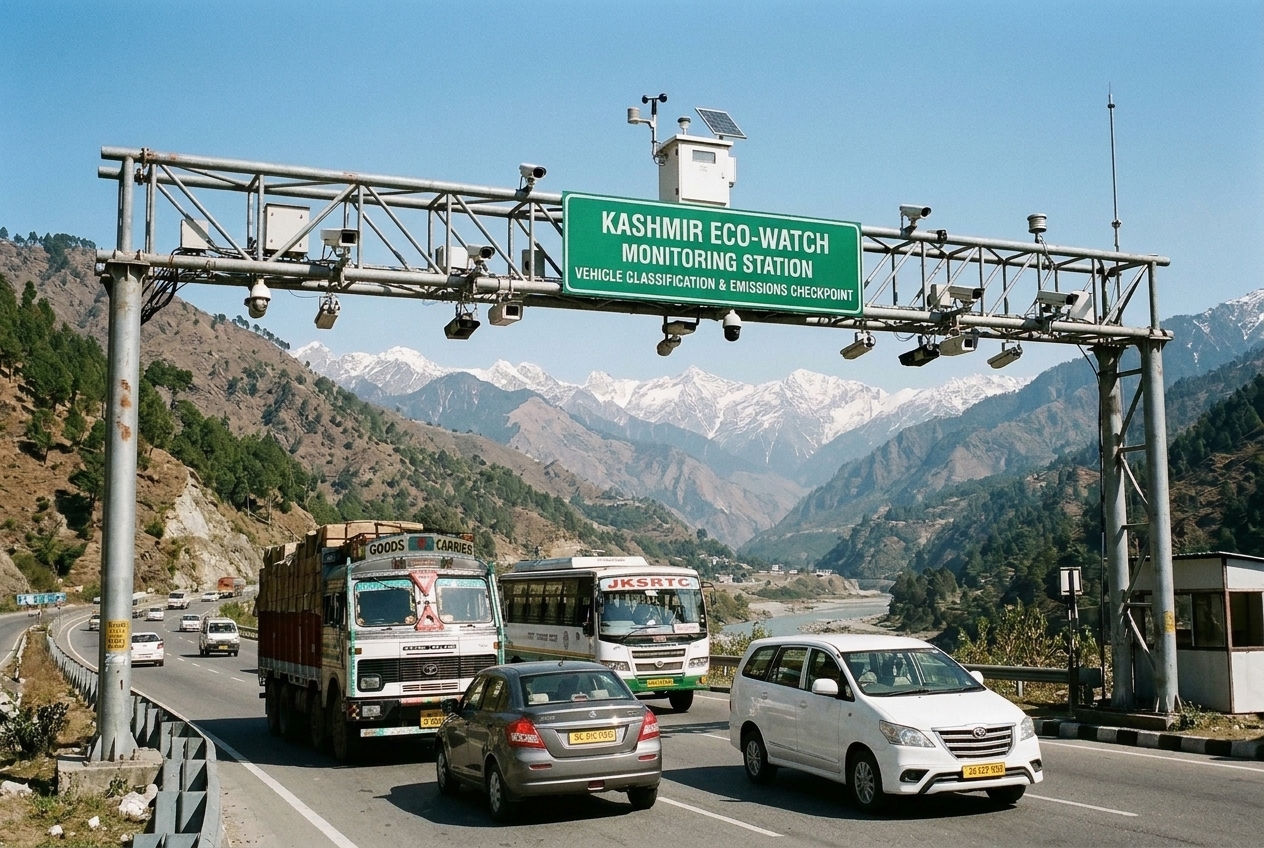
Urban Commuter Fleets, NH-44 / Mughal Road Heavy Diesel Horticultural Freight & Mountain Tourist Corridors

Covers proposed sampling corridors across Srinagar (Lal Chowk, Pantha Chowk, Parimpora, Nowgam), Ganderbal (Sonamarg corridor), Baramulla (Sopore, Pattan, Gulmarg corridor), Anantnag (Bijbehara, Pahalgam corridor), Pulwama (Pampore industrial/highway belt), Budgam (Airport & brick-kiln belt), Bandipora, Kupwara (Handwara), Kulgam, and Shopian (horticultural freight & Mughal Road) — treated strictly as candidate sampling sites until field-verified.

Valley Bowl Atmospheric Mixing LayerUrban Sensitive Receptors (Hospitals & Schools)Riparian/Wetland & Protected Wildlife CorridorsPir Panjal & Greater Himalayan Snowpack Albedo Zones
SECTION 04

Historical Chronology (1990–2026)

Separates historical baselines (e.g., 2013–2017 particulate studies) and cumulative vehicle registrations from contemporary 2026 conditions.

Chronological milestones anchor regulatory transitions (BS-IV, BS-VI, Noise Rules 2000, NCAP, G.S.R. 991(E) Nov 2026 PUC amendments).

PeriodMilestone / InterventionDocumented RecordSource
2010–2026
BS-III → BS-IV → BS-VI Fuel/Vehicle Transition & G.S.R. 991(E) PUC Revision
Intervention
Phased emission standards introduced alongside persistent legacy diesel commercial vehicles and revised Nov 2026 PUC rules.REF-VEM-01
SECTION 05

Environmental & Regulatory Baseline

Standard plains test-cycle emission factors underestimate real-world Himalayan emissions unless corrected for sub-zero cold-start catalyst light-off delays, reduced oxygen partial pressure at altitude, and older BS-II/III/IV commercial diesel trucks.

Compares verified measurements against enforceable Indian NAAQS / Noise Pollution Rules 2000 while referencing WHO guidelines strictly as health benchmarks.

SECTION 07

Scientific Disciplines & Governing Equations

Applies COPERT/ARAI fleet emission factors E_p = Σ N_i D_i EF_{i,p}, Positive Matrix Factorization (PMF), ERA5 boundary-layer physics, and logarithmic acoustic integration LAeq,T.

Explicitly prohibits scientifically invalid practices such as arithmetic averaging of decibel readings or substituting uncalibrated satellite columns for ground roadside monitoring.

5 Scoped Sciences · 1 Quantitative Findings Populated
Atmospheric ScienceChemical & Atmospheric Sciences
Albedo Radiative Forcing on Snow: RF_BC = S_0 · (1 - α_clean) · Δα_BC
Environmental ChemistryChemical & Atmospheric Sciences
Benthic Diffusive Flux (Fick’s First Law): J_P = -φ D_s (∂C_pore / ∂z)
Environmental Data ScienceSpatial & Computational Sciences
Variance-Weighted Evidence Reconciliation: θ̂ = (Σ w_i θ_i) / Σ w_i, w_i = 1 / σ_i²
GISSpatial & Computational Sciences
Cadastral Buffer Attribution: A_loss = Area(P_wetland,t0 ∩ P_fill,t1)
EcotoxicologyChemical & Atmospheric Sciences
Ecological Risk Quotient: RQ = MEC / PNEC
SECTION 09

Satellite, GIS Network & Ground-Validation Protocol

Couples Sentinel-5P TROPOMI, MODIS/VIIRS MAIAC AOD, ERA5 mixing height, and OpenStreetMap road networks with mandatory ground-station validation.

Satellite trace-gas and aerosol retrievals cannot replace calibrated CPCB/JKPCC ground CAAQMS or Class-1 sound-level meters.

Initialising KEW-EIAI Spatial Investigation Atlas...
SECTION 16

Institutional Accountability

J&K Motor Vehicles Dept., JKPCC & Traffic Police (MVD / JKPCC / Traffic)

Separates statutory exemption, verified compliance, regulatory ambiguity, and unverified monitoring gaps without inferring noncompliance from missing public records.

J&K Motor Vehicles Dept., JKPCC & Traffic Police (MVD / JKPCC / Traffic)

Clarification Invited
Statutory Mandate:PUC calibration oversight, visible-smoke super-emitter enforcement, and regional mobile-source emission inventory compilation.
Project & Financial Ownership:PUC testing centres & commercial vehicle fitness inspections — Public mobility, NCAP/PRANA, highway, and regulatory enforcement budgets
Documented Audit / Scientific Findings:Roadside visible black-smoke emissions persist from heavy commercial vehicles despite nominal PUC certificates.
Official Institutional Response:Online PUCC linkage with VAHAN active; analyser audit & super-emitter challan logs invited.
SECTION 17

Regulatory & Statutory Analysis

Central Motor Vehicles Rules, 1989 (Rules 115 & 116), BS-VI Emission Norms & G.S.R. 991(E) (Nov 2026 PUC provisions).

Evaluates statutory instruments, Bharat Stage notifications, PUC mandates, and ambient air/noise rules.

SECTION 18

Scientific Evidence Matrix

Claim-by-claim verification separating Documented baselines from Unverified field/model hypotheses.

Inspect the Evidence Matrix below.

AssertionSource BasisClassificationVerification Details
EVID-0027-01Sub-zero ambient temperatures and high-altitude gradients substantially increase cold-start CO, HC, PM2.5, and black-carbon emissions per kilometre relative to 25 °C sea-level certification cycles.Scientific LiteratureDocumented

Established in EMEP/EEA Air Pollutant Emission Inventory Guidebook and ARAI/ICCT high-altitude/cold-start emission studies.

EVID-0027-02Pre-BS-IV heavy diesel freight vehicles hauling autumn apple harvests and construction aggregates contribute >45% of total vehicular black carbon in Kashmir Division.Hydrological & Telemetry SeriesUnverified

Requires RTO fleet-age matrix paired with corridor axle counts and roadside aethalometer/plume-chasing validation.

Required: Combine odometer-derived VKT, petrol/diesel district sales reconciliation, and roadside optical opacity/BC testing.

SECTION 19

Unanswered Questions & Data Acquisition Queue

Primary institutional datasets required from VAHAN, RTOs, JKPCC, CPCB PRANA, SMC, Traffic Police, and Health/SKIMS.

Official datasets and clarifications may be submitted via /environmental-investigations/submit.

  • What is the fuel-sales mass-balance discrepancy between bottom-up VKT emission estimates and total HSD/MS fuel dispensed across the 10 Kashmir districts?
SECTION 20

Alternative Solutions & Sustainable Mobility Pathways

Targeted Super-Emitter Diesel Retrofit/Scrappage + Rail Horticultural Freight Shift

Tests whether public transit, dust suppression, and clean heating outperform road-widening and flyover expansion.

Targeted Super-Emitter Diesel Retrofit/Scrappage + Rail Horticultural Freight Shift

Shifts bulk autumn apple/cement freight onto the USBRL Kashmir rail link and targets the dirtiest 15% diesel vehicles.

Precedent: Freight modal shift & targeted DPF/super-emitter programmes.

SECTION 21

Phased Recommendations

Immediate, medium-term, and long-term actions with measurable verification indicators.

Tracked in the KEW-EIAI Recommendations Tracker.

Medium-Term (1–3 Years)Proposed

Compile Fuel-Reconciled 1 km × 1 km Gridded Kashmir Mobile-Source Emission Inventory

Couple district HSD/petrol sales, VAHAN active cohorts, and ARAI/COPERT altitude-cold-start factors across all 10 districts.

Target: JKPCC, MVD & KU Atmospheric Sciences • Indicator: Open 1 km gridded PM2.5, BC, NOx, and non-exhaust wear inventory published.
SECTION 23

References & Primary Data Repositories

Traceable statutory notifications, peer-reviewed atmospheric studies, and national portals (VAHAN, CPCB, PRANA, PIB, IndiaCode).

All Documented assertions link to verified reference IDs below.

  1. [REF-VEM-01]Automotive Research Association of India (ARAI) & EMEP/EEA (2023). Indian Road Transport Emission Factors & EMEP/EEA Tier-3 Cold-Start, Road-Grade and Non-Exhaust Wear Methodology. CPCB / ARAI Pune & European Environment Agency. Technical Institute Report
    Provenance: Standard scientific methodology for tailpipe and brake/tyre wear emission inventories.
SECTION 08

Quantitative Multidisciplinary Findings (1 of 5 Scoped Sciences)

Mobile-Source Emission Inventory Physics (Chemical & Atmospheric Sciences)Provisionally Supported
E_p = Σ_i N_i · D_i · EF_{i,p} · γ_temp(T) · γ_alt(z) · γ_grade(θ)

Empirical Finding: A small fraction (10–15%) of poorly maintained heavy diesel trucks and buses typically contributes >50% of on-road black carbon and PM2.5.

Uncertainty & Methodological Limits: Requires local odometer/fuel-station sales validation of annual VKT D_i per vehicle class.

SECTION 11

Project & Intervention Inventory

InterventionExecuting Agency & PeriodScale / OutlayDocumented Outcome
INT-VEM-01BS-VI Fuel Rollout & Automated PUC Testing Centres
MoRTH, MVD & Oil Marketing Companies
2020–2026
Statutory compliance regimeBS-VI fuel supplied; real-world PUC pass/fail integrity and legacy super-emitter share under audit.