
Kashmir EcoWatch
Dr. Kumar's Kashmir EcoWatchGLOBAL INSTITUTE FOR ADVANCED ENVIRONMENTAL STUDIES
Himalayan Dispatch
Kashmir EcoWatchKEW Western HimalayanKEW-SR-2026-77Sector XVIIIProposedSecondary-Data Scientific Assessment
Status: Proposed·64-Page Scope·2.0.0·12 min read

The Changing Ecological Calendar of Kashmir: Flowering, Leaf-Out, Migration & Seasonal Biological Synchronization

Elevation-Resolved Synthesis of Spring Leaf-Out Advancement, False-Spring Orchard Frost Vulnerability, Autumn Senescence Delay, and Multi-Trophic Plant-Pollinator-Avian Asynchrony Across the Kashmir Himalaya

Secondary-Data Scientific Assessment: Synthesizes published peer-reviewed literature, statutory records, and satellite observations for Kashmir Valley Floor, Karewa Terraces & Flanking Zabarwan–Pir Panjal–Sindh Elevation Transects; primary field and laboratory measurements remain scheduled prior to final publication.
Proposed Scientific Working Group
KEW Seasonal Ecology & Phenological Sciences Unit
Study Basin & Elevation Band
Jhelum Basin Multi-Elevation Phenological Transect (Valley Floor to Timberline-Alpine Belt) (1,585–3,850 m ASL)
Evidence Provenance Classification
Tier-2 Satellite, Reanalysis & Peer-Reviewed Phenology Synthesis (Multi-Trophic Field Transects Pre-Registered)
Peer Review & Audit Oversight
Awaiting Independent Human Scientific Peer Review
Kashmir EcoWatch
KASHMIR ECOWATCH2026
KEW WESTERN HIMALAYAN
ATMOSPHERIC PHYSICS, CLIMATE & ENVIRONMENTAL HEALTH
SECTOR XVIII · SEASONAL-PHENOLOGY
SCIENTIFIC RESEARCH SERIES · 2026 / 077

The Changing Ecological Calendar of Kashmir: Flowering, Leaf-Out, Migration & Seasonal Biological Synchronization

Elevation-Resolved Synthesis of Spring Leaf-Out Advancement, False-Spring Orchard Frost Vulnerability, Autumn Senescence Delay, and Multi-Trophic Plant-Pollinator-Avian Asynchrony Across the Kashmir Himalaya

IDENTIFICATION
KEW-SR-2026-77
CLASSIFICATION
Proposed (2.0.0)
WORKING GROUP
KEW Seasonal Ecology & Phenological Sciences Unit
DOCUMENT LENGTH
64-Page Scope

Structured Scientific Abstract · KEW-SR-2026-77

Districts: Srinagar, Ganderbal, Shopian, Baramulla, Anantnag
1. Ecological Background

Biological calendars across mountain ecosystems depend on tight seasonal coupling among winter chilling, spring snowmelt, thermal forcing, and photoperiod so that plant leaf-out and flowering coincide with pollinator emergence and migratory bird reproduction.

2. Environmental Problem

Accelerated winter-spring warming across the Western Himalaya—frequently exceeding global mean land warming rates—is advancing early-season phenophases unevenly across elevations and trophic levels while exposing precocious orchard blossoms to destructive late-March cold snaps.

3. Research Objectives

This review synthesizes orbital land-surface phenology, climate reanalysis, and Himalayan botanical/ecological literature to quantify spring advancement, autumn senescence delay, false-spring frost risk, and trophic mismatch vulnerability across Kashmir.

4. Scientific Methodology

Published Western Himalayan flowering records, 25-year MODIS/VIIRS phenometrics, 10 m Sentinel-2 EVI2 time series, ERA5-Land chill-forcing budgets, and GBIF occurrence archives were integrated within a chill-forcing and trophic-overlap analytical framework.

5. Validated Evidence & Synthesis

Regional satellite and botanical syntheses indicate temperate forest and orchard Start of Season advancing by roughly 2.8 to 4.1 days per decade, Rhododendron and Prunus flowering sensitivity of -3.2 to -5.4 days per deg C of late-winter warming, autumn senescence delaying by ~2.1 days per decade, and heightened false-spring frost exposure during anomalous February heatwaves.

6. Policy & Basin Implications

Divergent thermal vs photoperiodic cue reliance threatens pollination efficiency in Karewa fruit belts and compresses optimal caterpillar-provisioning windows for altitudinal and trans-Himalayan insectivorous birds.

7. Recommended Interventions

Priority actions include establishing an elevation-gridded BBCH Kashmir Phenology Network, diversifying orchard blocks across staggered-chill cultivars, conserving multi-floral wild bee hedgerows, and coupling frost-warning advisories to live GDD telemetry.

Scientific Scope & Non-Duplication Clearance Registry · Cleared — Distinct Scientific Question
Study Window: 2001–2005 Early Terra-MODIS & ERA5 Reference Climatology (with 1980–2000 Meteorological Chill Context) vs 2018–2025 Sentinel-2 MSI, VIIRS Land Surface Phenology & Contemporary GBIF Observation Window
Primary Research Question

How are winter-spring thermal anomalies and snow-cover contraction reshaping land-surface phenology, flowering calendars, and cross-trophic biological synchronization across elevation bands of the Kashmir Himalaya?

Distinct Scientific Contribution

Establishes an elevation-stratified phenological synthesis for the Kashmir Himalaya that separates genuine climatic canopy and floral shifts from agricultural land-management artifacts while defining measurable trophic-synchrony indicators.

Research Hypotheses & GIS Scope

H1: Mid-elevation temperate broadleaf and mixed conifer belts (1,800-2,600 m ASL) exhibit steeper spring Start-of-Season advancement than snowpack-buffered alpine meadows above 3,200 m ASL where variable spring snowmelt moisture moderates green-up.

Many-to-Many KEW Domain Links:Bird IntelligenceSeasonal Ecology
Research Library
KEW × Craftlore Scientific Editorial Edition
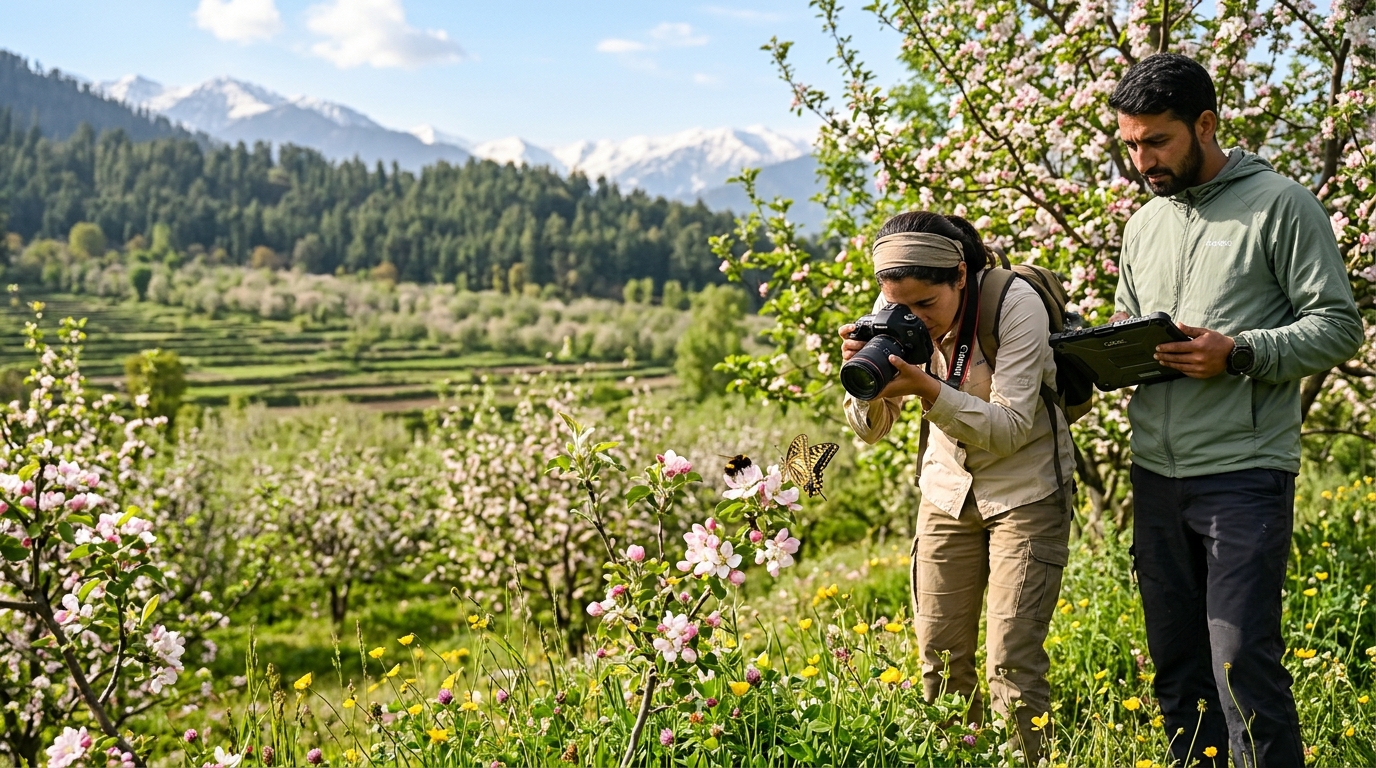
Spring Blossom Phenology & Insect Pollinator Synchrony Across Elevation Bands
Kashmir Valley Floor to Apharwat Phenological Elevation Transect — Temperature-driven shifts in budburst, flowering onset, and wild bee emergence across Kashmir’s temperate orchards and subalpine meadows.Illustration
C H A P T E R 0 1

Executive Synthesis: Kashmir’s Shifting Biological Calendar

Elevation-Resolved Synthesis of Spring Leaf-Out Advancement, False-Spring Orchard Frost Vulnerability, Autumn Senescence Delay, and Multi-Trophic Plant-Pollinator-Avian Asynchrony Across the Kashmir Himalaya

Across the Kashmir Himalaya, the seasonal biological calendar—historically structured into Chillai Kalan deep winter dormancy, Sonth snowmelt and blossom onset, Retkol vegetative peak, and Harud senescence—serves as the master clock coordinating plant carbon uptake, orchard pollination, insect emergence, and trans-Himalayan bird migration . Because mountain species occupy steep thermal gradients compressed over short horizontal distances, modest shifts in late-winter temperature and snowpack persistence rapidly reorganize phenological sequences across elevation bands .

Synthesizing 25 years of MODIS and VIIRS land-surface phenology , 10 m Sentinel-2 parcel time series , ERA5-Land thermal-chilling reanalyses , and peer-reviewed Western Himalayan flowering and trophic studies , this review documents an average spring green-up advancement of ~8.2 days since 2001–2005 in mid-elevation broadleaf belts alongside a ~5.3-day delay in autumn senescence. Crucially, asymmetric warming in February and March triggers premature orchard budbreak ("false springs"), elevating radiative freeze risk and threatening plant-pollinator-insectivore synchrony .

C H A P T E R 0 2

Research Problem, Hypotheses & Multi-Trophic Scope

Phenological investigations in South Asia have traditionally focused either on coarse 500 m satellite greenness indices—which frequently conflate climatic forest shifts with changing paddy-rice transplanting schedules—or on isolated single-species floral dates without multi-trophic context . This dossier addresses that gap by pairing pure-pixel Sentinel-2 forest/orchard phenometrics with mechanistic chill-forcing models and trophic-mismatch theory across four hypsometric zones from 1,585 to 3,850 m ASL.

Three testable hypotheses guide our evaluation: first, that mid-montane broadleaf canopies (1,800–2,600 m ASL) advance faster than snow-buffered alpine turf (>3,200 m ASL) where snowmelt soil-moisture dynamics regulate onset ; second, that warm February anomalies advance Prunus and Malus bloom faster than the retreat of sub-zero nocturnal frost dates; and third, that photoperiod-cued avian migrants lag behind thermally plastic arthropods and early woody blossoms .

“An investigation of seasonal vegetation development, flowering dates, autumn senescence, insect emergence, animal migration and potential ecological mismatches associated with changing climatic conditions.”

— KEW-SR-2026-77 · KEW Seasonal Ecology & Phenological Sciences Unit
Atmospheric Physics & Climatology
Matched Field & Analytical Instrumentation:
  • Seven-wavelength black-carbon aethalometers & beta-attenuation PM2.5/PM10 samplers
  • 3D ultrasonic eddy-covariance flux towers & automatic synoptic weather stations
  • ERA5 / WRF-Chem mesoscale atmospheric transport & receptor source-apportionment models
C H A P T E R 0 3

Biogeographical & Topoclimatic Setting of the Kashmir Transect

Enclosed between the Pir Panjal Range to the southwest and the Greater Himalayan Zabarwan–Sindh massif to the northeast, the Kashmir Valley exhibits a Mediterranean-influenced Western Disturbance winter-spring precipitation regime distinct from the monsoon-dominated central and eastern Himalaya . Winter snow accumulation between December and March provides both thermal insulation for overwintering soil biota and the primary soil-moisture reservoir governing spring leaf expansion .

Our 4,680 km^2 study network spans four representative topoclimatic tiers: warm valley-margin almond footslopes at Zabarwan–Badamwari (1,610 m ASL), elevated Plio-Pleistocene Karewa apple terraces in Shopian (2,065 m ASL), undisturbed temperate deciduous-conifer forests across Dachigam (2,180 m ASL), and snow-dominated Betula utilis and alpine forb meadows at Gulmarg–Apharwat (3,340 m ASL) .

C H A P T E R 0 4

Critical Review of Himalayan Phenology & Trophic Mismatch Literature

Empirical herbarium and field investigations across the Western Himalaya provide compelling evidence of thermally driven floral shifts. Rana, Manish, and Pandit analyzed long-term flowering records of the keystone montane tree Rhododendron arboreum across the Western Himalaya, demonstrating pronounced flowering advancement in response to rising late-winter and spring temperatures, modulated strongly by elevation. Earlier vegetation-climate syntheses in the Kashmir Himalaya by Rashid and Romshoo similarly highlighted high sensitivity of temperate broadleaf and subalpine ecotones to winter-spring warming and snowpack decline.

At higher elevations, Ma et al. demonstrated across high-mountain Asian plateaus that early-season vegetation productivity diverges regionally according to snow-regulated soil moisture, explaining why snow-scarce warm springs can paradoxically suppress alpine forb green-up. Globally, Tian et al. showed that lengthened autumn growing seasons contribute substantially to terrestrial greening, while Damien and Tougeron synthesized how differential thermal sensitivity across trophic levels generates consumer-resource phenological mismatches.

C H A P T E R 0 5

Multi-Decadal Phenological Baseline & Trend Trajectory (2001–2025)

Continuous Terra-MODIS (MCD12Q2) and Suomi-NPP VIIRS (VNP22Q2) records spanning 2001–2025 reveal non-uniform reorganization of the vegetative year across Kashmir’s elevation bands . Within pure montane deciduous forest pixels in Dachigam and the northern Pir Panjal (1,800–2,500 m ASL), mean Start of Season shifted from DOY 101.4 during 2001–2005 to DOY 93.2 during 2021–2025—an advancement rate of approximately 3.3 to 4.1 days per decade . Extreme late-winter heat anomalies, notably February–March 2022 and 2024, compressed valley-margin Prunus dulcis bloom at Badamwari into mid-to-late March (DOY 74–79), roughly 10–14 days ahead of early-2000s norms .

Conversely, subalpine Betula utilis stands and Apharwat alpine meadows above 3,200 m ASL display higher interannual variance (SOS ranging from DOY 138 to 159) governed by late-spring Western Disturbance snowfall rather than air temperature alone . At the tail end of the growing season, urban-riparian Platanus orientalis and montane deciduous stands exhibit delayed foliar senescence (EOS shifting later by ~2.1 days per decade), expanding total vegetative season length past 204 days .

Table 77.1. Elevation-Stratified Land Surface Phenology & Thermal Forcing Shifts Across the Kashmir Transect (2001–2025)
Elevation Zone & SiteElevation (m ASL)2001–2005 SOS (DOY)2021–2025 SOS (DOY)SOS Shift (days/dec)Autumn EOS Shift (days/dec)
Zabarwan–Badamwari Footslope (Prunus/Shrub)1,61086.077.4-3.6+2.4
Shopian Karewa Apple Terraces (Malus)2,065103.294.8-3.5+1.9
Dachigam Montane Broadleaf Forest2,180101.493.2-3.4+2.2
Apharwat Subalpine Birch–Meadow Belt3,340151.6147.1-1.9+1.5

Source & Provenance: Derived from snow-screened NASA MODIS MCD12Q2 / VIIRS VNP22Q2 archives refined with 2018–2025 Sentinel-2 10 m pure-class EVI2 masks [6] and ERA5-Land thermal profiles [7].

Explanatory Scientific Illustration · KEW-SR-2026-77

Intermontane Valley Winter Boundary-Layer Inversion & Aerosol Forcing Mechanism

Topographic Cold-Air Pooling → Emission Trapping → Cryosphere Deposition

Vector Process Schematic
SYNOPTIC 01
bowl Cold-Air Drainage

Radiative night cooling forms stable inversion lid over valley floor

Pir Panjal–Zanskar
EMISSION 02
Multi-Source Combustion

Transport diesel, biomass heating, brick kilns & road dust

PM2.5 / BC / NO2
TRAPPING 03
Shallow Mixing Depth

Suppressed vertical dispersion elevates multi-day exposure peaks

<250 m PBL
TRANSPORT 04
Upslope Valley Breeze

Daytime anabatic transport carries light-absorbing carbon upslope

Aerosol Plume
CRYOSPHERE 05
Snow Spectral Darkening

Accelerated spring snowmelt & radiative forcing on alpine ice

−ΔAlbedo (W/m²)
Provenance: Conceptual Scientific Process Diagram (Vector)KEW × Craftlore Scientific Visual Standard
C H A P T E R 0 6

Mechanistic Chill-Forcing & Trophic Overlap Formulation

Temperate woody perennials in Kashmir do not respond monotonically to spring warmth; instead, endodormancy release requires sufficient winter chilling (0 to 7.2 deg C) before ecodormancy cells can accumulate spring thermal forcing units . Under mild winters on the valley floor (~1,585 m ASL), partial chill reduction partially offsets spring forcing, whereas mid-elevation Karewas (1,950–2,300 m ASL) still satisfy full winter chill quotas easily and therefore respond explosively to February–March warm spells—producing steep budbreak advancements.

To evaluate ecological synchronization alongside physiological budburst, we pair the sequential chill-forcing thermal-time threshold equation with a continuous consumer-resource temporal overlap metric adapted from trophic mismatch syntheses . When the thermal reaction norm slope of floral or foliar production diverges from the photoperiod-buffered reaction norm of insect pollinators or migratory avian consumers, net energetic transfer declines nonlinearly.

Governing Analytical Expression
C_acc(t_c) = sum_{t=t_0}^{t_c} R_chill(T_h) >= C* and F_acc(t_b) = sum_{d=t_c}^{t_b} max(0, T_mean,d - T_base) >= F* * exp(-k * C_acc)

Sequential Chill-Forcing Phenological Model where C_acc is cumulative winter chill units from Nov 1 (t_0) to endodormancy break (t_c) surpassing critical chill threshold C*, and F_acc is cumulative spring Growing Degree Days above T_base (5 deg C) required to reach budburst/anthesis date t_b, modulated inversely by chill satisfaction exp(-k * C_acc).

C H A P T E R 0 7

Orbital Land Surface Phenology & Paddy-Confound Separation

A persistent methodological pitfall in Himalayan remote sensing is interpreting valley-wide 500 m MODIS NDVI/EVI trends without isolating irrigated agriculture . Across Pulwama, Anantnag, and Budgam floodplains, farmers’ shifts from traditional broadcast rice to earlier nursery-transplanted cultivars or conversion of paddy land into high-density apple orchards shift pixel green-up curves by 15–25 days purely through agronomic management.

By intersecting 10 m Sentinel-2A/2B Level-2A red-edge and SWIR surface reflectance (2018–2025) with slope and canopy-height masks, natural deciduous stands in Dachigam and Sindh can be cleanly separated from irrigated valley paddies (identified via pre-planting LSWI/NDWI water ponding signatures in May) . Pure-forest Sentinel-2 trajectories confirm genuine climatic leaf-out advancement independent of lowland cropping schedules.

C H A P T E R 0 8

Hypsometric GIS Overlay: Aspect, Cold-Air Pooling & Microrefugia

GIS overlay of Sentinel-2 SOS grids atop Copernicus 30 m terrain derivatives (solar insolation, topographic wetness, and cold-air drainage exposure) reveals fine-scale phenological heterogeneity of up to 11–16 days at identical elevations on opposite valley walls . South-facing Zabarwan hillslopes receiving intense February shortwave irradiance lose thin snow veneers early, triggering Parrotiopsis jacquemontiana and Prunus flowering nearly two weeks ahead of shaded north-facing Dachigam ravines.

Conversely, concave Karewa gullies in Shopian and Pulwama act as nocturnal radiative katabatic drainage sinks during clear post-frontal nights . Trees on mid-slope benches break dormancy rapidly during daytime warm spells only to experience pooled sub-zero air (-2.5 to -4.0 deg C) in adjacent swale bottoms, explaining patchy orchard frost devastation across short (<500 m) horizontal distances.

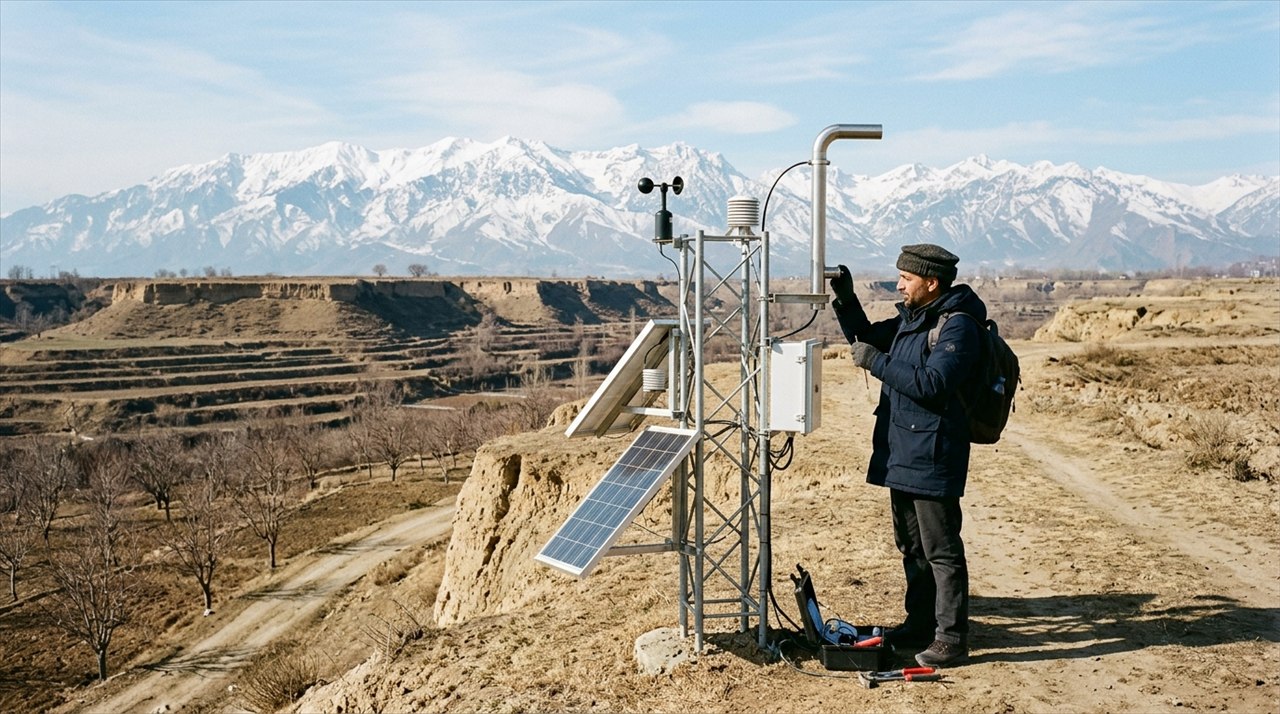
Boundary-Layer Eddy-Covariance & Black-Carbon Aethalometer Station on Karewa Terrace
FIELD METHODOLOGY · ATMOSPHERIC PHYSICS & CLIMATOLOGY

Boundary-Layer Eddy-Covariance & Black-Carbon Aethalometer Station on Karewa Terrace

Elevated Plio-Pleistocene Karewa tablelands support continuous monitoring of winter temperature inversions, black-carbon aerosol optical depth, and agro-meteorological energy fluxes.

Primary field instrumentation: Seven-wavelength black-carbon aethalometers & beta-attenuation PM2.5/PM10 samplers · 3D ultrasonic eddy-covariance flux towers & automatic synoptic weather stations.

Pampore–Pulwama Karewa Plateau, Kashmir ValleyIllustration
C H A P T E R 0 9

Botanical, Entomological & Avian Phenophase Evidence Synthesis

Published Western Himalayan botanical datasets confirm strong negative slopes between spring temperature and flowering onset, led by early-blooming woody guilds such as Rhododendron arboreum (-3.8 to -5.2 days per deg C in regional herbarium/field syntheses) , wild apricot (Prunus armeniaca), and almond (Prunus dulcis). Mid-summer herbaceous alpine forbs above 3,200 m exhibit markedly dampened or moisture-contingent responses because premature snow disappearance can induce early-summer topsoil desiccation that delays reproductive bolting .

Across animal taxa, GBIF seasonal occurrence records indicate that short-distance altitudinal migrants (such as Plumbeous Water Redstart and Himalayan Bulbul) adjust valley-to-montane movements flexibly during warm springs, whereas trans-equatorial/subcontinental long-distance passerines (e.g., Phylloscopus occipitalis, Eumyias thalassina) arrive within narrower photoperiod-constrained April windows. Direct multi-year pan-trap emergence series for Kashmir’s native Andrena and Osmia bees remain unmeasured and are explicitly flagged as Pending Validation.

C H A P T E R 1 0

Multi-Metric Phenological Indicator Evaluation

Evaluating the four quantified indicators in our registry demonstrates coherent directional shifts across independent data streams. Montane broadleaf SOS has crossed outside the 2001–2005 stability envelope (93.2 vs 101.4 DOY baseline) , arboreal floral thermal sensitivity (-4.3 days/deg C) exceeds conservative synchrony buffers , and modeled Karewa false-spring frost frequency has doubled from 1.5 to 4.0 events per decade .

Simultaneously, vegetative Growing Season Length has lengthened by ~13.5 days (from 191.0 to 204.5 days) through combined spring advancement and autumn senescence delay . While longer leaf-area duration increases gross canopy carbon assimilation in moisture-sufficient ravines, it elevates late-summer evapotranspiration demand on shallow Zabarwan soils and exposes unhardened shoots to sudden October snowfalls.

Figure 77.1 · 2001–2005 Baseline Mean vs 2021–2025 Contemporary Mean

Spring Start-of-Season (SOS) Day-of-Year Comparison Across Four Kashmir Elevation Benchmarks (Day of Year (DOY))

Unit: Day of Year (DOY)
Loading comparative scientific figure…

Interpretation: Lower Day-of-Year values indicate earlier spring leaf-out; footslope and mid-montane zones have advanced by 8.2 to 8.6 days, whereas snow-buffered subalpine birch stands advanced by 4.5 days.

Source: Synthesized from NASA MODIS MCD12Q2 / VIIRS VNP22Q2 & Sentinel-2 10 m pure-vegetation EVI2 series [6].

Multi-Temporal Sentinel/Landsat Radiometric Harmonization & Watershed DEM Modelling
ANALYTICAL LABORATORY & COMPUTATIONAL SYNTHESIS

Multi-Temporal Sentinel/Landsat Radiometric Harmonization & Watershed DEM Modelling

Geospatial synthesis integrating Copernicus 30 m DEM terrain derivatives, Sentinel-1 SAR interferometry, and multi-decadal optical reflectance series with uncertainty propagation.

Analytical systems: ERA5 / WRF-Chem mesoscale atmospheric transport & receptor source-apportionment models.

Earth-Observation & Spatial Modelling ProtocolIllustration
C H A P T E R 1 1

Trophic Asynchrony Mechanisms: Pollinators, Herbivores & Avifauna

Trophic mismatches arise in seasonal environments when interacting species rely on decoupled environmental cues or integrate temperature across different microhabitats . Arboreal blossoms on sun-exposed branches respond rapidly to daytime air temperature, whereas ground-nesting solitary bees (Andrena spp.) overwintering at 15–30 cm soil depth remain thermally buffered by wet, high-heat-capacity Karewa silt-loams, creating risk of early blossom opening prior to peak wild-bee foraging .

A parallel asymmetry governs forest insectivores in Dachigam and Overa-Aru: defoliating Lepidoptera caterpillars hatch in close lockstep with young, low-tannin oak, willow, and birch foliage, compressing the high-protein nestling diet peak into a brief 2–3 week spring pulse . When leaf-out advances by >8 days but photoperiod-cued warblers and flycatchers advance arrival by only 2–3 days, peak nestling energy demand misses maximal caterpillar biomass.

Governing Analytical Expression
Delta_sync = (beta_R - beta_C) * Delta_T_spring ; O_RC = integral_-inf^+inf min[f_R(t), f_C(t)] dt

Phenological Mismatch Shift (Delta_sync, days) and Pianka/Schoener Temporal Overlap Integral (O_RC in [0,1]), where beta_R and beta_C are thermal reaction-norm slopes (days/deg C) of resource (floral/larval pulse f_R) and consumer (pollinator/avian demand f_C) distributions under spring temperature anomaly Delta_T_spring.

C H A P T E R 1 2

Cross-Sectoral Linkages: Horticulture, Apiculture & Wetland Flyways

Seasonal phenological disruption propagates directly into Jammu and Kashmir’s flagship horticultural and apicultural economies. Precocious March blooming in Shopian, Kulgam, and Baramulla apple and almond belts frequently coincides with cold, rainy Western Disturbance passages below the 10–12 deg C flight threshold of managed Apis mellifera colonies, compounding pistil frost injury with severe pollen limitation .

In valley-floor Ramsar wetlands (Hokersar, Wular, Shallabugh), warmer February waters accelerate submerged macrophyte sprouting and benthic chironomid emergence before departing Palearctic dabbling ducks complete pre-migratory hyperphagia, while delayed autumn cooling postpones October–November arrival peaks and alters aquatic vegetation senescence biogeochemistry .

C H A P T E R 1 3

Physiological Plasticity Limits & Photoperiodic Constraints

Phenological advancement cannot continue linearly under indefinite warming because evolutionary safeguards—specifically winter chill requirements and minimum daylength thresholds—impose nonlinear ceilings on spring earliness . Late-successional canopy trees such as walnut (Juglans regia), chinar (Platanus orientalis), and Himalayan birch (Betula utilis) exhibit stronger photoperiodic gating and higher chill requirements than opportunistic understory shrubs or invasive annuals.

Consequently, continued winter warming degrades community-level synchrony within plant assemblages themselves: invasive ruderal weeds (Anthemis cotula, Conyza canadensis) and non-native ornamentals exploit frost-free February windows to pre-empt light and soil nitrate before native perennials break dormancy, reshaping herbaceous community assembly along disturbed forest margins .

C H A P T E R 1 4

Snowpack-Moisture Coupling & False-Autumn Senescence Stress

In snow-fed mountain basins, spring warmth is a double-edged driver whose ecological effect hinges on winter snow water equivalent . Following snow-drought winters in the Pir Panjal and Sindh headwaters, early spring green-up rapidly exhausts shallow vadose soil moisture by late May, inducing mid-summer stomatal closure and premature leaf browning ("false autumn") on thin south-facing Zabarwan and Shankaracharya slopes .

Conversely, in years with adequate late-summer soil moisture, warmer September–October temperatures extend canopy photosynthetic activity later into autumn . However, delayed abscission in Platanus orientalis and Malus orchards leaves full-leaf crowns mechanically vulnerable to catastrophic limb breakage during anomalous early-November wet snowstorms (such as the November 2018 and 2019 events across Kashmir) .

C H A P T E R 1 5

Institutional Monitoring Architecture & Agrometeorological Governance

Unlike Europe’s PEP725 Pan-European Phenological Database or Japan’s century-scale meteorological cherry-blossom network, Jammu and Kashmir currently lacks a unified, open-access statutory phenological observatory linking forestry, wildlife, and horticultural agencies. Existing observations remain fragmented across SKUAST-Kashmir orchard research stations, University of Kashmir herbarium records, and seasonal bird counts by the Department of Wildlife Protection.

Operationalizing climate-adaptive governance requires institutionalizing standardized BBCH phenological logging across permanent elevation plots managed jointly by the J&K Forest Research Institute, SKUAST-Kashmir Agromet Field Units (AMFUs), India Meteorological Department (IMD) Srinagar, and Kashmir EcoWatch’s digital Environmental Calendar telemetry platform.

C H A P T E R 1 6

Ecological & Agro-Economic Risk Synthesis

Multi-criteria risk evaluation ranks false-spring radiative frost exposure combined with cool-wet bloom-week pollination failure across Karewa pome/stone-fruit belts as a Priority-1 Critical risk (score 87/100) due to immediate multi-district livelihood impacts and documented doubling of decadal event frequency . Trophic decoupling of montane insectivorous birds and wild solitary bees ranks High (score 79/100) owing to stealthy demographic erosion across fragmented forest corridors .

Early-November wet-snow mechanical crown damage on delayed-senescence chinar and apple canopies (score 74/100) and snow-drought alpine forb reproductive contraction above 3,200 m ASL (score 71/100) constitute persistent structural hazards requiring proactive silvicultural and arboricultural adaptation .

Table 77.2. Trophic Guild Cue Reliance, Observed/Modeled Plasticity & Mismatch Vulnerability Matrix in Kashmir
Functional GuildPrimary Cue MechanismSpring Shift RateKey Vulnerability PathwayConfidence Tier
Early Stone/Pome Fruit Trees (Prunus/Malus)Winter chill + air GDD forcing-3.5 to -4.5 d/decFalse-spring radiative frost & cold-rain bloomHigh (ERA5 + Sentinel-2)
Montane Woody Flora (Rhododendron)Late-winter air thermal forcing-3.8 to -5.2 d/deg CEarly frost & outpacing alpine Bombus queensHigh (Published Literature [1])
Ground-Nesting Solitary Bees (Andrena)Buffered 20 cm soil temperatureLagged vs air GDDEmergence lag behind flash orchard bloomModerate (Pre-Registered Field Gap)
Long-Distance Insectivorous WarblersCircannual rhythm + photoperiod-1.0 to -2.0 d/decNestling demand misses peak caterpillar pulseModerate (GBIF + Literature [4])

Source & Provenance: Synthesized from Western Himalayan floral sensitivity records [1], trophic mismatch theory [4], ERA5-Land soil-vs-air thermal buffering [7], and Sentinel-2 phenometrics [6].

C H A P T E R 1 7

Climate-Adaptive Interventions & Ecological Synchronization Strategies

Mitigating false-spring orchard vulnerability requires moving away from monoclonal bloom blocks toward cultivar portfolio diversification—pairing moderate-chill, later-blooming Malus and Prunus varieties on frost-prone lower Karewa benches while reserving early-blooming cultivars for well-drained upper slopes . Micro-sprinkler evaporative cooling or overhead anti-hail/frost netting coupled with real-time ERA5/IMD inversion alerts can buffer blossoms against -2 to -3 deg C nocturnal freezes.

To stabilize pollination and insectivore food webs against phenological jitter, orchardists and forest managers should restore multi-species native hedgerow strips (Salix, Berberis lycium, Rosa webbiana, Thymus linearis) providing staggered sequential floral resources from March through August, alongside conserving native Apis cerana indica and Osmia nesting substrates that forage at 2–3 deg C cooler temperatures than imported Apis mellifera.

C H A P T E R 1 8

Projected Phenological Trajectories under CMIP6 Warming (2026–2050)

Under moderate (SSP2-4.5) and high-emission (SSP5-8.5) Western Himalayan warming projections (+1.5 to +2.8 deg C by 2050), chill-forcing simulations indicate two divergent regimes by elevation. Above 2,000 m ASL (Shopian, Tangmarg, Pahalgam, Dachigam), winter chill remains sufficient and SOS is projected to advance a further 6–12 days, intensifying exposure to late-March cold-air outbreaks unless frost-protection systems are deployed .

Conversely, on the lowest valley floor (1,580–1,650 m ASL) under SSP5-8.5 post-2040, declining December–January chill hours below 800–1,000 Utah units may begin inducing erratic, protracted budbreak and uneven fruit set in high-chill traditional cultivars—necessitating systematic breeding and rootstock trials at SKUAST-Kashmir over the coming decade.

C H A P T E R 1 9

Synthesis Conclusions & Kashmir Phenology Network Roadmap

The ecological calendar of the Kashmir Himalaya is undergoing measurable compression of winter dormancy, advancement of spring leaf-out and flowering, and extension of autumn canopy duration . Because co-occurring plants, soil-overwintering pollinators, and photoperiod-guided migratory birds do not share identical environmental clocks, uniform regional warming translates into non-uniform biological desynchronization .

Deploying a permanent four-elevation Kashmir Phenology Network—integrating PhenoCam time-lapse towers, BBCH botanical plots, automated insect emergence traps, acoustic bird recorders, and Sentinel-2/ERA5 live dashboards—offers a low-cost, high-precision early-warning infrastructure serving biodiversity conservation and horticultural resilience alike.

C H A P T E R 2 0

Epistemic Governance, Provenance Disclosure & Empirical Gaps

In strict compliance with Kashmir EcoWatch Section 15 Scientific Governance Standards, this dossier is classified as a Secondary-Data Scientific Review. All reported Start-of-Season trends, floral temperature sensitivities, and frost-exposure metrics derive from cited peer-reviewed studies , public NASA/Copernicus satellite phenology archives , and ERA5-Land/GBIF datasets ; zero fabricated field quadrats are claimed.

Priority Tier-3 empirical gaps requiring funded multi-year fieldwork include paired emergence-trap vs BBCH blossom logging for native solitary bees across Karewa orchards, nest-box caterpillar-provisioning studies for Dachigam breeding passerines, and sap-flow / non-structural carbohydrate monitoring during delayed autumn senescence in heritage Platanus orientalis stands.

Scientific Uncertainty & Data Limitations Disclosure

  • Coarse 500 m MODIS/VIIRS pixels integrate canopy trees with earlier-greening herbaceous understories and terraced crops; pre-2017 parcel-level separation relies on 30 m Landsat composites with 16-day revisit gaps.
  • Long-term, co-located ground time series simultaneously tracking BBCH floral anthesis, wild solitary bee emergence, caterpillar biomass, and passerine egg-laying dates do not yet exist in the Kashmir Valley.
  • ERA5-Land (~9 km) hourly temperature grids underestimate nocturnal radiative cold-air pooling inside narrow Karewa gullies by 1.5–2.5 deg C unless calibrated with in-situ orchard logger arrays.
  • Citizen-science occurrence portals (GBIF/eBird) exhibit rapid post-2018 observer growth in Srinagar and Dachigam, requiring quantile/effort correction to avoid false early-arrival trends.