
Kashmir EcoWatch
Dr. Kumar's Kashmir EcoWatchGLOBAL INSTITUTE FOR ADVANCED ENVIRONMENTAL STUDIES
Himalayan Dispatch
KEW-INV-0008 · GLACIERS & CRYOSPHERE · v0.2 (Proposed Charter)

KEW Western HimalayanKolahoi Glacier: The Future of Kashmir's Water Security

Glaciological mass-balance retreat, black-carbon albedo forcing, proglacial hazards, and Lidder–Jhelum water-resource vulnerability

Proposed Investigation (Stage 01)
Scoping Transparency Notice — Proposed Investigation (Stage 01)

In accordance with KEW-EIAI implementation standards, KEW-INV-0008 is currently in Proposed Investigation (Stage 01). It defines falsifiable scientific questions, geographic baselines, and initial verified literature anchors without asserting predetermined conclusions prior to full 24-section validation.

Documented Claims1
Unverified / Open0
Scoped Sciences6
Quantitative Findings0
Institutions Audited0
Single Master Record · 12 Derived Publication Outputs
Active View: Full Scientific Investigation (Scientists and researchers)
Showing 9 applicable sections
SECTION 01

Executive Summary & Scoping Status

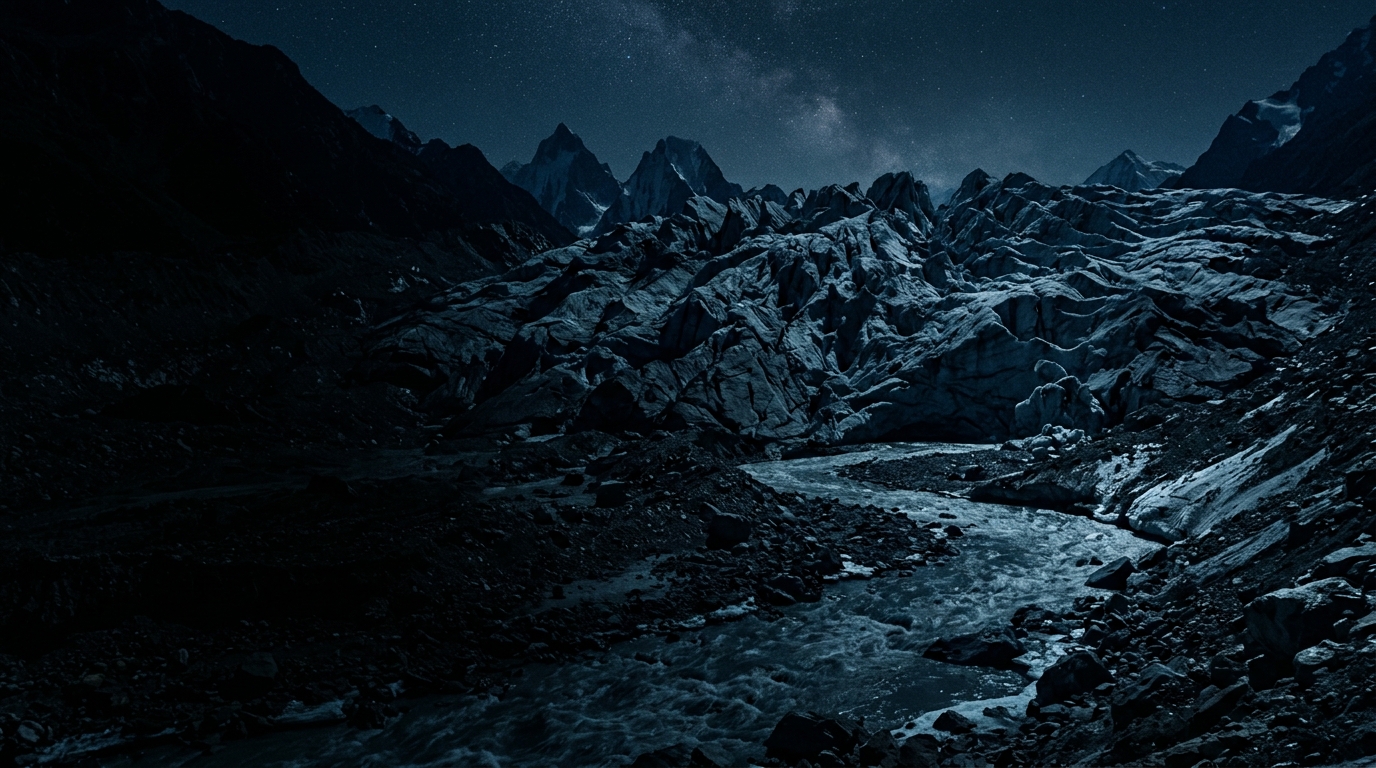
Proposed cryospheric and hydrological investigation into the mass-balance retreat of Kolahoi Glacier — Kashmir’s flagship “Goddess of Light” water tower — and its consequences for Lidder–Jhelum water security.

In strict compliance with KEW-EIAI scientific standards, this record represents an active/proposed investigation subject rather than predetermined conclusions. Only baseline documentary anchors and verified scoping assertions are populated prior to full peer-review sign-off.

SECTION 02

Investigation Background

Examines regional climate forcing, local black-carbon albedo reduction, proglacial lake evolution, and downstream late-summer irrigation risk.

Initiated under the initial 8-subject Western Himalayan Investigation Portfolio.

Governing Falsifiable Investigation Questions:
  1. What are the relative contributions of regional elevation-dependent warming, winter Western Disturbance snow deficits, and valley black-carbon aerosol deposition to Kolahoi’s accelerated mass loss?
  2. When does Kolahoi cross peak-water inflection for late-summer (August–September) West Lidder irrigation and drinking-water baseflows?
SECTION 03

Geographic Context

Headwaters of West Lidder (above Aru/Pahalgam) and Sind watershed divide in the Greater Himalaya.

Spatial centroid and watershed linkages are mapped in the KEW-EIAI Investigation Atlas.

West Lidder River (Aru–Pahalgam)Dudhsar & Hoksar Proglacial LakesDownstream Anantnag Irrigation & Drinking Water
SECTION 05

Environmental Baseline

Shrinkage of ~23% since 1962 documented across declassified Corona and modern satellite series.

Historical archival baselines are being cross-indexed from the KEW Research Library and Earth & Human Impact satellite layers.

SECTION 10

Hydrological Analysis

Models snowmelt vs glacier-ice melt shares in West Lidder late-summer low flows.

Hydrological gauging and sediment/discharge series under compilation.

SECTION 18

Initial Scoping Evidence Matrix

Preliminary verification classification separating documented baseline records from hypotheses awaiting empirical verification.

Inspect the Evidence Matrix below.

AssertionSource BasisClassificationVerification Details
EVID-KOL-01Kolahoi Glacier has lost ~23% of its surface area since 1962 with accelerating snout retreat and fragmentation.Scientific LiteratureDocumented

Established by Rashid et al. (2017) using Corona, Landsat, and high-resolution satellite series paired with field observations.

SECTION 19

Core Research & Institutional Questions

Falsifiable scientific and institutional questions guiding documentary discovery.

Contributions of peer-reviewed datasets or official records may be submitted via the Submit Investigation portal.

  • How can valley-floor black-carbon sources (brick kilns, winter biomass burning, diesel transport) be quantified in Kolahoi snowpack samples?
SECTION 23

Initial Reference Anchors

Foundational peer-reviewed and statutory sources anchoring scoping review.

Additional citations appended as Stage 03–04 Evidence Verification progresses.

  1. [REF-KOL-01]Rashid, I., Romshoo, S. A., & Abdullah, T. (2017). The recent deglaciation of Kolahoi glacier in Kashmir Himalaya, India in response to the changing climate. Journal of Asian Earth Sciences, 138, 38–50. Peer-Reviewed JournalDOI: 10.1016/j.jseaes.2017.02.002
    Provenance: Authoritative peer-reviewed baseline on Kolahoi Glacier shrinkage.
SECTION 13

Historical & Regulatory Chronology Ledger

PeriodMilestone / InterventionDocumented RecordSource
1962–2018
Multi-Decadal Area & Geodetic Mass Loss Documented
Ecological Shift
Survey of India toposheet to Sentinel/Landsat comparisons established ~23% area shrinkage and negative geodetic mass balance.REF-KOL-01