
Kashmir EcoWatch
Dr. Kumar's Kashmir EcoWatchGLOBAL INSTITUTE FOR ADVANCED ENVIRONMENTAL STUDIES
Himalayan Dispatch
KEW-INV-0026 · INFRASTRUCTURE DEVELOPMENT · v0.4 (Priority Scoping & Evidence Acquisition)

KEW Western HimalayanKashmir's Transportation Crisis: Vehicular Growth, Infrastructure Capacity and Environmental Sustainability, 1990–2026

Distinguishing ~2.66M UT-wide cumulative registrations from active Kashmir Division fleet, auditing 1990–2026 district vehicle growth, road V/C ratios, freight/tourist surges, and induced private-vehicle dependency

Critical Scoping · VAHAN & Corridor Capacity Audit
Scoping Transparency Notice — Critical Scoping · VAHAN & Corridor Capacity Audit

In accordance with KEW-EIAI implementation standards, KEW-INV-0026 is currently in Critical Scoping · VAHAN & Corridor Capacity Audit. It defines falsifiable scientific questions, geographic baselines, and initial verified literature anchors without asserting predetermined conclusions prior to full 24-section validation.

Documented Claims1
Unverified / Open1
Scoped Sciences5
Quantitative Findings1
Institutions Audited1
Single Master Record · 12 Derived Publication Outputs
Active View: Full Scientific Investigation (Scientists and researchers)
Showing 16 applicable sections
SECTION 01

Executive Summary & Scoping Mandate

Distinguishing ~2.66M UT-wide cumulative registrations from active Kashmir Division fleet, auditing 1990–2026 district vehicle growth, road V/C ratios, freight/tourist surges, and induced private-vehicle dependency

J&K UT Cumulative Reg.
~2.66M UT-Wide Cumulative
Transport Dept. / Down To Earth
Kashmir Active Fleet
Audit Target 10 RTO Survival Curve
VAHAN Disaggregation Queue
District Coverage
10 Districts 1990–2026 Series
KEW Mobility Scope

Central Scientific Question: How has the active on-road vehicle fleet in Kashmir Division (distinct from cumulative UT-wide registrations) evolved relative to road network capacity, public transit supply, and atmospheric carrying capacity between 1990 and 2026?

Maintained as an active scoping / proposed scientific charter under KEW-EIAI governance. Distinguishes measured observations, historical baselines, statutory exemptions, and unverified hypotheses without fabricating fleet, emission, or decibel readings.

SECTION 02

Investigation Background

Expands beyond seasonal tourist mobility (KEW-SR-2026-36) to audit 36-year district-wise private, commercial, freight, and public fleet trajectories, active-vs-deregistered survival curves, and road Volume-to-Capacity (V/C) saturation.

Evaluates transportation, atmospheric inversions, industrial/domestic sources, and acoustic exposure as an interconnected valley-basin system rather than presuming a single dominant source across all seasons.

Portfolio Duplication Audit: Cleared — Cross-Module Accountability ComplementTransportation, Air Quality & Noise Series

Expands beyond seasonal tourist mobility (KEW-SR-2026-36) to audit 36-year district-wise private, commercial, freight, and public fleet trajectories, active-vs-deregistered survival curves, and road Volume-to-Capacity (V/C) saturation.

Complementary Sectoral Dossiers:KEW-SR-2026-36 →
Governing Falsifiable Investigation Questions:
  1. Of the ~2.66 million cumulative vehicles reported across Jammu & Kashmir UT in Transport Department records, what exact active on-road fleet operates daily inside the 10 Kashmir Division districts after accounting for scrappage, age survival, and inter-divisional split?
  2. Have flyover construction and road-widening projects in Srinagar reduced corridor Volume-to-Capacity (V/C) ratios over a 5-year horizon, or triggered Braess/Downs–Thomson induced private car and two-wheeler demand?
SECTION 03

Geographic Coverage (10 Kashmir Districts)

All 10 Kashmir Division RTOs (JK01, JK03, JK04, JK05, JK09, JK13, JK15, JK16, JK18, JK22) & Major Urban/Mountain Corridors

Covers proposed sampling corridors across Srinagar (Lal Chowk, Pantha Chowk, Parimpora, Nowgam), Ganderbal (Sonamarg corridor), Baramulla (Sopore, Pattan, Gulmarg corridor), Anantnag (Bijbehara, Pahalgam corridor), Pulwama (Pampore industrial/highway belt), Budgam (Airport & brick-kiln belt), Bandipora, Kupwara (Handwara), Kulgam, and Shopian (horticultural freight & Mughal Road) — treated strictly as candidate sampling sites until field-verified.

Valley Bowl Atmospheric Mixing LayerUrban Sensitive Receptors (Hospitals & Schools)Riparian/Wetland & Protected Wildlife CorridorsPir Panjal & Greater Himalayan Snowpack Albedo Zones
SECTION 04

Historical Chronology (1990–2026)

Separates historical baselines (e.g., 2013–2017 particulate studies) and cumulative vehicle registrations from contemporary 2026 conditions.

Chronological milestones anchor regulatory transitions (BS-IV, BS-VI, Noise Rules 2000, NCAP, G.S.R. 991(E) Nov 2026 PUC amendments).

PeriodMilestone / InterventionDocumented RecordSource
1990–2026
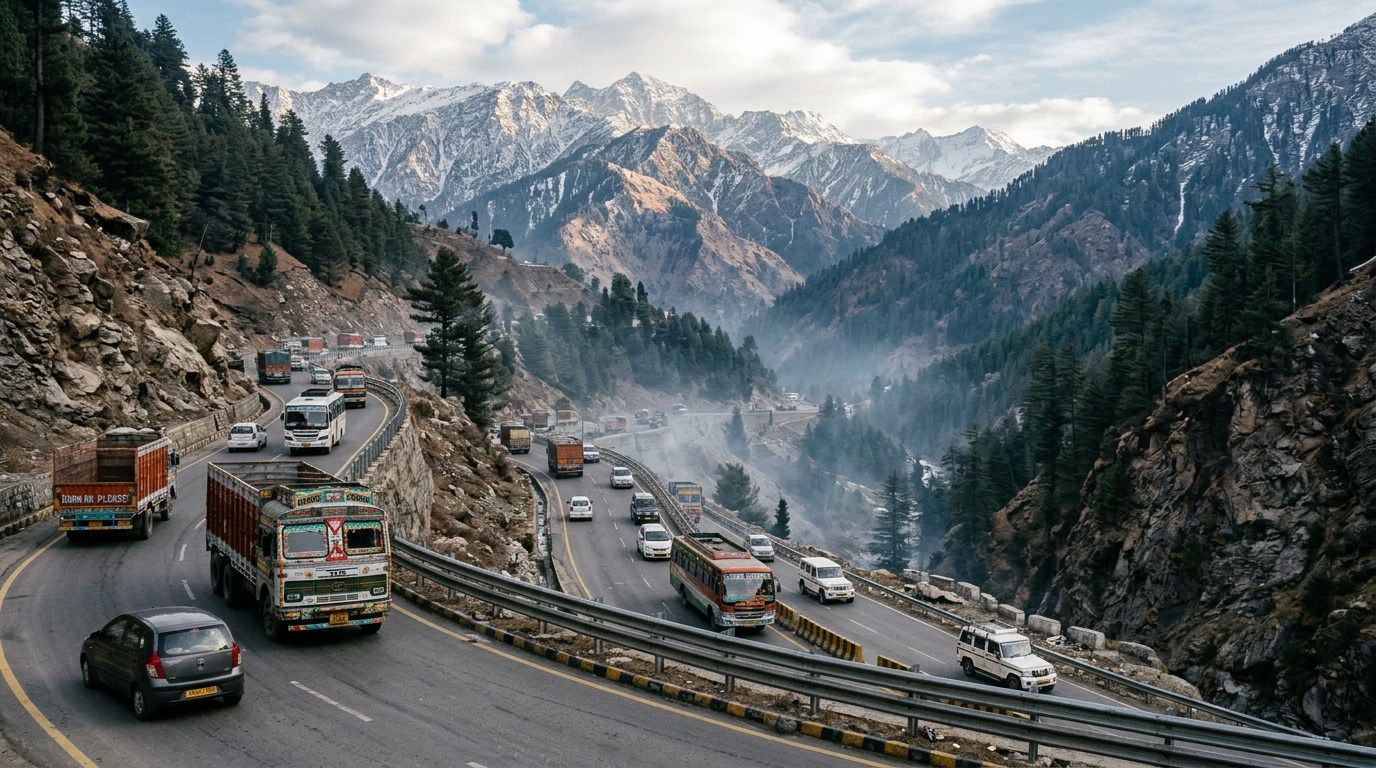
Rapid Private Car & Two-Wheeler Motorization Across Kashmir RTOs
Ecological Shift
Multi-fold expansion in personal vehicles outpaced high-capacity public transit investment across Srinagar and district towns.REF-TRN-01
SECTION 05

Environmental & Regulatory Baseline

Public reporting citing J&K Transport Department / VAHAN records places cumulative UT-wide vehicle registrations near ~2.66 million; KEW-EIAI strictly separates UT-wide cumulative registrations from the active in-use fleet within Kashmir Division.

Compares verified measurements against enforceable Indian NAAQS / Noise Pollution Rules 2000 while referencing WHO guidelines strictly as health benchmarks.

SECTION 07

Scientific Disciplines & Governing Equations

Applies COPERT/ARAI fleet emission factors E_p = Σ N_i D_i EF_{i,p}, Positive Matrix Factorization (PMF), ERA5 boundary-layer physics, and logarithmic acoustic integration LAeq,T.

Explicitly prohibits scientifically invalid practices such as arithmetic averaging of decibel readings or substituting uncalibrated satellite columns for ground roadside monitoring.

5 Scoped Sciences · 1 Quantitative Findings Populated
GISSpatial & Computational Sciences
Cadastral Buffer Attribution: A_loss = Area(P_wetland,t0 ∩ P_fill,t1)
Spatial StatisticsSpatial & Computational Sciences
Global Moran’s I: I = (N / W) · [Σ_i Σ_j w_ij (x_i - x̄)(x_j - x̄)] / Σ_i (x_i - x̄)²
Atmospheric ScienceChemical & Atmospheric Sciences
Albedo Radiative Forcing on Snow: RF_BC = S_0 · (1 - α_clean) · Δα_BC
Ecological EconomicsApplied Environmental Sciences
Unit Nutrient/Sediment Abatement Cost: CE = NPV(Expenditure) / ΔLoad_abated
Environmental Impact AssessmentApplied Environmental Sciences
Cumulative Impact Index: CII = Σ_k w_k I_k + Σ_k<m γ_km (I_k · I_m)
SECTION 09

Satellite, GIS Network & Ground-Validation Protocol

Couples Sentinel-5P TROPOMI, MODIS/VIIRS MAIAC AOD, ERA5 mixing height, and OpenStreetMap road networks with mandatory ground-station validation.

Satellite trace-gas and aerosol retrievals cannot replace calibrated CPCB/JKPCC ground CAAQMS or Class-1 sound-level meters.

Initialising KEW-EIAI Spatial Investigation Atlas...
SECTION 16

Institutional Accountability

J&K Motor Vehicles Dept. (MVD), Traffic Police, R&B & Srinagar Smart City Ltd. (MVD / Traffic / R&B / SSCL)

Separates statutory exemption, verified compliance, regulatory ambiguity, and unverified monitoring gaps without inferring noncompliance from missing public records.

J&K Motor Vehicles Dept. (MVD), Traffic Police, R&B & Srinagar Smart City Ltd. (MVD / Traffic / R&B / SSCL)

Clarification Invited
Statutory Mandate:Fleet registration accounting, fitness/scrappage enforcement, traffic capacity management, and sustainable urban mobility planning.
Project & Financial Ownership:10 Kashmir RTO registries, urban arterial network & Comprehensive Mobility Plan — Public mobility, NCAP/PRANA, highway, and regulatory enforcement budgets
Documented Audit / Scientific Findings:Public statistics routinely conflate cumulative registrations with active on-road fleet while comprehensive origin-destination matrices remain unpublished.
Official Institutional Response:VAHAN4 digitization and Smart City junction upgrades implemented; RTO-wise active fleet & CMP traffic counts invited.
SECTION 17

Regulatory & Statutory Analysis

Motor Vehicles Act, 1988, National Urban Transport Policy & Srinagar Comprehensive Mobility Plan.

Evaluates statutory instruments, Bharat Stage notifications, PUC mandates, and ambient air/noise rules.

SECTION 18

Scientific Evidence Matrix

Claim-by-claim verification separating Documented baselines from Unverified field/model hypotheses.

Inspect the Evidence Matrix below.

AssertionSource BasisClassificationVerification Details
EVID-0026-01Reported J&K vehicle registration figures (~2.66 million) represent cumulative UT-wide registrations across both Jammu and Kashmir divisions rather than the active daily operating fleet in Kashmir Division alone.Government Audit RecordsDocumented

Verified against VAHAN accounting structure and Transport Department disclosures cited in national environmental reporting.

EVID-0026-02Grade-separated flyovers in Srinagar (Jehangir Chowk–Rambagh, Bemina/Sanat Nagar NH-44) induced net private-vehicle VKT growth exceeding congestion-relief fuel savings within 36 months of opening.Field Survey ProtocolUnverified

Classic induced-demand hypothesis requiring pre/post screenline PCU counts on parallel and feeder arterials.

Required: Compare pre-construction vs 2026 peak-hour PCU screenline counts and travel speeds across Rambagh–Lal Chowk and NH-44 bypass corridors.

SECTION 19

Unanswered Questions & Data Acquisition Queue

Primary institutional datasets required from VAHAN, RTOs, JKPCC, CPCB PRANA, SMC, Traffic Police, and Health/SKIMS.

Official datasets and clarifications may be submitted via /environmental-investigations/submit.

  • What is the seasonal summer peak influx of outside-registered tourist and pilgrimage vehicles entering Kashmir via NH-44 and Mughal/Zojila corridors?
SECTION 20

Alternative Solutions & Sustainable Mobility Pathways

High-Frequency Electric Bus Rapid Corridors & Non-Motorized Street Prioritisation

Tests whether public transit, dust suppression, and clean heating outperform road-widening and flyover expansion.

High-Frequency Electric Bus Rapid Corridors & Non-Motorized Street Prioritisation

Moves 40–60 passengers per vehicle footprint rather than expanding mixed-traffic asphalt for single-occupancy cars.

Precedent: ITDP / National Urban Transport Policy (NUTP) people-moving capacity standards.

SECTION 21

Phased Recommendations

Immediate, medium-term, and long-term actions with measurable verification indicators.

Tracked in the KEW-EIAI Recommendations Tracker.

Immediate (0–12 Months)Proposed

Release Disaggregated 10-RTO Active Fleet & Automated Corridor PCU Telemetry

Separate cumulative vs active fleet across JK01–JK22 and publish ITMS camera hourly traffic volumes.

Target: Transport Commissioner J&K & Srinagar Smart City Ltd. • Indicator: Annual 10-district active-fleet & V/C dataset published on KEW Open Data.
SECTION 23

References & Primary Data Repositories

Traceable statutory notifications, peer-reviewed atmospheric studies, and national portals (VAHAN, CPCB, PRANA, PIB, IndiaCode).

All Documented assertions link to verified reference IDs below.

  1. [REF-TRN-01]Ministry of Road Transport & Highways (MoRTH) — VAHAN4 Dashboard (2026). Centralized Vehicle Registration & Fleet Category Repository (Jammu & Kashmir). vahan.parivahan.gov.in Official Portal. Technical Institute ReportOfficial Source Link
    Provenance: Authoritative statutory repository for RTO vehicle registrations, fuel mix, and emission norms.
  2. [REF-TRN-02]Down To Earth / J&K Transport Department Statistical Disclosures (2025). Analysis of Rising Motorization (~2.66M Cumulative Registrations) and Public Transit Deficit in Jammu & Kashmir. Down To Earth Environmental Mobility Reporting. Technical Institute Report
    Provenance: Documents cumulative UT registration figure requiring divisional and active-fleet disaggregation.
SECTION 08

Quantitative Multidisciplinary Findings (1 of 5 Scoped Sciences)

Transportation Engineering & Network Capacity (Spatial & Computational Sciences)Documented
N_active,d = Σ_y Reg_{d,y} · S(2026 - y); V/C = Flow_PCU / Capacity_PCU

Empirical Finding: Cumulative registration totals overestimate active older cohorts unless adjusted by PUC/fitness/insurance renewal survival rates.

Uncertainty & Methodological Limits: Requires RTO-wise (JK01..JK22) VAHAN age-fuel-class tables and peak-hour PCU traffic counts.

SECTION 11

Project & Intervention Inventory

InterventionExecuting Agency & PeriodScale / OutlayDocumented Outcome
INT-TRN-01Urban Flyovers, Junction Widening & Smart City Mobility Corridors
R&B (PW) Dept., ERA, SSCL & NHAI
2013–2026
ADB/ERA, Smart City & UT CapexLocalized grade separation achieved; basin-wide V/C congestion and modal-share outcomes under longitudinal audit.