
Kashmir, How Long Will You Remain Silent? | Kab Tak Khamosh?
Kashmir's Environmental Awakening: An Original Mystical Sufi Kalam on Meezan, Amaanat & Ecological Conscience
Dr. Zarf-e-Noori · SufiPulse USA · Contemporary Mystical Sufi • Spiritual Ecology • Three-Part Cinematic Master
Master Screening & Acoustic Arrangement
Instruments: Persian Ney · Afghan Rabab · Acoustic Cello · Meditative Ambient Strings · Traditional Percussion
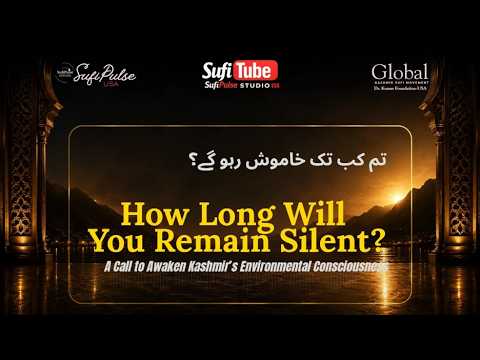
“How long will you remain silent? The rivers weep, the mountains call out in grief; The cosmic balance (Meezan) is a sacred trust (Amaanat), the dignity of all creation. What remembrance will you claim when the green gardens vanish? Where will devotion stand when the living waterfalls are silenced?”
The Living Landscape Behind the Composition
"Kab Tak Khamosh?" is a cinematic three-part ecological kalam by Dr. Zarf-e-Noori that bridges classical Rishi-Sufi environmental consciousness with empirical crisis response. Through a mystical dialogue between the poet and Rabb, it directly addresses human negligence, pollution across Dal Lake, Wular Lake, and the Jhelum River, deforestation in mountain catchments, and desiccation of perennial springs. Invoking the foundational traditions of Lall Arifa, Sheikh Noorani (Nund Rishi), Shah-e-Hamadan, Zain-ud-Din Wali, and Baba Payam-ud-Din, it rejects passive grief and demands that silence be replaced by scientific vigilance, watershed custodianship, and generational accountability.
Explore Kashmir EcoWatch empirical datasets, hydro-meteorological baselines, and spatial layers paired with this work:
Kashmir Environmental Silence vs. Action: Watershed Audit & Ecological Charter
Community environmental awareness and direct custodial stewardship increase when empirical water testing is paired with ethical responsibility toward the sacred trust (Amaanat) of creation.
3.0 Hours Interactive Workshop & Field Audit
- • Kashmir EcoWatch Water Quality Field Testing Kit (pH, Turbidity, DO)
- • Riparian habitat degradation scorecards and GPS mapping devices
- • Digital playback setup for "Kab Tak Khamosh?" (SufiPulse USA)
- • Youth Amaanat Ecological Action Plan Worksheets
Students quantify localized water quality impairment and translate ethical awareness into concrete community watershed conservation protocols.
1. Conduct a physical and sensor-based audit of a local canal, riverbank, or wetland shoreline, documenting plastic accumulation and effluent points. 2. Screen and listen to the three-part cinematic kalam "Kab Tak Khamosh?" 3. Engage participants in structured reflection connecting empirical water quality with ethical responsibility. 4. Formulate a local Youth Ecological Action Plan with measurable 90-day targets for riparian cleanup and community monitoring.
All music, lyrics, performance masters, and artwork for “Kashmir, How Long Will You Remain Silent? | Kab Tak Khamosh?” are © 2026 SufiPulse USA. Curated on Kashmir EcoWatch EcoVoices under non-commercial environmental education and creative stewardship partnership.